
AI and BLE for Industrial Real Estate
AI-Powered Industrial Real Estate Solutions with BLE Technologies
Industrial real estate is rapidly evolving from traditional warehouse and logistics property management into highly connected, data-driven operations. Artificial intelligence (AI), supported by Bluetooth Low Energy (BLE) gateways, BLE beacons, and BLE sensors, enables industrial property owners, developers, logistics park operators, and facility managers to monitor assets, optimize building utilization, improve maintenance planning, strengthen security, and reduce operating costs through continuous real-time intelligence.
BLE serves as the sensing layer that captures location, environmental, occupancy, and equipment data throughout industrial facilities, while AI transforms these data streams into actionable operational insights. Together, AI and BLE enable predictive decision-making rather than reactive facility management. Applications include warehouse occupancy optimization, equipment tracking, contractor safety monitoring, predictive HVAC maintenance, cold-storage monitoring, dock utilization analysis, tenant space analytics, and energy optimization.
Organizations operating distribution centers, manufacturing parks, logistics hubs, and multi-building industrial campuses increasingly rely on these intelligent systems to improve operational efficiency while maintaining compliance, sustainability objectives, and tenant service levels. GAO has helped organizations across North America deploy BLE-based IoT hardware and intelligent monitoring systems that support these operational objectives while meeting demanding industrial performance requirements.
Why AI Is Transforming Industrial Real Estate
Industrial real estate differs significantly from commercial office environments because facilities contain continuously moving assets, heavy equipment, warehouse automation systems, loading operations, maintenance activities, and multiple tenant workflows. Traditional Building Management Systems (BMS) and Computerized Maintenance Management Systems (CMMS) often operate independently, making it difficult to correlate operational events across an entire industrial property.
Artificial intelligence addresses this challenge by analyzing data collected from BLE-enabled sensing devices throughout industrial facilities. Rather than simply displaying sensor readings, AI detects patterns, predicts operational risks, recommends corrective actions, and automates routine facility decisions.
BLE technology is particularly well suited for industrial real estate because it provides:
- Low-power wireless sensing for multi-year battery operation
- Cost-effective indoor positioning
- Continuous environmental monitoring
- Asset identification
- Occupancy detection
- Personnel Location Awareness
- Equipment Utilization Monitoring
- Flexible Deployment Without Extensive Cabling
Unlike GPS, which performs poorly indoors, BLE enables room-level, zone-level, and aisle-level positioning across warehouses, manufacturing campuses, logistics centers, and industrial parks. AI further enhances these capabilities by interpreting spatial relationships, identifying anomalies, forecasting maintenance requirements, and optimizing resource allocation.
Fundamental Concepts of AI-Driven BLE Solutions for Industrial Real Estate
Modern industrial real estate increasingly depends on continuous operational visibility. Every loading dock, warehouse aisle, mechanical room, electrical substation, rooftop HVAC unit, tenant suite, storage yard, and maintenance area generates operational information that influences facility performance.
BLE devices provide the physical sensing layer responsible for collecting this information.
Typical BLE hardware includes:
- BLE Gateways
- BLE Beacons
- BLE Environmental Sensors
- BLE Temperature Sensors
- BLE Humidity Sensors
- BLE Vibration Sensors
- BLE Occupancy Sensors
- BLE Door Sensors
- BLE Motion Sensors
- BLE Air Quality Sensors
- BLE Current Sensors
- BLE Emergency Call Buttons
- BLE Wearables
- BLE Asset Tags
Artificial intelligence continuously processes information from these devices to perform:
- Predictive maintenance
- Indoor positioning
- Equipment health prediction
- Energy optimization
- Occupancy forecasting
- Space utilization analysis
- Contractor safety monitoring
- Abnormal environmental detection
- Security event correlation
- Lease utilization analytics
Rather than treating every BLE device independently, AI evaluates relationships among thousands of sensor readings collected across an industrial campus. This holistic approach enables facility operators to identify operational bottlenecks before they affect tenants or building performance.
AI-Driven BLE Solution Architecture for Industrial Real Estate Using BLE Gateways, Beacons, and Sensors
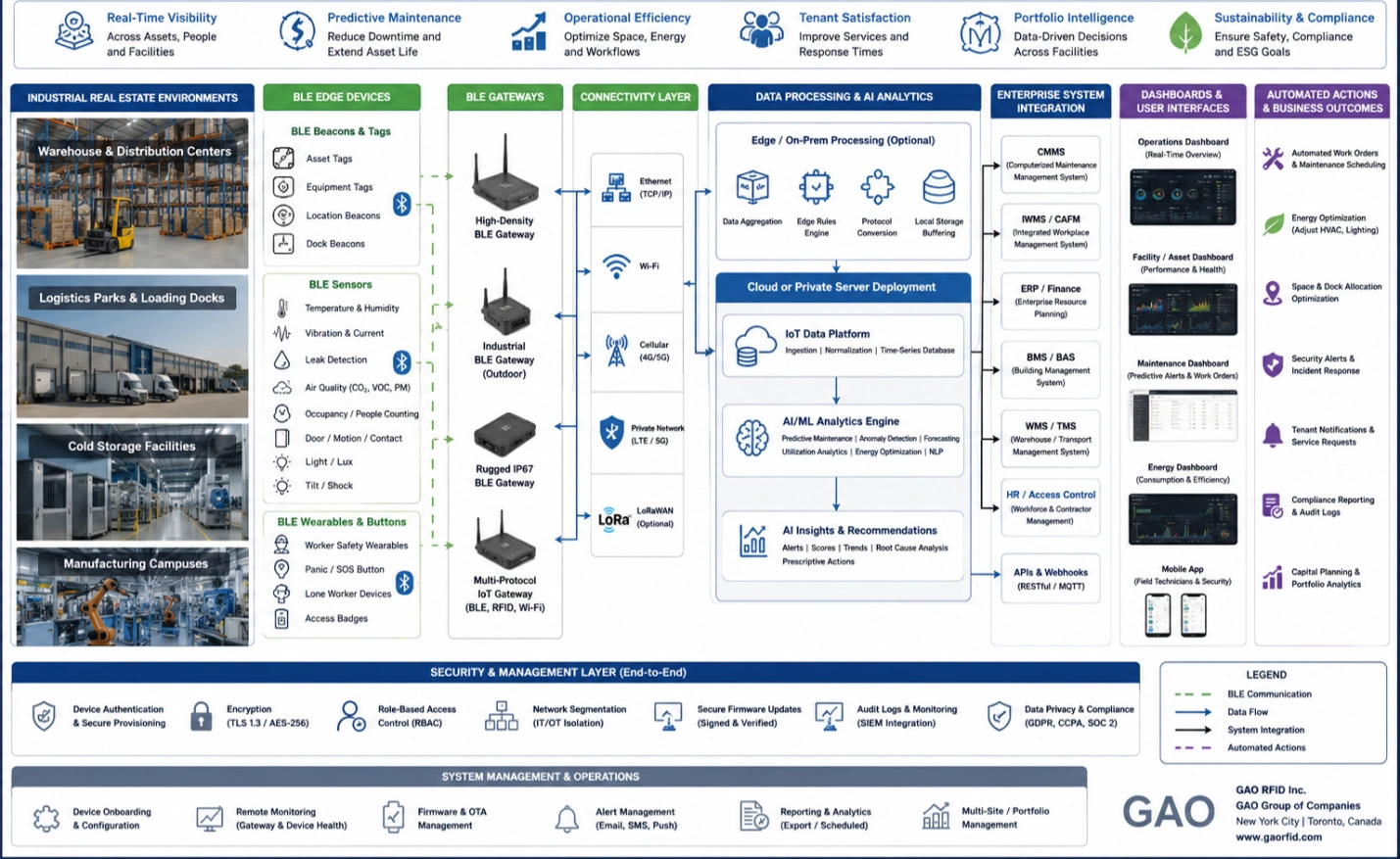
This diagram illustrates the end-to-end workflow of an AI-enabled BLE solution for industrial real estate, showing how BLE beacons, sensors, and gateways collect operational data from warehouses, logistics parks, cold storage facilities, and manufacturing campuses. The data is securely transmitted to AI analytics software, integrated with enterprise systems such as CMMS, IWMS, ERP, and BMS, and presented through operational dashboards that support predictive maintenance, asset tracking, energy optimization, and automated business decisions.
Industrial Real Estate Applications Enabled by AI and BLE
Industrial real estate includes a wide range of specialized facilities with distinct operational requirements. AI-powered BLE solutions can be tailored to each environment.
Distribution Centers
BLE asset tags track forklifts, pallets, returnable transport items, and mobile equipment throughout warehouse operations. AI analyzes movement patterns to reduce congestion, improve picking efficiency, optimize dock scheduling, and shorten vehicle turnaround times.
Logistics Parks
Large logistics parks contain multiple warehouses, shared infrastructure, truck staging areas, and utility systems. BLE gateways provide site-wide connectivity while AI coordinates traffic flow, parking utilization, maintenance scheduling, and shared resource allocation.
Manufacturing Campuses
Manufacturing facilities require precise environmental control and equipment monitoring. BLE sensors continuously monitor temperature, humidity, vibration, and machine conditions. AI identifies deviations that may indicate equipment degradation or process instability before production is affected.
Cold Storage Facilities
Cold storage operations demand strict temperature compliance. BLE environmental sensors transmit continuous readings throughout refrigerated zones. AI predicts refrigeration failures, identifies abnormal cooling trends, and recommends preventive maintenance before product quality is compromised.
Multi-Tenant Industrial Buildings
Industrial property managers must balance tenant comfort, operational efficiency, and infrastructure utilization. BLE occupancy sensing combined with AI enables intelligent HVAC scheduling, lighting control, maintenance prioritization, and utility optimization while supporting lease management and tenant satisfaction.
Equipment Maintenance Operations
Maintenance teams often spend valuable time locating tools, replacement parts, mobile lifts, generators, compressors, and testing equipment. BLE asset tracking significantly reduces search time, while AI predicts maintenance demand and recommends inventory replenishment based on historical usage patterns.
Operational Challenges Addressed by AI and BLE
Industrial real estate operators face complex challenges that cannot be solved through manual inspections alone.
Common operational challenges include:
- Limited visibility into equipment utilization
- Unplanned HVAC failures
- Inefficient loading dock scheduling
- Underutilized warehouse space
- Excessive energy consumption
- Contractor safety compliance
- Asset misplacement
- Poor indoor environmental quality
- Delayed preventive maintenance
- Tenant service response delays
- Manual inspection processes
- Battery replacement planning
- Environmental compliance monitoring
- Fragmented operational data across multiple software systems
AI enhances BLE-generated data by identifying hidden operational relationships that human operators may overlook. For example, recurring HVAC alarms combined with occupancy data, dock activity, and outdoor weather conditions can reveal underlying system inefficiencies that traditional monitoring systems treat as isolated events.
GAO has supplied BLE gateways, beacons, sensors, and IoT hardware to organizations seeking greater operational visibility across industrial facilities, enabling engineering teams to build scalable monitoring solutions tailored to demanding industrial environments.
End-to-End Operational Workflow for AI-Driven BLE Solutions in Industrial Real Estate
Successful AI-enabled industrial real estate systems depend on a well-designed operational workflow that transforms physical events occurring throughout warehouses, logistics parks, distribution centers, and industrial campuses into intelligent business actions. Bluetooth Low Energy (BLE) provides continuous sensing and location awareness, while AI converts high-volume operational data into maintenance recommendations, occupancy forecasts, energy optimization strategies, and security alerts.
A typical deployment follows several interconnected stages, each contributing to operational reliability and decision support.
Data Acquisition from Industrial Assets
The workflow begins with distributed BLE devices installed throughout industrial facilities. These devices continuously collect operational information from critical infrastructure and movable assets.
Common data sources include:
- BLE asset tags attached to forklifts, pallet jacks, trailers, mobile generators, compressors, ladders, and maintenance equipment
- BLE beacons installed throughout warehouse aisles, loading docks, storage yards, utility rooms, and tenant spaces for indoor positioning
- BLE temperature sensors monitoring cold storage rooms, electrical cabinets, and mechanical equipment
- BLE humidity sensors protecting inventory, packaging materials, and climate-sensitive manufacturing environments
- BLE vibration sensors detecting abnormal motor, fan, pump, compressor, conveyor, and HVAC equipment behavior
- BLE door and window sensors monitoring access points, dock doors, emergency exits, and secured maintenance areas
- BLE occupancy sensors measuring warehouse utilization, conference rooms, break areas, and shared operational spaces
- BLE air quality sensors measuring carbon dioxide (CO₂), particulate matter (PM2.5), volatile organic compounds (VOCs), and indoor environmental quality
- BLE wearable devices supporting lone-worker monitoring, contractor safety, and emergency response
Rather than relying on manual inspections or periodic audits, these devices generate continuous telemetry, providing an always-current operational view of the facility.
BLE Communication and Edge Collection
BLE devices transmit data using Bluetooth Low Energy advertising packets or connected communication sessions. BLE gateways installed throughout the property receive signals from hundreds or thousands of nearby devices.
Gateway placement is determined by factors such as:
- Warehouse ceiling height
- Rack density
- Metal shelving interference
- Reinforced concrete structures
- Equipment movement patterns
- Radio frequency (RF) propagation
- Expected device density
- Required positioning accuracy
Gateways aggregate BLE traffic and securely forward data to edge servers, private enterprise servers, or cloud-hosted software using Ethernet, Wi-Fi, cellular (4G/5G), or fiber connectivity. Local buffering allows data collection to continue during temporary network outages, reducing the risk of information loss.
Edge Processing and Local Intelligence
Many industrial real estate operations require immediate responses that cannot depend solely on cloud connectivity. Edge computing addresses this need by processing time-sensitive data close to the source.
Typical edge functions include:
- BLE device authentication
- Signal filtering
- Duplicate packet removal
- Received Signal Strength Indicator (RSSI) smoothing
- Indoor position estimation
- Sensor calibration validation
- Threshold-based alarm generation
- Local dashboard updates
- Temporary data storage
- Initial anomaly detection
For example, if a refrigerated warehouse experiences a rapid temperature increase, an edge server can immediately notify maintenance personnel and activate local alarms while simultaneously forwarding detailed telemetry to centralized AI software for deeper analysis.
AI Processing and Decision Intelligence
After data collection and preprocessing, AI models evaluate operational conditions across the industrial property.
Depending on business objectives, multiple AI techniques may operate simultaneously:
- Machine learning models forecasting equipment failures based on vibration, temperature, and runtime history
- Time-series forecasting predicting utility demand and occupancy trends
- Computer vision integrated with BLE positioning to verify loading dock activity
- Clustering algorithms identifying underutilized warehouse zones
- Anomaly detection models recognizing abnormal environmental conditions
- Reinforcement learning optimizing HVAC operation according to occupancy patterns
- Predictive analytics estimating maintenance priorities
- Graph-based analytics identifying relationships between equipment, personnel, and facility operations
Unlike rule-based monitoring systems that trigger alerts only when predefined thresholds are exceeded, AI continuously learns operational patterns and detects subtle deviations that may indicate emerging problems.
Enterprise Software Integration
Industrial real estate organizations rarely operate AI solutions in isolation. Operational value increases significantly when BLE-derived intelligence integrates with existing business software.
Common integrations include:
- Computerized Maintenance Management Systems (CMMS)
- Integrated Workplace Management Systems (IWMS)
- Enterprise Asset Management (EAM)
- Enterprise Resource Planning (ERP)
- Building Management Systems (BMS)
- Building Automation Systems (BAS)
- Warehouse Management Systems (WMS)
- Energy Management Systems (EMS)
- Security Information and Event Management (SIEM)
- Geographic Information Systems (GIS)
GAO has supported organizations by supplying BLE hardware that integrates with widely deployed industrial software environments, helping engineering teams accelerate deployment while preserving interoperability with existing operational systems.
Business Actions and Continuous Optimization
The final stage converts AI-generated insights into measurable operational improvements.
Typical automated or assisted actions include:
- Creating preventive maintenance work orders
- Dispatching maintenance technicians
- Optimizing dock assignments
- Adjusting HVAC operating schedules
- Detecting unauthorized asset movement
- Reallocating warehouse storage zones
- Improving tenant space utilization
- Triggering environmental compliance notifications
- Scheduling battery replacement for BLE devices
- Updating executive dashboards with real-time KPIs
End-to-End AI-Driven BLE Operational Workflow for Predictive Maintenance in Industrial Real Estate
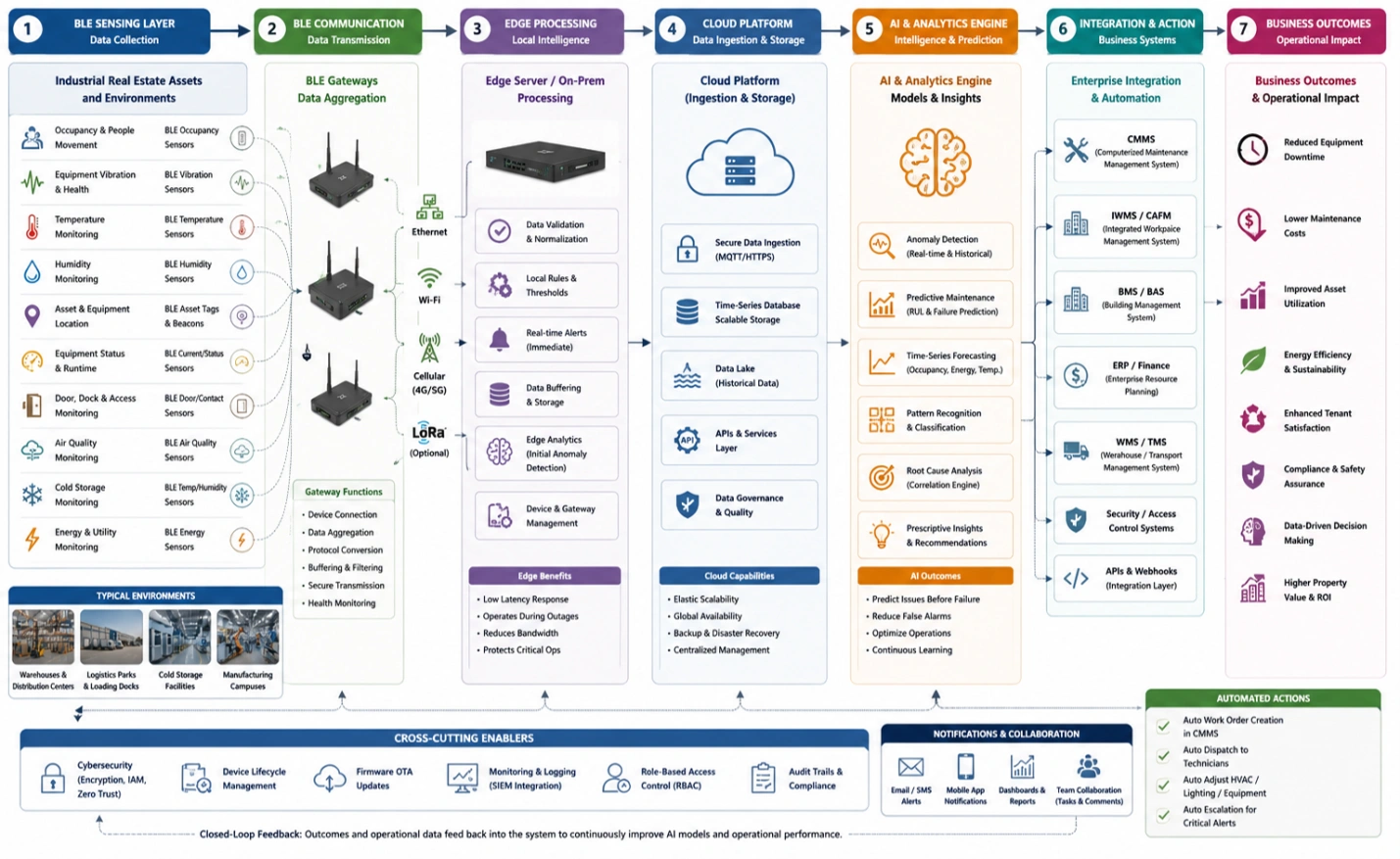
This workflow diagram illustrates how BLE sensors continuously collect occupancy, vibration, temperature, humidity, asset location, and equipment status data across industrial real estate facilities. The data flows through BLE gateways to edge servers and cloud software, where AI models perform anomaly detection, predictive maintenance, and operational analytics before integrating with CMMS, IWMS, ERP, and BMS to automate work orders, notify facility managers, and improve operational performance.
BLE Technology Components Supporting AI in Industrial Real Estate
AI-driven industrial real estate solutions rely on multiple hardware and software components working together to provide reliable sensing, communications, analytics, and automation.
BLE Gateways
BLE gateways serve as communication hubs between field devices and centralized software. They collect advertisements and sensor data from nearby BLE devices and transmit the information to edge servers or cloud applications.
Key engineering considerations include:
- Multi-channel BLE scanning performance
- Simultaneous