
AI and RFID for Residential Construction
Understanding AI Driven Residential Construction with RFID Enabled Identification
Artificial Intelligence of Things, commonly referred to as AIoT, combines artificial intelligence with connected devices, RFID systems, IoT sensors, industrial software, and edge computing to automate operational decision making. Within residential construction, RFID functions as the identification and traceability technology that continuously supplies accurate information about materials, tools, equipment, work packages, deliveries, and completed building components.
Unlike traditional manual inventory tracking or barcode based processes, RFID tags can identify multiple construction assets without direct line of sight. AI continuously evaluates these identification events together with scheduling information, procurement records, inspection reports, weather conditions, workforce productivity, and BIM models to generate operational recommendations.
Residential construction differs significantly from commercial construction because projects involve:
- Multiple housing units with repetitive construction phases
- Tight construction schedules
- Frequent subcontractor transitions
- High material consumption
- Numerous supplier deliveries
- Warranty documentation
- Customer selected finishes
- Building code inspections
- Neighborhood logistics constraints
- Budget sensitive procurement
AI models learn from historical residential project performance to optimize these unique operational characteristics rather than relying on generalized construction assumptions.
GAO supports organizations by supplying RFID hardware, readers, antennas, tags, gateways, and supporting IoT technologies that integrate with intelligent residential construction software.
AI Powered Residential Construction with RFID Enabled Project Intelligence
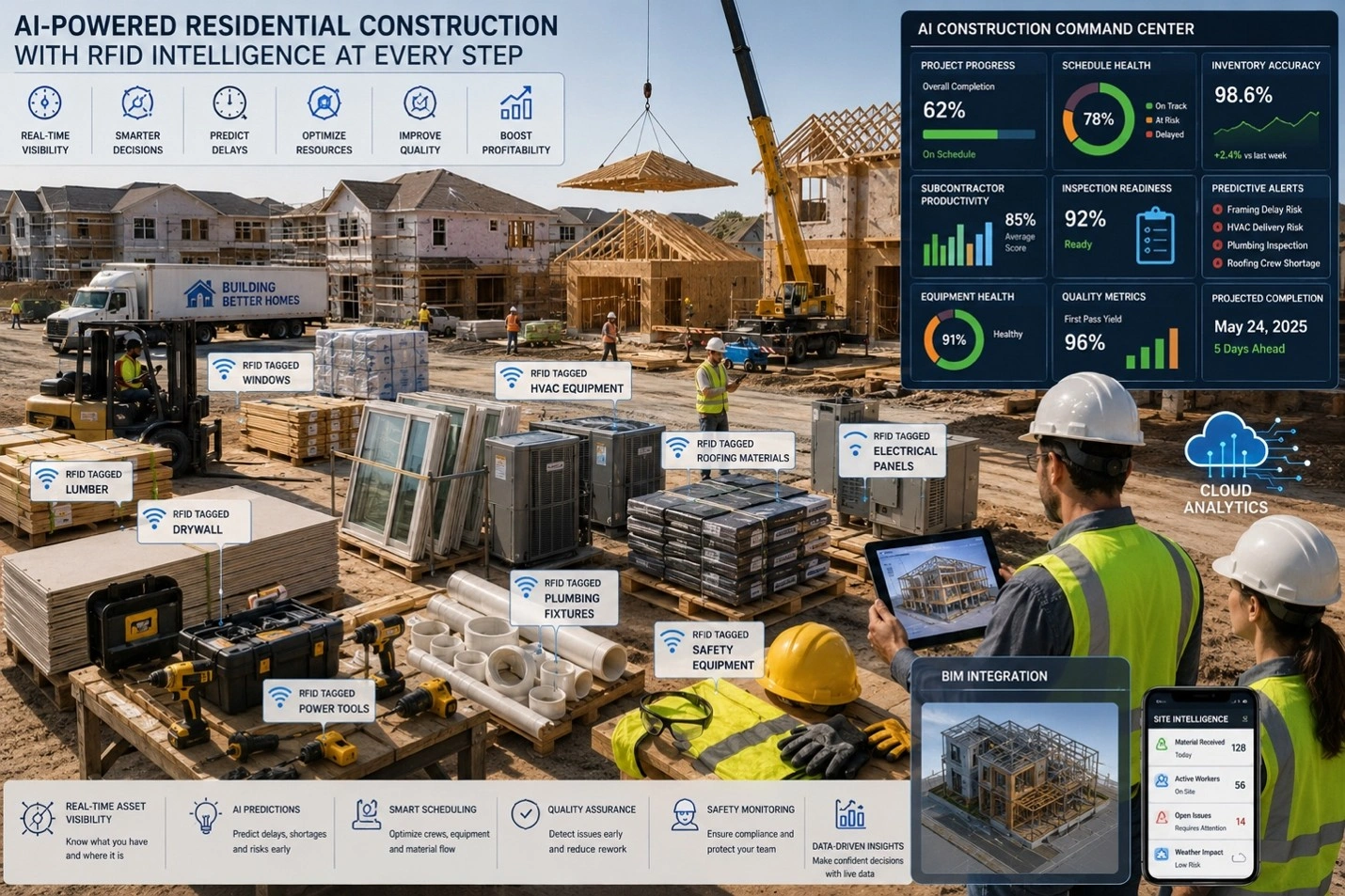
This illustration demonstrates how AI-powered residential construction uses RFID to provide real-time visibility of building materials, equipment, and workforce activities across a housing development. It highlights BIM integration, cloud analytics, predictive scheduling, inventory management, quality monitoring, and executive dashboards that help construction teams improve productivity, safety, and project delivery.
Why AI is Transforming Residential Construction Operations
Residential builders face increasing pressure to complete projects faster while maintaining profitability, quality, regulatory compliance, and homeowner satisfaction. Labor shortages, fluctuating material prices, fragmented subcontractor coordination, and supply chain uncertainty have made traditional project management methods increasingly difficult.
AI transforms residential construction by continuously analyzing operational data generated throughout every construction phase.
Key operational drivers include:
- Material availability forecasting
- Delivery schedule optimization
- Equipment utilization analysis
- Labor productivity measurement
- Subcontractor performance evaluation
- Construction sequence optimization
- Inspection readiness prediction
- Warranty documentation automation
- Procurement optimization
- Schedule risk prediction
- Cash flow forecasting
- Material theft detection
- Inventory reconciliation
- Construction quality prediction
- Building code compliance monitoring
Rather than reacting after delays occur, AI identifies developing issues before they become costly project disruptions.
Typical AI applications include:
- Predicting framing schedule delays
- Detecting abnormal equipment utilization
- Forecasting drywall shortages
- Optimizing concrete deliveries
- Identifying missing construction materials
- Predicting roofing completion dates
- Recommending labor reallocations
- Monitoring subcontractor performance
- Improving permit scheduling
- Automating punch list prioritization
These capabilities enable project teams to shift from reactive management toward predictive operational planning.
Residential Construction Applications Powered by AI and RFID
Although RFID provides the identification mechanism, AI delivers operational intelligence by interpreting information collected throughout residential construction activities.
Material Traceability
Residential construction materials move through numerous stages before installation.
Examples include:
- Lumber
- Rebar
- Structural steel connectors
- Concrete forms
- Drywall
- Roofing materials
- Windows
- Doors
- Cabinets
- Flooring
- Insulation
- Plumbing fixtures
- HVAC components
- Electrical panels
- Appliances
RFID tags attached during procurement allow every delivery to be verified automatically upon arrival. AI compares actual deliveries with purchase orders, BIM material schedules, construction milestones, and supplier performance histories to identify shortages, delivery risks, and procurement deviations.
Equipment Utilization Intelligence
Residential contractors operate numerous shared construction assets.
Examples include:
- Scissor lifts
- Mini excavators
- Compact loaders
- Concrete mixers
- Air compressors
- Portable generators
- Nail guns
- Laser levels
- Survey equipment
- Power tools
RFID identifies equipment movement while AI analyzes utilization frequency, idle time, maintenance history, operator assignments, and project demand.
Project managers receive recommendations regarding:
- Equipment relocation
- Fleet balancing
- Preventive maintenance scheduling
- Rental optimization
- Capital investment planning
Workforce Productivity Analysis
Construction labor represents one of the largest residential project expenses.
RFID enabled identification supports:
- Worker check in
- Trade certification verification
- Work zone access
- Tool assignment
- Safety compliance
AI correlates workforce activity with:
- Daily production rates
- Weather
- Crew composition
- Material availability
- Inspection schedules
- Equipment readiness
This allows supervisors to optimize crew deployment while minimizing schedule disruptions.
Construction Quality Management
Quality deficiencies frequently originate from undocumented installation activities.
RFID supports traceability for:
- Structural framing
- Plumbing rough in
- Electrical installation
- HVAC installation
- Waterproofing
- Roofing
- Insulation
- Fire stopping
- Windows
- Finish materials
AI evaluates inspection histories, defect frequencies, subcontractor performance, and installation sequences to identify quality risks before deficiencies propagate through later construction phases.
AI-Powered Residential Construction Workflow with RFID, BIM, and Predictive Analytics
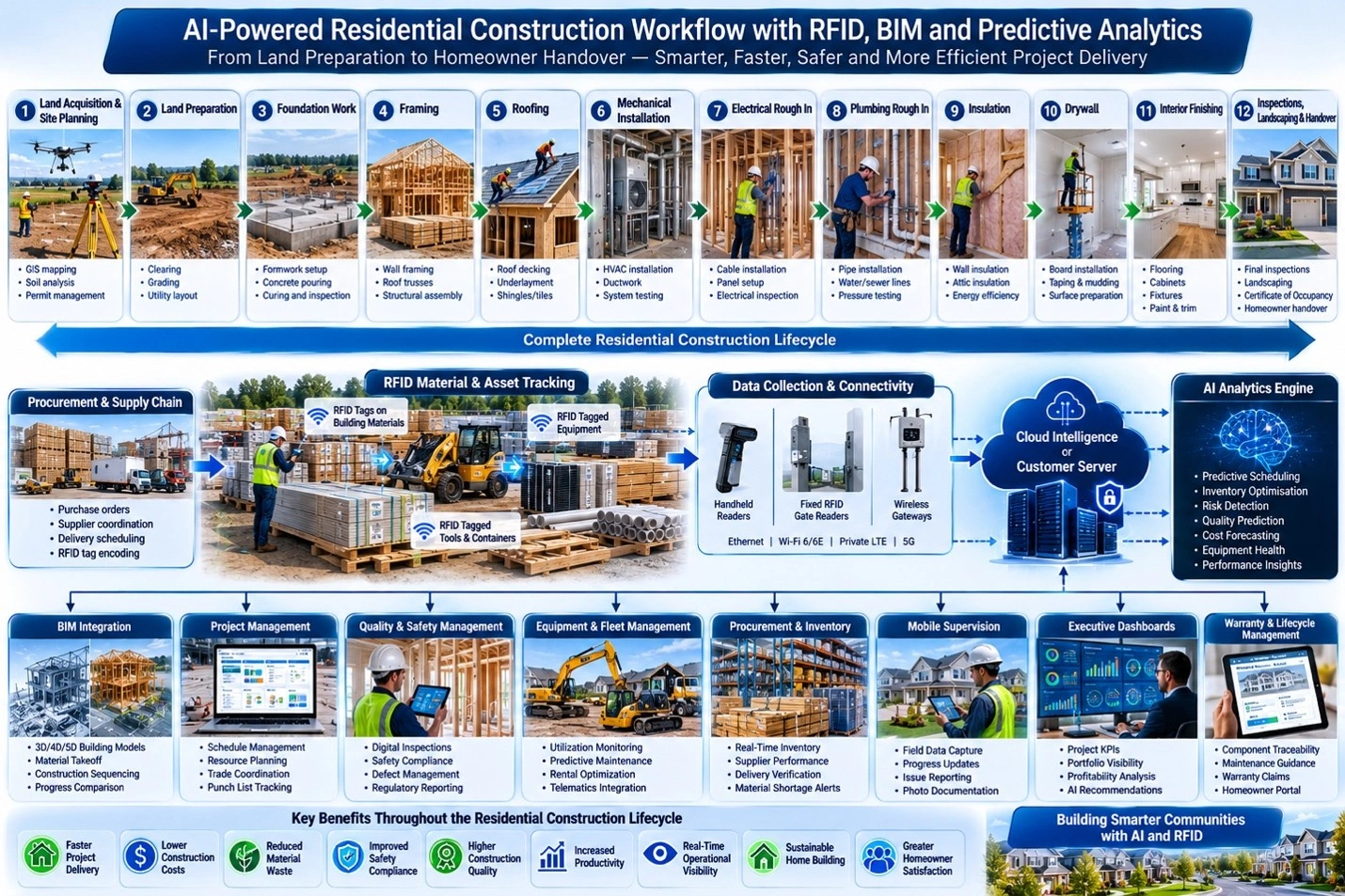
This workflow diagram illustrates the complete residential construction lifecycle enhanced by AI and RFID technologies, beginning with land preparation and progressing through construction, inspections, homeowner handover, and warranty documentation. It highlights how RFID-enabled material tracking, BIM integration, procurement systems, cloud intelligence, predictive scheduling, mobile supervision, and executive reporting work together to improve project visibility, efficiency, and decision-making.
Operational Workflow from RFID Data Capture to AI Driven Decision Making
Residential construction generates continuous operational events across distributed job sites. AI powered decision making depends upon reliable identification, accurate data collection, and integrated software systems.
The workflow typically begins with RFID tagged construction assets entering the project supply chain. Suppliers apply RFID identifiers to pallets, bundles, containers, mechanical equipment, prefabricated assemblies, electrical components, and high value construction materials before shipment. Upon arrival at the residential job site, fixed RFID readers installed at site entrances or handheld readers operated by receiving personnel automatically verify deliveries against procurement records.
Construction supervisors use rugged mobile readers to validate material movement between laydown yards, storage containers, staging areas, and individual homes under construction. Each RFID read event creates a timestamped record identifying the material, its location, movement history, assigned building lot, responsible subcontractor, and installation status.
Edge computing devices perform preliminary filtering by removing duplicate reads, validating tag integrity, checking read confidence, and applying business rules before forwarding relevant data through secure Ethernet, Wi-Fi, private LTE, or 5G networks to customer managed servers or cloud hosted software.
Middleware synchronizes RFID events with residential construction applications including:
- Building Information Modeling software
- Construction scheduling systems
- Procurement software
- Inventory management software
- Equipment management systems
- Workforce management software
- Inspection management software
- Quality assurance systems
- Warranty management applications
- Financial management systems
AI models continuously correlate RFID identification events with construction schedules, historical project performance, supplier delivery trends, weather forecasts, workforce productivity, and inspection results. Rather than simply reporting where materials are located, AI predicts future project conditions, estimates schedule risk, identifies procurement bottlenecks, forecasts inventory shortages, and recommends operational adjustments before delays occur.
Construction executives receive dashboards highlighting key performance indicators such as schedule adherence, material availability, labor productivity, inspection readiness, subcontractor performance, equipment utilization, inventory accuracy, and projected project completion dates.
GAO has supported customers implementing RFID identification technologies that provide the reliable operational data required for intelligent construction software and advanced AI analytics.
AI-Powered Residential Construction Workflow with RFID, BIM, and Predictive Analytics
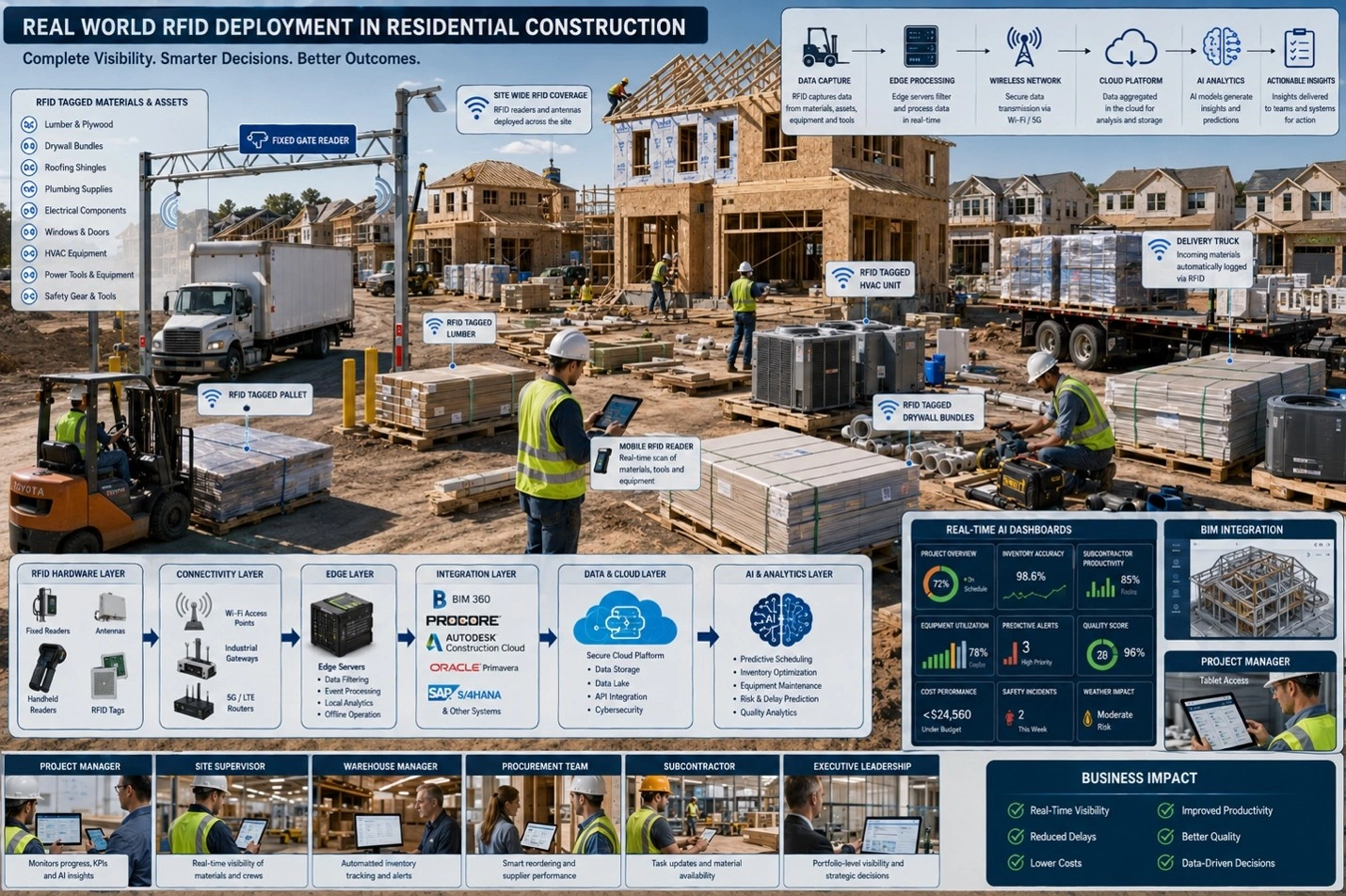
This workflow diagram illustrates the complete residential construction lifecycle enhanced by AI and RFID technologies, beginning with land preparation and progressing through construction, inspections, homeowner handover, and warranty documentation. It highlights how RFID-enabled material tracking, BIM integration, procurement systems, cloud intelligence, predictive scheduling, mobile supervision, and executive reporting work together to improve project visibility, efficiency, and decision-making.
RFID Technologies, AI Components, Software, and Deployment Considerations
Successful AI driven residential construction depends upon selecting identification technologies that match the physical characteristics of construction materials, environmental conditions, read distances, and operational workflows. RFID serves as the foundation for reliable asset identification, while AI software transforms identification events into operational intelligence.
RFID Technologies, AI Components, Software, and Deployment Considerations (Continued)
Residential construction projects involve thousands of movable assets, prefabricated components, building materials, tools, and equipment that require different identification methods throughout the construction lifecycle. Selecting the appropriate RFID technology depends on read range, environmental conditions, installation location, asset value, expected lifespan, and integration requirements rather than using a single tag type for every application.
UHF RFID for Large-Scale Residential Material Tracking
Ultra High Frequency (UHF) RFID is commonly selected for residential construction because it provides longer read distances and supports rapid identification of numerous tagged items simultaneously.
Typical residential construction applications include:
- Lumber bundles
- Drywall pallets
- Roofing materials
- Structural steel connectors
- Window assemblies
- Door packages
- HVAC equipment
- Electrical panels
- Plumbing fixtures
- Appliances
- Tool cribs
- Temporary fencing
- Rental equipment
- Waste containers
- Delivery verification
UHF RFID readers installed at site entrances, storage yards, material laydown areas, and warehouse loading docks automatically record material movements without interrupting construction activities.
AI analyzes these identification events together with procurement schedules, supplier lead times, installation sequencing, and subcontractor schedules to forecast shortages before they delay framing, mechanical installation, or finishing activities.
HF RFID for Controlled Identification
High Frequency (HF) RFID is well suited for applications requiring shorter read ranges and deliberate user interaction.
Residential construction examples include:
- Worker identification cards
- Inspection checkpoints
- Equipment checkout
- Maintenance documentation
- Warranty records
- Building component verification
- Access control
- Digital commissioning documentation
HF RFID minimizes accidental reads when construction personnel intentionally verify specific assets or completed work packages.
LF RFID for Harsh Construction Conditions
Low Frequency (LF) RFID performs reliably in environments where moisture, concrete, metal reinforcement, or underground installation can reduce higher-frequency performance.
Representative uses include:
- Embedded utility markers
- Concrete component identification
- Underground infrastructure documentation
- Permanent asset identification
- Landscaping irrigation infrastructure
- Water system maintenance records
Although LF RFID offers shorter reading distances, its environmental resilience makes it valuable for selected residential construction assets.
Supporting Hardware Components
An intelligent residential construction solution combines RFID with numerous complementary technologies.
Typical hardware includes:
- Fixed RFID readers
- Handheld RFID readers
- Wearable RFID readers
- Rugged tablets
- Edge gateways
- Industrial IoT gateways
- RFID antennas
- Passive RFID tags
- Active RFID tags
- Environmental sensors
- Smart cameras
- Computer vision cameras
- GPS receivers
- BLE beacons where appropriate
- Edge AI appliances
- Wireless access points
- Private LTE infrastructure
- 5G communication equipment
- Backup power systems
Construction-grade hardware should tolerate dust, vibration, rain, temperature fluctuations, and continuous outdoor operation.
GAO supplies RFID hardware, antennas, readers, gateways, and related IoT products designed for demanding industrial and construction environments.
AI Models Supporting Residential Construction Intelligence
Artificial intelligence delivers value because it converts operational information into practical recommendations rather than simply presenting historical reports.
Common AI methods include:
Machine Learning
Machine learning predicts:
- Project completion dates
- Material consumption
- Labor productivity
- Equipment utilization
- Supplier reliability
- Procurement timing
- Inspection readiness
Historical residential construction projects continuously improve prediction accuracy.
Computer Vision
Computer vision complements RFID by verifying:
- Material deliveries
- Worker PPE compliance
- Installation progress
- Concrete curing stages
- Framing completion
- Roofing progress
- Safety hazards
- Equipment presence
AI compares captured images with BIM models and planned schedules to estimate actual project progress.
Predictive Analytics
Predictive analytics identifies future operational risks such as:
- Material shortages
- Equipment failures
- Schedule slippage
- Budget overruns
- Labor shortages
- Weather disruptions
- Supplier delays
- Inspection bottlenecks
Rather than reporting completed events, predictive analytics recommends corrective actions before delays occur.
Generative AI
Generative AI assists project managers by automatically creating:
- Daily progress summaries
- Material variance reports
- Procurement recommendations
- Safety observations
- Inspection documentation
- Executive reports
- Risk assessments
- Maintenance recommendations
This reduces administrative workload while improving reporting consistency.
Communication Infrastructure
Reliable communications ensure RFID events reach construction software without interruption.
Common communication technologies include:
- Ethernet
- Wi-Fi 6
- Wi-Fi 6E
- Private LTE
- 5G
- Fiber optic backhaul
- VPN connectivity
- Secure remote access
Data exchange frequently uses:
- MQTT
- HTTPS
- REST APIs
- OPC UA where applicable
- Modbus TCP for supporting equipment
- JSON
- XML
Reliable communication design becomes particularly important on large residential developments where multiple homes are constructed simultaneously.
Cloud Version Versus Server Version
Residential construction organizations often select deployment models based on project scale, cybersecurity policies, IT resources, and regulatory requirements.
Cloud Version
Cloud-hosted software is appropriate when builders require centralized visibility across numerous geographically distributed projects.
Typical advantages include:
- Simplified software updates
- Multi-site project management
- Centralized dashboards
- Lower local infrastructure requirements
- Faster deployment
- Elastic computing resources
- Easier collaboration with subcontractors
Cloud deployments are especially useful for national and regional residential builders managing hundreds of concurrent housing developments.
Server Version
Server deployments place software on customer-managed infrastructure located within private data centers, regional computing facilities, or dedicated enterprise servers.
Advantages include:
- Greater infrastructure control
- Internal cybersecurity governance
- Lower external network dependency
- Integration with existing enterprise software
- Customized data retention policies
- Support for isolated construction environments
Some organizations also deploy edge servers directly at major construction sites to maintain operations even during temporary internet outages.
Choosing between cloud and server deployments depends upon project complexity, IT strategy, cybersecurity policies, integration requirements, and operational resilience objectives.
Cloud vs. Server Deployment Comparison for AI-Powered Residential Construction
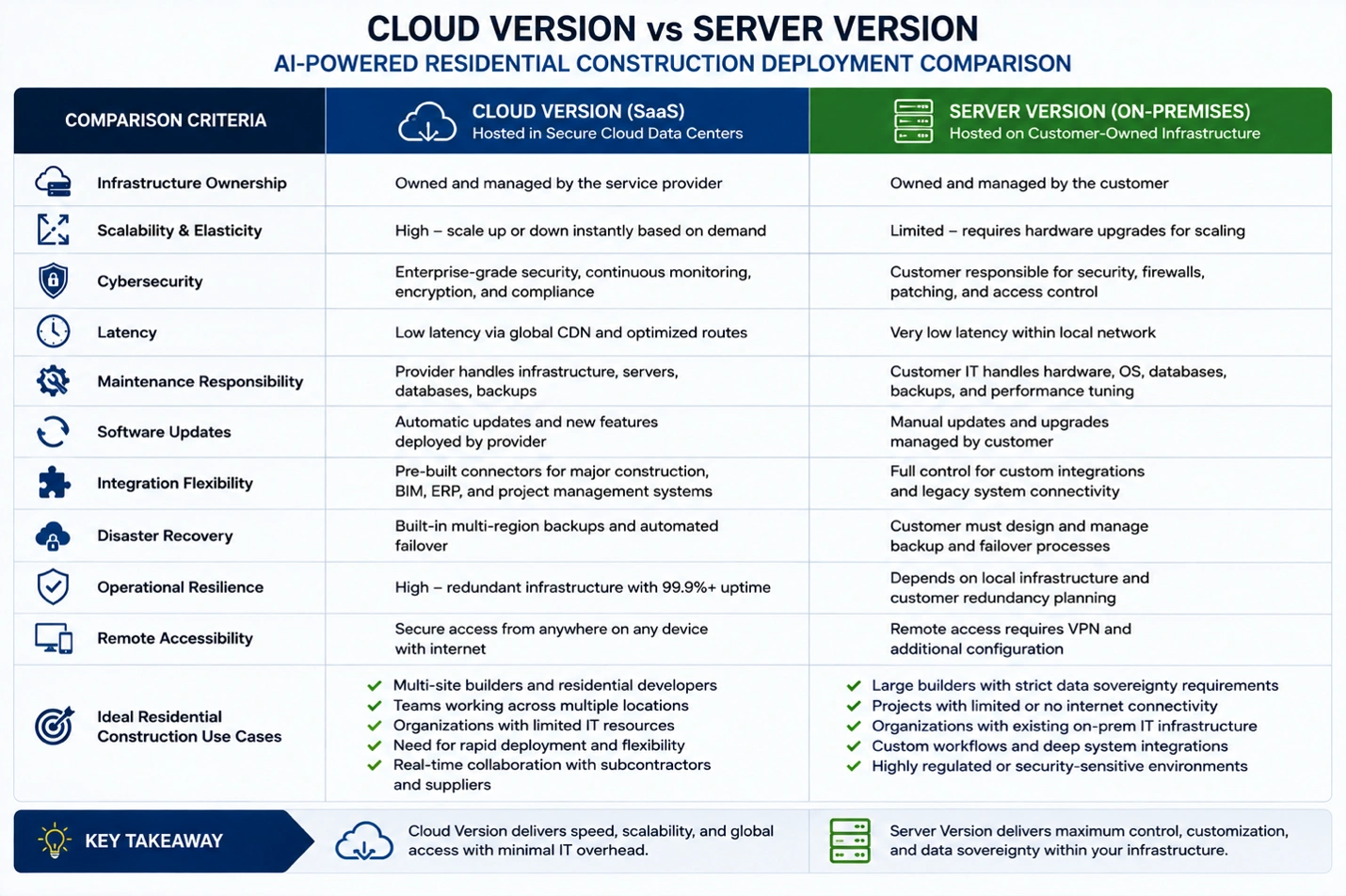
This comparison table evaluates Cloud Version and Server Version deployment models for AI-powered residential construction solutions. It compares infrastructure ownership, scalability, cybersecurity, latency, maintenance, software updates, integration flexibility, disaster recovery, operational resilience, remote accessibility, and recommended use cases to help construction organizations choose the most appropriate deployment strategy.
Cybersecurity Considerations
Residential construction projects increasingly exchange operational information across suppliers, subcontractors, engineering consultants, project managers, and homeowners. Protecting operational information is therefore essential.
Recommended security practices include:
- Device authentication
- Mutual TLS encryption
- Network segmentation
- Identity and access management
- Role-based permissions
- Multi-factor authentication
- Secure firmware updates
- Endpoint monitoring
- Continuous vulnerability assessment
- RFID reader authentication
- API security controls
- Audit logging
- Backup and disaster recovery planning
Construction organizations should also establish procedures for lost RFID devices, compromised credentials, unauthorized equipment movement, and software patch management.
GAO assists customers by supplying RFID technologies that can integrate with secure enterprise environments while supporting long-term operational reliability.
Integration with Residential Construction Software
AI-powered residential construction solutions become significantly more valuable when RFID information is synchronized with existing business software rather than operating independently.
Common integration targets include:
- Building Information Modeling (BIM)
- Autodesk Construction Cloud
- Procore
- Oracle Primavera P6
- Microsoft Project
- Oracle NetSuite
- SAP
- Oracle ERP
- Microsoft Dynamics 365
- CMMS software
- Procurement management systems
- Quality management software
- Document management systems
- Warranty management software
- GIS systems
Integration enables AI to correlate project schedules, procurement records, inspection outcomes, financial information, workforce activities, and RFID identification events into a unified operational picture.
System Integration Diagram for AI-Powered RFID in Residential Construction
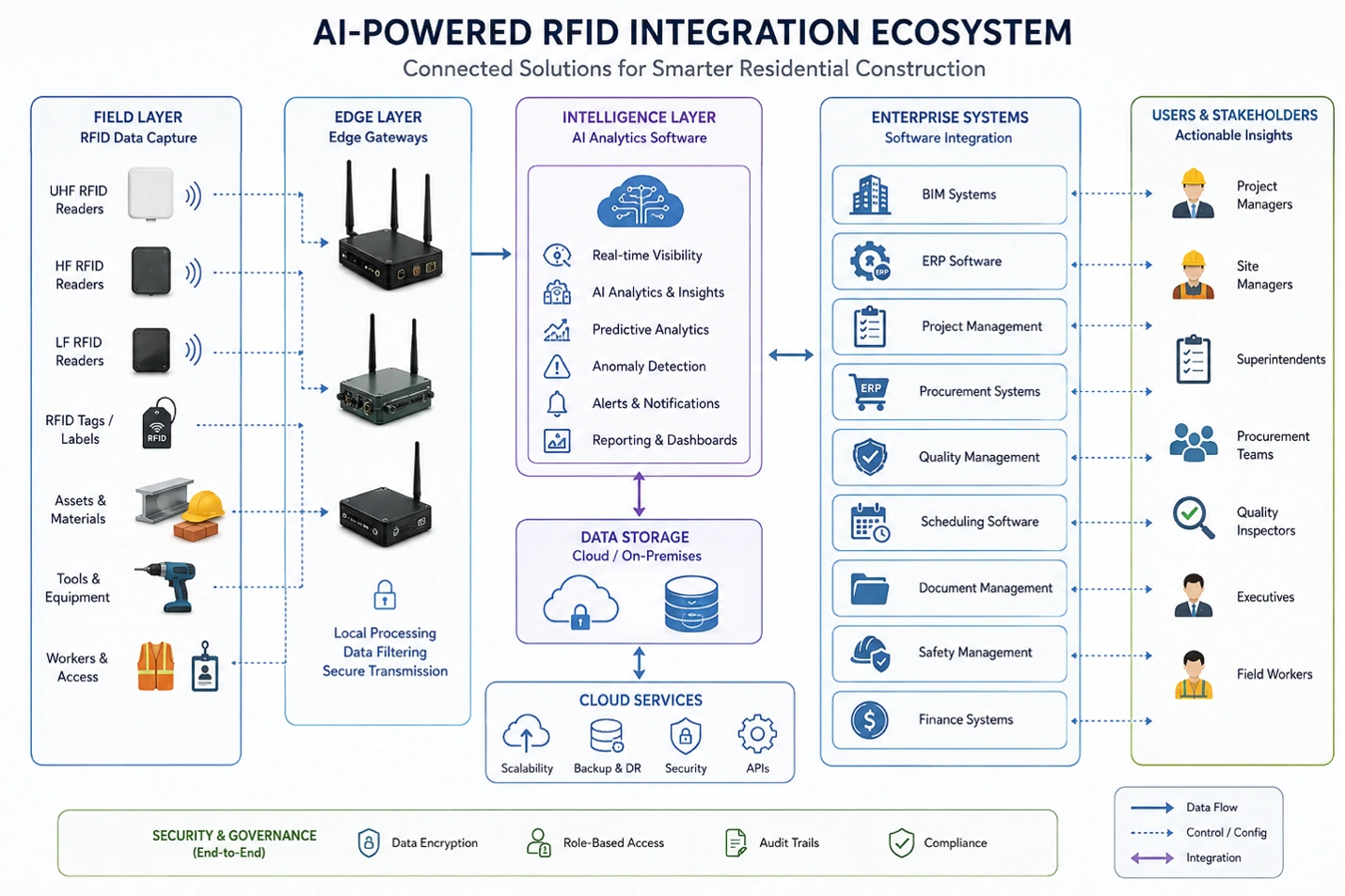
This system integration diagram illustrates how RFID readers connect through edge gateways to AI analytics software, BIM systems, ERP software, project management software, procurement systems, quality management software, scheduling software, cloud services, customer-managed servers, executive dashboards, mobile applications, and field supervisors. It demonstrates the end-to-end flow of construction data, enabling real-time visibility, automated workflows, improved collaboration, and data-driven decision-making across residential construction projects.
Technical Capabilities and Operational Value of AI-Powered Residential Construction Using RFID
Residential construction companies increasingly depend on operational intelligence rather than static reports to manage multiple projects, subcontractors, suppliers, and homeowners. RFID provides continuous identification of materials, equipment, and work activities, while AI converts those identification events into recommendations that improve scheduling, procurement, quality, safety, and profitability. Together, these technologies enable construction teams to make proactive decisions throughout every phase of the residential building lifecycle.
Real Time Material Visibility
Material shortages remain one of the leading causes of schedule delays in residential construction. Lumber, drywall, roofing products, windows, doors, insulation, plumbing components, electrical fixtures, and finish materials often arrive from multiple suppliers with varying lead times.
RFID continuously identifies incoming shipments and material movement across staging areas, warehouses, and individual lots. AI compares actual inventory against construction schedules, procurement records, and BIM quantities to determine whether sufficient materials are available for upcoming work.
Project managers benefit from:
- Reduced material shortages
- Improved inventory accuracy
- Faster receiving operations
- Better supplier accountability
- Lower emergency purchasing costs
- Reduced material loss
- Improved installation sequencing
Instead of manually verifying inventory, site supervisors receive automated notifications whenever projected shortages could affect framing, roofing, mechanical installation, or interior finishing.
Predictive Schedule Management
Residential developments involve hundreds of interdependent construction activities that must be completed in the correct sequence. Delays in one trade frequently affect every subsequent activity.
AI continuously evaluates:
- Material availability
- Crew productivity
- Weather forecasts
- Inspection schedules
- Equipment utilization
- Supplier performance
- Historical project data
Predictive scheduling models estimate future completion dates while identifying critical risks before delays become unavoidable.
Construction managers can proactively:
- Reassign labor
- Accelerate procurement
- Adjust subcontractor sequencing
- Reschedule inspections
- Optimize equipment allocation
Predictive scheduling significantly reduces idle labor, subcontractor conflicts, and homeowner occupancy delays.
Intelligent Equipment Utilization
Residential builders invest heavily in construction equipment that is frequently underutilized or unavailable when needed.
Examples include:
- Forklifts
- Mini excavators
- Skid steer loaders
- Concrete saws
- Air compressors
- Portable generators
- Laser levels
- Survey instruments
- Compact cranes
- Material lifts
RFID automatically records equipment movement throughout construction sites. AI analyzes historical utilization patterns, maintenance intervals, idle time, transportation frequency, and rental costs.
Recommended actions include:
- Equipment redistribution
- Rental reduction
- Preventive maintenance scheduling
- Fleet expansion planning
- Equipment retirement analysis
These recommendations improve asset utilization while reducing unnecessary capital expenditures.
AI Assisted Workforce Coordination
Residential construction projects depend upon numerous specialized subcontractors including:
- Concrete crews
- Framers
- Roofers
- Electricians
- Plumbers
- HVAC installers
- Insulation contractors
- Drywall installers
- Painters
- Flooring specialists
- Cabinet installers
- Landscapers
RFID enabled workforce identification records attendance, work area access, tool assignments, and equipment usage.
AI evaluates productivity trends across individual trades while identifying:
- Labor shortages
- Schedule conflicts
- Low productivity periods
- Overtime risks
- Trade coordination opportunities
Rather than relying on subjective observations, project managers receive objective performance insights supported by operational data.
Construction Quality Intelligence
Residential quality defects frequently originate from incomplete documentation, incorrect installation sequencing, or inadequate inspection procedures.
RFID establishes traceability for installed building components while AI evaluates:
- Inspection outcomes
- Rework frequency
- Warranty claims
- Installation durations
- Trade performance
- Material quality
- Supplier consistency
AI identifies recurring quality issues before they affect additional homes within the development.
Typical improvements include:
- Reduced punch list items
- Improved inspection pass rates
- Lower warranty costs
- Better homeowner satisfaction
- Faster project closeout
Safety Monitoring and Risk Reduction
Construction safety extends beyond regulatory compliance. AI helps identify operational conditions associated with increased accident risk.
RFID supports identification of:
- Personnel
- Safety equipment
- Restricted work zones
- Heavy machinery
- Temporary structures
- Emergency equipment
Combined with AI and supporting IoT sensors, construction supervisors can identify:
- Unauthorized access
- Equipment conflicts
- Worker congestion
- Heat stress risks
- Unsafe work patterns
- PPE compliance issues
Although AI assists decision making, final safety decisions remain under qualified construction personnel.
Business Benefits for Residential Construction Organizations
Successful AI deployments deliver measurable operational improvements across construction planning, procurement, execution, and project completion.
Key benefits include:
- Improved schedule adherence
- Better inventory accuracy
- Reduced construction waste
- Higher labor productivity
- Faster receiving operations
- Reduced equipment downtime
- Improved supplier accountability
- Better procurement planning
- Increased inspection readiness
- Lower warranty claims
- Improved homeowner satisfaction
- Better subcontractor coordination
- Improved project forecasting
- Enhanced executive visibility
- More accurate project costing
Rather than optimizing isolated activities, AI improves the overall efficiency of residential construction operations.
Engineering Best Practices for Successful Deployment
Successful implementation requires careful planning before hardware installation or software integration begins.
Define Business Objectives
Clearly identify measurable objectives such as:
- Reducing schedule delays
- Improving inventory accuracy
- Increasing equipment utilization
- Reducing material waste
- Improving inspection readiness
- Lowering warranty costs
Technology selection should support defined operational outcomes.
Prioritize High Value Assets
Begin deployment with assets that provide the greatest operational value.
Typical priorities include:
- Structural materials
- Mechanical equipment
- Electrical panels
- High value tools
- Rental equipment
- Safety equipment
- Prefabricated assemblies
Expanding gradually reduces implementation risk.
Integrate Existing Software
Avoid isolated deployments.
Integrate RFID identification with:
- BIM software
- ERP systems
- Procurement software
- Scheduling software
- Quality management
- Maintenance software
- Financial systems
Integrated information enables AI to generate significantly more accurate recommendations.
Standardize RFID Tagging
Develop standardized procedures covering:
- Tag placement
- Tag durability
- Asset naming
- Data formats
- Installation verification
- Maintenance procedures
- Lifecycle management
Standardization improves long-term data quality.
Validate AI Models Continuously
Construction operations evolve continuously.
AI models should be periodically retrained using:
- Completed project data
- Updated supplier performance
- Material pricing trends
- New construction methods
- Seasonal productivity changes
Continuous improvement maintains prediction accuracy.
Executive KPI Dashboard for AI-Powered Residential Construction with RFID Intelligence
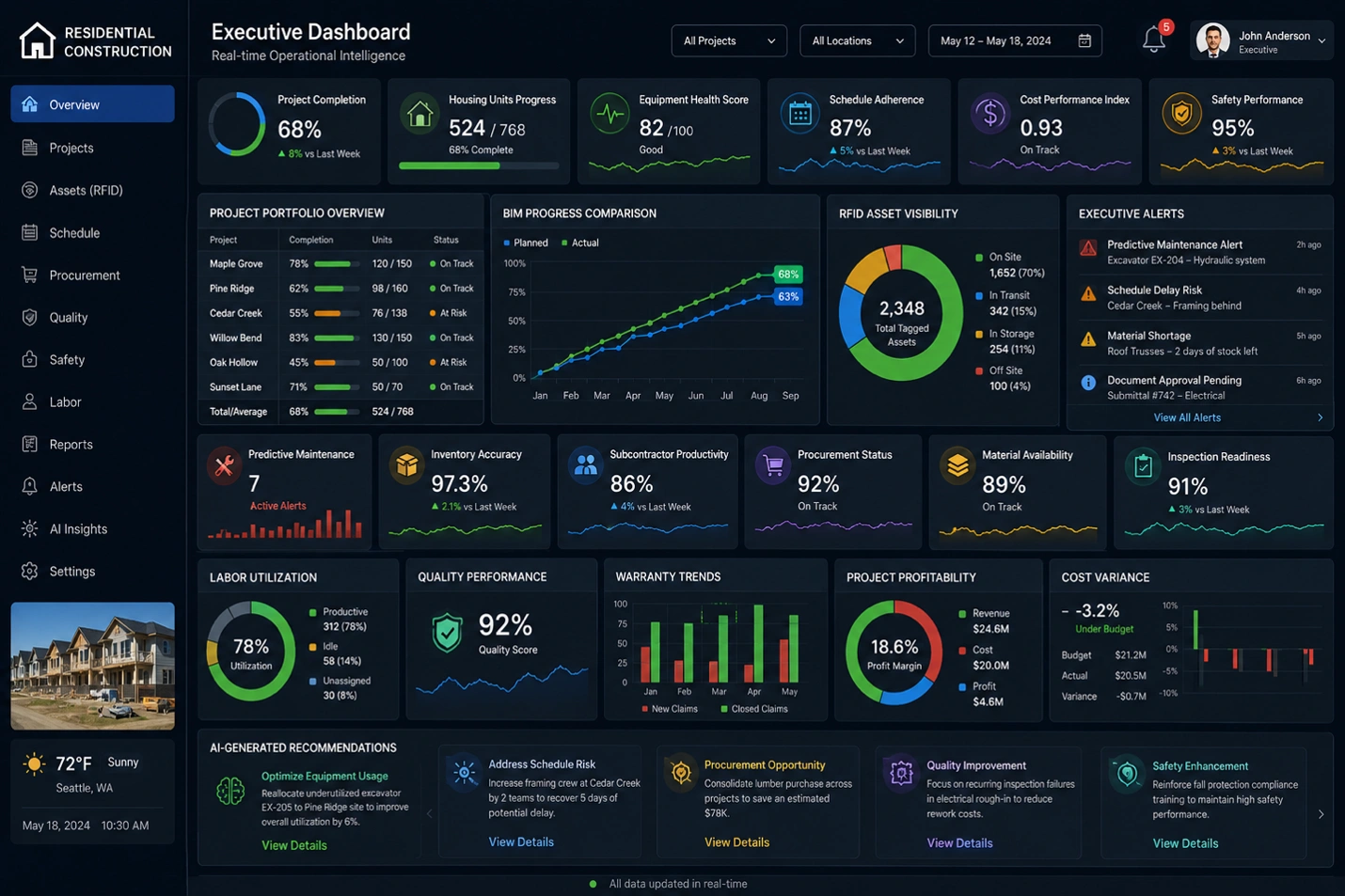
This executive KPI dashboard presents real-time operational intelligence for residential construction projects by consolidating AI analytics, RFID asset visibility, BIM progress, procurement, labor utilization, equipment health, safety, quality, and financial performance into a single interface. Interactive charts, gauges, heat maps, KPI panels, and AI-generated recommendations help construction executives monitor project performance, identify risks, optimize resources, and make faster, data-driven decisions.
Implementation Recommendations for AI-Powered Residential Construction
Successful AI-enabled residential construction initiatives require a structured implementation strategy that aligns technology investments with measurable operational improvements. Organizations that begin with clearly defined objectives, standardized data collection, and phased deployment generally achieve higher adoption rates and better long-term performance than projects attempting full-scale implementation from the outset.
Recommended implementation practices include:
- Conduct a comprehensive assessment of current construction workflows before selecting RFID hardware or AI software.
- Identify high-value use cases such as material tracking, equipment utilization, workforce coordination, or quality assurance for the initial deployment.
- Establish RFID tagging standards for materials, tools, equipment, and prefabricated building components to ensure consistent identification across projects.
- Integrate RFID data with BIM, ERP, scheduling, procurement, quality management, and financial software to maximize AI effectiveness.
- Define key performance indicators before deployment so improvements can be measured objectively.
- Perform pilot implementations on selected residential developments before expanding across multiple communities.
- Develop governance procedures covering data ownership, cybersecurity, software updates, user permissions, and AI model validation.
- Train project managers, field supervisors, warehouse personnel, procurement teams, and subcontractors on new operational processes.
- Review AI recommendations regularly and refine prediction models using completed project data and operational feedback.
- Monitor system performance continuously and expand deployment based on demonstrated business value.
Organizations that adopt a phased implementation strategy generally reduce project risk while establishing a strong operational foundation for future AI-enabled construction initiatives.
Measuring Success Through Residential Construction KPIs
Measuring the effectiveness of AI-powered residential construction requires operational metrics that reflect actual business performance rather than technology usage alone.
Common performance indicators include:
- Project schedule adherence
- Average project completion time
- Material inventory accuracy
- Equipment utilization rate
- Equipment downtime
- Material waste percentage
- Procurement lead time
- Supplier on-time delivery performance
- Construction rework rate
- First-pass inspection success rate
- Warranty claim frequency
- Labor productivity
- Crew utilization
- Safety incident rate
- Subcontractor productivity
- Average receiving time
- Inventory turnover
- Cost variance
- Budget adherence
- Homeowner satisfaction scores
Executive dashboards combining AI analytics with RFID-generated operational data provide construction leaders with continuous visibility into these performance indicators, enabling informed decision-making throughout the project lifecycle.
AI-Powered Residential Construction Lifecycle with RFID-Enabled Operational Intelligence
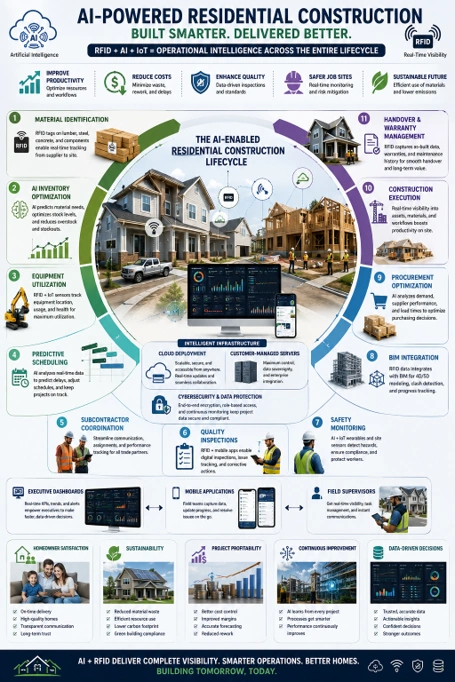
This infographic illustrates the end-to-end residential construction lifecycle enhanced by AI and RFID technologies, from material identification and inventory optimization to equipment utilization, subcontractor coordination, BIM integration, quality inspections, safety monitoring, procurement optimization, cloud and server deployments, cybersecurity, executive dashboards, warranty management, homeowner satisfaction, sustainability, and continuous operational improvement. It highlights how AI-driven insights and RFID-enabled visibility improve project delivery, reduce waste, increase productivity, and support data-driven decision-making throughout modern residential construction.
Conclusion
AI-powered residential construction supported by RFID is reshaping how builders plan, execute, monitor, and optimize housing projects. RFID provides accurate identification and traceability for construction materials, equipment, workforce activities, and completed building components, while artificial intelligence transforms operational data into predictive insights that improve scheduling, procurement, quality, safety, and project profitability.
Residential construction organizations adopting AIoT solutions gain greater visibility across the entire project lifecycle, from procurement and site logistics to inspections, homeowner handover, and warranty management. These capabilities help reduce delays, improve resource utilization, minimize material waste, strengthen quality assurance, and enhance collaboration among contractors, suppliers, and project stakeholders.
For more than three decades, GAO has supplied RFID, BLE, and IoT hardware products and systems that enable organizations throughout the United States and Canada to modernize their operations. Headquartered in New York City and Toronto, Canada, GAO is recognized among the world’s leading B2B and B2G suppliers of RFID and BLE technologies. Through continuous investment in research and development, stringent quality assurance, and experienced remote and onsite technical support, GAO helps construction organizations deploy reliable identification technologies that support intelligent, data-driven residential construction.
Whether implementing a pilot project or expanding across multiple housing developments, combining AI with RFID creates a strong foundation for improving operational efficiency, increasing project visibility, and delivering higher-quality homes with greater confidence.
Building the Future of Industrial AI and IoT with Aperture Venture Studio and GAO RFID Inc.
For more than three decades, GAO Group of Companies has invested extensively in research and development of industrial RFID, BLE, and IoT technologies. As artificial intelligence has become an essential component of modern residential construction and intelligent infrastructure, we established Aperture Venture Studio to accelerate the development, commercialization, and adoption of advanced AI and IoT solutions that address evolving construction challenges and other industrial applications.
Aperture has brought together leading AI researchers, IoT specialists, engineering professionals, operational executives, strategic investors, and technology organizations to advance practical industrial innovation. Through initiatives such as the Aperture Ventures Summit and TekSummit, we foster technical collaboration, share emerging best practices, and encourage knowledge exchange across AI, RFID, BLE, and IoT communities.
We welcome opportunities to collaborate with:
- Advisors, technical experts, and engineering professionals
- Investors supporting industrial AI and IoT innovation
- Construction organizations seeking advanced RFID and AI solutions
- Customers looking for reliable technical expertise, products, and deployment support
Together, Aperture Venture Studio and GAO continue to advance practical AI and IoT technologies that improve operational performance, support digital transformation, and help shape the future of intelligent residential construction.