
AI and RFID for Livestock Management
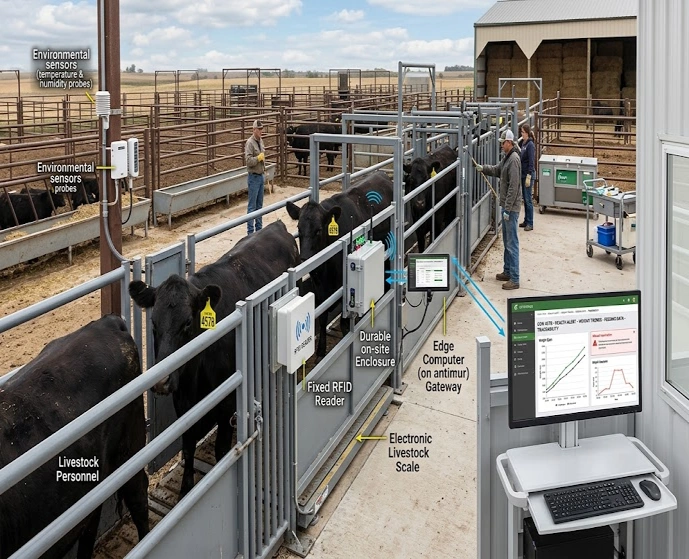
This photorealistic visual demonstrates a practical RFID and IoT sensor deployment within a cattle handling facility. It depicts cattle with tagged ears moving through a sorting chute equipped with fixed RFID readers, integrated scales, and environmental sensors. Real-time scanning events flow directly to an edge computer and management display, showcasing live individual records, weight trajectories, and automated health alerts for site personnel.
AI-Driven Livestock Management with Connected Animal Data
Artificial intelligence is transforming livestock management by turning animal identification, health records, movement data, feeding activity, breeding information, and farm operations into actionable decisions. AI-driven livestock systems can combine animal-level data with RFID identification, environmental sensors, cameras, weighing equipment, electronic identification systems, and farm management software. RFID provides reliable identity association for individual animals or groups, while AI analyzes historical and real-time observations to identify health risks, predict production outcomes, optimize feeding, support breeding decisions, and improve traceability. For cattle, dairy herds, swine, sheep, goats, and other managed livestock, this combination can reduce manual recordkeeping and strengthen the connection between physical animals and digital records. GAO supplies RFID and IoT hardware products and systems that can support livestock identification, data capture, tracking, and integration with software used by agricultural operations.
What AI-Powered Livestock Management Means
AI-powered livestock management applies machine learning, computer vision, predictive analytics, anomaly detection, and other Industrial AI techniques to livestock production and animal-care decisions. The objective is not simply to collect more farm data. The objective is to identify meaningful changes in animal condition, movement, productivity, resource consumption, and operational performance early enough for personnel to act.
RFID provides an identity layer that allows observations to be associated with a particular animal, pen, group, treatment event, or movement transaction. Depending on the operating environment, LF RFID, HF RFID, or UHF RFID can be selected according to read distance, tag form factor, animal-handling workflow, interference conditions, and identification requirements.
For example, a dairy operation can associate an animal’s RFID identity with milk-production records, feeding events, reproductive history, veterinary treatments, body-weight measurements, and activity observations. AI software can then analyze those combined data streams to detect deviations from an animal’s normal behavior or production pattern.
This distinction is important. RFID does not independently determine whether an animal is sick or predict its future productivity. It provides dependable identification and event capture. AI interprets that information alongside other data sources to generate predictions, classifications, alerts, and operational recommendations.
GAO’s RFID and IoT hardware can therefore serve as part of a larger livestock data workflow rather than functioning as an isolated identification system.
High-Value AI Applications Across Livestock Operations
Animal Health Monitoring and Early Risk Detection
Livestock health management is one of the strongest applications for AI because health deterioration can appear through multiple weak signals before a serious condition becomes obvious.
AI models can analyze:
- Changes in animal movement and activity
- Feeding and drinking behavior
- Body-weight changes
- Milk-production variation in dairy operations
- Temperature and environmental measurements
- Veterinary treatment history
- RFID-based movement events
- Pen or pasture location
- Video-derived posture and behavior indicators
- Historical health records
An anomaly-detection model can establish an expected behavioral or production profile and flag significant deviations. Personnel can then inspect the identified animal instead of relying exclusively on routine visual observation.
RFID is particularly valuable when an observation needs to be connected to an individual animal. An activity anomaly without reliable animal identity can be difficult to operationalize. An RFID-linked event can associate that anomaly with an animal record, allowing a worker or veterinarian to review previous treatments, breeding status, weight history, and other relevant information.
Livestock Traceability and Animal Identification
Animal traceability requires accurate relationships between an animal, its identification credential, location, ownership or production record, health events, and movements.
RFID-enabled identification can automate portions of this workflow by recording events at:
- Farm entry and exit points
- Livestock handling chutes
- Weighing stations
- Veterinary treatment areas
- Breeding facilities
- Sorting gates
- Loading and unloading areas
- Feed and production monitoring stations
- Quarantine areas
- Processing-related transfer points
AI can subsequently analyze movement histories and identify missing records, unusual transfers, inconsistent animal histories, or operational exceptions.
This creates a stronger digital chain of custody for livestock records. It can also support disease-control investigations by making it easier to reconstruct where an animal or group of animals was handled and when relevant events occurred.
Feeding Optimization and Feed Management
Feed represents a major operating cost in many livestock operations. AI can use animal identification, weight measurements, feeding records, production data, and environmental conditions to identify feeding patterns and potential inefficiencies.
A livestock feeding solution can associate RFID identities with:
- Individual or group feeding events
- Feed consumption measurements
- Body-weight readings
- Growth rates
- Milk-production levels
- Feed conversion indicators
- Feeding frequency
- Pen assignment
- Environmental conditions
AI models can then identify animals or groups whose consumption or growth differs significantly from expected patterns. Such analysis can help nutritionists and livestock managers investigate whether changes are related to health, feed availability, environmental stress, animal grouping, or other operational factors.
The value comes from connecting animal identity + operational event + historical context + AI analysis, rather than treating feeding data as an isolated measurement.
Breeding and Reproductive Management
AI can support breeding decisions by combining reproductive records with activity, movement, production, and historical animal data.
For dairy cattle and other managed breeding populations, the system can associate RFID identities with reproductive events such as:
- Heat or estrus observations
- Breeding dates
- Pregnancy checks
- Calving events
- Reproductive history
- Genetic information
- Lactation records
- Veterinary observations
Machine-learning models can identify patterns associated with reproductive readiness or abnormal reproductive intervals. RFID makes it possible to connect these observations to the correct animal record and reduce manual identification errors during handling.
AI should support rather than replace veterinary and animal-management judgment. Model outputs need to remain traceable to underlying observations so that livestock professionals can validate recommendations.
Livestock Weight Monitoring and Growth Prediction
Automated weighing combined with RFID can provide a practical foundation for animal growth analytics.
When an animal crosses an RFID-enabled weighing station, the system can associate its identification with:
- Current weight
- Previous weight
- Weight gain
- Age
- Breed
- Feed history
- Health events
- Location
- Production stage
AI models can estimate expected growth trajectories and identify animals that deviate from those trajectories. This can support sorting, nutrition management, treatment prioritization, breeding decisions, and market-readiness planning.
The engineering challenge is data quality. Scale readings must be correctly associated with the animal passing through the station, while duplicate reads, missed reads, tag orientation, animal congestion, and incorrect animal records must be handled before analytics are trusted.
Livestock Data Acquisition and Operational Workflow
A practical AI-enabled livestock system begins with reliable data acquisition at the point where animal activity occurs. RFID readers capture identification events while other devices provide measurements that RFID alone cannot produce.
A typical workflow can include:
- Animal identification: RFID ear tags or other livestock identification devices provide a machine-readable animal identity.
- Event capture: Fixed or handheld readers record animal movement through gates, chutes, weighing stations, treatment areas, and other controlled locations.
- Additional sensing: Scales, temperature sensors, environmental sensors, cameras, activity monitors, feeding systems, and production equipment generate complementary observations.
- Communication: Ethernet, Wi-Fi, cellular, BLE, or other suitable communication methods transport device data according to the farm’s physical environment and connectivity requirements.
- Edge processing: A local gateway or edge computer can filter duplicate RFID reads, validate device messages, buffer data during connectivity interruptions, and perform time-sensitive processing.
- Middleware: Integration software converts device-specific events into standardized records that can be consumed by livestock management applications.
- AI processing: Machine-learning and analytics services evaluate historical and real-time data for classification, prediction, anomaly detection, and prioritization.
- Operational decision: Alerts or recommendations are presented to farm managers, veterinarians, animal-health personnel, nutritionists, or other authorized users.
- Business action: Personnel inspect animals, adjust feeding, initiate treatment workflows, modify animal grouping, investigate traceability exceptions, or update operational records.
RFID, AI Hardware and Software for Livestock Systems
Livestock deployments require technology choices that match the physical handling environment rather than simply selecting the longest RFID read range. Animal movement, metal handling equipment, moisture, mud, tag orientation, reader placement, electrical availability, network coverage, and operational throughput all influence system performance.
RFID Technologies for Animal Identification
LF RFID can be appropriate for animal identification applications where close-range reading and established livestock identification practices are important. Low-frequency systems can perform well in controlled animal-handling workflows where the reader and tag pass relatively close to one another.
UHF RFID can provide longer read ranges and higher-throughput identification opportunities. It can be useful for gates, controlled movement points, inventory associated with livestock operations, and other situations where multiple tags or greater read distance are required. Read-zone engineering becomes particularly important because unwanted reads from nearby animals can affect data quality.
HF RFID operates at a shorter range and can be useful where close-proximity identification and data exchange are appropriate. Its use should be evaluated against the specific livestock workflow, tag construction, environmental conditions, and reader placement.
The correct RFID choice depends on the animal type, tag format, handling procedure, required read distance, expected throughput, interference environment, and data-capture objective.
Edge Computing and Connectivity
Livestock facilities may experience intermittent network connectivity, especially across large barns, remote pastures, feedlots, or geographically distributed agricultural sites. Edge processing can therefore be valuable for buffering RFID events, filtering duplicate reads, validating measurements, and maintaining local operation when the external network is unavailable.
A resilient system should avoid assuming that every RFID event must immediately reach a remote server. Local event buffering allows animal identification and operational processes to continue during temporary connectivity loss.
Communication options can include Ethernet for fixed equipment, Wi-Fi for connected facility devices, cellular connectivity for remote locations, and BLE for suitable short-range sensor links.
Cloud Version and Server Version
A Cloud Version can centralize livestock data from multiple farms, facilities, or production sites. It is appropriate when distributed teams require centralized dashboards, AI analytics, software updates, and consolidated traceability information without maintaining the application infrastructure locally.
A Server Version can run on edge servers, customer-managed servers, private data centers, or other privately hosted infrastructure. This model can be appropriate when a livestock organization requires greater control over data processing, local operation, network independence, integration with existing farm systems, or specific data-governance requirements.
Both models can use the same underlying device data and AI methods. The engineering decision should consider connectivity, data volume, latency, cybersecurity, operational continuity, integration requirements, IT capabilities, and the geographic distribution of livestock facilities.
AI Capabilities That Improve Livestock Operations
The operational value of AI becomes significant when livestock data is converted into decisions that personnel can act upon. RFID establishes dependable animal identity and event history, while AI can correlate those records with production, health, environmental, and behavioral observations.
Predictive Livestock Health Analytics
Predictive models can establish expected patterns for individual animals or groups and identify deviations that deserve inspection. For example, a sustained reduction in movement combined with lower feed consumption and abnormal environmental conditions may produce a higher-risk health alert than any individual signal would produce independently.
Useful AI methods include:
- Anomaly detection for unusual animal behavior or production patterns
- Classification models for health-risk categories
- Time-series analysis for weight, milk production, feed intake, or activity
- Predictive models for disease-risk assessment
- Risk scoring for prioritizing veterinary inspections
The system should retain the underlying observations supporting an alert. This makes it possible for veterinarians and livestock managers to distinguish genuine operational signals from sensor errors, temporary behavioral changes, or incomplete records.
Computer Vision for Livestock Behavior
Computer vision can complement RFID by observing characteristics that RFID cannot measure directly. Cameras can analyze posture, locomotion, animal density, feeding behavior, crowding, and movement patterns.
AI-based video analysis can help identify:
- Changes in gait or locomotion
- Prolonged inactivity
- Abnormal standing or lying behavior
- Feeding-area congestion
- Animal grouping changes
- Abnormal movement patterns
- Potential welfare concerns
- Changes in pen occupancy
RFID can provide the identity association when animals pass through a controlled identification zone, while computer vision provides visual observations across a larger area. Combining these sources can improve context, although animal-level video identification should be validated carefully before being used for automated decisions.
AI-Assisted Livestock Traceability
Traceability systems benefit from AI when large volumes of animal movement records need to be checked for inconsistencies.
AI can help detect:
- Missing movement events
- Duplicate identification events
- Unexpected animal transfers
- Inconsistent treatment histories
- Unusual location transitions
- Gaps in animal records
- Data-entry anomalies
- Potential chain-of-custody exceptions
The resulting system can prioritize records for investigation instead of requiring staff to manually examine every transaction.
Predictive Maintenance for Livestock Equipment
AI can also improve the reliability of the equipment supporting livestock operations. RFID readers, weighing systems, automated feeders, pumps, ventilation equipment, gates, motors, and other connected machinery can generate operational telemetry.
Predictive-maintenance models can examine:
- Motor operating patterns
- Equipment runtime
- Temperature and vibration
- Reader communication failures
- Scale measurement anomalies
- Repeated gate faults
- Feeding equipment interruptions
- Battery or power-related events
This allows maintenance teams to investigate emerging equipment problems before they disrupt animal handling or production workflows.
Livestock Deployment Engineering Considerations
Successful deployment depends more on data quality and workflow design than on RFID reader specifications alone. Livestock environments create several conditions that must be addressed during engineering and commissioning.
RFID Read-Zone Design
Reader placement should correspond to a clearly defined operational event. A reader at a livestock chute, for example, should capture the animal being weighed or treated rather than unrelated animals waiting nearby.
Engineers should evaluate:
- Reader and antenna positioning
- Tag orientation
- Required read distance
- Animal movement speed
- Multiple-animal reads
- Metal structures around handling equipment
- Water and environmental exposure
- Electromagnetic interference
- Reader power levels
- Read-zone containment
- Duplicate-event filtering
UHF RFID deployments require particular attention to unwanted reads because longer read ranges can cause tags outside the intended transaction zone to be detected.
Livestock Tag Durability
Animal identification devices must withstand the physical conditions of livestock operations. Tag selection should consider animal type, attachment method, expected service life, environmental exposure, handling practices, and regulatory identification requirements.
A technically strong RFID system can still fail operationally if tags detach frequently, become unreadable, or cannot be associated reliably with the correct animal record.
Data Quality and Identity Integrity
AI cannot compensate for incorrect animal identities. A reliable system should validate relationships between RFID identifiers and animal records before those records become inputs to predictive models.
Data validation can include:
- RFID identifier verification
- Duplicate animal-record detection
- Timestamp validation
- Reader-zone validation
- Weight plausibility checks
- Missing-event detection
- Animal-location consistency checks
- Synchronization between local and central databases
Identity integrity should be treated as a foundational requirement for AI-powered livestock analytics.
Edge and Network Resilience
Large ranches, feedlots, barns, and geographically distributed farms may have inconsistent connectivity. Local storage and edge processing can prevent temporary network failures from interrupting critical workflows.
A practical implementation can use store-and-forward processing:
RFID event → local validation → temporary edge storage → network synchronization → central database → AI analysis
Events should carry reliable timestamps and unique transaction identifiers so that synchronization does not create duplicate animal records.
Cybersecurity and Data Protection for Livestock Systems
Connected livestock systems can contain commercially sensitive information such as animal inventories, production data, breeding records, veterinary records, facility information, and operational performance.
Security controls should therefore be incorporated from the initial system design.
Important measures include:
- Role-based access for farm managers, veterinarians, nutritionists, technicians, and administrators
- Strong authentication for management applications
- Encryption of data during transmission
- Encryption of sensitive stored data where appropriate
- Network segmentation between operational devices and general business networks
- Secure device configuration
- Controlled remote administration
- Audit logging for animal-record modifications
- Regular firmware and software updates
- Backup and recovery procedures
- Monitoring for unauthorized device or account activity
AI systems introduce additional considerations. Model inputs should be validated, abnormal sensor data should not automatically be treated as animal behavior, and automated recommendations should have appropriate human review where animal health or welfare is involved.
GAO’s long-standing R&D investment in RFID, BLE, and IoT products is relevant to this type of deployment because hardware reliability, device configuration, integration, and technical support are critical parts of an operational livestock system.
Livestock Software Integration and Interoperability
RFID should not create another isolated database. Its greatest value comes from connecting identification events with the software already used to manage livestock operations.
Depending on the organization, integration targets may include:
- Livestock management software
- Herd management systems
- Dairy management systems
- Feed management software
- Veterinary information systems
- Farm ERP systems
- Inventory systems
- Laboratory information systems
- Breeding and genetics databases
- Production databases
- Business intelligence software
- Maintenance management systems
Application programming interfaces, database integration, message queues, file-based interfaces, or middleware can be used according to the existing IT environment.
A normalized event structure can include fields such as:
Animal ID | Timestamp | Reader ID | Location | Event Type | Measurement | Device ID | Confidence/Validation Status
This structure gives downstream applications a consistent representation of animal events even when different RFID readers, scales, cameras, and sensors are used across multiple facilities.
RFID Livestock Data Integration & AI Analytics Architecture
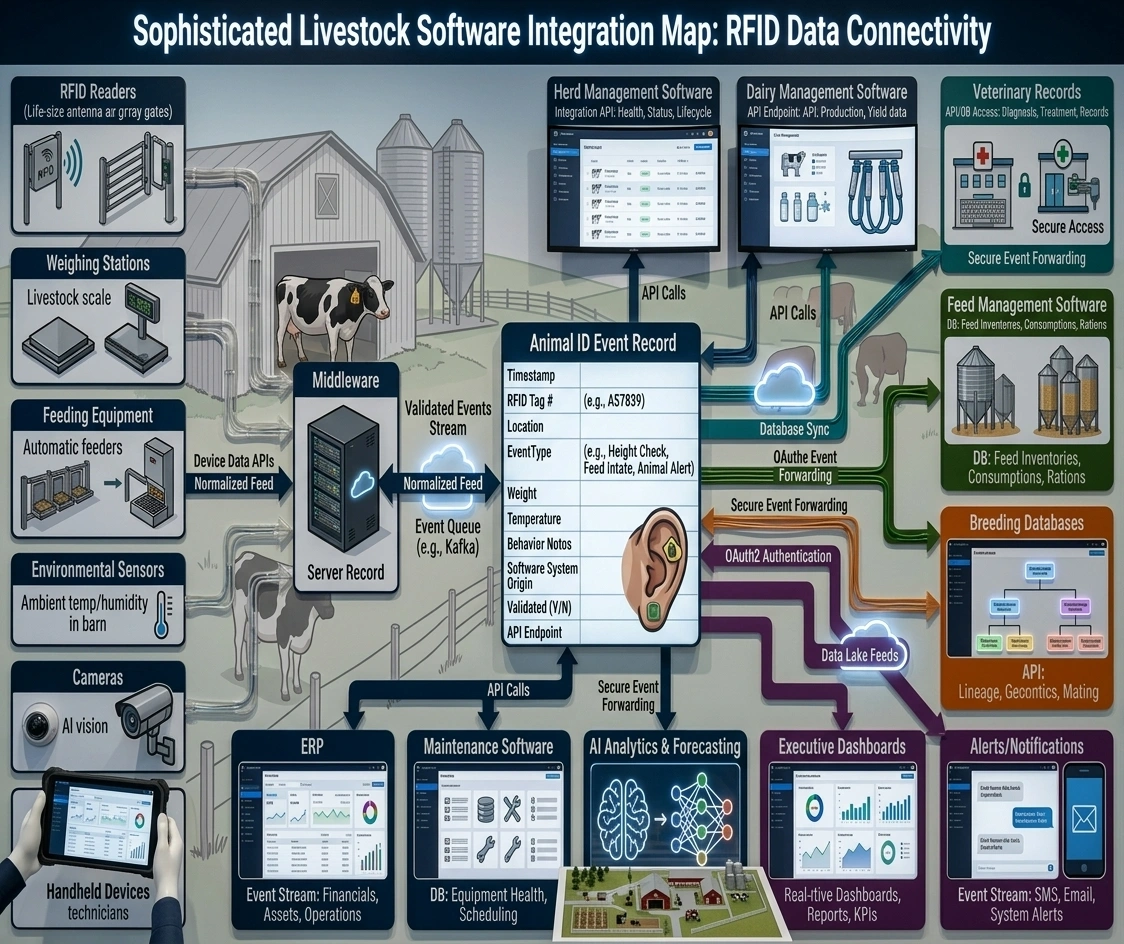
This integration diagram illustrates how real-time data captured from RFID ear tags, weighing scales, feeding equipment, and environmental sensors is processed through middleware into a central Animal ID Event Record. From this centralized data structure, secure API endpoints and event streams distribute normalized operational records to specialized management platforms, including herd management, veterinary databases, ERP systems, and AI analytics engines.
KPIs for AI-Powered Livestock Management
The effectiveness of an AI and RFID deployment should be evaluated using measurable operational indicators rather than technology adoption alone.
Relevant KPIs can include:
- RFID animal identification accuracy
- Missed-read rate
- Unwanted-read rate
- Animal record matching accuracy
- Average animal handling time
- Weight measurement frequency
- Average daily gain
- Feed conversion ratio
- Feed consumption variance
- Milk yield per animal
- Health-alert precision
- Time from anomaly detection to inspection
- Treatment response time
- Veterinary intervention rate
- Morbidity rate
- Mortality rate
- Reproductive performance
- Pregnancy rate
- Calving interval
- Breeding success rate
- Animal movement traceability completeness
- Traceability record error rate
- Equipment downtime
- Automated feeder availability
- RFID reader availability
- Network availability
- AI inference latency
- Alert acknowledgment time
- Cost per monitored animal
- Return on operational investment
The appropriate KPI set depends on the livestock production model. Dairy operations may emphasize milk yield, reproductive performance, somatic-cell-related indicators, feeding efficiency, and health interventions, while beef operations may emphasize average daily gain, feed conversion, animal movement, health events, and market readiness.
Implementation Strategy for Livestock AI and RFID
A phased implementation generally provides better engineering control than attempting to instrument every livestock workflow simultaneously.
Start with a Defined Operational Problem
The first step should be a measurable livestock problem, such as:
- Reducing manual animal identification
- Improving traceability
- Detecting health anomalies earlier
- Automating weight records
- Improving feeding decisions
- Reducing equipment downtime
- Improving reproductive monitoring
The selected problem determines what data must be collected and where RFID readers, sensors, cameras, and software integrations should be installed.
Conduct a Site and Workflow Assessment
Engineers should document animal flow from entry through handling, feeding, treatment, breeding, weighing, sorting, and exit.
The assessment should capture:
- Animal movement paths
- Existing identification methods
- Handling equipment
- Reader installation locations
- Power availability
- Network coverage
- Environmental conditions
- Existing software
- Data ownership
- Personnel responsibilities
- Current manual processes
- Existing failure points
Pilot Before Scaling
A controlled pilot can validate read performance, tag durability, animal-event association, network reliability, AI model behavior, and personnel workflows.
The pilot should establish baseline measurements before automation is introduced. This makes it possible to compare operational performance rather than simply confirming that the technology works.
Commission and Optimize
Commissioning should include physical installation verification, RFID read testing, device configuration, network testing, event validation, software integration testing, and user acceptance testing.
AI models require a separate validation process. Historical data should be examined for bias, missing observations, inconsistent identities, and environmental factors that could produce false alerts.
After commissioning, operational teams should monitor KPIs and progressively adjust reader placement, read-zone parameters, event filtering, model thresholds, and user alerts.
Practical Recommendations for Livestock Organizations
AI-powered livestock management should be engineered around animal workflows rather than around individual devices. RFID is most valuable when it provides reliable identity and event association for measurements and observations that AI can interpret.
Recommended practices include:
- Define the livestock decision that the system must improve before selecting hardware.
- Match LF, HF, or UHF RFID to the actual animal-handling workflow.
- Validate RFID read zones under real livestock movement conditions.
- Select tags based on animal type, attachment method, environmental exposure, and expected service life.
- Combine RFID with weighing, environmental sensing, computer vision, production data, or other relevant observations when the use case requires additional context.
- Use edge processing where connectivity interruptions could affect livestock operations.
- Integrate identification events with existing livestock management and veterinary software.
- Validate animal identity before feeding records, health observations, or AI outputs are associated with an animal.
- Establish baseline KPIs before deployment.
- Keep veterinarians and livestock professionals involved in validating health-related AI recommendations.
- Apply cybersecurity controls to RFID readers, edge devices, databases, software accounts, and remote access.
- Pilot the system in one clearly defined livestock workflow before expanding across facilities.
- Establish procedures for tag replacement, reader maintenance, software updates, data backup, and system recovery.
Building More Intelligent Livestock Operations
AI-powered livestock management becomes most effective when animal identification, operational observations, and decision-support analytics are designed as one connected workflow. RFID provides a practical mechanism for associating physical livestock events with individual animal records, while AI can transform those records into health-risk alerts, growth predictions, feeding insights, traceability analysis, and maintenance priorities.
The engineering focus should remain on reliable data capture, identity integrity, appropriate RFID selection, resilient connectivity, software integration, cybersecurity, and measurable livestock KPIs.
GAO provides RFID, BLE, and IoT hardware products and systems that can support organizations implementing these connected workflows. With experience serving organizations across the United States and Canada, GAO combines product development with remote and onsite technical support. Organizations evaluating AI-enabled livestock identification, traceability, monitoring, or automation can explore GAO’s technology solutions and technical assistance to determine an appropriate deployment approach.
Building the Future of Industrial AI and IoT with Aperture Venture Studio and GAO RFID Inc.
For more than three decades, GAO Group of Companies has invested heavily in R&D for industrial RFID, BLE, and IoT. As AI became increasingly useful for industrial applications, we expanded our work across AI and connected technologies and founded Aperture Venture Studio to advance AI and IoT solutions relevant to areas such as intelligent livestock management, traceability, and connected agricultural operations.
Aperture has attracted AI and IoT technical experts, entrepreneurial and operational executives, investors, and leading companies. Our Aperture Ventures Summit and TekSummit further support discussion of advanced AI and IoT technologies.