
AI and RFID for LNG Facilities
LNG facilities operate complex, safety-critical processes involving cryogenic equipment, liquefaction systems, storage tanks, loading infrastructure, pipelines, valves, instruments, maintenance materials, and mobile assets. AI can turn operational data from these environments into actionable insights for asset tracking, inventory control, maintenance, inspection, workforce coordination, and process visibility. RFID provides a practical identification and location-data layer for equipment and materials, with UHF, HF, and LF RFID selected according to operating conditions and read requirements. AI-enabled RFID solutions can connect identification events with computerized maintenance management systems (CMMS), enterprise resource planning (ERP), laboratory information systems, distributed control systems (DCS), supervisory control and data acquisition (SCADA) environments, and other LNG facility software. The resulting AIoT approach helps LNG operators establish more reliable asset histories, identify anomalies, improve material availability, reduce search time, and support safer maintenance and logistics operations without relying exclusively on manual records.
How AI Improves LNG Facility Asset and Operations Management
AI for LNG facilities combines machine learning, industrial analytics, computer vision where appropriate, edge processing, connected sensors, and identification technologies to improve decisions around physical equipment and operational workflows. RFID acts as an enabling data-capture technology by associating physical objects with digital identities as they move through receiving areas, warehouses, maintenance shops, process areas, compressor stations, tank farms, loading facilities, and controlled access points.
The most valuable applications are generally not based on RFID alone. An LNG operator gains greater value when identification events are correlated with maintenance history, inspection records, work orders, equipment criticality, operating conditions, inventory levels, personnel workflows, and other operational data.
AI can analyze these combined data streams to identify patterns that are difficult to detect through manual review. For example, an LNG maintenance organization can use asset movement and work-order history to identify repeatedly delayed equipment returns, unusual maintenance cycles, missing components, or inventory consumption patterns that may affect planned turnarounds.
Relevant applications include:
- AI asset tracking for LNG process equipment, maintenance tools, portable instruments, cylinders, spare parts, and mobile service equipment
- AI inventory management for cryogenic valves, gaskets, seals, fittings, instrumentation components, electrical materials, and critical maintenance spares
- AI maintenance support using asset identity, service history, inspection records, work orders, and equipment movement data
- AI-powered material traceability from procurement and receiving through storage, kitting, maintenance use, and final reconciliation
- AI-assisted turnaround planning using historical material consumption, asset availability, work-order dependencies, and equipment movement
- AI anomaly detection for unusual asset movements, missing equipment, abnormal inventory consumption, and process deviations
- AI-enabled inspection workflows that associate inspection observations with uniquely identified equipment
- AI logistics management for materials moving between warehouses, maintenance shops, process units, jetties, truck-loading areas, and other LNG operating zones
GAO supplies RFID and related IoT hardware products and systems that can provide the physical identification layer required for these workflows. The appropriate implementation depends on the LNG facility’s equipment materials, operating zones, hazardous-area requirements, read distances, environmental exposure, and integration requirements.
AIoT-Enabled RFID Architecture for Intelligent LNG Facility Management
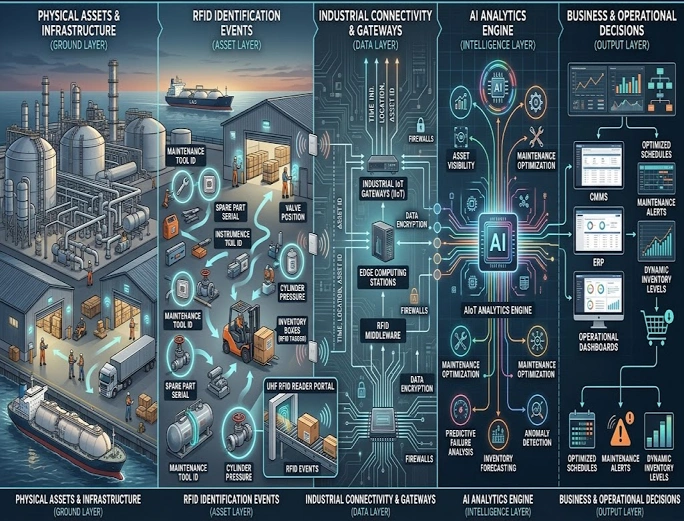
LNG Facility Workflows Where AI and RFID Deliver the Most Value
Asset Tracking Across LNG Process Areas
LNG facilities contain thousands of identifiable physical items whose location and status can affect maintenance productivity and operational readiness. These can include portable gas detectors, calibration equipment, torque tools, lifting accessories, inspection instruments, replacement valves, actuators, electrical components, control equipment, and specialized maintenance tools.
RFID identification can establish automated checkpoints as assets enter or leave warehouses, maintenance workshops, tool rooms, controlled storage areas, and designated process zones. AI can then analyze movement histories instead of treating every RFID event as an isolated transaction.
A useful implementation distinguishes between asset identity and operational state. An RFID read can establish that an item was detected at a particular location, while the CMMS or maintenance system determines whether that item is awaiting inspection, assigned to a work order, under repair, calibrated, available for service, or retired.
This distinction is important for LNG operations because a physical location alone does not necessarily indicate equipment readiness.
AI Inventory Management for LNG Spare Parts
LNG maintenance organizations must maintain availability of critical spares while controlling inventory carrying costs. Stockouts can delay maintenance activities, while excessive inventory can tie up capital and create storage, preservation, and obsolescence problems.
RFID can automate identification of tagged materials during receiving, put-away, picking, kitting, issue, return, and periodic reconciliation. AI can combine these events with historical consumption, planned maintenance, equipment criticality, lead times, procurement records, and turnaround schedules.
This creates opportunities for more accurate demand forecasting. An AI model can identify that a particular class of valve actuator, gasket, instrument component, or electrical spare is likely to experience increased demand before a scheduled maintenance campaign. The result is not simply a more automated inventory count. It is a decision-support process connecting material availability with actual LNG maintenance requirements.
Maintenance and Inspection Traceability
Maintenance and inspection activities require reliable association between physical equipment and digital records. An LNG facility may need to maintain information about inspection intervals, service history, calibration, repairs, replacement components, and work-order completion.
RFID can provide the physical identity needed to associate equipment with these records. AI can analyze the resulting historical information for patterns such as repeated maintenance interventions, unusually long equipment turnaround times, recurring component replacement, or discrepancies between planned and actual work.
For example, an RFID-tagged portable instrument can be associated with calibration records and maintenance status. A reader event at a maintenance facility can provide an additional operational signal that the instrument has returned for service. AI can use these events alongside CMMS records to identify workflow delays or recurring maintenance patterns.
LNG Turnaround and Shutdown Support
Planned shutdowns and turnarounds place exceptional demands on LNG maintenance organizations. Large quantities of tools, components, consumables, inspection equipment, contractors’ equipment, and replacement parts may move through temporary staging areas.
AI can analyze historical turnaround data to estimate material requirements and identify bottlenecks. RFID can provide near-real-time visibility into whether required equipment or material has reached the appropriate staging area.
A practical system can associate RFID events with work packages, equipment IDs, storage locations, and maintenance tasks. This makes it easier for supervisors to determine whether a work package is materially ready rather than relying exclusively on manual confirmation.
From RFID Events to AI-Driven LNG Decisions
A technically effective LNG solution should treat RFID events as operational data rather than as the final output. The complete workflow normally includes physical identification, data capture, communications, event processing, enterprise integration, AI analysis, and operational action.
Data Acquisition at the LNG Facility
The process begins when a tagged asset or material is detected. UHF RFID is generally useful where longer read ranges and rapid identification of multiple tagged objects are required, such as warehouse receiving, material staging, maintenance logistics, and selected controlled-area checkpoints.
HF RFID can be useful for short-range, deliberate identification workflows where close coupling between the reader and tagged object is desirable. LF RFID can be considered for specialized identification requirements where its characteristics are better suited to the physical environment or application.
RFID selection must account for metal surfaces, liquids, equipment geometry, tag mounting, required read distance, temperature exposure, vibration, chemical exposure, and the possibility of interference or multipath effects around industrial structures.
Edge Processing and Event Management
Raw RFID reads can contain duplicate detections, transient reads, and events that do not represent a meaningful business transaction. Middleware or edge software should therefore filter and normalize data before sending events to higher-level applications.
A typical processing sequence may include:
- Reader detects a tag associated with an LNG asset or material
- Edge software receives the RFID event
- Duplicate or low-confidence reads are filtered
- Reader location and timestamp are associated with the event
- The RFID identifier is mapped to the corresponding asset or material record
- Business rules determine whether the event represents movement, receipt, issue, return, or another operational state
- Relevant information is transmitted to enterprise software
- AI models evaluate the event together with historical and contextual data
- A maintenance, inventory, logistics, or supervisory action is generated
The processing location should be selected according to latency, connectivity, cybersecurity, data sovereignty, and operational resilience requirements.
Enterprise Software Integration
LNG operators commonly use multiple systems to manage maintenance, procurement, inventory, process operations, engineering information, safety, inspection, and workforce activities. RFID should not create a disconnected information repository.
Integration can connect identification events with:
- CMMS and enterprise asset management systems
- ERP and procurement systems
- Warehouse management software
- Maintenance planning and scheduling software
- Inspection and integrity management systems
- DCS and SCADA environments where integration is technically and operationally appropriate
- Digital work-order systems
- Contractor and tool management systems
- Operational data historians
- AI analytics and reporting applications
API-based integration, message brokers, industrial gateways, database interfaces, or other controlled integration methods can be used depending on the existing LNG software environment.
AI Analytics and Operational Decisions
AI models become useful when the system has enough reliable historical and contextual data to establish meaningful patterns. Possible techniques include supervised machine learning, anomaly detection, time-series analysis, forecasting, classification, optimization, and natural-language interfaces for authorized operational information.
AI should support rather than bypass established LNG safety procedures. A model identifying an unusual asset movement, for example, should generate a review or workflow notification rather than independently initiating a hazardous operational action.
RFID Hardware and AI Infrastructure for LNG Facilities
A successful LNG deployment requires more than selecting an RFID tag and reader. Hardware, software, communications, environmental conditions, installation practices, cybersecurity, and integration must be evaluated as one operational solution.
UHF RFID for LNG Material and Asset Visibility
UHF RFID is often appropriate for applications requiring longer-range identification and rapid reading of multiple tagged items. Warehouse operations, receiving, maintenance material staging, tool management, and controlled movement checkpoints are potential applications.
Tag selection is particularly important around LNG equipment because metal, liquid-containing objects, pipes, vessels, and dense equipment layouts can change RF performance. Industrial-grade tags designed for metal mounting may be necessary for tools and metallic equipment.
HF and LF RFID for Specialized Identification
HF RFID can support close-range identification applications where controlled presentation of the tagged object to the reader is acceptable. This can be useful for specific maintenance, authentication, document association, or controlled equipment workflows.
LF RFID operates at lower frequencies and may be appropriate for specialized identification scenarios where its propagation characteristics and read behavior align with the application. The decision should be based on actual site requirements rather than selecting one RFID frequency for every LNG workflow.
RFID Readers, Antennas, Gateways, and Industrial Networking
Reader placement should be established through an engineering site survey. LNG facilities contain pipe racks, steel structures, process vessels, electrical equipment, barriers, and other physical conditions that can affect radio-frequency performance.
Readers can connect to industrial Ethernet or other approved communication infrastructure. Edge gateways can aggregate events from multiple readers and provide protocol conversion, local processing, buffering, and controlled communication with higher-level systems.
Equipment installed in regulated or hazardous areas requires careful assessment of applicable electrical and hazardous-location requirements. Standard commercial RFID equipment should not automatically be assumed suitable for classified areas.
Cloud Version and Server Version for LNG Operations
A cloud-hosted SaaS deployment can provide centralized software management, analytics, reporting, and multi-site visibility when facility connectivity and organizational cybersecurity policies permit external hosting. It can be particularly useful for organizations managing multiple LNG locations and seeking centralized analytics.
A Server Version places application software on customer-managed edge servers, private data centers, facility servers, or other privately hosted infrastructure. This approach can be preferable where operational data must remain within controlled infrastructure, connectivity to external cloud services is constrained, or site-level resilience and integration requirements favor local processing.
A hybrid deployment can also be appropriate. RFID event processing and critical operational functions can run locally while selected analytics, historical reporting, or cross-site benchmarking services operate in a controlled cloud environment.
The appropriate model depends on cybersecurity requirements, network availability, latency, data governance, integration constraints, maintenance responsibilities, and the LNG operator’s existing IT and OT policies.
RFID-Enabled Asset Tracking Hardware for LNG Operations
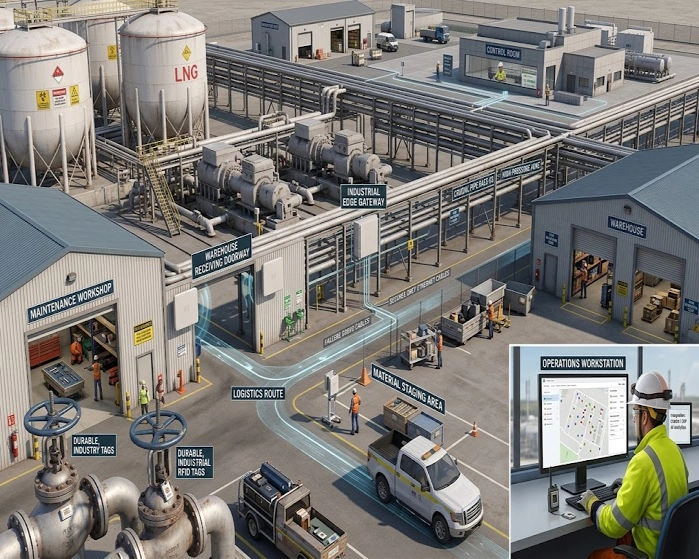
Engineering Design Considerations for LNG RFID Deployments
LNG facilities present environmental and operational conditions that require RFID deployments to be engineered around the physical site rather than treated as standard warehouse installations. Cryogenic equipment, metallic process infrastructure, dense pipe racks, insulated vessels, electrical equipment, moving vehicles, and restricted operating zones can all influence identification reliability.
A site survey should evaluate:
- Required read zones and expected tag presentation
- Equipment construction materials and metallic mounting surfaces
- Presence of liquids, cryogenic insulation, piping, and vessels
- Reader-to-reader interference and antenna orientation
- Required identification accuracy and acceptable false-read rates
- Reader mounting locations and cable routing
- Network availability and industrial communication paths
- Electrical power availability and backup requirements
- Environmental exposure including temperature, moisture, vibration, dust, and chemicals
- Hazardous-area classification and applicable equipment certification requirements
- Physical security and protection against accidental equipment damage
- Maintenance access for readers, antennas, gateways, and associated infrastructure
RFID performance should be validated using representative tags and actual LNG-facility materials. Laboratory testing with a generic tag may not accurately predict performance after the tag is attached to a stainless-steel valve, instrument enclosure, pipe component, or liquid-containing container.
GAO can provide RFID hardware products and systems that support asset identification, inventory visibility, and industrial tracking workflows. Actual deployment specifications should be selected following site assessment and application testing.
Tag Selection for Cryogenic and Industrial Assets
Tag durability is particularly important when RFID is applied to LNG equipment. The tag must remain physically attached and readable throughout the expected service life of the tagged object.
Selection criteria can include:
- Operating and storage temperature range
- Resistance to moisture and condensation
- Resistance to hydrocarbons and cleaning chemicals where applicable
- Mechanical impact and vibration resistance
- Metal-mount performance
- Attachment method and surface compatibility
- Required read distance
- Expected tag lifetime
- Encapsulation requirements
- Regulatory or hazardous-area constraints
- Maintenance and replacement procedures
Cryogenic exposure deserves specific attention. A tag that performs acceptably at normal ambient temperature should not automatically be assumed to maintain its required mechanical and RF characteristics during repeated exposure to very low temperatures.
Read Accuracy and Event Quality
A high reader count does not necessarily produce better operational visibility. Poorly controlled read zones can create excessive duplicate events or detect assets outside the intended checkpoint.
Engineering teams should establish measurable performance criteria such as:
- Tag detection probability
- False-read rate
- Duplicate-event rate
- Location confidence
- Event latency
- Reader availability
- Data synchronization reliability
- Battery or power-system availability where applicable
Event filtering should be configured according to the operational meaning of the checkpoint. A warehouse doorway may require different logic from a maintenance-tool cabinet or controlled material staging area.
AI Applications for LNG Maintenance, Inventory, and Safety Support
AI becomes particularly valuable when LNG operators have accumulated sufficient historical data to establish relationships between equipment, materials, maintenance activities, and operational events.
Predictive Maintenance Support
Predictive maintenance models can combine equipment condition data, maintenance history, inspection information, operating measurements, and asset identity. RFID contributes reliable identification and movement information rather than acting as the predictive model itself.
For example, AI can analyze repeated maintenance events associated with a particular equipment class and compare them with inspection findings, service intervals, spare-part consumption, and operational conditions.
Potential outputs include:
- Maintenance priority recommendations
- Identification of abnormal maintenance frequency
- Spare-part demand forecasts
- Work-order delay detection
- Equipment service-history analysis
- Maintenance backlog risk indicators
- Identification of recurring component failures
These recommendations should remain subject to engineering review and established maintenance procedures, especially for safety-critical LNG equipment.
AI-Powered Inventory Forecasting
Inventory forecasting can use historical RFID transactions together with ERP purchasing records, work orders, turnaround schedules, supplier lead times, equipment criticality, and consumption patterns.
An AI model could identify that consumption of a particular category of gasket, valve component, instrument, or electrical spare is increasing faster than expected. Procurement personnel can then investigate whether the change reflects a genuine maintenance requirement, a temporary project, inaccurate inventory records, or another operational condition.
This approach improves decision quality because AI is interpreting physical inventory events within their LNG maintenance context.
AI-Based Anomaly Detection
Anomaly detection can identify unusual patterns that deserve investigation.
Examples include:
- An asset appearing repeatedly in unexpected locations
- A maintenance tool remaining outside its assigned area for an unusual duration
- Unexpected consumption of critical spare parts
- A tagged asset appearing simultaneously in conflicting locations
- Abnormally long material staging times
- Repeated discrepancies between physical and digital inventory
- Unexpected movement of controlled equipment
- Work orders showing material availability but no corresponding physical movement
The system should distinguish between an anomaly and an automatically confirmed incident. Human review remains important because legitimate LNG activities can produce unusual movement patterns during shutdowns, emergency maintenance, commissioning, and construction.
Cybersecurity and OT Integration for LNG RFID Systems
Connecting physical identification systems to LNG operational networks introduces cybersecurity considerations. RFID readers, gateways, middleware, application servers, APIs, databases, and analytics systems should be included within the organization’s security assessment.
A practical security design can include:
- Network segmentation between IT and OT environments
- Role-based access controls
- Strong authentication for administrative interfaces
- Encrypted communications where supported and appropriate
- Controlled API access
- Security logging and audit trails
- Firmware and software update procedures
- Asset inventory for RFID infrastructure
- Backup and recovery procedures
- Vulnerability management
- Controlled remote access
- Configuration management
- Monitoring for unauthorized system changes
RFID systems should not be connected directly to safety-critical control functions without appropriate engineering, cybersecurity, functional-safety, and change-management review.
A well-designed implementation normally keeps identification and analytics functions logically separated from direct process control. The AI system can recommend an action while authorized personnel and established control systems retain responsibility for safety-critical decisions.
Standards, Regulations, and Compliance Considerations for LNG Facilities
RFID and AI deployments in LNG facilities must be evaluated within the regulatory environment applicable to the facility’s location, process configuration, hazardous areas, and operating activities. Requirements can differ between jurisdictions and between facility types.
Relevant areas of consideration include:
- U.S. Occupational Safety and Health Administration requirements where applicable
- U.S. Pipeline and Hazardous Materials Safety Administration requirements for applicable LNG facilities
- U.S. Coast Guard requirements for applicable marine LNG operations
- National Fire Protection Association standards relevant to LNG facilities
- International Electrotechnical Commission standards relevant to hazardous locations and electrical equipment
- IEC 60079 series requirements for explosive atmospheres where applicable
- API standards and recommended practices relevant to LNG and process equipment
- ASME standards applicable to pressure equipment and piping
- ISA standards relevant to industrial automation and cybersecurity
- NIST cybersecurity guidance where adopted by the organization
- Canadian federal and provincial requirements for Canadian LNG facilities
- Local electrical, fire, building, environmental, and occupational safety requirements
Compliance should be determined by the facility’s engineering, safety, regulatory, and legal teams. RFID hardware intended for general industrial use should not be installed in classified hazardous locations unless its certification and installation method satisfy the applicable requirements.
Implementing AI and RFID in an LNG Facility
A phased deployment generally reduces technical and operational risk. The objective should be to prove measurable value in a controlled workflow before expanding identification coverage across the facility.
Planning and Use-Case Selection
Begin with a specific operational problem rather than a technology-first deployment.
Suitable initial use cases can include:
- Maintenance-tool tracking
- Critical spare-part inventory
- Warehouse receiving and issuing
- Material staging for turnarounds
- Portable instrument management
- Inspection-equipment traceability
- Controlled movement of maintenance assets
The business case should define measurable baseline performance before hardware is installed.
Site Survey and RFID Testing
The next phase should evaluate physical conditions, reader placement, tag performance, network connectivity, power, hazardous-area requirements, and operational workflows.
Representative testing should include the actual asset materials and containers expected in production. Metallic valves, instrument cases, maintenance tools, drums, bins, and other representative objects should be tested using candidate RFID tags.
A pilot should measure detection reliability rather than simply confirming that a tag can be read.
Integration and Commissioning
Once RFID performance has been validated, the system can be integrated with relevant enterprise software.
Commissioning should verify:
- RFID reader configuration
- Antenna coverage
- Tag-to-asset database mapping
- Event filtering
- Location mapping
- Middleware rules
- API or database integration
- User permissions
- Dashboard accuracy
- Alarm and notification behavior
- Network resilience
- Backup and recovery procedures
- Cybersecurity controls
User acceptance testing should be performed with warehouse personnel, maintenance planners, technicians, inventory personnel, reliability engineers, and other affected users.
Optimization and Scale-Up
After commissioning, operational data should be reviewed to identify false reads, missed reads, workflow exceptions, integration failures, and user adoption issues.
AI models should also be evaluated continuously. Model accuracy can decline when maintenance practices, equipment populations, supplier behavior, or operational schedules change.
Scaling should therefore follow validated workflows rather than simply increasing reader or tag counts.
Measuring AI and RFID Performance in LNG Facilities
A deployment should be evaluated using operational KPIs rather than the number of RFID tags or readers installed.
Useful measurements include:
| KPI | LNG Facility Application | Measurement Objective |
|---|---|---|
| Asset location accuracy | Maintenance tools and mobile equipment | Determine confidence in physical asset location |
| Inventory accuracy | Critical spares and maintenance materials | Compare digital records with physical stock |
| Material search time | Maintenance and turnaround activities | Measure time required to locate required items |
| Stockout frequency | Critical maintenance components | Identify material availability problems |
| Work-order material readiness | Planned maintenance | Determine whether required materials are available |
| Tool utilization | Maintenance equipment | Measure idle, active, and unavailable periods |
| Asset return time | Shared maintenance assets | Identify delayed returns |
| RFID read reliability | Checkpoints and storage areas | Measure identification performance |
| Event processing latency | RFID-to-application workflows | Measure data delivery speed |
| Inventory reconciliation effort | Warehouses and maintenance stores | Quantify manual work reduction |
| Maintenance delay caused by missing materials | Turnarounds and routine maintenance | Quantify operational impact |
| Anomaly detection precision | Asset and inventory monitoring | Evaluate usefulness of AI alerts |
The most useful KPI framework connects technical performance to operational outcomes. A high RFID read rate has limited value if maintenance personnel still spend excessive time searching for equipment or if inventory records remain inaccurate.
Practical Engineering Recommendations for LNG Operators
LNG operators considering AI-enabled RFID should prioritize data quality, physical deployment conditions, and operational integration.
Recommended practices include:
- Start with a clearly defined LNG workflow and measurable operational problem
- Select RFID frequency according to the physical use case rather than applying one frequency universally
- Test tags on actual LNG equipment and materials
- Perform site surveys before finalizing reader and antenna locations
- Evaluate hazardous-area requirements before equipment procurement
- Separate RFID event capture from safety-critical process control
- Filter raw RFID reads before creating business transactions
- Establish a controlled asset master linking RFID identifiers to equipment and material records
- Integrate with CMMS, ERP, warehouse, inspection, and maintenance systems where operationally justified
- Use edge processing where local resilience or low latency is important
- Select cloud-hosted or privately hosted server deployment according to cybersecurity and operational requirements
- Establish data ownership, retention, access-control, and audit requirements
- Validate AI recommendations against engineering and maintenance expertise
- Establish baseline KPIs before deployment
- Conduct pilot testing before facility-wide expansion
- Revalidate AI models when workflows, equipment populations, or operating conditions change
- Maintain RFID infrastructure as part of the facility’s broader technology asset-management program
GAO Support for LNG RFID and AIoT Solutions
GAO provides RFID, BLE, and related IoT hardware products and systems that can support industrial asset identification, tracking, inventory, and connected operational workflows. Our role can include supplying appropriate RFID tags, readers, antennas, gateways, and associated hardware for organizations developing LNG facility tracking and traceability solutions.
Headquartered in New York City and Toronto, Canada, GAO is ranked among the top 10 leading B2B and B2G suppliers of BLE and RFID technologies globally, with additional B2B2C and B2D activities. GAO and its sister companies, GAO Research and GAO Tek, form GAO Group, with operations based in New York City and Toronto.
For three decades, GAO Group has served organizations across the United States and Canada, including Fortune 500 companies, leading research and development organizations, universities, and U.S. and Canadian government agencies. The group’s substantial investment in research and development, stringent quality assurance processes, and remote and onsite technical support provide a foundation for organizations evaluating industrial RFID and IoT deployments.
For LNG operators, the practical objective is not simply to deploy identification hardware. The objective is to establish dependable physical data that can improve material traceability, maintenance visibility, asset accountability, inventory accuracy, and AI-supported operational decisions.
Key Takeaways for AI-Enabled LNG Facility Operations
AI-enabled RFID can provide LNG operators with a practical way to connect physical equipment and material movements with maintenance, inventory, inspection, and operational information. The greatest value comes from combining dependable identification data with contextual information from CMMS, ERP, warehouse management, inspection, and operational systems.
RFID frequency selection, tag engineering, reader placement, event filtering, cybersecurity, hazardous-area compliance, and software integration should be treated as interconnected engineering decisions. AI should then be applied to validated operational data for forecasting, anomaly detection, maintenance analysis, and decision support.
A phased deployment with representative testing, measurable KPIs, controlled integration, cybersecurity validation, and continuous optimization can provide a more reliable path to scale. GAO’s RFID and IoT hardware products and technical capabilities can support organizations evaluating these requirements.
Building the Future of Industrial AI and IoT with Aperture Venture Studio and GAO RFID Inc.
For more than three decades, GAO Group of Companies has invested heavily in R&D of industrial RFID, BLE, and IoT. As AI has become increasingly useful for industrial applications, we have advanced AI and IoT technologies that combine RFID and BLE with connected operational systems. We have also founded Aperture Venture Studio to advance AI and IoT solutions relevant to applications such as LNG facility asset tracking, inventory visibility, maintenance intelligence, and industrial operations.
Aperture has attracted AI and IoT technical experts, entrepreneurial and operational executives, influential investors, and leading companies. We have also developed Aperture Ventures Summit and TekSummit to discuss advanced AI and IoT topics.
We welcome you to join us as:
- Advisors, Co-founders, or Employees
- Investors
- Customers