
AI and RFID for Aerospace Precision Machining
What AI-Driven Aerospace Precision Machining Traceability Means
Aerospace Precision Machining involves the controlled manufacture of high-value components with demanding requirements for dimensional accuracy, material integrity, process repeatability, documentation, and configuration control. Typical parts include turbine-engine components, structural fittings, actuator components, landing-system parts, housings, brackets, precision shafts, and complex machined assemblies.
An AIoT solution for this environment combines artificial intelligence with connected equipment, sensors, RFID data capture, machine data, inspection data, and manufacturing software. The objective is not simply to know where an item is located.
These capabilities must remain subject to approved manufacturing procedures and human review. AI recommendations should not autonomously override controlled process parameters, inspection requirements, engineering changes, or authorized work instructions without appropriate validation and governance.
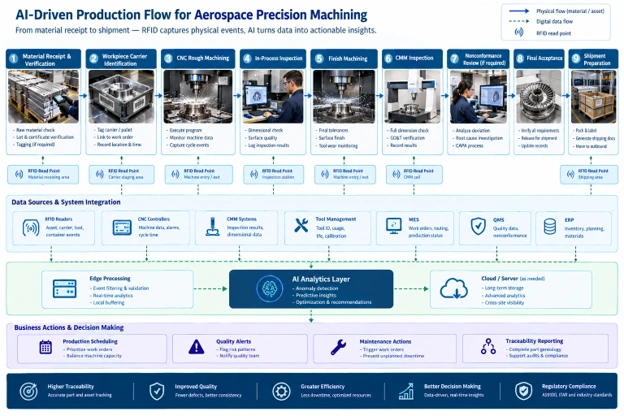
AI-Driven Production Workflow for Aerospace Precision Machining
Aerospace Precision Machining Applications and Deployment Scenarios
The most valuable AI applications begin with a specific machining problem rather than with the technology itself. Aerospace suppliers should identify high-cost traceability gaps, recurring delays, quality risks, or asset-control issues and then determine where AI, RFID, machine connectivity, and analytics provide measurable improvement.
AI Work-in-Process Tracking and Routing Control
Complex aerospace components may move between rough machining, stress relief or other approved processes, finish machining, deburring, inspection, cleaning, and subsequent operations. Depending on the manufacturing environment, reusable carriers, trays, pallets, containers, and selected fixtures can provide identification points for RFID-based movement capture.
AI can analyze movement history against the approved routing, operation completion status, queue time, due dates, machine availability, inspection capacity, and material and configuration status. This helps production control teams identify work that is physically present but digitally unresolved, work waiting beyond expected thresholds, or components approaching schedule risk.
A critical engineering principle is to distinguish asset identification from aerospace part identification. Directly tagging a finished aerospace component may be inappropriate unless explicitly permitted by the relevant engineering, material, environmental, customer, and certification requirements. Reusable carriers or process containers are often more practical identification targets.
AI Tool Management and Cutting Tool Traceability
Tooling errors can be expensive in precision machining. A complex tool assembly may involve a holder, cutter body, insert or cutting edge, extensions, balancing requirements, offsets, and approved usage conditions.
AI-supported tool management can analyze tool consumption, machining history, breakage events, spindle loads, cycle times, and inspection outcomes to improve decisions about tool replacement and inventory. RFID can support identification of selected reusable toolholders, tool assemblies, presetting assets, and tool-storage locations where the physical and environmental conditions support reliable reading.
- Locating approved tool assemblies before a scheduled job.
- Associating reusable tool assemblies with machining history.
- Detecting unexpected movement of controlled tooling from designated areas.
- Improving tool crib inventory accuracy.
- Supporting calibration and maintenance status checks for selected reusable tooling assets.
- Comparing actual tool consumption with historical expectations.
- Identifying unusual tool-life behavior for engineering review.
RFID should not be treated as a substitute for tool presetting, offset verification, approved tooling records, or operator checks. Reliable aerospace machining still depends on validated procedures and controlled data.
AI Quality Intelligence and Part Genealogy
Aerospace Precision Machining generates evidence across multiple stages. AI quality systems can use controlled historical data to identify relationships among process conditions and quality outcomes.
Relevant data may include material heat or lot information; work order and serialized part records; CNC program and approved revision information; machine identification; tool and fixture records; operation timestamps; operator or authorized personnel records where appropriate; in-process inspection results; CMM dimensional results; surface-finish measurements; nonconformance records; corrective-action data; and environmental or special-process records when relevant.
AI can support anomaly detection, risk scoring, classification of recurring defect patterns, and prioritization of investigations. Human quality and engineering teams remain responsible for disposition decisions and compliance with approved quality procedures.
For traceability, RFID-generated events can establish additional evidence that a controlled carrier, fixture, container, or selected asset passed a designated point. Event timestamps should be synchronized with authoritative systems rather than creating competing records.
AI Predictive Maintenance for CNC Machining Assets
High-value machining centers often represent capacity constraints. Unplanned downtime can disrupt downstream inspection, tooling schedules, and delivery commitments.
AI maintenance models may evaluate spindle vibration, temperature trends, motor current, servo behavior, alarm history, lubrication-system conditions, cycle counts, load profiles, and historical maintenance records.
Machine condition monitoring can identify deviations that warrant inspection before failure becomes disruptive. The AI output should normally produce a maintenance recommendation, risk score, or work-order trigger rather than automatically taking uncontrolled action on critical equipment.
GAO has helped organizations build connected identification and IoT solutions by supplying hardware products and systems that support the capture of physical operational events. For aerospace machining deployments, hardware selection should follow a site survey, read-range validation, electromagnetic-interference assessment, and integration plan rather than relying solely on nominal reader specifications.
Operational Challenges AI and RFID Address in Aerospace Precision Machining
Aerospace machining environments have constraints that make generic asset-tracking projects insufficient. Metal-rich work areas, coolant exposure, complex machine layouts, controlled documentation, high-value workpieces, and rigorous traceability requirements all affect system design.
Metal, Coolant, and Read Reliability
UHF RFID behavior can be affected by metal surfaces, liquids, tag orientation, polarization, reader placement, antenna gain, and reflections. Aerospace machining cells can contain machine enclosures, steel fixtures, coolant systems, chip conveyors, carts, and densely packed metallic assets.
Reliable deployment requires testing the actual tag, reader, antenna, mounting method, orientation, and read zone under production conditions. A design that performs well in a demonstration may produce missed or unintended reads on a live shop floor.
HF RFID can be useful where shorter read distances and controlled proximity are advantageous. LF RFID may suit specific close-range identification requirements where its operating characteristics are appropriate. Technology selection should therefore follow the application rather than a blanket preference for one RFID frequency.
Maintaining the Digital Thread Across Multiple Systems
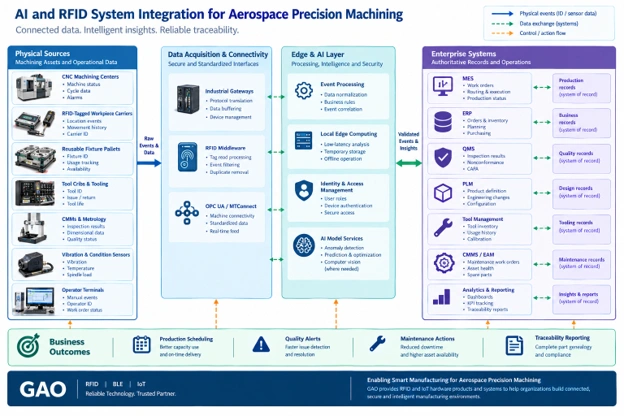
Aerospace Precision Machining data may be distributed among ERP systems for orders, inventory, purchasing, and planning; MES software for work execution and routing; QMS software for inspection and nonconformance management; PLM and engineering systems for controlled product definitions; CNC and DNC systems for machining program control; tool-management software; CMMS or EAM software for maintenance; CMM and metrology software; and industrial data historians.
AI becomes more useful when data relationships are well defined. A serialized part, work order, operation, machine, program revision, fixture, tool assembly, and inspection result should have consistent identifiers or carefully managed mappings.
Creating a separate database without authoritative-system integration can create conflicting records. A better approach identifies the system of record for each data type and uses middleware or controlled interfaces to exchange relevant events.
AI and RFID System Integration for Aerospace Precision Machining
Avoiding Poor AI Inputs
AI cannot compensate for unreliable master data, uncontrolled timestamps, duplicate asset IDs, incomplete inspection records, or inconsistent process-state definitions.
- Clear identifiers for parts, carriers, fixtures, tools, and machines.
- Defined event semantics such as received, queued, started, paused, completed, inspected, rejected, and released.
- Time synchronization across readers, gateways, machines, and software.
- Data-quality rules for missing, duplicate, or impossible events.
- Revision-control relationships for manufacturing instructions and approved programs.
- Retention and access rules appropriate to customer, contractual, and regulatory requirements.
This foundational work is often more important than selecting a complex AI model.
Complete AIoT Workflow for Aerospace Precision Machining
A robust solution connects physical production activity with controlled data and business action. The following lifecycle illustrates how AIoT can operate in an aerospace machining environment.
Data Acquisition and Physical Event Capture
The workflow begins with relevant production data rather than collecting every possible signal. Data sources may include RFID readers, CNC controllers, CMMs, barcode systems, vibration sensors, machine alarms, tool-management records, MES transactions, and quality results.
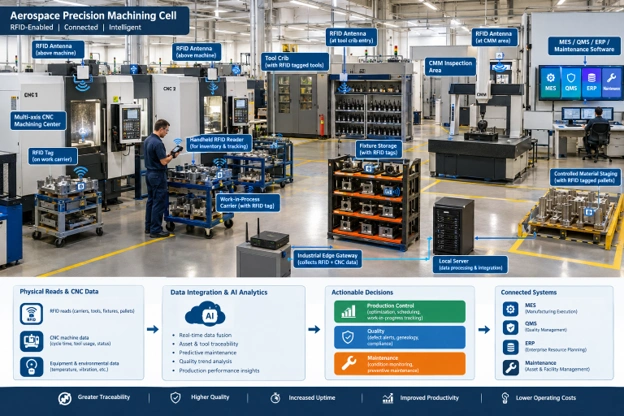
RFID events should be generated only where a read adds operational value. Typical controlled read locations may include tool crib issue and return points; work-in-process transfer areas; designated machining-cell entry points; fixture storage areas; controlled calibration or maintenance locations; and material and reusable-container staging areas.
Each event can contain an asset or carrier ID, timestamp, reader location, event type, and confidence or validation information where supported.
Communication and Edge Processing
Industrial gateways can collect machine and sensor data through protocols such as OPC UA, MTConnect, Modbus TCP, Ethernet/IP, PROFINET, or vendor-supported interfaces, depending on equipment and integration requirements.
Edge processing can perform event filtering, duplicate suppression, local validation, temporary buffering during connectivity loss, protocol translation, initial anomaly detection, and low-latency inference.
A machining facility with strict latency, connectivity, or data-governance requirements may retain more processing on privately managed servers or edge systems.
AI Analysis and Decision Support
Cleaned events and authorized production data are analyzed using models selected for specific tasks. Examples include time-series models for spindle or vibration trend analysis; anomaly-detection models for unusual cycle behavior; classification models for recurring quality patterns; regression models for cycle-time or tool-consumption forecasting; optimization algorithms for work sequencing; computer vision models for permitted visual inspection applications; and retrieval-augmented AI systems for searching approved procedures and maintenance knowledge, with appropriate access controls.
Model outputs should include sufficient context for review. A useful alert should identify the affected asset or job, the reason for the alert, the supporting signals, confidence or risk information where applicable, and the recommended next action.
Integration, Action, and Continuous Improvement
Validated AI results can trigger controlled actions such as creating a maintenance review request; flagging a work order for production-control review; prioritizing an inspection queue; alerting quality engineering to an emerging pattern; identifying a missing traceability event; recommending additional verification before the next operation; and updating a dashboard with schedule-risk information.
Closed-loop learning should use approved outcomes. For example, if an anomaly was investigated and found to be harmless, the resolution can help improve future model evaluation. If it led to a verified machine or quality issue, that outcome can support retraining under controlled model-management procedures.
This workflow creates the foundation for a practical AI-supported machining system: physical identification and operational data are captured, validated, contextualized, analyzed, and converted into actions that support production, quality, maintenance, and traceability decisions.
Technical Components for AI-Enabled Aerospace Precision Machining
A practical solution for Aerospace Precision Machining requires coordinated selection of identification hardware, machine connectivity, industrial computing, software interfaces, AI models, and cybersecurity controls. The objective is to capture trustworthy production events without interfering with CNC operations, inspection procedures, or controlled manufacturing processes.
RFID Hardware for Machining Operations
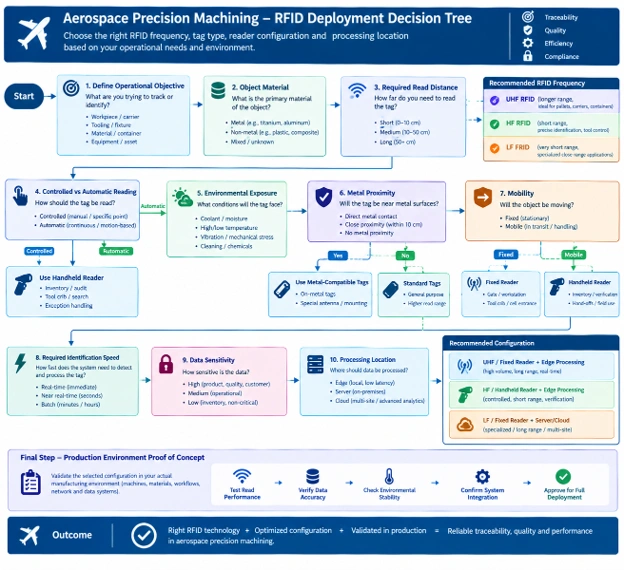
RFID hardware should be selected according to the physical object, read distance, material composition, environmental exposure, and required identification reliability.
- UHF RFID: Appropriate for selected work-in-process carriers, tooling assets, fixture pallets, containers, and controlled movement points where longer read ranges are useful. Metal-compatible tags and carefully positioned antennas are particularly important around CNC equipment.
- HF RFID: Useful for shorter-range identification where controlled proximity between the reader and tagged object is desirable, such as specific tool-control or workstation transactions.
- LF RFID: Can be considered for specialized close-range identification applications where its propagation characteristics and operating environment match the requirement.
- Fixed RFID readers: Suitable for defined transfer points, tool-control stations, and production-cell entrances.
- Handheld RFID readers: Useful for inventory verification, tool-room searches, exception handling, and physical reconciliation.
- Industrial antennas: Antenna orientation, polarization, mounting distance, shielding, and read-zone geometry should be validated with the actual metallic fixtures and equipment.
- Industrial RFID tags: Aerospace machining applications may require ruggedized or metal-mount tags capable of tolerating coolant, temperature variation, vibration, cleaning processes, and mechanical handling.
GAO supplies RFID and IoT hardware products and systems that can be evaluated for these types of manufacturing applications. A production deployment should still undergo an application-specific proof of concept before hardware quantities are finalized.
Industrial Connectivity and Communication
Machine and sensor connectivity provides the operational context that makes identification events useful. Depending on the installed equipment, communication can involve OPC UA, MTConnect, industrial Ethernet, Modbus TCP, Ethernet/IP, PROFINET, REST APIs, MQTT, or vendor-specific interfaces.
The integration layer should normalize events from different equipment without altering authoritative manufacturing records. For example, an RFID read indicating that a workpiece carrier entered a machining area becomes significantly more valuable when correlated with the MES work order, CNC machine state, operation number, and expected routing.
Industrial gateways can also buffer events during temporary network interruptions. This prevents every brief connectivity failure from becoming a traceability gap.
Edge Computing and AI Models
Edge computing is particularly useful when Aerospace Precision Machining requires low-latency analysis, local processing, or reduced transmission of sensitive production information.
Edge systems can perform RFID event filtering and deduplication; machine-data normalization; local anomaly detection; short-term data buffering; initial AI inference; protocol conversion; and secure forwarding to private servers or approved cloud services.
AI models should be selected according to the machining problem. Time-series models are suitable for equipment-condition signals, while classification and anomaly-detection techniques can help identify unusual production behavior. Optimization methods can assist scheduling and tool utilization. Computer vision can support specific inspection or process-monitoring tasks where validated imaging conditions are available.
Model governance is essential. Training data, model versions, thresholds, validation results, and deployment changes should be controlled so that production personnel can determine which model produced a particular recommendation.
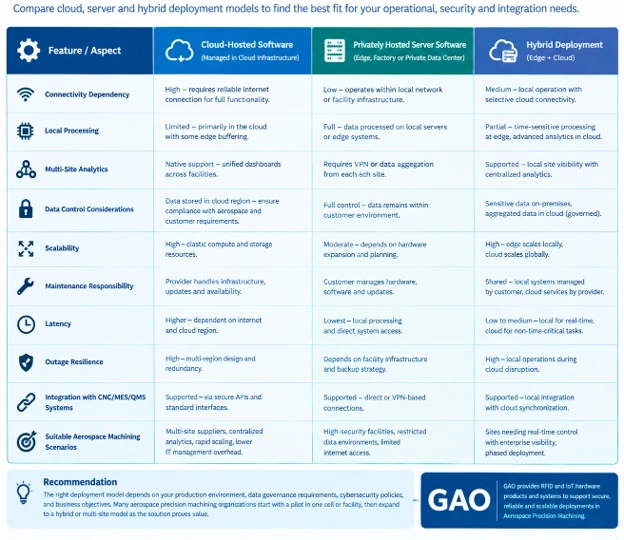
Cloud Version and Server Version
A Cloud Version places the application software and associated analytics services in managed cloud infrastructure. This approach can be useful when multiple machining facilities need consolidated dashboards, centralized analytics, cross-site benchmarking, or scalable computing resources. Connectivity requirements, data residency, customer contractual restrictions, and cybersecurity policies should be evaluated before transmitting aerospace production data outside the facility.
A Server Version deploys software on customer-managed edge servers, factory servers, private data centers, or other privately hosted infrastructure. This model can be preferable when production data must remain within controlled facilities, when network connectivity is limited, or when local processing is required for operational continuity.
A hybrid arrangement can place time-sensitive event processing near CNC cells while sending selected, governed data to centralized analytics. This can provide local resilience without preventing broader production analysis.
AI and RFID Deployment Options for Aerospace Precision Machining
Cybersecurity and Access Control
Connected machining systems increase the number of interfaces that require protection. Security should therefore be designed into the system rather than added after installation.
- Network segmentation between production equipment, business systems, and external services.
- Role-based access control for operators, maintenance personnel, engineers, quality staff, and administrators.
- Multifactor authentication for appropriate administrative and remote-access functions.
- Encryption for data transmitted between authorized systems.
- Secure credential and certificate management.
- Application and operating-system patch management.
- Audit logging for configuration and administrative activities.
- Controlled remote support access.
- Backup and recovery procedures.
- Monitoring for unusual network or application behavior.
Aerospace manufacturers should align cybersecurity practices with their contractual obligations and applicable requirements. Depending on the organization and program, relevant frameworks and standards may include NIST guidance, ISO/IEC 27001, NIST SP 800-171, CMMC requirements where applicable, and customer-specific cybersecurity clauses.
Engineering Design Considerations for Aerospace Precision Machining
AI-driven traceability succeeds when the physical process and digital model agree. Several engineering decisions deserve attention before commissioning.
Tag Placement and Read-Zone Engineering
Metal surfaces can detune ordinary RFID tags and produce unpredictable performance. The mounting surface should therefore be considered part of the RFID design.
For a workpiece carrier, the engineering team should test the proposed tag position under empty and loaded conditions; different carrier orientations; normal operator handling; machine-cell proximity; coolant and contamination conditions; maximum expected reader density; and nearby tagged assets.
Read zones should be intentionally constrained. A reader that detects every nearby tool cart may produce more data but less reliable traceability.
Identity and Data Modeling
Each tracked object needs a stable identity. A useful data model may associate a carrier ID with a serialized work order, operation number, machine, fixture, tool assembly, timestamps, and inspection state without treating those relationships as permanent.
This distinction matters because a reusable fixture may support hundreds of jobs, while a serialized workpiece normally has a much narrower production history. The software should preserve these relationships as time-bounded events rather than embedding incorrect permanent associations.
Integration Testing Before Production Release
Commissioning should include controlled testing against expected production scenarios.
- Verify RFID read performance at every designated read point.
- Confirm duplicate-read filtering.
- Test network-loss buffering.
- Verify timestamp synchronization.
- Confirm MES transaction behavior.
- Test invalid or unexpected routing events.
- Validate machine-data mappings.
- Verify QMS and inspection-result associations.
- Confirm user permissions.
- Test alarm escalation.
- Verify backup and recovery.
- Document failure modes and manual fallback procedures.
A pilot should ideally cover representative CNC machines, workpiece carriers, tooling, operators, and production routes rather than testing only a laboratory configuration.
RFID Deployment Decision Tree for Aerospace Precision Machining
AI and RFID Capabilities for Aerospace Machining Performance
The combination of AI with connected identification creates value when physical events can be interpreted alongside machining and quality data.
Improved Part and Process Traceability
RFID-generated events can reduce manual location updates for selected assets and carriers. AI can then interpret those events against expected routing and production schedules.
The resulting system can identify unusual dwell times, missing transitions, unexpected movement, or incomplete transactions. Production control personnel can investigate exceptions before they become larger scheduling or documentation problems.
Better Tool and Fixture Utilization
Tool and fixture availability can constrain aerospace machining schedules. AI can analyze historical consumption and current job requirements to identify likely shortages or scheduling conflicts.
RFID-supported identification makes it easier to determine whether a reusable toolholder, fixture, or carrier is physically available and where it was last observed. This reduces time spent searching for assets and improves confidence in digital inventory records.
Faster Quality Investigation
A quality investigation often requires reconstruction of what happened during production. A connected record can reduce the effort needed to correlate a part with its manufacturing route, machine, tooling, inspection results, and relevant material information.
AI can help quality engineers identify similar historical cases and prioritize potentially related records. It should assist investigation rather than replace formal nonconformance disposition.
Predictive Production and Maintenance
Production and maintenance teams often compete for the same machine capacity. AI can combine machine condition, cycle history, maintenance records, and scheduled work to identify equipment likely to require attention.
A more mature implementation can connect maintenance risk with production scheduling. If a CNC machining center shows increasing condition risk while carrying several high-priority jobs, production control can evaluate alternative capacity before an unexpected outage occurs.
Scalable Multi-Cell Deployment
A well-designed solution can begin with one machining cell or one traceability problem and expand after operational performance is validated.
- Additional CNC cells.
- Tool crib operations.
- Fixture management.
- CMM and inspection areas.
- Work-in-process staging.
- Maintenance assets.
- Multiple manufacturing facilities.
Standardized event definitions, device-management practices, security controls, and integration interfaces make expansion more manageable.
RFID-Enabled Aerospace Precision Machining Cell: Connected Smart Manufacturing
KPIs for AI-Enabled Aerospace Precision Machining
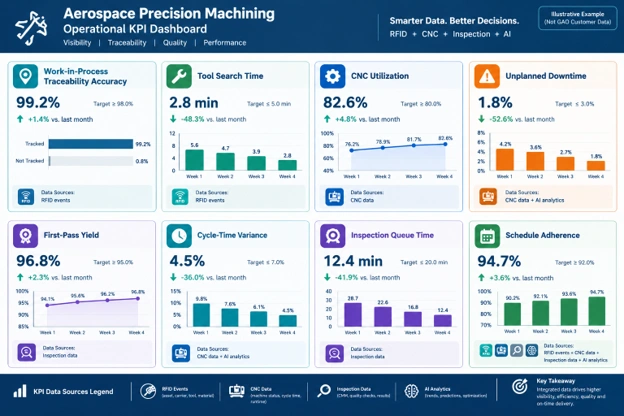
Technology adoption should be measured against production and quality outcomes rather than RFID read counts or AI model complexity alone.
| KPI | What It Measures | AI/RFID Contribution |
|---|---|---|
| Work-in-process location accuracy | Agreement between physical and digital status | RFID events reduce manual location uncertainty |
| Traceability transaction completeness | Percentage of required events successfully captured | Automated identification reduces missed manual transactions |
| Tool search time | Time required to locate required tooling | RFID improves physical asset visibility |
| Fixture search time | Time required to locate reusable fixtures | RFID-supported identification improves availability information |
| CNC utilization | Productive use of available machine capacity | AI identifies downtime and scheduling patterns |
| Unplanned downtime | Production time lost to unexpected equipment events | Predictive analytics can identify emerging conditions |
| First-pass yield | Parts accepted without rework | AI can identify process patterns associated with quality risk |
| Cycle-time variance | Difference between expected and actual machining duration | AI detects unusual cycle behavior |
| Inspection queue time | Time parts wait for required inspection | AI can support inspection prioritization |
| Schedule adherence | Completion against planned production timing | AI correlates routing, capacity, and queue conditions |
| Tool-life prediction accuracy | Agreement between predicted and actual tool behavior | Machine-learning models improve replacement decisions |
| Nonconformance recurrence | Repetition of known defect patterns | AI supports pattern discovery and investigation |
Aerospace Precision Machining KPI Dashboard: RFID, CNC, Inspection and AI Metrics
Implementation Recommendations for Aerospace Precision Machining
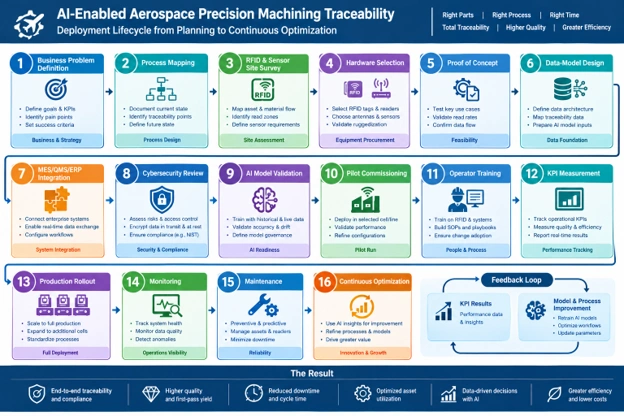
Successful deployment normally starts with a narrowly defined operational problem and expands after the physical and digital workflow has been validated.
Start With a Measurable Machining Problem
Potential starting points include excessive tool-search time, unreliable work-in-process visibility, fixture availability problems, recurring machine downtime, or lengthy quality investigations. The baseline should be documented before installation. Without a baseline, organizations may find it difficult to demonstrate whether the solution actually improved machining performance.
Validate Hardware in the Production Environment
RFID performance should be tested using the actual tags, machine enclosures, fixtures, carriers, coolant conditions, and operator workflows. Laboratory demonstrations cannot fully reproduce a metal-dense CNC environment.
Integrate With Existing Systems
Avoid creating a parallel production database that operators must maintain manually. MES, QMS, ERP, PLM, tool-management, and maintenance systems should remain authoritative for their designated records. Middleware should translate physical events into useful business transactions without obscuring the original event history.
Govern AI Before Automating Decisions
AI recommendations should be tested against historical and live production data before being connected to operational workflows. Define acceptable false-positive and false-negative rates according to the business consequence of each use case. A tool-life recommendation and an aerospace quality disposition do not carry the same risk and should not receive the same level of automation.
Design for Failure
A production system must continue operating when a reader, network connection, edge computer, server, or integration endpoint becomes unavailable. Manual fallback procedures, local buffering, retry logic, health monitoring, backup processes, and clear exception handling should be included in the commissioning plan.
AI-Enabled Aerospace Precision Machining Traceability Deployment Lifecycle
GAO Expertise in RFID and AIoT Solutions for Aerospace Precision Machining
GAO’s experience in RFID, BLE, and IoT hardware products and systems provides a foundation for organizations evaluating connected identification and industrial data-capture requirements. Headquartered in New York City and Toronto, Canada, GAO is ranked among the top 10 leading B2B and B2G suppliers of BLE and RFID technologies worldwide.
GAO, together with its sister companies GAO Research and GAO Tek, forms the GAO Group, with operations based in New York City and Toronto. For three decades, the companies have served organizations across the United States and Canada, including Fortune 500 companies, leading research and development organizations, universities, and government agencies.
For Aerospace Precision Machining, the practical focus is hardware and system suitability. RFID readers, antennas, tags, gateways, and related IoT equipment must be matched to the physical machining environment and integrated with the customer’s existing software and operating procedures. GAO has invested substantially in research and development and maintains stringent quality-assurance processes, while providing technical support remotely or onsite.
Key Takeaways for AI and RFID in Aerospace Precision Machining
AI-driven Aerospace Precision Machining is most effective when it connects machine, quality, tooling, work-in-process, and production-control data to specific operational decisions. RFID can provide reliable physical identification at carefully selected points, while AI adds interpretation, prediction, anomaly detection, and optimization.
The strongest deployments do not attempt to digitize every object or automate every decision. They establish authoritative identities, validate physical read performance, integrate with existing manufacturing systems, protect production data, and measure results using machining and quality KPIs.
GAO can help organizations evaluate RFID, BLE, and IoT hardware products and systems for these requirements, including application-specific deployment considerations and technical support. Readers evaluating an aerospace machining project can learn more about GAO’s technology capabilities, product options, and engineering support when developing a practical implementation plan.
Building the Future of Industrial AI and IoT with Aperture Venture Studio and GAO
For more than three decades, GAO Group of Companies has invested heavily in research and development involving industrial RFID, BLE, IoT, and connected technologies. As generative AI becomes increasingly useful for industrial applications, we continue developing practical AI and IoT solutions that connect machine data, RFID, BLE, and other operational signals. We have founded Aperture Venture Studio to advance and scale practical AI and IoT solutions for applications such as Aerospace Precision Machining, industrial traceability, asset management, and intelligent operations. Aperture brings together technical experts, operational leaders, investors, and industry participants to accelerate useful industrial innovation. We also convene Aperture Ventures Summit and TekSummit to exchange knowledge on advanced AI and IoT topics. We welcome advisors, technical collaborators, employees, investors, and customers to join us in advancing these technologies.