
AI and RFID for Offshore Platforms
AI-Enabled Offshore Platform Operations with RFID
AI-enabled offshore platform operations use connected identification, sensing, operational data, and intelligent analytics to improve how offshore operators track assets, manage materials, support maintenance, monitor workflows, and make operational decisions. RFID provides machine-readable identification for equipment, tools, spare parts, consumables, containers, and other tagged assets, while AI converts continuously collected operational data into predictions, anomaly detection, prioritization, and workflow recommendations.
For offshore platforms, this combination is particularly valuable because personnel, equipment, materials, and maintenance activities operate across geographically distributed decks, hazardous areas, workshops, laydown zones, warehouses, pipe racks, living quarters, and supply interfaces. UHF, HF, and LF RFID can be selected according to read distance, asset characteristics, environmental conditions, and deployment location. AI can then correlate RFID events with maintenance management, inventory, logistics, safety, and production data. GAO supplies RFID, BLE, and IoT hardware products and systems that can support these connected offshore workflows, with deployment designs adapted to the physical and operational constraints of offshore facilities.
RFID-Enabled AIoT Architecture for Offshore Oil & Gas Asset Management
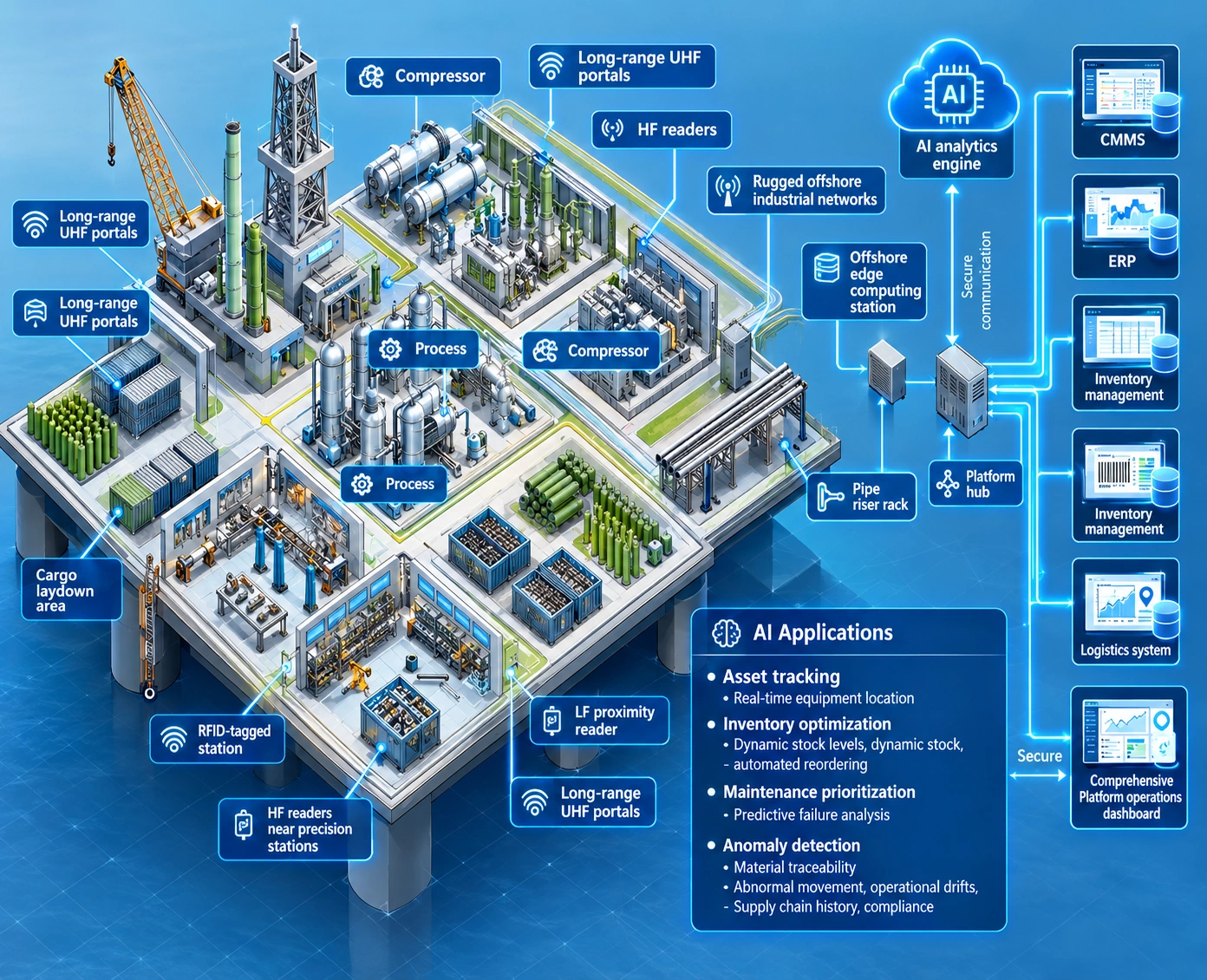
A detailed engineering blueprint and isometric visualization of an offshore oil and gas production platform integrated with RFID asset tracking. The diagram illustrates data collection across key operational zones—including drilling, process modules, compressor areas, workshops, and laydown yards—and maps event streams directly to edge devices, enterprise management systems (CMMS, ERP, Logistics), and an AI analytics engine.
What AI-Enabled RFID Means for Offshore Platforms
Artificial Intelligence of Things, commonly called AIoT or AI and IoT, combines artificial intelligence with IoT devices, sensors, connected equipment, and industrial systems. For offshore platforms, AIoT can combine RFID event data with information from computerized maintenance management systems, enterprise resource planning systems, industrial control systems, condition-monitoring sensors, access systems, logistics records, and operational databases.
RFID itself does not make an operational decision. Its primary role is to establish reliable identification and location-related events for tagged objects. AI adds interpretation and decision support by identifying patterns across those events and other operational data sources.
A typical offshore maintenance scenario illustrates the distinction. An RFID reader can detect that a tagged torque wrench has entered a maintenance area. Middleware can associate the tool identity with its asset record and timestamp. An AI application can compare that event with planned maintenance activities, technician work orders, tool availability, inspection status, and historical usage. The resulting system may identify that a required tool is unavailable, incorrectly located, overdue for inspection, or likely to create a maintenance delay.
This approach changes RFID from an isolated identification technology into an operational data source for offshore decision support.
Why Offshore Platforms Need Intelligent Asset and Material Visibility
Offshore facilities have several characteristics that make reliable asset visibility difficult:
- Equipment and materials are distributed across multiple decks, modules, workshops, storage areas, and temporary work locations.
- Maintenance teams frequently move tools, components, consumables, and temporary equipment between work sites.
- Offshore logistics depend on supply vessels, helicopters, shore bases, containers, manifests, and tightly coordinated material movements.
- Corrosive saltwater exposure, vibration, temperature variation, metallic structures, and electromagnetic interference can affect identification and communications equipment.
- Safety-critical maintenance depends on correct parts, calibrated tools, documented inspections, and controlled work procedures.
- Unplanned equipment movement can create search time, inventory discrepancies, work-order delays, and unnecessary material transfers.
- Limited offshore storage capacity increases the importance of accurate inventory records and replenishment planning.
- Offshore personnel rotations make consistent workflow execution and asset accountability particularly important.
AI can help transform these operational observations into actionable information. Instead of simply showing that an asset was detected, an AI-enabled system can evaluate whether its movement is expected, whether the asset is available for a scheduled task, and whether its current status conflicts with maintenance or inventory records.
Core Offshore Platform Applications for AI and RFID
AI Asset Tracking for Offshore Equipment and Tools
Asset tracking is one of the strongest applications for RFID-enabled AI on offshore platforms. Tags can identify tools, lifting accessories, test instruments, maintenance equipment, portable equipment, containers, and selected high-value components.
UHF RFID is generally useful when longer read ranges and rapid identification of multiple tagged assets are required. Fixed readers can be installed at controlled transition points such as workshop entrances, warehouse doors, material handling areas, or selected deck access locations. Handheld RFID readers can supplement fixed infrastructure when technicians need to locate or verify individual assets.
AI can analyze asset movement histories and determine expected versus unusual movement patterns. For example, if a tool assigned to one maintenance team repeatedly appears in another work area, the system can identify the pattern and support investigation before the shortage affects a scheduled job.
AI Inventory Management for Offshore Spare Parts
Offshore spare-parts management involves balancing availability against limited storage capacity and the cost of transporting materials offshore. Critical spares can include pumps, valves, actuators, instrumentation components, electrical equipment, mechanical seals, bearings, filters, fasteners, and other maintenance materials.
RFID can associate physical items with inventory records as they enter storage, move to a maintenance staging area, or are issued to a work order. AI can analyze consumption rates, maintenance schedules, equipment criticality, historical demand, and logistics lead times.
This supports applications such as:
- Predicting potential spare-parts shortages before scheduled maintenance.
- Identifying slow-moving or misplaced inventory.
- Correlating material consumption with maintenance activities.
- Prioritizing replenishment for safety-critical or production-critical equipment.
- Detecting discrepancies between physical inventory and digital records.
- Improving shore-base-to-offshore replenishment planning.
GAO can provide RFID hardware and supporting systems that help organizations establish the physical data-capture layer required for these inventory workflows.
AI-Assisted Maintenance and MRO Traceability
Maintenance, repair, and overhaul activities generate large volumes of information. A single work order may involve technicians, tools, replacement components, inspection records, permits, calibration certificates, and maintenance procedures.
RFID can establish physical associations between an asset, component, tool, and maintenance location. AI can then correlate those events with maintenance records and operational data.
For example, an AI application could identify that a component removed from a compressor system has entered a maintenance workshop, associate the component with its equipment hierarchy and work order, and compare the activity with historical maintenance patterns. AI-based anomaly detection could identify unusual replacement frequency or repeated maintenance activity associated with a particular equipment class.
The engineering value comes from connecting physical events with existing maintenance information rather than attempting to replace established maintenance management processes.
AI-Driven Material Traceability and Offshore Logistics
Offshore material movement can involve shore warehouses, staging yards, supply vessels, cargo baskets, containers, cranes, laydown areas, and platform storage locations. RFID can create timestamped identification events at selected transfer points.
AI can use those events to identify material-flow patterns and exceptions. A system may flag a shipment that has not reached its expected offshore destination, identify material remaining in a laydown area beyond an expected period, or detect repeated delays between logistics stages.
Traceability can also support controlled handling of critical components. A digital record can associate the item’s identifier with purchase information, inspection status, storage location, work-order assignment, and movement history.
Offshore Platform Operational Workflows Supported by AI
AI and RFID applications should be mapped to actual offshore workflows rather than deployed as isolated tracking projects. The highest-value deployments normally begin with processes where missing information directly affects maintenance execution, material availability, safety controls, or logistics performance.
Maintenance Tool Control
A maintenance tool-control workflow can begin when a tool is registered and RFID-tagged. Readers at selected workshop or storage transition points capture movement events, while technicians can use handheld readers for inventory verification.
The resulting data can be associated with:
- Tool identity and asset number.
- Tool category and specification.
- Calibration or inspection status.
- Assigned department or maintenance team.
- Current and previous locations.
- Related work orders.
- Check-out and return events.
- Maintenance and inspection history.
AI can use this information to identify unusual movement, recurring shortages, abnormal utilization, or potential conflicts between tool availability and planned work.
Critical Spare-Part Control
Critical components can follow a controlled lifecycle from receiving to storage, staging, installation, and maintenance history. RFID provides physical identification while enterprise software remains the system of record for relevant business and maintenance information.
AI can evaluate inventory availability against upcoming maintenance plans and equipment criticality. This enables maintenance planners to identify material constraints earlier and coordinate replenishment with offshore logistics.
Offshore Cargo and Container Visibility
Containers and cargo units can be RFID-tagged and monitored at designated transfer locations. AI can analyze movement events together with shipping schedules, cargo manifests, destination information, and offshore requirements.
The objective is not simply to produce a location list. The more valuable outcome is exception visibility, such as identifying cargo that has not progressed through an expected logistics stage or materials that remain offshore after their operational requirement has ended.
AI Methods Relevant to Offshore RFID Data
AI methods should be selected according to the operational question rather than the availability of a particular model.
Predictive Analytics
Predictive models can estimate material consumption, tool demand, maintenance workload, or logistics requirements using historical RFID events and complementary operational data.
For example, an inventory forecasting model can combine RFID-derived consumption history with maintenance schedules and equipment criticality to estimate future demand for selected spare parts.
Anomaly Detection
Anomaly detection is particularly useful where offshore operations generate expected movement patterns. AI can identify deviations such as unusual asset movement, repeated inventory discrepancies, unexpected tool utilization, or material remaining in a location longer than expected.
Machine Learning for Maintenance Prioritization
Machine learning can combine RFID-derived asset histories with CMMS data, equipment condition information, failure history, and work-order records. The resulting models can help prioritize maintenance activities or identify assets requiring additional review.
AI recommendations should remain explainable and traceable, particularly when decisions affect safety-critical equipment. The AI system should support engineers and maintenance planners rather than bypassing established safety procedures, authorization controls, or maintenance governance.
RFID Technologies for Offshore Platform Deployments
Offshore RFID selection should be based on physical environment, asset composition, read distance, installation location, required throughput, and the workflow being instrumented.
UHF RFID
UHF RFID is suitable for applications requiring relatively long read distances and rapid identification of multiple tagged objects. Offshore applications can include warehouse inventory, tool control, cargo identification, material staging, and controlled transition points.
Metal structures and liquid-rich environments can influence UHF performance. Tags therefore need to be selected and tested according to the actual mounting surface. Specialized on-metal tags can be important for metallic equipment and tools.
HF RFID
HF RFID can be appropriate for shorter-range, more controlled identification tasks where proximity reading is desirable. Applications can include controlled verification, workstation-level identification, selected maintenance processes, and item authentication.
LF RFID
LF RFID can support specialized short-range identification requirements where its characteristics are advantageous. The technology may be considered for selected access, equipment identification, or harsh-environment applications based on the required operating distance and tag-reader configuration.
The appropriate RFID technology is therefore determined by the workflow rather than by choosing one frequency for every offshore use case.
RFID Hardware and Data-Capture Layer for Offshore Operations
The physical RFID layer may include fixed readers, antennas, handheld readers, RFID tags, industrial enclosures, mounting hardware, network connectivity, edge gateways, and supporting power infrastructure.
Fixed readers are appropriate when assets pass through known control points. Handheld readers provide flexibility for technicians performing inventory surveys, maintenance verification, or locating tagged items. RFID tags should be selected according to the asset material, attachment method, temperature range, chemical exposure, vibration, impact, and required service life.
Reader placement requires an offshore site survey. Metal structures can create multipath effects and unintended read zones, while pipes, tanks, machinery, and equipment congestion can affect antenna performance. Reader power and antenna configuration should therefore be validated through commissioning tests rather than assumed from laboratory specifications.
Industrial networking may use Ethernet, Wi-Fi where appropriate, cellular or satellite connectivity for selected backhaul scenarios, and other site-approved communication methods. Edge processing can reduce dependency on continuous external connectivity by buffering events and maintaining local processing capabilities when offshore links are constrained.
The RFID event layer should also incorporate filtering and duplicate-event suppression. Without event normalization, a single asset may generate many reader observations that do not represent meaningful operational transitions. Middleware should transform raw reads into business events such as “tool entered workshop,” “spare part issued,” “cargo received,” or “asset detected at a defined location.”
Offshore RFID Data Flow from Physical Events to AI Decisions
A complete AI-enabled offshore RFID solution begins with physical identification and ends with an operational action. The data path should be designed so that each RFID observation can be associated with an identifiable asset, location, time, and business process.
The typical flow is:
- RFID tags identify tools, components, containers, equipment, or materials.
- Fixed or handheld readers capture tag observations at defined offshore locations.
- Edge gateways collect reader data and provide local buffering, filtering, and protocol conversion.
- RFID middleware converts raw observations into meaningful events and resolves duplicate reads.
- Integration services associate RFID events with asset IDs, work orders, inventory records, equipment hierarchies, and logistics records.
- AI services analyze current and historical events together with maintenance, inventory, condition-monitoring, and operational data.
- Dashboards, alerts, APIs, or workflow systems deliver recommendations to maintenance planners, materials coordinators, logistics personnel, reliability engineers, and operations teams.
- Authorized personnel take the appropriate business or maintenance action.
- Resulting actions are written back into relevant enterprise systems, creating a traceable operational history.
This separation between identification, event processing, analytics, and business action is important. It allows an offshore operator to replace or expand individual components without redesigning the entire solution.
Offshore Oil Platform RFID and Edge Network Integration Architecture
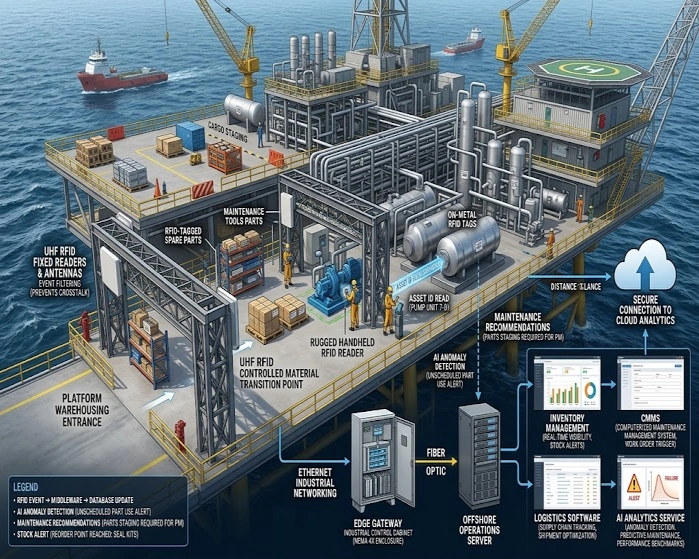
A detailed engineering illustration of an offshore oil platform showing physical RFID hardware, edge gateways, and network infrastructure routing asset data directly into CMMS, ERP, and cloud-based AI analytics.
Edge, Cloud, and Server Deployment for Offshore Platforms
Offshore connectivity conditions make deployment location an important engineering decision. A solution should continue performing essential data-capture and event-processing functions when communications with shore-based infrastructure are temporarily unavailable.
Edge Processing
Edge computing places selected processing functions close to RFID readers and offshore operations. An edge gateway or industrial server can receive reader events, filter duplicates, buffer data, perform local identity resolution, and forward normalized events when connectivity is available.
Edge processing is valuable for offshore environments because satellite, microwave, or other backhaul connections can experience bandwidth constraints, latency, or temporary outages. Local buffering prevents short communication interruptions from automatically becoming data-loss events.
Cloud Version
The Cloud Version uses cloud-hosted software and analytics managed within cloud infrastructure. RFID event data can be transmitted from the offshore installation through approved secure connectivity to cloud services.
Cloud deployment can be appropriate when organizations need centralized analytics across multiple offshore facilities, shore bases, warehouses, vessels, and maintenance operations. It can also simplify centralized software administration and provide scalable computing resources for AI workloads.
However, cloud connectivity should not be treated as a prerequisite for every operational function. Critical local processes should have appropriate offline or degraded-connectivity behavior.
Server Version
The Server Version places software on customer-managed edge servers, private data centers, shore-based servers, or other privately hosted enterprise infrastructure. It can be appropriate where data residency, network isolation, operational control, integration requirements, or offshore connectivity constraints favor private hosting.
A hybrid arrangement can combine local event processing with private or cloud-based AI analytics. For example, an offshore server can normalize and temporarily store RFID events while forwarding selected datasets to a central analytics environment when communications permit.
GAO can supply RFID hardware products and systems that form part of these deployment arrangements, while integration decisions should be based on the operator’s network policies, cybersecurity requirements, connectivity characteristics, and operational objectives.
Integrating AI and RFID with Offshore Enterprise Systems
RFID should normally complement existing software rather than create a parallel source of truth.
Relevant systems may include:
- Computerized maintenance management systems for work orders, equipment hierarchies, maintenance history, and preventive-maintenance schedules.
- Enterprise resource planning systems for purchasing, inventory, suppliers, financial records, and material management.
- Warehouse management systems for receiving, storage, picking, staging, and issue processes.
- Logistics management systems for cargo movements, vessel coordination, manifests, and transportation events.
- Enterprise asset management software for equipment lifecycle information.
- Condition-monitoring systems for vibration, temperature, pressure, electrical measurements, and other equipment-health information.
- Identity and access-management systems for authenticated users and controlled system access.
- Data historians and operational databases containing time-series and process information.
Integration commonly uses REST APIs, message brokers, database interfaces, industrial gateways, event streams, or other approved interfaces. The correct method depends on the customer’s existing software and cybersecurity policies.
A critical design principle is identity consistency. An RFID tag identifier should not become an isolated identifier that cannot be correlated with the asset number, equipment hierarchy, stock-keeping unit, serial number, or work-order reference already used by the organization.
For example, a tagged pump component could have:
- RFID tag identifier.
- Manufacturer serial number.
- Enterprise asset or material number.
- Equipment hierarchy.
- Purchase-order reference.
- Warehouse location.
- Inspection status.
- Associated work order.
- Installation history.
Maintaining these relationships enables AI models to reason about physical events in an operational context.
Cybersecurity for Offshore AI and RFID Systems
Cybersecurity should be incorporated into RFID deployment from the design stage. Offshore systems can interact with operational technology, enterprise IT, logistics software, and external communications, making uncontrolled connectivity undesirable.
Security measures can include:
- Network segmentation between RFID infrastructure, enterprise IT, and operational technology networks.
- Role-based access control for maintenance, inventory, engineering, and administrative users.
- Strong authentication for system administrators and API integrations.
- Encryption for data transmitted between offshore systems and remote infrastructure.
- Secure management of edge gateways, readers, servers, and handheld devices.
- Centralized logging of authentication, configuration, integration, and operational events.
- Vulnerability management and controlled firmware/software updates.
- Device inventory and lifecycle management.
- Backup and recovery procedures for local databases and configuration.
- API authentication, authorization, rate controls, and input validation.
- Least-privilege permissions for service accounts.
- Monitoring for unexpected network connections or abnormal system behavior.
RFID systems should also be separated conceptually from safety instrumented functions. Asset identification or AI recommendations should not be represented as substitutes for emergency shutdown systems, fire and gas systems, permit-to-work controls, or other safety-critical controls.
Engineering Challenges and Practical Solutions
Metal and RF Propagation
Offshore facilities contain extensive steel structures, pipes, tanks, pressure vessels, machinery, and electrical equipment. These surfaces can alter RFID propagation and produce reflections or unintended read zones.
Engineering response: perform an RF site survey and test representative tags on actual assets. Use appropriate on-metal tags, antenna orientation, reader power settings, shielding where justified, and controlled read zones.
Harsh Environmental Conditions
Saltwater, humidity, corrosion, temperature changes, vibration, impact, chemicals, and mechanical handling can shorten the life of poorly selected tags and readers.
Engineering response: specify tags and hardware according to the actual environmental envelope. Validate enclosure ratings, mounting methods, adhesive performance, cable protection, connector selection, and mechanical durability.
Uncontrolled Read Events
A reader may detect an asset that is physically nearby but not actually participating in the intended workflow.
Engineering response: use controlled read zones, antenna placement, filtering rules, event correlation, directional movement logic, and workflow-specific validation.
Intermittent Connectivity
Offshore communication links may not provide continuous high-bandwidth connectivity.
Engineering response: use edge buffering, local processing, store-and-forward mechanisms, synchronization controls, and clearly defined degraded-connectivity behavior.
RFID Tag Attachment
Tags can detach from tools or equipment when adhesives are poorly matched to the surface or environment.
Engineering response: select mounting techniques according to material, temperature, vibration, cleaning procedures, mechanical impact, and expected service duration. Where necessary, use mechanical fastening rather than relying exclusively on adhesive attachment.
AI Data Quality
AI cannot compensate reliably for poor source data. Duplicate RFID reads, incorrect asset identities, missing maintenance records, inconsistent location names, and incomplete inventory data can reduce model accuracy.
Engineering response: establish data-quality rules before model development. Validate asset master data, normalize location identifiers, resolve duplicate observations, and monitor event completeness.
Offshore RFID Implementation Lifecycle
Successful implementation should proceed from an operational problem rather than from RFID hardware selection alone.
Operational Assessment
Identify processes where missing asset or material visibility creates measurable cost, downtime, safety-support, logistics, or maintenance problems.
Use-Case Prioritization
Prioritize applications according to operational value, technical feasibility, data availability, and deployment complexity. Tool control, critical-spare visibility, material traceability, and selected logistics processes are potential starting points.
Asset and Workflow Mapping
Document the physical movement of assets and materials. Identify where items are received, stored, issued, staged, installed, returned, inspected, or transferred.
RFID Site Survey
Evaluate reader locations, antenna orientation, metal structures, equipment density, environmental exposure, network availability, power availability, and potential interference.
Tag and Reader Testing
Test representative assets with candidate RFID tags. Testing should include actual mounting surfaces and operational conditions rather than relying exclusively on vendor laboratory specifications.
Integration and Commissioning
Connect RFID middleware with the required inventory, maintenance, logistics, and asset systems. Validate identifier mapping and event semantics before production deployment.
Pilot Operation
Run a controlled pilot with measurable operational objectives. Compare system-generated events against manually verified physical events.
Optimization
Tune reader power, antenna positioning, filtering rules, event logic, AI thresholds, dashboards, and workflow alerts based on measured performance.
Scale and Maintain
Expand to additional warehouses, decks, maintenance areas, equipment categories, or offshore facilities only after the initial workflow demonstrates acceptable read performance, data quality, integration reliability, and operational value.
KPIs for AI-Enabled Offshore Asset and Material Management
The KPI framework should measure operational outcomes rather than RFID activity alone.
Relevant measures include:
- Asset search time for maintenance tools and equipment.
- Percentage of critical spare parts correctly identified and located.
- Physical-to-system inventory accuracy.
- Inventory discrepancy rate.
- Material retrieval time.
- Maintenance work orders delayed by unavailable materials.
- Tool availability at scheduled maintenance start.
- Tool inspection or calibration compliance.
- Cargo receiving cycle time.
- Material dwell time in offshore staging areas.
- Percentage of RFID events successfully processed.
- Duplicate-event rate.
- Unidentified or unresolved asset-event rate.
- RFID read success rate under representative operating conditions.
- Data synchronization success rate.
- AI alert precision and false-alert rate.
- Mean time from anomaly detection to human review.
- Reduction in manual inventory-counting effort.
- Reduction in asset search-related maintenance delays.
The most meaningful KPI baseline should be established before deployment so that improvements can be evaluated against the original operational condition.
Relevant Standards, Regulations, and Industry Practices
Offshore RFID deployments must be evaluated against the regulations and standards applicable to the operator, facility type, country, equipment classification, and hazardous-area designation. Requirements can differ substantially between jurisdictions and installations.
Relevant reference areas may include:
- IEC 60079 series for equipment and systems associated with explosive atmospheres.
- IEC 61508 for functional safety principles where applicable to associated safety-related systems.
- IEC 61511 for safety instrumented systems in the process industry.
- IEC 62443 for industrial automation and control-system cybersecurity.
- ISO 55000 series for asset-management principles.
- ISO/IEC 18000 series for RFID air-interface standards.
- ISO/IEC 15693 and related standards for applicable HF RFID implementations.
- API recommended practices and standards relevant to offshore equipment and operations.
- NORSOK standards where applicable to projects using Norwegian offshore requirements.
- U.S. Coast Guard requirements where applicable to regulated offshore operations.
- Bureau of Safety and Environmental Enforcement requirements for applicable U.S. offshore activities.
- OSHA requirements where applicable to occupational safety.
- National and regional electrical, hazardous-location, communications, and environmental requirements.
RFID hardware installed in classified or hazardous locations requires particular attention. Ordinary commercial RFID equipment should not automatically be assumed suitable for hazardous areas. Certification, enclosure requirements, installation practices, power limitations, intrinsic-safety considerations, and separation requirements must be evaluated for the specific installation.
Business Value of AI-Enabled Offshore RFID
Combining AI with RFID can create value by connecting physical asset events to maintenance, inventory, and logistics decisions.
- Lower maintenance search time: AI can identify likely asset locations and detect movement patterns, reducing time spent manually searching for tools and components.
- Improved spare-parts availability: Demand forecasting and maintenance-plan correlation can identify potential shortages before they affect planned work.
- Better inventory accuracy: Automated identification reduces dependence on manual counting and improves synchronization between physical inventory and software records.
- More effective logistics: RFID events create evidence of material movement while AI highlights delays and exceptions requiring attention.
- Improved maintenance coordination: Tool, material, and work-order information can be correlated so planners identify resource constraints earlier.
- Greater traceability: Tagged components can retain a digital movement history across receiving, storage, staging, installation, and maintenance activities.
- Scalable data collection: Once readers, middleware, and integration patterns are established, additional asset categories and workflows can be added systematically.
- Improved operational visibility: AI can transform large volumes of RFID observations into exceptions, trends, and recommendations that personnel can act upon.
The strongest deployments do not attempt to automate every offshore process. They focus on specific operational decisions where better physical visibility produces measurable improvement.
Building a Practical AI and RFID Strategy for Offshore Platforms
A technically sound strategy begins with the offshore workflow and works backward toward the technology.
Organizations should:
- Select a small number of high-value asset, inventory, maintenance, or logistics problems.
- Define measurable baseline KPIs before installing equipment.
- Map the physical movement of assets and materials.
- Establish authoritative asset, material, and location identifiers.
- Select UHF, HF, or LF RFID according to the actual use case.
- Test tags on representative metallic, plastic, composite, and liquid-associated assets.
- Conduct RF site surveys before final reader and antenna placement.
- Use edge processing where connectivity limitations could affect operational continuity.
- Integrate RFID events with existing CMMS, ERP, inventory, logistics, and asset-management systems.
- Establish cybersecurity controls before connecting RFID infrastructure to enterprise networks.
- Keep AI recommendations explainable and subject to appropriate human authorization.
- Treat hazardous-area requirements as a design constraint from the beginning.
- Pilot the complete workflow rather than testing RFID hardware in isolation.
- Measure operational outcomes before scaling across additional offshore locations.
GAO’s experience supplying RFID, BLE, and IoT hardware products and systems can support organizations that need to connect physical assets with digital operational processes. GAO Group companies have served customers in the United States and Canada for three decades, including Fortune 500 companies, R&D organizations, universities, and government agencies. GAO maintains stringent quality-assurance processes and provides expert technical support remotely or onsite.
Key Takeaways for Offshore Platform Operators
AI-enabled RFID can provide offshore platforms with a practical method for connecting physical assets and material movements to maintenance, inventory, logistics, and operational decision-making.
The technology is most effective when deployed around clearly defined workflows. UHF RFID can provide efficient identification across selected warehouse and transition-point applications, while HF and LF RFID can address shorter-range or specialized identification requirements. Edge processing can preserve local event handling when offshore connectivity is constrained, while private server and cloud deployments can provide different approaches to centralized analytics and software management.
AI adds value by detecting anomalies, forecasting requirements, correlating events, prioritizing work, and identifying exceptions. The resulting system should augment established offshore engineering and safety processes rather than bypass them.
GAO can help organizations evaluate RFID hardware, connected identification systems, and supporting IoT technologies for offshore asset tracking, inventory, material traceability, and maintenance workflows. Readers interested in developing a technically grounded deployment can explore GAO’s RFID and IoT solutions and work with technical specialists to evaluate suitable hardware, integration, and deployment approaches.
Building the Future of Industrial AI and IoT with Aperture Venture Studio and GAO RFID Inc.
For more than three decades, GAO Group of Companies has invested heavily in R&D for industrial RFID, BLE, and IoT technologies. As generative AI became increasingly useful for industrial applications, we expanded our work across AI and IoT, including RFID and BLE, and founded Aperture Venture Studio to develop AI and IoT solutions relevant to demanding environments such as offshore operations.
Aperture has attracted AI and IoT technical experts, entrepreneurial and operational executives, investors, and leading companies. We have also developed Aperture Ventures Summit and TekSummit to discuss advanced AI and IoT topics.
These efforts have helped build diverse technical communities around AI and IoT. We welcome participation as advisors, co-founders or employees, investors, or customers.