
AI and BLE for Sports Arenas
AI for Sports Arenas: Intelligent Venue Operations with BLE
AI is changing how sports arenas manage crowds, assets, facilities, security, and fan services by converting real-time operational data into actionable decisions. In a modern sports arena, BLE gateways, beacons, and sensors can provide location and condition data from staff devices, mobile assets, equipment, service areas, entrances, concessions, and other operational zones. AI and machine learning can then analyze these data streams to identify congestion, detect unusual movement patterns, predict equipment or facility issues, optimize staffing, and support faster operational decisions. The result is not simply better location visibility. It is a connected operational process in which sensing, communication, analytics, and venue workflows work together. For arena operators, this approach can improve crowd management, asset utilization, maintenance response, security coordination, energy management, and service quality while providing measurable operational data for planning and continuous improvement.
AI-Enabled BLE Sports Arena Operations and Real-Time Venue Intelligence
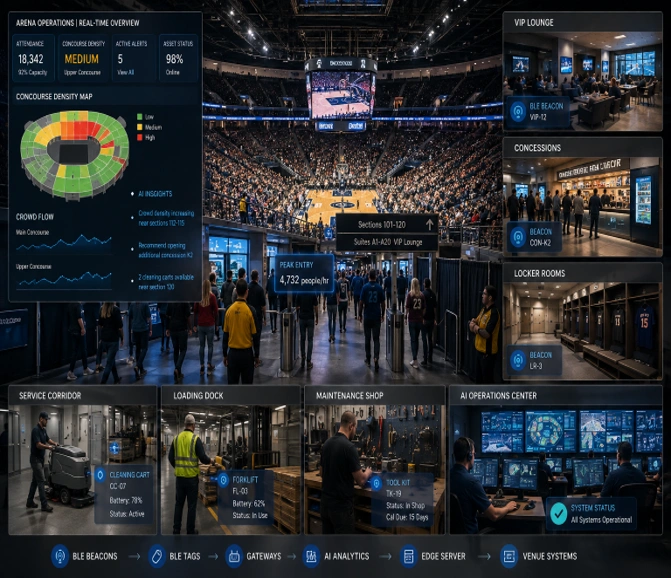
This composite visual illustrates how AI and BLE support real-time sports arena operations. It shows crowd-density monitoring, BLE-enabled asset tracking, concession and VIP areas, maintenance resources, loading docks, service corridors, and an AI operations center connected through BLE beacons, tags, gateways, edge processing, and venue systems.
What AI Means for Sports Arena Operations
AI for sports arenas refers to the use of artificial intelligence, machine learning, computer vision, predictive analytics, and related AIoT technologies to interpret operational data and support venue decisions. BLE functions as one of the practical sensing and identification technologies that can supply location, proximity, telemetry, and event data to these AI-enabled applications.
The most useful implementations begin with a specific operational problem rather than with the technology itself. Arena operators may need to understand why congestion develops near an entrance, where mobile equipment is located, whether service teams are reaching assigned zones on time, or whether unusual movement patterns require additional attention. AI can analyze data from BLE-enabled devices together with ticketing, access control, video systems, building management systems, point-of-sale systems, work-order software, and other venue data sources.
A BLE-enabled system can provide proximity or location events from tags, beacons, smartphones, staff devices, and sensors. Gateways collect those signals and forward relevant information to local or cloud-based software. Analytics can then transform raw observations into operational indicators, alerts, predictions, or recommended actions.
This distinction is important. BLE does not independently provide intelligence. It provides a cost-effective wireless sensing and identification layer that can support AI applications when the collected data is sufficiently accurate, timely, and contextually meaningful.
GAO supplies BLE gateways, beacons, sensors, RFID products, and related IoT hardware that can be incorporated into these venue systems. The appropriate hardware selection depends on the required location accuracy, battery life, environmental conditions, radio density, mounting position, network availability, and integration requirements.
Priority AI Applications for Sports Arenas
Sports arenas contain highly dynamic environments. A single event can involve tens of thousands of spectators, temporary staff, permanent operations teams, vendors, security personnel, athletes, media crews, contractors, and large quantities of mobile equipment. AI applications therefore need to account for rapidly changing occupancy, access permissions, operating schedules, and physical conditions.
AI Crowd Flow and Concourse Congestion Management
Crowd movement is one of the strongest applications for AI in sports arenas. BLE-enabled location observations can help establish movement patterns around entrances, gates, stairways, elevators, concourses, concession areas, restrooms, merchandise stores, and seating sections.
AI models can analyze historical and real-time movement data to identify abnormal congestion and estimate where crowd density may increase. Venue operations teams can use these insights to reposition personnel, adjust access routes, open additional service points, or communicate operational changes.
A practical system should distinguish normal event behavior from genuinely abnormal conditions. A post-event concert, a basketball game during halftime, and a sold-out playoff match can produce very different movement profiles. AI models should therefore incorporate event schedules, venue zones, expected attendance, access-control information, and historical operating patterns rather than treating every movement anomaly as an incident.
AI Asset Tracking for Arena Equipment
Sports arenas depend on mobile and semi-mobile assets such as cleaning equipment, maintenance tools, carts, portable barriers, medical equipment, radios, AV equipment, lighting components, catering equipment, and event infrastructure.
BLE tags can provide identification and proximity information for these assets. Gateways positioned throughout service corridors, storage areas, loading docks, maintenance rooms, and operational zones can collect tag observations.
AI can use this information to identify asset utilization patterns, detect equipment that remains unused for unusual periods, support loss-prevention workflows, and improve dispatch decisions. A maintenance supervisor, for example, can determine whether a required tool or mobile service cart is already near the work location rather than sending personnel to search multiple storage areas.
The business value comes from reducing search time and improving asset availability. The technical objective is not necessarily centimeter-level positioning for every item. Many arena workflows can operate effectively with zone-level or room-level location information.
AI Predictive Maintenance for Arena Facilities and Equipment
Arena operations depend on HVAC systems, refrigeration equipment, pumps, electrical equipment, lighting systems, escalators, elevators, access-control equipment, scoreboards, broadcast infrastructure, and other facility systems.
BLE sensors can supplement fixed building systems by monitoring selected equipment, service personnel, or mobile maintenance resources. AI can correlate equipment observations with work orders, maintenance history, environmental conditions, operating schedules, and event calendars.
This is particularly valuable before high-attendance events. A maintenance team can prioritize assets whose condition or operational behavior indicates elevated risk before an event places additional demand on the facility.
Predictive maintenance should not be implemented by simply attaching sensors to every asset. Criticality analysis should identify which assets can create safety, revenue, operational, or event-continuity consequences when they fail. Sensor selection and data frequency can then be matched to those risks.
AI Staff and Service Workflow Optimization
Sports arenas coordinate security personnel, ushers, cleaners, maintenance technicians, catering teams, medical personnel, guest-service representatives, and event contractors. BLE-enabled staff badges or devices can provide location and presence information when appropriate privacy and access-control policies are established.
AI can analyze service response times, zone coverage, task assignments, and operational demand. A venue may use these insights to identify understaffed areas, optimize shift allocation, or improve response to operational requests.
The system should not be designed solely as a personnel surveillance mechanism. Clear data governance, role-based access, retention policies, and purpose limitation are important, particularly when location data can be associated with individual employees.
AI Security and Incident Support
AI can support security operations by correlating multiple data sources. BLE proximity information can provide additional context about the location of authorized personnel, mobile security equipment, emergency resources, or selected tagged assets.
For example, if an operational alert is generated in a particular concourse zone, the system can identify nearby authorized response resources and provide that information to the appropriate operations software. BLE observations can complement access-control logs, video analytics, emergency communications, and incident-management systems.
BLE should not be treated as a replacement for access control, video surveillance, or established emergency systems. Its value is as an additional data source that can improve situational awareness and coordination.
AI and BLE Application Map for Sports Arena Operations
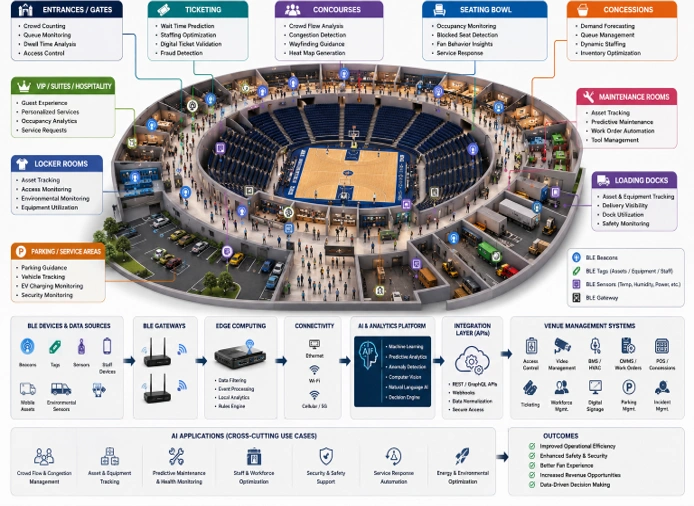
This infographic maps AI applications across key sports arena zones, including entrances, concourses, seating, concessions, VIP areas, locker rooms, maintenance rooms, loading docks, and service areas. It shows how BLE beacons, tags, sensors, and gateways feed edge computing, connectivity, AI analytics, APIs, and venue management systems to support crowd management, asset tracking, predictive maintenance, staff optimization, security, and service response.
From Arena Data Capture to AI-Driven Decisions
A practical AIoT solution for sports arenas generally follows a sequence from physical observation to operational action. The exact implementation varies according to venue size, existing IT systems, network availability, and the required response time.
Data Acquisition at the Venue
Data begins with BLE beacons, tags, sensors, mobile devices, gateways, and existing venue systems. BLE devices can transmit identifiers, telemetry, proximity events, or sensor measurements. Gateway placement determines how reliably those signals can be observed.
Sports arenas require careful radio planning because concrete structures, steel, people, temporary event installations, broadcast equipment, and dense wireless environments can affect RF behavior. Gateway locations should therefore be selected using actual venue conditions rather than relying solely on theoretical coverage calculations.
BLE Gateway Communication
BLE gateways receive wireless advertisements or connections from nearby devices and forward selected data to software systems through Ethernet, Wi-Fi, cellular, or other available network infrastructure.
A venue with reliable wired network connectivity may favor Ethernet-connected gateways in fixed operational areas. Temporary event spaces may require alternative connectivity depending on the venue’s network policy.
Gateway configuration should also consider local device density. Thousands of BLE devices operating around a major event can produce substantially different traffic patterns from a lightly occupied venue. Filtering and aggregation at the gateway or edge layer can reduce unnecessary upstream traffic.
Edge Processing and Data Normalization
Edge processing can reduce latency and bandwidth requirements while allowing selected operational decisions to continue when connectivity to a remote service is interrupted.
The edge layer may normalize BLE observations, remove duplicate events, associate identifiers with known zones, apply basic rules, and forward structured data to analytics software. Time synchronization is important because AI models that correlate BLE observations with access control, video analytics, or work-order events can produce misleading results when timestamps are inconsistent.
AI Analytics and Venue Software
Processed data can be stored and analyzed by software running on cloud infrastructure or privately managed servers. Machine learning models can identify patterns, anomalies, correlations, and predictive indicators.
A useful implementation should expose AI results through software already used by venue personnel rather than forcing operators to monitor another disconnected application. Depending on the workflow, outputs may appear as dashboards, alerts, maintenance recommendations, staffing indicators, asset-location views, or incident-management events.
Operational Action
The final stage is a business or operational response. An AI-generated congestion alert has value only when venue personnel can act on it. Similarly, an asset-location prediction matters when a technician can use the information to retrieve equipment, and a maintenance prediction matters when it can create or prioritize a work order.
The effectiveness of AI for sports arenas should therefore be measured across the entire workflow, from sensing accuracy through operational response time and measurable venue outcomes.
End-to-End AI and BLE Workflow for Sports Arena Operations
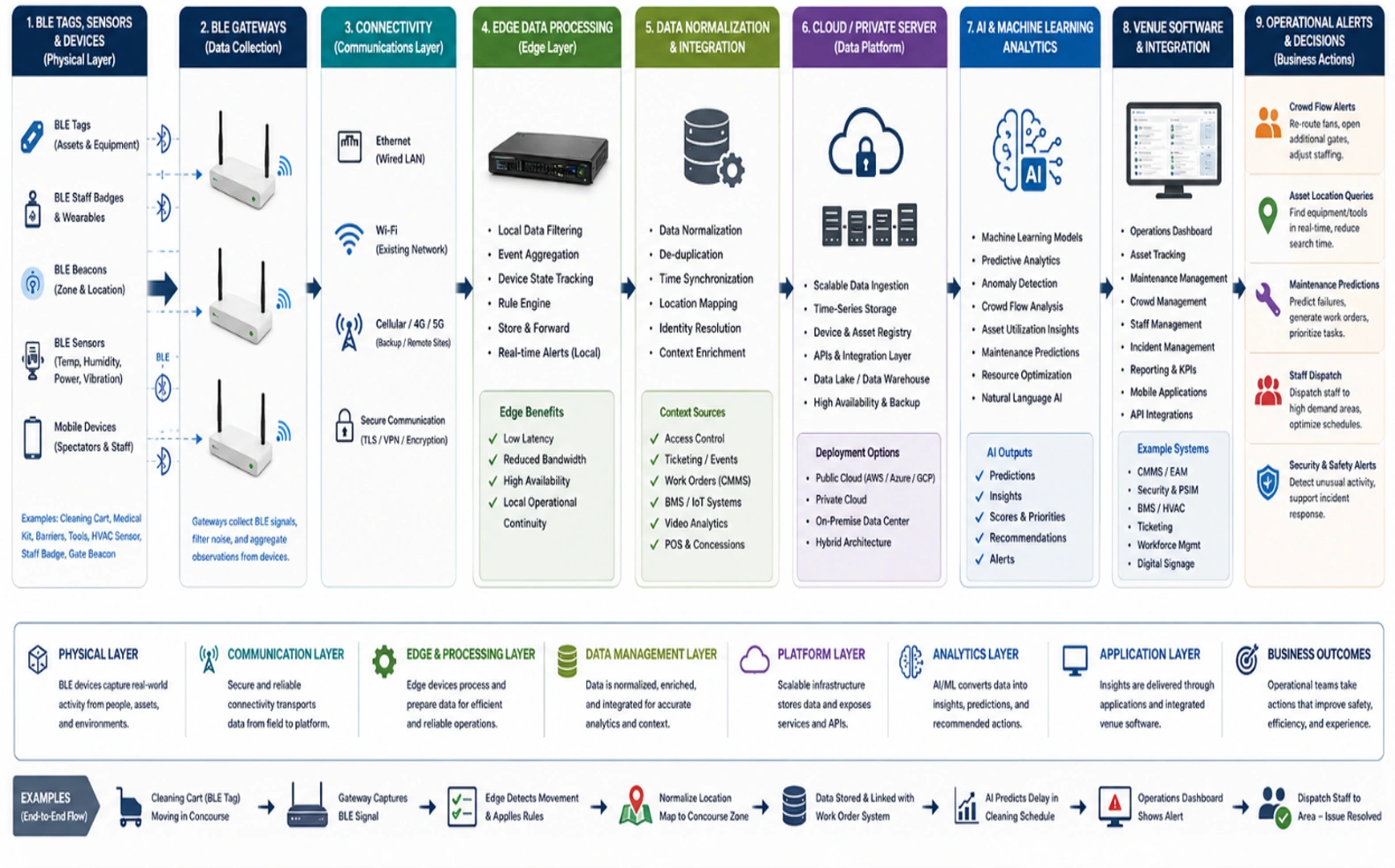
This diagram traces sports arena data from BLE tags, sensors, beacons, and staff devices through gateways, secure connectivity, edge processing, data normalization, cloud or private servers, AI analytics, and venue software. It shows how these processing stages produce operational outputs such as crowd-flow alerts, asset-location queries, maintenance predictions, and staff dispatch decisions.
BLE Hardware and AI Software for Sports Arena Systems
The technical design of a sports arena solution depends on the operational question being answered. BLE hardware should be selected according to sensing requirements, while AI software should be selected according to the decision workflow and available data.
BLE Beacons, Tags, Sensors, and Gateways
BLE beacons can transmit identifiers that help establish proximity and zone presence. BLE tags can be attached to mobile assets or selected operational resources. BLE sensors can add measurements such as temperature or other supported telemetry where environmental monitoring is required.
BLE gateways provide the connection between local wireless observations and the venue’s software environment. Their installation locations are especially important in large arenas because structural obstructions and changing crowd density can affect received signal characteristics.
GAO’s experience supplying BLE and RFID hardware for organizations in the United States and Canada supports a practical approach in which device selection is matched to the operational environment rather than treated as a generic hardware procurement exercise.
Cloud Version and Server Version
A Cloud Version can be appropriate when a sports organization needs centralized software access across multiple venues, wants cloud-managed infrastructure, or prefers to reduce the operational burden of maintaining application servers. Cloud deployment can also simplify centralized analytics and software updates when network connectivity is dependable.
A Server Version can be more appropriate when venue operators require privately managed infrastructure, tighter control over data processing, integration with existing facility servers, or operation within restricted network environments. This can include customer-managed servers, private data centers, edge servers, or other privately hosted infrastructure.
The decision should be based on network reliability, cybersecurity policy, data governance, integration requirements, latency, operational support capability, and the expected number of venues and devices. A hybrid design can also be appropriate when low-latency processing occurs locally while selected analytical data is transferred to centralized software.
Integration with Sports Arena IT and Facility Systems
AI applications become more useful when their outputs can be correlated with existing venue systems. Sports arenas commonly operate multiple technology domains that were deployed at different times and may use different data models.
Potential integration points include:
- Access-control and credentialing systems for entrances, restricted areas, staff access, and event credentials
- Ticketing and event-management systems for attendance and scheduled event context
- Video management and computer vision systems for visual occupancy and incident information
- Building management systems for HVAC, environmental controls, and facility conditions
- Computerized maintenance management systems for work orders, preventive maintenance, and technician activity
- Point-of-sale systems for concession and merchandise operations
- Digital signage systems for operational messaging
- Security and incident-management software for alerts and response coordination
- Workforce-management systems for staffing schedules and assignments
- Inventory and procurement software for operational supplies and equipment
Integration should use well-defined interfaces and data ownership rules. APIs, message brokers, database interfaces, or other supported integration methods can be selected according to the systems already deployed at the venue.
A key engineering consideration is identity resolution. A BLE device identifier, an asset record, a work-order identifier, and a venue zone need consistent relationships if AI is expected to correlate them reliably. Poor data mapping can undermine otherwise accurate sensor data.
Sports Arena AI and BLE Systems Integration Architecture
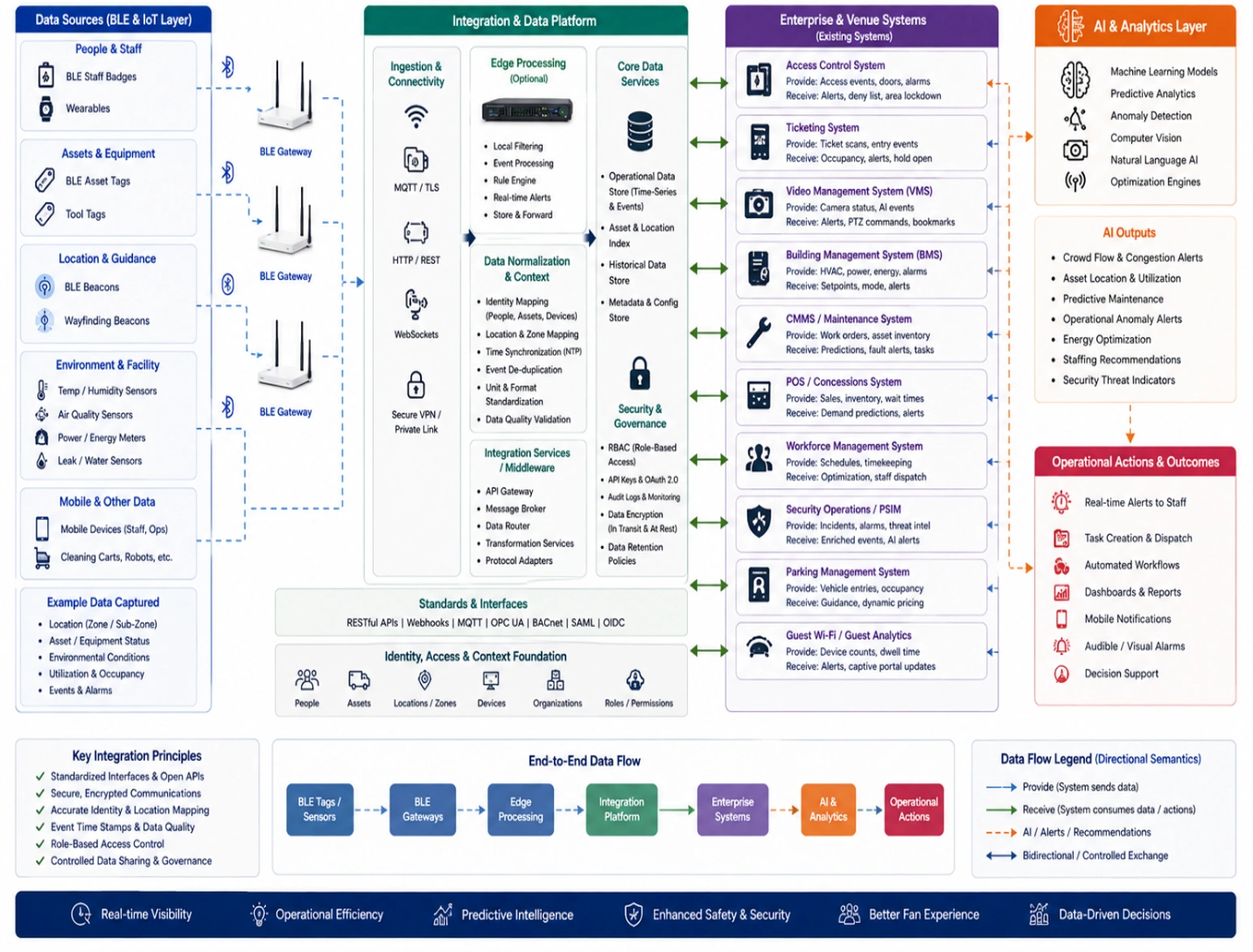
This diagram illustrates the complete integration architecture for AI-enabled sports arena operations, connecting BLE tags, beacons, sensors, and staff devices through gateways, edge processing, middleware, and core data services. It shows controlled data exchange with access control, ticketing, video management, BMS, CMMS, POS, workforce, security, parking, and guest analytics systems, with AI producing alerts, predictions, recommendations, and operational actions.
Engineering Considerations for AI-Enabled Sports Arenas
Successful deployment requires more than selecting BLE devices and connecting them to AI software. Sports arenas are challenging RF and operational environments where crowd density, reinforced concrete, steel structures, temporary installations, broadcast equipment, and changing event configurations can influence wireless performance and data quality.
Location Accuracy and Zone Design
The required location accuracy should be determined from the operational workflow.
Asset search may only require room-level or zone-level visibility, while applications involving automated movement analysis may require more granular positioning. Higher location accuracy generally requires additional infrastructure, stronger calibration procedures, or more sophisticated positioning methods.
Arena zones should therefore be designed around operational decisions rather than arbitrary geometric boundaries. Examples include:
- Ticketing and entrance zones
- Security screening areas
- Concourses and circulation paths
- Seating sections
- Locker rooms and restricted areas
- Loading docks and service corridors
- Equipment storage rooms
- Maintenance areas
- Medical response zones
- Concession and hospitality areas
A zone model should also account for temporary event configurations. A venue may change barricades, hospitality areas, media zones, sponsor installations, and staff-only routes between events.
RF Planning and Gateway Placement
BLE gateway placement directly affects observation quality. A theoretical signal-coverage map may not accurately represent performance during a sold-out event because spectators themselves can alter radio propagation.
Commissioning should include testing during representative operating conditions whenever practical. Measurements should be collected from actual asset locations and movement paths rather than only from empty areas.
Gateway density should also be balanced against installation cost, network capacity, maintenance requirements, and the desired positioning accuracy. More gateways are not automatically better if the resulting observations are not used by the application.
Data Quality and AI Model Reliability
AI models depend on reliable input data. Missing BLE observations, duplicated events, inconsistent timestamps, incorrect asset identifiers, or poorly defined zones can generate false alerts and reduce confidence in analytical results.
A production system should monitor data quality as an operational KPI. Useful measurements include observation completeness, gateway availability, sensor battery status, event timestamp consistency, location confidence, duplicate-event rates, and stale-device counts.
The AI model should also distinguish between sensor uncertainty and genuine operational anomalies. A sudden absence of observations from one gateway, for example, should not automatically be interpreted as an asset leaving the venue.
Event-Based Capacity Planning
Arena technology behaves differently during normal facility operation and major events. A system that performs well during an empty venue test may encounter substantially greater wireless and network traffic when thousands of spectators, staff devices, tags, and temporary systems are active.
Capacity testing should therefore consider peak event conditions. Gateway processing, network bandwidth, database ingestion, API throughput, analytics workloads, and alert-processing capacity should be evaluated against expected maximum loads.
Cybersecurity, Privacy, and Operational Governance
AI-enabled sports arena systems can process sensitive operational information. Depending on the implementation, location data may relate to employees, contractors, equipment, restricted areas, or security operations. Cybersecurity and privacy controls should therefore be designed into the solution rather than added after deployment.
Device and Network Security
BLE devices and gateways should be inventoried and managed throughout their lifecycle. Recommended controls can include:
- Unique device identities and controlled provisioning
- Secure gateway configuration
- Credential rotation and access management
- Network segmentation for IoT infrastructure
- Encrypted communications where supported
- Controlled firmware and software updates
- Monitoring for unauthorized devices
- Removal or quarantine of retired devices
- Centralized logging for security-relevant events
Network segmentation is particularly useful when BLE gateways communicate with systems that also contain operational or security-sensitive information. A dedicated IoT network or appropriately segmented VLAN can limit the potential impact of a compromised device.
Identity and Access Management
Not every arena employee needs access to every location or operational dataset. Role-based access should separate functions such as facilities management, security operations, asset management, event operations, and system administration.
AI-generated alerts should also be distributed according to operational responsibility. A maintenance prediction should reach the appropriate maintenance workflow rather than becoming an unrestricted security notification.
Employee and Guest Privacy
Location-aware systems require clear governance when information can be associated with identifiable people. The venue should define the purpose of data collection, which personnel can access it, how long data is retained, and when individual-level data should be anonymized or aggregated.
Privacy requirements can vary according to jurisdiction, organizational policy, employment arrangements, and the nature of the collected information. Technical design should therefore involve appropriate legal, privacy, security, and operational stakeholders before production deployment.
Measuring AI Performance in Sports Arena Operations
AI projects should be evaluated through operational KPIs rather than AI model accuracy alone. A technically accurate prediction has limited value if it does not improve an arena workflow.
Relevant measures can include:
- Average crowd congestion detection time
- Time required to respond to operational incidents
- Asset search time
- Asset utilization rate
- Asset loss or misplacement rate
- Maintenance response time
- Preventive maintenance compliance
- Unplanned equipment downtime
- Staff response time
- Service request completion time
- Gateway availability
- BLE device battery life
- Data observation completeness
- False-alert rate
- AI prediction precision and recall where appropriate
- Network and application availability
- Mean time to repair IoT infrastructure
- Energy consumption for monitored facility zones
A useful measurement program establishes a baseline before deployment. If an arena normally requires eight minutes to locate critical mobile equipment, for example, the project can evaluate whether BLE-assisted workflows reduce that time. Similar before-and-after measurements can be applied to maintenance response, asset utilization, or crowd-management processes.
Implementation Lifecycle for Sports Arena AI and BLE Solutions
Define the Operational Use Case
The first step is to identify the operational decision that needs improvement. Examples include locating mobile maintenance equipment, detecting concourse congestion, improving staff response, or predicting selected equipment failures.
The use case should specify the required data, decision latency, acceptable location uncertainty, responsible personnel, and measurable outcome.
Survey the Arena
A technical site survey should document:
- Floor plans and operational zones
- Building materials and RF obstructions
- Existing wireless infrastructure
- Network availability
- Power availability
- Gateway mounting locations
- Equipment storage and movement routes
- Restricted areas
- High-density spectator zones
- Maintenance and service areas
- Existing IT and facility systems
A survey performed during representative event conditions can reveal practical constraints that are difficult to identify during an empty-building inspection.
Select Hardware and Software
Hardware selection should reflect the use case. A battery-powered asset tag has different requirements from a fixed environmental sensor. A gateway installed in a service corridor may have different environmental and network requirements from one installed in a public concourse.
Software selection should similarly consider AI capabilities, data ingestion, APIs, dashboards, alerting, user management, deployment model, and integration with existing venue systems.
GAO can support this stage with BLE and RFID hardware products and technical assistance for organizations evaluating connected asset and sensing applications.
Pilot a Representative Zone
A pilot should cover a real operational workflow rather than simply demonstrating that a BLE tag can be detected.
For example, an asset-tracking pilot might include a loading dock, equipment storage room, maintenance corridor, and one operational zone. The team can measure location visibility, battery behavior, gateway performance, network reliability, asset search time, and user acceptance.
A crowd-management pilot may instead focus on one entrance or concourse and compare BLE-derived movement information with existing attendance, access-control, or video data.
Commission and Validate
Commissioning should verify device installation, gateway connectivity, software configuration, data mappings, alert thresholds, user permissions, and integration behavior.
Validation should include negative tests as well as successful scenarios. Engineers should test gateway outages, device battery depletion, network interruptions, duplicate observations, incorrect identifiers, unavailable APIs, and other failure conditions.
Scale by Operational Priority
After a successful pilot, deployment can expand according to business priority. Critical operational zones and high-value assets should generally receive attention before attempting venue-wide instrumentation.
This approach also allows AI models to be refined using actual operational data before expanding to additional event types, buildings, or venues.
Operational Benefits of AI-Enabled Arena Systems
Combining AI analytics with BLE-based sensing can improve several areas of sports arena management when the solution is connected to actual operational workflows.
Faster Operational Response
Real-time location and event information can reduce the time required to understand where a problem is occurring and which resources are available nearby. AI can prioritize alerts so operations teams can focus on situations requiring attention.
Better Asset Utilization
Location and utilization information can reveal whether expensive mobile equipment is appropriately distributed across an arena. This can reduce unnecessary duplicate purchases and improve availability during high-demand events.
More Predictable Maintenance
AI can identify patterns associated with equipment conditions and maintenance history. Maintenance teams can then prioritize inspections and work orders based on risk rather than relying exclusively on fixed schedules.
Improved Crowd Management
AI can combine movement observations with event context to identify developing congestion. Earlier awareness gives event operations teams more opportunity to adjust staffing, routing, or communications before congestion becomes a significant operational issue.
Improved Scalability Across Venues
Standardized device management, data models, and software interfaces can make it easier for organizations operating multiple arenas to apply common operational processes while still adapting zone configurations to individual venues.
The objective should not be to make every arena process autonomous. Human operators remain essential for decisions involving safety, security, emergency response, guest experience, and unusual event conditions. AI is most useful when it provides timely, interpretable information that improves those decisions.
Practical Design Recommendations for Sports Arena AI
Several engineering principles can improve the reliability of AI-enabled BLE deployments.
- Start with operational decisions rather than device counts or AI model selection.
- Define the required location accuracy before selecting positioning hardware.
- Perform RF testing under realistic spectator and event conditions.
- Use zone-level tracking when room-level or zone-level information is sufficient.
- Treat BLE observations as probabilistic data and preserve confidence information where practical.
- Synchronize timestamps across BLE, access-control, video, maintenance, and event systems.
- Establish device identity and asset identity mappings before building AI workflows.
- Separate IoT networks from sensitive venue systems where appropriate.
- Define cybersecurity ownership for gateways, sensors, software, and network infrastructure.
- Establish data retention and access policies for personnel-related location information.
- Validate AI alerts against real operational outcomes.
- Test failure conditions before production commissioning.
- Monitor battery status and gateway health as part of routine venue operations.
- Design for peak event conditions rather than average daily occupancy.
- Use APIs and controlled interfaces for integration with existing venue software.
- Expand deployment based on measured operational value rather than attempting to instrument every asset simultaneously.
GAO Expertise for AI-Enabled Sports Arena Solutions
GAO has supplied BLE, RFID, and IoT hardware products and systems to organizations across the United States and Canada for three decades. Its engineering work spans connected identification, sensing, gateways, and related technologies that can support sports arena applications such as asset tracking, environmental monitoring, personnel workflows, and location-aware operational systems.
Headquartered in New York City and Toronto, Canada, GAO is recognized among the leading B2B and B2G BLE and RFID suppliers globally. GAO and its sister companies, GAO Research and GAO Tek, form the GAO Group, with operations based in New York City and Toronto. The group has served Fortune 500 companies, R&D organizations, universities, and government agencies while maintaining substantial investment in product and system R&D.
For sports arena operators, this experience is relevant when technology selection requires more than an isolated sensor purchase. Successful deployment can require hardware compatibility, RF engineering, software integration, testing, commissioning, and ongoing technical support.
Key Takeaways for Sports Arena Technology Teams
AI for sports arenas is most effective when it connects real-time operational data with specific venue decisions. BLE gateways, beacons, and sensors can provide an important data source for applications such as crowd-flow analysis, asset tracking, predictive maintenance, staff coordination, and operational response.
The strongest implementations begin with measurable workflows, establish data-quality requirements, evaluate RF conditions, integrate with existing venue software, and validate performance under realistic event conditions. Cloud, private server, edge, and hybrid deployments each have legitimate applications depending on network, security, integration, and operational requirements.
Sports arena technology teams evaluating these applications can work with GAO to examine BLE and RFID hardware, sensing requirements, gateway deployment, integration considerations, and technical support for connected venue systems.
AI and BLE Sports Arena Operations Performance Dashboard
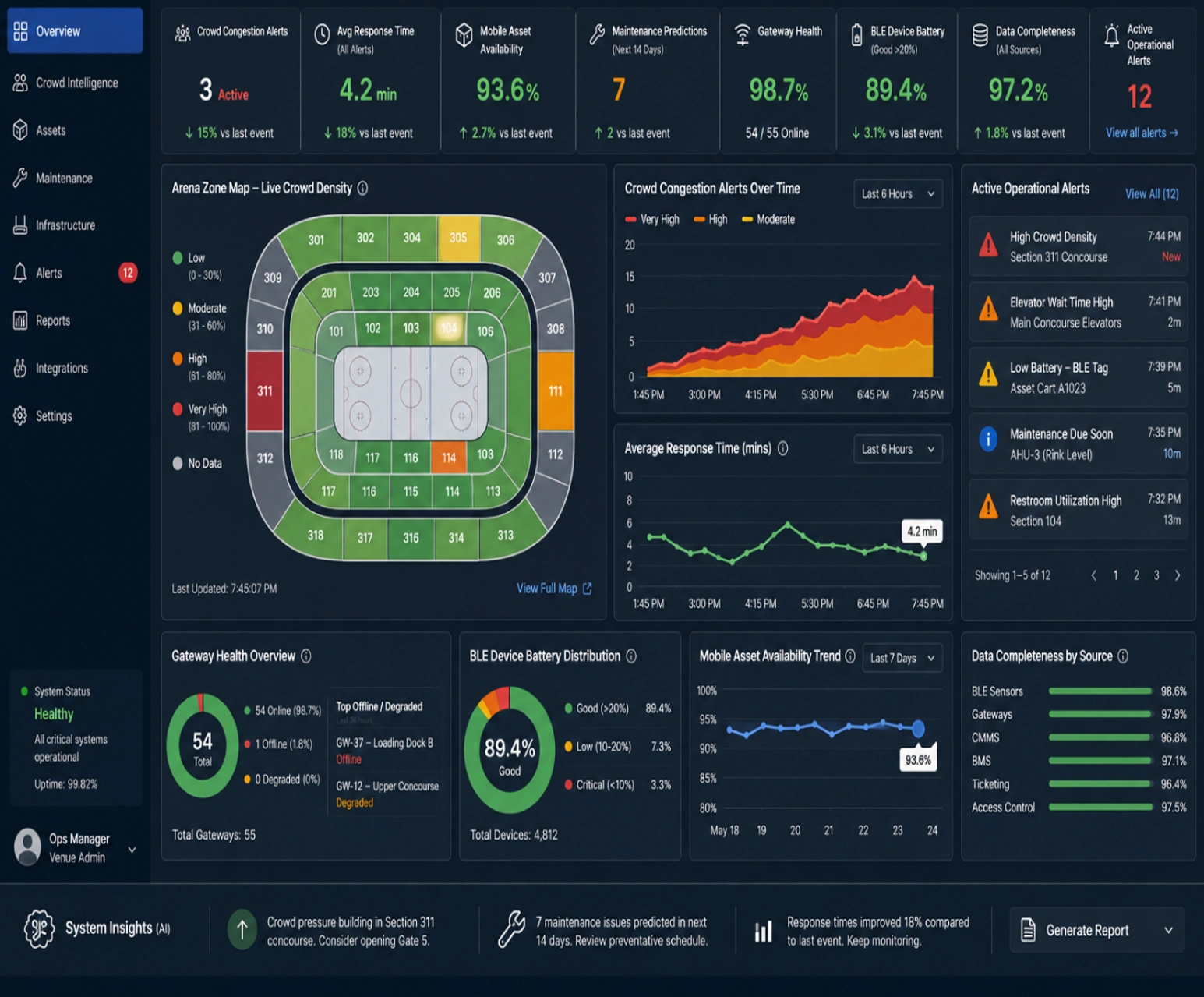
This enterprise dashboard mockup illustrates how venue operations teams can monitor AI and BLE performance from a centralized interface. It combines crowd-density and congestion monitoring, response-time trends, mobile asset availability, maintenance predictions, gateway health, BLE device battery status, data completeness, and active operational alerts.
Building the Future of Industrial AI and IoT with Aperture Venture Studio and GAO RFID Inc.
For more than three decades, GAO Group of Companies has invested heavily in R&D for industrial BLE, RFID, and IoT. As generative AI has become increasingly useful for industrial applications, we have expanded our work in AIoT, including AI-enabled BLE and RFID solutions relevant to sports arena operations. We have also established Aperture Venture Studio to advance AI and IoT technologies that address practical operational challenges across industries, including connected venue systems.
Aperture has attracted AI and IoT technical experts, entrepreneurial and operational executives, influential investors, and leading companies. We have also developed Aperture Ventures Summit and TekSummit to discuss advanced AI and IoT topics.
These activities contribute to technical communities focused on practical AI and IoT development. We welcome qualified professionals to participate as advisors, co-founders or employees, investors, or customers.