
AI and RFID for Grain Storage
AI-Driven Grain Storage Management with RFID Traceability
Modern grain storage operations must maintain accurate records of incoming grain, storage-bin assignments, lot identity, moisture conditions, inventory quantities, transfers, handling activities, and outbound shipments. AI and RFID for grain storage combines artificial intelligence with connected identification and sensing technologies to improve how these activities are monitored and managed. UHF RFID is particularly useful for identifying tagged bags, containers, pallets, equipment, and handling assets, while HF and LF RFID can support more specialized identification requirements. AI analyzes RFID events together with sensor, inventory, environmental, equipment, and transaction data to identify discrepancies, predict operational problems, and support timely decisions. For grain elevators, silos, warehouses, mills, cooperatives, and agricultural storage facilities, the resulting system can strengthen lot traceability, inventory accuracy, storage-condition management, equipment utilization, and shipment verification. GAO supplies RFID, BLE, and IoT hardware products and systems that can be incorporated into these grain-storage workflows.
AIoT-Enabled Grain Storage: From Sensor Data to Predictive Insights
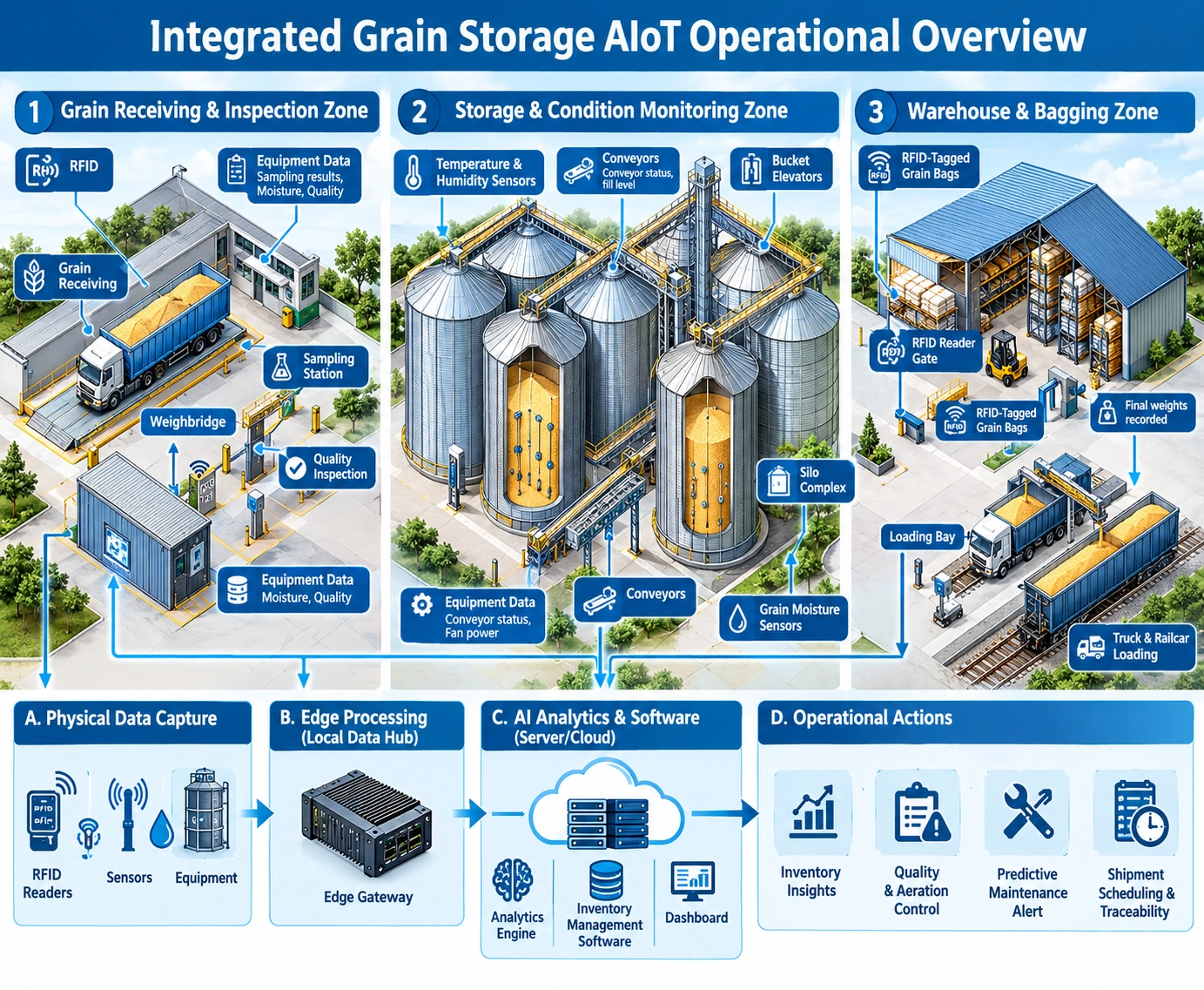
This enterprise infographic illustrates a comprehensive overview of a modern grain storage facility powered by an AIoT (Artificial Intelligence of Things) ecosystem. It demonstrates how diverse data streams—including physical grain movement, RFID tag and reader events, environmental sensor readings (temperature, humidity, moisture), and equipment metrics—are collected from physical operations. This data flows through edge processing to a central AI analysis engine, which processes the information to generate predictive aeration alerts, condition forecasts, inventory insights, and other operational actions to optimize quality management and logistics.
What AI Means for Modern Grain Storage Operations
Artificial Intelligence of Things, commonly called AIoT or AI and IoT, combines artificial intelligence with IoT devices, sensors, connected equipment, and industrial systems. For grain storage, this means that identification events and physical measurements can become inputs to software that detects patterns and supports operational decisions.
A grain storage facility generates many types of information:
- Grain lot and batch identifiers
- Supplier and receiving information
- Weighbridge measurements
- Grain moisture and quality measurements
- Bin and silo assignments
- Temperature readings at different grain depths
- Humidity and environmental conditions
- Conveyor and elevator operating information
- Fan and aeration activity
- Cleaning and drying operations
- Loading and unloading transactions
- Warehouse and yard movements
- Truck and trailer identification
- Equipment inspection records
- Maintenance events
- Shipment and customer records
RFID provides machine-readable identity information for selected physical objects and assets. AI provides a mechanism for interpreting this information together with other operational data. The important engineering principle is that RFID does not independently determine whether grain is deteriorating or whether a storage condition is unsafe. Instead, RFID establishes reliable identity and location relationships, while sensors and operational systems provide the measurements that AI can analyze.
For example, an RFID event can establish that a tagged grain container entered a receiving area. A moisture measurement can characterize the grain condition. A temperature sensor can provide information about the associated storage location. Inventory software can establish the quantity and lot record. AI can then evaluate these data streams for inconsistencies, abnormal conditions, or patterns associated with elevated operational risk.
GAO’s RFID and IoT hardware can therefore serve as part of a larger grain storage information system rather than being treated as a standalone identification system.
Grain Storage Applications for AI, RFID, and Connected Sensing
Grain Receiving and Lot Identification
Receiving is one of the most important points for establishing reliable grain identity. Grain arriving from farms, cooperatives, suppliers, or other storage facilities may need to be associated with supplier information, commodity type, variety, quality measurements, weight, moisture level, inspection results, and receiving time.
RFID can identify reusable containers, pallets, handling units, sampling equipment, or other physical assets associated with receiving operations. Where grain is handled in bulk, RFID is generally more useful for identifying the associated lot, handling unit, equipment, or transaction than for attempting to tag individual kernels.
AI can compare receiving information against historical records and expected operational patterns. Examples include identifying unusual moisture readings, detecting inconsistencies between physical movements and inventory transactions, and flagging receiving records that require additional inspection.
Silo and Bin Inventory Management
Grain storage facilities often manage multiple bins, silos, warehouses, and temporary storage locations. Inventory accuracy becomes difficult when material is transferred repeatedly between receiving, cleaning, drying, storage, blending, and shipping operations.
An RFID-enabled system can associate physical handling events with storage transactions. AI can then reconcile these events with weighbridge data, inventory records, and sensor measurements.
Useful applications include:
- Detecting discrepancies between recorded and observed material movements
- Identifying unexpected handling sequences
- Associating grain lots with specific storage locations
- Improving transfer records between bins and silos
- Supporting inventory reconciliation
- Identifying unusual dwell times
- Improving visibility into storage capacity utilization
- Supporting batch and lot traceability
Grain Quality and Storage-Condition Monitoring
Temperature, moisture, humidity, airflow, and aeration are important factors in maintaining stored-grain quality. Sensor networks can continuously collect measurements from storage environments, while RFID provides identity relationships between storage locations, equipment, inspection assets, and operational records.
AI can analyze historical and current measurements to identify abnormal temperature trends, unusual moisture conditions, sensor deviations, or patterns that warrant operator inspection.
This approach is different from simply configuring a high-temperature alarm. A conventional alarm may react when a measurement exceeds a fixed threshold. AI can evaluate the direction, rate of change, duration, location, historical behavior, and relationships between multiple measurements.
For example, a gradually increasing temperature in one region of a grain storage structure may deserve attention even before a predefined alarm threshold is reached. AI can prioritize such events for inspection while maintaining human oversight over decisions involving grain handling or safety.
Conveyor, Elevator, and Handling-Asset Visibility
Grain storage depends heavily on material-handling equipment such as bucket elevators, belt conveyors, screw conveyors, drag conveyors, augers, grain dryers, fans, aeration systems, and loading equipment.
RFID can identify maintenance tools, mobile equipment, inspection assets, containers, or other reusable physical resources. BLE or other IoT technologies can supplement RFID where continuous location information is required.
AI can combine equipment operating data with maintenance records and movement information to identify abnormal utilization patterns, repeated service requirements, or operational bottlenecks.
This can help storage operators move from reactive equipment management toward condition-informed maintenance planning.
Shipment Verification and Outbound Traceability
Outbound grain handling requires accurate association between the grain being loaded, its lot information, customer or destination, shipment record, vehicle, and relevant quality documentation.
RFID can provide an automated identity checkpoint for tagged handling assets or shipment-related equipment. AI can compare RFID events, weighing information, inventory transactions, and shipment orders.
A mismatch can trigger an exception for human review before shipment completion. This provides an additional control against incorrect lot selection, missing transactions, or discrepancies between physical and digital records.
Key Grain Storage Challenges Addressed by AI
Inventory Discrepancies
Grain inventories can become difficult to reconcile when material passes through several processes and storage locations. Manual entries, delayed transactions, scale differences, unrecorded transfers, and incorrect bin assignments can create discrepancies.
AI can identify unusual relationships between physical identification events, weighing information, storage records, and inventory transactions. The objective is not to replace inventory controls but to identify exceptions that deserve investigation.
Limited Visibility Across Storage Locations
A facility may have numerous bins, silos, warehouses, yards, receiving points, and loading areas. Operators need to understand where material and supporting assets are located without relying entirely on manual checks.
RFID provides automated identification at defined read points. Other connected sensors can provide continuous measurements where necessary. AI can consolidate these observations into operational information that is easier to interpret.
Grain Quality Risk
Stored grain can experience changing environmental conditions that require monitoring and intervention. Static thresholds alone may not provide sufficient context for identifying developing problems.
AI-based analysis can examine time-series sensor data, storage location, grain characteristics, aeration activity, and historical patterns. This can help operators prioritize inspections and investigate developing anomalies.
Manual Data Entry
Paper-based inspection records and manually entered movement transactions can introduce delays and transcription errors. Automated identification and sensor collection can reduce the amount of information operators must enter manually.
The strongest results occur when automated data capture is integrated with existing grain inventory, weighing, quality, maintenance, and shipment software rather than creating another isolated database.
Equipment and Maintenance Visibility
Grain handling equipment operates under demanding conditions involving dust, vibration, mechanical loading, and continuous material movement. Maintenance teams need reliable information about inspections, service history, equipment identity, and operating conditions.
AI can help identify recurring maintenance patterns and prioritize equipment requiring inspection. RFID can provide automated identification for selected maintenance assets, tools, components, or inspection records.
AI and RFID Grain Storage System Components
A practical deployment normally combines several technical layers. The exact configuration depends on whether the facility handles bulk grain, bagged grain, palletized products, or a combination of these operations.
RFID Hardware
UHF RFID is generally suitable for longer-range identification at receiving points, warehouse areas, loading zones, and controlled read locations. UHF tags can be selected according to mounting surface, environmental exposure, read range, and attachment method.
HF RFID can be appropriate for short-range identification where controlled proximity is preferred. LF RFID can be considered for specialized applications involving compatible tags and readers, particularly where short-range identification and specific environmental characteristics make it appropriate.
Reader selection should consider antenna placement, metal structures, dust, moisture, machinery, tag orientation, conveyor speed, expected read density, and the required read zone. Grain facilities frequently contain large metal structures and electrically noisy equipment, so field testing is important before committing to a large installation.
Environmental and Grain Sensors
RFID identification alone does not provide grain-condition measurements. Grain storage systems can incorporate temperature cables, moisture sensors, humidity sensors, airflow measurements, ambient environmental sensors, and equipment telemetry.
These measurements provide the physical context needed by AI models.
Edge Computing and Communications
RFID readers and IoT sensors require reliable communication with processing systems. Ethernet is common for fixed industrial equipment, while Wi-Fi or cellular connectivity may support selected mobile or remote assets.
Edge computing can process RFID events and sensor data close to the grain storage operation. This reduces unnecessary data transmission and can support rapid local responses when connectivity to a remote server or cloud service is temporarily unavailable.
Middleware and Event Processing
RFID middleware converts raw reader observations into useful events. Instead of storing every raw radio observation as a business transaction, software can filter duplicate reads, apply time windows, associate antennas with locations, and generate events such as:
- Grain handling asset detected at receiving
- Container entered a defined storage zone
- Equipment passed a controlled checkpoint
- Shipment-related asset reached loading
- Unexpected movement detected
This event layer is important because AI models require structured operational data rather than uncontrolled streams of duplicate RFID reads.
AI and Machine Learning Software
AI software can apply anomaly detection, time-series analysis, classification, forecasting, predictive maintenance methods, optimization models, and other machine learning techniques.
For grain storage, models can analyze relationships among storage conditions, grain characteristics, movement history, equipment activity, inventory records, and operational schedules.
The model should remain explainable enough for operators and engineers to understand why an alert or recommendation was produced, especially when the result could influence grain handling, inspection, aeration, drying, or shipment decisions.
Cloud Version and Server Version
A Cloud Version can host grain storage software and AI processing in managed cloud infrastructure. This approach can be appropriate for organizations operating multiple storage facilities that need centralized analytics, fleet-wide reporting, remote monitoring, and shared software management.
A Server Version can run on an edge server, customer-managed server, private data center, facility server, or other privately hosted infrastructure. This can be appropriate when grain storage operations require greater control over data location, local processing, connectivity independence, or integration with existing private systems.
A hybrid design can also place time-sensitive RFID and sensor processing near the storage operation while sending selected operational data to centralized cloud services for broader analytics.
RFID and IoT-Enabled Grain Storage Facility with Real-Time Traceability
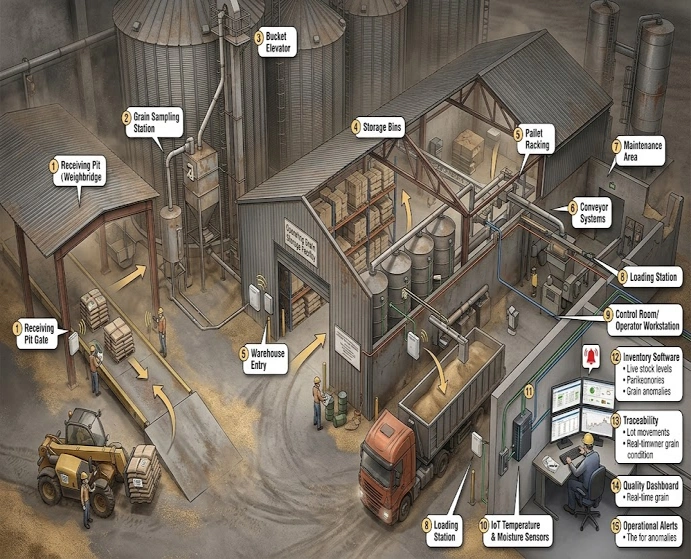
This detailed illustration depicts a realistic, industrial grain storage environment with integrated RFID asset tracking and IoT monitoring systems. Key infrastructure components—including receiving pits, bucket elevators, grain sampling stations, storage bins, and loading bays—are outfitted with UHF RFID reader checkpoints and environmental sensors. Physical movements of grain lots and equipment pass data through an edge server directly into the control room’s inventory, traceability, and AI-driven quality dashboards.
Grain Storage Data Flow from Physical Events to AI Decisions
A reliable AI-driven grain storage solution begins with accurate physical data acquisition. The first stage is identifying the operational event that matters, such as receiving a grain lot, moving a handling unit, assigning material to a storage location, inspecting a silo, beginning aeration, or loading a shipment.
RFID readers capture identification events when tagged objects enter defined read zones. Sensors collect environmental or grain-condition measurements. Weighbridges and quality systems contribute quantitative measurements, while equipment controllers and maintenance systems provide additional operational context.
The data then passes through communication networks to edge processing or centralized software. Edge processing can normalize timestamps, filter duplicate RFID observations, validate device messages, and associate an event with a specific facility location.
The resulting operational events can then be matched with inventory and transaction records. This creates a structured data foundation for AI analysis.
For example, a storage event can contain relationships such as:
- Grain lot identifier
- Storage bin or silo identifier
- RFID reader and antenna location
- Detection timestamp
- Weight transaction
- Moisture measurement
- Temperature measurements
- Equipment involved
- Operator or process reference
- Previous storage location
- Destination location
- Related inventory transaction
AI models can use these relationships to detect anomalies, forecast trends, identify unusual movement patterns, and prioritize operational exceptions. The final step is a business action such as operator inspection, inventory reconciliation, maintenance scheduling, quality review, storage reassignment, or shipment verification.
The engineering challenge is therefore not simply connecting an RFID reader to software. The system must establish reliable relationships between physical grain movement, storage conditions, equipment activity, inventory transactions, and AI-generated decisions.
AI-Driven Operational Improvements for Grain Storage
Combining AI with RFID-enabled identification and connected sensing can improve grain storage operations by connecting physical events with the information used to manage inventory, quality, equipment, and shipments. The greatest value generally comes from integrating several operational data sources rather than deploying RFID in isolation.
More Accurate Grain Inventory and Lot Traceability
AI can continuously compare RFID events, weighing records, storage transactions, and movement histories. When the expected movement sequence differs from observed activity, the system can generate an exception for review.
This is particularly useful when grain moves through receiving, cleaning, drying, temporary storage, permanent storage, blending, and shipment. Instead of depending entirely on manually entered location information, automated identification creates additional evidence about physical handling events.
Potential improvements include:
- Faster inventory reconciliation
- Better grain-lot visibility
- Reduced manual transaction entry
- Improved storage-location accuracy
- Faster investigation of inventory discrepancies
- Stronger shipment verification
- More complete historical movement records
Earlier Detection of Storage Anomalies
AI can evaluate temperature, moisture, airflow, aeration activity, and historical trends rather than relying only on isolated threshold alarms.
A model can recognize changes that may require inspection and rank alerts according to operational significance. Operators can then focus attention on storage locations showing unusual behavior rather than manually reviewing every sensor reading.
Such systems should remain decision-support tools. Grain storage personnel should retain authority over physical inspection, aeration, grain movement, drying, conditioning, and other operational interventions.
Predictive Maintenance for Grain Handling Equipment
Conveyors, bucket elevators, fans, dryers, augers, motors, bearings, and other mechanical equipment can generate operating and maintenance information.
AI can analyze equipment utilization, fault events, inspection history, service intervals, vibration information where available, and other telemetry to identify maintenance patterns.
RFID can supplement this process by associating inspection tools, maintenance assets, components, or service records with specific equipment.
The resulting workflow can help maintenance teams answer practical questions:
- Which equipment requires inspection?
- Which assets have recurring service problems?
- Which equipment is being used more heavily than expected?
- Which maintenance activities remain outstanding?
- Where are inspection or maintenance resources located?
Improved Shipment and Loading Control
Outbound loading creates a final opportunity to verify that the correct grain, quantity, handling unit, and transaction are associated with the intended shipment.
AI can compare order information with inventory availability, physical identification events, weighing data, and loading activity. An exception can be raised when the observed sequence does not correspond to the expected transaction.
This type of control is especially useful where multiple grain lots or grades are stored within the same facility and where shipment accuracy has financial or contractual consequences.
Better Utilization of Storage Capacity
AI can analyze storage occupancy, historical throughput, expected receipts, shipment schedules, grain characteristics, and storage-location constraints.
The resulting recommendations can support decisions about where incoming grain should be assigned and how storage capacity should be allocated. RFID events provide additional physical evidence about handling activities and location transitions.
The objective is not simply to maximize storage utilization. Operators must also consider grain compatibility, quality requirements, turnover, aeration requirements, cleaning procedures, contamination controls, and equipment accessibility.
Engineering Considerations for Grain Storage RFID Deployment
Tag Selection and Mounting
RFID tag performance depends heavily on the physical environment. Grain facilities contain metal silos, conveyors, motors, structural steel, electrical equipment, dust, moisture, and moving machinery.
Tag selection should therefore consider:
- Operating temperature
- Moisture exposure
- Attachment surface
- Metal proximity
- Required read distance
- Reader power
- Antenna orientation
- Mechanical impact
- Cleaning procedures
- Expected service life
A tag that performs well on cardboard may behave very differently when attached to metal equipment. Engineering validation should therefore occur in the actual grain-storage environment.
Reader and Antenna Placement
RFID readers should be positioned around meaningful operational checkpoints rather than simply distributed throughout a facility.
Possible read locations include receiving areas, controlled conveyor transfer points, warehouse entrances, maintenance stores, loading stations, and equipment checkpoints.
Antenna placement must account for the direction and speed of movement. Uncontrolled read zones can create duplicate or ambiguous events, especially around conveyors and loading areas.
Read-Event Filtering
Raw RFID observations can contain multiple reads of the same tag. Middleware should consolidate these observations into meaningful events.
For example, instead of recording dozens of antenna observations while a tagged asset remains near a reader, software can create one event such as:
Asset detected at loading checkpoint at 14:32.
This event can then be associated with the appropriate shipment, work order, or inventory transaction.
Environmental Interference
Grain storage facilities can create challenging radio-frequency conditions. Large metal surfaces, electrical motors, variable-frequency drives, cables, moving equipment, and structural components can affect RFID performance.
Site surveys and pilot testing should evaluate actual tag-reader combinations, antenna positions, reader power settings, read-zone boundaries, and interference conditions.
RFID commissioning should include operational tests during normal equipment activity rather than only static tests when machinery is turned off.
Integration with Existing Grain Software
An AI and RFID system should normally exchange information with existing software rather than forcing operators to maintain parallel records.
Relevant integration targets may include:
- Grain inventory management software
- Warehouse management systems
- ERP systems
- Quality management software
- Laboratory information systems
- Maintenance management systems
- Weighbridge software
- SCADA systems
- PLC-controlled equipment
- Transportation management software
- Shipment and order-management applications
- Business intelligence software
Common integration methods include REST APIs, database interfaces, message queues, MQTT for appropriate IoT applications, OPC UA for industrial equipment integration, and structured event interfaces.
The correct interface depends on the existing facility controls, data ownership, cybersecurity requirements, and software capabilities.
Cybersecurity and Data Protection for AI Grain Storage Systems
Connected grain storage systems introduce additional digital interfaces between RFID readers, sensors, industrial equipment, software, and enterprise networks. Cybersecurity should therefore be considered during system design rather than added after commissioning.
Important controls include:
- Unique credentials for connected devices
- Role-based access controls
- Network segmentation between operational technology and business networks
- Encryption for appropriate data exchanges
- Secure API authentication
- Controlled remote administration
- Device inventory and lifecycle management
- Logging and audit trails
- Regular software and firmware maintenance
- Backup and recovery procedures
- Monitoring for unauthorized access
- Secure configuration of edge and server systems
RFID itself should not be treated as a complete cybersecurity control. The broader system requires protection at the device, network, application, server, database, and user-access levels.
AI introduces additional considerations. Training datasets should be validated, model inputs should be monitored for abnormal values, and changes to models should be controlled. Operators should also be able to distinguish between measured sensor information, RFID-derived events, software-generated alerts, and AI recommendations.
For facilities connected to industrial control systems, cybersecurity design should also consider applicable operational-technology security practices and the facility’s existing risk-management procedures.
Grain Storage Implementation and Commissioning Approach
A successful implementation normally begins with operational mapping rather than hardware installation.
Map Grain Storage Processes
Document the movement of grain and supporting assets from receiving through final shipment. Identify where identity, quality, inventory, environmental, and equipment information is currently generated.
This process should include receiving personnel, grain quality technicians, elevator operators, maintenance teams, inventory personnel, IT staff, and management.
Identify High-Value Automation Points
Not every physical location requires RFID. The strongest deployment candidates are checkpoints where automated identification directly supports an operational decision.
Examples include receiving, controlled transfers, equipment stores, maintenance checkpoints, warehouse entrances, and shipment verification.
Conduct an RFID Site Survey
Test representative tags, readers, antennas, mounting positions, reader power, read-zone boundaries, and network connectivity under actual operating conditions.
Testing should include equipment running normally, because electrical and mechanical operating conditions can influence performance.
Establish the Data Model
Define relationships among grain lots, storage locations, handling assets, equipment, transactions, sensor measurements, shipments, and timestamps.
A well-designed data model is essential for AI because the model must understand the operational relationship between an observation and the physical process it represents.
Integrate Before Scaling
A pilot should demonstrate the complete transaction rather than only successful RFID reads.
For example, a receiving test should demonstrate:
Physical arrival → identification → weighing → quality record → storage assignment → inventory update → AI analysis → operator action.
This provides much stronger validation than testing whether a tag can simply be detected by a reader.
Commission and Validate
Commissioning should verify read performance, event accuracy, network reliability, software integration, alert behavior, cybersecurity controls, backup procedures, and operator workflows.
User acceptance testing should involve actual grain storage personnel because an technically correct system can still fail operationally if alerts are difficult to understand or workflows do not match how the facility operates.
Scaling AI and RFID Across Grain Storage Facilities
A pilot at one grain elevator or storage facility should establish reusable standards before expansion.
Organizations operating multiple grain storage sites can standardize tag identification schemes, event definitions, device naming, API interfaces, cybersecurity controls, data models, and KPI definitions.
Scaling should not assume that every facility has identical physical characteristics. A flat warehouse may have very different RFID requirements from a tall grain elevator with multiple silos and long conveyor routes.
A scalable deployment can therefore standardize the software and data model while adapting the physical RFID layer to each facility.
AI models may also require site-specific calibration. Differences in grain varieties, climate, storage structures, sensor placement, operating practices, and equipment can influence the data distribution used by machine-learning models.
Operational teams should monitor model performance after deployment and periodically review false positives, missed events, changing sensor behavior, and process changes.
Practical Design Recommendations for AI and RFID in Grain Storage
A technically sound grain storage solution should follow several principles.
- Start with a clearly defined grain-storage problem such as inventory discrepancy, lot traceability, storage-condition monitoring, shipment verification, or equipment maintenance.
- Use RFID where physical identification adds measurable operational value.
- Use sensors for physical conditions that RFID cannot measure, including temperature and moisture.
- Place readers at controlled operational checkpoints rather than attempting indiscriminate facility-wide coverage.
- Test RFID tags on the actual surfaces and equipment where they will be installed.
- Process raw RFID observations into meaningful operational events before feeding them into AI systems.
- Integrate the solution with existing grain inventory, quality, weighing, maintenance, and shipment systems.
- Keep AI recommendations traceable to the underlying measurements and events.
- Retain human approval for operational decisions involving grain quality, equipment intervention, and safety.
- Design cybersecurity controls across devices, networks, applications, servers, and user accounts.
- Establish baseline KPIs before deployment.
- Validate the complete operational workflow during pilot testing.
- Design for local processing where connectivity reliability or response time requires it.
- Use cloud deployment where centralized multi-site analytics and remote management provide clear operational value.
- Use privately hosted server deployment when local control, data-location requirements, or integration constraints make it more suitable.
- Reassess tag performance, sensor calibration, software interfaces, and AI model performance as operating conditions change.
GAO Expertise in RFID and Connected Grain Storage Systems
GAO provides RFID, BLE, and IoT hardware products and systems that can support identification, asset visibility, monitoring, and connected operational workflows in grain storage environments. Our experience with RFID deployments provides practical insight into reader placement, tag selection, data capture, integration, and field commissioning.
Headquartered in New York City and Toronto, Canada, GAO is ranked among the top 10 leading B2B and B2G suppliers of BLE and RFID technologies globally. GAO and sister companies GAO Research and GAO Tek form GAO Group, with operations based in New York City and Toronto.
For three decades, GAO Group has served organizations across the United States and Canada, including Fortune 500 companies, leading research and development organizations, prestigious universities, and U.S. and Canadian government agencies. The group has invested heavily in research and development and maintains stringent quality assurance processes, while providing expert technical support remotely or onsite.
For grain storage operators, system integrators, and engineering teams, this combination of hardware capability and technical support can be useful when moving from an RFID proof of concept toward a production-grade connected grain-storage system.
Key Takeaways for AI-Enabled Grain Storage
AI and RFID can improve grain storage when they are applied to specific operational problems rather than treated as standalone technologies. RFID provides reliable identification at selected physical checkpoints, while sensors provide measurements of grain and storage conditions. AI can connect these observations with inventory, quality, equipment, and shipment information to identify anomalies and support decisions.
The strongest implementations begin with process mapping, accurate data modeling, appropriate tag and reader selection, controlled read zones, reliable communications, software integration, cybersecurity, and measurable KPIs. Cloud, server, edge, or hybrid deployment should be selected according to the facility’s operational and data requirements.
GAO can support organizations evaluating RFID, BLE, and IoT hardware and connected systems for grain storage applications. Readers interested in developing a deployment strategy can explore GAO’s technology resources, engineering support, and relevant RFID and IoT solutions for their specific storage environment.
Building the Future of Industrial AI and IoT with Aperture Venture Studio and GAO RFID Inc.
For more than three decades, GAO Group of Companies has invested heavily in R&D of industrial RFID, BLE, and IoT. As generative AI became useful for industrial applications, we expanded our work in AI and IoT, including RFID and BLE, and founded Aperture Venture Studio to develop AI and IoT solutions relevant to applications such as intelligent grain storage, traceability, asset visibility, and industrial monitoring.
Aperture has attracted AI and IoT technical experts, entrepreneurial and operational executives, influential investors, and leading companies.
We have also developed Aperture Ventures Summit and TekSummit to discuss advanced AI and IoT topics.
These activities have helped build technical communities around industrial AI and IoT.
We welcome you to join us as:
- Advisors, Co-founders, or Employees
- Investors
- Customers