
Ai and BLE for Technical Education
AI-Driven Technical Education Using BLE Solutions
Artificial intelligence is transforming technical education by enabling intelligent laboratories, connected classrooms, predictive facility management, and data-driven academic operations. Combined with Bluetooth Low Energy (BLE) technologies, AI-powered technical education solutions provide real-time visibility into educational assets, laboratory equipment, student engagement, instructor resources, and campus infrastructure across engineering colleges, vocational institutes, polytechnic schools, research laboratories, and university innovation centers.
Technical education institutions manage sophisticated laboratories, expensive engineering equipment, research assets, specialized classrooms, and safety-critical environments that require continuous monitoring and efficient utilization. AI analyzes operational information collected from BLE beacons, BLE sensors, BLE gateways, laboratory software, learning management systems, and campus management applications to optimize equipment utilization, improve laboratory scheduling, enhance student safety, automate attendance, and support informed academic decision-making.
Organizations implementing AI-enabled BLE solutions benefit from improved laboratory efficiency, increased asset visibility, better learning experiences, enhanced campus safety, and more effective resource planning. Through decades of supplying BLE, RFID, and industrial IoT hardware, GAO has supported universities, research institutions, government organizations, and technology-focused campuses implementing reliable connected solutions.
AI-Enabled BLE Technical Education Campus for Intelligent Learning and Operations
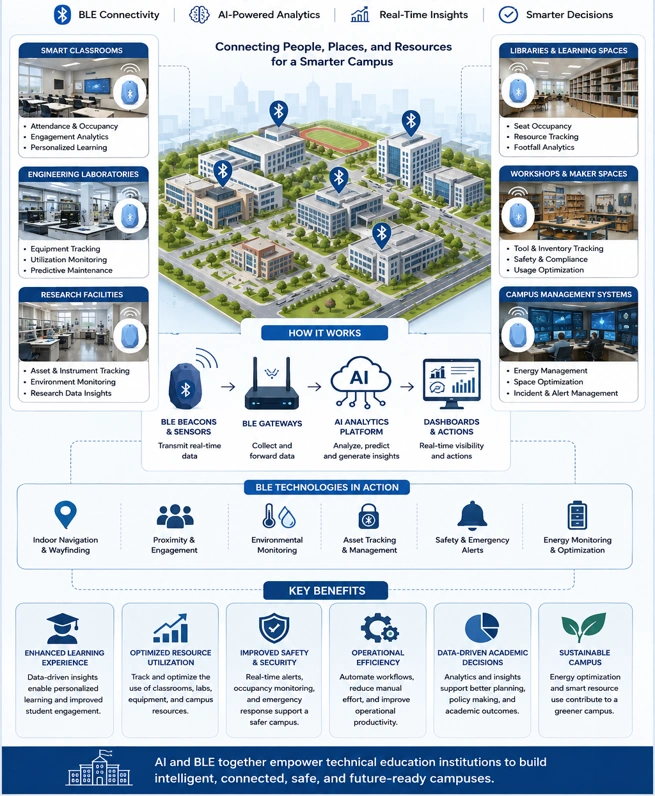
This infographic illustrates how AI and Bluetooth Low Energy (BLE) technologies connect engineering laboratories, smart classrooms, research facilities, libraries, workshops, and campus management systems into an intelligent technical education environment. It demonstrates how BLE beacons, gateways, sensors, and AI analytics deliver real-time visibility, optimize resource utilization, improve student and faculty experiences, enhance campus safety, and support data-driven academic decision-making.
Understanding AI-Powered Technical Education
Modern technical education extends well beyond classroom instruction. Engineering colleges, polytechnic institutes, research laboratories, electronics workshops, robotics centers, manufacturing laboratories, computer laboratories, and innovation hubs require coordinated management of people, equipment, instructional resources, and physical infrastructure.
Artificial Intelligence enables educational institutions to transform operational data into actionable intelligence. Machine learning models evaluate laboratory utilization, classroom occupancy, equipment availability, student engagement, maintenance schedules, energy consumption, and curriculum delivery performance.
BLE technologies provide continuous indoor location awareness and low-power sensing capabilities that support these intelligent educational operations. BLE beacons transmit location identifiers throughout campus buildings, BLE gateways aggregate information from connected devices, and BLE sensors monitor environmental conditions such as temperature, humidity, occupancy, vibration, and air quality within laboratories and classrooms.
Unlike manual attendance registers, spreadsheet-based equipment tracking, or periodic facility inspections, BLE-enabled AI systems continuously collect operational information. AI converts this information into recommendations that improve teaching efficiency, optimize laboratory scheduling, reduce equipment downtime, and enhance campus experiences for students, faculty members, researchers, and administrators.
Technical education institutions increasingly seek digital transformation initiatives that improve operational efficiency while supporting experiential learning, laboratory safety, and research productivity. AI-assisted BLE systems provide the operational intelligence needed to achieve these objectives.
Why AI Is Transforming Technical Education
Technical education institutions face increasingly complex operational challenges driven by expanding student populations, sophisticated laboratory environments, industry collaboration, digital learning initiatives, and growing research activities.
Several challenges make AI especially valuable:
- Laboratory scheduling conflicts
- Underutilized engineering equipment
- Difficulty locating shared laboratory assets
- Student attendance monitoring
- Workshop safety management
- Preventive maintenance planning
- Classroom occupancy optimization
- Energy management
- Research asset utilization
- Campus security monitoring
- Laboratory environmental control
- Faculty workload balancing
AI addresses these challenges by identifying operational patterns that traditional administrative systems cannot easily recognize.
Predictive analytics estimate laboratory demand based on course schedules, enrollment trends, semester calendars, historical utilization, and research activities.
Computer vision can complement BLE technologies by monitoring laboratory occupancy while respecting institutional privacy policies.
Natural language processing assists educators by summarizing academic reports, analyzing student feedback, and identifying curriculum improvement opportunities.
Reinforcement learning continuously optimizes classroom allocation, laboratory bookings, and equipment utilization as institutional priorities evolve.
GAO has observed increasing adoption of intelligent BLE technologies within universities seeking improved visibility into educational resources while reducing administrative overhead.
AI-Enabled BLE Technical Education Campus for Intelligent Learning and Smart Campus Operations
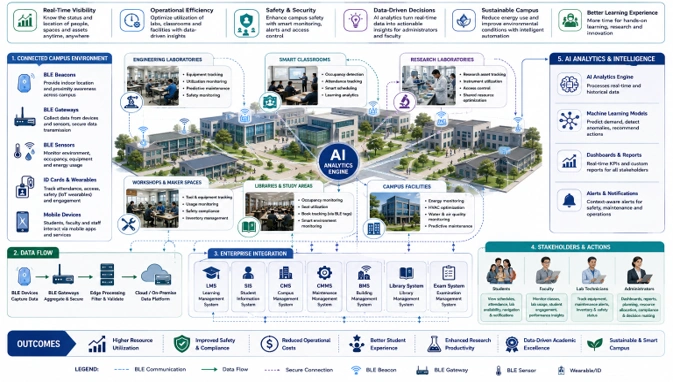
This infographic illustrates how Artificial Intelligence (AI) and Bluetooth Low Energy (BLE) technologies integrate classrooms, engineering laboratories, research facilities, libraries, workshops, and campus management systems into a connected smart campus. It highlights the flow of data from BLE beacons and sensors through gateways to AI analytics platforms, enabling real-time monitoring, predictive insights, resource optimization, enhanced safety, and data-driven academic decision-making. The key takeaway is that AI-powered BLE infrastructure improves learning experiences while increasing operational efficiency and sustainability across technical education institutions.
Technical Education Applications Enabled by AI and BLE
AI-enabled BLE solutions support nearly every operational function across engineering institutions, technical universities, vocational training centers, and research campuses.
Intelligent Laboratory Management
Engineering laboratories contain expensive oscilloscopes, CNC machines, robotics equipment, programmable logic controllers, industrial automation trainers, network analyzers, testing instruments, and research devices.
AI continuously evaluates laboratory occupancy, equipment availability, maintenance history, reservation schedules, and utilization rates.
BLE-enabled location tracking automatically identifies equipment movement while AI recommends improved scheduling to maximize laboratory usage.
Benefits include:
- Improved laboratory utilization
- Reduced equipment search time
- Better reservation management
- Lower maintenance costs
- Increased practical training availability
Smart Classroom Management
BLE-enabled occupancy monitoring provides real-time information regarding classroom utilization.
AI analyzes:
- Student attendance
- Classroom occupancy
- Faculty schedules
- Course demand
- Room utilization
- Environmental conditions
Institution administrators can optimize classroom assignments while reducing scheduling conflicts and improving facility utilization.
Research Asset Tracking
Research laboratories frequently share expensive instruments among multiple departments.
BLE beacons attached to portable laboratory equipment enable continuous asset visibility.
AI detects unusual movement patterns, predicts equipment demand, and recommends optimized allocation strategies that improve research productivity while reducing unnecessary equipment purchases.
Campus Safety Monitoring
Safety remains a critical priority within engineering workshops, chemical laboratories, electrical laboratories, fabrication facilities, and robotics laboratories.
BLE sensors continuously monitor:
- Temperature
- Humidity
- Air quality
- Equipment vibration
- Laboratory occupancy
- Emergency exit accessibility
AI analyzes these conditions to identify anomalies and automatically notify laboratory supervisors before minor issues escalate into operational risks.
Operational Workflow from BLE Data Collection to AI Decision-Making
Successful AI-enabled technical education solutions depend upon continuous operational information collected from connected educational environments.
Data Acquisition
BLE beacons, gateways, environmental sensors, wearable devices, laboratory equipment, smart classroom systems, and campus infrastructure continuously generate operational information.
Collected information includes:
- Student location events (where institutionally permitted)
- Laboratory occupancy
- Equipment utilization
- Classroom attendance
- Environmental conditions
- Maintenance indicators
- Building occupancy
- Energy consumption
Communication Infrastructure
BLE gateways receive information transmitted from nearby BLE beacons and sensors.
Edge computing devices preprocess operational information before securely forwarding validated datasets to campus software, reducing unnecessary network traffic and improving response times.
Edge Processing and Intelligent Data Validation
Edge computing devices positioned across laboratories, classrooms, libraries, innovation centers, and campus buildings process BLE events before forwarding information to centralized software. Local processing minimizes network latency and enables immediate responses for time-sensitive educational operations such as laboratory access control, equipment checkout, and environmental monitoring.
Typical edge processing tasks include:
- Filtering duplicate BLE beacon signals
- Validating student and faculty identification events
- Aggregating occupancy information
- Detecting abnormal environmental readings
- Prioritizing safety alerts
- Synchronizing laboratory equipment status
- Compressing sensor data for efficient transmission
This distributed processing approach reduces bandwidth consumption while ensuring critical operational events remain available even during temporary network interruptions.
Enterprise Software Integration
AI-powered BLE solutions exchange operational information with numerous software systems used throughout technical education institutions.
Common integrations include:
- Learning Management Systems (LMS)
- Student Information Systems (SIS)
- Campus Management Systems
- Laboratory Information Management Systems (LIMS)
- Computerized Maintenance Management Systems (CMMS)
- Library Management Software
- Identity and Access Management (IAM)
- Timetabling and Scheduling Software
- Energy Management Systems
- Building Management Systems (BMS)
- Business Intelligence Dashboards
Rather than functioning as isolated technologies, BLE devices continuously provide operational information that AI software correlates with academic schedules, laboratory reservations, maintenance records, and campus operations.
GAO has supplied BLE hardware and IoT solutions compatible with widely deployed educational software, enabling institutions to modernize connected campus environments without replacing existing operational systems.
BLE Technologies, AI Software, and Supporting Infrastructure
Successful AI-driven technical education solutions combine BLE hardware, artificial intelligence, campus networking, enterprise software, and cybersecurity controls into an integrated operational environment.
BLE Hardware Components
A typical deployment includes:
- BLE Beacons for indoor positioning and asset identification
- BLE Gateways for collecting and forwarding beacon and sensor data
- BLE Environmental Sensors for monitoring laboratory conditions
- Wearable BLE devices for authorized personnel or student safety applications
- Smart ID badges
- Mobile devices supporting BLE communication
- Edge gateways
- Wireless access points
- Network switches
Each hardware component contributes to accurate indoor visibility while maintaining low power consumption and scalable campus coverage.
Artificial Intelligence Software
AI capabilities commonly implemented include:
- Predictive laboratory scheduling
- Equipment utilization forecasting
- Student attendance analytics
- Classroom occupancy optimization
- Preventive maintenance prediction
- Energy consumption optimization
- Indoor navigation assistance
- Academic resource planning
- Security anomaly detection
- Learning analytics dashboards
Machine learning continuously improves prediction accuracy using historical operational information collected across semesters, academic departments, and campus facilities.
Communication Infrastructure
Reliable communication is essential for maintaining continuous BLE connectivity across classrooms, workshops, libraries, research laboratories, and administrative buildings.
Common communication technologies include:
- Bluetooth Low Energy (BLE)
- Wi-Fi 6 and Wi-Fi 6E
- Ethernet
- Private 5G (for large campuses)
- MQTT messaging
- HTTPS APIs
- RESTful web services
- TLS-encrypted communications
- VPN-secured remote connectivity
These communication methods ensure secure exchange of operational information between BLE devices, AI software, and institutional systems.
Cloud and Server Deployment Models
Educational institutions should select deployment models based on campus size, privacy requirements, research activities, regulatory obligations, and IT governance policies.
Cloud Deployment
Cloud-hosted AI software is well suited for universities operating multiple campuses or distributed research facilities.
Advantages include:
- Centralized academic reporting
- Institution-wide analytics
- Simplified software updates
- Elastic computing resources
- Disaster recovery capabilities
- Secure remote administration
- Multi-campus resource optimization
Cloud deployments are particularly valuable for learning analytics, institutional reporting, predictive enrollment planning, and enterprise-wide facility optimization.
Server Deployment
Many technical education institutions maintain privately managed servers to support laboratory operations and protect sensitive academic information.
Typical server-based applications include:
- Laboratory management
- Campus access control
- Local attendance processing
- Equipment tracking
- Examination management
- Research data processing
- High-speed indoor positioning
- Building automation
Server deployments provide lower latency and greater control over sensitive institutional information.
AI-Enabled BLE Workflow Diagram for Smart Technical Education Campus Operations
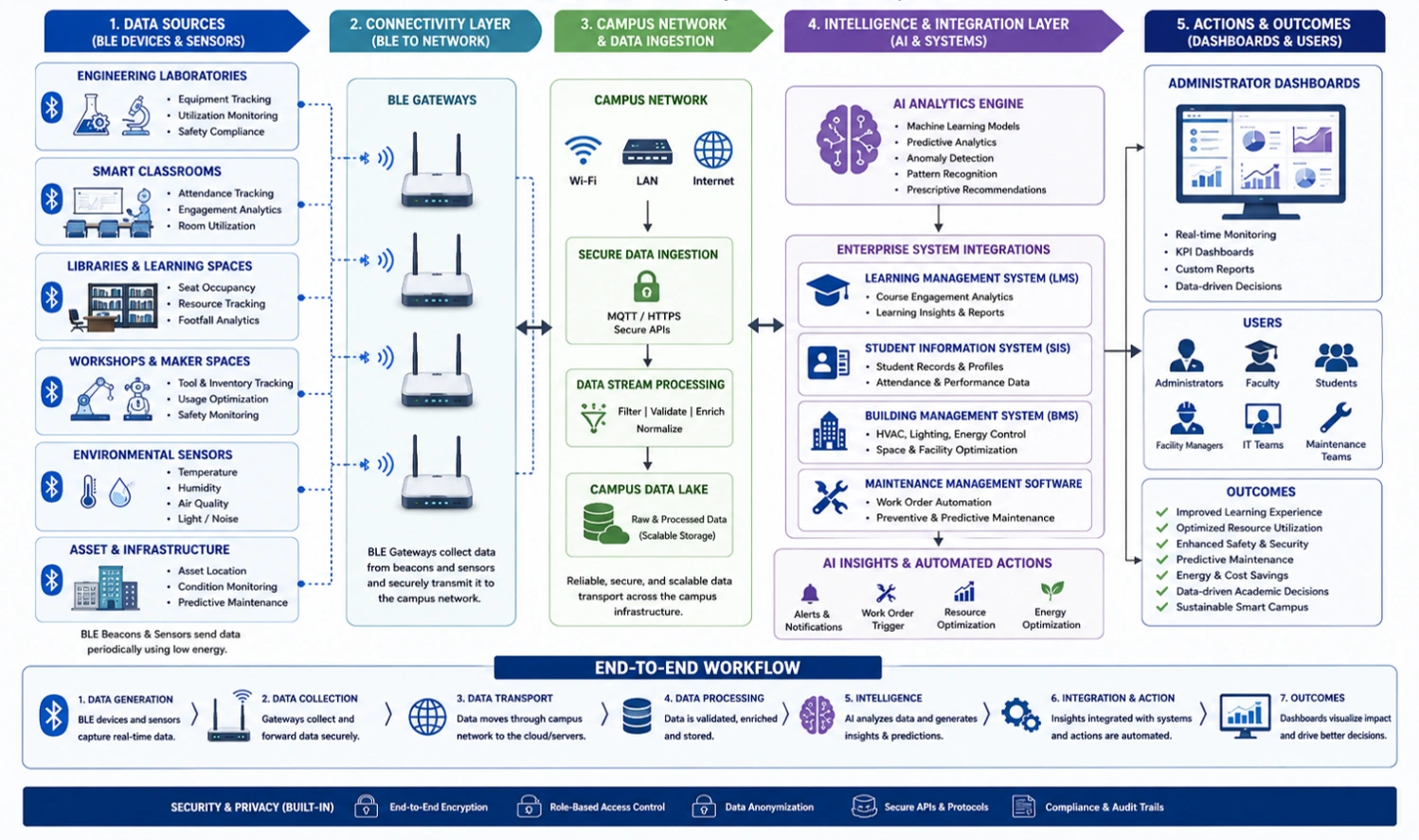
This workflow diagram illustrates the end-to-end flow of data across an AI-enabled Bluetooth Low Energy (BLE) technical education campus, from BLE beacons, sensors, and gateways to AI analytics and enterprise systems. It demonstrates how engineering laboratories, smart classrooms, environmental monitoring, campus networks, Learning Management Systems (LMS), Student Information Systems (SIS), Building Management Systems (BMS), and maintenance software are integrated through intelligent data flows. The key takeaway is that AI-powered BLE infrastructure enables real-time monitoring, predictive analytics, automated decision-making, and optimized campus operations for enhanced learning, safety, and resource management.
Cybersecurity and Data Protection for AI-Enabled BLE Technical Education
Technical education institutions manage sensitive academic records, research data, laboratory access permissions, and campus operational information. As AI-enabled BLE solutions become more integrated into educational environments, cybersecurity and data privacy must be incorporated throughout the deployment lifecycle.
Key cybersecurity measures include:
- Role-Based Access Control (RBAC) for students, faculty, researchers, laboratory technicians, and administrators
- Multi-Factor Authentication (MFA) for administrative portals and remote management
- End-to-end encryption for BLE communications and enterprise data transmission
- Secure device authentication for BLE gateways, beacons, and environmental sensors
- Network segmentation separating academic networks from operational technology (OT) systems
- Continuous firmware management and software patching
- Security Information and Event Management (SIEM) integration for real-time threat monitoring
- Comprehensive audit logs for laboratory access, equipment movement, and administrative actions
- Secure API authentication between AI applications and campus software
Educational institutions should also implement privacy policies that clearly define how location information, attendance records, and operational analytics are collected, stored, and accessed. AI models should process only the information necessary to support educational objectives while complying with institutional privacy requirements.
Regulatory Standards and Compliance Considerations
Although technical education environments are less regulated than healthcare or financial sectors, institutions must comply with education-specific regulations, research governance policies, and cybersecurity standards.
Relevant compliance frameworks may include:
- Family Educational Rights and Privacy Act (FERPA) for student records (United States)
- General Data Protection Regulation (GDPR) for applicable international institutions
- ISO/IEC 27001 Information Security Management
- ISO/IEC 27701 Privacy Information Management
- NIST Cybersecurity Framework
- IEEE standards for educational technology interoperability
- Institutional research ethics policies
- Occupational Safety and Health (OSH) laboratory safety requirements
- Local education authority regulations
- Internal governance and data retention policies
AI-enabled BLE systems should maintain detailed audit trails, automate access logging, support incident investigations, and simplify compliance reporting while protecting institutional data.
AI-Enabled BLE Security and Compliance Architecture for Smart Technical Education Campuses
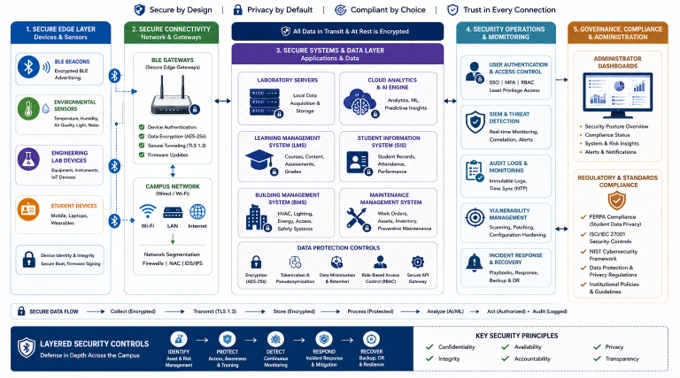
This security and compliance diagram illustrates a layered cybersecurity architecture for an AI-enabled Bluetooth Low Energy (BLE) technical education environment. It shows how BLE devices, gateways, laboratory servers, cloud analytics, Learning Management Systems (LMS), Student Information Systems (SIS), Building Management Systems (BMS), and administrator dashboards are protected through encrypted communications, user authentication, SIEM monitoring, audit logging, and secure data flows. The diagram also highlights FERPA compliance, ISO/IEC 27001 security controls, and defense-in-depth practices that safeguard campus data, privacy, and operational resilience.
Business and Operational Benefits of AI-Driven BLE Technical Education
Combining Artificial Intelligence with BLE technologies delivers measurable improvements across academic operations, laboratory management, campus facilities, and institutional planning.
Key benefits include:
- Improved laboratory utilization through intelligent scheduling
- Higher visibility of engineering and research assets
- Reduced equipment loss and unauthorized movement
- Automated attendance tracking with minimal administrative effort
- Enhanced student and faculty safety through real-time environmental monitoring
- Lower maintenance costs using predictive maintenance models
- Better classroom utilization and space optimization
- Reduced campus energy consumption through occupancy-based automation
- Improved research productivity by maximizing shared equipment availability
- Faster incident response through real-time alerts
- Data-driven academic planning using operational analytics
- Better resource allocation across departments and campuses
- Increased operational efficiency while improving the overall learning experience
By combining AI with BLE-enabled sensing and indoor positioning, institutions can make informed decisions that improve educational outcomes while reducing operational costs.
Engineering Best Practices for Deployment
Successful implementation requires careful planning, interdisciplinary collaboration, and continuous optimization.
Recommended engineering practices include:
- Perform comprehensive wireless site surveys before installing BLE beacons and gateways.
- Design beacon placement to minimize signal interference from laboratory equipment, reinforced concrete structures, and metal enclosures.
- Conduct pilot deployments in selected laboratories before expanding campus-wide.
- Integrate AI software with existing LMS, SIS, BMS, CMMS, and campus management systems.
- Establish governance policies for data quality, cybersecurity, AI model validation, and privacy protection.
- Develop preventive maintenance schedules for BLE hardware and supporting network infrastructure.
- Train faculty, laboratory technicians, IT administrators, and facility managers on system operation and maintenance.
- Continuously evaluate key performance indicators such as laboratory utilization, equipment availability, attendance accuracy, maintenance response time, and energy efficiency.
- Review AI model performance regularly and refine predictive algorithms using updated operational data.
Drawing on more than three decades of supplying BLE, RFID, and industrial IoT hardware, GAO helps educational institutions select reliable connected technologies that support long-term digital transformation initiatives.
Advancing Technical Education with AI and BLE
AI-powered technical education, enabled by BLE technologies, is transforming how engineering colleges, polytechnic institutes, vocational training centers, and research campuses manage educational resources, laboratory operations, and campus facilities. By combining low-power wireless sensing with advanced AI analytics, institutions can improve asset visibility, optimize laboratory utilization, strengthen campus safety, automate attendance, and enhance learning environments.
As technical education increasingly emphasizes smart laboratories, digital learning, and data-driven decision-making, AI-enabled BLE solutions provide the operational intelligence necessary to improve efficiency, support innovation, and prepare institutions for future educational demands. GAO continues to provide dependable BLE, RFID, and IoT hardware solutions that help educational organizations implement scalable, secure, and intelligent connected campus environments.
Building the Future of Industrial AI and IoT with Aperture Venture Studio and GAO RFID Inc.
For more than three decades, GAO Group of Companies has invested extensively in research and development of industrial BLE, RFID, and IoT technologies. As artificial intelligence continues to expand opportunities within technical education and smart campus environments, we have advanced AI-enabled IoT solutions and established Aperture Venture Studio to accelerate the development and adoption of intelligent AI and IoT technologies across education, research, and industrial sectors.
Supported by experienced AI researchers, IoT engineers, operational leaders, and collaborative technical communities through initiatives such as Aperture Ventures Summit and TekSummit, GAO continues to contribute to practical AI and BLE innovation. We welcome collaboration with educational institutions, technology professionals, researchers, investors, and organizations seeking reliable BLE and AI solutions for modern technical education environments.