
AI and RFID for Telecom Operators
How AI and RFID Support Telecom Operator Operations
AI-enabled asset management and field operations are becoming increasingly important for telecom operators managing large inventories of network equipment, distributed facilities, field-service assets, and maintenance activities. RFID provides the physical identification and location data that allows AI-driven software to understand where tagged telecom assets are, how they move, and whether operational events match expected workflows.
For telecom operators, the combination supports use cases such as network equipment inventory, warehouse control, spare-parts management, field-service logistics, data-center asset tracking, tool accountability, and maintenance planning. UHF RFID is particularly useful for bulk identification across warehouses and equipment rooms, while HF and LF RFID can address more specialized identification requirements.
GAO supplies RFID, BLE, and other IoT hardware products and systems that can support telecom operating environments. The resulting solution can connect RFID readers, tags, gateways, edge computing, enterprise software, and AI analytics to improve asset visibility and operational decision-making.
Telecom Operator AI and RFID Operations Overview
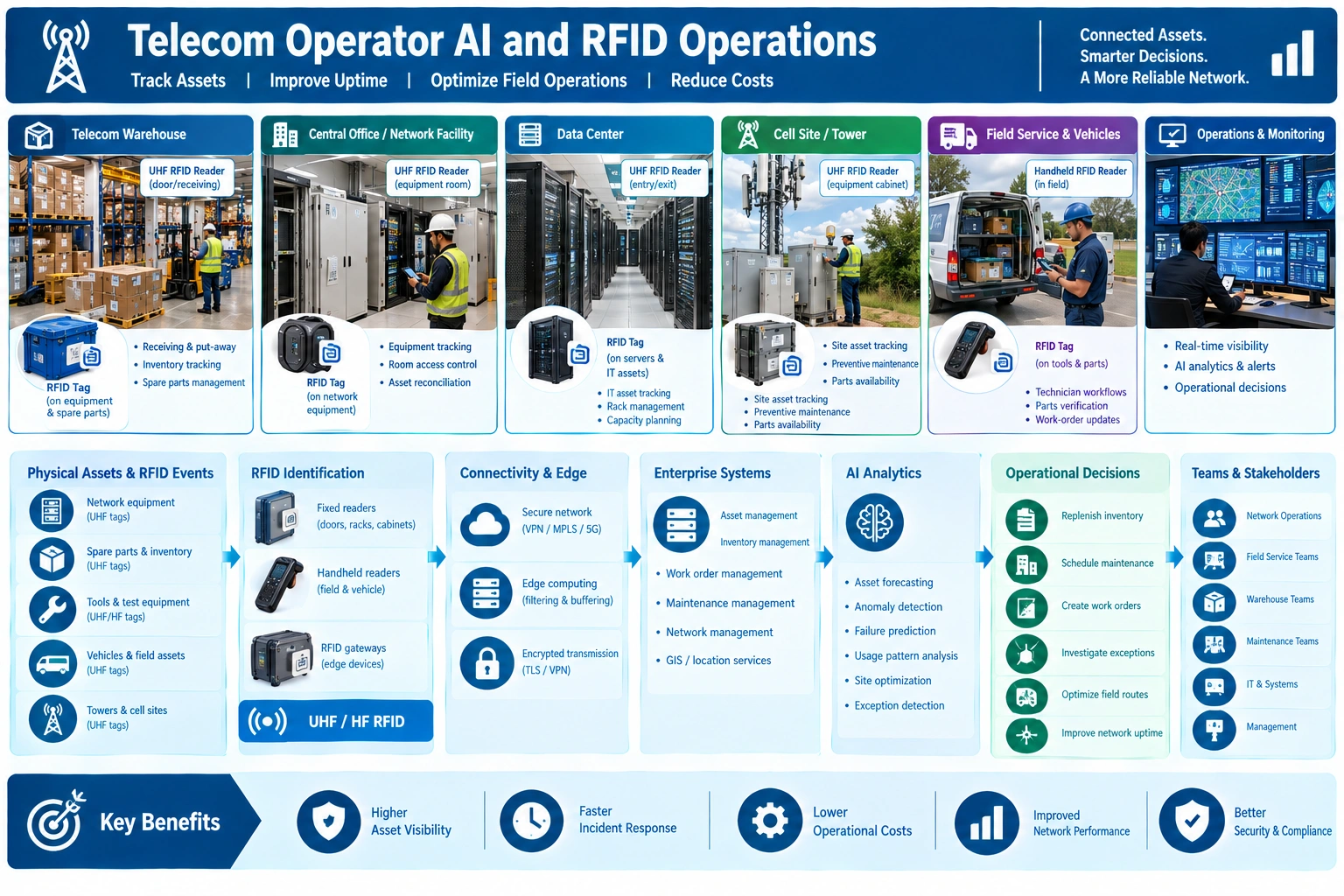
This infographic shows RFID-tagged telecom assets moving through warehouses, network facilities, data centers, cell sites, and field operations into secure connectivity, enterprise systems, AI analytics, and operational decisions.
How AI and RFID Support Telecom Operator Operations
Telecom operators manage asset flows that extend from procurement and central warehouses to network deployment, field maintenance, repair centers, equipment rooms, and remote sites. Equipment can move repeatedly between these locations during installation, maintenance, replacement, refurbishment, and decommissioning.
Common assets include radio units, remote radio units, baseband equipment, antennas, routers, switches, optical networking equipment, power systems, batteries, cabinets, fiber-related equipment, test instruments, tools, spare parts, and maintenance kits. Tracking these assets manually can create discrepancies between physical inventory and records in enterprise systems.
RFID supplies machine-readable identification events. AI adds analytical capability by correlating those events with inventory records, work orders, maintenance schedules, shipment information, technician assignments, and historical movement patterns.
For example, a telecom operator can use RFID to record when a tagged radio unit leaves a warehouse, arrives at a staging location, is assigned to a field-service team, reaches a cell site, and later returns for repair. AI software can compare those events against the expected work order and identify unusual movement, missing equipment, duplicate records, delayed returns, or inventory anomalies.
The value therefore comes from connecting physical asset events with telecom operating processes rather than simply deploying RFID readers.
Telecom Asset and Field-Service Use Cases
Network Equipment Inventory Management
Telecom operators may maintain large inventories of equipment distributed across regional warehouses, field depots, repair facilities, and network locations. AI-assisted RFID inventory management can reconcile physical equipment with enterprise inventory records and identify discrepancies.
UHF RFID is useful when multiple tagged items must be identified rapidly within warehouses, staging areas, or equipment rooms. Fixed readers can capture movement through controlled points, while handheld readers can support periodic cycle counts and field verification.
AI can analyze inventory history to identify unusual shrinkage, repeated discrepancies, slow-moving equipment, and unexpected asset transfers. This allows inventory teams to prioritize investigations instead of relying entirely on manual counting.
Spare Parts and MRO Inventory
Network maintenance depends on timely availability of spare parts and maintenance, repair, and operations inventory. Stockouts can delay restoration work, while excessive inventory ties up capital and warehouse space.
RFID can associate physical spare parts with item records, storage locations, and movement events. AI can use consumption history, failure patterns, maintenance schedules, and regional demand to support replenishment decisions.
For telecom operators, this is particularly relevant to high-value or operationally critical spares that must be available near geographically distributed network assets.
Field Technician Asset Accountability
Technicians frequently carry test instruments, tools, replacement equipment, cables, batteries, and maintenance kits between depots, vehicles, customer locations, and network sites.
RFID can identify equipment issued to a technician or vehicle and record return events. AI can detect patterns such as equipment that remains unreturned beyond a normal service interval, tools repeatedly associated with particular work orders, or assets that appear at unexpected locations.
The operational objective is not simply to know where a tool is. Telecom operations teams can use this information to reduce lost equipment, improve technician readiness, and support more accurate work-order closure.
Cell-Site Equipment Deployment
Cell-site construction and modernization projects require accurate control of equipment moving from warehouses to staging areas and ultimately to remote network locations.
RFID identification can be used during picking, staging, shipment verification, site receipt, and installation. AI software can compare actual movement with project schedules and expected equipment allocations.
An exception can be generated when equipment assigned to one site is routed toward another location, when a required component has not reached the staging area, or when equipment remains in a warehouse beyond its planned deployment date.
Data Center and Central Office Asset Tracking
Telecom operators often maintain network equipment in data centers, central offices, switching facilities, and other controlled technical environments. These locations may contain equipment with different ownership, maintenance, replacement, and configuration requirements.
RFID can provide automated identification at controlled access points and during inventory audits. AI can correlate asset presence with configuration records, maintenance activities, work orders, and decommissioning schedules.
This approach can help operations teams identify equipment that remains physically present after records indicate retirement, or detect discrepancies following equipment replacement activities.
Repair, Refurbishment, and Return Logistics
Failed telecom equipment frequently moves from network locations to repair centers and then back into inventory or field deployment.
RFID can establish a traceable movement history for tagged equipment through collection, transportation, repair intake, diagnostic processing, refurbishment, quality inspection, and redeployment.
AI can analyze repair history and identify recurring failure patterns, abnormal turnaround times, or equipment categories associated with higher return rates. Such information can support maintenance planning and asset lifecycle decisions.
Telecom RFID Deployment: From Warehouse to Network Sites
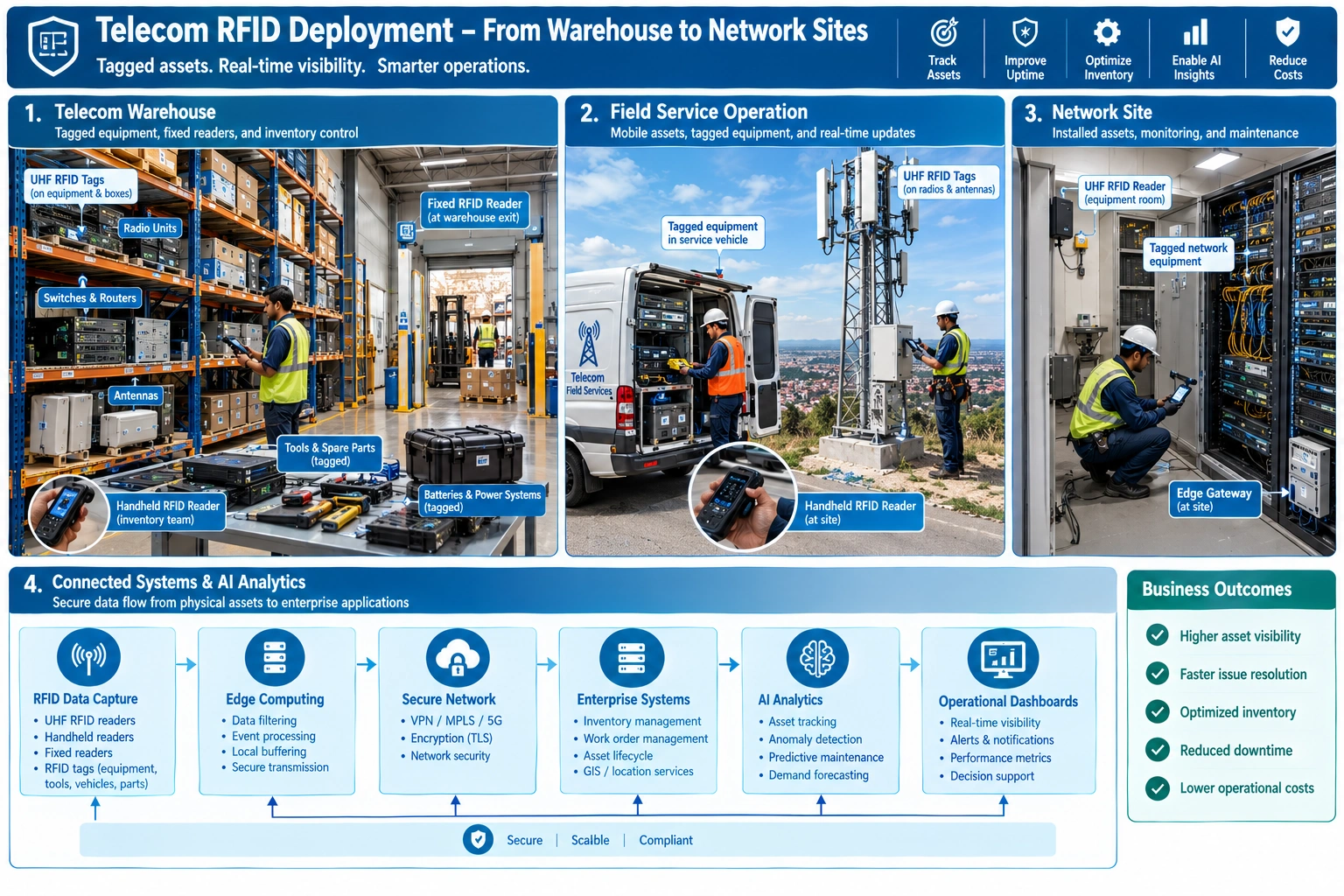
This visual shows RFID deployment across a telecom warehouse, field-service vehicle, and network site, connecting tagged equipment through edge computing and secure networks to enterprise systems and AI analytics.
AI-Driven Telecom Asset Visibility and Decision Support
Telecom operators generate asset information across procurement, warehouse management, network deployment, field service, maintenance, repair, and decommissioning. A useful AI solution must therefore combine multiple operational data sources rather than treating RFID events as isolated records.
RFID readers provide identification events such as asset identity, reader location, timestamp, and direction of movement. Depending on the deployment, additional information can come from work-order software, inventory databases, transportation records, configuration management databases, enterprise resource planning systems, maintenance systems, and technician applications.
AI can correlate these data sources to establish operational context.
Examples include:
- Inventory anomaly detection: Identify differences between expected and observed telecom equipment quantities.
- Asset movement analysis: Detect unusual transfers between warehouses, depots, field vehicles, repair centers, and network sites.
- Work-order verification: Compare equipment movement with scheduled installation, replacement, or maintenance activities.
- Predictive spare-parts planning: Estimate future demand from maintenance history, failure patterns, network expansion schedules, and consumption rates.
- Maintenance prioritization: Identify equipment requiring attention based on asset history, condition information, service intervals, and operational importance.
- Return-delay detection: Identify tools, test equipment, replacement units, or repairable assets that remain outside their expected location.
- Deployment exception management: Detect equipment that has not reached its intended staging or installation location within the planned timeframe.
- Asset lifecycle analysis: Combine deployment, maintenance, repair, replacement, and retirement events to improve lifecycle planning.
GAO can supply RFID readers, tags, handheld equipment, gateways, and related IoT hardware that provide the physical data foundation for these telecom operator workflows.
Telecom Operator Operational Workflow from RFID Capture to AI Action
A practical implementation begins with the physical asset and ends with an operational action. The workflow can be organized into several connected layers.
Physical Identification
RFID tags are attached to selected telecom assets according to asset material, operating environment, read distance, mounting constraints, and lifecycle requirements. Tag selection should account for metal surfaces, outdoor exposure, temperature, equipment enclosure design, and required read performance.
UHF RFID is generally suited to longer-range identification and bulk reads. HF RFID can be appropriate for shorter-range controlled identification, while LF RFID can serve specialized applications requiring lower-frequency identification characteristics.
RFID Data Acquisition
Fixed readers can capture movement through warehouse doors, staging points, equipment-room entrances, or other controlled locations. Handheld readers provide flexible identification for cycle counts, site inspections, maintenance activities, and field verification.
Reader placement should be engineered around actual telecom workflows. Poor antenna positioning, uncontrolled RF paths, metal structures, and unintended read zones can produce duplicate or missed events.
Edge Processing and Event Filtering
Raw RFID reads may contain repeated observations of the same asset. Edge software or middleware can filter duplicate reads, normalize identifiers, apply location rules, and convert raw observations into meaningful events such as asset arrival, departure, transfer, or presence.
This reduces unnecessary traffic to central systems and provides a cleaner event stream for downstream analytics.
Enterprise Software Integration
Processed asset events can be associated with inventory records, work orders, asset identifiers, technician assignments, purchase records, maintenance history, and network locations.
Integration can use APIs, middleware, message queues, database interfaces, or other supported enterprise integration mechanisms depending on the operator’s existing software environment.
AI Analytics
AI models analyze historical and current operational information to identify patterns, anomalies, forecast requirements, and prioritize actions.
For example, an AI model can learn normal movement patterns for spare equipment and flag an asset that repeatedly moves through an unexpected sequence of locations. Another model can analyze spare-part consumption and maintenance history to identify regions where inventory levels are likely to become insufficient.
Operational Action
The final stage is an operational response. A detected exception can generate an investigation task, inventory adjustment request, replenishment recommendation, maintenance action, technician notification, or work-order update.
The effectiveness of the solution should therefore be measured by operational outcomes, not only RFID read rates.
RFID Hardware, AI Software, and Telecom Integration
A telecom operator’s AI-enabled RFID solution depends on correctly matching identification hardware, communications, edge processing, enterprise software, and AI analytics to the physical operating environment. Equipment selection should be based on asset material, read distance, mobility, environmental conditions, transaction volume, and integration requirements rather than RFID frequency alone.
UHF, HF, and LF RFID for Telecom Operations
UHF RFID is generally appropriate for telecom warehouses, equipment staging areas, field depots, and controlled movement points where longer read ranges and rapid identification of multiple tagged items are valuable. UHF readers can identify groups of equipment during receiving, picking, shipment verification, and return processing.
HF RFID is better suited to shorter-range controlled identification. Telecom operators can use HF for specific equipment identification points, technician workflows, access-related processes, or applications where close-proximity reads are preferred.
LF RFID can support specialized applications where its operating characteristics are appropriate, particularly where short-range identification and challenging physical conditions influence the design.
Tag selection also requires attention to the physical construction of telecom assets. On-metal RFID tags may be required for equipment housings, cabinets, racks, tools, batteries, and other metallic surfaces. Ruggedized tags may be necessary for outdoor field equipment exposed to moisture, temperature variation, vibration, dust, or mechanical handling.
Fixed and Handheld RFID Readers
Fixed RFID readers provide continuous identification at defined operational points. Telecom warehouses can use them at receiving and shipping doors, while equipment rooms can use them at controlled entry or exit locations.
Handheld readers provide a different operating model. Technicians and inventory personnel can scan equipment during cycle counts, maintenance, site inspections, installation, recovery, and reconciliation activities.
A combined deployment is often more practical than choosing one reader type exclusively. Fixed readers automate predictable movement events, while handheld readers address locations and workflows where infrastructure cannot economically be installed.
RFID Middleware and Event Processing
RFID middleware converts reader observations into usable business events. Filtering repeated reads, associating readers with locations, normalizing tag identifiers, and applying timing rules are important before information reaches AI analytics or enterprise software.
For example, ten observations of the same tagged router while it remains near a warehouse doorway should not automatically become ten separate inventory movements. Event processing can consolidate these observations into a meaningful departure event.
This layer also provides an important boundary between physical RFID infrastructure and telecom business systems.
AI Models for Telecom Operator Workflows
AI methods should be selected according to the operational problem.
Anomaly detection can identify unusual asset movement, unexpected inventory changes, and abnormal workflow sequences.
Time-series forecasting can estimate spare-part demand based on historical consumption, maintenance schedules, network expansion, and regional requirements.
Classification models can categorize asset conditions, movement exceptions, or operational events.
Predictive models can support maintenance planning by combining equipment history, service records, failure information, and operational conditions.
Optimization methods can assist with inventory allocation, technician preparation, spare-part positioning, and resource planning.
Generative AI can assist authorized personnel in querying operational records, summarizing exceptions, explaining asset histories, and producing maintenance or inventory reports when connected to controlled enterprise data.
AI outputs should remain traceable to the underlying asset events and enterprise records. Telecom operators should avoid treating a model prediction as an authoritative asset record without appropriate validation.
Communication Infrastructure
RFID readers and gateways may communicate with edge servers or central systems using Ethernet, Wi-Fi, cellular connectivity, or other network technologies appropriate to the deployment.
Remote cell sites create different connectivity requirements from centralized warehouses. A warehouse may have reliable wired connectivity, whereas a remote site may depend on cellular or other available communications.
Edge processing can reduce dependence on continuous backhaul connectivity by allowing local event processing and temporary data buffering before synchronization with centralized software.
Enterprise Software Integration
A telecom operator can integrate RFID events with systems such as:
- Enterprise resource planning software
- Warehouse management software
- Inventory management systems
- Asset management systems
- Configuration management databases
- Computerized maintenance management systems
- Work-order management software
- Field-service management systems
- Transportation and logistics software
- Network management systems
- Procurement systems
- Data center infrastructure management software
The integration model should preserve authoritative ownership of records. RFID should normally provide physical observation data, while the relevant enterprise application remains responsible for the corresponding business record.
Cloud Version and Server Version
A Cloud Version can be appropriate when a telecom operator wants centrally managed software accessible across multiple warehouses, regional facilities, repair centers, and operational teams. Cloud deployment can simplify centralized software maintenance and provide a common environment for geographically distributed operations.
A Server Version can be deployed on edge servers, customer-managed servers, private data centers, regional facilities, or other privately hosted infrastructure. This approach can be appropriate where telecom operators require greater control over data location, network connectivity, integration boundaries, or operational dependencies.
The two models can also be combined operationally. RFID event processing may occur close to the equipment while selected information is synchronized with a centralized software environment.
The appropriate choice depends on security requirements, network availability, integration policies, latency requirements, data governance, existing IT infrastructure, and the operator’s operating model.
Engineering Considerations for Telecom RFID Deployment
Successful deployment requires more than installing readers and attaching tags. Telecom operators should first determine which operational decisions require better physical asset information and then engineer RFID coverage around those workflows.
Asset and Tag Selection
Tagging should begin with an asset classification exercise. High-value equipment, mobile tools, repairable units, critical spares, and frequently transferred equipment may provide greater initial value than attempting to tag every physical item.
Metallic equipment requires careful tag selection because metal can affect RFID performance. Batteries, racks, cabinets, radio equipment, and tools may require on-metal tags or mounting methods validated through site testing.
Reader Placement and RF Performance
Reader locations should correspond to actual business events. A warehouse shipping door, for example, may require directional read control so that an asset leaving the facility is not incorrectly interpreted as returning.
Telecom environments contain metal racks, cabinets, cable trays, equipment enclosures, and other structures that can influence RF propagation. Site surveys and pilot testing are therefore important before large-scale deployment.
Read Accuracy and Event Confidence
A high raw read count does not necessarily mean high operational accuracy. The system should distinguish between raw tag observations and validated business events.
Operational rules can use reader location, signal behavior, timing, asset status, workflow state, and related enterprise records to establish event confidence.
Data Quality
AI analysis is only as useful as the data supplied to it. Asset identifiers must remain consistent across RFID tags and enterprise records.
Important data-quality controls include:
- Unique asset identifiers
- Consistent asset naming
- Accurate location codes
- Valid work-order references
- Correct tag-to-asset associations
- Time synchronization across readers and servers
- Duplicate-event filtering
- Exception handling for missing or damaged tags
- Controlled master-data updates
Cybersecurity
RFID infrastructure becomes part of the telecom operator’s connected operational environment and should therefore be protected accordingly.
Security controls can include authenticated device access, network segmentation, encrypted communications where supported, role-based application access, secure API integration, audit logging, credential management, software patching, and controlled administrative privileges.
AI systems should also apply access controls to operational data. A field technician, warehouse operator, maintenance planner, and network administrator may require different levels of visibility.
Interoperability
Telecom operators frequently operate heterogeneous software environments accumulated through network expansion, acquisitions, equipment modernization, and regional operations.
RFID integration should therefore use clearly defined interfaces and normalized identifiers. API-based integration, middleware, message-based interfaces, and database integration can be selected according to the existing software environment.
GAO’s experience supplying RFID and IoT hardware helps organizations address the physical identification portion of these deployments while considering integration requirements with the customer’s existing software systems.
Business and Operational Benefits for Telecom Operators
Combining AI with RFID can improve telecom operations because physical asset events become available as structured information for analysis and workflow control.
Better Asset Accountability
Telecom operators can establish clearer movement histories for equipment, tools, spare parts, and repairable assets. This can reduce uncertainty about whether equipment is at a warehouse, vehicle, field location, repair center, or network facility.
Faster Inventory Reconciliation
Automated identification can reduce the manual effort required for physical counts. AI can further prioritize discrepancies according to asset value, operational importance, movement history, and recurrence.
Improved Field-Service Readiness
Technicians can receive equipment and tools based on actual work requirements. RFID can verify that required items have been assembled before dispatch, while AI can identify recurring preparation failures.
Reduced Equipment Loss
Movement records can help identify assets that remain outside their expected operational path. AI can distinguish ordinary temporary movement from patterns that require investigation.
Better Spare-Part Availability
Forecasting can use historical consumption and maintenance information to support regional spare-part allocation. This can help reduce avoidable stockouts while limiting unnecessary inventory accumulation.
More Accurate Asset Lifecycle Records
Combining RFID movement events with work orders and maintenance records can create a more complete history from receipt through deployment, service, repair, redeployment, and retirement.
KPIs for AI-Enabled RFID Telecom Operations
Telecom operators should establish baseline measurements before deployment and compare post-deployment results against the same operational definitions.
Useful KPIs include:
- Asset inventory accuracy
- RFID event accuracy
- Asset location confidence
- Inventory reconciliation time
- Cycle-count labor hours
- Spare-part stockout rate
- Spare-part inventory turnover
- Field-service equipment readiness
- Work-order equipment verification rate
- Asset recovery rate
- Unreturned tool rate
- Repair turnaround time
- Equipment deployment cycle time
- Warehouse picking accuracy
- Shipment verification accuracy
- Asset exception rate
- Duplicate asset-record rate
- Asset retirement reconciliation rate
- Technician preparation time
- Emergency spare-part fulfillment time
These KPIs should be tied to actual operating objectives. For example, reducing RFID read errors is useful, but reducing the time required to reconcile critical network equipment may provide a more meaningful business outcome.
Implementing AI and RFID Across Telecom Operations
A phased deployment is generally easier to validate than attempting to tag every asset and connect every facility simultaneously.
Define the Operational Scope
Select a workflow with measurable operational problems. A regional spare-parts warehouse, repair center, field-tool program, or cell-site deployment process can provide a controlled starting point.
Establish the Asset Data Model
Define asset identifiers, locations, ownership, lifecycle states, work-order relationships, tag identifiers, and event types before connecting RFID data to production systems.
Conduct a Physical Pilot
Test tags, reader positions, antenna configurations, mounting methods, read zones, and environmental conditions using representative telecom equipment.
Validate Business Events
Confirm that physical reads translate correctly into receiving, shipping, transfer, deployment, return, repair, or maintenance events.
Integrate Enterprise Systems
Connect validated RFID events with inventory, asset management, work-order, maintenance, field-service, and other relevant software.
Introduce AI Analytics
Once sufficient quality historical data exists, introduce anomaly detection, forecasting, prioritization, or other AI methods that address defined operational problems.
Measure and Expand
Compare KPI results against the baseline, correct operational and technical weaknesses, and then extend the solution to additional facilities, asset classes, and workflows.
GAO Support for Telecom RFID and AIoT Deployments
GAO provides RFID, BLE, and IoT hardware products and systems that can support asset identification, location visibility, inventory management, and connected operational workflows. Our hardware portfolio can be considered for telecom warehouses, field-service operations, equipment rooms, repair facilities, and other environments where physical asset identification is required.
GAO has served organizations in the United States and Canada for three decades, including Fortune 500 companies, R&D organizations, universities, and government agencies. Our New York City and Toronto presence supports technical engagement with organizations requiring remote or onsite assistance for RFID and IoT deployments.
For telecom operators, implementation should begin with the operating problem, asset population, physical environment, existing enterprise software, and measurable KPI rather than selecting RFID hardware in isolation. GAO can help organizations evaluate appropriate RFID and IoT hardware products and systems around those requirements.
Key Takeaways for Telecom Operators
AI-enabled RFID can give telecom operators a more reliable connection between physical equipment and digital operational records. UHF RFID is particularly useful for bulk identification and movement tracking, while HF and LF RFID can address more specialized identification requirements.
The strongest implementations combine appropriately selected tags and readers with event processing, enterprise software integration, secure communications, and AI analytics. Deployment should be validated through physical pilots, data-quality testing, workflow verification, cybersecurity controls, and measurable KPIs.
Telecom operators can begin with high-value workflows such as spare-parts management, field-service equipment accountability, warehouse reconciliation, repair logistics, or cell-site deployment and then expand after demonstrating measurable operational value.
GAO provides RFID, BLE, and IoT hardware products and systems that can form part of these telecom operational solutions. Readers interested in applying AI, RFID, and connected asset technologies to telecom operations can explore GAO’s technical solutions and engineering support.
Building the Future of Industrial AI and IoT with Aperture Venture Studio and GAO RFID Inc.
For more than three decades, GAO Group of Companies has invested heavily in R&D covering industrial RFID, BLE, and IoT. As AI became increasingly useful for industrial applications, we expanded our work across AI and IoT technologies, including RFID and BLE, while Aperture Venture Studio has supported the development and scaling of AI and IoT solutions relevant to industries such as telecommunications.
Aperture brings together AI and IoT technical experts, operational executives, investors, and industry participants. GAO also supports technical discussions through initiatives such as the Aperture Ventures Summit and TekSummit, helping advance practical conversations around AI and IoT applications.
We welcome participation from advisors, employees, investors, and customers interested in advancing practical AI and IoT solutions.