
AI and RFID for Automotive Electronics Manufacturing
Transforming Automotive Electronics Manufacturing with AI-Powered RFID Intelligence
Automotive electronics manufacturing has become one of the most complex segments of the automotive sector. Electronic Control Units (ECUs), Advanced Driver Assistance Systems (ADAS), battery management systems, infotainment modules, telematics devices, vehicle sensors, power electronics, printed circuit board assemblies (PCBAs), and semiconductor-based components must be produced with exceptional quality, traceability, and regulatory compliance. Manufacturing environments must simultaneously manage high-volume production, component-level traceability, strict quality requirements, and increasingly sophisticated supply chains.
Artificial Intelligence combined with RFID-enabled data collection is helping automotive electronics manufacturers improve visibility across production operations, material handling processes, quality assurance activities, and inventory management functions. RFID technology provides automated identification and tracking of electronic components, work-in-progress assemblies, finished products, tooling, and returnable transport items, while AI analyzes operational data to optimize production scheduling, detect anomalies, predict equipment failures, and improve manufacturing quality.
AIoT solutions integrate RFID readers, sensors, connected manufacturing equipment, edge computing systems, machine learning models, manufacturing execution software, and enterprise resource planning systems to create intelligent production environments. These systems help manufacturers improve traceability, reduce defects, increase throughput, strengthen compliance, and support the production of increasingly sophisticated automotive electronics.
For organizations seeking scalable RFID hardware, industrial IoT systems, and technical expertise, GAO has helped automotive and electronics manufacturers deploy RFID-enabled tracking, monitoring, and operational visibility solutions across complex production environments.
AI-Driven RFID Applications in Automotive Electronics Manufacturing Facility
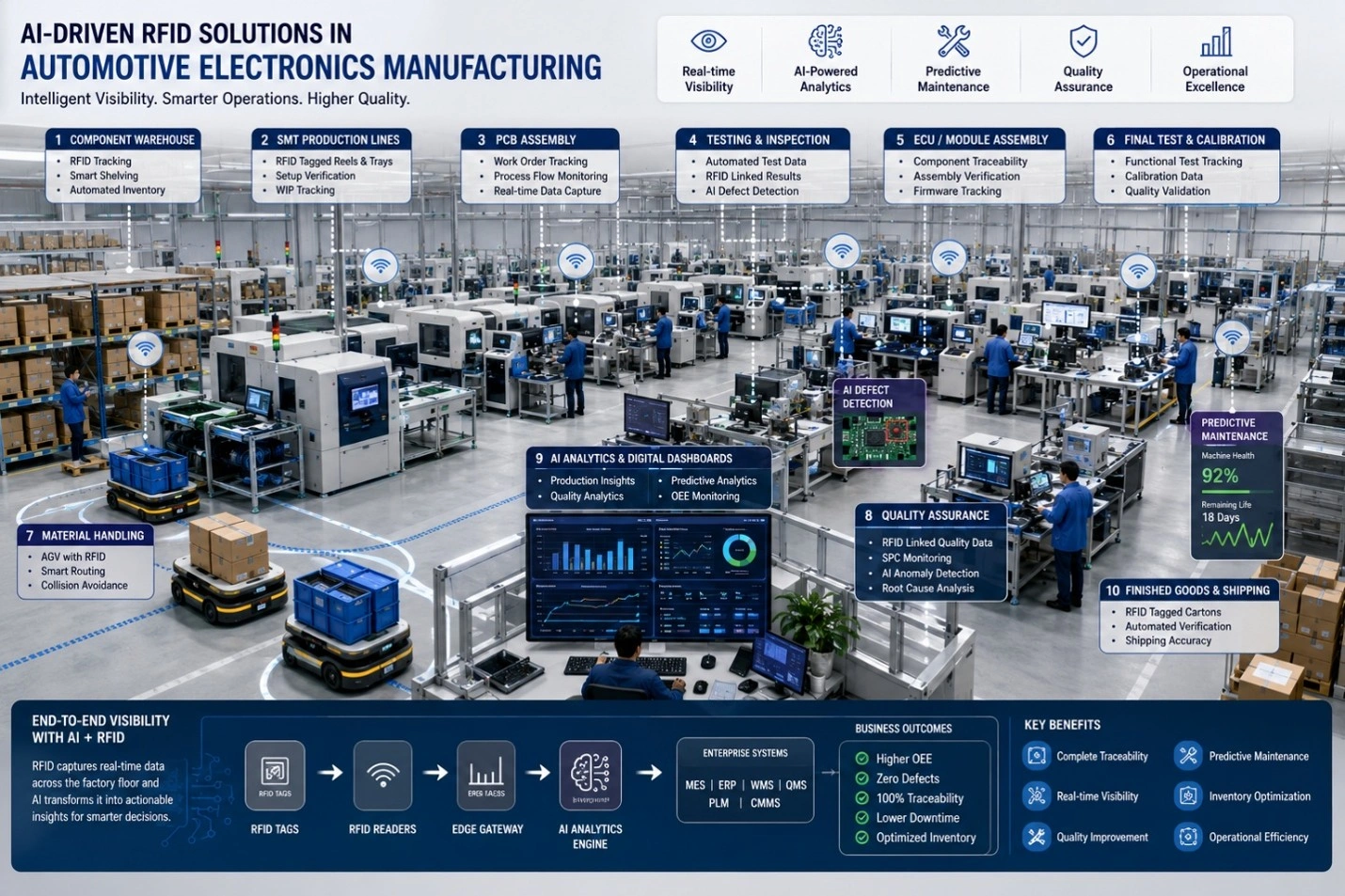
Understanding AI-Enabled RFID Systems in Automotive Electronics Manufacturing
Automotive electronics production requires complete visibility from incoming electronic components through final assembly and shipment. Traditional barcode systems often depend on manual scanning and line-of-sight requirements, creating operational bottlenecks and potential data gaps.
RFID-based identification systems automatically capture information from tagged materials, assemblies, containers, and assets throughout production workflows. AI transforms this operational data into actionable intelligence that supports manufacturing optimization and business decision-making.
Why Automotive Electronics Manufacturing Requires Advanced Traceability
Electronic systems increasingly determine vehicle performance, safety, connectivity, and autonomous driving capabilities. Manufacturers must maintain detailed records of:
- Semiconductor lots
- PCB manufacturing batches
- Component genealogy
- Firmware versions
- Assembly processes
- Calibration records
- Test results
- Supplier information
- Quality inspections
- Warranty traceability data
AI-powered RFID solutions provide automated visibility throughout these processes while reducing manual data collection requirements.
Relationship Between AI and RFID in Electronics Production
RFID provides the digital identity and location information for materials, products, equipment, and assets.
AI technologies analyze RFID-generated data streams to:
- Detect production anomalies
- Forecast material shortages
- Predict machine downtime
- Optimize production sequencing
- Improve inventory accuracy
- Identify quality risks
- Enhance supplier performance analysis
- Support autonomous material movement
The combination creates a continuously improving manufacturing intelligence system capable of supporting modern automotive electronics operations.
Automotive Electronics Manufacturing Applications Enabled by AI and RFID
Electronic Component Traceability
Automotive electronics manufacturers process millions of components daily, including microcontrollers, sensors, integrated circuits, capacitors, connectors, and power management devices.
RFID-based traceability systems allow manufacturers to:
- Track supplier shipments
- Monitor warehouse movements
- Verify material consumption
- Trace component genealogy
- Support recall investigations
- Maintain compliance documentation
AI algorithms analyze traceability data to identify sourcing risks, process deviations, and recurring quality issues before they impact production.
Smart PCB Assembly Management
Surface Mount Technology (SMT) operations require precise component placement and continuous production monitoring.
RFID-tagged feeder reels, component trays, and work orders provide real-time visibility into:
- Material consumption
- Production status
- Machine utilization
- Setup verification
- Changeover efficiency
Machine learning models evaluate production trends to optimize line balancing and reduce bottlenecks across PCB assembly operations.
AI-Based Inventory Optimization
Inventory management challenges frequently impact automotive electronics facilities due to high component variety and supply chain complexity.
RFID-enabled inventory tracking provides real-time visibility into:
- Component availability
- Storage locations
- Consumption rates
- Safety stock levels
- Supplier deliveries
- Warehouse utilization
AI forecasting systems use historical production schedules, demand patterns, and inventory movements to improve replenishment planning and reduce stockouts.
Work-in-Progress Tracking
Complex automotive electronics manufacturing involves multiple production stages, including:
- SMT assembly
- Through-hole assembly
- Conformal coating
- Functional testing
- Calibration
- Programming
- Final inspection
- Packaging
RFID tags attached to production carriers, pallets, trays, or assemblies automatically record movement through each process stage.
AI software evaluates production flow data to identify:
- Queue buildup
- Throughput limitations
- Process inefficiencies
- Unexpected delays
- Resource constraints
This enables production managers to make data-driven operational adjustments.
RFID Deployment Workflow for Automotive Electronics Manufacturing with AI Analytics
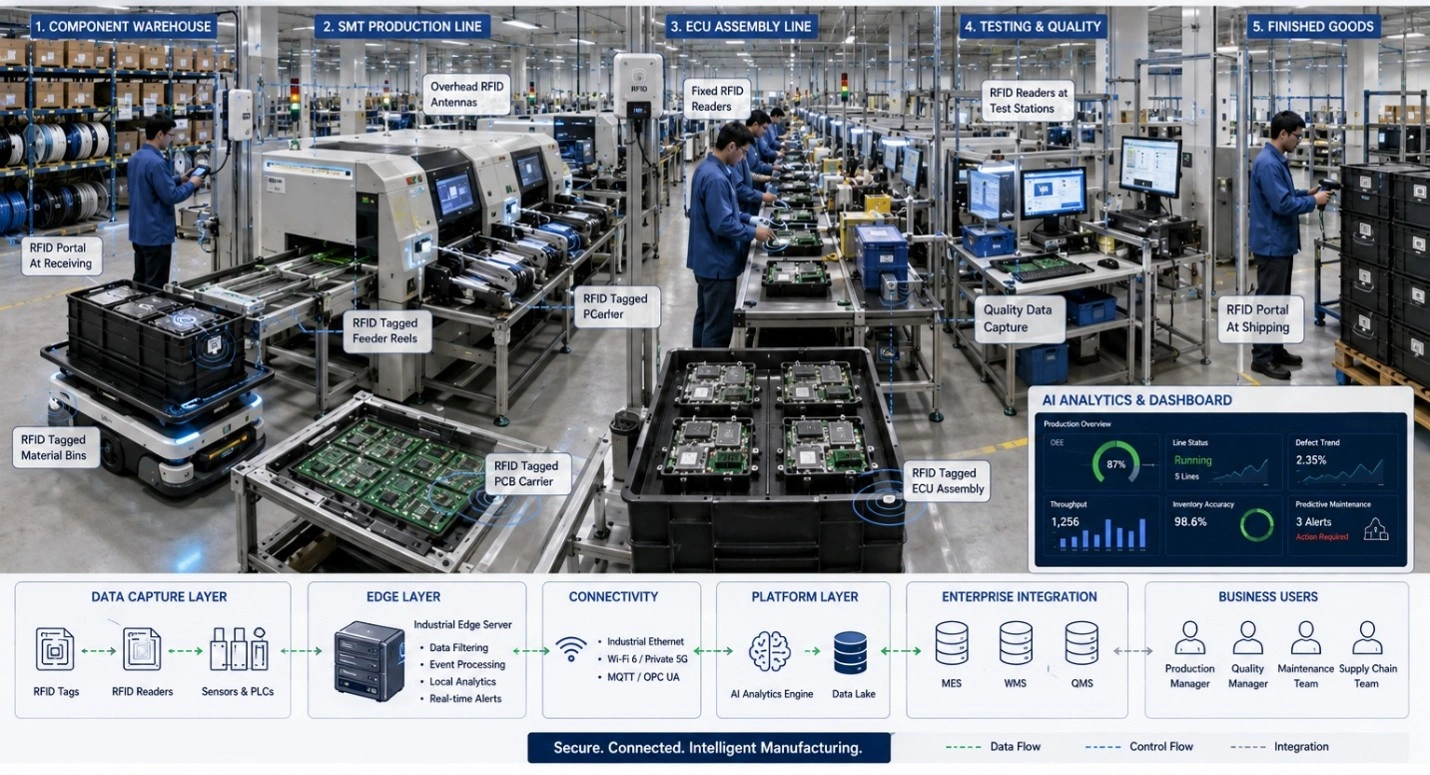
Operational Workflow of AI-Driven RFID Manufacturing Systems
Automotive electronics manufacturing environments require continuous information flow from production assets, materials, equipment, and enterprise software systems.
Data Acquisition Layer
Operational data originates from:
- RFID tags on electronic components
- RFID-tagged PCB carriers
- Smart production containers
- Returnable transport items
- Electronic shelf systems
- Automated storage systems
- Industrial sensors
- SMT production equipment
- Automated optical inspection systems
- Functional testing equipment
Data collection occurs through fixed RFID readers, handheld readers, industrial gateways, and connected manufacturing equipment.
Communication Infrastructure
Collected information is transmitted using industrial communication technologies such as:
- Ethernet/IP
- PROFINET
- Modbus TCP
- OPC UA
- MQTT
- Wi-Fi 6
- Private 5G
- Industrial edge networks
These communication layers support real-time visibility across manufacturing operations while maintaining deterministic performance requirements.
Edge Processing and Local Intelligence
Edge servers positioned near production equipment perform:
- RFID event filtering
- Device management
- Data normalization
- Local analytics
- Quality rule validation
- Low-latency decision support
Edge AI enables rapid responses for manufacturing environments where milliseconds may affect production quality and throughput.
Enterprise Software Integration
RFID and AI systems commonly integrate with:
- Manufacturing Execution Systems (MES)
- Enterprise Resource Planning (ERP)
- Warehouse Management Systems (WMS)
- Product Lifecycle Management (PLM)
- Quality Management Systems (QMS)
- Computerized Maintenance Management Systems (CMMS)
- Supply Chain Management software
This integration creates a connected information environment where operational events automatically trigger business processes.
AI-Driven Decision Making
Machine learning models continuously evaluate manufacturing data to support:
- Production optimization
- Inventory forecasting
- Quality prediction
- Predictive maintenance
- Labor planning
- Supplier performance monitoring
- Capacity planning
- Process improvement initiatives
Manufacturing teams receive recommendations through dashboards, alerts, workflow automation tools, and operational reporting systems.
AI-Driven Manufacturing Workflow for RFID-Enabled Automotive Electronics Production
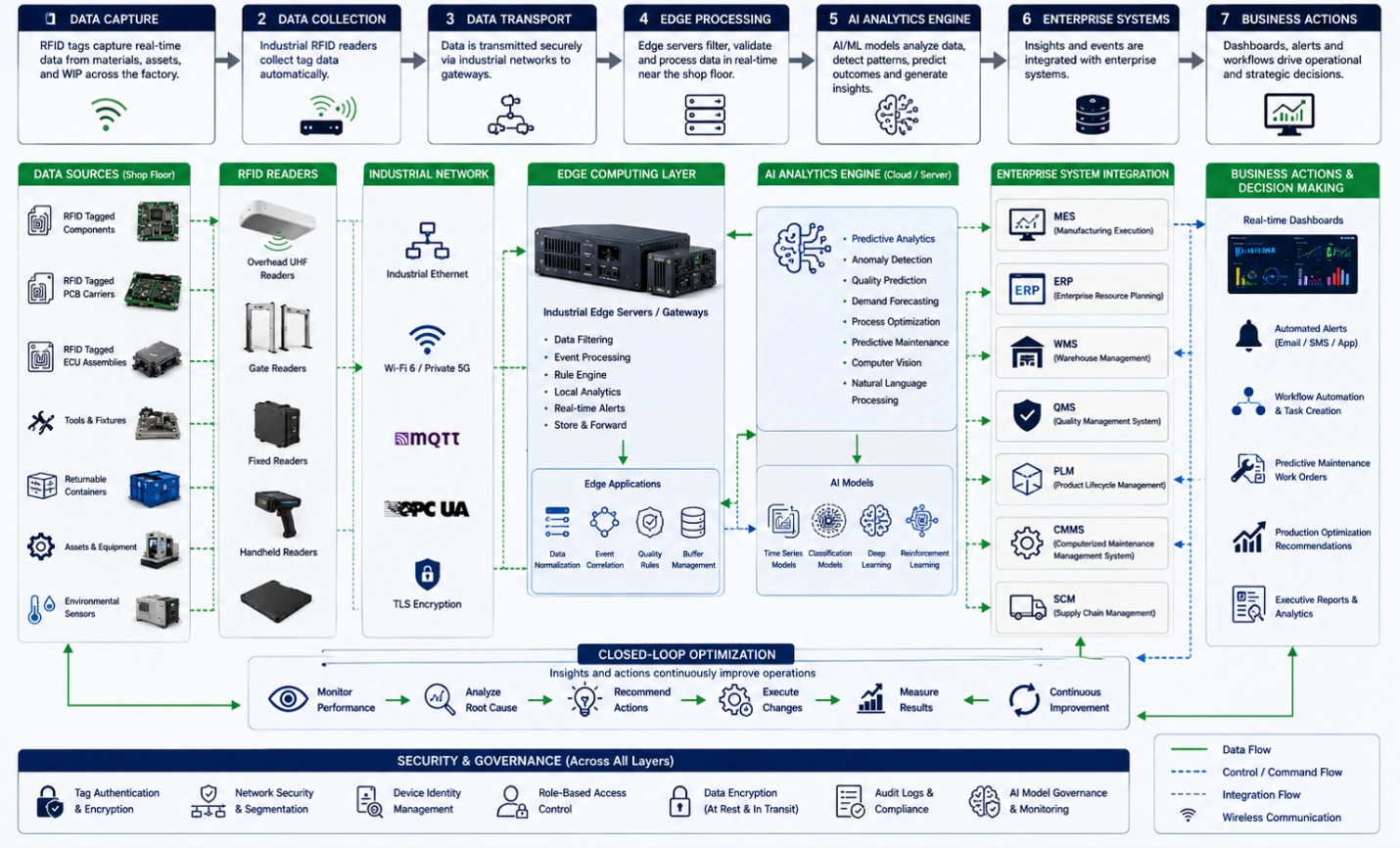
Core Technologies Supporting AI-Powered Automotive Electronics Manufacturing
Modern automotive electronics manufacturing solutions combine specialized hardware, software, communication infrastructure, and AI technologies to deliver intelligent operational visibility.
RFID Technologies Used in Automotive Electronics Manufacturing
UHF RFID
UHF RFID is commonly used for:
- Work-in-progress tracking
- Warehouse inventory visibility
- Pallet tracking
- Returnable container management
- Finished goods logistics
Its longer read range makes it suitable for high-volume manufacturing environments.
HF RFID
HF RFID is frequently deployed for:
- Electronic component authentication
- PCB carrier identification
- Process control applications
- Manufacturing execution workflows
HF technology performs well where controlled read zones are required.
LF RFID
LF RFID supports:
- Tool identification
- Harsh-environment asset tracking
- Maintenance applications
- Equipment access control
LF solutions are often selected where metallic interference presents operational challenges.
Hardware Components
Automotive electronics facilities typically deploy:
- Fixed industrial RFID readers
- Handheld RFID readers
- RFID antennas
- Industrial gateways
- Edge computing appliances
- Industrial PCs
- Programmable Logic Controllers (PLCs)
- Vision inspection cameras
- Environmental monitoring sensors
- Automated storage and retrieval systems
Each component contributes to automated visibility, operational monitoring, and production intelligence.
AI Technologies Used in Automotive Electronics Manufacturing
Machine learning techniques commonly include:
- Predictive analytics
- Deep learning
- Computer vision
- Reinforcement learning
- Time-series forecasting
- Anomaly detection
- Natural language processing
- Digital twin modeling
These technologies support advanced manufacturing optimization and quality improvement initiatives.
AI Technology Stack for RFID-Enabled Automotive Electronics Manufacturing
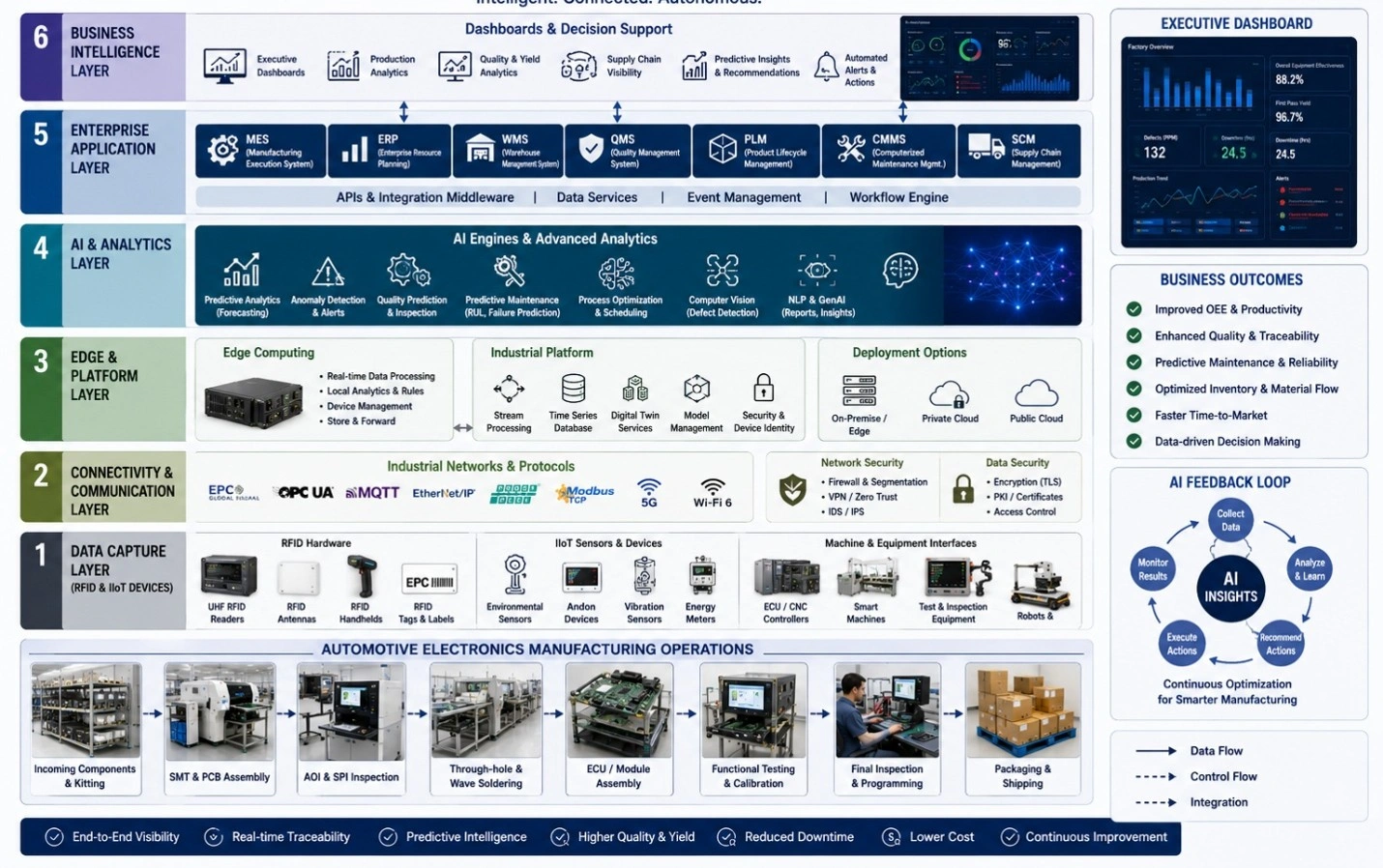
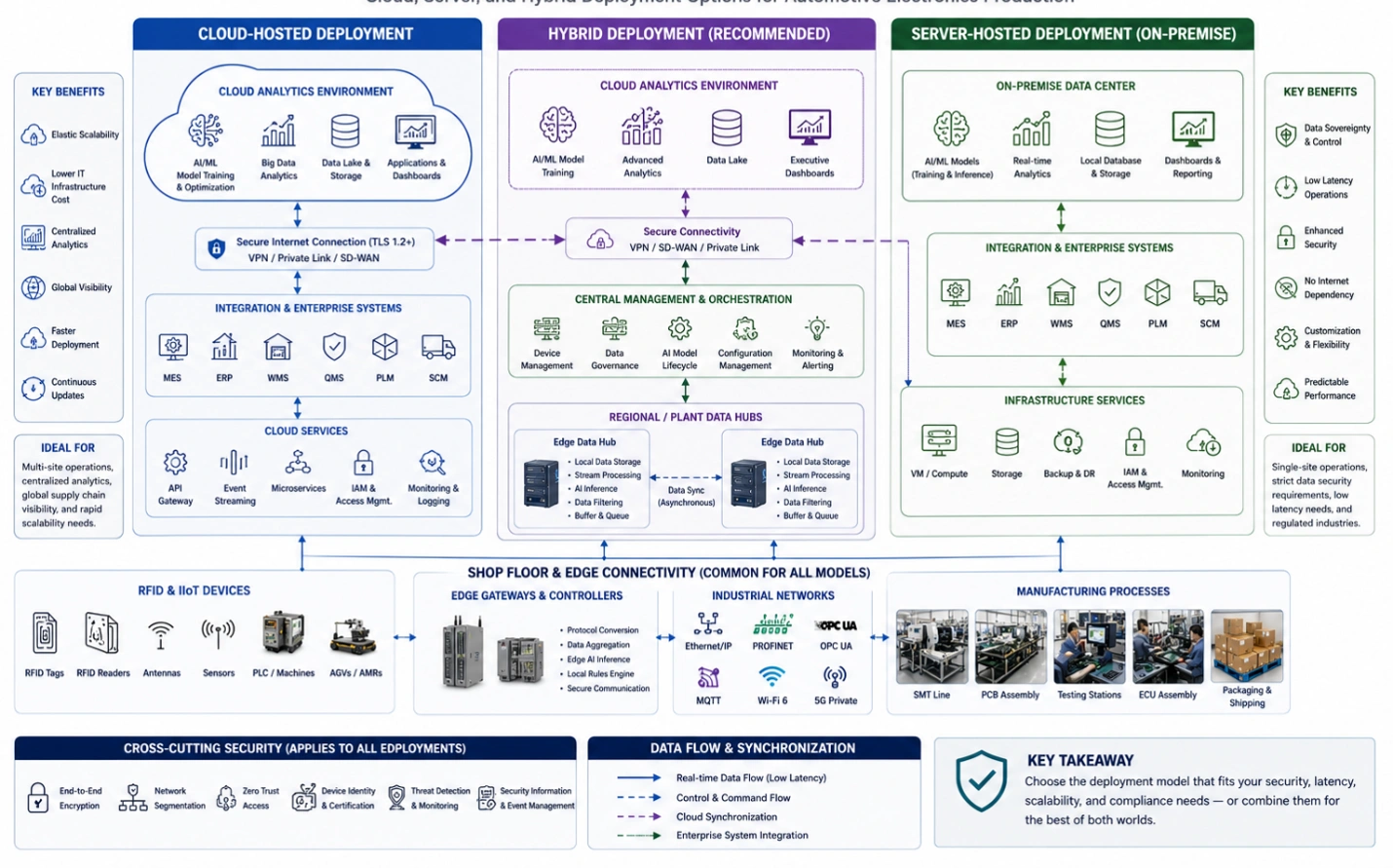
Cloud and Server Deployment Models for Automotive Electronics Manufacturing
Automotive electronics manufacturers operate under strict requirements for quality control, production continuity, cybersecurity, and intellectual property protection. Selecting the appropriate deployment model is therefore a critical engineering decision.
Cloud Deployment
Cloud-hosted AI manufacturing solutions are often used when organizations require centralized visibility across multiple production facilities, suppliers, and distribution networks.
Typical advantages include:
- Multi-factory production visibility
- Centralized analytics and reporting
- Scalable AI model training
- Reduced infrastructure maintenance
- Rapid software updates
- Global supply chain collaboration
Cloud deployments are particularly beneficial for manufacturers managing geographically distributed PCB assembly operations, electronics suppliers, and vehicle assembly plants.
Server Deployment
Many automotive electronics manufacturers prefer privately hosted server deployments because of regulatory requirements, intellectual property protection, and low-latency operational needs.
Server-hosted solutions may be deployed within:
- Factory data centers
- Edge computing environments
- Regional manufacturing hubs
- Customer-managed private cloud environments
- Industrial control network segments
Advantages include:
- Enhanced data sovereignty
- Reduced external connectivity dependencies
- Lower operational latency
- Greater control over cybersecurity policies
- Support for mission-critical manufacturing operations
Many automotive electronics facilities adopt hybrid deployments where real-time production intelligence remains on local servers while long-term analytics and business reporting are synchronized to cloud environments.
Deployment Selection Considerations
Key factors influencing deployment decisions include:
- Production volume
- Regulatory requirements
- Data retention policies
- Network availability
- AI processing requirements
- Supplier integration complexity
- Cybersecurity objectives
- Geographic distribution of facilities
Organizations often conduct pilot deployments before scaling AI-enabled RFID solutions across multiple production lines.
Hybrid Cloud and Server Deployment Models for AI-Driven RFID Automotive Electronics Manufacturing
Cybersecurity and Data Protection for Automotive Electronics Manufacturing
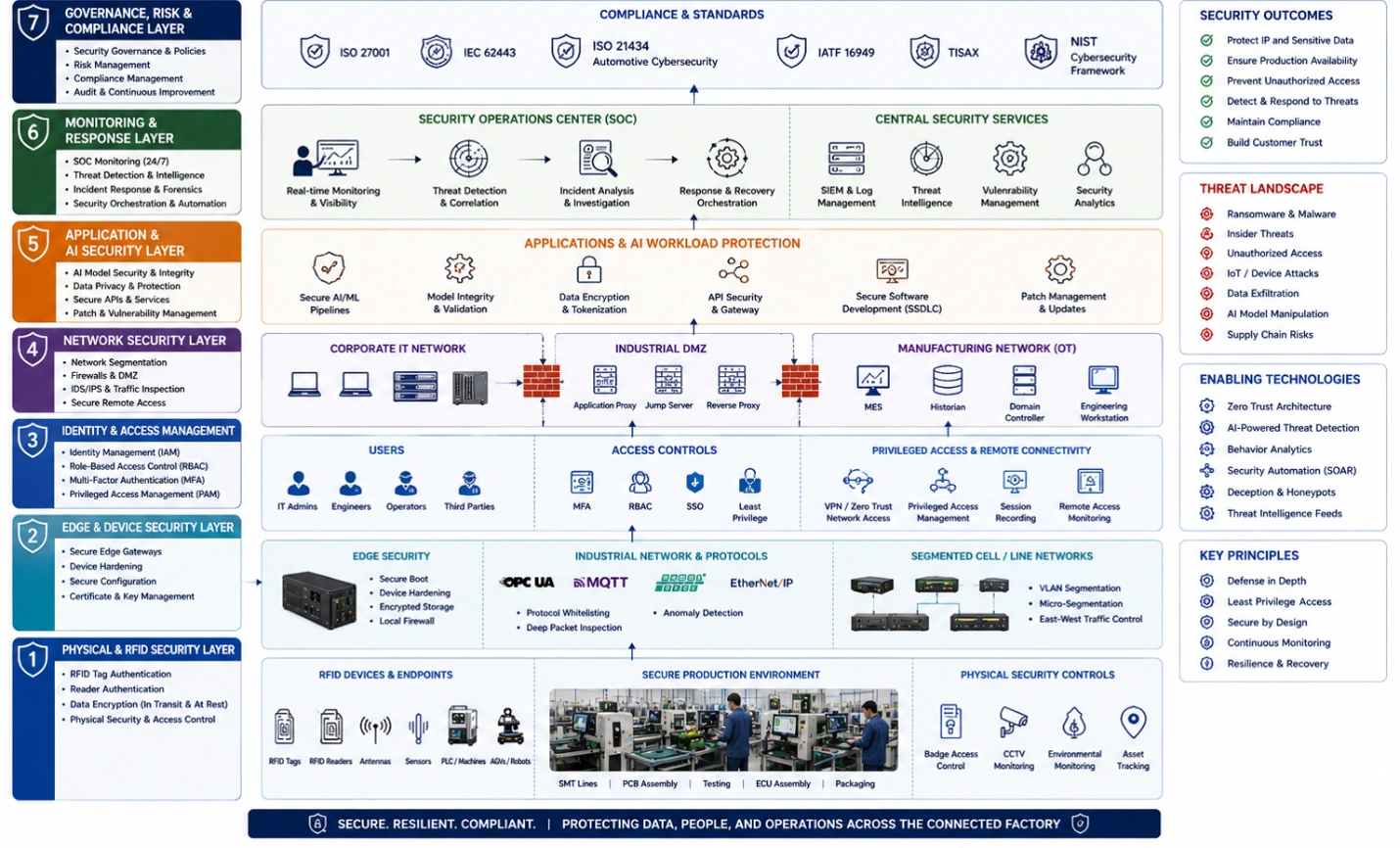
Automotive electronics manufacturing environments contain valuable intellectual property, firmware assets, calibration data, supplier information, and production records. Security considerations must therefore extend beyond conventional IT systems.
RFID Security Controls
Automotive electronics manufacturers commonly implement:
- Tag authentication
- Reader authentication
- Data encryption
- Secure key management
- Access control policies
- Anti-cloning mechanisms
- Event logging and auditing
These controls help prevent unauthorized data access and counterfeit component substitution.
Manufacturing Network Security
Industrial cybersecurity measures often include:
- Network segmentation
- Industrial firewalls
- Zero-trust access policies
- Secure remote maintenance
- Device identity management
- Continuous vulnerability monitoring
- Intrusion detection systems
Production systems should be isolated appropriately from corporate networks while maintaining operational visibility.
AI Security Considerations
AI systems require additional protections against:
- Data poisoning
- Model manipulation
- Unauthorized model access
- Training dataset corruption
- Adversarial attacks
- Sensitive data exposure
Manufacturers should establish governance processes for AI model validation, monitoring, and lifecycle management.
Compliance and Regulatory Alignment
Automotive electronics manufacturers frequently align deployments with:
- IATF 16949
- ISO 9001
- ISO 27001
- ISO 21434
- TISAX
- NIST Cybersecurity Framework
- IEC 62443
- Automotive SPICE
Proper implementation supports quality management, cybersecurity compliance, and customer requirements throughout the automotive supply chain.
Industrial Cybersecurity Framework for AI-Enabled RFID Automotive Electronics Manufacturing
Technical Capabilities Delivered by AI-Driven RFID Manufacturing Systems
Automotive electronics manufacturers increasingly rely on intelligent manufacturing systems to maintain competitiveness while meeting demanding quality and traceability requirements.
Real-Time Production Visibility
AI-enhanced RFID systems provide continuous visibility into:
- Component movements
- Production status
- Material availability
- Equipment utilization
- Inventory conditions
- Logistics operations
Manufacturing teams can rapidly identify disruptions before they affect production schedules.
Predictive Maintenance
Production equipment such as:
- SMT placement machines
- Reflow ovens
- AOI systems
- ICT testers
- Functional testing stations
- Robotic assembly systems
Generate operational data that AI models analyze to predict maintenance requirements before failures occur.
Automated Quality Intelligence
AI systems correlate:
- Component genealogy
- Process parameters
- Test results
- Environmental conditions
- Supplier information
This allows manufacturers to identify hidden causes of defects and improve first-pass yield.
Intelligent Material Flow Management
RFID visibility combined with AI optimization improves:
- Line-side replenishment
- Warehouse operations
- AGV routing
- Component staging
- Production sequencing
- Inventory allocation
These improvements reduce material shortages and improve manufacturing efficiency.
Advanced Traceability and Recall Support
Automotive manufacturers must often trace products through multiple production stages and supplier tiers.
AI-powered RFID systems support:
- Component-level genealogy
- Batch traceability
- Supplier traceability
- Warranty analysis
- Recall investigations
- Root-cause analysis
This capability is particularly important for safety-critical automotive electronics.
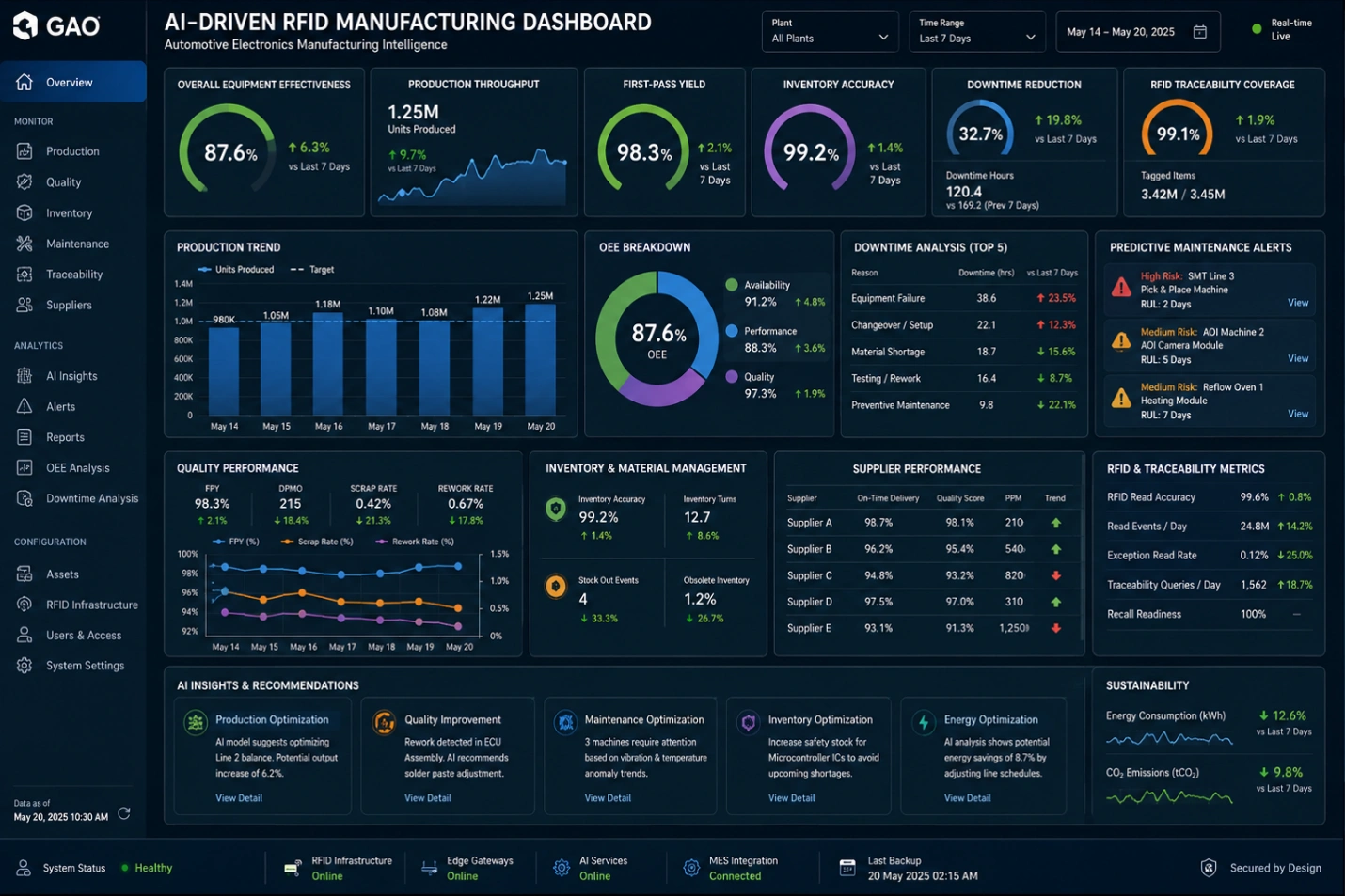
AI-Driven RFID Manufacturing KPI Dashboard for Automotive Electronics Production
Operational and Business Benefits for Automotive Electronics Manufacturers
Manufacturing Performance Improvements
Organizations implementing AI-enabled RFID solutions commonly pursue:
- Improved Overall Equipment Effectiveness (OEE)
- Reduced unplanned downtime
- Faster production throughput
- Increased inventory accuracy
- Improved production scheduling
- Reduced work-in-progress accumulation
Quality and Compliance Benefits
Benefits frequently include:
- Enhanced component traceability
- Better defect containment
- Faster corrective actions
- Improved audit readiness
- Reduced warranty exposure
- Improved supplier accountability
Supply Chain Optimization
Automotive electronics supply chains involve thousands of components and numerous suppliers.
AI-powered visibility supports:
- Demand forecasting
- Supplier performance analysis
- Inventory optimization
- Material availability forecasting
- Logistics planning
- Risk management
Scalability Advantages
Modern AIoT manufacturing systems can scale across:
- Individual production cells
- SMT production lines
- Manufacturing facilities
- Regional operations
- Global manufacturing networks
This scalability enables consistent operational standards across distributed production environments.
Key Performance Indicators for AI-Enabled Automotive Electronics Manufacturing
Manufacturers commonly evaluate deployment success using metrics such as:
- Overall Equipment Effectiveness (OEE)
- First Pass Yield (FPY)
- Defects Per Million Opportunities (DPMO)
- Inventory Accuracy
- Inventory Turnover
- Production Throughput
- Changeover Time
- Mean Time Between Failure (MTBF)
- Mean Time To Repair (MTTR)
- On-Time Delivery
- Work-in-Progress Levels
- Component Traceability Coverage
- Supplier Quality Performance
- Manufacturing Cycle Time
- Warranty Return Rate
AI-powered analytics continuously monitor these indicators to support operational improvement initiatives.
Implementation Best Practices for Automotive Electronics Manufacturing
Successful deployments typically begin with clearly defined operational objectives and measurable business outcomes.
Recommended practices include:
- Establish component-level traceability requirements early
- Validate RFID performance near electronic assemblies and metallic equipment
- Conduct pilot testing on representative production lines
- Integrate RFID events with MES and ERP software
- Define cybersecurity requirements before deployment
- Create governance processes for AI model management
- Develop data quality standards
- Train operators, engineers, and maintenance personnel
- Continuously measure KPI improvements
- Scale deployments incrementally using proven operational results
GAO has supported organizations across North America by providing RFID hardware, industrial IoT systems, and technical expertise that help reduce deployment risk while improving operational visibility.
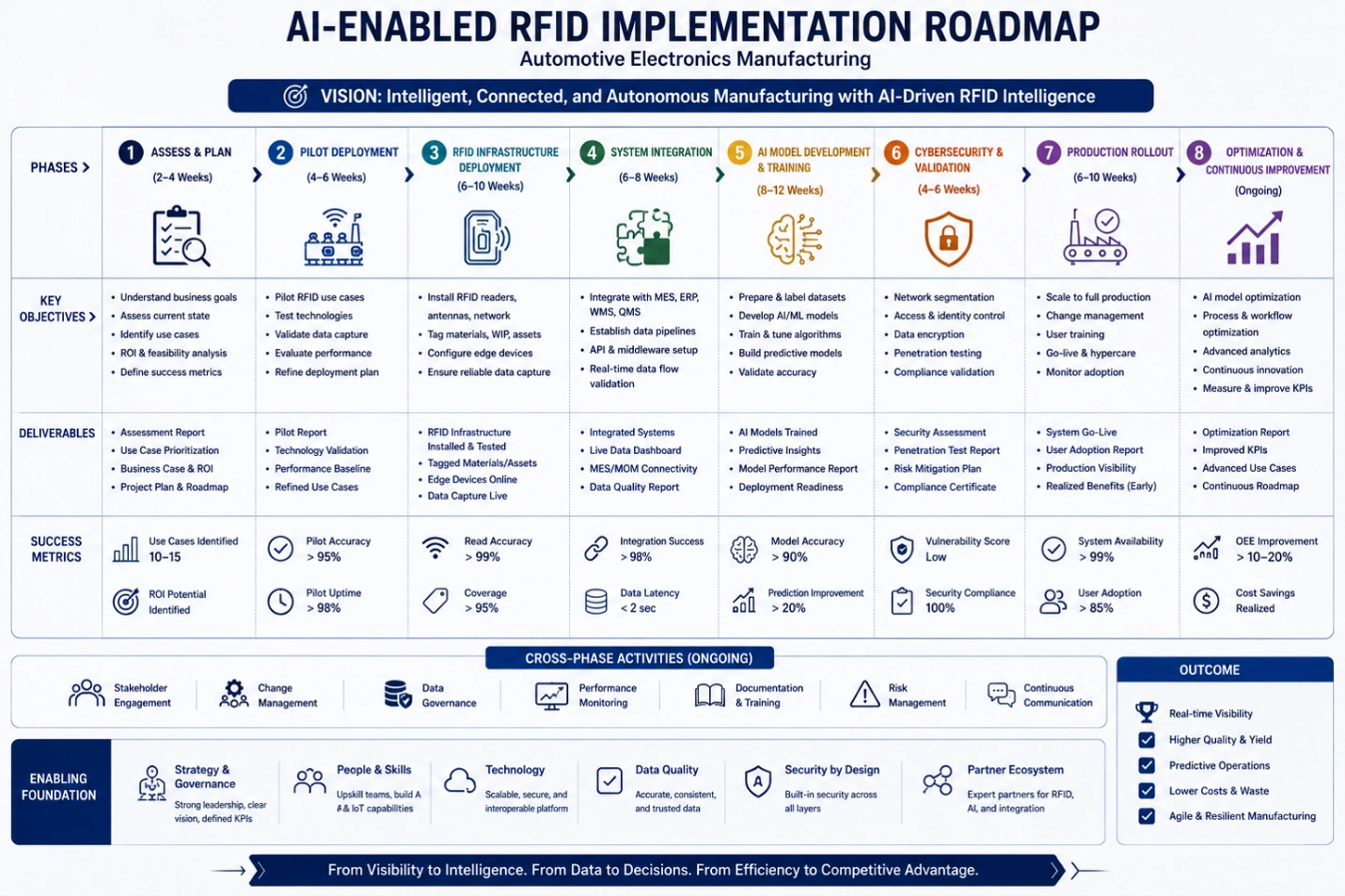
Implementation Roadmap for AI-Powered RFID Automotive Electronics Manufacturing
A phased deployment approach generally produces the most reliable outcomes.
Assessment Phase
- Production workflow analysis
- Traceability requirement review
- Infrastructure assessment
- Cybersecurity evaluation
- ROI analysis
Pilot Deployment
- RFID hardware installation
- Limited production-line implementation
- Data validation
- Initial software integration
- KPI benchmarking
System Integration
- MES integration
- ERP integration
- Quality system integration
- Warehouse system integration
- AI model deployment
Production Rollout
- Multi-line deployment
- Workforce training
- Operational validation
- Cybersecurity testing
- Performance optimization
Continuous Improvement
- AI model refinement
- Process optimization
- KPI monitoring
- Capacity expansion
- Supplier network integration
AI-Enabled RFID Implementation Roadmap for Automotive Electronics Manufacturing
Why Automotive Electronics Manufacturers Choose GAO
Organizations implementing RFID-enabled manufacturing visibility solutions often require dependable hardware, technical expertise, and long-term support capabilities.
Headquartered in New York City and Toronto, Canada, GAO is recognized among the leading global suppliers of RFID and BLE technologies for business and government applications. For more than three decades, GAO and its affiliated organizations have served manufacturers, research institutions, universities, Fortune 500 companies, and government agencies throughout North America.
Our experience supporting industrial RFID, IoT, and AI-enabled operational visibility initiatives helps organizations address challenges related to traceability, inventory management, production monitoring, asset visibility, and manufacturing optimization. Through rigorous quality assurance processes and expert technical support available remotely or onsite, GAO assists customers throughout planning, deployment, integration, and operational improvement initiatives.
Advancing Automotive Electronics Manufacturing Through Intelligent Traceability and AI
Automotive electronics manufacturing continues to evolve as vehicles become increasingly dependent on software-defined functionality, advanced sensors, connectivity systems, battery technologies, and autonomous driving capabilities. Maintaining visibility across complex production processes, supplier networks, quality systems, and inventory operations has become essential for operational success.
AI-powered RFID solutions help manufacturers improve traceability, strengthen quality assurance, optimize inventory management, enhance predictive maintenance capabilities, and support data-driven manufacturing decisions. When properly integrated with MES, ERP, quality management, and supply chain systems, these solutions create measurable improvements in productivity, compliance, operational resilience, and customer satisfaction.
Organizations evaluating intelligent manufacturing initiatives should focus on clear operational objectives, scalable deployment strategies, cybersecurity requirements, and long-term business value while selecting technology partners capable of supporting the entire deployment lifecycle.
Building the Future of Industrial AI and IoT with Aperture Venture Studio and GAO
For more than three decades, GAO Group of Companies has invested heavily in research and development of RFID, BLE, IoT, and industrial digitalization technologies. As artificial intelligence has become increasingly valuable for automotive electronics manufacturing, smart traceability, predictive maintenance, quality intelligence, and connected factory operations, we have expanded our focus on AI and IoT technologies and founded Aperture Venture Studio to accelerate the development and growth of advanced industrial AI and IoT solutions serving manufacturing and other technology-driven sectors.
Aperture has attracted leading AI and IoT technical experts, experienced operational executives, influential investors, and major industry participants. Through initiatives such as Aperture Ventures Summit and TekSummit, we continue to facilitate discussions on advanced AI and IoT technologies while supporting vibrant technical communities and diversified innovation networks.
We welcome you to join us as:
- Advisors, co-founders, or employees
- Investors
- Customers
Together, we can help shape the future of intelligent manufacturing, industrial AI, RFID-enabled visibility, and connected operations.