
AI and BLE for Mixed-use Properties
AI and BLE for Mixed-use Properties: Smarter Property and Facility Management
AI for mixed-use properties combines artificial intelligence with connected building systems, occupancy data, access events, asset locations, environmental conditions, and operational records to improve how residential, commercial, retail, hospitality, parking, and shared facilities are managed. BLE gateways, beacons, and sensors provide location, proximity, environmental, and equipment data that AI software can analyze alongside access control, building management, maintenance, tenant, and security information.
For mixed-use property operators, this combination supports applications such as AI occupancy intelligence, visitor management, access monitoring, asset tracking, indoor navigation, maintenance optimization, energy management, parking operations, and safety monitoring. AI models can identify abnormal occupancy patterns, predict equipment service requirements, correlate access events with facility conditions, and help staff prioritize operational responses. BLE is particularly useful where property managers need room-level or zone-level visibility without extensive cabling. GAO supplies BLE, RFID, and IoT hardware products and systems that can support these connected property-management applications.
AIoT-Enabled Mixed-Use Property with BLE Asset, Occupancy, and Facility Intelligence
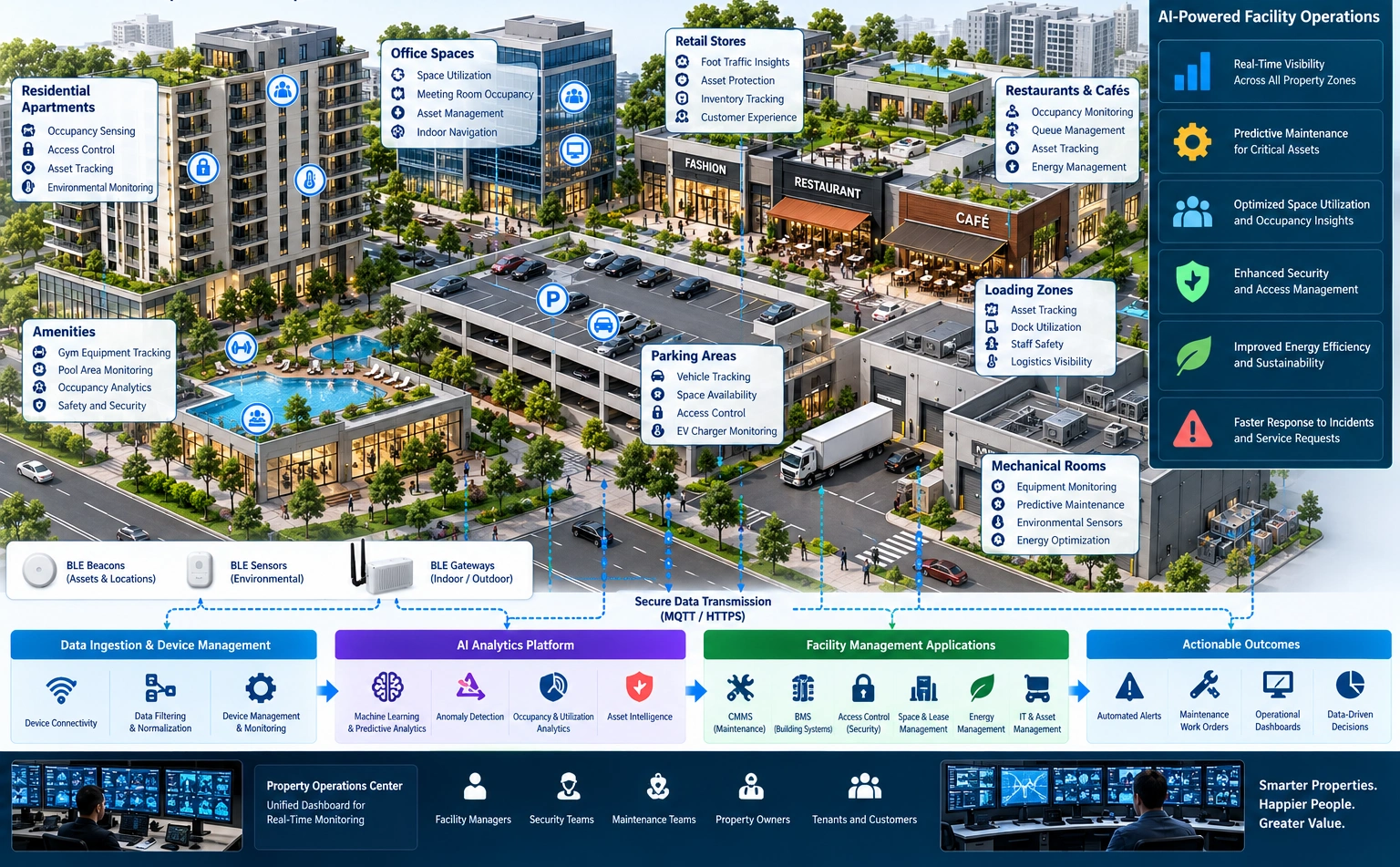
This isometric illustration shows how BLE beacons, sensors, and gateways connect apartments, offices, retail stores, restaurants, amenities, parking, loading zones, and mechanical rooms across a mixed-use property. Operational data flows through AI analytics and facility-management applications to support occupancy insights, predictive maintenance, asset tracking, security, energy efficiency, automated alerts, and data-driven decisions.
What AI Means for Mixed-use Property Operations
Mixed-use properties create an unusually diverse operational environment because several occupancy and service models coexist within the same physical development. A single property may contain residential towers, retail units, restaurants, offices, fitness facilities, conference areas, parking structures, loading docks, mechanical rooms, and public spaces. Each environment produces different operational data and has different access, safety, maintenance, and service requirements.
AI helps property and facility management teams transform these data streams into operational decisions. Instead of treating each subsystem as an isolated source of information, AI software can correlate events across building systems.
Examples include:
- AI occupancy analysis can compare room, floor, tenant-area, amenity, and common-area utilization patterns.
- AI access monitoring can identify unusual badge or credential activity when combined with time, location, occupancy, and scheduled-access information.
- AI maintenance analysis can identify recurring equipment faults and prioritize work orders using historical service records and sensor observations.
- AI asset tracking can help facilities teams locate mobile maintenance equipment, cleaning carts, tools, safety equipment, and other tagged property.
- AI visitor intelligence can analyze arrival patterns and help staff anticipate congestion at reception areas, elevators, parking entrances, or controlled-access zones.
- AI environmental monitoring can correlate temperature, humidity, occupancy, and equipment conditions to identify abnormal operating conditions.
- AI facility analytics can compare actual utilization against planned space usage and help property managers improve scheduling and resource allocation.
BLE provides an important data-acquisition layer for these applications. Battery-powered BLE beacons and sensors can be positioned around rooms, corridors, equipment areas, parking facilities, and common spaces, while BLE gateways collect nearby device transmissions and forward them to processing software.
Mixed-use Property Workflows Where AI Delivers Operational Value
Occupancy and Space Utilization
Mixed-use developments require accurate understanding of how different areas are being used throughout the day. Office floors may experience weekday peaks, restaurants may have concentrated evening demand, fitness facilities may follow scheduled classes, and residential amenities may experience different patterns during weekends.
BLE proximity events can contribute location data while other building systems provide complementary occupancy information. AI can combine these inputs to identify utilization trends and detect unexpected changes.
Property managers can use the resulting information for:
- Common-area utilization analysis
- Amenity scheduling
- Meeting-room and shared-space optimization
- Cleaning schedule adjustment
- Security staffing decisions
- Elevator and lobby congestion analysis
- Tenant-space utilization studies
- Parking occupancy analysis
The engineering objective should not simply be to collect more location data. Sensor density, gateway placement, radio interference, battery life, privacy requirements, and required location accuracy should be selected according to the operational decision being supported.
Access, Visitor, and Security Operations
Access control in mixed-use properties often involves multiple populations, including residents, employees, retail staff, contractors, visitors, delivery personnel, and facility-management teams. Access policies can also differ between residential entrances, commercial floors, parking facilities, loading docks, and restricted mechanical areas.
AI can analyze access events against expected schedules and physical location information to identify anomalies. BLE proximity data can provide additional context when a credential event alone does not establish where an individual or asset was physically located.
Useful workflows include:
- Detecting unusual access activity outside normal operating schedules
- Monitoring restricted maintenance areas
- Supporting visitor movement analysis
- Identifying repeated access failures
- Correlating access events with occupancy conditions
- Supporting emergency personnel location awareness
- Monitoring contractor movement through authorized zones
AI should assist security personnel rather than replace access-control policy enforcement. Identity verification, credential authorization, door controllers, and life-safety systems should continue to operate according to their validated control logic.
Maintenance and Mobile Asset Management
Facility-management teams in mixed-use properties frequently move tools, inspection equipment, cleaning equipment, spare parts, portable appliances, ladders, carts, and safety equipment between buildings and floors. Searching for mobile equipment consumes staff time and can delay maintenance work.
BLE tags or beacons attached to selected assets can provide proximity or zone-level location information through BLE gateways. AI software can then analyze asset movement, utilization, dwell time, and service records.
A practical workflow can connect:
- BLE-tagged maintenance assets
- Gateway location data
- Computerized maintenance management systems
- Work orders
- Technician assignments
- Inspection records
- Equipment service history
- Spare-parts records
AI can use these relationships to identify frequently used equipment, underutilized assets, abnormal movement patterns, and potential maintenance bottlenecks.
BLE-Enabled Facility Asset Tracking and AI-Driven Maintenance Workflow
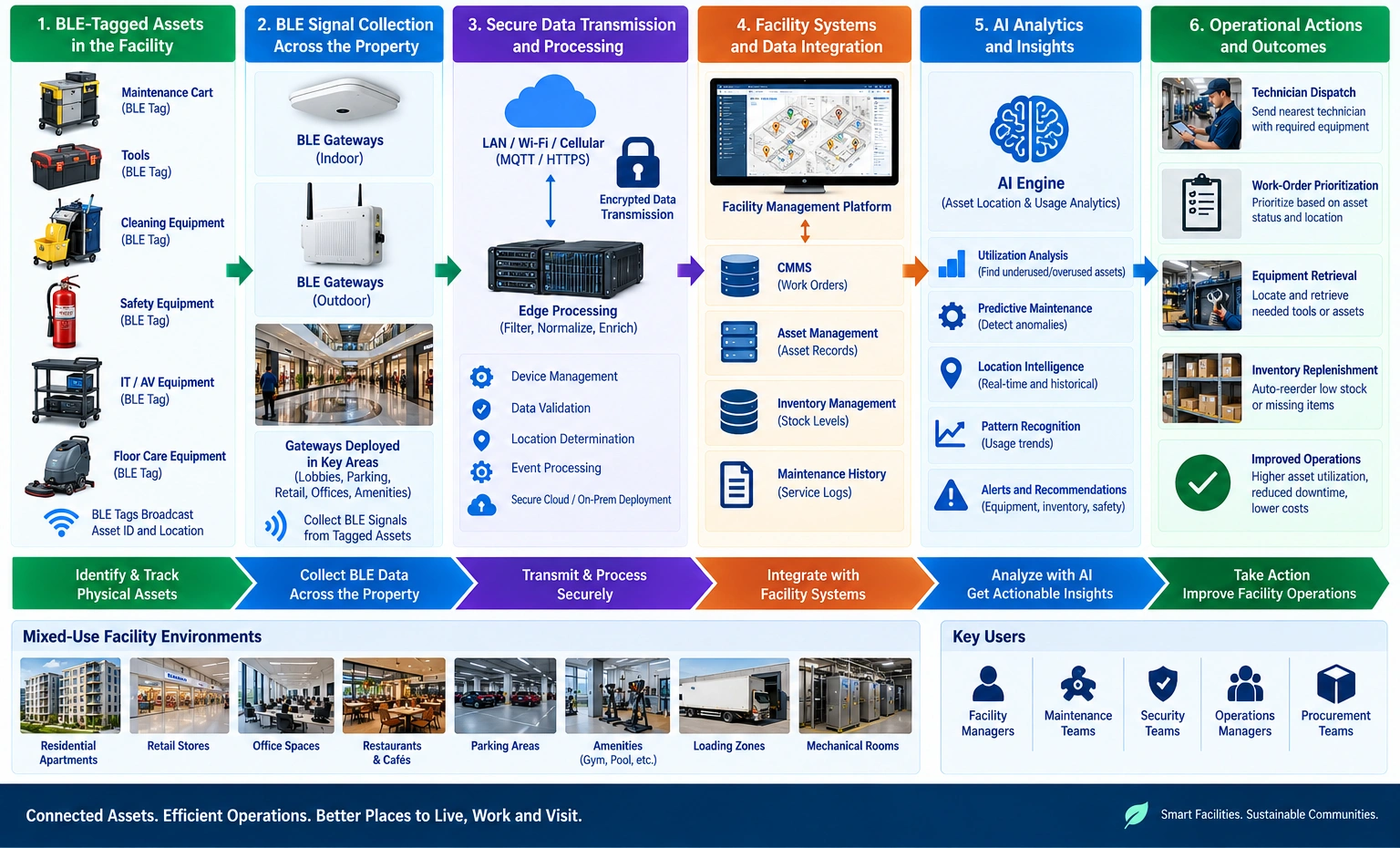
This workflow illustrates how BLE-tagged maintenance carts, tools, cleaning equipment, safety equipment, and other mobile assets are tracked across mixed-use facilities. BLE gateway data flows through secure edge processing, facility-management systems, and AI analytics to enable technician dispatch, work-order prioritization, equipment retrieval, inventory replenishment, and improved asset utilization.
AI-Driven Mixed-use Property Applications
Smart Building Occupancy Intelligence
Occupancy intelligence can help operators understand how residents, tenants, employees, visitors, and customers use shared spaces. AI models can analyze historical and near-real-time information to identify recurring patterns rather than relying solely on static occupancy assumptions.
For example, a property manager could compare fitness-center utilization, conference-room occupancy, retail-area activity, parking demand, and shared amenity usage by time period. These insights can support staffing, cleaning, maintenance, security, and space-planning decisions.
AI-Powered Facility Maintenance
Predictive and condition-based maintenance become more useful when AI has access to both equipment information and contextual facility data. Temperature, humidity, vibration, equipment status, location, work-order history, and occupancy conditions can be evaluated together where suitable sensors and integrations are available.
AI can help maintenance teams prioritize abnormal conditions rather than treating every alert equally. A temperature excursion in an occupied tenant area, for example, may require a different response from a similar reading in an unoccupied service room.
Intelligent Parking and Mobility Operations
Parking structures within mixed-use properties create location and occupancy challenges because vehicles, pedestrians, security personnel, service vehicles, and deliveries share constrained areas. AI can analyze parking utilization, entry and exit activity, congestion patterns, and operational events.
BLE can support selected proximity and wayfinding applications, while cameras, access-control systems, parking sensors, and license-plate systems may provide complementary data. The most effective solution depends on required accuracy, privacy requirements, environmental conditions, and the specific parking workflow.
Indoor Wayfinding and Staff Operations
Large mixed-use developments can be difficult to navigate, particularly for visitors, maintenance technicians, security personnel, contractors, and emergency-response teams. BLE beacons can provide location references that support indoor navigation and zone identification.
AI can add operational context by considering destination, current conditions, building access restrictions, congestion, and scheduled activities. For facility teams, this can reduce time spent locating work areas and improve coordination between work orders and physical locations.
BLE Hardware and AI Data Acquisition for Mixed-use Properties
BLE deployment for mixed-use properties normally uses three complementary components: BLE beacons, BLE sensors, and BLE gateways.
BLE beacons transmit identifiable signals that can establish proximity or zone presence. They can be attached to selected assets, installed at entrances, positioned in corridors, or deployed at designated indoor-location reference points.
BLE sensors provide measurable operational information such as temperature, humidity, motion, contact state, or other supported parameters. Their value increases when sensor readings can be associated with a specific room, asset, tenant area, or facility zone.
BLE gateways receive transmissions from nearby BLE devices and forward collected information to application software through available network connectivity. Gateway placement requires consideration of floor plans, wall construction, radio attenuation, interference, device density, required coverage, and network availability.
The BLE layer should be designed around the actual operational requirement. A property that only needs room-level asset presence does not necessarily require the same device density as a solution requiring higher-resolution indoor positioning.
GAO provides BLE and RFID hardware products and systems that can be incorporated into property-management deployments, including applications where BLE data must coexist with other IoT and identification technologies.
AI, IoT and Property Management System Integration
AI-driven mixed-use property operations depend on integrating sensor information with existing software rather than creating an isolated data stream. Relevant systems can include building management systems, building automation systems, access-control software, video management systems, computerized maintenance management systems, property management systems, parking-management software, visitor-management systems, tenant applications, work-order databases, and energy-management software.
A typical data flow is:
- BLE beacons and sensors generate identification, proximity, environmental, or equipment data.
- BLE gateways collect nearby device transmissions.
- Network infrastructure transports gateway data using the property’s approved connectivity.
- Middleware normalizes device information and associates readings with property zones, assets, rooms, or equipment.
- Edge or server-side processing performs filtering, validation, buffering, and event handling where required.
- AI software analyzes current and historical data.
- APIs or integration services exchange relevant events with facility-management and property-management systems.
- Staff receive alerts, dashboards, work orders, or recommended actions.
- Operational outcomes are recorded and can become additional data for future analysis.
Cloud and Server Deployment Considerations
Cloud Version
A cloud-hosted deployment can be appropriate for property portfolios distributed across multiple buildings or geographic locations. Gateway data can be transmitted securely to cloud-hosted software where centralized analytics, dashboards, device management, reporting, and AI processing are required.
This approach can simplify centralized administration and make portfolio-level comparisons easier. It is particularly useful when a property-management organization needs common analytics across multiple mixed-use developments.
Network resilience remains important. Gateways should have suitable buffering or store-and-forward capabilities where temporary connectivity interruptions could otherwise result in lost operational events.
Server Version
A Server Version places application software on customer-managed servers, private data centers, edge servers, or other privately hosted enterprise infrastructure. This model may be appropriate where property operators have strict data-governance requirements, existing private computing infrastructure, integration constraints, or policies limiting external processing.
Private server deployment can also be useful where certain facility systems must remain within controlled network boundaries. Engineers should evaluate computing requirements, database capacity, redundancy, backup procedures, patch management, cybersecurity controls, API connectivity, and remote administration before deployment.
The choice between cloud and Server Version should therefore be driven by property portfolio structure, data governance, network availability, integration requirements, operational support capabilities, and cybersecurity policy rather than by deployment preference alone.
Engineering Design and Deployment Lifecycle
Successful AI deployment in mixed-use properties begins with the operational problem, not with the selection of a sensor or AI model. Property owners, facility managers, security teams, building engineers, IT departments, and integrators should first define the decisions that the system must improve.
Planning and Requirements Definition
A requirements study should document the property’s physical layout, mixed-use components, operating schedules, tenant requirements, existing building systems, network infrastructure, security policies, and facility-management workflows.
Important planning questions include:
- Which areas require occupancy, proximity, environmental, or asset-location information?
- Is room-level, zone-level, floor-level, or higher-resolution positioning actually required?
- Which events require real-time alerts and which can be processed periodically?
- Which systems must exchange information with the AI software?
- Which information contains personal or potentially identifiable data?
- Which operations must continue if network or cloud connectivity is interrupted?
- What measurable KPI will determine whether the deployment has delivered value?
A useful engineering practice is to create a zone and asset register before installing BLE devices. Each gateway, beacon, sensor, room, floor, equipment area, and monitored asset should have a consistent identifier.
Radio Survey and Hardware Selection
BLE performance depends strongly on the physical environment. Reinforced concrete, elevator shafts, metal doors, mechanical equipment, glass treatments, tenant partitions, and dense radio environments can influence signal behavior.
A commissioning survey should therefore evaluate:
- Expected BLE coverage
- Gateway mounting locations
- Radio interference
- Device density
- Signal attenuation
- Battery-powered device accessibility
- Network connectivity
- Environmental exposure
- Maintenance access
- Required positioning accuracy
Beacon density should be determined from the required business outcome. Increasing device count does not automatically produce better operational data if gateway placement, calibration, signal filtering, or location modeling are poorly designed.
Commissioning, Testing, and Calibration
Commissioning should verify each layer independently before full AI processing is enabled. Engineers should confirm device identity, telemetry transmission, gateway reception, network delivery, timestamp consistency, zone mapping, database records, API behavior, and application-level event generation.
Test scenarios should include normal operation as well as failure conditions. Examples include a disconnected gateway, depleted sensor battery, temporary network outage, duplicate device identifier, incorrect zone assignment, unexpected access event, and invalid sensor reading.
AI models should also be evaluated against known operational conditions. A model that performs well in one property may require recalibration when floor layouts, tenant behavior, equipment schedules, or occupancy patterns change.
AI Models for Mixed-use Property Management
AI methods should be selected according to the operational decision rather than applied simply because a large volume of sensor data exists.
- Anomaly detection: identifies unusual occupancy, environmental, access, or equipment patterns.
- Time-series forecasting: predicts occupancy, energy demand, environmental conditions, or equipment behavior.
- Classification models: categorize facility events, equipment conditions, or maintenance priorities.
- Clustering: identifies recurring usage patterns among rooms, amenities, tenants, or facility zones.
- Predictive maintenance models: estimate the probability or timing of equipment-related problems.
- Computer vision: can provide complementary occupancy, safety, parking, or condition information where cameras are appropriate and privacy requirements permit.
- Optimization models: help determine operating schedules, maintenance priorities, space utilization strategies, or resource allocation.
- Generative AI: can help facility teams query operational records, summarize incidents, explain trends, or retrieve information from maintenance documentation when appropriate controls are implemented.
- Edge AI: can process selected events locally when latency, bandwidth, privacy, or resilience requirements favor local computation.
The AI layer should preserve the distinction between an observation, a prediction, a recommendation, and an automated control action. Facility operators should be able to understand which category an AI-generated output belongs to before acting on it.
Cybersecurity and Privacy for AI-Enabled Mixed-use Properties
Mixed-use properties bring together building automation, access control, tenant services, IT networks, IoT devices, security systems, and sometimes residential technology. Connecting these systems creates additional cybersecurity considerations.
A secure implementation should address device identity, credential management, encryption, network segmentation, software updates, vulnerability management, logging, access control, backup, incident response, and secure decommissioning.
NIST’s IoT cybersecurity guidance is particularly relevant when evaluating BLE gateways, sensors, and other connected devices. NISTIR 8259 Rev. 1, published in April 2026, describes foundational cybersecurity activities for IoT product manufacturers, while NISTIR 8259A defines a core baseline of technical device cybersecurity capabilities.
Practical controls for mixed-use property deployments include:
- Assign unique identities to gateways, sensors, and other connected devices.
- Restrict administrative access according to operational roles.
- Separate IoT and building-control traffic from general tenant networks where appropriate.
- Use encrypted communication for data moving between gateways and application services.
- Maintain an inventory of deployed firmware and software versions.
- Establish a patch and vulnerability-management process.
- Monitor gateway and server logs for abnormal behavior.
- Apply data-retention rules based on the operational purpose of each dataset.
- Avoid collecting personally identifiable information when a less intrusive measurement can achieve the same operational objective.
- Establish procedures for removing devices when assets, tenants, contractors, or property zones change.
Privacy should be considered during system design rather than added after deployment. For example, an occupancy application may require aggregated zone utilization rather than continuous individual movement histories.
Interoperability with Building and Property Systems
Mixed-use property operations commonly involve equipment and software from multiple vendors. Interoperability is therefore a major engineering requirement.
Common integration targets include:
- Building Management Systems
- Building Automation Systems
- HVAC controllers
- Energy meters
- Access-control systems
- Video management systems
- Visitor-management software
- Property Management Systems
- Computerized Maintenance Management Systems
- Work-order systems
- Parking-management systems
- Tenant applications
- Digital signage
- Lighting-control systems
- Elevator monitoring systems
- Emergency and life-safety systems
Protocols and interfaces may include BACnet, Modbus, MQTT, REST APIs, webhooks, databases, Ethernet, Wi-Fi, cellular connectivity, and vendor-specific interfaces.
The integration layer should normalize identifiers and timestamps so that an AI model can distinguish, for example, “Tower A, Level 7, Office 704” from “Tower B, Level 7, Office 704.” Incorrect asset or location mapping can produce technically valid data that leads to operationally incorrect conclusions.
Standards and Regulatory Considerations
Mixed-use property deployments should be evaluated against the regulations and standards applicable to the building’s location, occupancy type, equipment, and intended application. Standards do not all govern AI or BLE directly. Many instead establish requirements for the physical building, energy performance, life safety, accessibility, cybersecurity, or measurement practices within which an AI-enabled solution operates.
Relevant U.S. and Canadian references can include:
- ANSI/BOMA Z65.6 for measurement of mixed-use properties. BOMA International identifies its 2026 Mixed-Use Properties Standard as an ANSI-approved standard addressing floor-area measurement and allocation in mixed-use buildings.
- ASHRAE Standard 90.1 for energy efficiency requirements applicable to covered buildings and sites.
- ASHRAE Standard 55 for thermal environmental conditions.
- ASHRAE Standard 62.1 for ventilation and acceptable indoor air quality in applicable nonresidential environments.
- ASHRAE Standard 62.2 for applicable residential ventilation requirements.
- NFPA 72 for fire alarm and signaling systems where applicable.
- NFPA 70, the National Electrical Code, for electrical installations in applicable U.S. projects.
- International Building Code and applicable local building codes.
- International Fire Code and local fire regulations.
- Americans with Disabilities Act requirements in applicable U.S. facilities.
- Americans with Disabilities Act Accessibility Guidelines where applicable.
- OSHA requirements relevant to facility employees and workplace safety.
- Canadian Electrical Code and applicable provincial requirements.
- National Building Code of Canada and applicable provincial or municipal building requirements.
- Canadian fire and life-safety requirements applicable to the property jurisdiction.
- Provincial privacy legislation and applicable federal Canadian privacy requirements.
- Local energy benchmarking and carbon-reduction requirements.
- Municipal green-building requirements and building-performance standards.
The technology should never interfere with certified life-safety functions. AI recommendations should be treated separately from safety-critical control logic unless the complete control path has been engineered, tested, approved, and maintained under the applicable requirements.
Leading Technology and Software Categories
The mixed-use property technology market includes building automation suppliers, facility-management software providers, IoT connectivity companies, analytics providers, security vendors, and specialized AI companies. Procurement teams should evaluate capabilities rather than selecting a supplier solely on brand recognition.
Major building technology participants include Johnson Controls, Siemens, Schneider Electric, Honeywell, Tridium, and other established building-automation and facility-technology providers. For example, Johnson Controls describes OpenBlue as an AI-enabled system for building performance, including equipment analytics, occupancy-related insights, energy optimization, and facility operations. Siemens has also described the use of cloud intelligence to connect building data and improve operational decision-making.
BLE and IoT hardware should be evaluated separately from higher-level building-management software. A property may combine BLE gateways and sensors from one supplier with access control, BMS, CMMS, and AI software from other suppliers.
GAO’s role can be particularly relevant where property teams need BLE, RFID, and IoT hardware products and systems that can be incorporated into a broader facility-management solution.
Practical Deployment Examples in U.S. and Canadian Mixed-use Properties
The following examples illustrate real property developments and the technology lessons they demonstrate. They should not be interpreted as claims that every listed property uses the exact GAO BLE and AI configuration described on this page.
800 Fulton Market, Chicago
800 Fulton Market is a mixed-use office tower in Chicago that incorporated capacity-monitoring and smart-building systems. The project was designed with wellness, sustainability, and building-performance objectives, and project documentation describes cloud-based machine-learning insights used by the property team.
The engineering lesson for other mixed-use properties is that occupancy and building-condition data become more valuable when connected to facility operations rather than treated as isolated measurements.
35 Hudson Yards, New York City
35 Hudson Yards is a large mixed-use development containing residential, office, retail, and hotel functions. A published case study describes near-real-time building analytics and more than 11,000 monitored data points used to improve operational performance.
This type of development demonstrates why mixed-use properties benefit from common data models and cross-system analysis. Mechanical systems, occupancy, energy, tenant requirements, and equipment performance can interact in ways that are not visible when each subsystem is analyzed independently.
Ogden Commons, Chicago
Ogden Commons is a mixed-use redevelopment combining housing, healthcare, and commercial or retail functions. Its project profile illustrates the complexity of managing multiple building uses and stakeholders within a coordinated development.
For an AI and BLE deployment, such environments are suitable for phased implementation. Property operators can begin with a specific operational problem, such as maintenance asset tracking or common-area occupancy, then extend data collection and analytics after validating the first workflow.
88 Scott Street, Toronto
88 Scott Street is a 58-story Toronto mixed-use development containing residential, office, and retail areas. The City of Toronto identifies the project as having achieved Toronto Green Standard Tier 2 requirements and LEED Gold certification.
The project illustrates why mixed-use facility management must account for different occupancy profiles, energy requirements, and shared building services rather than treating the entire property as one homogeneous operating environment.
777 Bay, Toronto
777 Bay is a major mixed-use tower in downtown Toronto with office, education, government, and retail uses. A 2026 case study describes long-term reinvestment, renovation, sustainability, and modernization efforts at the property.
The relevant lesson for AI-enabled property operations is the importance of modernization strategies that can work with existing buildings. Retrofit deployments often require integration with legacy equipment rather than assuming that every property can be equipped with entirely new building systems.
North American Mixed-Use Smart Building Case Studies and Technology Landscape
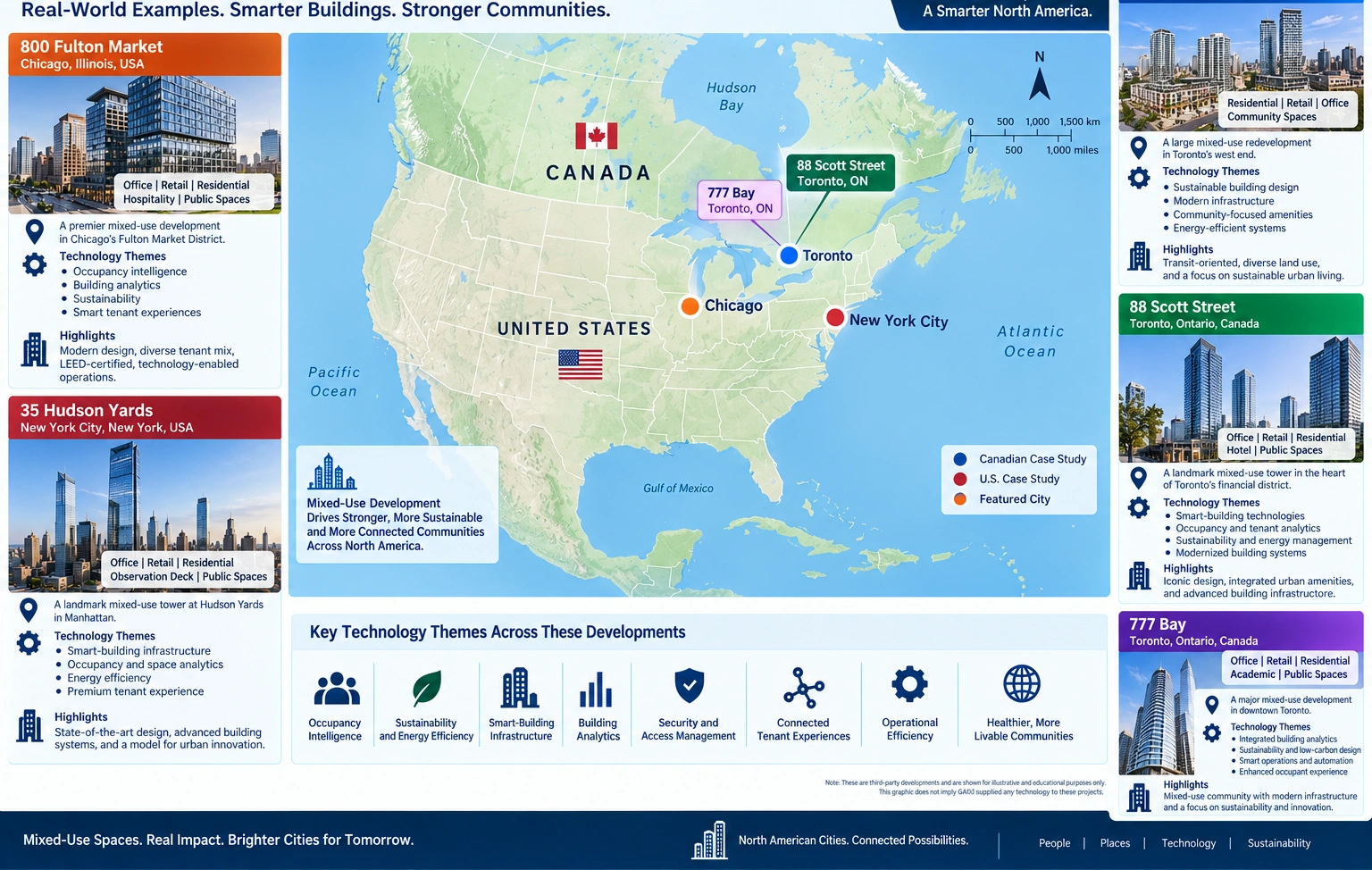
This North American map highlights mixed-use developments in Chicago, New York City, and Toronto, including 800 Fulton Market, 35 Hudson Yards, Ogden Commons, 88 Scott Street, and 777 Bay. The case-study callouts illustrate technology themes such as occupancy intelligence, building analytics, smart-building infrastructure, sustainability, security, energy efficiency, and connected tenant experiences.
Measuring AI and BLE Performance in Mixed-use Properties
A deployment should be evaluated using measurable property-management KPIs rather than device counts alone.
Useful KPIs include:
- Occupancy detection accuracy
- Zone-location accuracy
- BLE gateway availability
- Sensor reporting reliability
- BLE device battery life
- Asset retrieval time
- Asset search time per work order
- Maintenance response time
- Mean time to repair
- Preventive-maintenance completion rate
- Unplanned equipment downtime
- False-alarm rate
- Access-event anomaly detection rate
- Visitor processing time
- Parking occupancy accuracy
- Common-area utilization
- Amenity utilization
- HVAC runtime
- Energy use intensity
- Peak electrical demand
- Indoor temperature compliance
- Indoor humidity compliance
- Indoor air-quality exception rate
- Work-order completion time
- Technician travel time
- Cost per maintenance event
- Tenant service response time
- System availability
- Cybersecurity incident rate
- Data-loss or telemetry-gap rate
- AI recommendation acceptance rate
The most meaningful measurement approach compares the baseline condition with post-deployment performance. For example, reducing the time required to locate maintenance equipment may be more valuable to a facility team than increasing the number of BLE devices installed.
Implementation Recommendations for Property Owners and Facility Managers
A successful deployment should progress from measurable operational requirements toward scalable technical implementation.
- Start with one or two high-value workflows such as maintenance asset tracking, occupancy intelligence, visitor operations, or environmental monitoring.
- Document the property’s floor plans, zones, equipment, access areas, network infrastructure, and existing software before selecting device quantities.
- Define the required location accuracy before designing BLE coverage.
- Conduct an RF survey and pilot before installing devices throughout a large property.
- Use consistent identifiers for buildings, floors, rooms, assets, gateways, sensors, and tenant areas.
- Integrate with existing CMMS, BMS, access-control, property-management, and parking systems where practical.
- Establish cybersecurity requirements during procurement.
- Separate operational data from personally identifiable information whenever possible.
- Use edge processing or local buffering when network outages could disrupt important workflows.
- Validate AI recommendations against facility-engineering knowledge before enabling automated control.
- Establish battery replacement and preventive-maintenance procedures for battery-powered devices.
- Monitor data quality continuously rather than assuming that a deployed sensor remains reliable indefinitely.
- Create clear ownership for device management, network administration, AI model monitoring, and operational response.
- Measure the baseline before deployment so that improvements can be demonstrated quantitatively.
- Expand only after the initial workflow has achieved its defined technical and business targets.
How GAO Supports AI-Enabled Mixed-use Property Solutions
GAO has supplied BLE, RFID, and IoT hardware products and systems to organizations requiring connected identification, sensing, tracking, and monitoring capabilities. For mixed-use property projects, these technologies can provide the physical data layer needed by applications such as asset tracking, environmental monitoring, location awareness, inventory control, access-related workflows, and facility operations.
GAO is headquartered in New York City and Toronto, Canada, and has served customers throughout the United States and Canada for three decades. The broader GAO Group, including GAO Research and GAO Tek, has worked with Fortune 500 companies, R&D organizations, universities, and government agencies while investing substantially in product and systems research and development.
For property and facility-management teams, the practical value of a hardware supplier is not simply device availability. Deployment support, product selection, integration requirements, system testing, technical documentation, and ongoing troubleshooting can materially affect the performance of a connected property solution. GAO provides remote and onsite technical support according to project requirements.
Key Takeaways for AI and BLE in Mixed-use Properties
AI can help mixed-use property operators move from isolated sensor readings and building-system alarms toward data-driven facility decisions. BLE beacons, sensors, and gateways provide one useful source of location, proximity, environmental, and asset information, while BMS, access control, CMMS, property-management, parking, energy, and other systems contribute complementary operational data.
The strongest deployments focus on specific operational outcomes such as reducing maintenance response time, improving space utilization, locating mobile assets, optimizing building services, identifying abnormal conditions, or improving visitor and access operations.
GAO can support organizations evaluating BLE, RFID, and IoT hardware products and systems for these applications. Property owners, facility managers, system integrators, and engineering teams can learn more about GAO’s technologies, deployment capabilities, and technical support when developing or modernizing AI-enabled mixed-use property operations.
Building the Future of Industrial AI and IoT with Aperture Venture Studio and GAO RFID Inc.
For more than three decades, GAO Group of Companies has invested heavily in R&D of industrial BLE, RFID, and IoT. As generative AI has become useful in industrial applications, we have expanded our work in AI and IoT, including BLE and RFID, and established Aperture Venture Studio to advance practical AI and IoT solutions relevant to applications such as intelligent mixed-use property management.
Aperture brings together AI and IoT technical experts, entrepreneurial and operational executives, investors, and leading companies. Through Aperture Ventures Summit and TekSummit, we also facilitate discussion of advanced AI and IoT technologies. We welcome advisors, co-founders and employees, investors, and customers to participate in these growing technical communities.