
AI and BLE for Academic Libraries
AI and BLE for Academic Libraries
Academic libraries are increasingly using artificial intelligence to improve collection management, resource utilization, facility operations, security, and the user experience across research-intensive campuses. AI solutions can analyze location, movement, occupancy, environmental, and utilization data captured through connected devices, including BLE beacons, BLE gateways, and BLE sensors. This combination supports practical applications such as AI library asset tracking, intelligent study-space utilization, equipment monitoring, wayfinding, inventory visibility, and abnormal-activity detection. BLE provides relatively low-power wireless identification and sensing capabilities, while AI converts the resulting data into operational insights and automated decisions. For academic libraries with large collections, distributed study areas, special collections, laboratories, archives, and extended operating hours, AI-enabled monitoring can reduce manual work and improve visibility without requiring every operational process to become fully automated. GAO supplies BLE, RFID, and IoT hardware products and systems that can support these library-focused deployments.
AIoT-Enabled Academic Library with BLE Asset, Occupancy, and Facility Intelligence
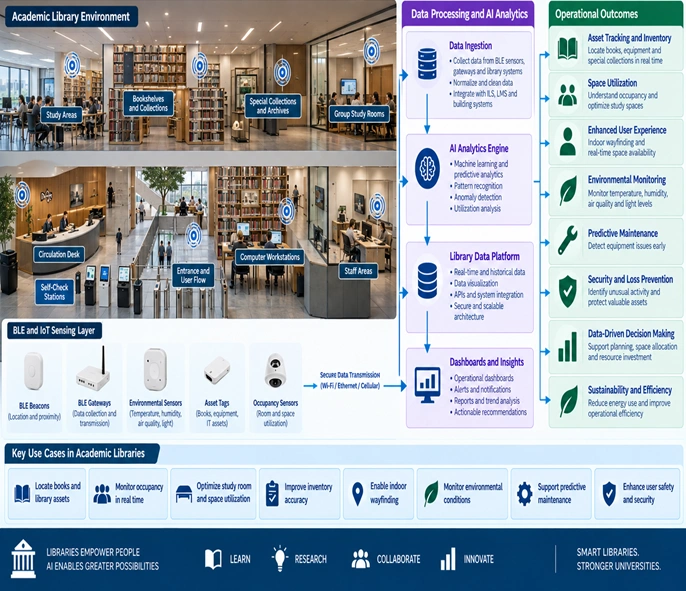
This visual shows how BLE beacons, gateways, environmental sensors, asset tags, and occupancy sensors collect data across academic library spaces. The data flows through secure transmission, AI analytics, and library platforms to support asset tracking, space utilization, wayfinding, environmental monitoring, predictive maintenance, security, and data-driven decisions.
How AI Is Transforming Academic Library Operations
AI for academic libraries refers to the use of machine learning, computer vision where appropriate, predictive analytics, natural language processing, anomaly detection, and other AI methods to improve decisions involving collections, facilities, users, equipment, and library services. The most useful implementations do not treat AI as an isolated software function. Instead, AI works with operational data generated by circulation systems, integrated library systems, access-control systems, occupancy sensors, environmental sensors, location technologies, building systems, and other campus information sources.
Academic libraries have unusually diverse operational requirements. A central university library may contain hundreds of thousands or millions of cataloged resources, while branch libraries can serve specialized disciplines such as medicine, engineering, law, business, or the sciences. Libraries may also maintain rare books, manuscripts, archival materials, audiovisual collections, research equipment, computer labs, group-study rooms, individual study areas, and staff workspaces.
AI can identify patterns across these operational datasets that are difficult to detect through manual observation. Examples include recurring periods of study-room congestion, unusual movement of high-value equipment, environmental conditions that could threaten sensitive collections, underused areas, recurring inventory discrepancies, and demand patterns that affect staffing or resource allocation.
BLE contributes wireless location and sensing data that can be incorporated into these AI workflows. BLE beacons can provide proximity references, BLE gateways can collect transmissions from tags and sensors, and BLE sensors can report conditions such as temperature, humidity, occupancy-related signals, or other monitored parameters. The resulting data can be processed locally or centrally depending on latency, privacy, network, and integration requirements.
GAO’s experience supplying BLE, RFID, and IoT hardware products and systems is relevant where academic libraries need physical data capture to complement their existing library software and campus information systems.
AI Library Asset Tracking and Resource Visibility
Academic libraries can use AI-assisted asset tracking to improve visibility of mobile and high-value resources. Depending on the asset and required accuracy, tracked resources may include laptops, tablets, audiovisual equipment, scanners, projectors, research instruments, mobile shelving equipment, loanable technology, library carts, and selected special-collection containers.
AI can correlate location events with circulation records, authorized movement, expected return times, and historical behavior. This creates opportunities to identify exceptions rather than requiring library staff to manually inspect every movement event.
Intelligent Study-Space Utilization
Study-room and seating utilization is another practical AI application. BLE sensing can provide signals associated with occupancy or proximity, while AI models can identify utilization patterns over time.
Academic library administrators can use these insights to evaluate:
- Individual study-room utilization
- Group-study room demand
- Peak examination-period occupancy
- Underused floors or zones
- Computer workstation utilization
- After-hours space demand
- Queue and congestion patterns
- Space requirements for future renovations
The objective is not simply to count occupied seats. AI can combine occupancy-related observations with time, day, academic calendar periods, room characteristics, and historical demand to support more informed facility decisions.
AI-Assisted Collection and Inventory Operations
AI can help academic libraries identify inventory anomalies by comparing expected records with observed events. BLE can complement RFID or barcode-based workflows when mobile location, environmental monitoring, or equipment tracking is required.
For example, an AI system could identify an unusual concentration of inventory exceptions in a particular branch, floor, shelving area, or collection category. Library staff can then investigate the specific exception rather than manually reviewing the entire collection.
Environmental Monitoring for Collections and Archives
Temperature and humidity are important operational variables for academic libraries that maintain archival materials, manuscripts, rare books, photographs, magnetic media, and other sensitive resources.
BLE sensors can periodically report environmental conditions through BLE gateways. AI analytics can identify persistent deviations, abnormal changes, recurring environmental patterns, or zones requiring inspection. The value comes from moving beyond simple threshold alarms toward condition-based analysis.
For sensitive collections, the system should still preserve conventional environmental controls and validated preservation procedures. AI should support professional judgment rather than replace collection-preservation policies.
AI-Enabled Library Security and Anomaly Detection
Academic libraries can also apply AI to identify unusual operational events involving authorized assets, restricted areas, equipment, and facility access. BLE location information can supplement access-control records and other security data.
- Equipment appearing in an unexpected library zone
- Tracked resources remaining outside an authorized area
- Repeated movement events during unusual hours
- Assets entering restricted collection areas
- Unexpected occupancy patterns in closed sections
- Environmental anomalies affecting restricted storage areas
Security implementations should minimize unnecessary monitoring of individuals and should distinguish asset monitoring from user surveillance. University privacy requirements, institutional policies, applicable laws, and data-governance procedures must be incorporated before deployment.
Academic Library Workflows Supported by AI and BLE
A successful AI-enabled academic library solution begins with a defined operational workflow rather than with hardware selection. The first step is determining what decision library staff need to improve and what data is required to support that decision.
A typical asset-monitoring workflow can begin when a BLE-enabled tag or sensor transmits data. Nearby BLE gateways receive the transmission and forward relevant information through the library’s wired or wireless network. Middleware normalizes the incoming events and associates device identifiers with authorized assets or monitored zones.
The processing layer can then apply filtering, aggregation, rules, statistical analysis, or AI models. Depending on the use case, the system may calculate location estimates, detect unusual movement, estimate occupancy patterns, identify environmental trends, or correlate physical observations with library records.
Processed information can then be integrated with library management software, facilities systems, security applications, dashboards, ticketing systems, or data warehouses. Operational users receive actionable information rather than raw wireless events.
Data Acquisition and Identification
Data acquisition can involve several sources:
- BLE tags attached to loanable equipment or selected mobile assets
- BLE beacons defining library zones or location references
- BLE sensors monitoring environmental conditions
- BLE gateways receiving wireless transmissions
- RFID readers and tags for collection and inventory workflows
- Barcode scanners used by library staff
- Integrated library system records
- Circulation and loan transactions
- Room-reservation systems
- Building management systems
- Access-control events
- Campus network and identity systems
The appropriate combination depends on the operational requirement. BLE is particularly useful when libraries need wireless location or sensing without requiring every monitored item to be continuously connected to Wi-Fi.
Communication and Edge Processing
BLE gateways provide the connection between local wireless devices and the library’s IP network. Gateway placement should account for floor plans, shelving density, reinforced walls, elevators, mechanical spaces, interference sources, expected tag density, and required location accuracy.
Edge processing can filter duplicate events, reject malformed packets, aggregate repeated sensor observations, and reduce unnecessary traffic before information reaches centralized software. This is particularly useful in large academic libraries where numerous gateways may generate substantial event volumes.
Network design should include appropriate VLAN segmentation, firewall rules, certificate or credential management, device authentication, firmware management, and monitoring. Library IT teams should also establish procedures for replacing failed gateways and recovering devices after network changes.
AI Processing and Decision Support
AI processing can occur on centralized servers, private infrastructure, or cloud-hosted systems depending on institutional requirements.
Machine learning can be useful for pattern recognition, anomaly detection, demand forecasting, occupancy analysis, and predictive maintenance. Rule-based logic remains valuable for deterministic events such as “asset leaves an authorized zone” or “temperature exceeds a defined preservation threshold.”
A practical implementation often combines both approaches. Deterministic rules handle events requiring predictable responses, while AI analyzes complex or historical patterns that are difficult to encode as fixed rules.
Operational Action
The final stage is an operational response. A library system should not stop at generating a dashboard.
Potential actions include:
- Alerting library staff about an asset exception
- Opening a facilities work order
- Escalating an environmental condition
- Reassigning staff during high-demand periods
- Adjusting study-room management procedures
- Investigating inventory discrepancies
- Reviewing equipment circulation practices
- Updating space utilization plans
- Triggering maintenance inspection
- Providing historical reports for library administration
This data-to-action process is what turns connected sensing into an operational AI solution for academic libraries.
AI, BLE Hardware, Software, and Deployment Choices for Academic Libraries
Academic library deployments normally combine wireless identification or sensing hardware, gateways, networking, middleware, databases, analytics software, AI processing, and integrations with existing university systems. Hardware selection should follow the required operational outcome rather than starting with a particular wireless technology.
BLE beacons can establish zone references or transmit identifiers, while BLE tags can be attached to selected mobile assets. BLE sensors can provide environmental or other condition data. BLE gateways collect transmissions and pass relevant information to software through IP-based connectivity.
The physical environment of an academic library affects deployment significantly. Dense shelving can influence radio propagation, while concrete floors, metal structures, elevators, server rooms, and mechanical spaces can create coverage variations. A site survey should therefore be completed before final gateway quantities and mounting locations are determined.
BLE Gateways for Library Data Collection
BLE gateways serve as local collection points for BLE advertisements and sensor transmissions. A gateway may forward data through Ethernet, Wi-Fi, cellular connectivity, or another supported network connection depending on the installation.
For academic libraries, important gateway considerations include:
- Coverage across reading rooms and collection areas
- Gateway density and expected device population
- Ethernet and PoE availability
- Wi-Fi capacity where wireless backhaul is used
- Network segmentation
- Remote device management
- Firmware update procedures
- Time synchronization
- Failure detection and recovery
- Physical mounting and tamper protection
BLE Beacons and Sensors in Library Environments
BLE beacons can be deployed at known locations to support proximity and zone-level positioning. BLE sensors can provide data relevant to collection preservation, facilities management, or monitored equipment.
Sensor selection should reflect the actual environmental variable being measured. Temperature and humidity sensors, for example, should be selected and positioned according to the preservation requirements of the monitored collection rather than simply maximizing device density.
AI Models and Analytics Software
AI software can process location, occupancy, environmental, inventory, and operational datasets. Suitable methods may include anomaly detection, classification, clustering, time-series forecasting, regression, and predictive models.
The model should be selected according to the decision being supported. A library seeking to forecast study-space demand has a different modeling requirement from a library detecting abnormal movement of loanable equipment.
Data quality is equally important. Missing gateway events, duplicated transmissions, inconsistent asset identifiers, incorrect room mappings, and clock synchronization problems can reduce model reliability. Data validation should therefore be treated as part of the AI implementation rather than as an afterthought.
Cloud Version and Server Version for Academic Libraries
A Cloud Version can be appropriate for academic libraries that want centrally managed software, elastic computing resources, remote access, and simplified infrastructure maintenance. It can support multi-branch library environments where data from several locations needs to be analyzed centrally. Institutional requirements for data residency, identity management, retention, privacy, and network connectivity should be evaluated before selecting this model.
A Server Version can be appropriate when a university requires greater control over data processing, network isolation, integration with privately hosted applications, or institutional IT management. The server may be located in a campus data center, private data center, customer-managed infrastructure, or another privately hosted environment.
The decision should consider:
- University cybersecurity policies
- Data governance requirements
- Identity and access management
- Network connectivity
- Integration with existing campus systems
- IT staffing and maintenance capabilities
- Data retention policies
- Disaster recovery requirements
- Software update responsibilities
- Multi-campus deployment requirements
GAO can supply BLE and RFID hardware products and related IoT technologies that form part of these deployments, allowing academic library and university IT teams to select physical data-capture components according to their operational requirements.
Engineering Considerations Before Deployment
Academic library AI projects often fail to deliver expected value when the deployment begins with device installation instead of operational requirements. A better approach starts with a clearly defined use case, measurable KPI, data requirement, integration path, and operational owner.
A library should first determine whether the target problem concerns asset location, collection inventory, room utilization, environmental conditions, equipment availability, security exceptions, or another measurable operational process.
Location accuracy also requires careful definition. Zone-level visibility may be sufficient for tracking loanable equipment between floors or departments, while room-level or sub-room positioning may require denser infrastructure and more sophisticated location processing.
Privacy should receive similar attention. A system designed to understand space utilization does not necessarily need personally identifiable information. Where possible, deployments should separate asset identifiers, anonymous occupancy signals, and user identity data. Access to detailed event histories should follow least-privilege principles.
University IT, library leadership, facilities personnel, cybersecurity teams, and procurement staff should jointly review the proposed deployment before commissioning. Pilot testing should validate radio coverage, data quality, gateway reliability, software integration, alert behavior, and operational response procedures before expanding to additional library branches or floors.
Interoperability With Existing Academic Library Systems
AI and BLE systems should complement existing library technologies rather than create isolated data stores. Relevant integration points can include integrated library systems, circulation systems, discovery services, room-booking applications, facilities management software, access-control systems, campus identity services, data warehouses, and reporting tools.
Common integration methods may include APIs, webhooks, database interfaces, message brokers, CSV or structured data exchange, and other institutionally approved interfaces.
The most useful integration is usually the one that moves an AI finding into an existing operational process. For example, an environmental anomaly can become a facilities ticket, while a repeated asset-location exception can become an investigation task for library staff.
GAO’s hardware products and systems can be incorporated into broader academic library IoT deployments where BLE or RFID data capture is required alongside existing university software.
Cybersecurity and Data Governance
Security controls should extend from individual BLE devices through gateways, networks, servers, cloud services, and user interfaces. Device credentials should be managed securely, unused services should be disabled, firmware should be maintained, and gateway communications should use appropriate encryption and authentication.
Academic institutions should also define who can access raw location events, aggregated utilization statistics, environmental history, and asset records. Retention periods should correspond to legitimate operational needs rather than retaining detailed movement data indefinitely.
A well-designed implementation treats cybersecurity, privacy, device lifecycle management, and data governance as operational requirements from the beginning rather than as final-stage compliance activities.
Key AI Capabilities and Operational Benefits for Academic Libraries
AI-enabled academic library systems become most valuable when they convert continuous physical-world observations into decisions that library staff, facilities teams, and university administrators can act on. BLE devices provide one source of operational data, while AI methods can correlate that information with circulation records, room schedules, environmental history, maintenance records, and other approved datasets.
More Accurate Academic Library Asset Visibility
AI-assisted asset tracking can provide a more complete view of mobile library resources than periodic manual checks. A library can establish expected locations or movement patterns for loanable technology and selected equipment, then use automated analysis to identify exceptions.
The resulting workflow can support:
- Faster identification of misplaced laptops, tablets, projectors, scanners, and audiovisual equipment
- Better visibility of equipment moving between branches or departments
- Reduced time spent searching for mobile resources
- Detection of assets remaining outside approved locations
- Improved reconciliation between physical resources and circulation records
- Historical analysis of equipment movement and utilization
BLE is particularly useful where assets need to be observed without requiring a dedicated Wi-Fi connection for every tag. RFID can complement the same workflow where libraries require rapid item-level identification during inventory or circulation activities.
AI-Based Space and Occupancy Intelligence
Academic library space is often divided into individual study areas, collaborative rooms, computer laboratories, quiet zones, research spaces, reading rooms, and specialized facilities. Demand can change substantially during examinations, registration periods, semester transitions, and major research deadlines.
AI can analyze historical occupancy observations to identify recurring patterns and forecast demand. Library administrators can use these findings when evaluating furniture arrangements, opening hours, room allocation, study-space policies, and future renovations.
The technical objective should be defined carefully. If the decision only requires room-level utilization, a lower-resolution occupancy solution may be preferable to a system attempting continuous individual positioning.
Predictive Environmental Monitoring
Environmental AI can move academic library preservation from simple threshold alarms toward trend-based monitoring. A temperature or humidity reading becomes more informative when analyzed alongside historical conditions, room characteristics, seasonal changes, HVAC behavior, and collection sensitivity.
AI can identify:
- Gradual environmental drift
- Repeated temperature excursions
- Persistent humidity patterns
- Sudden changes following HVAC events
- Zones requiring inspection
- Conditions associated with recurring facilities problems
BLE sensors and gateways can provide the underlying measurements, while AI software determines whether an observed change represents an isolated event or a developing operational problem.
Intelligent Inventory and Collection Management
AI can help libraries prioritize inventory investigations by identifying anomalies in collection records, movement patterns, and physical observations.
For example, repeated discrepancies associated with a particular collection area could indicate shelving-process problems, cataloging inconsistencies, scanning gaps, unauthorized movement, or another operational issue. Combining RFID or barcode inventory information with BLE location observations can provide complementary visibility.
AI should not independently declare a library item missing based solely on a wireless event. Human review remains important because books and other resources are frequently moved legitimately during circulation, reshelving, interlibrary loan, reference activities, exhibitions, preservation work, and collection maintenance.
Operational Analytics for Library Management
AI-generated analytics can help library leadership understand how physical resources and facilities are being used.
Potential measures include:
- Asset utilization rate
- Study-room occupancy
- Seat utilization
- Equipment circulation frequency
- Inventory exception rate
- Average asset search time
- Environmental excursion frequency
- Mean time to respond to alerts
- Gateway availability
- Sensor reporting reliability
- Library-space utilization by time period
- Resource demand by branch or collection area
These measures can provide stronger evidence for staffing, facilities planning, procurement, maintenance, and capital-investment decisions.
Academic Library Applications Across the Operational Lifecycle
AI and BLE deployments can support multiple stages of academic library operations, but the implementation should remain use-case driven.
Library Asset Tracking and Equipment Circulation
Loanable technology programs create a strong application for location-aware monitoring. Libraries can associate BLE tags with equipment records and use gateway observations to improve visibility between checkout, authorized use, storage, and return.
AI can analyze utilization history to identify equipment that is consistently overbooked, underused, frequently misplaced, or repeatedly unavailable. Procurement teams can then use actual utilization data when deciding whether additional equipment should be purchased or existing resources redistributed.
Study Room and Reading Space Management
AI-assisted occupancy analysis can help libraries understand demand without requiring staff to manually inspect every room.
Historical patterns can support decisions concerning:
- Room reservation policies
- Study-room capacity
- Extended opening hours
- Furniture allocation
- Quiet-zone planning
- Computer workstation provision
- Branch library resource allocation
Where privacy is important, occupancy data should be aggregated and separated from personally identifiable user information whenever practical.
Special Collections and Restricted Research Areas
Special collections, archival rooms, manuscript storage, and rare-book areas require tighter controls than ordinary circulation areas.
Location-aware assets can help staff identify unexpected movement of equipment or containers associated with restricted collections. Environmental sensors can provide continuous measurements for storage conditions.
The system should be designed so that security events do not automatically imply misconduct. Alerts should initiate an appropriate verification procedure involving authorized personnel.
Library Computer Labs and Loanable Technology
Academic libraries frequently provide computers, monitors, tablets, cameras, recording equipment, presentation devices, and other technology resources. AI-assisted utilization analysis can identify demand patterns and support preventive maintenance scheduling.
Combining asset records with maintenance history can also help estimate when equipment requires inspection or replacement.
Research Libraries and Distributed Branches
Large universities may operate central libraries together with discipline-specific branches. A common software environment can consolidate information while allowing each library to retain local operational rules.
For example, a medical library may have different environmental requirements and asset types from an engineering library. The data model should therefore support branch-specific attributes rather than assuming every library location operates identically.
Standards, Security, Privacy, and Regulatory Considerations
Academic library technology deployments operate within a combination of wireless, information-security, accessibility, privacy, records-management, and institutional governance requirements. Applicable requirements vary according to the university, jurisdiction, data collected, and system integrations.
Relevant technical and governance references can include:
- Bluetooth Core Specification requirements applicable to BLE devices
- IEEE 802.11 standards where Wi-Fi provides gateway backhaul
- Internet Protocol networking standards
- TLS for protected network communications
- IEEE 802.1X where institutionally required for network authentication
- NIST Cybersecurity Framework practices
- NIST guidance for cybersecurity risk management
- NIST SP 800-53 controls where applicable to institutional information systems
- NIST SP 800-61 incident-response guidance
- FERPA considerations when library data becomes associated with student education records
- State or provincial privacy requirements applicable to university operations
- Canadian privacy requirements such as PIPEDA where applicable
- Accessibility requirements relevant to library services and digital interfaces
- University records-retention and data-governance policies
- Institutional information-security policies
- Vendor security and software-assurance requirements
BLE deployment does not automatically make a system compliant with any particular regulation. Compliance depends on the data collected, processing activities, institutional policies, jurisdiction, and system design.
Libraries should also establish data classification, retention, access-control, incident-response, and device-decommissioning procedures before production deployment.
Privacy by Design for Academic Libraries
Privacy is particularly important when technology can potentially produce information about where people are located.
A privacy-conscious deployment should determine whether the operational objective can be achieved without identifying individuals. Asset tracking, environmental monitoring, and aggregate room utilization often have legitimate operational purposes that do not require a persistent identity trail for every library user.
Where identity is required for an authorized function, access should be limited to appropriate personnel and protected using institutional authentication and authorization controls.
Wireless Reliability and Device Lifecycle Management
BLE performance depends on the physical environment and installation design. Academic libraries contain dense shelving, metal furniture, reinforced structures, elevator shafts, equipment rooms, and changing layouts that can affect radio behavior.
Commissioning should therefore include:
- Site surveys
- Gateway coverage verification
- Device identification testing
- Packet reception testing
- Location accuracy validation
- Battery-life verification
- Network failover testing
- Gateway restart testing
- Environmental sensor calibration checks
- Alert delivery testing
- Software integration testing
- Security-control validation
Device lifecycle planning should also account for battery replacement, firmware updates, gateway replacement, asset reassignment, device retirement, and secure disposal.
Multi-Floor Academic Library BLE Deployment and RF Coverage Plan
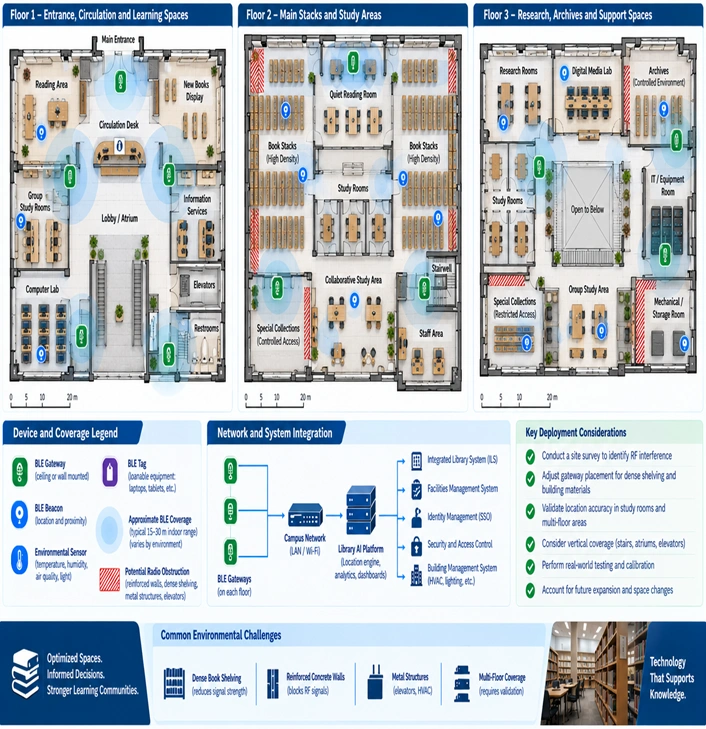
This engineering floor-plan visual shows strategic BLE gateway, beacon, tag, and environmental sensor placement across three academic library floors. Approximate coverage zones and potential radio obstructions—including dense shelving, reinforced walls, elevators, and metal structures—highlight the importance of site surveys, testing, and validation for reliable BLE performance.
Implementation Roadmap for AI-Enabled Academic Libraries
A phased implementation can reduce technical and operational risk. The first phase should establish the business problem and define measurable outcomes. Library staff, university IT, facilities, cybersecurity, and procurement stakeholders should agree on the scope before equipment is purchased.
Planning and Requirements Definition
The planning stage should document:
- Target assets or spaces
- Required location or sensing accuracy
- Data sources
- Expected event frequency
- Required reporting intervals
- AI decisions to be supported
- Existing software integrations
- Network availability
- Privacy requirements
- Security requirements
- Required KPIs
- Estimated device lifecycle
- Expansion requirements
The resulting requirements document becomes the basis for hardware selection and system design.
Pilot Deployment
A pilot should represent real library conditions rather than an empty laboratory environment. A suitable pilot may include a reading area, study rooms, a collection zone, equipment-storage area, and one operational workflow.
Testing should compare actual system results with manually verified observations.
For location applications, the pilot should establish practical accuracy under real shelving and occupancy conditions. For environmental monitoring, sensor measurements should be compared against appropriate reference instruments. For AI analytics, historical data should be reviewed for false positives, missing events, and operationally irrelevant alerts.
Integration and Commissioning
After the pilot demonstrates technical viability, integrations can be expanded to approved university systems.
Commissioning should verify the complete chain:
- Physical device
- BLE transmission
- Gateway reception
- Network communication
- Middleware processing
- Database storage
- AI analysis
- API or software integration
- Alert generation
- Staff notification
- Operational response
- KPI reporting
Testing only the BLE devices without testing the downstream operational workflow does not validate the complete solution.
Optimization and Scaling
Scaling should be based on measured performance rather than simply adding more devices.
If the pilot shows insufficient location accuracy, engineering teams should determine whether the cause is gateway placement, environmental interference, device orientation, signal behavior, software configuration, or an inappropriate positioning method.
AI models should also be recalibrated when library layouts, operating hours, collection arrangements, or user behavior change significantly.
GAO can support organizations with BLE, RFID, and IoT hardware products and systems used in location, identification, sensing, and monitoring applications. Academic library teams can use the same engineering discipline to expand from a validated pilot to multiple branches or campus facilities.
AIoT-Enabled Academic Library Deployment Lifecycle and Continuous Improvement Strategy
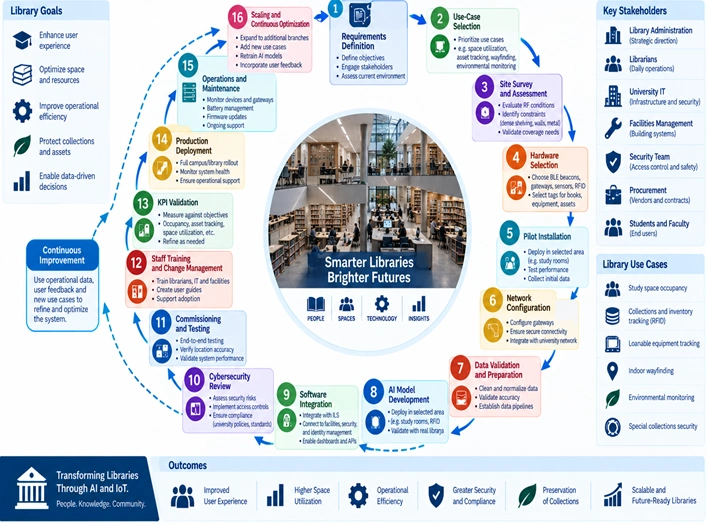
This lifecycle visual presents a structured path for deploying AI and IoT technologies across academic libraries, from requirements definition and site assessment through hardware selection, data preparation, AI development, integration, cybersecurity review, testing, and staff training. It concludes with KPI validation, production deployment, maintenance, scaling, and a continuous improvement loop that uses operational data and feedback to refine the system.
GAO’s Role in Academic Library AI and IoT Deployments
GAO supplies BLE, RFID, and IoT hardware products and systems that can support academic library applications involving asset visibility, sensing, identification, inventory workflows, and operational monitoring. Our products can serve as physical data-capture components within larger university technology environments.
Headquartered in New York City and Toronto, Canada, GAO is ranked among the world’s leading B2B and B2G suppliers of BLE and RFID technologies. GAO and sister companies GAO Research and GAO Tek form GAO Group, with operations based in New York City and Toronto.
For three decades, GAO Group has served customers across the United States and Canada, including Fortune 500 companies, leading research and development organizations, prestigious universities, and U.S. and Canadian government agencies. This experience provides a practical foundation for supporting deployments where wireless identification, sensing, networking, and enterprise software integration must work together.
GAO Group invests substantially in research and development and maintains stringent quality assurance processes. Technical support can be provided remotely or onsite according to project requirements, which can be important when academic institutions deploy connected devices across multiple buildings or campuses.
Key Takeaways for AI-Enabled Academic Libraries
AI can provide academic libraries with more useful operational intelligence when it is connected to reliable physical-world data and existing library workflows. BLE gateways, beacons, and sensors can provide location and condition information, while RFID and other identification technologies can complement collection and inventory processes.
The strongest implementations focus on measurable problems such as asset search time, study-space utilization, environmental monitoring, inventory exceptions, equipment utilization, and operational response. Library IT teams should validate wireless coverage, data quality, privacy controls, cybersecurity, software interoperability, AI performance, and staff workflows before scaling.
GAO can provide BLE, RFID, and IoT hardware products and systems that support these data-capture requirements. Organizations evaluating academic library AI solutions can engage GAO to explore appropriate hardware, system configurations, engineering considerations, and technical support for their specific deployment.
Building the Future of Industrial AI and IoT with Aperture Venture Studio and GAO RFID Inc.
For more than three decades, GAO Group of Companies has invested heavily in R&D of industrial BLE, RFID, and IoT. As AI has become increasingly useful for operational applications, we have developed AI and IoT technologies and founded Aperture Venture Studio to advance practical AI and IoT solutions, including technologies relevant to academic libraries, connected facilities, asset visibility, and intelligent resource management.
Aperture has attracted AI and IoT technical experts, entrepreneurial and operational executives, influential investors, and leading companies. We have also developed Aperture Ventures Summit and TekSummit to discuss advanced AI and IoT topics and foster technical communities. We welcome you to join us as advisors, co-founders or employees, investors, or customers.