
AI and BLE for Corporate Campuses
AI-Driven Corporate Campus Operations with Connected IoT
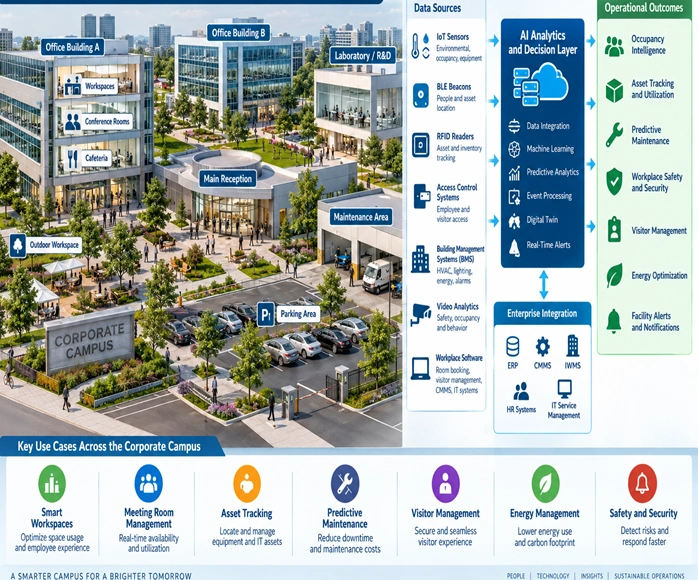
AI for corporate campuses combines artificial intelligence with connected sensors, building systems, workplace data, and operational software to improve how facilities, people, assets, and spaces are managed. BLE gateways, beacons, and sensors can provide location, occupancy, environmental, and equipment data that AI systems analyze for operational decisions. This approach supports workplace utilization, facility maintenance, employee safety, visitor management, meeting-room optimization, asset visibility, and energy management across multi-building corporate campuses. AIoT extends conventional IoT by applying machine learning, Edge AI, computer vision, and analytics to connected operational data. For facility managers, workplace technology teams, security personnel, and corporate real estate departments, the value comes from converting fragmented campus data into actionable information. GAO supplies BLE, RFID, IoT hardware products and systems that can support these corporate campus applications, including deployments requiring integration with existing building and enterprise software.
AIoT-Enabled Corporate Campus with Connected Building and Workplace Intelligence
Why AI Matters for Corporate Campus Management
Corporate campuses generate large volumes of operational information through access control, security systems, work-order applications, room-booking systems, building automation, environmental sensors, asset databases, and workplace applications. Much of this information remains separated by building or department, making it difficult for facility teams to identify relationships between events.
AI can correlate these data sources to identify patterns that conventional dashboards may overlook. A workplace management team, for example, can combine occupancy information with meeting-room reservations to identify underused conference rooms. Facilities personnel can correlate equipment telemetry, work-order history, operating hours, and environmental conditions to identify assets that may require inspection before a failure occurs.
AI for corporate campuses can support:
- Workplace occupancy and utilization analysis
- Meeting-room and collaboration-space optimization
- Employee and visitor movement analysis
- Corporate asset tracking and equipment visibility
- Facility maintenance prioritization
- Building energy optimization
- Indoor environmental monitoring
- Security event analysis
- Emergency response and personnel accountability
- Parking and transportation management
- Space planning and workplace redesign
- Inventory visibility for facilities and maintenance supplies
The objective is not simply to collect more campus data. The objective is to establish reliable data flows that allow facility managers and corporate real estate teams to make better operational decisions.
Corporate Campus Applications for AI-Enabled Facility Operations
Workplace Occupancy and Space Utilization
AI can analyze occupancy patterns across offices, collaboration areas, conference rooms, cafeterias, training rooms, and shared workspaces. Corporate real estate teams can compare actual utilization with scheduled reservations and planned capacity.
BLE sensors and beacons can contribute location and presence information, while other IoT sensors can measure environmental conditions or room occupancy. AI models can then identify recurring utilization patterns by building, floor, zone, time period, or workspace type.
This information can support decisions about office consolidation, desk allocation, meeting-room capacity, cleaning schedules, and workplace redesign. The engineering objective is to collect sufficient data while respecting corporate privacy requirements and avoiding unnecessary identification of individuals.
Corporate Asset Tracking and Equipment Visibility
Corporate campuses contain laptops, mobile equipment, tools, maintenance equipment, laboratory instruments, audiovisual equipment, carts, emergency equipment, and other movable assets. Asset databases often show ownership and assigned locations but may not reflect actual physical location.
AI-assisted asset tracking can combine BLE location data, RFID identification, asset-management records, service history, and movement events. The resulting system can flag assets that remain outside their expected zones, identify unusual movement patterns, and improve asset recovery.
RFID can be particularly useful where items pass through controlled points such as receiving areas, storage rooms, equipment rooms, or inventory checkpoints. BLE can complement RFID where continuous or zone-level location information is required across larger campus areas.
Predictive and Condition-Based Facility Maintenance
Facility managers typically oversee HVAC equipment, air-handling units, pumps, chillers, generators, elevators, electrical equipment, security equipment, and other critical building infrastructure.
AI can evaluate sensor readings, maintenance history, runtime, alarms, environmental conditions, and work orders to identify abnormal operating patterns. Instead of relying exclusively on fixed preventive-maintenance intervals, facilities teams can prioritize inspections according to measured equipment conditions and operational risk.
For example, a model can identify repeated temperature deviations or abnormal operating behavior associated with a particular mechanical asset. The resulting recommendation can be sent to a computerized maintenance management system for technician review and work-order creation.
Smart Meeting Rooms and Collaboration Spaces
Meeting rooms create a distinctive corporate campus management challenge because reservation records do not necessarily correspond with actual occupancy. AI can compare booking information with occupancy observations to identify no-shows, recurring overbooking, insufficient room capacity, or rooms that are consistently unsuitable for particular meeting types.
Facilities teams can use these insights to adjust room configurations, improve scheduling policies, optimize cleaning cycles, and plan future collaboration spaces.
Corporate Campus Safety and Emergency Response
AI can support safety operations by correlating access events, location information, environmental sensors, alarm conditions, and emergency procedures. During an incident, authorized personnel can obtain a more current picture of affected areas and potentially identify equipment or personnel requiring attention.
BLE-enabled location systems can provide zone-level information for designated equipment or personnel devices, while RFID can identify tagged assets moving through controlled areas. Integration with access control, fire alarm, video management, and emergency notification systems must be carefully engineered because safety-critical decisions should not depend on a single wireless data source.
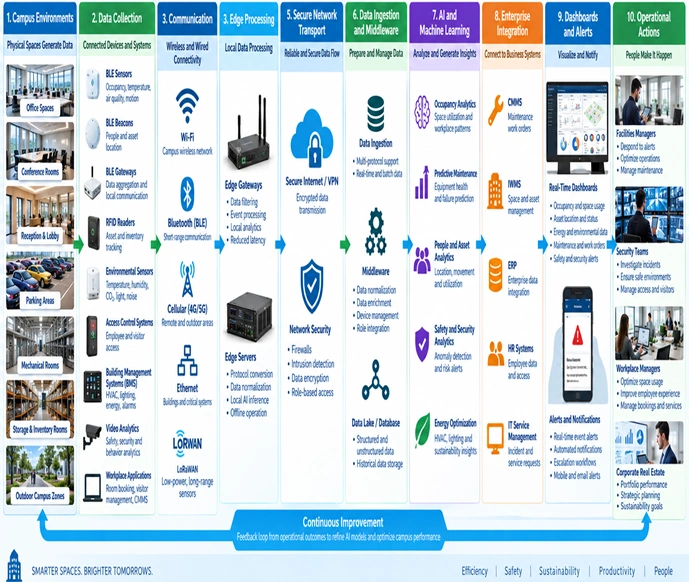
From Campus Data Capture to AI-Driven Decisions
A practical corporate campus AI solution begins with data acquisition rather than with the AI model itself. Sensors, building systems, access systems, asset identifiers, and workplace applications provide different types of operational information.
A typical workflow includes:
- Data capture: BLE sensors, beacons, gateways, RFID readers, environmental sensors, access-control systems, building automation equipment, and software applications collect operational events.
- Wireless communication: BLE devices transmit relevant telemetry to nearby gateways or compatible receiving systems. Other building systems can communicate through Ethernet, Wi-Fi, cellular, BACnet, Modbus, MQTT, or other appropriate interfaces.
- Edge processing: Local computing can filter duplicate events, normalize sensor readings, buffer information during network interruptions, and perform selected analytics before forwarding data.
- Data ingestion: Middleware receives events from different systems and converts them into consistent records for downstream processing.
- AI processing: Machine-learning models identify patterns, anomalies, utilization trends, predicted maintenance conditions, or other operational signals.
- Enterprise integration: Relevant results can be transferred to computerized maintenance management systems, integrated workplace management systems, building management systems, access control software, security applications, asset-management databases, and reporting tools.
- Operational action: Facilities personnel, security teams, workplace managers, or corporate real estate teams review recommendations and take appropriate action.
- Feedback and optimization: Outcomes from work orders, inspections, occupancy changes, and operational decisions can be incorporated into subsequent analysis.
This closed operational cycle is important because AI accuracy depends on the quality, consistency, and context of the underlying campus data.
Corporate Campus AIoT Data Flow from Connected Systems to Operational Decisions
Core Technologies Supporting AI for Corporate Campuses
BLE Beacons, Gateways and Sensors
BLE technology can provide a practical wireless layer for corporate campus location and sensing applications. Beacons can broadcast identifiers from fixed locations, while BLE sensors can report information such as temperature, humidity, motion, occupancy-related signals, or equipment conditions. Gateways receive BLE transmissions and forward relevant information into campus software.
The appropriate deployment depends on the required accuracy, physical environment, battery life, network availability, and density of monitored spaces. Dense office environments can produce multipath effects and signal variation, while concrete structures, elevators, mechanical rooms, and metal equipment can affect radio performance. A site survey and pilot deployment are therefore preferable to assuming uniform coverage across every building.
AI and Machine Learning
AI models can process historical and real-time campus information to support anomaly detection, forecasting, classification, optimization, and predictive maintenance. Time-series models can evaluate equipment and environmental readings, while clustering and statistical methods can identify recurring occupancy patterns.
Computer vision may also contribute to selected applications such as space utilization, safety monitoring, and vehicle-flow analysis, subject to privacy, legal, and corporate policy requirements. Edge AI can be useful when latency, bandwidth, or data-localization requirements make continuous transmission to a remote service undesirable.
Enterprise Software Integration
Corporate campus AI should not operate as an isolated application. Integration with existing systems allows AI-derived information to become operationally useful.
Relevant software can include:
- Integrated workplace management systems
- Computerized maintenance management systems
- Building management systems
- Enterprise asset management software
- Access control and identity-management systems
- Visitor management software
- Space reservation and desk-booking applications
- Security information and event management systems
- Enterprise resource planning systems
- Facilities service-request applications
- Business intelligence and reporting software
GAO’s BLE and RFID hardware products and systems can be incorporated into such environments where organizations require additional physical data capture without replacing established corporate software.
Cloud and Server Deployment for Corporate Campus AI
Corporate campus deployments can use cloud-hosted software, privately hosted server environments, or a hybrid arrangement. The appropriate choice depends on security requirements, data-governance policies, network connectivity, latency, existing IT infrastructure, and the number of buildings involved.
Cloud Version uses cloud-hosted software and infrastructure managed through a cloud environment. It can simplify centralized management across geographically distributed corporate campuses, support scalable analytics, and reduce the amount of application infrastructure that facility IT teams must maintain locally. Cloud deployment is particularly useful when a corporation manages multiple locations and wants centralized reporting and AI model management.
Server Version places application software on customer-managed servers, private data centers, edge servers, or other privately hosted enterprise infrastructure. This model can be appropriate when corporate policies require greater control over operational data, when connectivity to external cloud services is restricted, or when selected processing must remain close to building systems.
A hybrid implementation can place time-sensitive processing and buffering at the campus edge while sending selected data to centralized cloud or private-server applications. This approach can reduce bandwidth requirements while retaining centralized analysis and reporting.
Engineering Considerations for Corporate Campus Deployments
Successful deployments require more than selecting sensors and connecting them to software. Corporate campuses contain multiple buildings, construction materials, network environments, tenant areas, security zones, and operational departments.
Important engineering considerations include:
- Conducting radio surveys before determining gateway and beacon locations
- Establishing location accuracy requirements for each use case
- Separating operational requirements from employee-identification requirements
- Defining data-retention and access-control policies
- Selecting battery-powered sensors according to expected maintenance cycles
- Accounting for concrete, metal, glass, elevators, and mechanical equipment that can affect wireless performance
- Designing network redundancy for critical operational data
- Establishing time synchronization across connected systems
- Defining APIs and data models before integration
- Testing event latency and duplicate-event handling
- Establishing cybersecurity controls for gateways and connected devices
- Monitoring battery health and device availability after commissioning
- Creating documented procedures for device replacement and recalibration
GAO’s experience supplying IoT, BLE, and RFID products to organizations in the United States and Canada supports deployments where physical data collection must be integrated into established operational processes. GAO’s parent group companies operate from New York City and Toronto, Canada, and have served Fortune 500 companies, research organizations, universities, and government agencies over three decades.
AI Capabilities That Improve Corporate Campus Operations
AI becomes operationally valuable when it converts continuous campus data into predictions, classifications, anomalies, and recommendations that facilities and workplace teams can act upon.
Occupancy Forecasting and Workplace Planning
Historical occupancy data can be used to forecast demand for offices, meeting rooms, collaboration areas, cafeterias, and shared facilities. AI models can identify recurring patterns by weekday, season, business unit, building, or time of day.
Corporate real estate teams can use these forecasts when evaluating space requirements, cleaning resources, heating and cooling schedules, and room configurations. BLE-generated presence data can provide an additional source of evidence when reservation records alone do not accurately represent actual usage.
Predictive Maintenance and Failure Detection
AI-based maintenance analysis can identify deviations from normal equipment behavior before a conventional alarm is triggered. Models can compare temperature, vibration, runtime, pressure, energy consumption, maintenance history, and other available signals.
Facilities managers can prioritize inspections based on predicted risk rather than treating every asset identically. This can reduce unnecessary service calls while helping teams identify developing problems in critical HVAC, electrical, mechanical, and building-service equipment.
Anomaly Detection for Campus Security
AI can correlate access events, sensor activity, location observations, and security-system events to identify patterns requiring investigation. Examples include unexpected movement of tagged equipment, activity in restricted areas outside scheduled operating periods, or unusual occupancy patterns.
Such systems should support security personnel rather than automatically making high-impact decisions. Human review, documented escalation procedures, and appropriately configured access controls remain important.
Energy and Environmental Optimization
Corporate campuses can use AI to correlate occupancy, temperature, humidity, air quality, equipment status, and building-management data. Models can identify opportunities to adjust HVAC operation or investigate zones where environmental conditions consistently diverge from expected levels.
BLE sensors can supplement fixed building-management instrumentation where additional localized measurements are needed. AI analysis can then help facilities teams determine whether an issue results from equipment behavior, occupancy changes, scheduling, or environmental conditions.
Intelligent Asset and Inventory Management
AI can combine asset identifiers, location observations, inventory records, maintenance schedules, and movement histories. Facilities departments can use the resulting analysis to identify misplaced equipment, recurring shortages, dormant assets, or unusual movement patterns.
RFID is useful for controlled identification points such as receiving docks and storage areas, while BLE can provide broader location awareness for mobile equipment. Combining the two technologies can provide more complete asset visibility than relying on either technology alone.
Business and Operational Benefits for Corporate Campuses
AI-driven corporate campus management can produce measurable benefits when the underlying data is sufficiently accurate and connected to actual workflows.
- Higher space utilization: Occupancy analysis helps corporate real estate teams understand which workspaces are consistently used, underused, or mismatched with demand.
- Reduced maintenance disruption: Predictive analysis can identify abnormal equipment behavior earlier, allowing facilities teams to investigate before failures interrupt operations.
- Better asset accountability: BLE location information and RFID identification can reduce time spent searching for mobile equipment and improve asset records.
- Improved employee experience: Better meeting-room availability, environmental monitoring, and workplace planning can address recurring facility problems.
- More efficient facility staffing: AI-derived demand patterns can help schedule cleaning, maintenance, security, and support services around actual campus activity.
- Improved energy management: Correlating occupancy and building conditions can help identify opportunities for more efficient HVAC and building-system operation.
- Faster operational response: Automated alerts and prioritized recommendations can reduce the time between detecting an abnormal condition and assigning an appropriate response.
- Scalable multi-building management: Centralized analytics can allow corporate real estate teams to compare facilities while maintaining building-specific operational rules.
GAO’s BLE and RFID products can provide the physical data-capture layer required for these applications, while integration with existing software determines how effectively the information reaches the teams responsible for action.
Corporate Campus KPIs for AI and IoT Programs
Measurement should begin before deployment so that organizations can establish a baseline and determine whether the solution produces operational improvement.
Useful KPIs include:
- Workspace utilization rate
- Meeting-room utilization rate
- Meeting-room no-show rate
- Average room occupancy
- Occupancy forecast accuracy
- Asset location accuracy
- Asset search time
- Asset recovery rate
- Asset loss or misplacement rate
- Maintenance response time
- Mean time to repair
- Preventive-maintenance compliance
- Predictive-maintenance alert precision
- Unplanned equipment downtime
- HVAC fault detection rate
- Energy consumption per occupied area
- Indoor air-quality exception rate
- Facility service-request resolution time
- Cleaning response time
- Visitor processing time
- Security-event investigation time
- BLE gateway availability
- Sensor battery life
- Sensor reporting reliability
- Data-ingestion success rate
- AI alert response time
- False-positive alert rate
- System integration availability
- Cost per monitored building
- Return on operational investment
KPI selection should match the business problem. A corporate campus implementing AI for meeting-room utilization does not need to measure the same outcomes as a facilities department deploying predictive maintenance for chillers and air-handling equipment.
Cybersecurity, Privacy and Data Governance
Corporate campus systems can collect information associated with employees, contractors, visitors, facilities, and physical assets. Security and privacy therefore need to be incorporated into the design rather than treated as an afterthought.
Important controls include:
- Device authentication and secure provisioning
- Encrypted communications where supported
- Role-based access control
- Least-privilege administrative access
- Secure gateway configuration
- Network segmentation between IoT devices and sensitive corporate systems
- Credential rotation and lifecycle management
- Firmware and software update procedures
- Asset inventory for connected devices
- Centralized security logging
- Monitoring for unauthorized device activity
- Defined data-retention periods
- Separation of personally identifiable information from operational telemetry where practical
- Documented procedures for incident response
- Regular vulnerability assessment and security review
Privacy design is particularly important for workplace location applications. A corporate campus may need zone-level occupancy information without continuously associating every BLE observation with a named employee. Data minimization, access restrictions, retention policies, transparent organizational policies, and appropriate legal review can reduce unnecessary privacy exposure.
AI models also require governance. Facilities teams should understand what data is used, what an AI recommendation means, how confidence is represented, and when human verification is required.
Standards and Regulatory Considerations
Corporate campus deployments frequently cross several technical and regulatory domains. Requirements depend on location, building type, application, and the sensitivity of the information being processed.
Relevant standards and frameworks can include:
- Bluetooth Core Specification: Relevant to BLE device interoperability and radio communication behavior.
- IEEE 802.15.4: Relevant to some complementary low-power wireless sensing technologies that may coexist with BLE systems.
- BACnet: Commonly used for building automation and control system integration.
- Modbus: Used with many building and industrial control devices for equipment data exchange.
- MQTT: Useful for lightweight messaging between connected devices, gateways, and software services.
- NIST Cybersecurity Framework: Provides a structured approach to cybersecurity risk management.
- NIST IoT cybersecurity guidance: Relevant to device identification, configuration, data protection, software updates, and device security.
- ISO/IEC 27001: Relevant where organizations establish formal information-security management processes.
- ISO/IEC 27701: Relevant to privacy information management where applicable.
- OSHA requirements: May apply to workplace safety practices in U.S. corporate facilities.
- ADA requirements: May affect workplace and facility accessibility in applicable U.S. environments.
- Canadian privacy requirements: Applicable obligations can include federal or provincial privacy legislation depending on the organization and jurisdiction.
- FCC requirements: Relevant to radio equipment deployed in the United States.
- Innovation, Science and Economic Development Canada requirements: Relevant to applicable radio equipment deployed in Canada.
The exact compliance profile should be established during project planning with the organization’s legal, cybersecurity, facilities, and IT teams. Wireless technology selection alone does not determine regulatory compliance.
Common Corporate Campus Deployment Challenges
Inconsistent Wireless Conditions
Large campuses can contain concrete structures, elevators, metal partitions, glass walls, mechanical rooms, underground parking, and outdoor spaces. These conditions can produce radio attenuation, reflections, and variable signal strength.
A practical response is to perform site surveys and pilot testing in representative locations before finalizing device density. Location requirements should be specified in measurable terms such as room-level, zone-level, or approximate coordinates rather than simply requesting “accurate tracking.”
Fragmented Facility Data
BMS, CMMS, IWMS, access control, asset management, and security systems may use different identifiers, timestamps, APIs, and data models.
Data normalization should therefore be planned before large-scale deployment. A consistent asset ID, building ID, floor identifier, room identifier, and event timestamp can significantly simplify downstream AI analysis.
False AI Alerts
An AI model can produce false positives when sensor readings are noisy, campus operating schedules change, or insufficient historical data exists.
Thresholds should be validated against actual facility conditions, and models should be monitored after commissioning. Human feedback from maintenance and workplace teams can help improve detection logic.
Battery and Device Maintenance
Large BLE deployments may involve hundreds or thousands of battery-powered devices. Poor battery planning can gradually reduce data quality as devices begin reporting intermittently.
Facilities teams should maintain a device inventory, battery-health monitoring, replacement schedule, and documented commissioning records. Critical sensing points may require redundant measurements or alternative power arrangements.
Integration With Legacy Building Systems
Older corporate buildings may use legacy controllers or proprietary interfaces. Replacing those systems solely to introduce AI can be costly and operationally disruptive.
Gateway-based integration, protocol converters, APIs, and middleware can sometimes allow new sensing capabilities to complement existing equipment without replacing functioning building infrastructure.
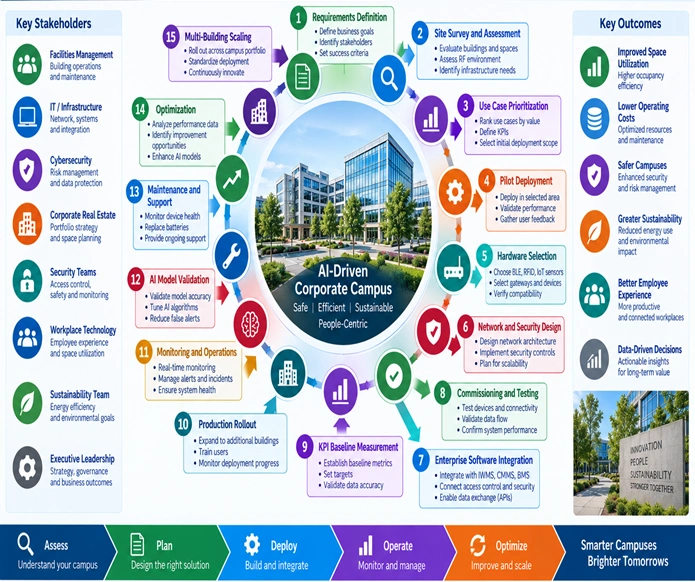
Corporate Campus Implementation Lifecycle
A phased deployment reduces technical and operational risk.
Requirements and Site Assessment
Begin by documenting the business problem, monitored spaces, asset categories, location accuracy, sensing requirements, expected data frequency, integration requirements, privacy constraints, and measurable KPIs.
Facilities and IT teams should jointly identify which existing systems already provide usable information. This prevents unnecessary duplication of sensors and integrations.
Pilot Deployment
A representative pilot should include the physical conditions expected in the production environment. For example, a corporate campus location-tracking pilot should test office areas, conference rooms, elevators, corridors, mechanical spaces, and areas containing substantial metal infrastructure where applicable.
Pilot results should measure signal behavior, location accuracy, data reliability, battery performance, gateway coverage, network latency, and integration behavior.
Integration and Commissioning
Production commissioning should verify every important data path. A BLE device transmitting successfully is not sufficient evidence that the corporate campus solution is operational.
Testing should cover:
- Device identification
- Gateway connectivity
- Event transmission
- Timestamp accuracy
- Duplicate-event handling
- Data normalization
- API communication
- AI processing
- Dashboard presentation
- Alert delivery
- Work-order creation where applicable
- User permissions
- Failure recovery
- Network interruption behavior
Optimization and Scale-Up
After commissioning, facilities teams should review KPIs and operational feedback. Device placement, AI thresholds, reporting intervals, gateway density, and integration rules can be adjusted based on observed conditions.
Multi-building expansion should use standardized deployment documentation while allowing for building-specific radio and operational characteristics.
Maintenance and Continuous Improvement
Long-term operation requires monitoring device availability, gateway health, battery status, software versions, security events, model performance, and integration failures.
AI models should also be periodically evaluated because campus behavior changes. Office occupancy patterns, building renovations, equipment replacements, new access policies, and changes in work schedules can all affect the assumptions used by historical models.
AI-Driven Corporate Campus Management Lifecycle from Deployment to Scaling
Practical Corporate Campus Deployment Scenarios
Multi-Building Workplace Utilization
A corporation managing several office buildings can deploy BLE sensing across selected floors to understand actual workspace utilization. AI can compare observed patterns with room reservations and occupancy schedules.
The resulting information can support corporate real estate decisions about meeting-room configurations, desk allocation, cleaning schedules, and future space requirements.
Facilities Equipment Monitoring
A facilities department can attach appropriate IoT or BLE sensors to selected equipment and combine their measurements with CMMS work-order history. AI can identify abnormal operating patterns and prioritize technician inspections.
This approach is particularly useful when maintenance teams need condition information from equipment that is not sufficiently instrumented by existing building controls.
Mobile Equipment Tracking
A corporate campus can use BLE tags on selected mobile assets such as maintenance equipment, carts, audiovisual equipment, specialized tools, or shared devices. Gateways positioned across buildings can provide location observations.
RFID can be added at receiving, storage, or controlled transition points where reliable item identification is more important than continuous location. AI can then analyze movement history and identify unusual or inefficient asset utilization.
Visitor and Security Operations
Visitor management can combine scheduled visitor information with access events and authorized location data. AI can identify operational patterns such as reception congestion or unusual activity requiring review.
Privacy and security controls should determine what information is retained and which personnel can access it. Physical security applications should retain appropriate human oversight.
How GAO Supports AI-Enabled Corporate Campus Solutions
GAO provides BLE, RFID, and IoT hardware products and systems that can support corporate campus sensing, identification, location, and monitoring requirements. These products can be used as components of broader solutions involving workplace software, building systems, asset-management applications, and AI analytics.
Headquartered in New York City and Toronto, Canada, GAO is recognized among the leading B2B and B2G suppliers of BLE and RFID technologies. GAO and its sister companies, GAO Research and GAO Tek, form GAO Group, with operations based in New York City and Toronto.
GAO Group has served organizations throughout the United States and Canada for three decades, including Fortune 500 companies, major research and development organizations, prestigious universities, and government agencies. Its work has included substantial research and development investment, stringent quality-assurance processes, and technical support delivered remotely or onsite.
For corporate campus projects, this experience is relevant where the physical sensing layer must operate reliably alongside established facility, security, IT, and workplace systems.
Key Recommendations for Corporate Campus AI Programs
Organizations evaluating AI for corporate campuses should prioritize the operational problem rather than beginning with a particular sensor or AI model.
- Define measurable facility and workplace outcomes before selecting hardware.
- Establish the required location accuracy for each application.
- Use BLE where scalable wireless presence, location, or sensing is appropriate.
- Use RFID where reliable item identification at controlled transition points is valuable.
- Combine technologies when campus workflows require both continuous location awareness and checkpoint identification.
- Perform representative site surveys before determining gateway density.
- Treat privacy and cybersecurity as design requirements.
- Normalize data from BMS, CMMS, IWMS, access control, asset management, and IoT systems.
- Validate AI recommendations against real facility conditions.
- Keep human review in workflows involving safety, security, or consequential operational decisions.
- Establish battery, firmware, gateway, and sensor maintenance procedures before full deployment.
- Measure baseline KPIs and compare post-deployment results against them.
- Use pilot deployments to validate wireless performance, integration, data quality, and AI behavior.
- Design for future building expansion without assuming every building will have identical radio conditions.
- Select cloud, private-server, or hybrid processing according to corporate IT, security, connectivity, and data-governance requirements.
Advancing AI-Enabled Corporate Campus Management
AI for corporate campuses is most effective when it connects physical facility conditions with the software systems that manage workplace, maintenance, security, assets, and building operations. BLE gateways, beacons, and sensors can provide valuable location and sensing data, while RFID can strengthen asset identification at controlled points. AI converts these observations into forecasts, anomaly detection, utilization intelligence, and maintenance recommendations.
GAO can help organizations evaluate and implement BLE, RFID, and IoT hardware products and systems that support these operational requirements. Organizations planning corporate campus modernization can learn more about GAO’s technologies, technical resources, engineering support, and deployment capabilities to determine which sensing and identification approach best fits their facilities.
Building the Future of Industrial AI and IoT with Aperture Venture Studio and GAO RFID Inc.
For more than three decades, GAO Group of Companies has invested heavily in R&D for industrial BLE, RFID, and IoT. As generative AI has become increasingly useful for industrial applications, we have advanced AIoT technologies that combine AI, IoT, BLE, and RFID, and founded Aperture Venture Studio to develop AI and IoT solutions relevant to corporate campuses, property operations, workplace management, and other industries.
Aperture has attracted AI and IoT technical experts, entrepreneurial and operational executives, influential investors, and leading companies. We have also developed the Aperture Ventures Summit and TekSummit to discuss advanced AI and IoT topics and build technical communities around these technologies.
We welcome you to join us as:
- Advisors, Co-founders, or Employees
- Investors
- Customers