
AI and BLE for Hyperscale Data Centers
AI-Driven Operations for Hyperscale Data Centers
AI for hyperscale data centers combines machine learning, Industrial AI, Edge AI, computer vision, and connected sensing with operational data from servers, racks, power systems, cooling equipment, personnel, tools, and other critical assets. BLE beacons, gateways, and sensors can provide location, proximity, environmental, and equipment-state data that AI software uses to identify anomalies, predict maintenance requirements, optimize workflows, and support operational decisions. For hyperscale facilities, this combination is particularly useful because thousands of racks, network devices, batteries, tools, spare parts, contractors, and technicians operate across highly controlled spaces. AI can correlate BLE-derived events with data from DCIM, BMS, CMMS, IT asset management, access control, and network systems. The resulting system supports more accurate asset visibility, predictive maintenance, technician safety, capacity planning, inventory control, and incident response while reducing dependence on manual inspections and disconnected operational records.
AIoT-Enabled Hyperscale Data Center with BLE Monitoring and Predictive Operations
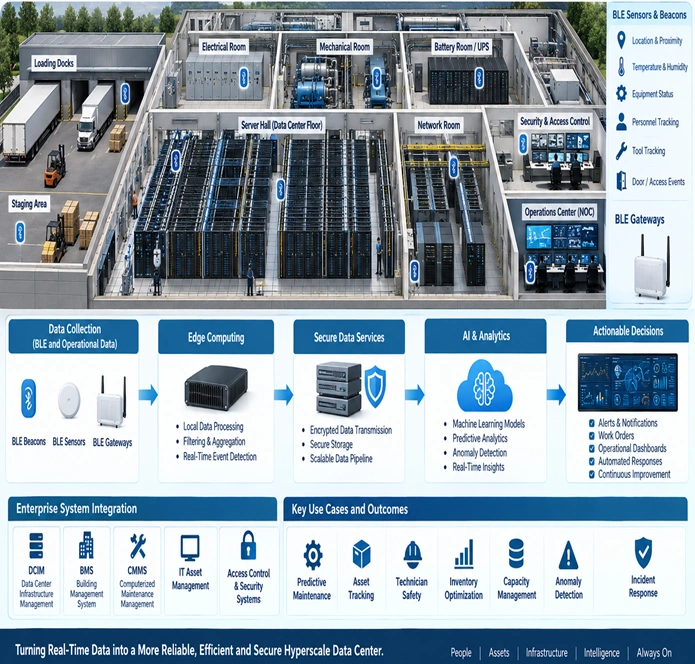
What AI Means for Hyperscale Data Center Operations
Hyperscale data centers present an unusually demanding operational environment. Facilities may contain tens of thousands of physical assets distributed across large server halls, electrical distribution areas, cooling systems, security zones, staging areas, and maintenance spaces. The operational challenge is not simply collecting more data. The challenge is correlating heterogeneous data sources quickly enough to support safe and economically sound decisions.
AI addresses this problem by identifying patterns across operational datasets that are difficult to evaluate manually. A machine learning model can correlate equipment telemetry, maintenance history, environmental conditions, work orders, asset movements, power consumption, and alarm events to identify conditions associated with equipment failure or abnormal operation.
BLE provides an additional source of contextual data. A BLE beacon attached to a mobile asset can establish its presence near a gateway, while BLE sensors can provide localized environmental measurements. The resulting events can be associated with rack identifiers, equipment records, technician work orders, maintenance zones, and time-series data.
For example, an AI-assisted maintenance system can correlate a technician’s BLE-tagged location with a work order, identify the relevant rack or electrical cabinet, retrieve previous maintenance events, and highlight abnormal sensor readings before the technician begins work. This moves the use of BLE beyond simple asset location toward operational intelligence.
GAO supplies BLE, RFID, and IoT hardware products and systems that can provide the physical data layer required for these types of applications. The appropriate configuration depends on facility layout, RF conditions, asset density, location accuracy requirements, battery strategy, cybersecurity requirements, and integration with existing data center systems.
Hyperscale Data Center Applications for AI and BLE
AI Asset Tracking for Servers, Network Equipment, and Tools
Physical asset visibility is a persistent challenge in hyperscale facilities. Servers, network appliances, optical equipment, test instruments, replacement components, carts, tools, and maintenance equipment can move between receiving areas, staging rooms, server halls, repair areas, and secure storage.
BLE tags can associate mobile assets with location zones or gateways. AI software can then analyze movement histories rather than treating each location event as an isolated record.
Relevant applications include:
- Tracking high-value test and maintenance equipment across server halls
- Monitoring movement of network equipment between staging and deployment areas
- Associating tagged equipment with maintenance work orders
- Identifying assets that remain outside their expected operational zone
- Detecting unusual movement patterns that may warrant investigation
- Improving asset reconciliation during equipment refresh programs
- Supporting chain-of-custody records for equipment entering or leaving controlled areas
The AI layer becomes particularly valuable when movement information is correlated with authorized work orders, access records, maintenance schedules, and asset lifecycle data.
Predictive Maintenance for Power and Cooling Equipment
Power and cooling systems are among the most operationally important systems in a hyperscale data center. UPS systems, switchgear, power distribution units, battery systems, generators, pumps, chillers, CRAH or CRAC equipment, cooling towers, valves, and other mechanical components require continuous monitoring and scheduled maintenance.
AI can evaluate historical telemetry, maintenance records, alarms, environmental conditions, and equipment operating patterns to identify early indicators of degradation.
BLE sensors can complement fixed building-management sensors where localized measurements are useful. For example, wireless sensors may provide additional temperature or environmental observations around equipment cabinets or maintenance-sensitive areas without requiring extensive new cabling.
AI-based maintenance workflows can help maintenance teams:
- Detect deviations from normal equipment behavior
- Prioritize inspection activities according to predicted risk
- Correlate environmental changes with equipment performance
- Identify recurring failure patterns
- Improve spare-parts planning
- Reduce unnecessary preventive maintenance
- Support condition-based maintenance decisions
BLE should not replace safety-critical wired instrumentation where deterministic sensing, redundancy, or regulatory requirements demand it. A practical design uses wireless sensing where it provides operational value without compromising critical control functions.
Technician Location and Safety
Technicians, contractors, and operations personnel frequently work around high-voltage electrical equipment, rotating machinery, cooling systems, battery rooms, and restricted operational zones.
BLE-enabled personnel badges can provide zone-level or room-level presence information. AI can analyze personnel movement in relation to work orders, scheduled maintenance, restricted areas, and facility events.
Potential applications include:
- Identifying personnel presence in designated maintenance zones
- Supporting emergency personnel accounting
- Detecting unexpected presence in restricted areas
- Associating technician location with active work orders
- Improving response coordination during facility incidents
- Analyzing congestion around maintenance areas
- Supporting investigation of operational events through historical location records
These systems should be designed around privacy, role-based access, data minimization, retention policies, and clearly defined operational purposes.
BLE-to-AI Data Center Asset and Personnel Tracking Workflow
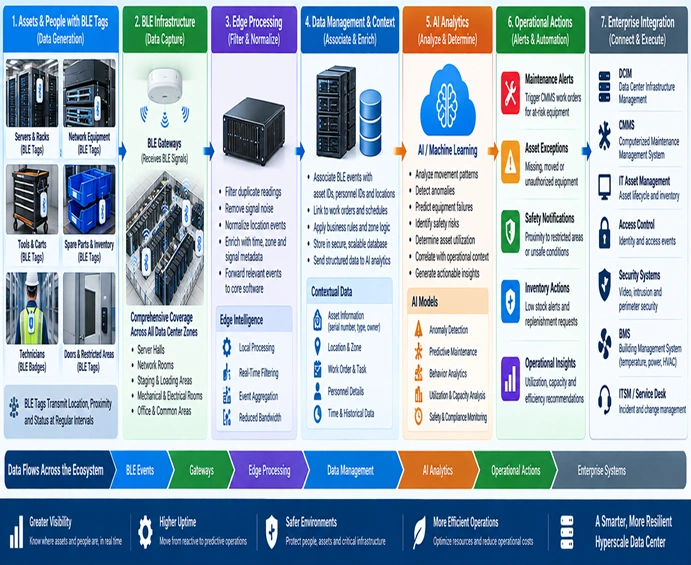
Operational Workflows from BLE Data to AI Decisions
A reliable AI solution for hyperscale data centers begins with disciplined data acquisition. BLE devices should be selected according to the required measurement, transmission interval, battery life, RF environment, physical mounting location, and maintenance model.
The operational workflow typically follows this sequence:
- Data acquisition: BLE beacons identify tagged assets while BLE sensors collect environmental or equipment-related measurements.
- Wireless communication: BLE gateways receive advertisements or sensor transmissions within defined facility zones.
- Edge processing: Gateways or nearby computing resources filter duplicate events, normalize payloads, apply signal-quality rules, and buffer data during temporary network interruptions.
- Secure transport: Validated events are transmitted through the data center’s approved network infrastructure using appropriate authentication and encryption mechanisms.
- Data processing: Middleware associates device identifiers with asset records, locations, work orders, equipment classes, and timestamps.
- AI analysis: Machine learning models detect anomalies, classify operational conditions, estimate risk, identify unusual movement, or predict maintenance requirements.
- Enterprise integration: Results can be passed to DCIM, CMMS, BMS, IT asset management, inventory, access-control, or security systems.
- Operational decision: Data center personnel receive alerts, prioritized maintenance recommendations, asset exceptions, safety events, or inventory actions.
- Feedback and optimization: Confirmed maintenance outcomes and operational events are fed back into the analytical process to improve model performance.
The quality of AI decisions depends heavily on the quality of the underlying asset master data. A technically sophisticated model cannot reliably identify an equipment anomaly if device IDs, rack identifiers, equipment classes, location records, or maintenance histories are inconsistent.
BLE Hardware, AI Software, and Data Center Integration
BLE hardware should be treated as one component of a larger hyperscale data center information system. BLE gateways receive wireless transmissions, BLE beacons provide identifiers for mobile or fixed assets, and BLE sensors generate measurements such as temperature or other environmental conditions where appropriate.
Gateway placement requires RF engineering rather than simple geometric spacing. Metal racks, cable trays, power equipment, concrete structures, server cabinets, and other conductive objects can influence propagation and multipath behavior. A commissioning process should therefore include RF surveys, gateway placement validation, signal-strength analysis, packet reception testing, and location-zone verification.
The software layer normally includes device management, event ingestion, rules processing, asset identity resolution, APIs, databases, dashboards, and AI analytics. Integration with DCIM, BMS, CMMS, IT asset management, access control, and security software allows BLE events to acquire operational meaning.
AI methods may include anomaly detection, time-series forecasting, classification, clustering, predictive maintenance models, and computer vision where cameras are part of the overall solution. Edge AI can be useful when a decision must be made close to the facility or when reducing unnecessary transmission of raw data is important.
Cybersecurity should cover device identity, credential management, encrypted communications, network segmentation, API authentication, software access controls, logging, vulnerability management, firmware lifecycle management, and secure administration.
Cloud Version and Server Version for Hyperscale Data Centers
A Cloud Version can be appropriate when geographically distributed facilities need centralized monitoring, analytics, fleet management, and standardized reporting. Cloud-hosted software can aggregate data from multiple data centers while supporting centralized AI model management and enterprise analytics.
A Server Version can be preferable where operational data must remain within privately controlled infrastructure, where integration with internal systems is highly customized, or where network isolation and local processing requirements are significant. The server can operate on edge servers, customer-managed servers, private data centers, or other privately hosted enterprise infrastructure.
A hybrid deployment is also practical. Time-sensitive event processing can remain close to the facility, while aggregated analytics and fleet-level reporting can be performed in cloud infrastructure.
The appropriate choice should consider network dependency, data residency, cybersecurity controls, latency, integration requirements, operational ownership, disaster recovery, model-management processes, and the data center’s existing IT standards.
Technical Capabilities and Operational Improvements for Hyperscale Data Centers
Combining AI with BLE-derived operational data can improve how hyperscale data center teams manage physical assets, maintenance activities, personnel, inventory, and facility conditions. The greatest value comes from correlating BLE events with existing operational records rather than treating wireless location or sensor data as a standalone application.
More Accurate Asset Visibility
AI can transform continuous asset observations into actionable asset intelligence. Instead of presenting a static list of where tagged equipment was last detected, analytics can identify unexpected movements, prolonged inactivity, missing equipment, and deviations from normal asset workflows.
For hyperscale data centers, this can improve:
- Server and network equipment staging
- Tool accountability
- Spare-parts visibility
- Equipment refresh operations
- Repair and return workflows
- Asset custody records
- Movement between secure zones
- Reconciliation between physical and IT asset records
GAO can supply BLE and RFID hardware products and systems that support physical asset identification and tracking requirements, allowing organizations to select the sensing technology according to asset type, facility conditions, and required location granularity.
Predictive Maintenance and Failure Risk
Predictive maintenance becomes more useful when AI has access to both machine data and operational context. A temperature excursion, for example, becomes more meaningful when associated with a specific equipment cabinet, maintenance history, workload condition, technician activity, and environmental trend.
AI models can calculate risk scores from combinations of:
- Historical equipment telemetry
- Temperature and humidity trends
- Maintenance records
- Alarm histories
- Equipment age
- Replacement history
- Work-order frequency
- Operating conditions
- Local environmental measurements
- Power and cooling behavior
The objective is not simply to predict that something might fail. The practical objective is to help data center engineers determine which equipment requires attention, why it is considered abnormal, and what action should occur next.
Improved Inventory and Spare-Parts Management
Hyperscale data centers maintain substantial inventories of servers, network components, power-system parts, cooling components, cables, optics, batteries, tools, and consumables. Misplaced or incorrectly recorded components can increase mean time to repair and create unnecessary procurement activity.
AI can analyze inventory movements, consumption rates, maintenance schedules, and historical failure patterns. BLE can provide additional visibility for mobile inventory and high-value equipment.
This enables:
- More accurate stock-location records
- Demand forecasting for maintenance parts
- Identification of slow-moving inventory
- Detection of unexpected inventory movement
- Better staging of replacement components
- Improved maintenance-kitting workflows
- Reduced search time for critical parts
Capacity and Resource Optimization
Hyperscale facilities continuously balance compute expansion, rack availability, electrical capacity, cooling capacity, floor-space utilization, maintenance resources, and network infrastructure.
AI can combine asset-location information with DCIM data and facility telemetry to identify underutilized resources, operational bottlenecks, unusual equipment concentrations, and maintenance patterns.
BLE-derived location data can contribute physical context that may not be represented accurately in software records. This is particularly useful for mobile equipment, temporary staging areas, carts, test equipment, and maintenance resources.
Faster Incident Response
During a facility incident, operations teams need to know which equipment, personnel, and operational zones are affected. AI can correlate alerts from multiple systems and prioritize events according to severity and operational impact.
BLE-based presence information can supplement access-control and security information by indicating the last known zone of tagged personnel or mobile equipment. This can support emergency response without making BLE the sole safety mechanism.
For critical life-safety functions, the BLE system should complement rather than replace dedicated fire, emergency notification, access-control, and safety systems.
Engineering Design Considerations for BLE in Hyperscale Facilities
BLE deployment in a hyperscale data center requires careful engineering because the physical environment differs significantly from an office, warehouse, or retail facility.
RF Planning and Location Accuracy
Large quantities of metal, server cabinets, cable trays, electrical equipment, containment structures, and mechanical infrastructure can affect BLE propagation. Gateway density should therefore be determined through site surveys and validation rather than a fixed gateway-per-area formula.
The required location accuracy should also be defined before hardware selection. A system intended to identify a technician’s general room may require a substantially different configuration from one intended to distinguish between adjacent equipment zones.
Commissioning should evaluate:
- BLE advertising intervals
- Gateway reception performance
- RSSI behavior
- Packet reception rates
- Multipath effects
- Gateway placement
- Antenna orientation
- Interference sources
- Battery performance
- Zone boundaries
- Location-event stability
Where higher location accuracy is required, organizations should evaluate appropriate positioning methods and environmental constraints instead of assuming that BLE alone provides a specific accuracy level.
Battery Management and Device Lifecycle
Battery-powered BLE beacons and sensors introduce a lifecycle-management requirement. Device selection should consider advertising frequency, measurement interval, transmission power, battery chemistry, temperature exposure, mounting accessibility, and expected service life.
A useful device-management system should track:
- Device identifier
- Asset association
- Installation location
- Battery status
- Firmware version
- Last communication
- Sensor condition
- Maintenance history
- Replacement status
AI can also analyze battery-discharge patterns to identify devices approaching replacement thresholds and optimize maintenance scheduling.
Data Quality and Identity Management
Data quality is one of the most important factors in AI-enabled physical infrastructure. A BLE gateway may correctly receive an identifier, but that event has limited operational value if the identifier is not correctly associated with the corresponding asset.
Data center organizations should establish authoritative relationships among:
BLE device → asset ID → equipment type → rack or zone → facility → owner → maintenance record
Asset identity should remain consistent across DCIM, CMMS, IT asset management, inventory, and other relevant systems.
Cybersecurity and Network Segmentation
Wireless sensing introduces additional endpoints that must be incorporated into the data center’s cybersecurity program.
Recommended controls include:
- Unique device identities
- Controlled gateway enrollment
- Strong administrative authentication
- Encrypted communications where supported
- Network segmentation
- Least-privilege access
- API authentication
- Audit logging
- Firmware management
- Vulnerability assessment
- Secure credential rotation
- Controlled remote administration
- Defined device retirement procedures
BLE gateways should be treated as managed network-connected devices rather than unmanaged accessories.
Integration with Data Center Software
AI-enabled BLE systems deliver substantially greater value when integrated with the software already used to operate hyperscale facilities.
DCIM Integration
Data center infrastructure management systems can provide information about racks, power distribution, cooling resources, capacity, alarms, and facility locations. BLE events can add physical asset and movement information to these records.
For example, a tagged network device detected in a staging area can be associated with a DCIM record indicating its intended rack location. AI can identify discrepancies between expected and observed states.
CMMS and Maintenance Management
CMMS software contains work orders, preventive-maintenance schedules, technician assignments, equipment histories, and maintenance records.
BLE location events can help associate technicians and equipment with active work orders. AI can analyze these relationships to identify maintenance delays, repeated service events, or equipment with unusually high intervention frequency.
BMS and Facility Systems
Building management systems provide data from HVAC, electrical, mechanical, and environmental systems. AI can combine this information with localized BLE sensor observations to identify relationships that may not be visible from either data source independently.
IT Asset Management and Network Operations
IT asset management systems can contain configuration records, ownership information, lifecycle status, and equipment identifiers. Network-management systems can provide device-state and connectivity information.
Connecting these sources with physical asset observations helps distinguish between a device that is logically recorded as active and one that is physically located somewhere unexpected.
APIs and Middleware
Middleware should normalize data from BLE gateways before exposing it to AI applications or enterprise software. Common integration mechanisms can include REST APIs, message brokers, event-driven interfaces, databases, and other approved enterprise integration methods.
The integration layer should handle:
- Device identity mapping
- Timestamp normalization
- Duplicate-event filtering
- Data validation
- Location-zone mapping
- Event buffering
- Authentication
- Error handling
- API monitoring
- Audit logging
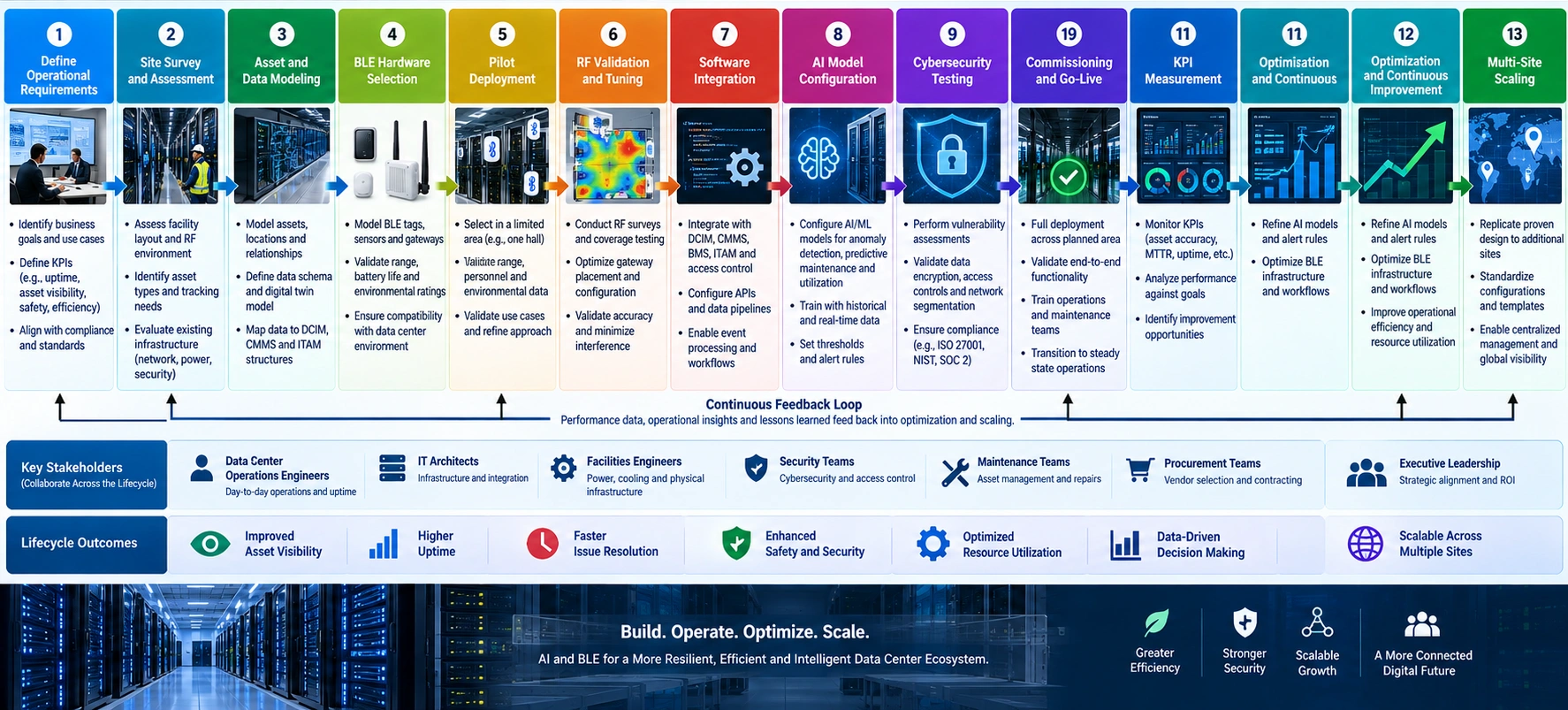
Implementation Lifecycle for Hyperscale Data Centers
A successful deployment should progress from an operational problem to measurable outcomes rather than beginning with hardware installation.
Planning and Requirements Definition
The first stage should define the operational problem, measurable KPI, physical environment, data sources, required location resolution, asset population, user groups, and integration requirements.
Typical questions include:
- Which assets require continuous or periodic visibility?
- Which locations require environmental sensing?
- What level of positioning accuracy is operationally necessary?
- Which events require immediate notification?
- Which existing systems contain authoritative asset information?
- What information should remain locally processed?
- What cybersecurity controls apply?
- Which operational team owns the resulting alerts?
Hardware Selection and Pilot Deployment
A pilot should represent real facility conditions. Testing only in an office environment can produce misleading results because server halls and electrical rooms have substantially different RF characteristics.
Pilot testing should measure:
- Coverage
- Reception reliability
- Location stability
- Battery consumption
- Gateway performance
- Network behavior
- Environmental durability
- Data quality
- Integration reliability
GAO’s experience supplying BLE, RFID, and IoT hardware products and systems can support organizations evaluating appropriate hardware configurations for specific operational requirements.
Commissioning and Validation
Commissioning should verify the complete chain from physical device to operational application.
A validation test can trace:
BLE device → gateway → network → middleware → asset record → AI processing → alert → enterprise workflow
This end-to-end approach is more valuable than testing individual components independently because many production failures occur at system boundaries.
Optimization and Scaling
After commissioning, organizations should review false alerts, missed events, battery consumption, gateway loading, data volumes, AI-model performance, and user feedback.
Scaling should consider future server-hall expansion, additional facilities, increased device counts, network capacity, gateway management, database growth, and AI inference requirements.
KPIs for AI-Enabled Hyperscale Data Center Operations
The appropriate KPIs depend on the use case, but useful measurements include:
- Physical asset inventory accuracy
- Asset search time
- Mean time to locate equipment
- Mean time to repair
- Mean time to respond
- Preventive maintenance compliance
- Maintenance backlog
- Repeat equipment failures
- Spare-parts availability
- Inventory variance
- Technician utilization
- Unauthorized-zone events
- Environmental anomaly detection rate
- False-alert rate
- BLE device availability
- Gateway availability
- Battery replacement frequency
- Data ingestion success rate
- AI prediction accuracy
- Work-order completion time
Baseline measurements should be captured before deployment where possible. This allows data center operators to distinguish genuine operational improvements from changes caused by unrelated process or infrastructure modifications.
Standards, Compliance, and Governance
Hyperscale data center deployments should align with applicable facility, cybersecurity, privacy, electrical, occupational safety, and information-management requirements.
Relevant frameworks and standards may include:
- ANSI/TIA-942 for telecommunications infrastructure and data center considerations
- ISO/IEC 27001 for information security management
- NIST Cybersecurity Framework for cybersecurity risk management
- NIST SP 800-series guidance where applicable to security controls
- ISO/IEC 23894 for AI risk management
- Applicable electrical and fire-safety codes
- OSHA requirements for applicable U.S. workplaces
- NEC requirements for applicable electrical installations
- Canadian electrical and occupational safety requirements for Canadian facilities
- Organizational policies governing personnel-location data and retention
The exact compliance obligations depend on facility jurisdiction, customer requirements, system function, and whether the BLE solution interacts with safety-critical or security-critical systems. BLE location data involving employees or contractors should receive appropriate privacy and access-control treatment.
GAO Experience Supporting BLE and IoT Deployments
Headquartered in New York City and Toronto, Canada, GAO is recognized among the world’s leading B2B and B2G suppliers of BLE and RFID technologies. GAO and its sister companies, GAO Research and GAO Tek, form GAO Group, with operations based in New York City and Toronto.
For three decades, GAO Group has supplied technology products and systems to organizations across the United States and Canada, including Fortune 500 companies, leading research and development organizations, universities, and government agencies. This long operating history has involved substantial research and development investment as well as stringent quality assurance processes.
For hyperscale data center projects, this experience is relevant because successful deployment depends on more than selecting a wireless device. Hardware selection, RF conditions, gateway placement, software integration, data quality, cybersecurity, commissioning, and ongoing technical support all influence operational performance. GAO provides remote and onsite expert support where appropriate to help customers address these implementation requirements.
Key Takeaways for AI and BLE in Hyperscale Data Centers
AI-enabled hyperscale data center operations benefit most when physical observations are connected to established operational processes. BLE beacons, gateways, and sensors can supply useful location and environmental data, while AI converts that information into maintenance priorities, asset exceptions, safety insights, inventory recommendations, and operational intelligence.
The strongest implementation approach is to:
- Start with a clearly defined data center operational problem
- Establish measurable baseline KPIs
- Define asset and location identities before deployment
- Conduct RF surveys and physical-site testing
- Select BLE hardware according to environmental and lifecycle requirements
- Integrate BLE events with DCIM, CMMS, BMS, IT asset management, and other relevant systems
- Apply AI where correlation, prediction, classification, or anomaly detection creates measurable value
- Keep safety-critical functions on appropriately engineered dedicated systems
- Apply network segmentation and device-level cybersecurity controls
- Validate the complete data path during commissioning
- Monitor data quality and model performance after deployment
- Scale only after the pilot demonstrates operational and technical value
Organizations evaluating AI for hyperscale data center asset management, predictive maintenance, personnel safety, inventory visibility, or facility operations can learn more about GAO’s BLE, RFID, and IoT hardware products and systems and discuss requirements with our technical support team.
AI and BLE Hyperscale Data Center Implementation Lifecycle and Scaling Strategy
Building the Future of Industrial AI and IoT with Aperture Venture Studio and GAO RFID Inc.
For more than three decades, GAO Group of Companies has invested heavily in R&D of industrial BLE, RFID, and IoT. As generative AI has become useful in industrial applications, we have developed AI and IoT technologies and founded Aperture Venture Studio to build, launch, and scale AI and IoT companies addressing practical applications such as intelligent hyperscale data center operations.
Aperture has attracted AI and IoT technical experts, entrepreneurial and operational executives, influential investors, and leading companies. We have also developed Aperture Ventures Summit and TekSummit to discuss advanced AI and IoT topics and foster technical communities. We welcome advisors, co-founders or employees, investors, and customers to participate in this growing field.