
AI for Telecom Infrastructure with BLE-Enabled IoT Systems
AI-Driven Telecom Infrastructure Operations
Artificial Intelligence of Things (AIoT) is changing how telecom infrastructure operators monitor, maintain, secure, and optimize distributed communications assets. AI for telecom infrastructure combines artificial intelligence, machine learning, connected sensors, operational data, and communications systems to turn physical infrastructure data into actionable decisions. BLE gateways, BLE beacons, and BLE sensors can provide localized identification, proximity, environmental, and equipment-status data across telecommunications facilities, network operation centers, data centers, tower sites, warehouses, and field-service environments. AI can then correlate these signals with network management systems, maintenance records, inventory databases, work orders, and environmental conditions. The result is more informed asset utilization, predictive maintenance, technician workflows, inventory control, site security, and infrastructure planning. GAO supplies BLE, RFID, and IoT hardware products and systems that can support these data acquisition requirements for organizations managing complex telecom infrastructure across geographically distributed operations.
BLE-Enabled Telecom AIoT for Real-Time Asset Intelligence and Predictive Operations
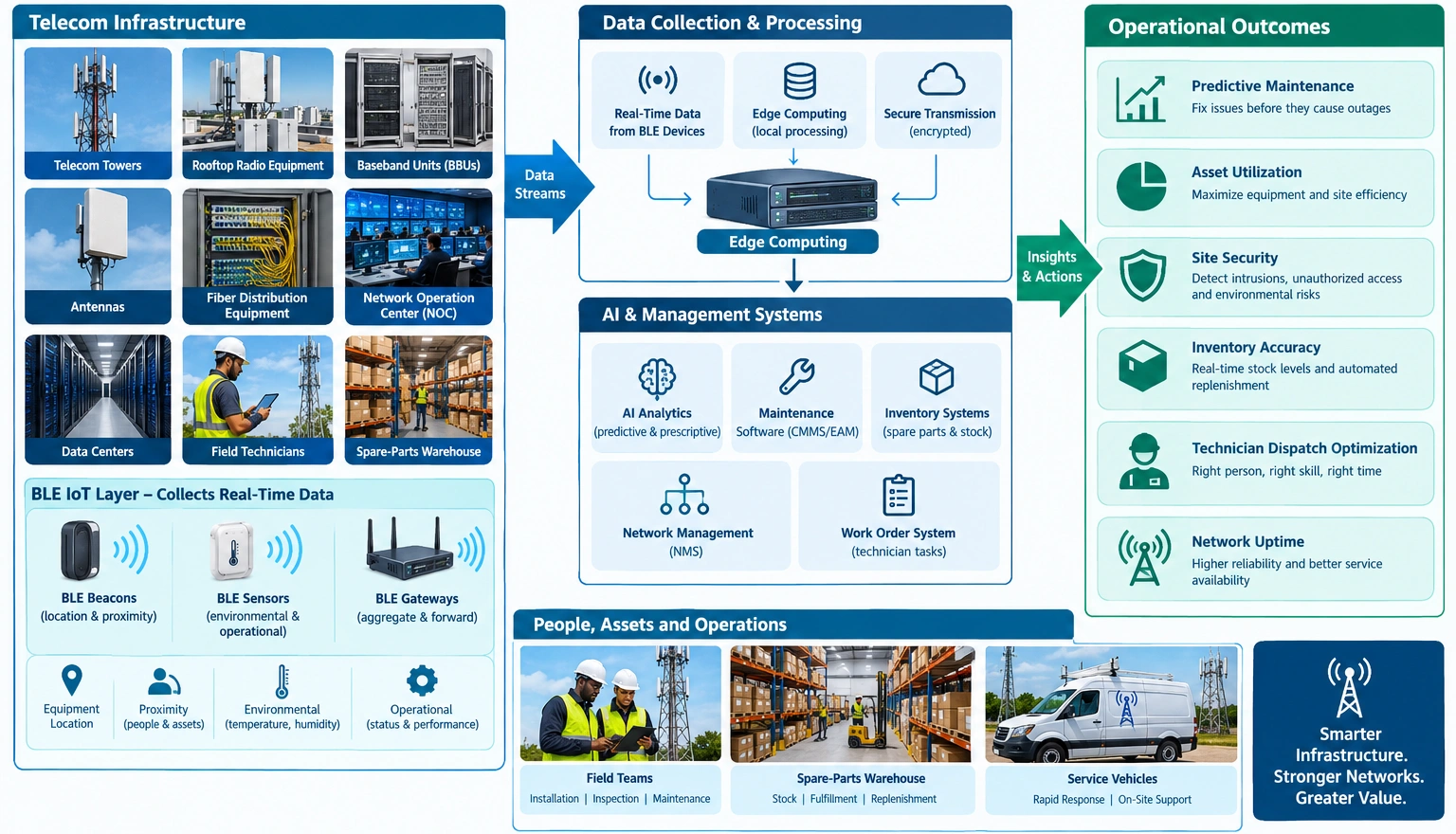
Alt Text
Telecom AIoT infographic showing BLE data collection, AI analytics, asset management, and network operations.
What AI Means for Modern Telecom Infrastructure
Telecom infrastructure includes physical and digital assets that must remain available, correctly configured, secure, and serviceable. Network operators and infrastructure owners may manage thousands of radio units, antennas, cabinets, batteries, rectifiers, generators, fiber components, test instruments, tools, spare parts, and environmental monitoring devices distributed across many sites.
AI becomes valuable when infrastructure data is sufficiently contextualized to support operational decisions. A sensor reading by itself may have limited value. The same reading linked to a specific equipment cabinet, tower location, maintenance history, asset class, technician assignment, and historical operating profile can provide a basis for anomaly detection or predictive maintenance.
AI-enabled telecom infrastructure systems can support:
- AI asset tracking for radio equipment, test instruments, batteries, tools, spares, and other mobile or fixed assets.
- AI predictive maintenance by correlating equipment conditions, environmental measurements, historical failures, and service records.
- AI inventory management for telecom spare parts, replacement modules, cables, connectors, batteries, and field-service materials.
- AI field-service optimization by combining asset location, technician availability, work orders, site conditions, and required tools.
- AI site security by identifying unusual movement or unauthorized access patterns around sensitive telecom facilities.
- AI environmental monitoring for temperature, humidity, vibration, water ingress, power conditions, and other factors affecting equipment reliability.
- AI warehouse operations by improving visibility of high-value network components and reducing time spent searching for serviceable inventory.
- AI compliance and audit support by maintaining more reliable records of equipment movement, maintenance activity, and controlled access.
BLE is particularly useful where short-range wireless identification or sensing is required. A BLE beacon attached to a telecom asset can provide a persistent digital identity, while BLE sensors can capture environmental or equipment-related measurements. BLE gateways positioned within facilities or selected field locations can forward these observations to local servers or cloud-based software.
The resulting system is not simply a wireless tracking installation. Its value depends on the quality of the data model, asset hierarchy, gateway placement, sensor configuration, AI processing, software integration, and operational procedures surrounding the collected information.
Telecom Infrastructure Applications for AI and BLE
AI Asset Tracking for Network Equipment and Field Tools
Telecom operators frequently move equipment between central warehouses, regional depots, staging areas, network sites, maintenance vehicles, and repair facilities. Asset records can become inaccurate when equipment is transferred without timely updates.
BLE beacons can provide a digital identity for selected assets, while gateways capture proximity or location events within defined coverage areas. AI software can analyze movement histories to identify unusual transfers, prolonged inactivity, missing equipment, or deviations from expected workflows.
High-value applications include:
- Tracking portable spectrum analyzers, fiber testers, power meters, laptops, and specialized installation tools.
- Monitoring movement of radio units, network modules, batteries, and other serviceable components.
- Associating equipment movement with maintenance work orders and technician assignments.
- Identifying assets that remain at staging areas beyond expected deployment periods.
- Supporting reconciliation between physical equipment and computerized maintenance management system records.
The engineering objective should not be to tag every physical object indiscriminately. Asset classes should be prioritized according to replacement cost, operational criticality, mobility, loss exposure, and the value of improved visibility.
AI Predictive Maintenance for Telecom Sites
Telecom infrastructure reliability depends on more than network software. Physical conditions such as heat, humidity, vibration, power instability, battery temperature, water ingress, and cabinet conditions can contribute to equipment degradation.
BLE sensors can collect localized measurements where wired instrumentation is impractical or where additional monitoring points are needed. AI models can compare current readings with historical patterns and expected operating ranges.
Potential AI-driven maintenance functions include:
- Detecting abnormal temperature behavior in equipment rooms or cabinets.
- Identifying environmental conditions associated with battery degradation.
- Detecting recurring patterns before equipment failure or site alarms occur.
- Prioritizing maintenance according to predicted risk and site criticality.
- Combining sensor observations with maintenance history to improve failure prediction.
- Reducing unnecessary preventive maintenance by distinguishing normal variation from meaningful anomalies.
A practical deployment should establish threshold rules before introducing more complex machine-learning models. Rule-based alarms provide a baseline against which anomaly-detection and predictive models can be validated.
AI Inventory Management for Telecom Spare Parts
Network availability can be affected by whether the correct replacement component is available at the correct location when a technician needs it. Telecom inventory may include optical modules, connectors, cables, antennas, power components, batteries, radio modules, circuit boards, mounting hardware, and specialized test equipment.
BLE and RFID can provide item-level or container-level identification, while AI can analyze consumption rates, replenishment patterns, stock aging, work-order requirements, and regional demand.
AI inventory management can help identify:
- Frequently consumed telecom spare parts.
- Slow-moving and obsolete components.
- Stock shortages that could affect maintenance response times.
- Regional inventory imbalances.
- Components repeatedly issued for particular equipment types.
- Unexpected inventory movement or discrepancies.
- Spare-parts requirements associated with planned maintenance programs.
GAO’s BLE and RFID hardware can be incorporated into inventory visibility systems where organizations need wireless identification and sensing capabilities alongside existing inventory software.
BLE Telecom Asset Tracking Workflow from Real-Time Data to AI-Driven Actions
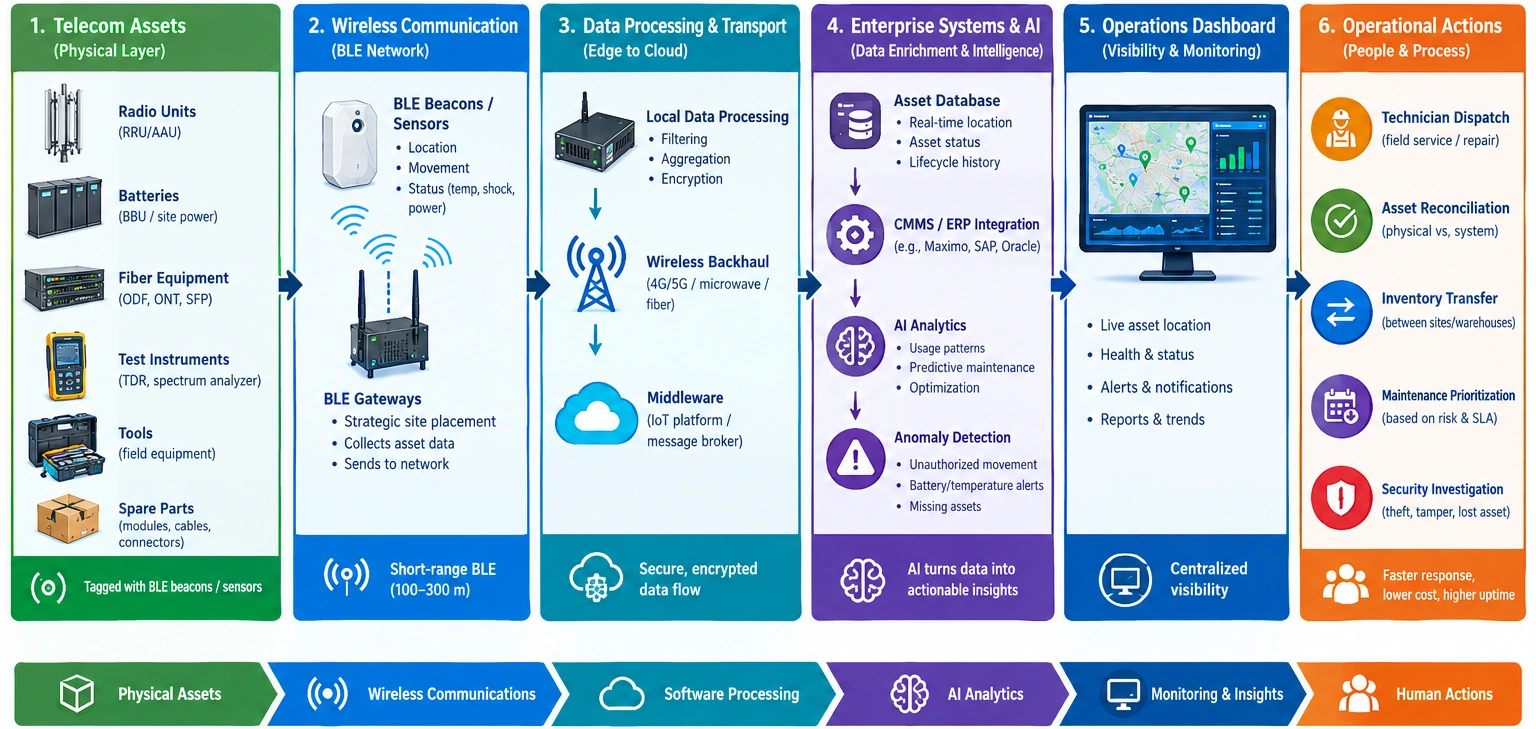
Alt Text:
AI telecom asset tracking workflow from BLE-tagged equipment through AI analytics to operational actions.
AI-Assisted Telecom Site Security and Access Monitoring
Telecommunications facilities can contain high-value equipment and sensitive network infrastructure. Unauthorized access, unexplained equipment movement, and gaps in maintenance records can increase operational and security risk.
BLE proximity information can complement conventional access-control technologies by providing additional context about people, tools, and equipment. For example, an access event can be correlated with the presence of an authorized technician, the movement of assigned equipment, and an approved maintenance work order.
AI can identify patterns such as:
- Equipment movement without an associated work order.
- Repeated access events outside expected maintenance windows.
- Unusual movement between controlled areas.
- Equipment remaining outside an approved zone.
- Repeated discrepancies between personnel, assets, and recorded maintenance activity.
BLE should not be treated as a replacement for access-control systems, surveillance, or established cybersecurity controls. It is better used as an additional data source that strengthens operational context.
Telecom Infrastructure Workflow from Sensing to AI Decisions
A successful AI-enabled telecom infrastructure solution requires a complete information flow rather than isolated sensors. The operational process typically begins when physical infrastructure generates an observation.
Data Acquisition
BLE beacons provide identifiers associated with assets, tools, containers, or equipment. BLE sensors can provide measurements such as temperature, humidity, vibration, motion, or other supported parameters. Gateways receive nearby BLE transmissions and prepare the information for upstream processing.
Asset identifiers should be associated with authoritative records containing equipment type, serial number, site, owner, operational status, maintenance history, and other relevant attributes.
Wireless Communication and Edge Processing
BLE normally handles the local wireless connection between sensors, beacons, and gateways. Gateways can then use Ethernet, Wi-Fi, cellular, or other available backhaul technologies to transmit data to a server or cloud environment.
Edge processing can filter duplicate observations, normalize sensor values, apply initial rules, buffer data during connectivity interruptions, and reduce unnecessary upstream traffic. This is particularly useful at remote telecom sites where network connectivity may be intermittent or bandwidth constrained.
Middleware and Enterprise Software Integration
Middleware connects field observations with operational applications. Depending on the telecom environment, integration targets can include:
- Network management systems.
- OSS and BSS environments.
- CMMS and computerized maintenance systems.
- ERP and procurement software.
- Warehouse management systems.
- Asset management databases.
- Access-control systems.
- Workforce management systems.
- Data lakes and analytics environments.
- Business intelligence software.
APIs, message brokers, database connectors, and event-driven interfaces can be used to exchange data. A well-designed integration should preserve asset identifiers and timestamps so that AI models can reconstruct the operational context of each event.
BLE Hardware and Software for Telecom Infrastructure
BLE hardware should be selected according to the physical environment, required coverage, asset characteristics, battery constraints, data frequency, and integration requirements. Telecom facilities vary substantially between controlled indoor environments and exposed remote sites, so one hardware configuration should not automatically be applied everywhere.
BLE Beacons for Telecom Asset Identification
BLE beacons can be attached to equipment, tool cases, mobile assets, spare-parts containers, or other objects requiring location or proximity visibility. Beacon selection should consider battery life, enclosure requirements, mounting method, transmission interval, radio environment, and expected maintenance cycle.
BLE Sensors for Site and Equipment Conditions
BLE sensors can provide localized measurements useful for telecom infrastructure monitoring. Sensor selection should match the failure modes being investigated rather than simply maximizing the number of measured variables.
For example, temperature monitoring may be valuable around batteries or equipment rooms, while humidity or water-ingress monitoring may be more relevant in vulnerable cabinets or facilities.
BLE Gateways for Data Collection
BLE gateways provide the bridge between local wireless devices and the broader telecom IT environment. Gateway placement should consider radio propagation, cabinet construction, equipment density, interference, antenna orientation, power availability, backhaul, and serviceability.
Remote sites may require gateway configurations that tolerate intermittent backhaul. Regional facilities may support Ethernet or Wi-Fi connectivity, while mobile applications can use cellular connectivity where fixed network infrastructure is unavailable.
Cloud Version and Server Version
A Cloud Version places the application and analytics software within cloud-hosted infrastructure. This model can be appropriate when telecom organizations require centralized visibility across geographically distributed sites, rapid deployment, elastic computing resources, and centralized software administration.
A Server Version deploys software on customer-managed servers, private data centers, edge servers, factory-style server environments, or other privately hosted infrastructure. This approach can be preferable where data residency, operational isolation, internal cybersecurity policies, network independence, or integration with private telecom systems is important.
Hybrid deployments can also be practical. Edge systems can perform local filtering and immediate operational decisions while centralized servers or cloud services perform broader analytics across multiple regions.
AI Models and Analytics
AI methods should correspond to the operational problem and available training data. Telecom infrastructure applications may use:
- Anomaly detection for abnormal environmental or equipment behavior.
- Time-series analysis for sensor trends.
- Classification models for equipment or event categories.
- Predictive models for maintenance risk.
- Clustering for identifying recurring site or asset behavior.
- Computer vision where cameras are used to inspect physical infrastructure.
- Generative AI for maintenance knowledge retrieval, technical documentation assistance, and natural-language operational queries.
AI outputs should remain traceable to source data. Maintenance recommendations should expose relevant sensor trends, equipment history, site information, and confidence indicators rather than presenting unexplained predictions.
Cloud vs. Server Deployment Models for AI-Enabled Telecom Infrastructure
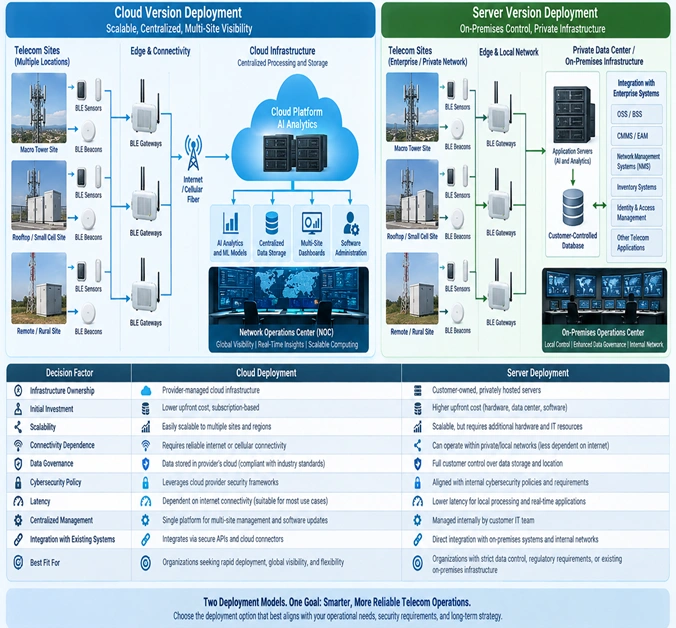
Alt Text:
Cloud vs. server telecom AI architecture comparing BLE data flows, analytics, governance, scalability, and integration.
Engineering Considerations for Telecom BLE Deployments
BLE deployments in telecom environments require radio planning and operational validation. Metal cabinets, racks, batteries, concrete structures, cable trays, RF equipment, and other physical obstructions can affect propagation. Radio-frequency congestion and interference should also be assessed during commissioning.
Important engineering considerations include:
- Establishing the required location granularity before selecting gateway density.
- Separating asset identification requirements from precise real-time positioning requirements.
- Performing site surveys before finalizing gateway locations.
- Testing BLE performance around metal enclosures and network equipment racks.
- Defining acceptable latency for asset events and sensor alerts.
- Establishing battery replacement intervals and maintenance ownership.
- Designing local buffering for unreliable backhaul connections.
- Protecting gateway management interfaces and communications channels.
- Synchronizing timestamps across gateways, servers, and enterprise systems.
- Validating asset identity mappings before AI models consume operational data.
- Establishing baseline operating conditions before enabling predictive alerts.
- Testing false-positive and false-negative rates during pilot deployment.
- Maintaining firmware and software update procedures throughout the system lifecycle.
The most effective telecom deployments typically begin with a clearly defined operational problem, measurable KPIs, and a limited set of high-value asset or maintenance workflows. Additional sites, asset categories, sensors, and AI models can then be introduced after the initial system demonstrates reliable data quality and operational value.
AI-Enabled Operational Improvements in Telecom Infrastructure
Combining AI with connected telecom infrastructure data can improve decision-making when the underlying information is timely, accurately associated with physical assets, and integrated with operational records. The greatest value generally comes from connecting asset, environmental, maintenance, inventory, and workforce information rather than analyzing each data source independently.
Predictive Maintenance and Network Availability
AI-based maintenance models can rank equipment or sites according to estimated failure risk. A model can combine temperature trends, battery condition, vibration, power events, maintenance history, equipment age, alarm records, and environmental conditions.
This enables maintenance teams to move from purely calendar-based servicing toward condition-informed interventions. A technician can receive a work order containing the affected asset, recent measurements, historical maintenance information, recommended inspection points, and required replacement components.
The practical objective is not simply to predict failures. It is to improve mean time between failures (MTBF), mean time to repair (MTTR), network availability, maintenance efficiency, and service continuity.
AI-Assisted Field Service
Telecom field technicians may travel between towers, shelters, exchanges, data centers, and other network facilities while carrying specialized tools and replacement equipment. Poor visibility into equipment and inventory can increase travel time and delay restoration.
AI can combine work orders, technician skills, geographic location, equipment requirements, spare-parts availability, site access conditions, and asset information to support better dispatch decisions.
BLE-enabled asset visibility can provide additional information about whether the required tools and components are actually available before a technician is dispatched.
Potential improvements include:
- Better technician-to-work-order matching.
- Reduced travel associated with missing tools or parts.
- Faster identification of equipment requiring service.
- Improved first-time-fix rates.
- Better utilization of specialized test equipment.
- More accurate maintenance documentation.
- Reduced time spent locating mobile assets.
AI Inventory Optimization
Telecom organizations often need to maintain spare equipment without allowing excessive capital to remain tied up in slow-moving inventory. AI can analyze historical consumption, failure patterns, maintenance schedules, regional demand, and equipment populations to improve stocking decisions.
BLE and RFID identification can strengthen the physical inventory record by providing additional evidence of asset movement. This is particularly useful for expensive network components that move between warehouses, repair centers, staging areas, and field locations.
AI can consequently support decisions concerning reorder points, safety stock, inventory allocation, obsolete equipment, repairable assets, and emergency reserves.
Operational Security and Anomaly Detection
AI can detect patterns that are difficult to identify through manual review. Examples include unexpected equipment movement, repeated access to restricted areas, unusual asset transfers, unexplained sensor behavior, or activity occurring outside scheduled maintenance windows.
BLE proximity information can be correlated with access-control events and work-order information to establish operational context. Such correlation can help security and operations teams distinguish legitimate maintenance activity from events requiring investigation.
BLE should remain one component of a broader security program that includes identity management, physical access control, network security, encryption, logging, surveillance where appropriate, and established incident-response procedures.
Telecom Infrastructure KPIs for AI and BLE Programs
Technology deployment should be evaluated using measurable operational outcomes. Telecom infrastructure teams should establish a baseline before deployment so that changes can be attributed to the new system rather than assumed from system activity alone.
Relevant KPIs include:
- Network availability and service uptime.
- Mean time between failures.
- Mean time to repair.
- Mean time to detect infrastructure anomalies.
- Preventive versus corrective maintenance ratio.
- First-time-fix rate.
- Technician utilization.
- Technician travel time per work order.
- Work-order completion time.
- Asset location accuracy.
- Asset reconciliation accuracy.
- Missing or misplaced asset rate.
- Spare-parts stockout frequency.
- Inventory carrying cost.
- Inventory turnover.
- Emergency spare-parts usage.
- Equipment aging and obsolescence rate.
- Battery failure rate.
- Environmental alarm frequency.
- False-positive maintenance alerts.
- False-negative incident rate.
- BLE gateway availability.
- Sensor reporting reliability.
- Data ingestion latency.
- AI prediction accuracy.
- AI alert-to-action time.
- Unauthorized asset movement incidents.
- Maintenance cost per site.
- Cost per restored service event.
- Percentage of assets with current digital records.
A telecom organization should not attempt to optimize every KPI simultaneously. A practical program selects a small group of operational metrics that directly correspond to the initial usiness problem.
Cybersecurity, Privacy, and Data Governance
AI-enabled telecom infrastructure introduces additional connected endpoints, gateways, software interfaces, and data flows that must be incorporated into the organization’s cybersecurity program.
Security controls should cover the complete chain from BLE devices through gateways, networks, middleware, AI services, databases, and enterprise applications.
Device and Gateway Security
BLE devices should be inventoried and assigned unique identities. Gateway management interfaces should be protected using strong authentication, role-based access controls, secure configuration, and controlled firmware updates.
Where supported by the selected implementation, organizations should use appropriate BLE security mechanisms, authenticated communications, encryption, secure key management, and protections against unauthorized device association.
Network and Application Security
Gateway traffic should be transmitted through appropriately secured network connections. APIs and application interfaces should use authentication and authorization appropriate to the sensitivity of the information being exchanged.
Security monitoring should include:
- Gateway authentication events.
- Configuration changes.
- Firmware updates.
- API access.
- Failed authentication attempts.
- Unexpected device associations.
- Data transmission anomalies.
- Administrative activity.
- Changes to asset identity records.
Telecom operators should also consider network segmentation so that IoT gateways do not receive unnecessary access to critical network-control environments.
Data Governance for AI
AI models require reliable historical data, but not every collected data element should be retained indefinitely. Organizations should define data ownership, retention periods, access permissions, data quality requirements, and audit procedures.
AI-generated recommendations should be distinguishable from authoritative equipment records. A predictive maintenance score, for example, should not automatically overwrite the asset’s official maintenance status without an approved operational process.
Standards and Regulatory Considerations for Telecom Deployments
Telecom infrastructure deployments may intersect with telecommunications regulation, cybersecurity requirements, radio-frequency requirements, occupational safety obligations, privacy rules, and information-security standards.
Relevant standards and regulatory areas can include:
- FCC requirements applicable to radio-frequency equipment and intentional radiators deployed in the United States.
- ISED Canada requirements for applicable wireless equipment deployed in Canada.
- FCC Part 15 considerations for applicable unlicensed wireless devices.
- Bluetooth SIG specifications governing Bluetooth technology implementations.
- NIST Cybersecurity Framework practices for identifying, protecting, detecting, responding to, and recovering from cybersecurity risks.
- NIST IoT cybersecurity guidance relevant to connected devices and device lifecycle management.
- ISO/IEC 27001 for information-security management where adopted by the organization.
- ISO/IEC 27701 where privacy-information management requirements are applicable.
- IEC 62443 concepts where industrial control and connected operational environments overlap with telecom infrastructure facilities.
- Applicable electrical, fire, building, tower, occupational safety, and environmental requirements.
Specific requirements depend on the equipment, jurisdiction, installation environment, frequency characteristics, data collected, and organization operating the infrastructure. Engineering teams should validate regulatory requirements before deployment rather than treating a general standards list as an approval checklist.
GAO’s experience supplying BLE, RFID, and IoT products for North American customers provides a foundation for addressing hardware and system requirements that must fit established technical and operational environments. GAO Group companies have served U.S. and Canadian organizations for three decades, including Fortune 500 companies, research organizations, universities, and government agencies.
Telecom Infrastructure Deployment Lifecycle
Requirements and Site Assessment
The deployment should begin with a documented operational requirement. Examples include reducing tool-search time, improving spare-parts control, detecting environmental risks, or improving maintenance prioritization.
The engineering team should document:
- Asset classes to be monitored.
- Required location or proximity accuracy.
- Site types.
- Expected BLE coverage areas.
- Sensor measurements required.
- Data-reporting frequency.
- Backhaul availability.
- Power constraints.
- Environmental conditions.
- Existing software systems.
- Security requirements.
- Target KPIs.
A radio survey should then identify physical obstructions, equipment density, potential interference, gateway locations, and coverage gaps.
Hardware Selection and Pilot Deployment
BLE beacons, sensors, and gateways should be selected according to the actual telecom environment. Battery life should be evaluated together with transmission interval, temperature range, enclosure requirements, mounting conditions, and maintenance access.
A pilot should normally represent the operational complexity of the intended deployment. Testing only in an empty office can produce misleading results if the production environment contains metal cabinets, racks, equipment shelters, dense radio equipment, or intermittent backhaul.
Commissioning and Integration
Commissioning should verify device identity, gateway connectivity, timestamp accuracy, data integrity, coverage, battery reporting, software integration, and alert behavior.
Integration testing should confirm that asset identifiers remain consistent between the BLE system and systems such as CMMS, ERP, inventory management, workforce management, and network operations software.
AI Model Validation
AI should initially operate against known historical or pilot data. Maintenance personnel should review model outputs and classify alerts as useful, unnecessary, or incorrect.
Model performance should be evaluated using operational measures rather than accuracy alone. A model that produces technically accurate predictions but generates too many false alarms may create additional workload and reduce user confidence.
Optimization and Scale-Up
Once the initial deployment demonstrates reliable data collection and measurable operational improvement, organizations can expand coverage.
Scale-up may include:
- Additional telecom sites.
- More asset categories.
- Additional environmental sensors.
- Regional warehouses.
- Mobile technician inventories.
- More sophisticated predictive models.
- Additional enterprise integrations.
- Centralized analytics across multiple operating regions.
The system should be periodically reviewed because network equipment, site configurations, maintenance procedures, and AI models change over time.
Practical AI and BLE Use Cases Across Telecom Infrastructure
Cellular Tower and Radio Site Monitoring
Remote sites can use BLE sensors to supplement existing monitoring for environmental conditions, equipment movement, cabinet conditions, and maintenance activity. AI can identify abnormal patterns and prioritize sites requiring inspection.
Data Center and Network Facility Asset Management
BLE asset identification can help track portable test equipment, network components, tools, replacement modules, and other mobile assets within controlled facilities. AI can analyze asset utilization and movement patterns to improve allocation.
Fiber Network Maintenance
Fiber installation and maintenance operations may involve specialized tools, test instruments, patching components, optical modules, and replacement materials. Asset visibility can help ensure that technicians arrive with required equipment, while AI can correlate maintenance patterns with recurring faults.
Telecom Spare-Parts Warehousing
AI inventory systems can combine historical demand with physical asset observations to improve stock allocation. BLE or RFID can help distinguish received, staged, issued, returned, repairable, and obsolete components.
Network Operations and Maintenance Coordination
AI can combine physical infrastructure observations with work-order and alarm information. This creates additional operational context for NOC and field-service teams without requiring each team to manually reconcile multiple information sources.
Mobile Technician and Vehicle Inventory
Tools and replacement parts carried in service vehicles can be monitored using BLE identification. AI can compare scheduled work with available equipment and flag potential shortages before dispatch.
Battery and Backup Power Monitoring
Battery systems are critical to telecom site resilience. Temperature and environmental observations can contribute to condition-based monitoring, while AI can identify abnormal trends requiring investigation.
Telecom Equipment Lifecycle Management
AI can help identify aging equipment, frequently serviced assets, underutilized components, and equipment approaching replacement thresholds. Physical asset identification improves confidence that lifecycle decisions correspond to the correct equipment.
U.S. and Canadian Telecom Infrastructure Deployment Examples
Telecom infrastructure is geographically distributed, so deployment requirements differ between dense urban facilities, remote tower sites, regional warehouses, and large data centers.
Representative deployment scenarios include:
- New York City, New York: Dense telecom facilities can use BLE asset visibility to manage tools, network components, and maintenance equipment where physical congestion makes manual asset searches inefficient.
- Toronto, Ontario: Regional network facilities can combine asset identification, environmental sensing, and centralized analytics across multiple operational locations.
- Dallas, Texas: Large network and data-center operations can use AI-assisted equipment lifecycle management and inventory analytics.
- Chicago, Illinois: Multi-site maintenance organizations can use BLE-based equipment visibility to coordinate field tools and replacement components.
- Denver, Colorado: Environmental monitoring can provide additional operational context for infrastructure exposed to significant seasonal temperature changes.
- Seattle, Washington: Telecom facilities can combine environmental sensing with maintenance history to investigate moisture-related infrastructure risks.
- Atlanta, Georgia: Regional telecom warehouses can use AI inventory analysis alongside wireless asset identification to improve spare-parts allocation.
- Phoenix, Arizona: High-temperature operating conditions make thermal monitoring and predictive maintenance particularly relevant to infrastructure reliability programs.
- Vancouver, British Columbia: Distributed infrastructure can use connected sensing and asset visibility to support maintenance planning across regional facilities.
- Montreal, Quebec: Bilingual operational environments and distributed network facilities can benefit from structured asset records and centralized maintenance analytics.
- Calgary, Alberta: Remote infrastructure management can combine environmental observations with maintenance records to prioritize field inspections.
- Ottawa, Ontario: Network and technology facilities can use controlled asset tracking and access-context information for equipment management.
These examples describe representative deployment environments rather than claims of specific customer deployments. Actual system design should be based on the operator’s infrastructure, existing software, site conditions, security requirements, and operational KPIs.
Selecting an AI and BLE Solution for Telecom Infrastructure
Telecom organizations evaluating a solution should examine the complete operational chain rather than comparing BLE hardware specifications in isolation.
Important evaluation criteria include:
- Required asset-location precision.
- BLE gateway coverage and density.
- Beacon battery life.
- Sensor measurement accuracy.
- Environmental operating range.
- Backhaul options.
- Edge-processing capability.
- Cloud and privately hosted server options.
- API and enterprise software integration.
- Asset database compatibility.
- Cybersecurity controls.
- Device-management capabilities.
- AI model transparency.
- Data retention and governance.
- System scalability.
- Maintenance requirements.
- Total cost of ownership.
- Availability of technical support.
- Hardware replacement and lifecycle policies.
GAO can support organizations that need BLE, RFID, and IoT hardware products and systems as part of broader asset tracking, sensing, inventory, maintenance, and infrastructure-monitoring initiatives. Its product and engineering experience can be relevant when organizations need to connect physical telecom operations with software-based monitoring and analytics.
Key Takeaways for AI-Driven Telecom Infrastructure
AI for telecom infrastructure is most effective when artificial intelligence is connected to reliable operational data and existing maintenance, inventory, network, and workforce processes. BLE beacons, sensors, and gateways can provide useful physical-world observations, but the operational value comes from combining those observations with asset records, work orders, environmental information, and network data.
Key implementation principles include:
- Start with a measurable telecom infrastructure problem.
- Prioritize high-value or high-risk assets.
- Perform RF and physical site assessments before gateway deployment.
- Establish reliable asset identities and timestamps.
- Integrate BLE data with existing operational software.
- Use edge processing where connectivity or latency requires it.
- Select cloud or privately hosted server deployment according to data, security, connectivity, and integration requirements.
- Establish baseline KPIs before deploying predictive AI.
- Validate AI alerts with maintenance professionals.
- Monitor false positives and false negatives.
- Apply cybersecurity controls across devices, gateways, networks, APIs, and software.
- Scale only after data quality and operational workflows have been validated.
For telecom infrastructure operators, the objective is not simply to connect more equipment. The objective is to create better operational visibility, faster maintenance decisions, stronger asset accountability, and more predictable infrastructure performance. GAO can provide BLE, RFID, and IoT hardware products and systems that help organizations implement these connected infrastructure workflows.
Building the Future of Industrial AI and IoT with Aperture Venture Studio and GAO RFID Inc.
For more than three decades, GAO Group of Companies has invested heavily in R&D for industrial BLE, RFID, and IoT technologies. As AI became increasingly useful for industrial applications, we expanded our work into AIoT solutions that connect intelligent analytics with physical infrastructure, including telecom assets and connected equipment. Through Aperture Venture Studio we support the development and scaling of advanced AI and IoT solutions relevant to industries such as digital communications and telecom infrastructure.
Aperture has attracted AI and IoT technical experts, entrepreneurial and operational executives, influential investors, and leading companies. We have also developed the Aperture Ventures Summit and TekSummit to discuss advanced AI and IoT topics and connect technical communities.
GAO RFID Inc. is headquartered in New York City and Toronto, Canada, and is ranked among the top 10 leading B2B and B2G, and to a lesser degree B2B2C and B2D, BLE and RFID suppliers globally. GAO RFID Inc., GAO Research Inc., and GAO Tek Inc. form GAO Group, with operations based in New York City and Toronto. GAO Group has served U.S. and Canadian customers, including Fortune 500 companies, leading R&D organizations, prestigious universities, and government agencies.
We have invested substantially in product and system R&D and maintain stringent quality-assurance processes while providing expert technical support remotely or onsite. We welcome organizations and professionals interested in contributing as:
- Advisors, co-founders, or employees.
- Investors.
- Customers.