
AI-Driven Diagnostic Imaging Center Operations with BLE
How AI Improves Diagnostic Imaging Center Flow, Asset Readiness, and Patient Throughput
AI for diagnostic imaging centers uses operational data to reduce delays around MRI, CT, PET/CT, ultrasound, mammography, fluoroscopy, and X-ray examinations. BLE gateways, beacons, and sensors provide location and condition signals for mobile imaging equipment, contrast supplies, patient transport devices, staff workflows, and room-status processes. AI turns those signals into actionable predictions, such as a delayed patient arrival, an idle imaging room, an unavailable MRI-compatible wheelchair, or a likely examination bottleneck.
For diagnostic imaging centers, the objective is not simply asset visibility. It is dependable exam completion, safe patient movement, optimized scanner utilization, shorter turnaround time, and a better experience for referring providers and patients. GAO supplies BLE and IoT hardware systems that help imaging organizations collect reliable operational data for AI-assisted scheduling, asset management, workflow monitoring, and maintenance planning.
AI-Assisted BLE Workflow for Diagnostic Imaging Centers
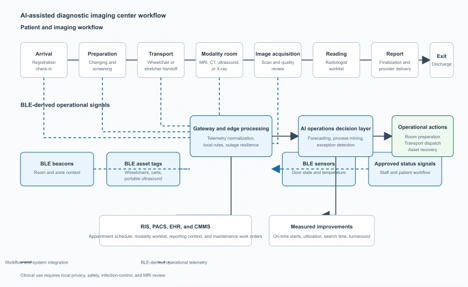
This workflow diagram maps the diagnostic imaging patient journey from registration through discharge. It shows BLE location and sensor data flowing through edge processing and AI decision software to improve room readiness, transport coordination, equipment recovery, and utilization monitoring.
Diagram of BLE signals and AI actions supporting patient flow, equipment tracking, and imaging operations.
What AI-Enabled BLE Operations Mean for Diagnostic Imaging Centers
AIoT in a diagnostic imaging center combines artificial intelligence with connected devices, sensors, imaging systems, and clinical software. BLE is an enabling data layer rather than the primary outcome. A beacon attached to a portable ultrasound unit, for example, can contribute evidence about utilization, dwell time, room transitions, and availability. AI models then combine that evidence with appointment schedules, modality worklists, staffing rosters, patient preparation states, and historical examination durations.
This approach supports several imaging-center priorities:
- Finding portable ultrasound, ECG carts, infusion pumps, crash carts, MRI-safe stretchers, lead aprons, and patient transport wheelchairs before they delay an examination.
- Predicting CT and MRI room turnover constraints, including delayed cleaning, contrast preparation, patient screening, and transport handoff.
- Detecting utilization imbalance across modality rooms, satellite sites, and outpatient imaging locations.
- Identifying repeated workflow deviations that contribute to no-shows, late starts, extended patient wait times, or scanner idle periods.
- Supporting traceable handling of contrast media, temperature-sensitive supplies, and high-value accessories without putting BLE tags in the diagnostic image path.
- Improving preventive-maintenance planning by correlating equipment movement, runtime context, fault history, and service work orders.
Diagnostic Imaging Center AI should be evaluated against clinical operations, not generic IoT metrics. Useful outcomes include completed exams per scanner hour, on-time exam starts, patient cycle time, room turnover duration, modality utilization, repeat-scan rate, equipment search time, report turnaround time, and percent of appointments delayed by unavailable transport or equipment.
Operational Challenges AI Can Address in Imaging Facilities
Diagnostic imaging centers operate under tightly coupled constraints. A missing MRI-compatible wheelchair can delay a scheduled MRI slot, which shifts technologist workload, disrupts downstream patient transport, and affects the radiologist’s expected reading volume. A CT room may appear available in a scheduling system while remaining operationally unavailable because cleaning, contrast preparation, patient screening, or a prior exam overrun is incomplete.
Common deployment targets include:
Mobile asset availability: Facilities often have limited quantities of specialty assets such as MRI-safe infusion pumps, mobile C-arms, portable ultrasound systems, nuclear medicine dose carriers, and bariatric wheelchairs. AI-assisted location and utilization analysis reduces manual search time and reveals whether the issue is true shortage, poor asset distribution, or excessive dwell time.
Patient-flow coordination: Patient arrival, registration, insurance verification, changing, screening questionnaires, creatinine testing, IV placement, sedation readiness, transport, and recovery can create variable delays. AI can estimate readiness risk before a scheduled modality slot is lost.
Modality-room turnover: MRI and CT turnover depends on infection-control procedures, patient transfer, coil selection, protocol setup, contrast handling, and cleaning. Operational models can identify the highest-impact causes of extended turnover by modality, protocol type, daypart, and staff assignment.
Equipment reliability: Imaging modalities already expose service information through vendor tools and DICOM modality worklists. AI can enrich maintenance planning with actual utilization patterns and movement data for associated mobile equipment, reducing avoidable disruption during high-demand clinic hours.
Multi-site standardization: Imaging networks frequently run hospital outpatient departments, freestanding centers, breast imaging clinics, and mobile imaging services. Consistent device commissioning, tag naming, data retention, and integration rules are needed before results can be compared across locations.
GAO helps organizations select BLE hardware and supporting IoT components appropriate for clinical environments, including tags designed for reusable equipment, gateways for monitored coverage zones, and sensors for selected temperature, door-state, or environmental workflows.
AI Signals for Diagnostic Imaging Center Bottlenecks
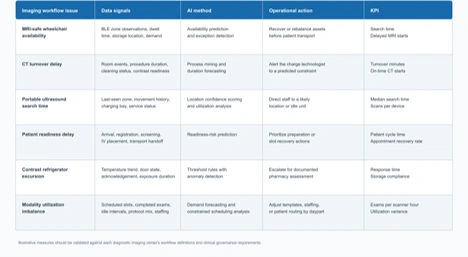
This comparison table connects six diagnostic imaging workflow issues with the BLE and operational data required to detect them. It identifies the suitable AI method, the operational response, and the KPI used to evaluate improvement.
Comparison table linking imaging workflow bottlenecks to BLE data signals, AI methods, actions, and KPIs.
End-to-End Data Flow for AI Imaging Center Operations
Capture and Commissioning at the Point of Care
Implementation begins with a workflow survey, not tag placement. Teams should map patient movement, modality-room boundaries, equipment storage areas, clean and soiled holding zones, contrast rooms, recovery bays, staff work areas, and loading docks. Each tracked object requires a defined business purpose, owner, status model, battery-maintenance approach, and escalation rule.
BLE asset tags may be assigned to mobile ultrasound devices, procedure carts, radiation protection equipment, patient transport assets, and selected accessories. Fixed BLE beacons can define room-level context where required. Environmental BLE sensors may support refrigerator, supply-room, or restricted-area monitoring when their accuracy, calibration, and alerting characteristics meet the defined use case.
Commissioning must account for imaging-suite conditions. MRI areas require strict safety review. Equipment placed in or near MRI Zones III and IV must be evaluated by the site’s MRI safety program; only MR Safe or MR Conditional devices may be used according to their labeling and local policy. BLE devices must never be assumed appropriate for the scanner room merely because they are small or wireless. CT, fluoroscopy, nuclear medicine, and mammography environments similarly require placement planning to avoid obstructing workflows, cleaning processes, infection-control requirements, or manufacturer guidance.
Communication, Edge Processing, and Data Quality
BLE gateways receive advertising packets from tags and sensors, then forward observations using secured Ethernet, Wi-Fi, cellular backhaul, or segmented clinical networks. Location accuracy depends on the use case. Zone-level detection may be sufficient for locating a portable ultrasound system in a department; room-level accuracy for patient-flow monitoring may require denser gateway placement, controlled beacon configuration, site calibration, and validation during normal operating conditions.
An edge server can filter duplicate observations, normalize tag identifiers, evaluate dwell-time rules, and continue local operations during intermittent WAN connectivity. This is especially valuable where imaging centers require low-latency room status alerts or have restrictive data-egress policies. Data-quality controls should detect low tag battery, gateway outage, clock drift, unexpected tag movement, missing observations, and ambiguous room-boundary events before those signals reach AI models.
Integration with Clinical and Operational Software
Middleware maps BLE events into business meaning. A “portable ultrasound detected in Room 4” event is useful only when correlated with the asset registry, room status, appointment schedule, modality worklist, service history, and departmental workflow rules. Common integration targets include:
- Radiology information systems and scheduling software for appointment, procedure, and status context.
- PACS and vendor-neutral archives for imaging workflow visibility, without using BLE data as diagnostic-image evidence.
- DICOM Modality Worklist and HL7 interfaces for procedure identity and status exchange.
- Electronic health records for approved patient-flow and care-coordination context.
- Computerized maintenance management systems for work orders, maintenance status, and asset service history.
- Real-time location system software, enterprise asset management, identity and access management, and business intelligence tools.
FHIR APIs can be appropriate where modern healthcare applications expose FHIR resources, while HL7 v2 remains common for ADT, scheduling, and order-related interoperability. Integration design should minimize protected health information. Pseudonymous encounter identifiers, short retention windows, role-based views, and clear data-use boundaries reduce privacy risk while preserving operational value.
Secure AI and BLE Integration for Diagnostic Imaging Centers
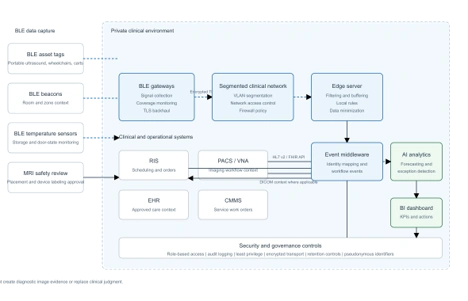
This block diagram shows BLE telemetry flowing through gateways, a segmented clinical network, edge processing, and event middleware. It connects imaging and enterprise software with AI analytics while highlighting encrypted transport, role-based access, audit logging, data minimization, and the private clinical boundary.
Block diagram of BLE telemetry flowing through secure clinical systems into AI analytics for imaging centers.
AI Models That Turn Imaging Operations Data into Decisions
Rule-based logic is often the first layer. Examples include alerting when a tagged MRI-safe wheelchair remains outside its designated zone, when a contrast refrigerator sensor crosses a configured threshold, or when a portable ultrasound unit has remained idle beyond a defined period. Rules are transparent and useful for initial validation, but they do not explain complex delay patterns.
Machine-learning models add predictive and optimization capabilities. Gradient-boosted models can estimate examination duration based on modality, protocol, contrast requirement, sedation flag, patient preparation state, daypart, and historical room performance. Time-series models can forecast scanner demand, support staffing decisions, and identify expected peaks in patient transport demand. Process-mining methods can reconstruct workflows from timestamped events and reveal where actual patient journeys diverge from intended workflows.
Computer vision may supplement, rather than replace, BLE data in narrowly defined areas such as equipment bay occupancy or queue estimation. Privacy review, signage, retention controls, and de-identification are essential when cameras are considered. Generative AI can assist operations leaders by summarizing nonclinical workflow exceptions, drafting maintenance handoff notes, or answering controlled questions over approved operational datasets. It should not independently make diagnostic findings, alter radiology reports, or override clinical judgment.
Solution Components for AI-Enabled Imaging Center Workflows
A diagnostic imaging center solution requires coordinated hardware, data services, integration software, and operational governance. BLE devices are only one component, and their contribution is strongest when they are paired with defined workflows and reliable data ownership.
BLE, Sensors, and Supporting Infrastructure
BLE asset tags provide periodic identification and proximity signals for assets that move through imaging workflows. BLE beacons can establish room or zone context. BLE sensors can monitor selected environmental conditions, such as storage temperature or door state, where a validated sensor specification supports the requirement. Gateways supply coverage and backhaul, while site surveys determine power, network ports, RF coverage, signal overlap, and interference considerations.
For healthcare deployments, device selection should consider disinfectant tolerance, enclosure rating, battery replacement process, attachment method, expected advertising interval, mounting location, and safety constraints around imaging modalities. A tag hidden behind metal equipment panels or enclosed in a lead-lined cabinet may produce poor observations; a tag placed where it interferes with cleaning or clinical use will not remain deployed correctly.
Cloud Version and Server Version
A Cloud Version uses cloud-hosted software to manage devices, ingest telemetry, run analytics, and deliver dashboards. It is often appropriate for multi-site imaging networks that need centralized configuration, aggregated utilization analysis, rapid dashboard access, and managed software operations. Cloud deployment requires a documented data flow, secure tenant controls, encryption, account governance, integration review, and a clear policy for protected health information.
A Server Version runs software on an edge server, customer-managed server, private data center, or privately hosted environment. It is appropriate when a diagnostic imaging center requires local data processing, constrained external connectivity, site-specific integration, low-latency alerts, or customer-controlled retention. A hybrid approach can retain identifiable operational data locally while sending de-identified aggregate metrics to centralized reporting.
GAO can help imaging organizations align hardware selection and deployment model with clinical workflows, IT security requirements, site coverage conditions, and long-term maintenance responsibilities.
Operational Value of AI-Assisted BLE Systems in Diagnostic Imaging Centers
AI-assisted imaging operations improve performance when BLE-derived location and condition signals are tied to a specific decision, owner, and response window. A tag on a portable ultrasound unit does not improve throughput by itself. Value occurs when the imaging charge technologist receives a reliable availability signal before a patient waits, or when an operations manager identifies recurring dwell time in a nonclinical holding area.
Key capabilities for diagnostic imaging centers include:
Asset readiness intelligence: AI evaluates the last confirmed location, movement pattern, maintenance state, battery status, and expected demand for mobile ultrasound systems, MRI-safe wheelchairs, transport stretchers, contrast injectors, lead aprons, and procedure carts.
Modality utilization analysis: CT, MRI, mammography, PET/CT, ultrasound, and general radiography utilization can be analyzed by scheduled time, completed examination time, protocol complexity, idle interval, room turnover, and appointment delay.
Patient-flow prediction: Models estimate whether a patient is likely to be ready for a modality room using approved signals such as arrival completion, screening status, transport assignment, IV placement, contrast preparation, and prior workflow duration.
Exception prioritization: AI ranks events by operational impact. A missing patient transport wheelchair before an MRI appointment may receive a higher priority than a low-utilization event in a noncritical storage area.
Maintenance coordination: Combined asset movement, service status, and utilization history help maintenance teams schedule work on portable assets without disrupting anticipated patient demand.
Operational reporting: Imaging directors can review room turnover distributions, no-show effects, delayed-start causes, asset search patterns, and utilization variance across sites and modalities.
GAO has helped organizations source BLE and IoT hardware systems for operational visibility projects where device selection, coverage planning, commissioning discipline, and technical support determine whether the collected data can support daily decisions.
Why These Improvements Occur
Imaging-center AI performs well when it resolves uncertainty between a scheduled event and the real condition of the department. Scheduling software may show an MRI appointment as active, while BLE observations and workflow events reveal that patient transport has not arrived, the required wheelchair is in another zone, and room turnover has not completed. AI can surface the dependency chain before it becomes a visible delay.
Operational improvements depend on disciplined signal design:
- Location events should represent a meaningful room, storage zone, or handoff point rather than an imprecise building-level presence.
- AI inputs should be time-synchronized with RIS scheduling status, modality worklist events, and CMMS service status.
- Staff should receive a limited number of actionable alerts with defined escalation ownership.
- Model outputs should be reviewed against actual imaging-center workflow outcomes before automation rules are expanded.
- Patient-related use cases should collect the minimum necessary data and remain subject to privacy, clinical governance, and local policy review.
Security, Safety, and Interoperability for Imaging Center AI
Diagnostic imaging centers must protect operational data without treating every BLE signal as clinical data. A BLE asset identifier can often remain separate from protected health information until a specific operational workflow requires a controlled correlation. Data minimization reduces exposure and simplifies integration review.
Security controls should include:
- Segmented clinical networks that isolate gateways and edge servers from guest Wi-Fi and nonclinical devices.
- Mutual authentication, encrypted TLS transport, certificate lifecycle management, and restricted gateway enrollment.
- Role-based access controls for technologists, imaging managers, biomedical engineering teams, IT administrators, and facilities personnel.
- Immutable audit logs for device configuration changes, location-data access, alert acknowledgement, data exports, and integration events.
- Encryption for data in transit and data at rest, with documented retention periods for raw observations and aggregated analytics.
- Gateway health monitoring for connectivity loss, spoofing attempts, unexpected device behavior, low battery, and clock synchronization issues.
- Secure interfaces for HL7 v2, FHIR APIs, DICOM workflow context, and CMMS integrations.
HIPAA privacy and security requirements, the HITECH Act, applicable state privacy laws, and contractual security obligations should guide data governance in U.S. diagnostic imaging centers. Canadian facilities should also evaluate applicable provincial health-information rules. Imaging organizations should involve privacy, information security, radiology leadership, biomedical engineering, and MRI safety personnel before patient-linked workflows are enabled.
MRI safety requires separate scrutiny. Devices, tags, mounts, and batteries near Zones III and IV require review against local MRI safety policies and manufacturer labeling. BLE hardware should not be placed in an MRI scanner environment without documented approval. A reliable solution may intentionally exclude the scanner room and monitor the adjacent controlled zones instead.
Cloud, Server, or Hybrid AI Deployment for Imaging Centers
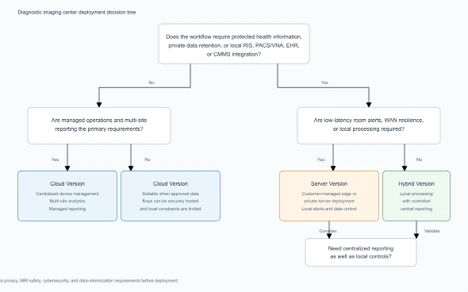
This decision tree evaluates protected data, local system integration, low-latency alerts, WAN resilience, and multi-site reporting requirements. It guides diagnostic imaging centers toward a cloud-hosted, customer-managed server, or hybrid AI deployment.
Decision tree selecting cloud, server, or hybrid AI deployment for diagnostic imaging center workflows.
Deployment Roadmap for AI-Enabled Diagnostic Imaging Centers
Plan the Use Case Before Selecting Devices
A successful deployment starts with one measurable imaging-center problem. Examples include reducing portable ultrasound search time, preventing delayed MRI starts caused by missing transport equipment, improving CT turnover visibility, or monitoring contrast storage conditions. Each use case needs an operational owner, baseline KPI, response procedure, data-retention rule, and acceptance criterion.
Site surveys should assess RF propagation through lead-lined rooms, concrete walls, equipment storage areas, changing rooms, elevators, and satellite locations. BLE coverage should be validated during normal operating conditions, including when mobile assets are parked, moved, cleaned, or stored behind equipment.
Commission, Integrate, and Validate
Device commissioning should assign each tag a stable asset identifier, asset class, department owner, battery-maintenance procedure, and permitted location zones. Gateway commissioning should document network segment, power source, physical mounting location, coverage boundaries, and outage alert routing.
Integration testing should verify:
- BLE location events map to the correct asset and zone.
- RIS and scheduling context cannot be incorrectly associated with another patient encounter.
- CMMS work orders suppress or label assets that are unavailable for clinical use.
- Alert thresholds match real operating conditions and do not create unnecessary paging.
- API permissions follow least-privilege access.
- Historical reporting clearly distinguishes inferred events from directly observed events.
- AI predictions are compared with actual delays, completed exams, and staff observations.
A phased rollout often begins with one modality cluster, such as MRI and portable ultrasound, before expanding to CT, mammography, PET/CT, and multi-site operations. This approach reveals coverage gaps, tag-attachment issues, data-quality exceptions, and workflow ownership questions while the operational scope remains manageable.
Maintain Data and Model Reliability
BLE batteries, adhesives, tags, gateways, firmware, room layouts, and workflow policies change over time. Imaging-center teams should maintain a device inventory, replacement schedule, gateway-health review, periodic coverage test, and exception-management process. AI models also require monitoring for drift when scheduling templates, patient mix, staffing patterns, modality capabilities, or operational procedures change.
GAO’s product R&D, quality assurance processes, and remote or onsite expert support can help diagnostic imaging centers establish maintainable BLE and IoT deployments rather than isolated proof-of-concept installations.
Diagnostic Imaging Center AI & BLE Deployment Lifecycle
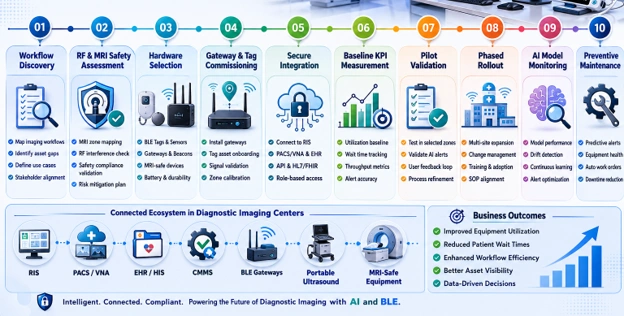
A 10-phase enterprise timeline showing how diagnostic imaging centers can implement AI and BLE—from workflow discovery and RF/MRI safety assessment through secure integration, pilot validation, phased rollout, AI model monitoring, and predictive maintenance. The visual also highlights RIS, PACS/VNA, EHR/HIS, CMMS, BLE gateways, portable ultrasound, MRI-safe equipment, and cybersecurity controls, along with key business outcomes such as improved equipment utilization, reduced patient wait times, workflow efficiency, asset visibility, and data-driven decisions.10-phase AI and BLE deployment timeline for diagnostic imaging, from safety assessment to predictive maintenance.
KPIs for Measuring Diagnostic Imaging Center AI Results
Technical teams should measure signal quality before claiming workflow gains. A location solution with inconsistent zone detection can create false asset-availability assumptions, while an accurate system with poor alert ownership may still fail operationally.
Recommended KPI groups include:
Patient flow: patient cycle time, registration-to-modality time, on-time examination starts, late-start rate, no-show recovery rate, and transport wait time.
Modality performance: completed exams per scanner hour, room turnover minutes, protocol-adjusted examination duration, scanner idle time, and utilization variance by daypart.
Asset operations: median equipment search time, asset availability rate, dwell time outside designated storage, utilization by asset class, and maintenance-related unavailability.
Storage and environmental control: temperature excursion count, excursion acknowledgement time, documented assessment completion, sensor communication uptime, and calibration status.
Technical reliability: gateway uptime, tag battery exception rate, room-level event confidence, integration-message success rate, alert acknowledgement time, and model prediction accuracy.
GAO is headquartered in New York City and Toronto and is ranked among the top 10 leading B2B and B2G BLE and RFID suppliers worldwide. Our teams can support the hardware and technical planning needed to collect dependable operational data for these imaging-center KPIs.
Practical Recommendations for Diagnostic Imaging Center Leaders
AI-enabled BLE operations should begin with a narrow, high-friction workflow where the improvement can be verified. Portable asset retrieval, MRI-safe transport equipment availability, CT turnover coordination, and contrast storage monitoring are practical candidates because they have identifiable events, clear owners, and measurable outcomes.
Diagnostic imaging centers should:
- Establish imaging-specific workflow definitions before deploying tags or gateways.
- Separate diagnostic-image evidence from operational telemetry and analytics.
- Use edge processing when local alerting, resilience, or private data handling requires it.
- Validate room and zone accuracy under real clinical conditions rather than empty-building conditions.
- Build alert playbooks with technologists, schedulers, patient transport, biomedical engineering, and facilities teams.
- Review MRI safety, privacy, cybersecurity, and infection-control requirements before hardware placement.
- Expand only after baseline KPIs, integration behavior, and staff adoption are verified.
For three decades, GAO has served U.S. and Canadian customers, including Fortune 500 companies, leading R&D organizations, universities, and government agencies. Learn more about GAO’s BLE, RFID, and IoT hardware products, technical engineering support, and imaging-center solution guidance for AI-assisted operations.
Building the Future of Industrial AI and IoT with Aperture Venture Studio and GAO RFID Inc.
For more than three decades, GAO Group of Companies has invested heavily in industrial BLE, RFID, and IoT research and development. As generative AI proved valuable for operational applications such as diagnostic imaging center coordination, we expanded our AIoT work and founded Aperture Venture Studio to advance practical AI and IoT initiatives across healthcare delivery and other fields. Aperture brings together AI and IoT specialists, experienced operational leaders, investors, and leading organizations. Through Aperture Ventures Summit and TekSummit, we support advanced technical dialogue and active AI and IoT communities. We welcome advisors and employees, investors, and customers to participate.