
AI and BLE for Robotics Production
AI and BLE for Robotics Production
AI and IoT are changing robotics production by turning machine, tool, work-in-process, and production-floor data into operational decisions. For robotics manufacturers, the value is not simply connecting more equipment. The objective is to understand where robot components and production assets are, determine whether equipment is operating within expected conditions, identify developing quality or maintenance problems, and provide actionable information to manufacturing teams. BLE gateways, BLE beacons, and BLE sensors can provide low-power location and condition data from assembly cells, machining areas, test stations, warehouses, and finished-goods storage. AI can then correlate this information with manufacturing execution systems, quality records, maintenance histories, and production schedules. This combination supports predictive maintenance, asset tracking, production traceability, anomaly detection, worker-safety monitoring, and production-flow optimization. GAO supplies BLE, RFID, and IoT hardware products and systems that can be incorporated into these robotics-production workflows.
AI and BLE System for Robotics Production
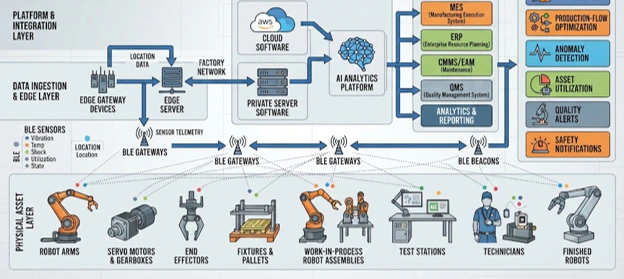
How AI Improves Robotics Production Operations
AI in robotics production means applying machine learning, computer vision, statistical analytics, anomaly detection, optimization, and other Industrial AI methods to the data generated by manufacturing processes. AIoT combines artificial intelligence with IoT devices, sensors, connected equipment, and industrial systems. In robotics production, that combination is particularly useful because a finished robot is the result of many interdependent manufacturing stages.
A robotic system may contain motors, gearboxes, harmonic drives, encoders, controllers, wiring assemblies, batteries, end effectors, structural components, fasteners, sensors, and precision mechanical parts. Production teams must maintain component availability while controlling dimensional accuracy, torque, calibration, firmware configuration, assembly quality, and final functional performance.
BLE can serve as a practical data-acquisition layer for selected non-safety-critical assets. BLE sensors can report environmental or equipment-condition measurements, while BLE beacons can identify mobile assets, tools, fixtures, bins, carts, pallets, and work-in-process assemblies. BLE gateways collect these transmissions and forward relevant information to software where it can be combined with production records.
Bluetooth technology is particularly relevant where robotics manufacturers need battery-powered sensing or location information without installing dedicated cables to every mobile asset. Current Bluetooth capabilities include Direction Finding using Angle of Arrival and Angle of Departure, while newer capabilities such as Channel Sounding can support more accurate distance estimation than approaches based only on RSSI.
The engineering value comes from combining this operational context with existing manufacturing data. A BLE location event by itself only says where an asset is. AI can determine whether the asset’s movement corresponds to the production plan, whether a fixture is repeatedly waiting at a particular station, or whether equipment behavior differs from historical operating patterns.
GAO’s BLE and IoT hardware can therefore be considered an input layer within a broader robotics-production solution rather than the complete AI solution itself.
Robotics Production Use Cases for Industrial AI and IoT
Predictive Maintenance for Robot Manufacturing Equipment
Robotics manufacturers depend on machining centers, CNC equipment, robotic assembly cells, conveyors, compressors, test benches, torque tools, welding equipment, and other production machinery. Unexpected equipment failure can interrupt multiple downstream operations.
AI-based predictive maintenance can combine equipment-condition information with maintenance records, operating hours, production schedules, and historical failure patterns. BLE sensors can contribute vibration, temperature, humidity, or other suitable measurements from selected equipment where wireless sensing is technically appropriate.
Useful AI outputs include:
- Early identification of abnormal vibration or temperature trends
- Remaining-useful-life estimation for selected equipment
- Maintenance-priority recommendations
- Detection of unusual equipment utilization
- Identification of recurring failure patterns
- Automated maintenance alerts
- Correlation between machine condition and production defects
The important engineering consideration is that wireless sensor data should complement, rather than automatically replace, native machine-control instrumentation. High-frequency servo-control or functional-safety data normally remains within the machine’s dedicated control system.
AI Asset Tracking for Robot Components and Work-in-Process
Robotics production involves large numbers of mobile objects. Fixtures, tooling, component bins, pallets, subassemblies, calibration equipment, test equipment, and partially assembled robots can move between machining, assembly, inspection, testing, rework, and storage areas.
A BLE-based RTLS can provide location events for selected assets. BLE Direction Finding can provide more sophisticated positioning than simple proximity detection in appropriately designed installations.
AI can use location history to identify:
- Work-in-process dwell time
- Bottlenecks between production cells
- Repeated movement between assembly and rework
- Underutilized fixtures
- Missing tools
- Excessive material-search time
- Unplanned movement of production assets
- Storage congestion
- Delays between testing and final assembly
This changes asset tracking from a passive location lookup into an operational analytics function.
BLE Asset Tracking Workflow for Robotics Production
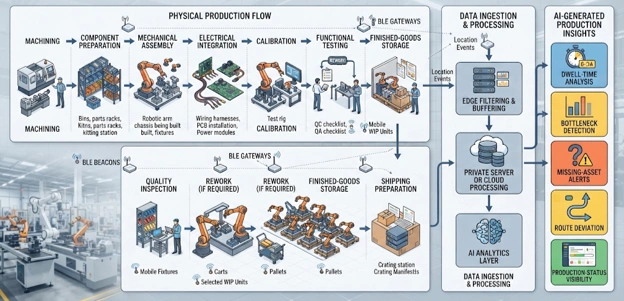
AI-Assisted Production Quality and Traceability
Robotics manufacturers frequently need to associate components and assembly activities with a specific robot serial number or production order. Traceability becomes particularly important when a defect is discovered after assembly or during field operation.
BLE should not be treated as the sole source of product genealogy. Instead, BLE events can provide contextual information about where an assembly, fixture, or tool was located and when it was present at a workstation. Production systems can then correlate those events with:
- Robot serial numbers
- Work orders
- Component lots
- Torque records
- Calibration results
- Inspection measurements
- Firmware versions
- Test results
- Rework records
- Operator or technician activities
AI can identify correlations between manufacturing conditions and later defects. For example, repeated failures associated with a particular production cell, fixture, component lot, or environmental condition can become candidates for engineering investigation.
AI for Production Flow and Bottleneck Detection
Robot production contains sequential and parallel operations. A machining delay can affect assembly. Assembly congestion can delay calibration. Calibration failures can increase test-station queues, while rework can consume the same fixtures required for new production orders.
AI can analyze timestamps, asset locations, equipment utilization, queue lengths, cycle times, and production schedules to identify abnormal process flow.
Relevant outputs include:
- Cycle-time deviation
- Workstation utilization
- Queue buildup
- Bottleneck probability
- Work-in-process accumulation
- Rework concentration
- Fixture utilization
- Production-order delay risk
- Predicted completion time
The objective is not simply to display a dashboard. The system should help production managers determine what action is likely to improve throughput.
Robotics Production Challenges AIoT Can Address
Robotics manufacturers face several operational problems that make contextual data valuable:
- High-value work-in-process can be difficult to locate when it moves between production cells.
- Fixtures and specialized tooling may be shared across multiple assembly or test stations.
- Maintenance teams can struggle to correlate intermittent equipment behavior with eventual failures.
- Production managers may have limited visibility into actual movement and dwell time between process stages.
- Rework can create hidden queues that are difficult to identify from production-order data alone.
- Metal structures, machinery, enclosures, and dense production equipment can complicate wireless propagation.
- Large numbers of battery-powered sensors create an ongoing battery-management requirement.
- Manufacturing data may be distributed across MES, ERP, CMMS/EAM, quality systems, PLCs, robot controllers, and standalone test equipment.
- Safety-critical functions must remain separated from analytics functions unless the complete safety design has been engineered and validated accordingly.
- Wireless data quality must be validated before AI models are allowed to influence operational decisions.
The last point is especially important. AI cannot compensate for unreliable sensor placement, missing data, poor asset identity, inaccurate timestamps, or inconsistent production records.
From BLE Sensor Data to AI-Driven Production Decisions
A practical robotics-production solution can follow a layered data flow:
Physical production process → BLE sensing and identification → BLE gateway → edge processing → server or cloud software → data integration → AI analytics → manufacturing decision
Data Acquisition at the Production Cell
BLE sensors can capture selected environmental and equipment-condition parameters. BLE beacons can provide identity and location information for mobile assets. Depending on the use case, a tag may be attached to a fixture, tooling cart, pallet, work-in-process assembly, or maintenance asset.
Sensor selection should be based on the engineering variable that actually influences the production decision. Adding sensors without defining the downstream decision increases installation and maintenance overhead without necessarily improving manufacturing performance.
BLE Gateway and Edge Processing
BLE gateways provide the connection between wireless devices and the production network. A gateway can receive BLE advertisements or connected-device data and forward normalized records to an edge server, private server, or cloud service.
Edge processing is useful when robotics production requires local filtering, buffering, protocol conversion, or rapid alert generation. For example, a gateway or edge computer can remove duplicate observations, normalize timestamps, validate sensor values, and temporarily store data during a network interruption.
Bluetooth LE operates in the 2.4 GHz ISM band and uses 40 RF channels. Industrial deployment therefore requires attention to radio interference, metal obstructions, gateway placement, antenna orientation, and device density.
Manufacturing Data Integration
AI becomes substantially more useful when BLE data is associated with production context.
Common integration targets include:
- MES for production orders, work-center status, and routing
- ERP for inventory, procurement, and production planning
- CMMS or EAM for maintenance history and work orders
- Quality management systems for inspection and nonconformance records
- PLC and SCADA systems for machine-state information
- Robot controllers for operating status and cycle information
- Laboratory or test software for calibration and functional-test results
- Data historians for time-series industrial measurements
GAO can support robotics manufacturers by supplying the BLE and IoT hardware layer required to acquire selected operational data, while the final integration should be engineered around the manufacturer’s existing production software and control environment.
AI Data Flow for Robotics Production
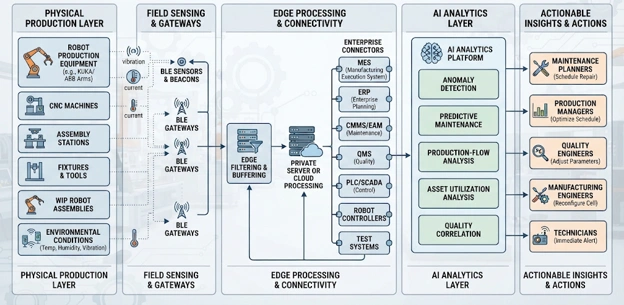
BLE Hardware, AI Software, and System Design for Robotics Production
A robotics-production deployment normally combines several technical components rather than relying on a single device or software package. The correct design depends on the measurement frequency, required location accuracy, radio environment, battery-life requirement, data volume, latency, and integration requirements.
BLE Sensors
BLE sensors are appropriate for selected low-power measurements such as temperature, humidity, vibration, shock, or other supported parameters. Sensor placement should reflect the physical source of the measurement. A vibration sensor attached to a machine enclosure, for example, must be mechanically coupled appropriately if the resulting signal is expected to represent machine behavior.
BLE Beacons
BLE beacons can provide a persistent wireless identity for mobile production assets. They are useful for fixtures, carts, tooling, pallets, containers, work-in-process units, and other objects whose identity and movement matter to production operations.
BLE Gateways
Gateways receive BLE transmissions and provide upstream connectivity. Gateway density should be determined through an RF site survey rather than a simple area-per-gateway calculation. Robotics factories contain metal structures, robot cells, cabinets, machinery, racks, and moving objects that can change propagation conditions.
Bluetooth’s industrial guidance specifically recognizes manufacturing challenges involving metal surfaces, interference, dense deployments, and long operating lifetimes.
AI and Machine Learning
AI models can operate on historical and streaming production data. Appropriate methods may include:
- Time-series anomaly detection
- Supervised classification
- Regression
- Forecasting
- Clustering
- Predictive maintenance models
- Optimization algorithms
- Computer vision
- Sensor-fusion models
- Large language models for controlled manufacturing knowledge interfaces
Model selection should follow the production problem. A simple statistical threshold can be more reliable and explainable than a complex machine-learning model when the engineering relationship is already well understood.
Cloud Version and Server Version
A Cloud Version can be appropriate when multiple robotics-production facilities need centralized analytics, remote monitoring, cross-site reporting, and scalable storage. Cloud deployment can also simplify centralized model management when corporate IT policies permit the required data flows.
A Server Version can be deployed on factory servers, customer-managed edge servers, private data centers, or other privately hosted infrastructure. This approach is often appropriate when production data must remain within controlled networks, when connectivity to external services is restricted, or when low-latency local processing is important.
A hybrid approach can also be practical: local edge processing handles immediate data collection and buffering, while selected historical information is transferred to centralized software for long-term analytics.
Cybersecurity and Operational Safety
BLE connectivity should be treated as one component of the robotics-production security model. Device authentication, access control, encryption, credential management, secure gateway configuration, network segmentation, software patching, logging, and asset inventory should be addressed during system design.
IEC 62443 provides a relevant cybersecurity framework for industrial automation and control systems, and recent IEC guidance specifically addresses applying the 62443 series to Industrial Internet of Things environments.
Safety requires a separate engineering boundary. ISO 10218-1:2025 addresses safety requirements for industrial robots, while ISO 10218-2:2025 addresses industrial robot applications and robot cells, including integration, commissioning, operation, maintenance, and decommissioning. Collaborative robot applications also remain covered by ISO/TS 15066:2016, which ISO currently lists as confirmed while a replacement work item is under development.
AI and BLE analytics should therefore support production decisions without being assumed to provide a safety function unless the complete safety system has been designed, validated, and certified for that purpose.
Technical Capabilities and Operational Value in Robotics Production
The practical value of AI-supported BLE sensing in robotics production comes from connecting physical production events with manufacturing context. A location event, vibration measurement, or temperature reading becomes more useful when it can be associated with a robot serial number, work order, production cell, maintenance record, or quality result.
Production Visibility and Work-in-Process Control
AI can transform BLE location observations into a continuously updated view of work-in-process movement.
For robotics manufacturers, this can help answer operational questions such as:
- Which robot assemblies are currently waiting between production stages?
- How long has a fixture remained at a workstation?
- Which production cells consistently accumulate work-in-process?
- Which tooling assets are unavailable when a production order reaches a workstation?
- How much time is spent moving assemblies rather than processing them?
- Which production orders are likely to miss their planned completion time?
This information can help manufacturing engineers distinguish between an equipment-capacity problem and a material-flow problem. That distinction is important because adding another production machine will not solve a bottleneck caused by fixture shortages or excessive rework.
Predictive Maintenance and Equipment Utilization
Predictive maintenance becomes more actionable when machine-condition data is combined with actual utilization.
For example, two assembly machines may operate for the same number of calendar hours but experience very different workloads. AI can incorporate runtime, cycle count, environmental conditions, vibration patterns, maintenance history, and production demand to identify equipment that requires closer inspection.
BLE sensors can contribute supplementary condition data where appropriate. Native PLC, CNC, robot-controller, and machine-monitoring data should remain the primary source for variables that require high sampling rates or deterministic measurement.
The resulting maintenance process can move from:
Failure → emergency maintenance → production disruption
toward:
Condition change → AI anomaly detection → engineering review → planned maintenance
The latter does not guarantee failure prevention. Its value is reducing uncertainty and providing maintenance personnel with earlier evidence for investigation.
Quality Correlation Across Production Stages
Robotics production quality problems can originate well before the defect becomes visible during final testing.
AI can correlate production history across machining, mechanical assembly, electrical integration, calibration, programming, and final functional testing.
BLE events can add contextual information about:
- Which fixture handled a work-in-process unit
- Which production cell processed it
- How long it remained in a particular area
- Whether it passed through an expected workstation
- Whether a mobile test asset was present
- Whether an environmental condition changed during processing
Quality engineers can then investigate relationships between process conditions and nonconformances instead of examining each defect in isolation.
Tool and Fixture Management
Robot manufacturers often use specialized fixtures for precision assembly, calibration, testing, alignment, or inspection. These assets can become production constraints when their location is unknown or when maintenance status is unclear.
BLE beacons can provide identity and location information, while enterprise software can associate that identity with maintenance and calibration records.
AI can subsequently identify:
- Fixtures approaching calibration intervals
- Repeated fixture movements between particular cells
- Underutilized tooling
- Abnormally long fixture dwell times
- Tool shortages associated with production delays
- Assets frequently sent for repair
This can improve utilization without requiring every production asset to become a connected machine.
Robotics Production AI KPI Dashboard
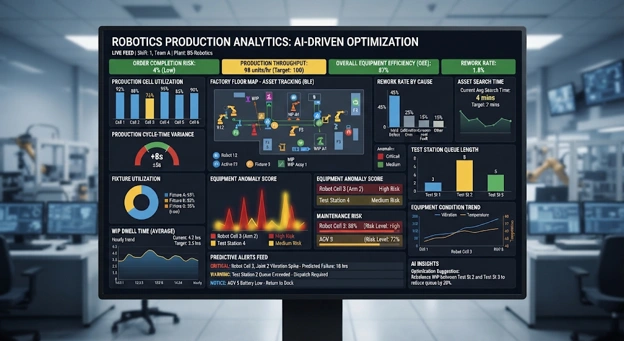
Deployment Planning for Robotics Production
Successful implementation starts with the manufacturing problem rather than with the wireless technology.
A robotics manufacturer should first identify which operational decision requires better information. Asset location, equipment condition, production-flow visibility, and maintenance prediction require different data characteristics and therefore different hardware and software designs.
Define the Production Objective
A deployment may begin with a narrowly defined problem such as:
- Reducing time spent searching for specialized fixtures
- Identifying bottlenecks in final robot assembly
- Monitoring environmental conditions around precision production equipment
- Detecting abnormal vibration in selected machines
- Tracking work-in-process between assembly and testing
- Improving maintenance planning for mobile production equipment
A clearly defined objective makes it possible to establish measurable baseline KPIs.
Select Assets and Measurements
Not every machine or asset needs a BLE device. Selection should consider:
- Asset value
- Mobility
- Failure consequences
- Measurement requirements
- Existing instrumentation
- Battery-access constraints
- RF conditions
- Required location accuracy
- Required reporting interval
- Cleaning and environmental conditions
- Maintenance procedures
A stationary CNC machine that already exposes high-quality vibration and operating-state data through its industrial control system may not need an additional BLE sensor for the same variable.
Conversely, a mobile fixture with no network connection may be an excellent candidate for a battery-powered BLE beacon.
Conduct an RF Site Survey
Robotics-production facilities can be difficult wireless environments. Metal robot structures, machinery, electrical cabinets, storage racks, production lines, and moving workpieces affect signal propagation.
A deployment should validate:
- BLE coverage
- Gateway placement
- Radio interference
- Multipath effects
- Location accuracy
- Device density
- Battery performance
- Network availability
- Gateway failover requirements
Pilot testing should occur during normal production rather than only in an empty factory. Moving equipment and human activity can change wireless conditions.
Establish Asset Identity
AI analytics depends on reliable identity mapping.
A production system should be able to distinguish a BLE device from the physical asset it represents. Asset identity may need to connect:
BLE device ID → physical asset ID → production role → maintenance record → production cell → ERP/MES record
Without this mapping, analytics may generate technically correct observations that cannot be translated into operational action.
Integrating AI and BLE with Manufacturing Software
The strongest robotics-production implementations treat wireless observations as another source of manufacturing data.
MES Integration
MES software can provide the production context required to interpret BLE events.
For example, if a BLE-tracked robot assembly is detected at a test station, MES data can identify the corresponding production order and operation. AI can then determine whether the elapsed time at the station is normal for that operation.
ERP Integration
ERP systems can provide information about production orders, inventory, procurement, materials, and planning. AI can use this information alongside production-floor observations to identify relationships between component availability and production delays.
CMMS and EAM Integration
Maintenance systems provide equipment histories, preventive-maintenance schedules, work orders, inspection results, and failure records.
Combining these records with sensor and utilization data can improve predictive-maintenance models and maintenance prioritization.
Quality Management Integration
QMS data can include nonconformance reports, inspection results, corrective actions, and quality trends. Linking these records to production-cell, equipment, fixture, and work-in-process information enables more detailed root-cause analysis.
Industrial Control Integration
PLC, SCADA, CNC, and robot-controller data can provide deterministic machine-state information. AI systems should generally consume this information through appropriately designed industrial interfaces rather than attempting to replace machine-control systems.
BLE is most useful where wireless identification, mobile-asset sensing, supplementary condition monitoring, or flexible data collection provides information that existing wired systems do not.
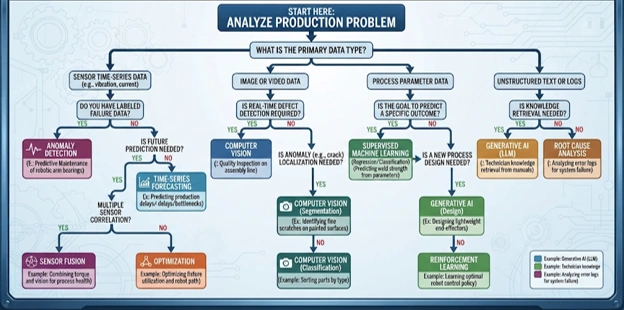
AI Models and Analytics for Robotics Manufacturing
Different robotics-production problems require different analytical approaches.
Anomaly Detection
Anomaly detection can identify measurements or operational sequences that differ from established normal behavior.
Potential inputs include:
- Vibration
- Temperature
- Equipment runtime
- Cycle time
- Asset dwell time
- Production sequence
- Test results
- Maintenance history
Anomaly detection is particularly useful when failure examples are limited and a complete labeled dataset is unavailable.
Predictive Models
Supervised machine-learning models can be developed when historical records contain sufficient examples of known outcomes.
Potential predictions include:
- Maintenance risk
- Production-delay risk
- Quality-failure probability
- Expected cycle-time deviation
- Asset demand
- Fixture requirements
Models should be validated against production data that was not used during training. Data leakage, class imbalance, sensor drift, and changes in production processes can otherwise produce misleading model performance.
Computer Vision
Computer vision can complement BLE-based information in robotics production.
Vision systems may inspect:
- Robot assembly completeness
- Component presence
- Connector placement
- Fastener presence
- Surface defects
- Part orientation
- Safety-equipment compliance
- Workstation conditions
BLE identifies or contextualizes an asset, while computer vision can inspect its physical state. Combining the two can help associate inspection results with specific work-in-process units or production stations.
Generative AI
Generative AI can provide controlled interfaces to manufacturing knowledge when connected to authorized data sources.
Potential applications include:
- Searching maintenance procedures
- Summarizing equipment histories
- Explaining recurring production anomalies
- Generating maintenance summaries
- Assisting technicians in locating approved procedures
- Summarizing production-shift events
Generative AI should not be allowed to invent maintenance procedures or override engineering controls. Responses should be grounded in approved documentation and governed manufacturing data.
AI Model Selection for Robotics Production
Implementation, Testing, and Commissioning
A controlled pilot is preferable to deploying a large wireless sensing system across an entire robotics plant without operational validation.
Pilot Deployment
The pilot should cover a representative production process and include the actual environmental conditions expected during production.
A suitable pilot might include:
- One production cell
- A limited set of BLE gateways
- Selected mobile assets
- A small group of condition sensors
- One MES or maintenance-system integration
- Defined AI analytics
- Baseline KPIs
- Production-user feedback
The objective is to determine whether the collected data actually improves the targeted decision.
Data Quality Validation
Before training or deploying AI models, engineering teams should evaluate:
- Missing observations
- Duplicate events
- Incorrect timestamps
- Sensor drift
- Battery-related measurement gaps
- Incorrect asset associations
- Gateway outages
- RF dead zones
- Unexpected device movement
- Abnormal data distributions
A model trained on unreliable operational data can produce confident but incorrect recommendations.
Operational Acceptance Testing
Testing should include real production scenarios such as:
- Moving assets between cells
- Gateway failure
- Temporary network loss
- Battery replacement
- Production-order changes
- Rework routing
- Equipment shutdown
- Sensor removal
- New asset registration
The system should define what happens when data is unavailable. A manufacturing process should not become dependent on a wireless analytics system for functions that must continue safely during an outage.
Scalability, Maintenance, and Lifecycle Management
Scaling a robotics-production deployment requires more than installing additional BLE devices.
Device Lifecycle
Production teams should maintain an inventory containing:
- Device identifier
- Asset association
- Installation location
- Battery condition
- Firmware version
- Configuration
- Calibration requirements
- Maintenance history
- Replacement status
Battery-powered devices require planned replacement or recharging procedures. Battery life should be evaluated using the actual advertising interval, sensor sampling frequency, temperature conditions, transmission power, and operational environment.
AI Model Lifecycle
AI models also require maintenance.
Production changes can alter the statistical behavior of the data. New equipment, revised assembly procedures, different production volumes, component substitutions, or software updates can cause model drift.
A mature system should therefore monitor:
- Model accuracy
- False-positive rate
- False-negative rate
- Data drift
- Sensor drift
- Prediction latency
- Alert response
- Operator acceptance
AI should be periodically evaluated against actual production outcomes.
Expansion Across Production Cells
After validating one process, the same principles can be extended to additional manufacturing areas.
Potential expansion areas include:
- Component preparation
- Mechanical assembly
- Electrical assembly
- Robot programming
- Calibration
- Functional testing
- Final inspection
- Rework
- Finished-goods storage
- Maintenance operations
GAO can provide BLE, RFID, and IoT hardware for different portions of these workflows, allowing manufacturers to select the sensing or identification method according to the physical and operational requirements of each process.
Key KPIs for AI-Enabled Robotics Production
A robotics-production AIoT initiative should be measured through operational outcomes rather than the number of connected devices.
| KPI | What It Measures | Potential AI Contribution |
|---|---|---|
| Work-in-process dwell time | Time between production operations | Bottleneck and delay prediction |
| Production cycle time | Duration of manufacturing operations | Cycle-time anomaly detection |
| Equipment utilization | Productive equipment usage | Utilization optimization |
| Unplanned downtime | Production interruption | Predictive maintenance |
| Mean time between failures | Equipment reliability | Failure-risk modeling |
| Mean time to repair | Maintenance responsiveness | Maintenance planning |
| Fixture utilization | Use of specialized tooling | Demand prediction |
| Asset-search time | Time spent locating production assets | AI-assisted asset tracking |
| First-pass yield | Quality without rework | Quality correlation |
| Rework rate | Manufacturing rework frequency | Root-cause analysis |
| Test-station queue time | Waiting before testing | Production-flow optimization |
| Production-order adherence | Actual versus planned progress | Delay prediction |
| Maintenance schedule adherence | Planned maintenance completion | Maintenance analytics |
| Sensor data availability | Reliability of collected data | Data-quality monitoring |
The appropriate KPI depends on the original business problem. Connecting assets without defining a measurable operational outcome can make the project difficult to justify and maintain.
AI Deployment Lifecycle for Robotics Production
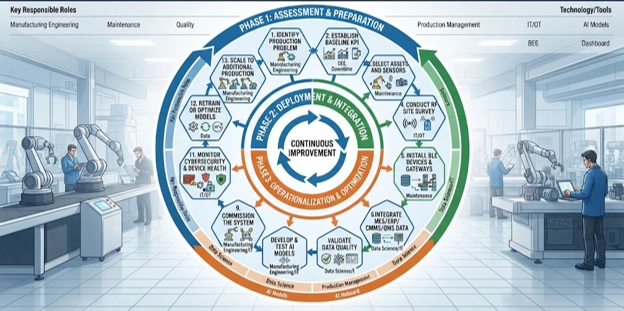
Engineering Recommendations for Robotics Production
A practical implementation should follow several principles.
- Start with a measurable manufacturing problem rather than a technology-first deployment.
- Use BLE for mobile identification, supplementary sensing, and wireless data collection where it provides a genuine engineering advantage.
- Retain PLC, CNC, robot-controller, and dedicated safety systems for functions that require deterministic control or certified safety performance.
- Conduct RF validation under real production conditions.
- Create a reliable relationship between wireless device IDs and physical production assets.
- Integrate BLE observations with MES, ERP, CMMS/EAM, QMS, and machine data where the operational use case requires it.
- Validate sensor data before using it to train AI models.
- Select AI methods according to available data, prediction requirements, explainability requirements, and operational risk.
- Keep human engineering review in the decision loop for maintenance, quality, and process changes with significant production consequences.
- Segment wireless and industrial networks according to the organization’s cybersecurity requirements.
- Establish battery, firmware, calibration, and replacement procedures before large-scale deployment.
- Monitor AI model performance after commissioning rather than treating model deployment as the final project stage.
- Measure improvements using manufacturing KPIs such as cycle time, downtime, first-pass yield, rework, asset-search time, and work-in-process dwell time.
- Expand the solution only after the pilot demonstrates measurable operational value.
GAO Support for AI and IoT in Robotics Production
GAO provides BLE, RFID, and IoT hardware products and systems that can support asset identification, wireless sensing, tracking, condition monitoring, and industrial data acquisition. For robotics manufacturers, the appropriate hardware combination depends on whether the requirement involves mobile tooling, work-in-process identification, equipment condition, environmental monitoring, or production-area visibility.
Headquartered in New York City and Toronto, Canada, GAO is recognized among the leading global B2B and B2G suppliers of BLE and RFID technologies. GAO and its sister companies, GAO Research and GAO Tek, form GAO Group, with operations based in New York City and Toronto.
For three decades, GAO Group has served organizations across the United States and Canada, including Fortune 500 companies, major R&D organizations, universities, and government agencies. Its engineering approach includes substantial R&D investment, stringent quality assurance, and technical support that can be provided remotely or onsite.
For robotics manufacturers evaluating AI-enabled production monitoring, the most useful starting point is a clearly defined production problem, followed by a technical assessment of sensing requirements, RF conditions, software integration, cybersecurity, and measurable KPIs. GAO’s technical team can help organizations evaluate suitable BLE, RFID, and IoT hardware and develop an implementation approach around those requirements.
Key Takeaways for AI-Enabled Robotics Production
AI can make robotics production more observable, predictive, and responsive when it is connected to reliable operational data. BLE beacons, BLE sensors, and BLE gateways can supply useful location, identity, and condition information for mobile production assets and selected equipment.
The highest-value applications are generally those where physical production events are difficult to observe through existing systems. These include work-in-process tracking, fixture management, predictive maintenance support, production-flow analysis, asset utilization, and quality correlation.
A successful implementation requires more than wireless connectivity. RF engineering, asset identity, data quality, MES and maintenance integration, AI model validation, cybersecurity, lifecycle management, and manufacturing KPI measurement must be addressed together.
GAO’s BLE, RFID, and IoT technologies can provide the hardware foundation for these solutions, while robotics manufacturers can combine that data with their existing production controls and software to build practical AI-enabled manufacturing workflows.
Learn more about GAO’s BLE, RFID and IoT technology solutions
Building the Future of Industrial AI and IoT with Aperture Venture Studio and GAO RFID Inc.
For more than three decades, GAO Group of Companies has invested heavily in R&D of industrial BLE, RFID, and IoT. As generative AI became useful in industrial applications, we expanded our work in AI and IoT technologies and founded Aperture Venture Studio to advance AI and IoT solutions relevant to industries such as robotics production. Aperture has attracted AI and IoT technical experts, operational executives, investors, and leading companies. We have also developed the Aperture Ventures Summit and TekSummit to discuss advanced AI and IoT topics. We welcome advisors, co-founders, employees, investors, and customers to participate in these initiatives.