
AI and RFID for Recycling Operations
AI-Driven Recycling Operations with RFID
AI and RFID for Recycling combines AI-driven analysis with UHF RFID, HF RFID, and LF RFID identification to improve how recycling facilities track materials, containers, equipment, recovered commodities, and operational workflows. Recycling operations generate large volumes of physical material movement data across collection, receiving, weighing, sorting, processing, baling, storage, shipment, and commodity recovery. RFID can provide machine-readable identification for selected assets and material-handling units, while AI can correlate those events with weighbridge records, material composition, contamination measurements, production schedules, maintenance records, and customer or supplier information. This combination can help recycling operators improve material traceability, inventory accuracy, equipment utilization, and operational decision-making. GAO supplies RFID, BLE, and IoT hardware products and systems that can support recycling facilities with asset identification, material tracking, inventory control, and connected operational workflows.
AI and RFID Recycling Operations Overview
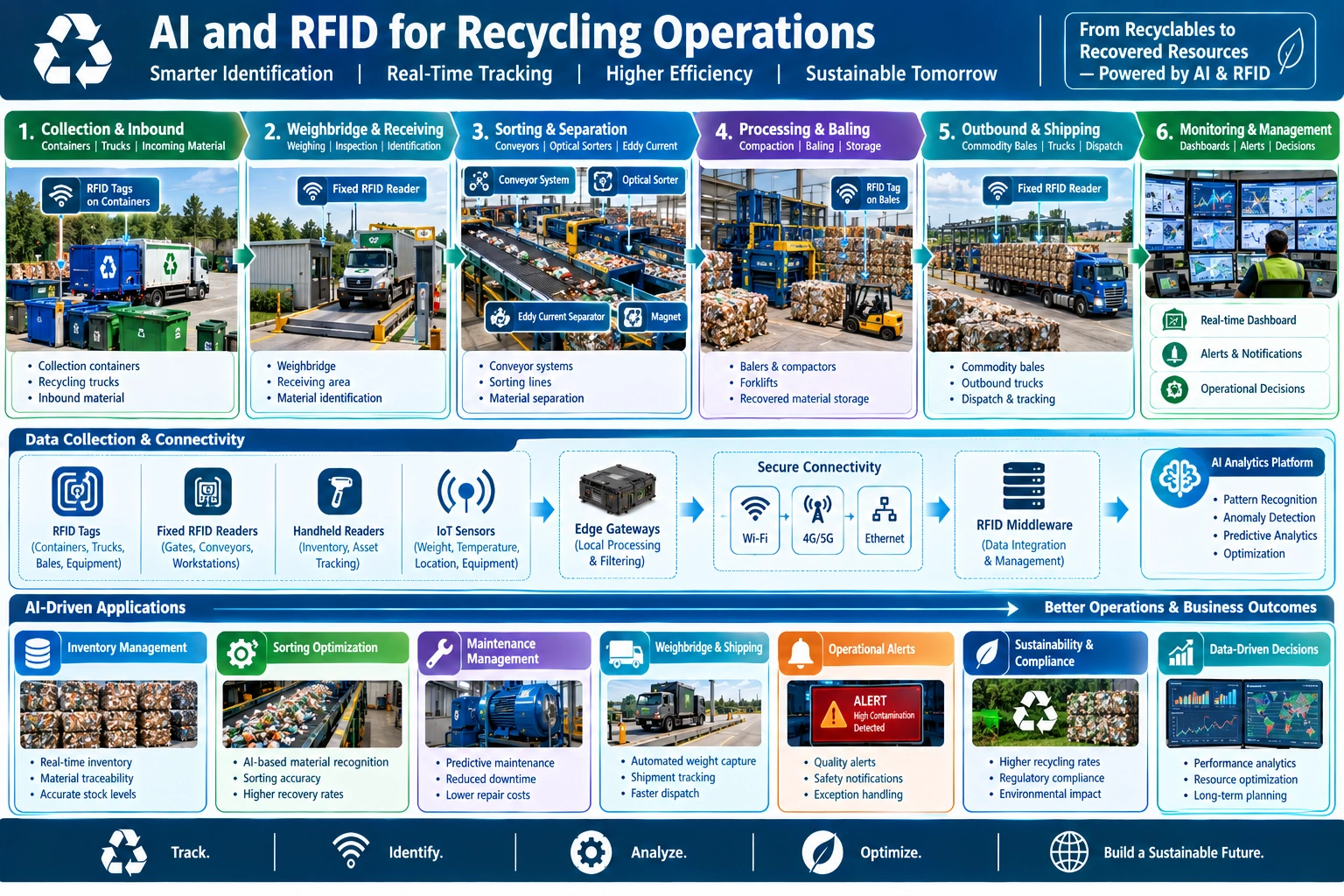
This enterprise diagram shows recycling materials and equipment moving through RFID identification, edge processing, AI analytics, and connected operational systems. It links sorting, inventory, maintenance, shipping, and management decisions through a connected data flow.
Why AI Matters for Modern Recycling Facilities
Recycling facilities operate under variable feedstock conditions. Material composition can change by collection route, supplier, season, geography, customer behavior, and processing method. A material recovery facility may simultaneously handle mixed paper, cardboard, plastics, ferrous metals, nonferrous metals, glass, organics, electronic waste, construction materials, or other recyclable streams.
The operational challenge is therefore broader than identifying individual materials. Operators need to understand what entered the facility, where it moved, how it was processed, what was recovered, what was rejected, and what ultimately shipped as a saleable commodity.
AI can analyze operational data from sorting equipment, weigh scales, RFID events, production records, quality inspections, maintenance systems, and historical material flows. Depending on the use case, machine learning, anomaly detection, forecasting, computer vision, and rules-based analytics can help identify process deviations and support faster operational decisions.
Relevant AI-enabled recycling applications include:
- AI-assisted material-flow analysis
- AI inventory management for recovered commodities
- AI contamination detection
- AI sorting optimization
- AI demand forecasting for recovered materials
- AI equipment maintenance prioritization
- AI anomaly detection for material movement
- AI route and collection analysis
- AI bale-quality monitoring
- AI-assisted production planning
- AI workload forecasting
- AI-based exception management
RFID is an enabling identification technology rather than the complete recycling solution. Its greatest value comes when physical identification events are connected to recycling workflows and analyzed alongside operational data.
Recycling Workflows Where AI and RFID Deliver the Most Value
Recycling Material Receiving and Weighbridge Operations
Receiving is the first major control point for many recycling facilities. Trucks may arrive carrying mixed recyclables, scrap metal, cardboard, plastics, electronic waste, or other recovered materials. Weighbridge transactions establish gross weight, tare weight, net weight, supplier or customer information, vehicle identification, and material classification.
RFID can associate reusable containers, roll-off containers, carts, bins, trailers, or selected material-handling units with persistent identifiers. Reader events can supplement weighbridge information by establishing where an identified container entered or exited the facility.
AI can compare RFID events with weight tickets, scheduled deliveries, historical loads, and expected material categories. Significant deviations can trigger inspection or reconciliation rather than relying entirely on manual review.
Recycling Container and Roll-Off Tracking
Recycling containers can circulate among customer locations, transfer stations, collection routes, warehouses, and processing facilities. Manual tracking can become difficult when containers are exchanged frequently.
RFID can provide an identity for reusable containers, carts, roll-off units, and specialized collection bins. Fixed readers at facility entry and exit points can capture movement events, while handheld readers can support yard audits.
AI can analyze container utilization, turnaround time, idle periods, route patterns, and abnormal movements. This can help recycling managers determine whether shortages result from excessive customer dwell time, poor yard allocation, maintenance requirements, or insufficient container inventory.
Sorting Line and Material Recovery Operations
Sorting lines may contain conveyors, trommels, screens, magnets, eddy current separators, optical sorters, air classifiers, ballistic separators, and manual quality-control stations. Material moves through several processing stages before becoming a recovered commodity or residue.
RFID is generally more useful for identifying containers, equipment, work-in-process units, and other tagged operational assets than for identifying every loose recyclable item moving rapidly through a conveyor. This distinction is important when designing a technically realistic system.
AI can use RFID-derived operational events together with conveyor measurements, equipment data, image-based classification, throughput measurements, and contamination observations. The resulting analysis can help identify process bottlenecks, unusual material flows, and quality deviations.
Recovered Commodity Inventory Management
Once recyclable material has been processed, facilities may store commodities such as baled cardboard, sorted plastics, ferrous metals, aluminum, paper grades, glass, or other recovered materials before shipment.
AI-enabled inventory management can estimate available commodity quantities by combining weighbridge transactions, production records, bale counts, RFID identifiers, storage locations, and shipment schedules.
RFID can provide persistent identification for selected bales, reusable handling units, storage containers, or other controlled inventory. Handheld readers can support periodic inventory verification, while fixed readers can monitor controlled movement points.
Bale Traceability and Shipment Verification
Baled commodities often move from processing areas into storage and then to outbound transportation. A discrepancy between the physical bale inventory and shipment documentation can create billing, customer-service, and reconciliation problems.
RFID can associate identifiers with selected bales or handling units. Shipping personnel can verify that the material assigned to an outbound order is physically present before loading.
AI can compare the expected shipment composition with observed asset movements, production records, customer requirements, and historical quality information. Exceptions can be escalated for manual verification before loading.
Recycling Equipment and Maintenance Management
Material recovery equipment operates under demanding conditions involving dust, vibration, abrasive materials, impact loads, and continuous throughput. Conveyors, compactors, balers, shredders, optical sorters, screens, motors, gearboxes, and separators require planned maintenance.
RFID can identify maintenance tools, spare parts, motors, components, and selected equipment. AI can combine those identity records with maintenance history, operating hours, fault records, vibration measurements, temperature readings, and work orders.
This creates a more complete basis for maintenance prioritization. The objective is not simply to know where a component is, but to understand its operational context and maintenance status.
RFID Recycling Facility Deployment
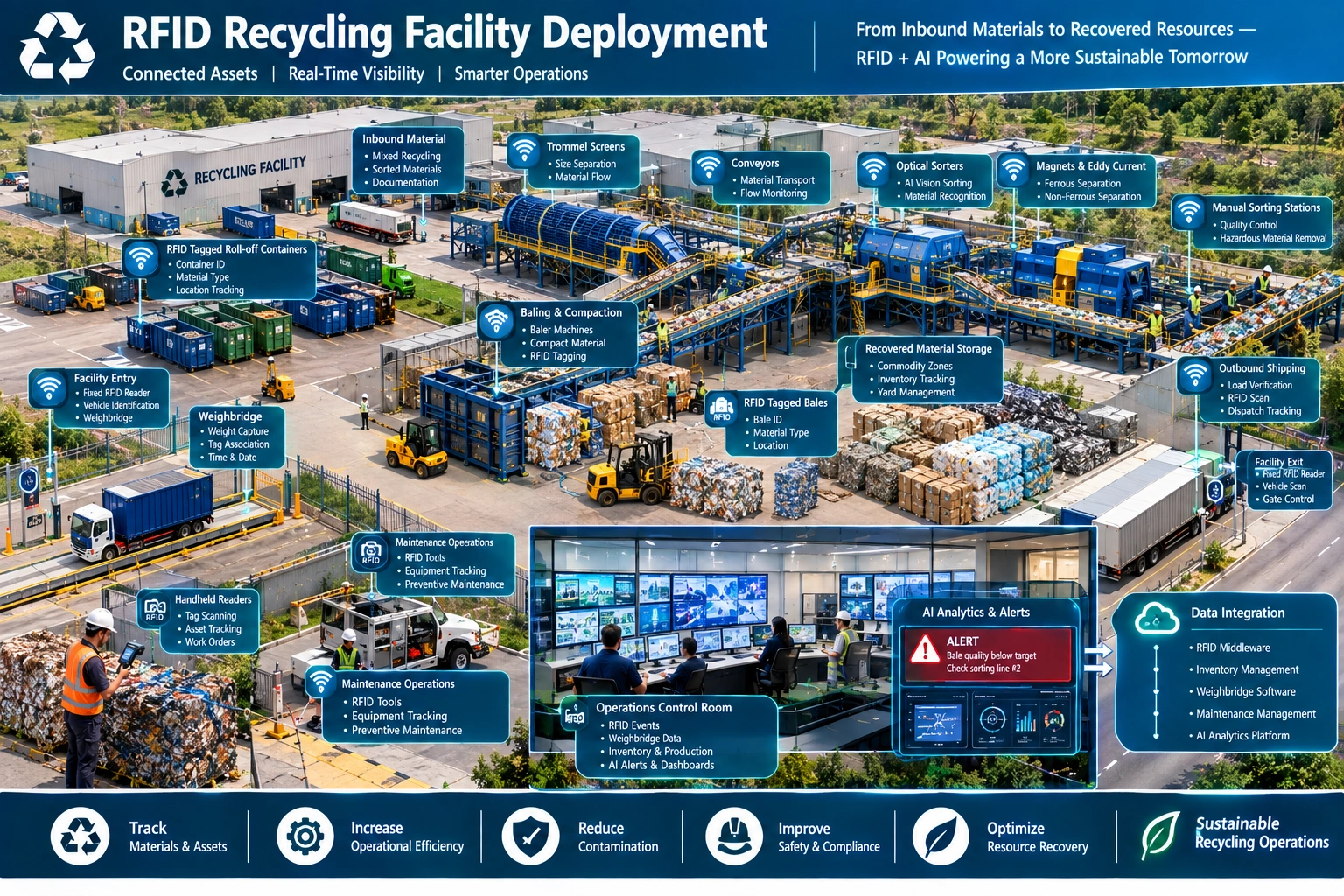
This realistic facility view shows RFID deployment across receiving, material sorting, baling, recovered-material storage, maintenance, and outbound shipping. It also highlights handheld and fixed RFID readers, the operations control room, AI alerts, and integration with weighbridge, inventory, maintenance, and production data.
Recycling Challenges Addressed by AI-Enabled Asset Tracking
Material and Inventory Discrepancies
Recovered materials can pass through receiving, sorting, processing, storage, and shipment. Each stage introduces opportunities for discrepancies between physical quantities and software records.
AI can reconcile multiple sources of information and identify unusual differences. RFID adds physical event data that can strengthen the reconciliation process.
Container Loss and Poor Utilization
Containers can remain at customer sites longer than expected, become misplaced within large yards, or be sent to the wrong facility.
RFID movement records provide additional visibility into container circulation. AI can calculate utilization patterns and identify containers whose behavior differs from expected operating cycles.
Contamination and Quality Variability
Recovered commodity quality is affected by contamination, incorrect sorting, moisture, mixed material streams, and inconsistent feedstock.
AI can help identify quality patterns using inspection records, computer vision, process data, and historical material information. RFID can associate quality observations with identified batches, containers, bales, or operational units where appropriate.
Yard Congestion
Large recycling yards can contain incoming containers, empty bins, recovered commodities, scrap, equipment, trailers, and outbound loads. Poor visibility can create unnecessary movement and loading delays.
RFID location events can supplement yard-management records. AI can analyze dwell time and movement patterns to identify congestion points and inefficient staging practices.
Equipment Downtime
Unexpected failure of a baler, conveyor, shredder, separator, or other processing equipment can reduce throughput and create downstream bottlenecks.
AI can combine maintenance history with equipment telemetry and operational records to prioritize maintenance. RFID can help verify spare parts, tools, and replacement components before maintenance work begins.
Recycling Data Flow from Material Movement to AI Decisions
A practical AI and RFID recycling solution should connect physical material-handling events with the software records already used by facility personnel. RFID data has limited operational value when it remains isolated from weighbridge, inventory, production, maintenance, and shipping information.
A typical recycling workflow can include:
- Asset identification: RFID identifiers are assigned to selected containers, bales, equipment, tools, reusable handling units, or other trackable assets.
- Data capture: Fixed RFID readers capture controlled movement events while handheld readers support yard audits, inventory verification, and maintenance activities.
- Connectivity: Ethernet, Wi-Fi, cellular, or other facility communication networks transport reader information.
- Edge processing: Local computing can filter duplicate reads, validate events, and maintain basic operation during temporary network disruptions.
- RFID middleware: Middleware converts raw reader observations into structured business events associated with known recycling assets.
- Operational integration: Data is exchanged with weighbridge software, inventory systems, fleet systems, maintenance management, warehouse systems, and shipment records.
- AI analytics: AI models analyze material flows, inventory changes, container utilization, maintenance history, production patterns, and quality information.
- Exception detection: The system identifies unusual movement, unexpected inventory changes, abnormal dwell times, or deviations from expected production.
- Decision support: Facility managers, yard supervisors, maintenance personnel, inventory teams, and shipping personnel receive prioritized information.
- Operational action: Personnel inspect material, move a container, adjust production, prepare maintenance, reconcile inventory, or validate a shipment.
- Lifecycle update: The completed action is recorded in the relevant recycling software, preserving traceability for subsequent operations.
RFID, AI Software, and Recycling Facility Infrastructure
RFID deployment should be based on the physical characteristics and movement patterns of recycling operations. UHF RFID is generally suited to longer-range identification at facility entry points, receiving areas, yards, storage zones, and controlled movement locations. HF RFID can be appropriate for shorter-range deliberate identification of selected items, while LF RFID can support specialized short-range applications where its characteristics match the operating environment.
Recycling facilities require careful consideration of metal surfaces, liquids, dense material, machinery, electromagnetic interference, dust, vibration, and outdoor exposure. Tag selection and reader placement should therefore be validated using representative containers, equipment, bales, tools, and handling units.
The broader solution can include RFID readers, antennas, tags, handheld terminals, edge gateways, RFID middleware, databases, APIs, AI software, dashboards, and enterprise integration services.
Cloud Version for Multi-Site Recycling Operations
A cloud-hosted SaaS deployment can be appropriate for recycling organizations operating multiple MRFs, transfer stations, collection facilities, warehouses, or commodity storage sites.
Centralized cloud software can aggregate RFID events, inventory information, material-flow records, and AI analytics across multiple locations. This can simplify cross-facility reporting and support comparative analysis of container utilization, material recovery, throughput, and maintenance performance.
Connectivity remains an important engineering consideration. Local edge processing should handle reader-level functions and temporary network interruptions so that a short connectivity outage does not cause the facility to lose critical identification events.
Server Version for Privately Hosted Recycling Systems
A Server Version can operate on customer-managed servers, private data centers, facility servers, regional computing infrastructure, or other privately hosted environments.
This approach can be appropriate when recycling organizations require direct control over operational data, integration interfaces, network segmentation, retention policies, or cybersecurity controls. Facilities with constrained connectivity may also benefit from local processing and storage.
A hybrid implementation can combine local RFID event processing with centralized analytics. The appropriate choice depends on facility connectivity, operational continuity requirements, cybersecurity policies, data governance, and integration needs.
AI Methods Used in Recycling Operations
AI methods should correspond to measurable recycling decisions rather than being introduced simply because the facility has collected large volumes of data.
- Anomaly detection: Identifies unusual container movements, inventory changes, equipment behavior, or processing patterns.
- Forecasting: Estimates commodity inventory, incoming material volumes, container demand, or maintenance requirements.
- Classification: Categorizes operational events, material-quality conditions, maintenance exceptions, or inventory discrepancies.
- Predictive maintenance: Uses equipment history and telemetry to help prioritize maintenance before failures affect throughput.
- Computer vision: Supports identification of material types, contamination, bale quality, and sorting conditions where cameras are appropriate.
- Generative AI: Can provide controlled access to approved work instructions, maintenance history, asset records, and operational explanations for authorized personnel.
AI should remain a decision-support mechanism unless the particular control has been engineered, validated, and approved for automated operation. Recycling equipment involving high-speed conveyors, compactors, balers, shredders, and other hazardous machinery requires established safety controls independent of AI recommendations.
Continuing directly from the AI methods section, here is Part 2 of the AI and RFID for Recycling webpage.
Recycling Facility Deployment and Integration Considerations
Successful AI and RFID deployment in recycling depends on matching identification hardware, reader coverage, software integration, and operational workflows. A technically strong installation should capture reliable events without forcing operators to change established material-handling procedures unnecessarily.
RFID Asset and Material Tag Selection
RFID tags should be selected according to the physical conditions experienced by recycling assets and materials.
UHF RFID is suitable for longer read ranges across recycling yards, receiving areas, staging zones, container movements, bale storage, and shipment verification.
HF RFID can support controlled identification points where shorter read ranges and intentional item presentation are preferred.
LF RFID can be useful for specialized identification requirements involving compatible equipment, controlled access points, or challenging operating conditions.
Rugged tags should be evaluated for exposure to moisture, dirt, abrasion, vibration, temperature variation, chemicals, and repeated handling.
Metal-mount RFID tags should be considered for compactors, balers, shredders, roll-off containers, vehicles, maintenance equipment, and other metallic assets.
Tag attachment methods should withstand washing, outdoor exposure, impacts, mechanical handling, and routine maintenance.
Tag memory and identifier structure should be defined according to the recycling organization’s asset and material traceability requirements.
Tag selection should be validated through physical testing rather than based solely on nominal read distance. Recycling facilities frequently contain metal structures, liquids, dense material loads, moving equipment, and RF-reflective surfaces that can affect RFID performance.
RFID Reader Placement and Coverage
Reader placement should follow the actual movement of recycling materials, containers, equipment, and vehicles.
Typical RFID read zones include:
- Receiving and weighbridge approaches
- Container entry and exit points
- Sorting-line transfer areas
- Bale production and staging areas
- Finished-material storage locations
- Loading docks
- Vehicle and trailer movement areas
- Maintenance shops
- Tool and spare-parts storage
- Controlled equipment access points
Fixed readers can automatically record movement through defined zones, while handheld readers provide exception handling, inventory audits, equipment searches, and maintenance verification.
A site survey should evaluate antenna orientation, expected tag presentation, interference sources, reader power, cable routing, network availability, and physical protection. Read zones should also be tested for unwanted reads from adjacent areas.
Integration with Recycling Software and Enterprise Systems
RFID event data becomes more valuable when connected with existing recycling software and enterprise systems.
Common integration targets include:
- Recycling management software
- Material recovery facility management systems
- Weighbridge and scale software
- ERP systems
- Warehouse management systems
- Transportation management systems
- Maintenance management software
- Fleet management systems
- Environmental reporting software
- Quality management systems
- Inventory databases
- Business intelligence and reporting software
An RFID event can contain the tag identifier, reader location, timestamp, direction, associated asset, material type, transaction reference, and confidence information. AI software can then combine these events with production, quality, maintenance, weight, scheduling, and historical records.
GAO supplies RFID hardware and systems that can be incorporated into broader recycling workflows, allowing organizations to build identification and tracking capabilities around their existing operational software rather than treating RFID as an isolated installation.
Security and Data Governance for AI-Enabled Recycling Tracking
AI and RFID systems create operational records describing material movement, container locations, equipment activity, employee interactions, maintenance events, and shipment transactions. Security controls should therefore be incorporated into system design from the beginning.
Important controls include:
- Role-based access for operators, supervisors, maintenance personnel, IT administrators, and management.
- Authentication for RFID readers, gateways, software services, and connected devices.
- Encryption for sensitive information transmitted between field devices and enterprise systems.
- Network segmentation for RFID and IoT equipment where operational risk requires isolation.
- Audit logging for configuration changes, user activity, data modifications, and administrative actions.
- Retention policies based on operational, contractual, regulatory, and business requirements.
- Backup and recovery procedures for RFID event data and associated databases.
- Device inventory management covering reader hardware, gateways, handheld equipment, and connected controllers.
- Firmware and software maintenance procedures.
- Access reviews for third-party integrators and support personnel.
AI models should also be governed according to their operational impact. Predictions affecting inventory reconciliation, contamination analysis, equipment maintenance, or shipment verification should be traceable to source data and model outputs.
Automated actions involving hazardous machinery should require appropriate engineering controls, interlocks, safety systems, and human oversight. AI recommendations should not replace established machine-safety requirements.
AI-Enabled Operational Improvements for Recycling
The strongest business case for AI and RFID comes from measurable improvements to physical recycling workflows.
Higher Inventory Accuracy
RFID can establish a digital identity for containers, equipment, bales, reusable assets, tools, and selected material units. AI can compare RFID movement records with inventory transactions, production records, weighbridge information, and shipment data.
This helps identify:
- Missing assets
- Duplicate records
- Unexpected movement
- Incorrect storage locations
- Unreconciled material quantities
- Shipment discrepancies
- Aging inventory
- Inventory records that require physical verification
Faster Receiving and Shipping Verification
Receiving and shipping operations can use RFID events to verify that expected assets or material units pass through designated areas.
AI can compare planned transactions against actual movements and identify exceptions such as:
- Unexpected container arrivals
- Missing expected containers
- Incorrect bale movements
- Shipment quantity discrepancies
- Material staged in the wrong area
- Repeated handling events
- Delayed outbound movements
This reduces dependence on manual searches and repetitive transaction checking.
Better Recycling Container Utilization
Container fleets often include roll-off containers, carts, bins, compactors, reusable totes, and other transport assets. RFID provides identity and movement information, while AI can analyze utilization patterns.
Useful calculations include:
- Average container turnaround time
- Idle time
- Dwell time at customer locations
- Time between collection and processing
- Utilization by route or service area
- Excess container deployment
- Container shortage frequency
- Maintenance-related availability
These measurements support better deployment and replacement decisions.
Improved Contamination and Material Quality Analysis
AI can combine material quality observations with RFID-linked batch, container, location, supplier, route, or processing information.
Computer vision can assist with identifying visible contamination or material classification issues, while machine learning can identify relationships between quality outcomes and operating conditions.
RFID provides the traceability layer that can associate those observations with specific material flows or handling events.
Better Equipment Maintenance Planning
Recycling equipment such as conveyors, balers, compactors, shredders, sorting equipment, screens, optical sorters, and material handling equipment can be linked to RFID identities and maintenance records.
AI can evaluate:
- Maintenance history
- Runtime
- Failure frequency
- Inspection results
- Replacement-part consumption
- Work-order history
- Operating conditions
- Downtime patterns
RFID can also identify tools, spare parts, service kits, and equipment components, improving maintenance inventory control.
Improved Material Traceability
Traceability is especially valuable when recycling organizations must establish where material originated, how it was processed, where it was stored, and when it was shipped.
An integrated system can associate:
Source → Container → Receiving → Weighing → Sorting → Processing → Bale → Storage → Shipment
AI can analyze this chain for anomalies, delays, quality patterns, and reconciliation issues.
Recycling KPIs for AI and RFID Programs
Performance measurement should begin before deployment so organizations can establish a baseline and quantify improvement.
| KPI | Operational Purpose |
|---|---|
| Physical-to-digital inventory accuracy | Measures alignment between actual and recorded assets/material |
| RFID read success rate | Measures identification reliability |
| Container turnaround time | Measures container fleet efficiency |
| Asset search time | Measures time required to locate tracked assets |
| Material reconciliation rate | Measures agreement between physical and digital records |
| Contamination rate | Measures material quality |
| Bale verification cycle time | Measures shipment and inventory verification speed |
| Unplanned equipment downtime | Measures reliability impact |
| Maintenance response time | Measures maintenance execution efficiency |
| Commodity inventory accuracy | Measures recovered-material inventory control |
| Shipment exception rate | Measures outbound transaction accuracy |
| Asset utilization | Measures use of containers and equipment |
| Material dwell time | Measures time between processing stages |
| Inventory aging | Identifies material held beyond target periods |
| Manual transaction rate | Measures dependence on manual data entry |
A useful implementation should connect each KPI to a specific workflow and source dataset. AI should not be introduced simply to create additional dashboards. The objective is to improve decisions that affect throughput, inventory, quality, equipment availability, labor productivity, and compliance.
Standards, Regulations, and Engineering Governance
Recycling operations can involve environmental requirements, worker safety rules, transportation requirements, electrical standards, data governance, and material-specific regulations. The applicable requirements depend on the recycling process, material categories, jurisdiction, facility configuration, and customer contracts.
Organizations should evaluate relevant requirements such as:
- FCC Part 15 requirements for applicable RFID radio equipment operating in the United States.
- ISED Canada requirements for applicable radio equipment deployed in Canada.
- OSHA requirements relevant to worker safety, industrial machinery, material handling, and facility operations in the United States.
- EPA and RCRA requirements where applicable to regulated waste streams and hazardous materials.
- Applicable state, provincial, and municipal environmental requirements.
- ISO/IEC RFID standards relevant to the selected RFID technology and identification method.
- GS1 identification standards where standardized product, asset, or supply-chain identifiers are appropriate.
- ISO 9001 for quality management where adopted by the organization.
- ISO 14001 for environmental management where adopted.
- ISO 45001 for occupational health and safety management where adopted.
- Applicable NFPA requirements for electrical, fire, and facility safety.
Compliance should be confirmed by qualified engineering, environmental, legal, and safety personnel for the specific deployment. No single RFID or AI configuration should be assumed to satisfy every recycling operation.
Practical Implementation Roadmap for Recycling
A phased deployment reduces technical risk and provides measurable evidence before expansion.
Assess the Current Recycling Workflow
Document how containers, materials, equipment, bales, tools, and spare parts currently move through the facility.
Capture:
- Manual identification points
- Existing barcode or RFID use
- Inventory reconciliation procedures
- Weighbridge transactions
- Material transfer points
- Equipment maintenance workflows
- Shipping verification
- Existing software integrations
- Network availability
- Current KPIs and baseline performance
Define the Recycling Asset Identity Model
Determine which physical objects require persistent digital identity.
Potential candidates include:
- Roll-off containers
- Recycling bins
- Carts and totes
- Balers
- Compactors
- Shredders
- Conveyors
- Mobile equipment
- Vehicles
- Trailers
- Tools
- Spare parts
- Bales
- Recovered commodities
- Reusable transport assets
Each identity should have an ownership model, identifier format, lifecycle status, location model, and associated operational records.
Conduct an RFID Site Survey
Evaluate RF performance at actual operating locations.
Testing should cover:
- Tag mounting positions
- Reader antenna placement
- Read-zone boundaries
- Material density
- Metal structures
- Liquid exposure
- Vehicle movement
- Interference
- Network connectivity
- Power availability
- Outdoor environmental conditions
Pilot testing should use representative recycling containers, equipment, material loads, and operational conditions.
Build the Integration Layer
Connect RFID events with recycling software, weighbridge records, inventory systems, maintenance software, fleet systems, and relevant enterprise applications.
Data mapping should define:
RFID Event → Asset Identity → Location → Transaction → Business Record → AI Analysis → Operational Action
Pilot a High-Value Workflow
A practical pilot may focus on one measurable problem such as container tracking, bale traceability, maintenance-part control, or shipment verification.
The pilot should have defined success criteria before deployment.
Validate AI Outputs
AI models should be evaluated against known operational outcomes.
Validation should consider:
- False positives
- False negatives
- Missing RFID events
- Data quality
- Model drift
- Exception handling
- Human review
- Explainability requirements
- Operational consequences
Commission and Optimize
After initial deployment, optimize reader placement, tag positioning, event filtering, integration logic, dashboards, alerts, and AI thresholds.
Field commissioning should verify performance during normal recycling activity rather than only during controlled demonstrations.
Scale by Operational Priority
Expansion should follow measured value.
A recycling organization may progress from:
Container Tracking → Material Traceability → Inventory Control → Equipment Tracking → Maintenance → Quality Analytics → Multi-Site Optimization
GAO can support organizations across the hardware and system lifecycle, from RFID product selection and field deployment through system integration and operational support.
Key Takeaways for AI and RFID in Recycling
AI and RFID provide complementary capabilities for recycling organizations. RFID establishes reliable physical identity and movement events, while AI analyzes those events with production, quality, maintenance, inventory, transportation, and environmental data.
The most practical applications include:
- Recycling container tracking
- Material receiving and reconciliation
- Bale traceability
- Recovered commodity inventory
- Sorting and quality analysis
- Equipment tracking
- Maintenance management
- Spare-parts control
- Shipment verification
- Yard visibility
- Asset utilization
- Exception detection
- Predictive maintenance
Successful deployments start with measurable operational problems rather than technology selection alone. RFID hardware should be tested under actual recycling conditions, AI models should be validated against operational outcomes, and system integrations should preserve data consistency across the facility.
GAO has supplied hardware products and systems for organizations requiring RFID, BLE, IoT, and related identification capabilities. Our engineering-oriented approach emphasizes practical deployment, system integration, quality assurance, and ongoing technical support.
GAO Group serves customers across the United States and Canada, including Fortune 500 companies, leading R&D organizations, prestigious universities, and government agencies. Its companies are headquartered in New York City and Toronto, Canada, with substantial investment in R&D, quality assurance, and remote or onsite expert support. GAO RFID Inc. is also ranked among the top 10 leading B2B and B2G BLE and RFID suppliers globally.
Building the Future of Industrial AI and IoT with Aperture Venture Studio and GAO RFID Inc.
For more than three decades, GAO Group has invested heavily in R&D across RFID, BLE, IoT, and related industrial technologies. Our work has expanded to AI-enabled solutions addressing practical operational challenges, including material tracking, asset visibility, maintenance, and process analytics in recycling. Aperture Venture Studio supports the development and scaling of industrial AI and IoT solutions relevant to these challenges and brings together technical experts, operational leaders, investors, and industry participants. Through initiatives such as the Aperture Ventures Summit and TekSummit, advanced AI and IoT applications are explored for practical industrial use. We welcome Advisors, technical contributors, Employees, Investors, and Customers.