
AI and RFID for Genomics Laboratories
AI Applications for Genomics Laboratories with RFID-Enabled Tracking
Genomics laboratories manage workflows in which specimen identity, sample integrity, chain of custody, processing conditions, and data accuracy directly affect sequencing and analysis outcomes. AI can improve these operations by detecting anomalies, predicting workflow bottlenecks, optimizing sample handling, and correlating laboratory events with genomic data. RFID provides an important physical data-capture layer by identifying specimens, racks, tubes, containers, equipment, and other laboratory assets as they move through receiving, accessioning, extraction, library preparation, sequencing, storage, and disposal. AI and RFID therefore address complementary parts of the genomics laboratory workflow: RFID captures reliable identity and location events, while AI interprets those events alongside laboratory information and instrument data. GAO supplies RFID, BLE, and IoT hardware products and systems that can support these data-capture requirements in genomics laboratory environments.
AI and RFID Genomics Laboratory Workflow: Sample Tracking and AI Analytics
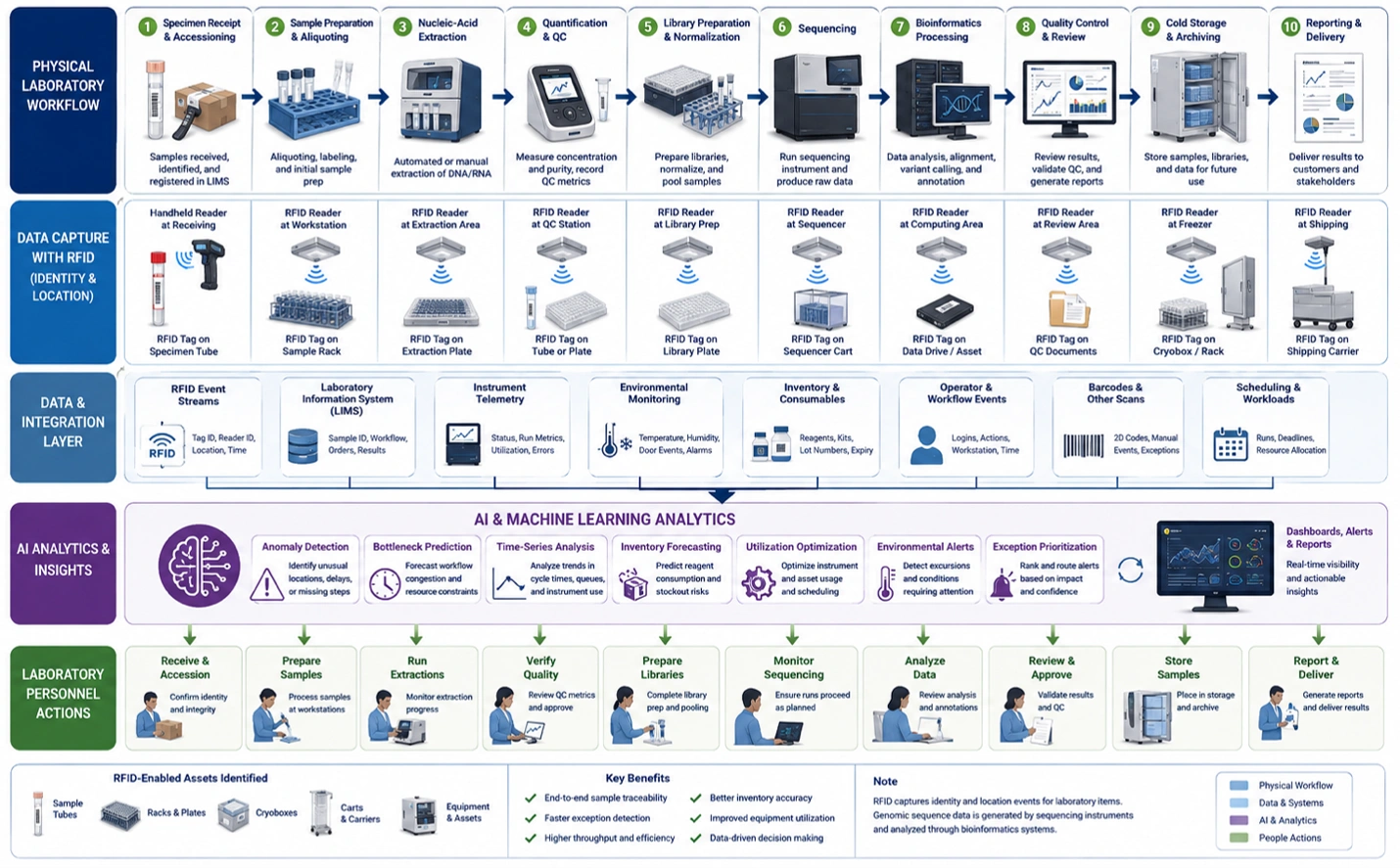
AI and RFID Genomics Laboratory Workflow This infographic illustrates a genomics laboratory workflow from specimen receipt and accessioning through sequencing, bioinformatics, quality control, storage, and reporting. It shows how RFID captures sample and asset identity and location events while AI analyzes RFID data, LIMS records, instrument telemetry, environmental conditions, and workflow timestamps to identify anomalies, predict bottlenecks, and support laboratory decisions.
Alt Text:
Genomics laboratory workflow showing RFID sample tracking, LIMS data, AI analytics, sequencing, storage, and reporting
What AI-Enabled RFID Tracking Means for Genomics Laboratories
AI-enabled genomics laboratory tracking combines machine-learning and analytics methods with automated identification and event capture. The objective is not simply to locate a tube. A useful system establishes a reliable relationship between specimen identity, physical location, processing step, operator action, instrument, time, environmental condition, and laboratory record.
RFID can capture these physical events without requiring every container to be manually scanned. UHF RFID is particularly useful for longer-range identification of racks, bins, carts, storage containers, and selected tagged assets. HF RFID can be appropriate for controlled close-range identification applications, while LF RFID can support specialized identification requirements where its propagation characteristics are advantageous.
AI then uses the resulting event history to identify unusual dwell times, unexpected movement, missing process steps, inventory discrepancies, storage anomalies, or workflow congestion. This distinction is important for genomics laboratories because AI should not be treated as a replacement for validated laboratory controls. Instead, it can provide an additional analytical layer that helps laboratory personnel recognize conditions requiring investigation.
The most valuable deployments connect RFID events with existing laboratory software rather than creating another isolated source of information. Relevant systems can include a Laboratory Information Management System (LIMS), Electronic Laboratory Notebook (ELN), sample management software, inventory management software, sequencing systems, instrument middleware, quality management software, and data repositories.
Where AI and RFID Deliver Value in Genomics Laboratory Operations
Genomics laboratories contain numerous physical and digital handoffs. A specimen may move through accessioning, aliquoting, extraction, quantification, normalization, library preparation, sequencing, quality control, analysis, and long-term storage. Each handoff creates an opportunity for delay, misidentification, incomplete documentation, or loss of physical traceability.
AI-supported RFID tracking can address several high-value workflows
Sample Accessioning and Chain of Custody
RFID can associate incoming specimen containers or laboratory carriers with unique identifiers and capture movement through receiving and accessioning areas. AI can analyze timestamps and movement patterns to identify abnormal delays or unexpected routing.
A practical implementation should maintain a deterministic relationship between the RFID identifier and the laboratory’s authoritative specimen identifier. The RFID tag should not become an uncontrolled replacement for the LIMS record. Instead, the RFID event should become another validated data point associated with the specimen or container.
Sample Preparation and Laboratory Workflow Monitoring
Sample preparation frequently involves repeated movement among workstations, instruments, refrigerators, freezers, centrifuges, liquid-handling equipment, and staging locations. RFID readers positioned at controlled transition points can capture movement automatically.
AI can use these events to identify:
- Unusually long dwell times between processing stages
- Containers entering an unexpected workstation
- Missing or incomplete workflow transitions
- Repeated movement between locations
- Accumulating work-in-process samples
- Deviations from expected processing sequences
These insights can help laboratory supervisors prioritize investigation before a bottleneck affects downstream sequencing capacity.
Cryogenic and Cold-Storage Inventory
Genomics laboratories can maintain substantial inventories of specimens, extracted DNA or RNA, libraries, controls, reagents, and reference materials. RFID can help identify racks, boxes, bins, and selected containers while minimizing repetitive manual searches.
AI can analyze historical movement and inventory events to identify frequently accessed locations, unusual inventory changes, potential reconciliation problems, and storage utilization trends.
For cryogenic environments, tag selection and reader design require particular engineering attention. Materials, condensation, freezer construction, tag placement, reader antenna positioning, and read performance can affect reliability. Laboratory validation should therefore be performed under actual storage and handling conditions rather than assuming laboratory-room RFID performance will translate directly to cryogenic storage.
Instrument and Equipment Utilization
Sequencers, liquid handlers, thermal cyclers, centrifuges, automated extraction systems, freezers, biosafety equipment, and other laboratory assets represent significant operational investments.
RFID or BLE identification can establish equipment-location and movement information, while instrument interfaces can provide operational telemetry. AI can combine these data sources to estimate utilization, detect unusual idle periods, identify workflow dependencies, and support maintenance planning.
GAO’s RFID, BLE, and IoT hardware capabilities can provide the physical identification layer needed to connect laboratory assets with software-based monitoring and analytics.
Reagent and Consumable Management
Genomics workflows depend on reagents, library-preparation materials, extraction consumables, sequencing consumables, controls, and other laboratory supplies. RFID can support automated identification and movement tracking for tagged inventory.
AI can use consumption history, processing schedules, inventory levels, and expiration information to forecast replenishment requirements. This can be particularly valuable where shortages of a single reagent or consumable can interrupt an otherwise available sequencing workflow.
The engineering objective should be traceability and decision support, not uncontrolled automatic purchasing. Inventory recommendations should remain subject to laboratory quality procedures and authorized procurement workflows.
AI-Driven Genomics Laboratory Workflow
A technically sound AI and RFID solution typically follows a data path from physical identification through validated laboratory action.
Data Acquisition
RFID readers capture tag identifiers and associated read events. Depending on the deployment, additional inputs may include:
- LIMS and sample-management records
- Sequencer status and run information
- Instrument telemetry
- Freezer temperature and environmental sensors
- Equipment utilization data
- Barcode and 2D-code scans
- Operator and workstation events
- Inventory transactions
- Quality-control measurements
- Laboratory scheduling information
RFID should be used where automated physical identification provides an operational advantage. Barcode and 2D-code identification remain useful where direct visual confirmation or high-density sample-level identification is required.
Communication and Edge Processing
Reader data generally passes through a local network to an edge gateway, server, or middleware service. Ethernet is often suitable for fixed readers, while Wi-Fi can support appropriately engineered mobile or distributed equipment. BLE can supplement RFID where mobile asset or personnel-location information is required.
Edge processing can filter duplicate RFID reads, normalize reader events, associate reads with reader zones, and suppress noisy or transient observations before forwarding meaningful events to downstream software.
This is particularly important in genomics laboratories because an RFID reader may observe the same tag multiple times while a rack remains within its read zone. A raw stream of reads is not equivalent to a sequence of laboratory workflow events. Middleware therefore needs event filtering, temporal logic, location rules, and identity resolution.
LIMS and Laboratory Software Integration
The normalized event stream can be integrated with laboratory software through APIs, databases, message brokers, or other supported interfaces. A common integration model is:
RFID reader → edge gateway → RFID middleware → event processing → LIMS/sample system → AI analytics → laboratory action
The exact implementation depends on the laboratory’s existing systems and validation requirements.
AI models should consume contextualized events rather than isolated tag reads. For example, a model detecting a workflow anomaly becomes substantially more useful when it knows the expected processing stage, sample type, instrument assignment, operator workflow, and elapsed time.
AI Analytics and Decision Support
AI methods applicable to genomics laboratory operations can include anomaly detection, time-series analysis, classification, forecasting, clustering, optimization, and natural-language interfaces for operational information.
Examples include:
- Predicting sample-processing delays
- Detecting abnormal sample movement
- Forecasting instrument workload
- Predicting reagent consumption
- Identifying inventory discrepancies
- Detecting unusual equipment utilization
- Ranking operational bottlenecks
- Predicting storage capacity requirements
- Correlating environmental events with workflow interruptions
- Supporting laboratory operations dashboards and alerts
AI outputs should remain explainable enough for laboratory personnel to understand why an event has been flagged. For regulated or quality-sensitive processes, model outputs should be treated as decision support unless the particular AI application has been appropriately validated for a more consequential role.
Core RFID Technologies for Genomics Laboratories
The choice between UHF, HF, and LF RFID should follow the physical environment, read distance, tag geometry, material composition, required throughput, and identification workflow.
| RFID technology | Genomics laboratory relevance | Typical consideration |
|---|---|---|
| UHF RFID | Racks, bins, carts, storage containers, asset tracking, transition points | Longer read range and rapid multi-tag identification, but RF performance can be affected by liquids and metal |
| HF RFID | Controlled close-range identification and selected laboratory identification workflows | Shorter read range with useful near-field characteristics |
| LF RFID | Specialized identification applications | Short range and lower data rates, useful where LF characteristics fit the physical environment |
Genomics laboratories should avoid selecting RFID technology solely by nominal read range. Real-world performance depends on tag construction, antenna orientation, liquid content, metal surfaces, freezer construction, reader placement, RF interference, and the physical density of tagged objects.
UHF, HF, and LF RFID Selection for Genomics Laboratories
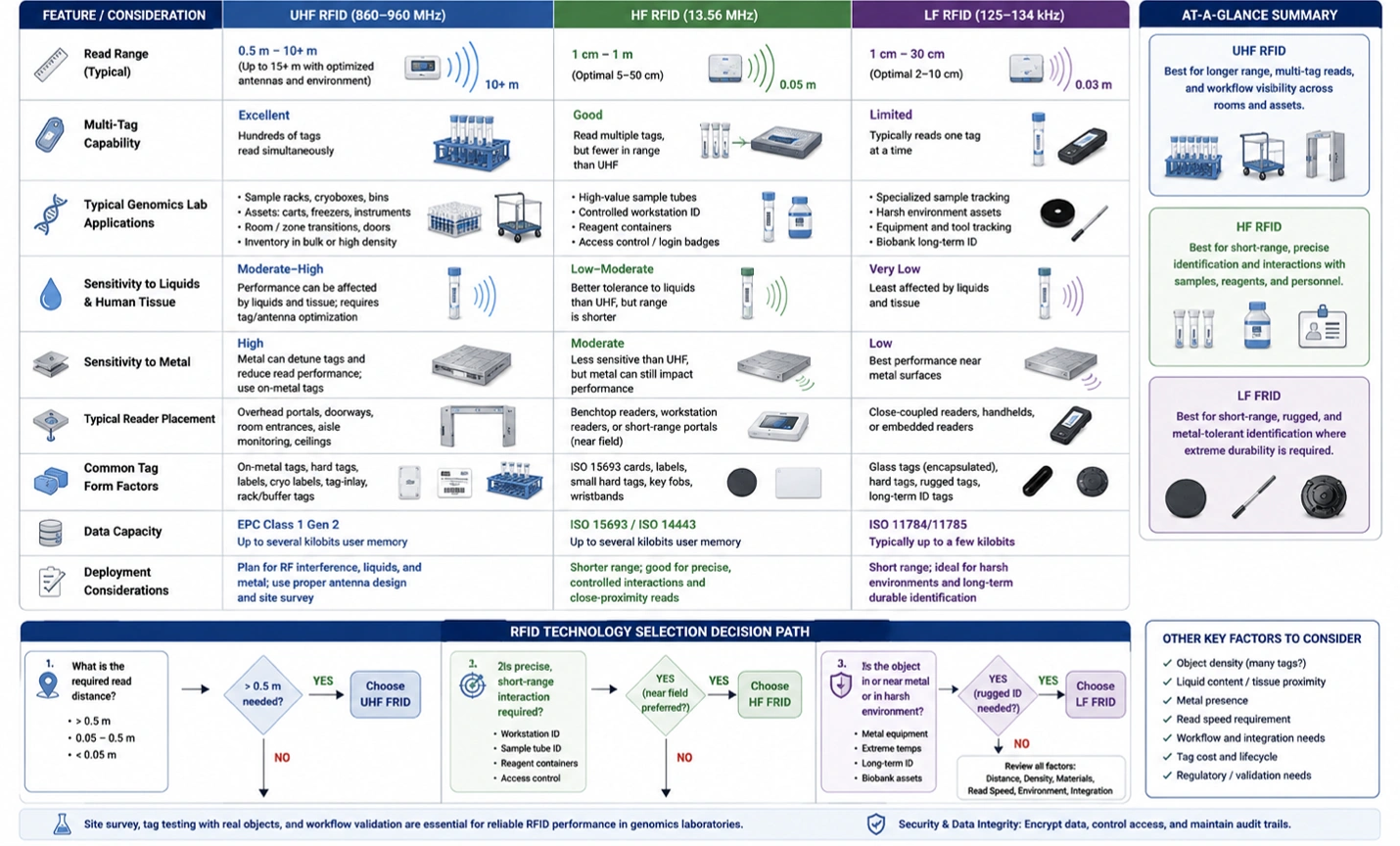
RFID Selection Guide for Genomics LabsThis infographic compares UHF, HF, and LF RFID across read range, multi-tag capability, liquid and metal sensitivity, reader placement, tag formats, data capacity, and genomics laboratory applications. A decision path helps laboratory engineers select the appropriate RFID technology based on read distance, object density, material characteristics, workflow requirements, and environmental conditions.
Alt Text:
UHF, HF, and LF RFID comparison for genomics laboratory sample, rack, equipment, and inventory tracking
Hardware and Software Components for AI-Enabled Genomics Tracking
A production deployment normally requires several coordinated components rather than an RFID reader alone.
RFID Tags and Identification Media
Tag selection should consider the target object, operating environment, required read distance, attachment method, sterilization or chemical exposure where relevant, temperature range, and whether the tagged object contains liquids or is mounted near metal.
For genomics laboratories, useful tag targets can include:
- Sample racks
- Cryoboxes
- Laboratory carts
- Storage bins
- Reagent containers
- Equipment
- Freezer shelves or locations
- Transport carriers
- Consumable inventory
- Selected sample containers where tag size and RF performance permit
RFID Readers and Antennas
Fixed readers can monitor controlled transitions such as storage-room entrances, laboratory work areas, staging zones, or equipment interfaces. Handheld readers can support inventory reconciliation and exception investigation.
Antenna placement is a major engineering consideration. Reader zones should be designed so that a tag is associated with the intended physical location rather than adjacent work areas. Excessive read coverage can create ambiguous location events, while insufficient coverage creates missed transitions.
RFID Middleware and Event Processing
Middleware converts low-level reader observations into meaningful events. Functions can include tag filtering, duplicate suppression, reader health monitoring, zone association, event timestamping, identity mapping, and integration with laboratory software.
A robust middleware layer should also preserve sufficient raw-event information for troubleshooting while presenting clean business events to downstream systems.
Edge Servers and Private Servers
A server-based deployment can run RFID middleware, integration services, databases, dashboards, and AI inference software on customer-managed infrastructure. This may be appropriate when the genomics laboratory requires greater control over data locality, network segmentation, system integration, or internal security policies.
A private server deployment does not necessarily mean a traditional local server room. The software can also operate within a privately hosted data center or customer-controlled cloud environment.
Cloud Version
A cloud-hosted software deployment can provide centralized analytics, fleet-level reporting, model management, remote monitoring, and cross-site visibility. Cloud processing is particularly useful when a genomics organization operates multiple laboratory locations and wants consolidated operational analytics.
A practical design often retains local edge processing for reader-event normalization and network resilience while forwarding validated events to cloud services for broader analytics.
AI Models and Analytics Software
AI processing can run at the edge, on private servers, or in cloud infrastructure depending on latency, data sensitivity, computational requirements, and connectivity.
Real-time alerts may benefit from edge or local-server inference. Historical forecasting and multi-site analysis may be better suited to centralized computing.
The AI layer should include appropriate data governance, model versioning, access controls, audit logging, monitoring, and procedures for investigating false positives and false negatives.
Security and Network Controls
Genomics laboratory RFID systems should be incorporated into the laboratory’s broader cybersecurity design. Relevant controls can include network segmentation, encrypted communications, authenticated APIs, role-based access control, device credential management, secure configuration, patch management, audit logging, and controlled administrative access.
RFID identifiers should not automatically be treated as sensitive genomic information. However, once an RFID identifier is associated with a specimen record, patient-related information, research subject information, or other controlled laboratory data, the combined dataset may require substantially stronger access and privacy controls.
GAO’s role can include supplying the RFID, BLE, and IoT hardware and systems that form the physical data-capture layer, while the laboratory’s IT and quality organizations define the applicable cybersecurity, validation, privacy, and data-governance requirements.
AI and RFID Reference Architecture for Genomics Laboratories
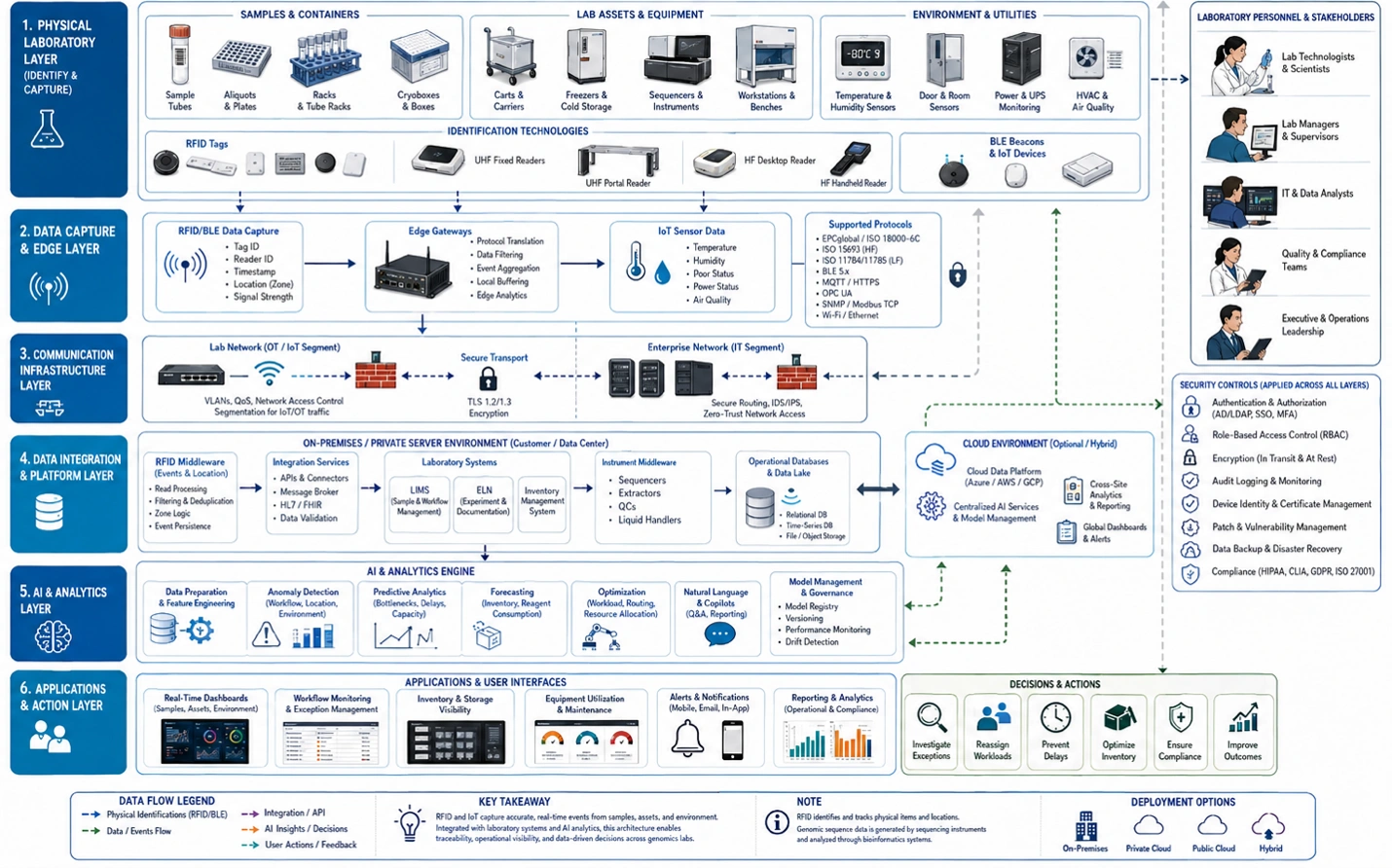
AI and RFID Genomics Lab ArchitectureThis reference architecture maps the complete data flow from genomics laboratory samples, equipment, RFID/BLE identification, and environmental sensors through edge processing, secure networks, LIMS integration, AI analytics, and operational applications. It also illustrates cloud, private-server, and hybrid deployment options, cybersecurity controls, laboratory stakeholders, and AI-supported decisions for traceability, workflow optimization, inventory management, and compliance.
Alt Text:
Genomics lab architecture linking RFID, sensors, LIMS, AI analytics, cloud and servers to operational decisions
Technical and Business Benefits of AI-Enabled Genomics Laboratory Tracking
Combining AI with RFID-based identification can improve genomics laboratory operations by connecting physical laboratory events with digital workflow information. The value comes from reducing the gap between what laboratory software says should be happening and what is actually happening to physical specimens, racks, equipment, and inventory.
Improved Sample Traceability
RFID can automatically record physical movement at defined laboratory locations, providing additional evidence of where a tagged sample carrier or container has been and when it passed a controlled point.
AI can analyze these events against expected workflow sequences. If a rack is expected to move from extraction to quantification but remains in a staging area beyond an established threshold, the system can flag the exception for investigation.
This approach can strengthen traceability without requiring laboratory personnel to manually document every routine movement.
Faster Exception Detection
Manual review is poorly suited to high-volume event streams. AI can continuously evaluate RFID events, LIMS records, equipment status, and environmental measurements.
Examples of exceptions include:
- Unexpected movement of a sample rack
- A sample carrier appearing in an incorrect processing zone
- Extended dwell time at a workstation
- Inventory records that do not correspond with physical observations
- Unexpected freezer or storage activity
- Equipment remaining idle while downstream work accumulates
- Repeated workflow reversals
- Missing transitions in a predefined laboratory process
The objective is to surface operational exceptions early enough for laboratory personnel to investigate them.
Higher Laboratory Throughput
AI can identify process bottlenecks by analyzing queue lengths, processing times, workstation utilization, instrument availability, and sample movement.
For example, a genomics laboratory may discover that sequencing capacity is not the actual constraint. Library preparation, extraction, normalization, quality-control review, or sample staging may be creating the effective bottleneck.
RFID provides physical movement information that can make these relationships more visible.
Better Inventory Visibility
RFID-supported inventory tracking can reduce the labor required to locate racks, boxes, equipment, and selected consumables. AI forecasting can then use historical consumption and workflow schedules to identify potential shortages.
The resulting system can support inventory reconciliation, replenishment planning, storage optimization, and investigation of discrepancies.
More Effective Equipment Utilization
Combining RFID or BLE asset identification with instrument telemetry can provide a broader view of equipment utilization.
Laboratory managers can evaluate:
- Instrument utilization rates
- Idle time
- Queue time
- Equipment availability
- Maintenance-related downtime
- Workflow dependency on individual instruments
- Utilization differences among laboratory locations
AI can identify patterns that are difficult to detect through periodic manual reports.
Improved Operational Security
Physical identification events can also contribute to security monitoring. Unexpected movement of laboratory equipment, controlled storage containers, or specimen carriers can generate alerts for authorized personnel.
Security controls should be designed carefully. An RFID event should be treated as an input to an investigation or access-control process rather than automatically interpreted as proof of unauthorized activity.
Genomics Laboratory AI Use Cases and Expected Outcomes
| Genomics laboratory use case | RFID or IoT input | AI capability | Operational outcome |
|---|---|---|---|
| Sample movement monitoring | Rack and container reads | Sequence anomaly detection | Earlier identification of unexpected movement |
| Accessioning | Receiving-area RFID events | Workflow timing analysis | Reduced accessioning delays |
| Cryostorage inventory | Box, rack, and location identification | Inventory analytics | Faster inventory reconciliation |
| Library preparation | Workstation and rack events | Bottleneck prediction | Better workload balancing |
| Sequencing operations | Instrument and sample events | Capacity forecasting | Improved run planning |
| Reagent management | Tagged inventory events | Consumption forecasting | Earlier replenishment decisions |
| Equipment utilization | RFID/BLE plus telemetry | Utilization modeling | Better equipment allocation |
| Environmental monitoring | Temperature and IoT sensors | Anomaly detection | Earlier investigation of storage excursions |
| Laboratory logistics | Carts, carriers, and room events | Route and dwell analysis | Reduced unnecessary movement |
| Quality investigation | Historical event records | Correlation and anomaly analysis | Faster root-cause investigation |
The strongest use cases normally begin with a clearly defined operational problem. Installing RFID first and searching for a use case later can produce excessive data without producing useful laboratory decisions.
Deployment Lifecycle for AI and RFID in Genomics Laboratories
A successful deployment should be treated as a controlled engineering and laboratory-operations project rather than a simple RFID installation.
Requirements and Workflow Assessment
The first stage is to document the physical and digital workflow.
Important questions include:
- Which specimens, racks, boxes, assets, or consumables require automated identification?
- Which workflow transitions need automatic event capture?
- Which locations require precise identification?
- Which existing barcode processes should remain?
- Which LIMS or laboratory systems contain the authoritative identity record?
- Which AI decisions would produce measurable operational value?
- Which processes require formal validation or quality approval?
- Which data may be transferred to cloud infrastructure?
A workflow map should identify the expected state transitions for each relevant laboratory process.
RFID Site Survey and Hardware Selection
The physical survey should evaluate room dimensions, doors, benches, freezers, metal surfaces, liquids, equipment placement, network availability, reader mounting positions, and likely sources of RF interference.
Tag selection should be tested using representative objects. A tag that performs well on an empty plastic container may behave differently when attached to a cryobox, metal equipment housing, liquid-filled vessel, or densely packed rack.
GAO can support this stage with RFID and IoT hardware selection based on the intended identification environment.
Pilot Deployment
A pilot should normally cover a bounded workflow rather than the entire laboratory.
Useful pilot candidates include a sample-storage area, accessioning process, rack movement between defined workstations, or equipment inventory.
Pilot testing should establish measurable baseline and post-deployment values.
Commissioning and Validation
Commissioning should test:
- RFID read performance
- Missed-read rates
- False reads
- Read-zone boundaries
- Tag orientation sensitivity
- Reader connectivity
- Event timestamp accuracy
- Middleware filtering
- LIMS integration
- Duplicate-event handling
- Network failure behavior
- Local data buffering
- Alert generation
- User permissions
- Audit logging
Laboratory validation requirements should be determined by the intended use and applicable quality system. RFID-generated information should not be assumed to constitute a validated laboratory result simply because the hardware is functioning correctly.
AI Model Validation
AI requires a separate validation approach from RFID hardware.
Historical laboratory data can be used to evaluate anomaly-detection or forecasting models. Testing should account for false positives, false negatives, data drift, changing workflows, seasonal demand, and changes in instrument utilization.
A model that generates too many alerts can quickly become operationally ineffective. Thresholds should therefore be evaluated against actual laboratory workload and the capacity of staff to investigate exceptions.
Production Operation and Optimization
After deployment, system performance should be continuously monitored.
Reader health, tag performance, middleware processing, integration errors, network availability, AI model performance, and user feedback should all contribute to ongoing optimization.
Changes to laboratory layouts or workflows should trigger an assessment of whether RFID read zones, integration logic, or AI models require adjustment.
Scaling Across Genomics Laboratory Locations
Multi-site deployment introduces additional considerations such as standardized tag identifiers, location naming conventions, reader configuration, software version control, network policies, and data governance.
A common data model is particularly valuable when different laboratories use different instruments or LIMS configurations.
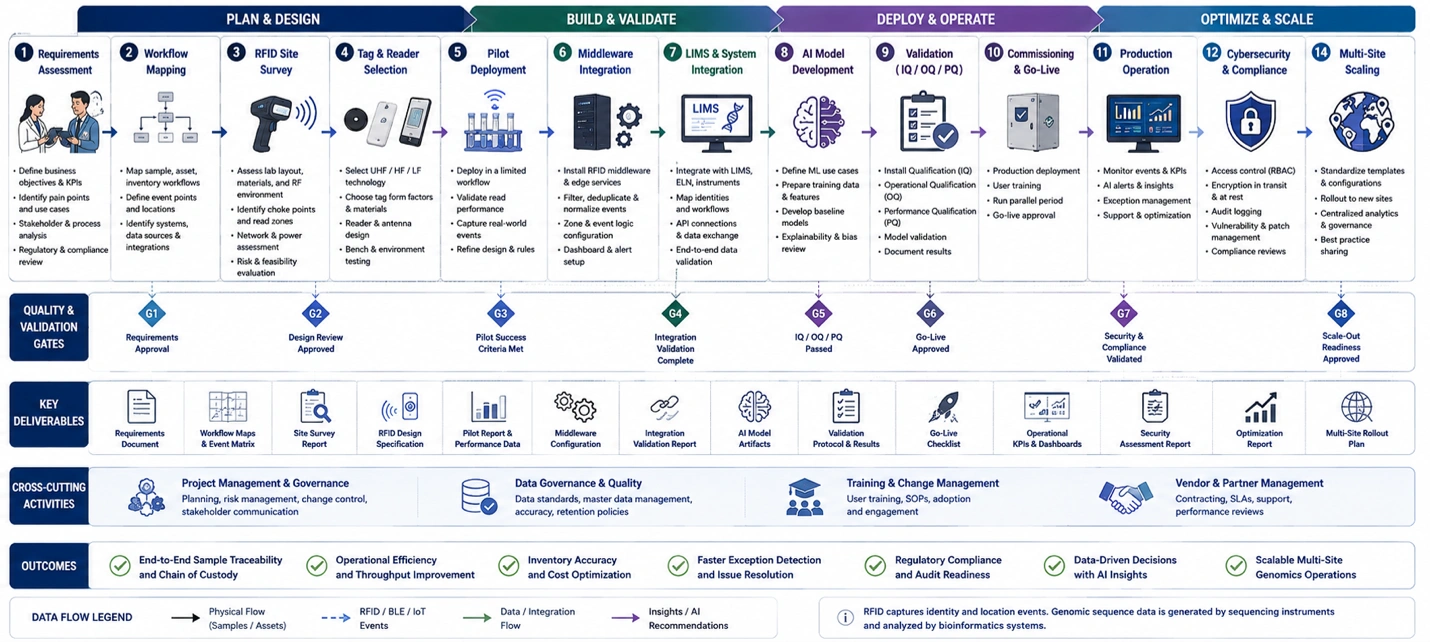
AI and RFID Deployment Lifecycle for Genomics Laboratories
AI and RFID Lifecycle for Genomics Labs
This lifecycle infographic maps the implementation journey from genomics laboratory requirements assessment, workflow mapping, RFID site surveying, and hardware selection through pilot deployment, LIMS and middleware integration, AI model development, validation, commissioning, and production operation. It also highlights cybersecurity, quality gates, KPI monitoring, maintenance, governance, and multi-site scaling to support reliable and continuously optimized genomics laboratory operations.
Alt Text:
Genomics laboratory lifecycle showing RFID planning, AI validation, deployment, cybersecurity, optimization, and scaling
Engineering Considerations and Common Failure Modes
Several implementation problems recur when RFID is introduced into laboratory environments.
Treating RFID Reads as Laboratory Events
A raw RFID read does not necessarily mean that a specimen has entered a process step. Readers may detect tags repeatedly, detect adjacent objects, or observe a tag while it is temporarily within a read zone.
Event processing should therefore distinguish between observation, location event, and workflow event.
Poor Read-Zone Design
Overlapping antenna fields can make it difficult to determine where an object actually is. Excessive read range can be just as problematic as insufficient range.
Controlled read zones, antenna positioning, shielding where appropriate, and physical testing should be used to establish reliable location boundaries.
Ignoring Liquids and Metal
Genomics laboratories contain substantial amounts of liquid and equipment with metal components. These materials can affect UHF RFID performance.
Testing should use production-like containers, racks, labels, and storage conditions.
Creating a Second Identity System
A common integration error is allowing RFID identifiers, barcode identifiers, and LIMS specimen identifiers to become disconnected.
A controlled identity mapping strategy should establish which system is authoritative for each identifier and how RFID events are associated with laboratory records.
Excessive AI Alerts
An AI model that flags every minor deviation can increase workload rather than reduce it.
Alert severity, confidence thresholds, suppression rules, escalation paths, and human review should be designed together.
Inadequate Offline Handling
Laboratory workflows cannot necessarily stop because a network connection temporarily fails. Edge or local systems should provide appropriate buffering and controlled synchronization so that temporary connectivity loss does not silently destroy event history.
Insufficient Cybersecurity Segmentation
RFID readers, gateways, laboratory instruments, administrative computers, and cloud services should not automatically share unrestricted network access.
Network segmentation, authenticated communication, least-privilege access, secure device configuration, and audit logging should be incorporated into the design.
KPIs for AI-Enabled Genomics Laboratory Operations
A deployment should be evaluated using measurable laboratory outcomes rather than RFID read counts alone.
Useful KPIs include:
- Sample-location accuracy
- RFID read success rate
- Missed-event rate
- False-event rate
- Sample retrieval time
- Accessioning cycle time
- Average workflow dwell time
- Work-in-process volume
- Sample throughput
- Sequencer utilization
- Instrument utilization
- Equipment downtime
- Reagent stockout frequency
- Inventory reconciliation time
- Inventory accuracy
- Cold-storage utilization
- Environmental excursion response time
- Exception detection time
- Mean time to investigate workflow anomalies
- AI alert precision
- AI alert false-positive rate
- Integration failure rate
- System availability
- Data synchronization latency
- Operator intervention frequency
- Cost per tracked workflow
The most meaningful KPI set should be established during requirements analysis. A laboratory focused on sequencing throughput will measure different outcomes from a biobank-oriented genomics operation or a high-volume diagnostic laboratory.
Regulatory, Quality, and Data Governance Considerations
Genomics laboratories operate within regulatory and quality environments that vary according to jurisdiction, laboratory type, specimen purpose, and intended use.
Relevant frameworks may include CLIA and applicable FDA requirements in the United States, CAP accreditation requirements where applicable, and Canadian federal or provincial requirements depending on the laboratory’s activities and location. Privacy and security obligations may also apply when laboratory systems contain identifiable health information.
Electronic records and electronic signatures can require appropriate controls under applicable regulatory frameworks, including requirements associated with 21 CFR Part 11 where relevant. Data protection requirements may also involve HIPAA for covered entities and business associates in applicable U.S. settings.
The important engineering principle is that RFID and AI should be incorporated into the laboratory’s existing quality and information-governance processes. Validation, auditability, access control, record retention, change management, and cybersecurity should be considered before production deployment.
Research genomics laboratories, clinical diagnostic laboratories, biobanks, pharmaceutical research laboratories, and academic sequencing centers may have substantially different compliance requirements. The deployment team should therefore establish the applicable requirements before finalizing the system design.
A hybrid model is often practical. Local edge systems can capture and normalize RFID events while a cloud or private-server environment performs broader analytics.
For laboratories with strict data-locality requirements, sensitive integrations, or extensive customer-managed infrastructure, a Server Version can provide greater control. Organizations operating multiple geographically distributed genomics laboratories may benefit from a Cloud Version for centralized analytics, provided security, privacy, network connectivity, and applicable regulatory requirements are properly addressed.
How GAO Supports RFID and IoT Requirements for Genomics Laboratories
GAO supplies RFID, BLE, and IoT hardware products and systems that can be incorporated into genomics laboratory identification, asset tracking, inventory, location monitoring, and data-capture projects. Hardware selection can encompass tags, readers, antennas, gateways, sensors, and related components according to the physical operating environment.
GAO’s experience supplying technology to organizations in the United States and Canada is supported by extensive R&D investment and quality-assurance processes. GAO Group companies have served Fortune 500 companies, R&D organizations, universities, and government agencies, providing products and technical support remotely or onsite.
For a genomics laboratory, the practical value of this experience is in selecting and integrating physical identification technologies around real operating conditions rather than treating RFID as an isolated product purchase.
Implementation Recommendations for Genomics Laboratories
A technically effective deployment should begin with the workflow rather than the RFID hardware.
- Define the laboratory problem and target KPI before selecting hardware.
- Map specimen, rack, equipment, inventory, and storage workflows.
- Establish authoritative identifiers and integration rules with the LIMS.
- Select UHF, HF, or LF RFID according to the physical use case rather than nominal read range.
- Test tags using actual laboratory containers, racks, liquids, equipment, and storage conditions.
- Engineer read zones to minimize unintended observations.
- Use middleware to transform raw RFID reads into validated operational events.
- Retain appropriate event history for troubleshooting and audit purposes.
- Start AI applications with measurable anomaly-detection, forecasting, or workflow-optimization problems.
- Keep laboratory personnel involved in AI alert design and exception handling.
- Validate RFID and AI behavior under production-like operating conditions.
- Incorporate cybersecurity, privacy, access control, and network segmentation into the initial design.
- Determine whether cloud, private-server, or hybrid deployment best fits the laboratory’s data and infrastructure requirements.
- Establish operational KPIs before production rollout.
- Monitor reader health, integration performance, model performance, and workflow changes after commissioning.
- Expand the deployment only after the initial workflow demonstrates measurable operational value.
Building More Traceable and Intelligent Genomics Laboratories
AI can make genomics laboratory operations more predictable by identifying workflow anomalies, forecasting bottlenecks, analyzing inventory behavior, and supporting equipment and capacity decisions. RFID provides a complementary physical identification mechanism that can automatically capture movement and location information for samples, racks, storage containers, equipment, and other laboratory assets.
The strongest solution connects these physical events with LIMS data, instrument information, environmental sensors, middleware, and AI analytics. Careful tag selection, read-zone engineering, identity management, validation, cybersecurity, and human oversight remain essential.
GAO can support organizations evaluating RFID, BLE, and IoT technologies for genomics laboratory tracking and operational monitoring. Readers can explore GAO’s technology products and technical support to determine which identification and sensing components are appropriate for their laboratory workflows.
Building the Future of Industrial AI and IoT with Aperture Venture Studio and GAO RFID Inc.
For more than three decades, GAO Group of Companies has invested heavily in R&D for industrial RFID, BLE, and IoT technologies. As generative AI became increasingly useful for industrial applications, we expanded our work in AI-enabled IoT solutions and founded Aperture Venture Studio to support the development and scaling of AI and IoT technologies relevant to applications such as genomics laboratory automation, tracking, and operational intelligence.
Aperture has attracted AI and IoT technical experts, entrepreneurial and operational executives, investors, and leading companies. We have also developed the Aperture Ventures Summit and TekSummit to discuss advanced AI and IoT topics.
These activities have helped us develop technical communities around AI and IoT. We welcome participation as advisors, co-founders or employees, investors, and customers.