
AI and BLE for Commercial Aviation Manufacturing
AI and BLE for Commercial Aviation Manufacturing
Commercial aviation manufacturing requires precise coordination of aircraft components, tooling, production equipment, work-in-process materials, inspection activities, and maintenance resources across complex production environments. AI can help manufacturers analyze production, asset, equipment, location, environmental, and quality data to identify abnormal conditions, predict maintenance requirements, improve material flow, and support operational decisions. BLE beacons, BLE sensors, and BLE gateways provide wireless data acquisition for selected manufacturing assets and processes. When combined with Industrial AI, machine learning, edge processing, and existing manufacturing software, BLE-enabled systems can support aircraft component visibility, tool accountability, predictive maintenance, production-flow analysis, and environmental monitoring. GAO supplies BLE, RFID, and IoT hardware products and systems that can provide the field-level data required for these applications. The resulting solution can connect physical manufacturing operations with AI-assisted analytics while maintaining appropriate human oversight for production and quality decisions.
AI-Enabled Commercial Aviation Manufacturing
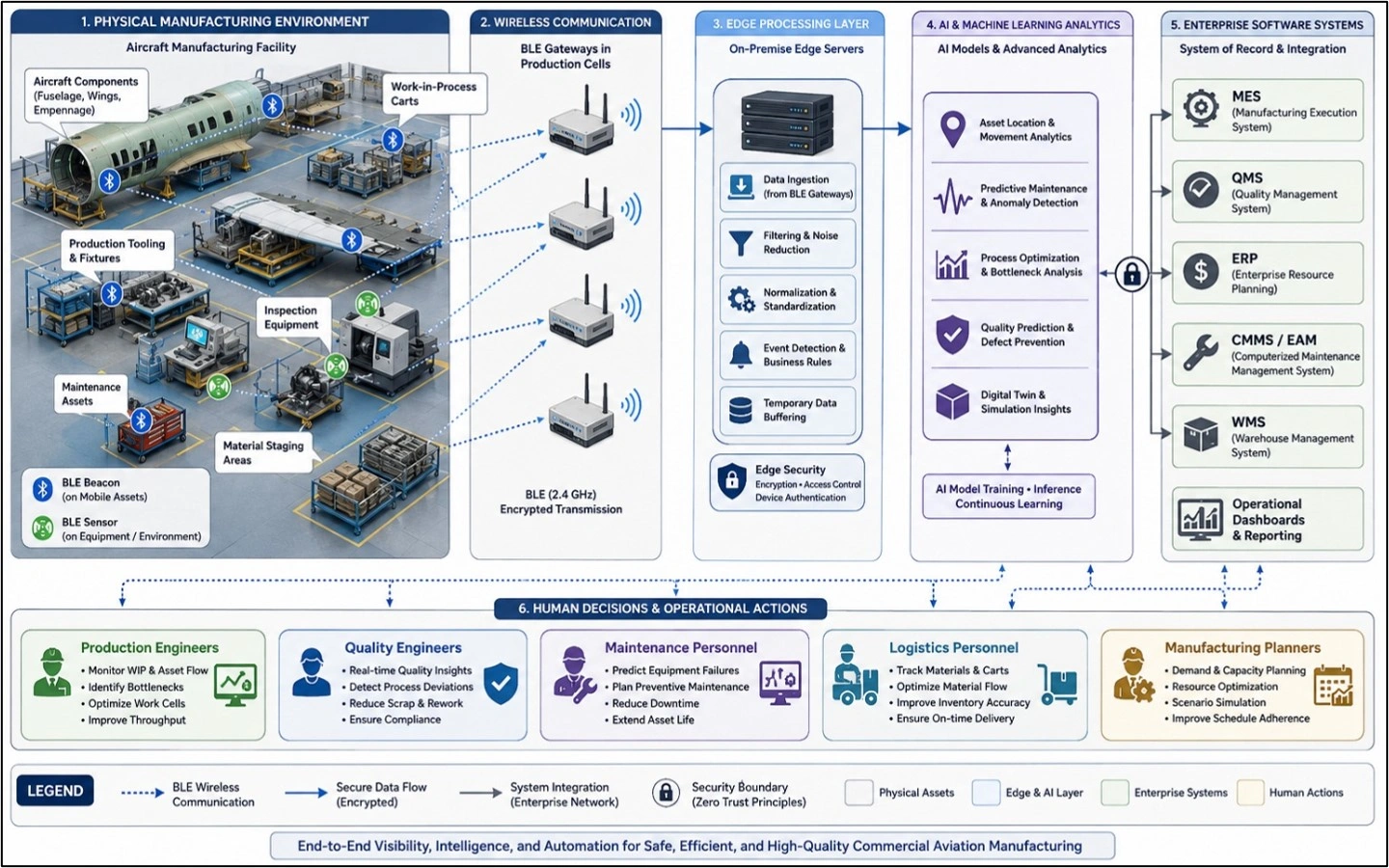
This architecture diagram illustrates how BLE beacons and sensors collect manufacturing asset and equipment data across an aviation facility. Data flows through BLE gateways and edge processing into AI/ML analytics, which integrate with MES, QMS, ERP, CMMS/EAM, WMS, and operational dashboards to support informed manufacturing decisions.
AI-Driven Manufacturing Intelligence for
AI for commercial aviation manufacturing combines machine learning, Industrial AI, predictive analytics, anomaly detection, computer vision, and other analytical methods with operational manufacturing data. Its purpose is to help manufacturing personnel identify patterns that may not be apparent through manual monitoring alone.
Aircraft manufacturing involves tightly controlled sequences. Materials and components can move through receiving, machining, fabrication, subassembly, inspection, rework, final assembly, testing, and logistics operations. Production tooling and inspection equipment may also move between workstations. This creates a large amount of operational information that must be correlated with production records.
AI can analyze this information to identify abnormal process behavior, prolonged production dwell times, unusual asset movement, equipment-condition changes, or environmental trends. BLE provides one potential source of location and condition information for selected assets.
The role of BLE is therefore primarily data acquisition. The operational value comes from combining BLE observations with production context and applying analytics that are relevant to aircraft manufacturing.
For example, a manufacturing organization could use asset-location data to identify where specialized tooling is located, combine equipment-condition data with maintenance history to identify potential degradation, or analyze work-in-process movement to identify recurring production delays.
GAO can support these applications by supplying BLE and IoT hardware products and systems for use in asset identification, wireless sensing, gateway communication, and related industrial data collection.
Commercial Aviation Manufacturing Applications for
AI-Based Aircraft Tool Tracking and Accountability
Aircraft production depends on specialized tooling, fixtures, torque tools, inspection instruments, carts, lifting equipment, and other production resources. Tool availability can directly affect workstation productivity when a required resource cannot be located quickly.
BLE-enabled identification can provide location observations for selected tools and equipment. Gateways positioned around production areas can collect beacon transmissions and send location events to software.
AI analytics can examine historical movement patterns and identify operational conditions such as:
- Repeated movement of tools between production cells
- Tools remaining outside expected work areas
- Unusual dwell times
- Frequently searched-for equipment
- Patterns associated with workstation delays
- Changes in tool utilization
Manufacturing teams can use these results to improve tool allocation, investigate process inefficiencies, and reduce avoidable search activity.
BLE location information should complement established tool-control procedures and should not replace formal inspection, calibration, or accountability processes.
Work-in-Process Visibility for Aircraft Components
Aircraft components can pass through numerous production and inspection stages before reaching final assembly. Tracking physical movement becomes more difficult when components are temporarily staged, transferred between work areas, sent for inspection, or returned for rework.
BLE can provide location information for selected component containers, carts, fixtures, or other trackable assets. AI can then analyze movement and dwell-time information against expected production sequences.
Potential applications include:
- Detecting prolonged staging periods
- Identifying unexpected movement between production zones
- Analyzing production queues
- Identifying recurring rework movement patterns
- Supporting production-flow analysis
- Improving visibility between manufacturing and inspection operations
This information can provide additional operational context to MES and quality systems.
Predictive Maintenance for Aircraft Manufacturing
Production equipment such as machining systems, compressors, material-handling equipment, environmental systems, and other industrial machinery requires planned maintenance. Unexpected equipment failures can disrupt production schedules and create downstream effects.
BLE sensors can provide supported measurements such as vibration, temperature, motion, or operating-state information. BLE gateways collect sensor transmissions and forward relevant data for processing.
AI models can compare current equipment behavior with historical operating conditions and maintenance records. Anomaly detection can identify changes that warrant investigation, while predictive models can estimate potential maintenance requirements where sufficient historical data is available.
Maintenance personnel can then evaluate AI-generated information alongside equipment service history, operating hours, inspection results, and manufacturer maintenance procedures.
The objective is not to allow AI to independently determine maintenance actions. AI provides additional evidence that qualified maintenance personnel can use when making decisions.
Predictive Maintenance Process Flow for Commercial
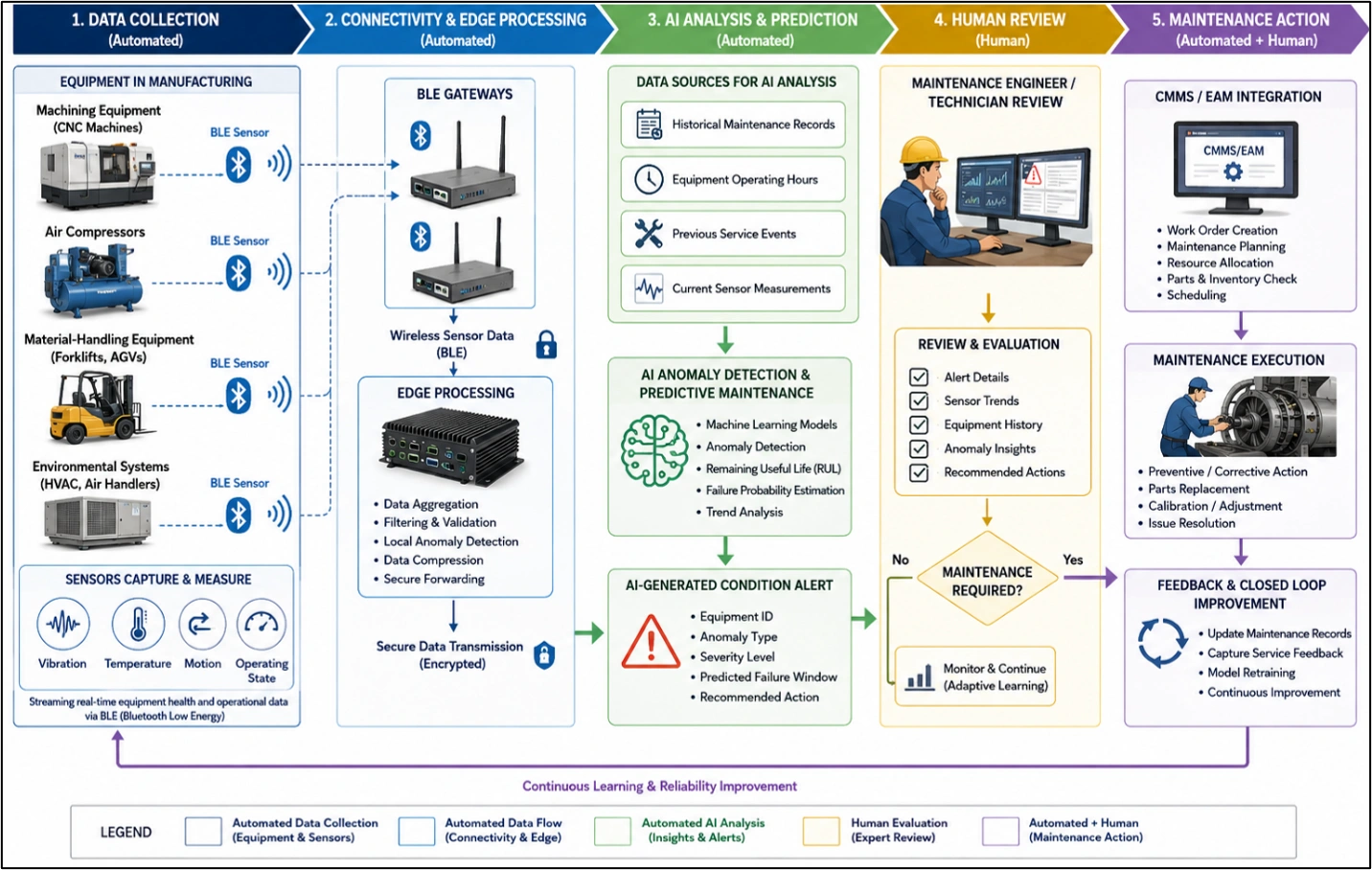
predictive maintenance workflow, from BLE sensor data collection on manufacturing equipment through edge processing and AI-based anomaly detection. It shows human review of condition alerts, CMMS/EAM integration, maintenance execution, and continuous feedback for reliability improvement.
Environmental Monitoring in Aviation Manufacturing
Some commercial aviation manufacturing operations require monitoring of environmental conditions affecting materials, production areas, storage locations, or controlled processes.
BLE sensors can transmit measurements such as temperature and humidity where the selected hardware supports these measurements. Gateways collect readings and transmit them to monitoring software.
AI analytics can examine historical environmental measurements and identify persistent deviations, recurring fluctuations, or correlations with operational events.
For example, an abnormal environmental pattern can be associated with a specific storage location, production area, time period, or manufacturing activity. This information can help personnel investigate potential causes and determine whether corrective action is necessary.
Environmental monitoring requirements should remain aligned with applicable manufacturing procedures, material specifications, quality requirements, and controlled processes.
AI-Assisted Quality and Process Deviation Analysis
Quality assurance is central to commercial aviation manufacturing. AI can assist quality teams by analyzing relationships among production conditions, equipment behavior, environmental data, inspection results, and manufacturing events.
BLE-derived location and sensor information can provide additional context for these analyses.
For example, a system could associate an environmental measurement with a production event or identify whether equipment-condition changes occurred before a process deviation. AI can help identify patterns that warrant further engineering or quality investigation.
Computer vision can also complement these approaches for image-based inspection applications. Visual inspection data can be analyzed alongside production-stage information and equipment context where appropriate.
AI should support, rather than replace, established quality procedures, qualified personnel, inspection requirements, and product acceptance processes.
Commercial Aviation Manufacturing Data Flow
A practical AI and BLE deployment begins with reliable data acquisition on the manufacturing floor. Data quality depends on appropriate device selection, BLE gateway placement, asset identification, radio propagation, environmental conditions, network connectivity, and integration with existing manufacturing systems.
The complete operational flow can be divided into data capture, communication, processing, analytics, integration, and action.
Data Capture from Manufacturing Assets
BLE beacons can provide identification or location-related signals from selected aircraft manufacturing assets. BLE sensors can collect supported physical measurements from equipment or controlled areas.
Typical tracked resources can include:
- Aircraft manufacturing tooling
- Production carts
- Fixtures
- Inspection equipment
- Material containers
- Work-in-process handling equipment
- Maintenance resources
- Environmental monitoring points
Hardware selection should consider battery life, mounting method, enclosure requirements, environmental conditions, sensing requirements, maintenance access, and radio behavior.
BLE Gateway Communication
BLE gateways receive wireless transmissions from nearby beacons and sensors. Gateway deployment should be based on the physical characteristics of the manufacturing environment rather than nominal radio range alone.
Aircraft structures, metallic machinery, storage racks, production fixtures, walls, and other obstructions can influence radio propagation. A site survey can therefore be important when location accuracy is a key requirement.
Gateway placement should also consider power availability, network connectivity, maintenance access, physical protection, and potential sources of radio interference.
Edge Processing
Edge processing can occur near the manufacturing operation and can perform functions such as:
- Filtering unnecessary observations
- Normalizing device data
- Detecting local events
- Buffering information during temporary network interruptions
- Performing selected low-latency analytics
- Forwarding relevant data to higher-level software
Edge processing can be particularly useful when manufacturing operations require local event detection or when connectivity to centralized systems cannot always be assumed.
AI Analytics and Decision Support
After data preprocessing, AI software can analyze location, equipment-condition, environmental, production, maintenance, and quality information.
Depending on the application, analytical methods may include anomaly detection, classification, regression, predictive modeling, time-series analysis, optimization, and computer vision.
Model performance should be evaluated using representative commercial aviation manufacturing data. Production layouts, equipment behavior, operating procedures, and manufacturing conditions can change, so models require appropriate monitoring and maintenance.
Integration with Manufacturing Software
AI and BLE information can be integrated with existing systems including:
- MES for production execution and work-order context
- QMS for inspection, quality, and nonconformance records
- ERP for material, inventory, purchasing, and production information
- CMMS/EAM for maintenance management and equipment history
- Warehouse management software for material movement
- Industrial databases for historical analysis
- Operational dashboards for manufacturing and maintenance teams
Integration should establish clear ownership of each data type. Location observations, for example, may provide operational context while an MES, QMS, ERP, or other designated system remains the authoritative source for controlled manufacturing records.
End-to-End AI Data Flow for Commercial Aviation Manufacturing
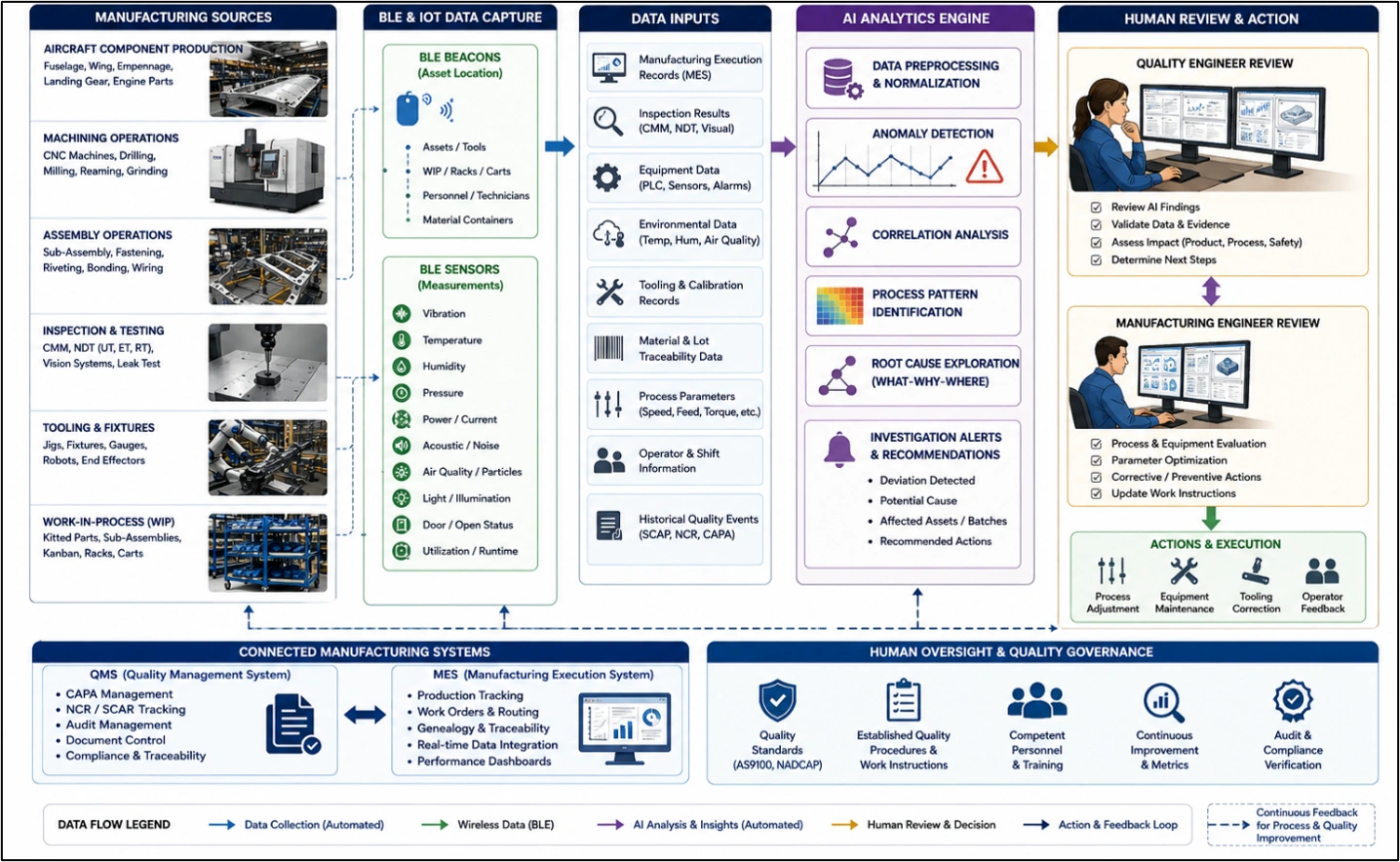
aircraft components, tooling, equipment, maintenance assets, and environmental points through BLE data capture, edge processing, secure transmission, and AI analytics. It shows integration with MES, QMS, ERP, CMMS/EAM, WMS, and data platforms before human teams use AI-assisted insights to make operational decisions.
BLE Hardware, AI Software, and Deployment Options
Commercial aviation manufacturing solutions require coordination between field devices, wireless communication, edge processing, AI software, manufacturing applications, and enterprise infrastructure. The appropriate configuration depends on the manufacturing use case, site conditions, data requirements, integration constraints, and security policies.
BLE beacons can associate digital identities with selected physical assets or locations. BLE sensors can add measurements where monitoring is required. BLE gateways provide the communication path between field devices and higher-level software.
GAO supplies BLE, RFID, and IoT hardware products and systems that can support industrial data acquisition requirements. For aviation manufacturing, hardware selection should consider radio performance, battery life, environmental conditions, device enclosure, mounting method, sensing capabilities, gateway density, network connectivity, and serviceability.
AI software can process the resulting information using methods appropriate to the application. Asset tracking may use location analytics and pattern analysis, equipment monitoring may use anomaly detection and predictive models, while inspection applications may incorporate computer vision.
Cloud Version
A cloud-hosted deployment can centralize analytics and information from multiple commercial aviation manufacturing facilities. It can be suitable where organizations require centralized reporting, remote access, cross-site analysis, and scalable computational resources.
BLE gateways can continue to provide local data acquisition while selected information is securely transmitted to cloud services.
Important engineering considerations include:
- Identity and access management
- Encryption in transit and at rest
- Device authentication
- API security
- Network segmentation
- Data governance
- Data residency requirements
- Availability and disaster recovery
- Integration with manufacturing software
Server Version
A server deployment places application and AI software on customer-managed servers, private data centers, factory servers, or other privately hosted infrastructure.
This model can be appropriate when a commercial aviation manufacturer requires greater control over data location, network dependencies, local processing, or integration with privately hosted manufacturing systems.
A privately hosted deployment can also be appropriate where manufacturing operations have restrictions on external connectivity or where organizational policies favor locally controlled computing resources.
Edge Processing
Edge processing places selected computational functions close to BLE gateways and manufacturing operations. It can support local filtering, event detection, buffering, and low-latency operational responses.
A hybrid configuration can combine edge processing with cloud-hosted or privately hosted server software. Local systems can handle immediate operational processing while centralized systems perform historical analytics, model training, reporting, and cross-site analysis.
Engineering Considerations for Commercial Aviation
Successful deployment requires more than attaching BLE devices to assets. Manufacturing teams should first define the operational problem, required data accuracy, asset population, process boundaries, integration requirements, and expected decision outputs.
BLE deployment should be engineered around actual production conditions. Metal structures, aircraft assemblies, machinery, tooling, storage areas, and changing production layouts can affect wireless performance.
AI implementation also requires appropriate historical data. Predictive models should not be deployed solely because sensor data is available. The organization should establish whether sufficient historical equipment, maintenance, production, environmental, or quality data exists to train and validate the intended model.
The system should also distinguish between operational recommendations and controlled manufacturing decisions. AI-generated alerts can support engineers, maintenance personnel, quality personnel, and planners, but decisions governed by formal procedures should remain subject to appropriate human authorization.
Implementing AI and BLE in Commercial Aviation
A successful deployment should begin with a clearly defined manufacturing problem and measurable operational objective. Commercial aviation manufacturing organizations can identify a limited number of high-value processes before expanding the system across additional production areas.
Use-Case Definition and Process Mapping
The initial assessment should document the physical process, existing information systems, assets involved, current data sources, and decisions that need improvement.
Relevant questions include:
- Which aircraft manufacturing assets require location or condition visibility?
- Which production processes experience recurring delays?
- Which tooling or equipment creates accountability problems?
- Which equipment failures have significant production consequences?
- Which environmental parameters require continuous monitoring?
- Which existing MES, QMS, ERP, CMMS/EAM, or warehouse records should receive or consume additional data?
- What level of location or measurement accuracy is actually required?
The objective should be measurable. Examples include reducing tool-search time, improving work-in-process visibility, reducing unplanned equipment downtime, improving maintenance response, or identifying production bottlenecks.
Site Survey and BLE Deployment Planning
A manufacturing-floor survey should identify production cells, aircraft assembly areas, machining areas, storage locations, inspection stations, maintenance zones, network infrastructure, power availability, and potential radio obstructions.
Metallic aircraft structures and production equipment can affect BLE signal behavior. Gateway placement should therefore be validated using the actual facility rather than relying only on theoretical radio range.
The survey should also determine:
- Required gateway density
- Expected asset population
- Device mounting locations
- Battery replacement or charging requirements
- Network connectivity
- Physical protection requirements
- Maintenance access
- Areas requiring higher location confidence
- Potential sources of wireless interference
Pilot Deployment
A pilot can begin with a defined production cell, tooling group, equipment group, or controlled manufacturing process.
The pilot should validate:
- BLE communication reliability
- Gateway coverage
- Location-event quality
- Sensor measurement consistency
- Edge processing behavior
- Data transmission
- AI model performance
- Manufacturing-system integration
- Alert accuracy
- User response to generated information
Pilot results should be measured against predefined operational KPIs before expanding the solution.
Integration and Commissioning
Integration should connect BLE and AI information with existing manufacturing software using controlled interfaces.
Commissioning should verify device identities, gateway connectivity, timestamps, asset associations, data quality, alert routing, access permissions, and system behavior under expected operating conditions.
Production personnel should also validate that information appears in a form that supports their actual workflow. A technically correct alert has limited value if it does not provide sufficient context for the engineer, technician, planner, or quality professional responsible for responding.
Cybersecurity and Data Governance for Aviation
Commercial aviation manufacturing systems can contain sensitive production, equipment, maintenance, quality, and operational information. Security controls should therefore be considered from the device layer through application and integration layers.
BLE devices should have appropriate identity and configuration controls. Gateways should be authenticated and managed according to organizational IT and OT policies. Network segmentation can help separate manufacturing communications from unrelated networks.
Important controls can include:
- Device identity management
- Authentication and authorization
- Encryption for data transmission
- Encryption for stored information
- Role-based access control
- Secure API authentication
- Network segmentation
- Gateway hardening
- Software and firmware update procedures
- Audit logging
- Security monitoring
- Backup and recovery procedures
- Controlled administrative access
AI systems introduce additional considerations. Training data should be protected from unauthorized modification, and model inputs should be monitored for unexpected changes. AI-generated recommendations should also retain sufficient context for qualified personnel to understand why an alert or prediction was generated.
Data governance should define which system is authoritative for production status, quality records, maintenance history, asset identity, and other controlled information.
Operational Benefits of AI-Enabled BLE Solutions
Combining AI with BLE-based data acquisition can provide value when wireless observations are connected to specific commercial aviation manufacturing decisions.
Improved Production Visibility
AI can analyze location and process-event information to identify where selected assets or work-in-process resources are located and how long they remain in particular production areas.
This can help manufacturing planners and engineers identify bottlenecks that may not be obvious from static production records.
Reduced Tool Search and Asset Retrieval Time
Location visibility for selected tooling and production resources can reduce unnecessary searching. Historical analytics can also reveal which resources are frequently unavailable or repeatedly moved between production cells.
The operational benefit comes from combining current location information with utilization patterns and production requirements.
Predictive Equipment Maintenance
Equipment-condition data can provide additional inputs for anomaly detection and predictive maintenance models. When validated against historical maintenance events, these models can help maintenance teams identify equipment requiring investigation before a failure affects production.
Better Quality Context
AI can correlate production events, equipment conditions, environmental measurements, and inspection information. This additional context can help quality and manufacturing engineers investigate potential process deviations.
Scalable Multi-Site Analytics
Cloud-hosted or privately hosted server software can consolidate selected information from multiple manufacturing locations. Standardized data structures can support comparisons of asset utilization, equipment conditions, production delays, or maintenance patterns across facilities.
Expansion should remain controlled. Adding more BLE devices without establishing data quality, integration standards, and operational ownership can increase system complexity without creating proportional value.
KPIs for AI and BLE in Commercial Aviation
The performance of a deployment should be measured using operational indicators rather than device counts alone.
Relevant KPIs can include:
- Tool-search time
- Tool availability rate
- Asset utilization
- Work-in-process dwell time
- Production queue duration
- Manufacturing cycle time
- Unplanned equipment downtime
- Mean time between failures
- Mean time to repair
- Predictive-maintenance alert precision
- Maintenance response time
- Environmental excursion frequency
- Environmental excursion duration
- Production schedule adherence
- Rework frequency
- Quality investigation time
- Location-event accuracy
- BLE gateway availability
- Sensor data completeness
- Data transmission success rate
The appropriate KPI depends on the use case. A tool-tracking deployment should not be judged using the same primary indicators as a predictive-maintenance deployment.
A baseline should be established before implementation. The organization can then compare post-deployment performance against the original operating condition.
Scaling AI and BLE Across Commercial Aviation
Scaling should follow validated use cases rather than simply increasing the number of connected devices.
A manufacturing organization can expand from one production cell to additional machining areas, assembly stations, inspection zones, maintenance facilities, or material-handling operations after the initial deployment demonstrates reliable performance.
Standardization becomes important during expansion. Asset naming, device identifiers, gateway configuration, event formats, integration interfaces, access controls, and maintenance procedures should be documented consistently.
AI models also require lifecycle management. Model accuracy should be evaluated as production conditions change. New equipment, revised layouts, different operating procedures, and changes in production volume can influence model performance.
Operational teams should establish ownership for:
- BLE device maintenance
- Gateway administration
- Data-quality monitoring
- AI model monitoring
- Manufacturing-system integration
- Cybersecurity
- KPI reporting
- User training
- Incident investigation
- System upgrades
GAO’s experience supplying BLE, RFID, and IoT hardware products and systems can support organizations that require industrial identification, wireless sensing, and connected-device infrastructure as deployments expand.
AI + BLE Scaling Roadmap for Commercial Aviation
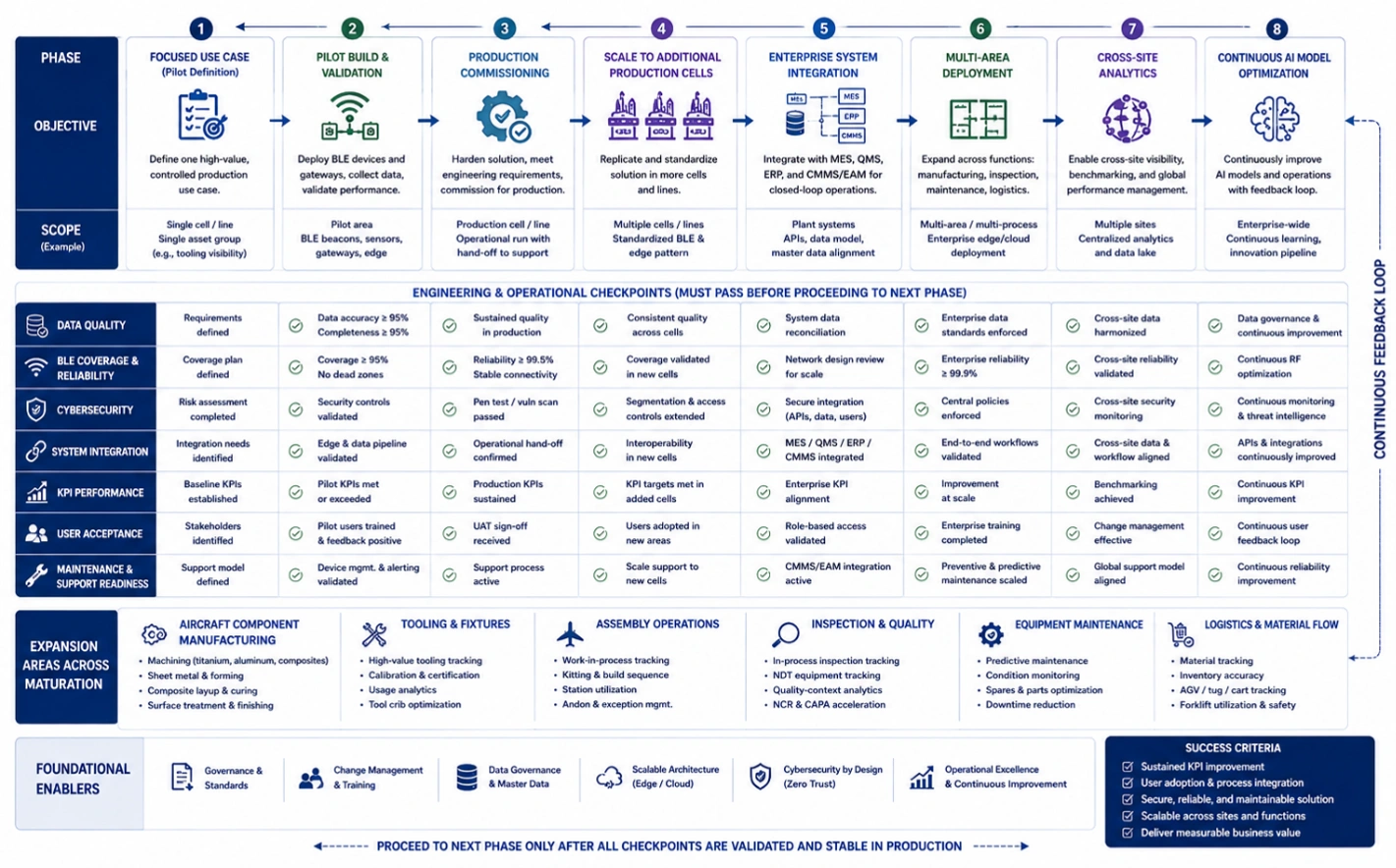
An eight-phase roadmap shows how AI and BLE can scale from a controlled production use case to pilot validation, commissioning, additional cells, enterprise integration, multi-area deployment, cross-site analytics, and continuous AI optimization. Each phase includes checkpoints for data quality, BLE coverage, cybersecurity, system integration, KPI performance, user acceptance, and maintenance readiness.
Practical Recommendations for Commercial Aviation
Organizations evaluating AI and BLE should focus on measurable manufacturing requirements rather than deploying wireless technology without a defined operational purpose.
Key recommendations include:
- Start with a specific production, tooling, maintenance, quality, or material-flow problem.
- Establish baseline KPIs before deployment.
- Conduct a physical BLE coverage survey.
- Select beacons, sensors, and gateways according to environmental and operational requirements.
- Validate device placement under actual aircraft manufacturing conditions.
- Use edge processing where local filtering, buffering, or low-latency event detection is valuable.
- Select cloud-hosted or privately hosted server software according to data, connectivity, security, and integration requirements.
- Integrate with existing MES, QMS, ERP, CMMS/EAM, and warehouse systems rather than creating isolated information.
- Validate AI models using representative manufacturing data.
- Maintain human review for quality, maintenance, and production decisions requiring qualified personnel.
- Establish cybersecurity controls before production deployment.
- Monitor data quality and AI performance after commissioning.
- Expand the solution only after the initial use case demonstrates measurable value.
GAO can provide BLE, RFID, and IoT hardware products and systems for organizations developing connected manufacturing solutions. Our support can include technology selection and technical guidance for applications involving asset identification, wireless sensing, gateway connectivity, and industrial data collection.
AI + BLE + IoT for Connected Commercial Aviation
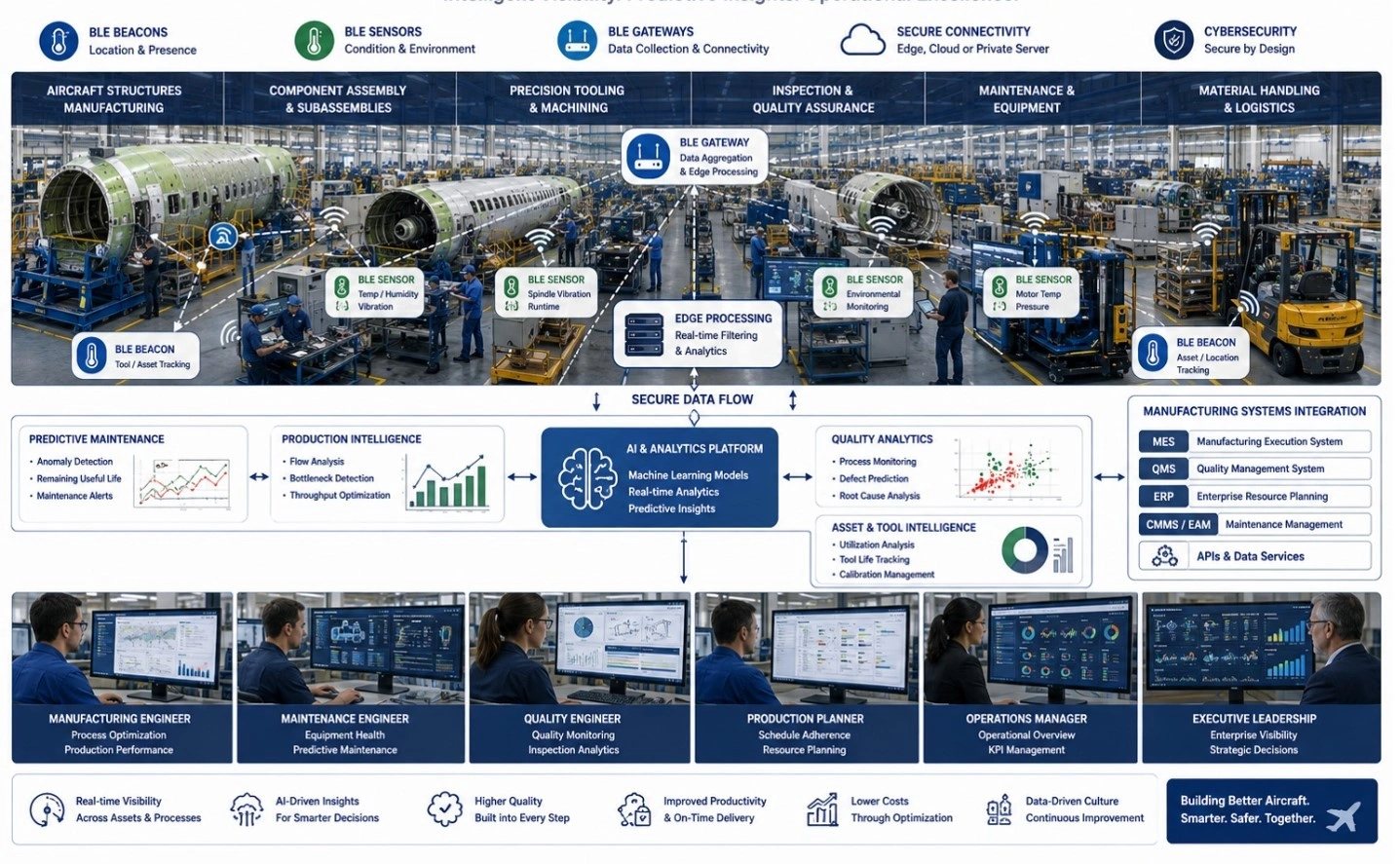
A connected aviation manufacturing environment illustrates BLE beacons, sensors, gateways, edge processing, and secure data flows across aircraft structures, assembly, tooling, inspection, maintenance, and logistics. AI analytics connect operational data to predictive maintenance, production intelligence, quality analysis, asset intelligence, and manufacturing systems such as MES, QMS, ERP, and CMMS/EAM.
Building AI-Enabled Commercial Aviation
AI can provide commercial aviation manufacturers with improved insight into production flow, equipment condition, asset utilization, environmental conditions, and quality-related events. BLE beacons, BLE sensors, and BLE gateways can provide useful location and condition data for selected manufacturing assets and processes.
The most effective implementations connect this data to existing manufacturing software and established operational procedures. Edge processing can support local responsiveness, while cloud or privately hosted server deployment can provide centralized analytics according to organizational requirements.
A disciplined deployment should progress through use-case definition, site assessment, pilot testing, commissioning, integration, cybersecurity validation, KPI measurement, and controlled expansion.
GAO provides BLE, RFID, and IoT hardware products and systems that can support these connected manufacturing requirements. Organizations can learn more about relevant technologies, engineering considerations, and implementation approaches through GAO’s technical resources and product offerings.
Building the Future of Industrial AI and IoT with
Aperture Venture Studio and GAO RFID Inc.
For more than three decades, GAO Group of Companies has invested substantially in R&D covering industrial BLE, RFID, and IoT technologies. As generative AI became increasingly useful for industrial applications, we expanded our work across AI and IoT, including BLE and RFID, and founded Aperture Venture Studio to support the development and scaling of AI and IoT businesses addressing practical industry requirements. For commercial aviation manufacturing, this work aligns with opportunities involving AI-assisted production intelligence, asset visibility, maintenance analytics, and connected industrial systems.
Aperture has attracted AI and IoT technical experts, entrepreneurial and operational executives, investors, and leading companies. We also developed the Aperture Ventures Summit and TekSummit to facilitate discussion of advanced AI and IoT topics.
GAO, headquartered in New York City and Toronto, Canada, is ranked among the top 10 leading B2B and B2G BLE and RFID suppliers globally. GAO, together with GAO Research and GAO Tek, forms GAO Group. For three decades, the companies have served organizations across the United States and Canada, including Fortune 500 companies, R&D organizations, universities, and government agencies. Our R&D investment, quality assurance processes, and remote and onsite technical support contribute to the development and deployment of industrial technology solutions.
We welcome qualified organizations and professionals interested in participating as:
- Advisors, co-founders, or employees
- Investors
- Customers