
AI and BLE for Commercial Print Services
AI-Enabled BLE and AIoT for Intelligent Commercial Printing Operations
AI-enabled commercial print services combine Industrial AI, machine learning, computer vision, and connected production data to improve print quality, equipment reliability, scheduling, material flow, and operational visibility. BLE sensors, BLE beacons, and BLE gateways can supply additional real-time data for assets and production conditions that may not be available from existing press controls, PLCs, or shop-floor systems. The resulting AIoT solution can connect physical printing operations with analytics, maintenance workflows, and business systems without requiring every sensing requirement to be added to the press control system.
For commercial printers handling digital printing, offset lithography, wide-format work, labels, folding cartons, direct mail, books, and short-run production, this combination is particularly useful where job variability, substrate changes, make-ready time, machine utilization, and quality consistency affect margins. AI can correlate production conditions with historical outcomes, while BLE provides practical wireless visibility for selected assets, mobile equipment, environmental conditions, and material movements.
AIoT-Enabled Commercial Print Services Workflow with BLE and AI
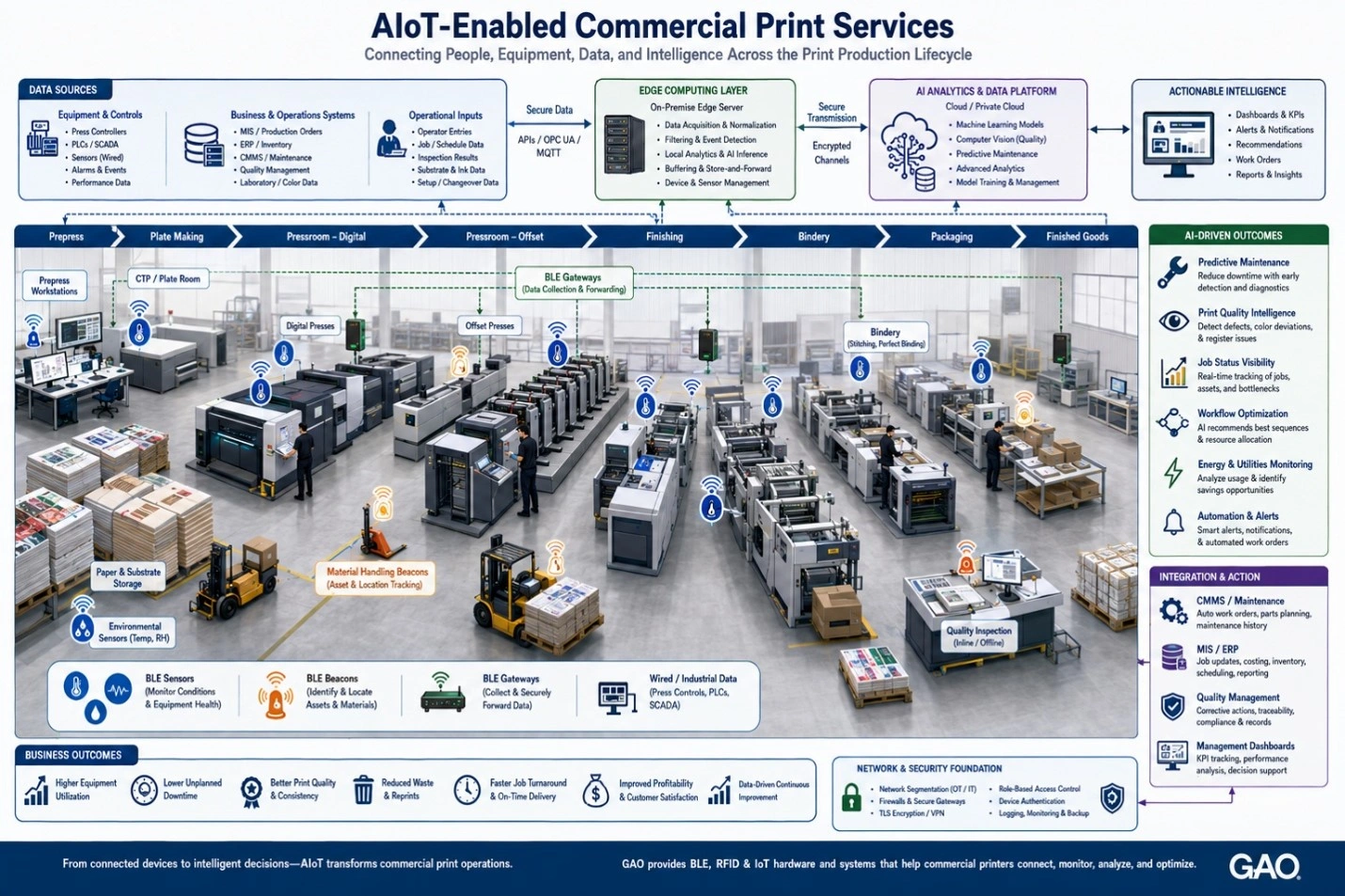
This visual maps a commercial print facility from prepress and plate making through digital and offset printing, finishing, bindery, packaging, and finished-goods staging. It shows how BLE sensors, BLE beacons, gateways, industrial data, edge computing, and AI analytics support predictive maintenance, print-quality intelligence, job visibility, workflow optimization, energy monitoring, and operational decision-making.
How AI Improves Commercial Print Services
AI for commercial print services is most valuable when it addresses measurable production problems rather than being deployed as a generic analytics layer. A practical implementation starts with a specific operational objective such as reducing unplanned press downtime, detecting print defects earlier, improving make-ready performance, optimizing job sequencing, locating mobile finishing equipment, or identifying abnormal environmental conditions that contribute to substrate and print-quality variation.
AIoT combines artificial intelligence with IoT devices, sensors, connected equipment, and industrial systems. Within a print facility, this can include machine-learning models analyzing press telemetry, computer vision inspecting printed output, AI-assisted scheduling using MIS and production data, and edge analytics evaluating sensor information close to the equipment.
BLE serves as an enabling data-capture technology for situations where wired instrumentation is costly, impractical, or unnecessary. A BLE sensor can measure selected parameters such as temperature, humidity, vibration, differential environmental conditions, or equipment-state indicators. A BLE beacon can provide an identity associated with a cart, roll-handling asset, tooling item, mobile device, or other tracked object. BLE gateways collect these signals and forward relevant information to software for correlation with production events.
GAO supplies BLE, RFID, and IoT hardware products and systems that can support organizations building these types of connected operational solutions. The appropriate hardware selection depends on the print process, sensing requirement, radio environment, battery-life requirement, mounting method, and integration design rather than simply selecting a wireless device by nominal range.
Commercial Print Applications for AI and BLE
Commercial print services contain several operational environments where AI can generate useful predictions or recommendations when reliable production data is available.
Predictive Maintenance for Printing and Finishing Equipment
Predictive maintenance can help maintenance teams identify developing equipment problems before they result in a production interruption. Models can correlate vibration, temperature, motor behavior, operating hours, alarm history, maintenance records, and production conditions.
Potential targets include press drive systems, pumps, compressors, chillers, dryers, fans, folding equipment, cutters, bindery machinery, conveyors, and other rotating or mechanically loaded equipment.
BLE sensing can supplement PLC and machine-controller data when a useful measurement is not already available through the equipment interface. The AI model can then combine the additional signal with CMMS history and machine operating states.
A useful implementation should distinguish between an AI-generated maintenance recommendation and a confirmed mechanical fault. Maintenance personnel should validate the condition through inspection, manufacturer procedures, vibration analysis, electrical testing, or other appropriate diagnostic methods before corrective action.
Print Quality Monitoring and Defect Detection
Computer vision can inspect printed sheets, labels, packaging graphics, variable-data output, and other products for defects such as registration problems, color variation, missing elements, streaks, smearing, substrate damage, or inconsistent finishing.
AI models become more useful when image data is associated with press conditions, substrate information, ink or toner settings, environmental conditions, job identifiers, and operator actions. BLE temperature and humidity sensing can provide supplementary context where paper, film, adhesive, coating, or other substrates are sensitive to environmental variation.
The objective is not simply to detect a defective sheet. A more advanced system can identify recurring relationships between process conditions and quality deviations, helping process engineers investigate root causes and establish better operating windows.
Job Tracking and Production Visibility
Commercial printers frequently move work through prepress, printing, drying or curing, cutting, folding, binding, finishing, inspection, packing, and shipping. Jobs may also wait between operations because of machine availability, quality approval, substrate constraints, or scheduling priorities.
BLE beacons can provide location or proximity information for selected carts, pallets, mobile equipment, tooling, and work-in-process containers. When integrated with MIS or production-order information, this data can improve visibility into where selected physical resources are located.
AI can use job status, equipment availability, estimated run time, queue conditions, setup requirements, and historical production performance to identify schedule conflicts and recommend better sequencing.
Environmental Monitoring for Print Quality
Temperature and relative humidity can influence paper handling, static electricity, dimensional stability, ink behavior, drying, coating performance, adhesive behavior, and other print-process variables.
BLE sensors can provide distributed environmental measurements across paper storage, pressrooms, finishing areas, and other relevant locations. AI can analyze those measurements alongside production and quality records to identify correlations that would be difficult to see from isolated environmental readings.
Sensor placement is important. A sensor positioned near a doorway, HVAC outlet, heat-producing machine, or exterior wall may not represent the conditions experienced by the substrate or process. Calibration, placement validation, battery management, and sensor-health monitoring should therefore be treated as engineering tasks rather than installation details.
Energy and Utility Optimization
Commercial print facilities can contain significant electrical and thermal loads associated with presses, dryers, compressors, HVAC systems, curing systems, dust collection, finishing equipment, and material handling.
AI models can analyze production volume, machine states, utility consumption, operating schedules, and environmental conditions to identify abnormal consumption or opportunities to reduce idle operation. BLE sensing can supplement existing instrumentation where localized measurements are useful.
The strongest results normally come from correlating energy consumption with production output rather than optimizing energy as an isolated KPI. A press consuming less energy while producing more waste or reducing throughput is not necessarily an operational improvement.
Commercial Print Production Data Workflow
A reliable AI solution begins with data acquisition and ends with a business or operational action. The data path should be designed around the existing print workflow rather than forcing production personnel to change every operating procedure.
Data Capture Across the Print Shop
Relevant information can originate from press controllers, PLCs, machine sensors, SCADA systems, digital press APIs, industrial gateways, quality inspection systems, laboratory or color-management records, MIS databases, CMMS records, ERP systems, and production operators.
BLE sensors and beacons provide another data source for selected physical conditions and assets. The wireless layer should be limited to measurements that benefit from wireless deployment. Existing machine data should normally remain the preferred source when a reliable value is already available through a supported industrial interface.
Potential data fields include:
- Press operating state and production mode
- Job identifier and production order
- Substrate type, size, weight, and relevant material attributes
- Make-ready duration and production run time
- Sheets or impressions produced
- Reject and waste quantities
- Press alarms and fault codes
- Motor, bearing, pump, or other equipment condition indicators
- Temperature and relative humidity
- Mobile cart, pallet, tooling, or equipment location
- Maintenance event and work-order history
- Inspection results and defect classifications
- Ink, toner, coating, adhesive, or finishing-process information
- Energy and utility measurements
- Operator-entered production observations
BLE Communication and Edge Processing
BLE sensors and beacons transmit short-range wireless information to BLE gateways positioned according to radio coverage, equipment layout, interference sources, and required update intervals. Gateway placement should account for metal structures, presses, cabinets, moving equipment, dense machinery, and other factors that can affect radio propagation.
The gateway can filter duplicate readings, validate timestamps, buffer information during temporary network interruptions, and forward normalized data to an edge server or other approved data service. This reduces unnecessary upstream traffic and allows the print facility to retain critical operational records during intermittent connectivity.
Industrial Ethernet, Wi-Fi, or other approved network infrastructure can carry gateway data toward analytics systems. Network design should separate wireless sensing traffic from safety-critical or process-control traffic where appropriate.
Data Integration With Print Management Systems
AI becomes operationally useful when sensor information can be associated with actual print jobs, machines, assets, maintenance events, and quality outcomes.
Common integration points include MIS, ERP, CMMS, production databases, historians, quality-management software, warehouse systems, and machine interfaces. Middleware can normalize timestamps, asset identifiers, job identifiers, units, and data formats before analytics are performed.
A practical example is correlating an abnormal vibration trend from a finishing machine with its asset record, operating hours, previous maintenance events, and current production schedule. Instead of generating an isolated sensor alarm, the system can provide maintenance personnel with a condition-based recommendation and relevant production context.
AI Decision Support for Commercial Print Operations
AI analysis can range from deterministic anomaly detection to supervised machine learning, time-series forecasting, computer vision, classification, clustering, and optimization models. Model selection should follow the operational question and available data.
A predictive-maintenance model may estimate the probability of a developing equipment condition. A quality model may classify image defects or identify relationships between process parameters and rejected output. A scheduling model may evaluate production constraints and recommend job sequences. An anomaly-detection model may identify unusual energy consumption, environmental conditions, machine behavior, or workflow delays.
The model output should remain explainable enough for its intended users. Reliability engineers may need contributing variables and trend history, while production supervisors may need a concise alert, affected job, machine status, and recommended next action.
AI should not be treated as an automatic substitute for press operators, maintenance technicians, quality engineers, or production planners. The most practical commercial print implementations establish clear approval points where personnel validate recommendations before consequential operational actions.
End-to-End AI Workflow for Commercial Print Services
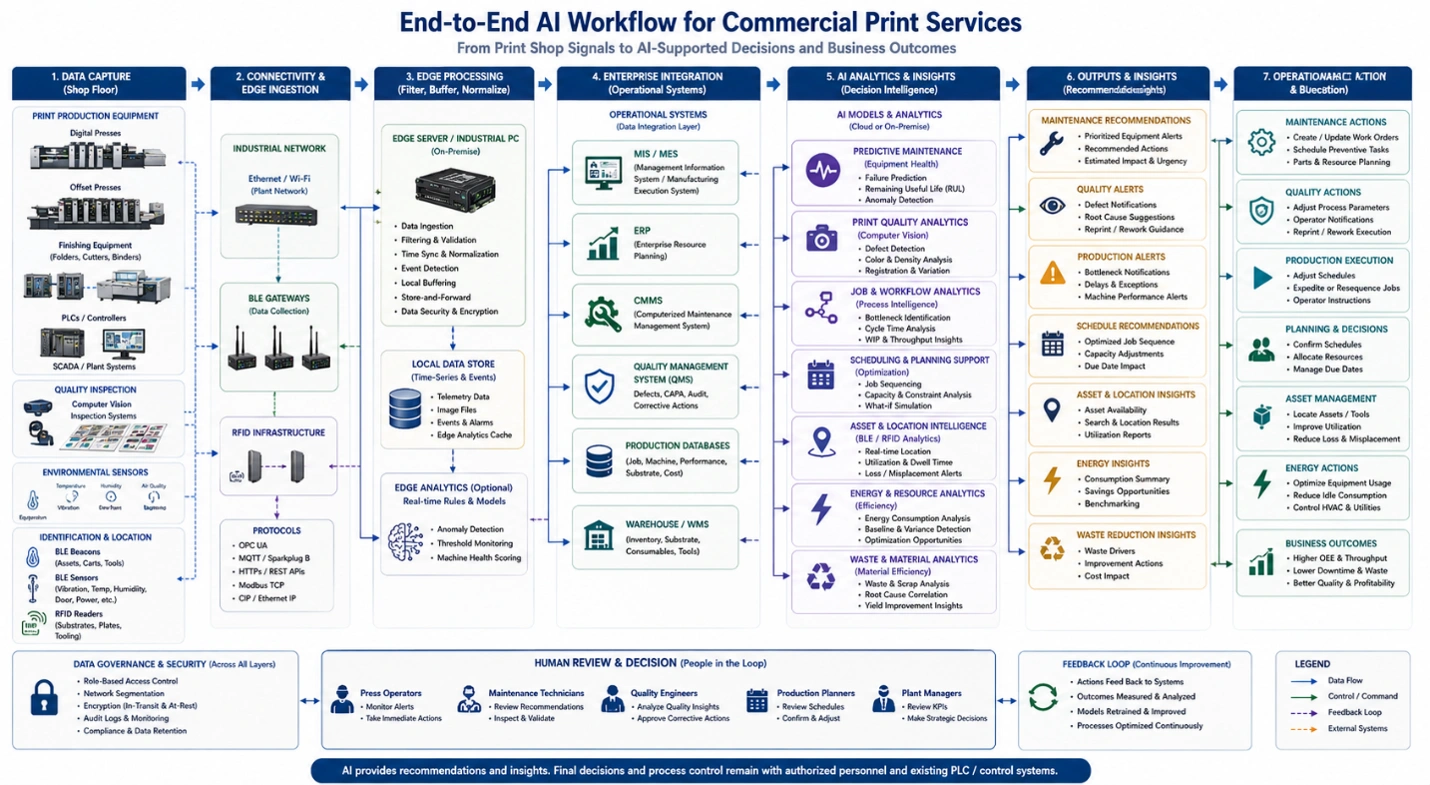
This diagram traces commercial print data from presses, finishing equipment, quality inspection, BLE/RFID devices, and environmental sensors through edge processing and business-system integration into AI analytics. It connects AI-generated maintenance, quality, scheduling, asset, energy, and waste insights with human-reviewed operational actions and measurable print-production outcomes.
Technical Foundation for AI-Enabled Commercial Print Services
A commercial print AI solution normally contains several coordinated technical layers. Each should have a defined purpose, ownership model, data contract, and failure behavior.
BLE Sensors, Beacons, and Gateways
BLE sensors are appropriate for selected measurements where wireless installation provides a practical advantage. Depending on the application, sensors may monitor temperature, humidity, vibration, contact state, or other supported parameters.
BLE beacons provide an identifiable wireless reference for physical assets. Their value in commercial print services is strongest when the business process requires visibility of mobile resources such as carts, pallets, tooling, production aids, or selected equipment.
BLE gateways collect nearby transmissions and provide the bridge between wireless devices and the print facility’s IP-connected software. Gateway configuration should account for transmission intervals, battery life, coverage, density, roaming behavior, antenna placement, and network availability.
AI, Edge Computing, and Data Services
Edge computing is useful where print operations require low-latency filtering, local buffering, data normalization, or continued operation during temporary upstream connectivity loss. Cloud services can provide centralized analytics and multi-site reporting where corporate IT policies permit external hosting.
Time-series databases or historians can retain machine and sensor measurements. Relational databases can maintain job, asset, work-order, and production records. Object storage can retain inspection images and other large datasets when required for computer-vision development.
Industrial and Enterprise Communication
Supported communication methods may include BLE at the sensor layer, Ethernet or Wi-Fi between gateways and network services, OPC UA for selected industrial data exchange, MQTT for telemetry transport, and REST APIs or database interfaces for business-system integration.
The correct interface depends on the equipment vendor, existing controls, cybersecurity requirements, network segmentation, and supported data interfaces. Direct modification of press-control logic should not be assumed merely because an AI application needs production information.
GAO’s role can include supplying the BLE hardware components and related IoT products needed to collect physical-world data, while the complete solution may also involve the customer’s existing machine vendors, controls engineers, IT team, MIS provider, CMMS administrator, and AI or systems-integration resources.
Cloud Version and Server Version for Commercial Print Services
Commercial print facilities should select the deployment model according to production latency, connectivity, data governance, IT policies, integration requirements, and the number of locations that will contribute data. Both cloud-hosted and privately hosted software can support AI-enabled print operations when the data path, security controls, and failure behavior are designed correctly.
Cloud Version for Multi-Site Print Operations
A cloud-hosted SaaS deployment is appropriate when a commercial printing organization wants centralized analytics across multiple plants, corporate reporting, scalable AI computation, and remote access for authorized users. Production data can be collected through BLE gateways and edge services at each facility, normalized locally, and transmitted to approved cloud services.
Cloud deployment is particularly useful for organizations operating several print facilities with different press fleets. A centralized system can compare equipment behavior, maintenance trends, job performance, energy intensity, and quality indicators across locations without requiring each site to maintain a separate analytics server.
Cloud processing should not imply that every machine signal must leave the facility. Edge filtering can remove unnecessary high-frequency data, retain temporary buffers, and forward only the measurements required for analytics. Sensitive production records, customer job information, or proprietary artwork should be governed according to the printer’s data-classification policies.
Server Version for Controlled Print Environments
A Server Version places the application software on edge servers, customer-managed servers, private data centers, factory servers, or other privately hosted infrastructure. This model can be preferable when a print facility requires tighter control over production data, has limited external connectivity, or needs local integration with MIS, CMMS, production databases, or machine interfaces.
Local processing can also reduce dependency on wide-area connectivity. If an external connection becomes unavailable, the print operation can continue collecting data and performing approved local analytics while the gateway or edge service buffers information for later synchronization.
Privately hosted deployment does create additional responsibilities. The customer or designated IT service provider typically manages server capacity, operating-system updates, backup, access control, vulnerability remediation, certificates, monitoring, and application lifecycle procedures.
Cybersecurity for AI and BLE in Commercial Print Services
Wireless sensing should be introduced without creating an uncontrolled pathway into press controls or other operational systems. A sound design treats BLE devices, gateways, edge servers, production networks, business systems, and remote users as separate trust domains with explicitly controlled interfaces.
Protecting BLE Devices and Gateways
BLE device identity should be managed according to the capability of the selected hardware. Where supported, secure pairing, encryption, device authentication, credential management, and controlled provisioning should be used.
Gateways deserve particular attention because they bridge wireless devices and IP networks. Administrative interfaces should not be exposed unnecessarily, unused services should be disabled, credentials should be managed securely, and firmware should be maintained according to the manufacturer’s security process.
Print facilities should also maintain an inventory of deployed BLE sensors, beacons, gateways, firmware versions, locations, owners, and replacement schedules. Device inventories become increasingly important as installations expand from a small pilot to hundreds or thousands of sensing points.
Segmenting Print Operations From Business Systems
A commercial printer should avoid treating the production network as an extension of the corporate office network. Press controls, PLCs, DCS or supervisory systems where present, industrial PCs, and safety-related functions should remain governed by the controls and cybersecurity practices applicable to those systems.
AI analytics can receive approved data through controlled interfaces such as OPC UA, MQTT brokers, APIs, database replication, historians, or middleware. Firewalls and network segmentation can restrict which systems communicate and which ports or services are permitted.
AI recommendations should not automatically alter safety interlocks or other safety-critical functions. A predictive-maintenance recommendation can be delivered to a maintenance workflow while the final decision remains with qualified personnel and established operating procedures.
Identity, Logging, and Remote Access
Role-based access should distinguish production supervisors, maintenance technicians, process engineers, quality personnel, IT administrators, and other authorized users. Authentication policies should reflect the organization’s security requirements, especially for remote access.
Security logs should record authentication events, configuration changes, gateway activity, software actions, model changes, and relevant administrative operations. Backups should include application configuration and important operational data, with recovery procedures tested rather than assumed.
IEC 62443 concepts can provide useful guidance for industrial cybersecurity zoning and controlled communication where the print facility has applicable OT environments. NIST cybersecurity practices can also inform identification, protection, detection, response, and recovery processes.
Cybersecurity Layers for AI-Enabled Commercial Print Services
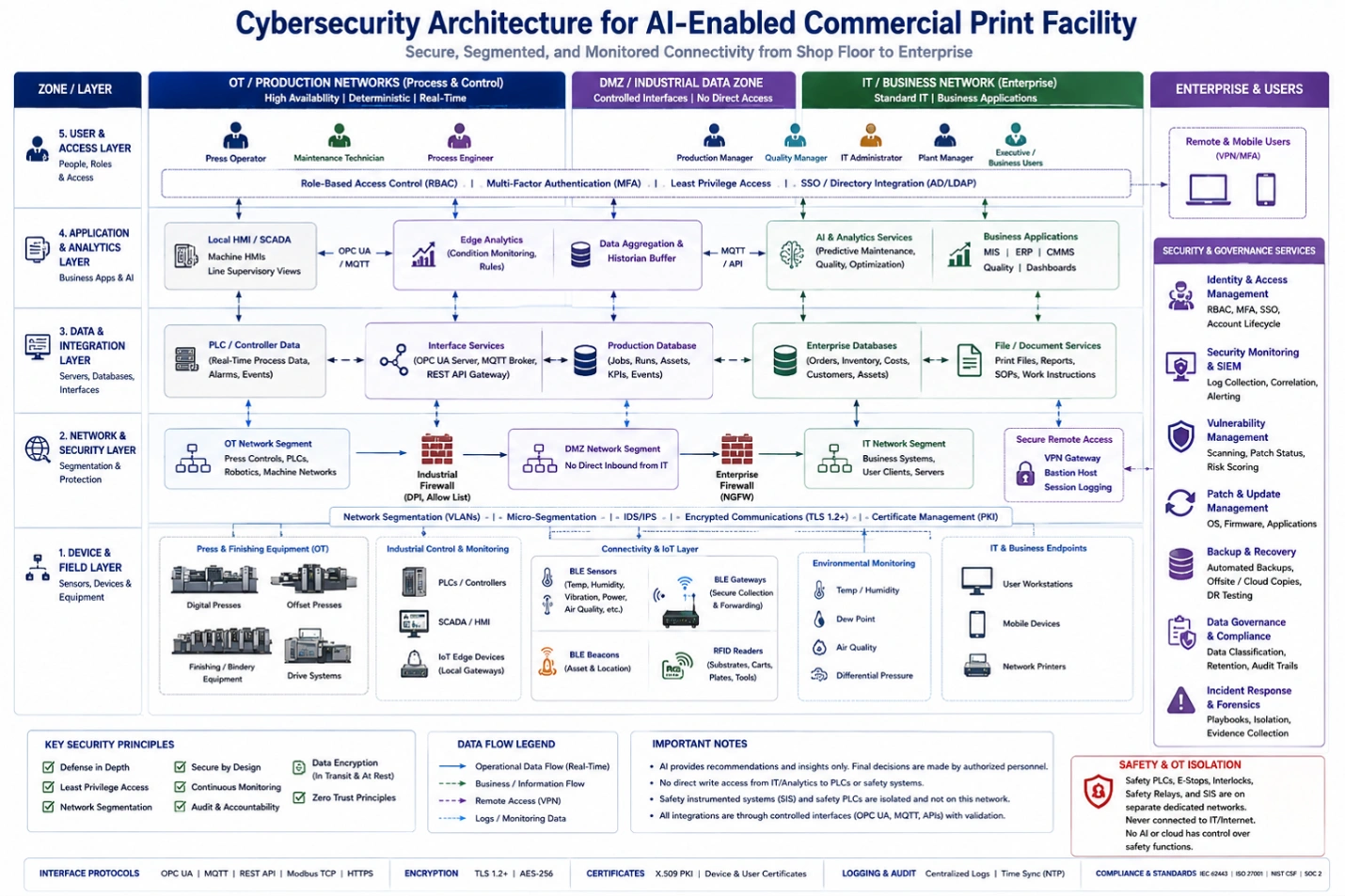
The completed diagram shows a segmented security model connecting commercial print equipment, BLE sensing, edge analytics, controlled data interfaces, AI services, and business applications. It emphasizes defense in depth, role-based access, encryption, monitoring, and controlled remote access while keeping press-control and safety functions isolated from AI and business networks.
AI Models and Analytics for Print Production
AI model selection should follow the production problem, data quality, operating variability, and required decision time. Commercial print services generate heterogeneous data because different jobs can use different substrates, colors, finishing processes, run lengths, press configurations, and quality requirements.
Predictive Maintenance Models
Time-series models, anomaly detection, classification, and regression can be used to evaluate equipment condition. Useful features may include vibration trends, temperature, motor current where available, operating hours, cycle counts, alarm frequency, maintenance history, and production load.
A model should be evaluated against actual maintenance outcomes rather than merely achieving a high statistical score on historical data. False positives can cause unnecessary inspections, while false negatives can allow an emerging problem to continue unnoticed.
Computer Vision for Print Quality
Computer vision can classify defects and compare output against approved references. Depending on the application, models may detect registration errors, missing print elements, color or density deviations, scratches, streaks, smearing, finishing defects, and other visual anomalies.
Training data should represent normal production variation as well as meaningful defects. Changes in substrate, lighting, camera position, print process, artwork, and finishing conditions can affect model performance. Production validation should therefore use representative jobs rather than relying exclusively on laboratory images.
Scheduling and Workflow Optimization
AI can support job sequencing by considering machine availability, estimated run time, substrate requirements, finishing constraints, due dates, setup requirements, operator availability, and downstream capacity.
The model should account for practical production rules. A mathematically efficient sequence may be unsuitable if it creates excessive substrate changes, additional wash-ups, incompatible finishing requirements, or bottlenecks at binding, cutting, folding, or shipping.
Environmental and Energy Analytics
AI can correlate temperature, humidity, equipment states, production schedules, and utility consumption with print-quality outcomes and production performance. This can help identify abnormal environmental conditions, inefficient idle periods, or unusual energy consumption.
BLE sensors can supplement fixed building-management or machine instrumentation where localized measurements are necessary. AI then provides context by relating those measurements to actual print activity rather than treating environmental readings as isolated numbers.
Implementation Lifecycle for AI-Enabled Commercial Print Services
Successful deployment normally begins with a narrowly defined operational problem. The technology selection should follow the problem rather than becoming the objective itself.
Planning and Baseline Measurement
The first step is to establish the baseline. A printer should document current performance for the selected use case before deploying AI.
Relevant KPIs can include:
- Overall equipment effectiveness where applicable
- Press utilization
- Make-ready time
- Setup time
- Throughput
- First-pass yield
- Scrap and substrate waste
- Reprint rate
- Defect rate
- Unplanned downtime
- Mean time between failures
- Mean time to repair
- Maintenance response time
- Job cycle time
- On-time job completion
- Energy consumption per unit of output
- Temperature and humidity excursions
- Asset search time
- Work-in-process dwell time
Baseline measurements make it possible to determine whether the AI solution actually improves production rather than simply generating more data.
Site Survey and Hardware Selection
A site survey should examine pressroom layout, finishing areas, substrate storage, electrical infrastructure, network availability, environmental conditions, radio propagation, equipment accessibility, and potential BLE interference.
Hardware selection should consider:
- Required sensing parameter and measurement range
- Sampling and transmission interval
- Battery life
- Mounting method
- Vibration and temperature exposure
- Enclosure requirements
- BLE radio performance
- Gateway coverage
- Firmware management
- Calibration requirements
- Hazardous-location requirements where applicable
- Network connectivity
- Integration interfaces
BLE should be selected where its wireless characteristics fit the application. RFID may be more appropriate for certain identification workflows, while wired instrumentation or existing machine telemetry may be preferable for high-frequency process measurements.
GAO has supplied BLE and RFID hardware products and IoT systems to organizations that require practical sensing, identification, and connectivity solutions. Engineering selection should still be based on the specific machine, facility, environment, and integration requirements.
Commissioning and Data Validation
Commissioning should verify device identity, sensor readings, timestamps, gateway coverage, network communication, data completeness, and association between physical assets and software records.
A common implementation mistake is beginning model development before validating the underlying data. AI cannot reliably compensate for incorrect asset identifiers, missing timestamps, inconsistent units, duplicated readings, sensor drift, or incomplete maintenance records.
Data validation should include expected ranges, missing-data detection, duplicate detection, timestamp synchronization, sensor-health status, and reconciliation against known machine states.
Pilot, KPI Verification, and Scale-Up
A controlled production pilot should focus on one or a small number of high-value use cases. The pilot should have predefined acceptance criteria, responsible personnel, baseline KPIs, data-quality thresholds, and escalation procedures.
Model performance should be monitored after deployment because print jobs, equipment condition, substrates, operating practices, and production schedules change. Model drift can occur when the operating distribution changes significantly from the training data.
Enterprise Software Integration for Commercial Print Services
AI becomes substantially more useful when its outputs enter the software already used by production, maintenance, quality, and management teams.
MIS systems can provide job specifications, schedules, customer orders, machine assignments, and production status. ERP systems can connect production activity with inventory, purchasing, costing, and order management. CMMS software can receive maintenance recommendations and associate them with equipment histories and work orders.
Quality systems can provide inspection results, defect classifications, approval records, and corrective-action information. Warehouse and material-management systems can provide substrate inventory and movement information.
BLE asset information can be associated with these records through consistent asset identifiers. For example, a BLE beacon attached to a finishing cart has limited value if the software cannot associate its identifier with the corresponding cart record and production workflow.
Interfaces should define ownership of master data. The MIS should not unexpectedly overwrite an asset identifier maintained by another system, and AI software should not become the uncontrolled source of truth for production orders.
AI Integration for Commercial Print Production and Operations
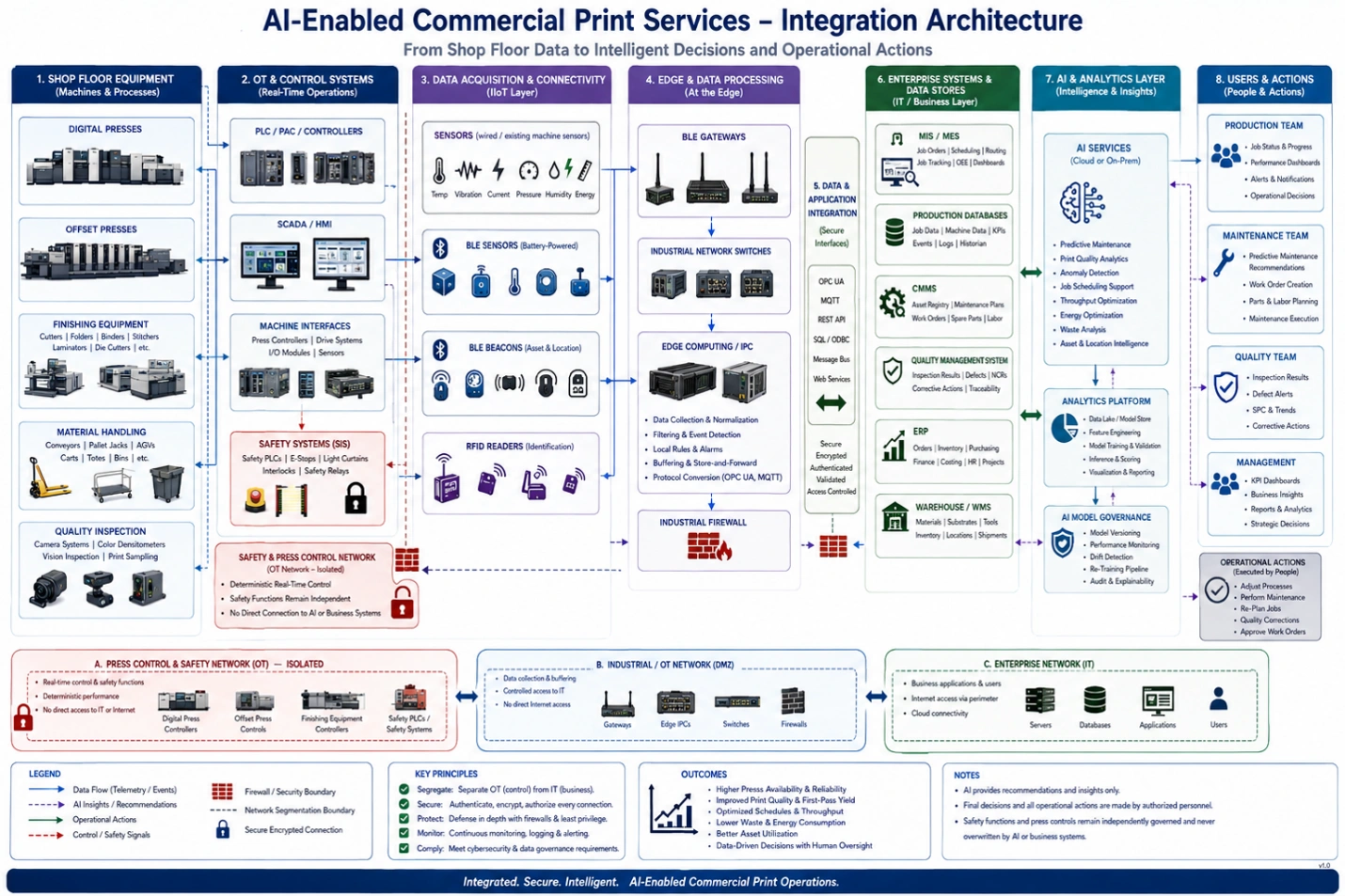
The completed diagram shows how commercial print equipment, PLCs, SCADA, BLE sensors, BLE beacons, and RFID readers feed edge processing and controlled data interfaces before reaching MIS, CMMS, ERP, quality, warehouse, and AI systems. It also maps AI recommendations to production, maintenance, quality, and management actions while maintaining independent governance of press-control and safety functions.
Commercial Print KPIs for AI-Enabled Operations
AI projects should be evaluated through production outcomes rather than sensor counts or dashboard usage. A practical KPI framework can connect technical performance with print-shop economics.
| Operational Area | Representative KPI | AI or IoT Contribution |
|---|---|---|
| Press production | Press utilization | Identifies idle, setup, and production patterns |
| Make-ready | Average make-ready duration | Finds recurring setup causes and sequencing opportunities |
| Quality | First-pass yield | Correlates process conditions with quality outcomes |
| Waste | Substrate waste rate | Identifies process and job conditions associated with waste |
| Reliability | Unplanned downtime | Detects abnormal equipment behavior |
| Maintenance | Mean time between failures | Supports condition-based intervention |
| Maintenance | Mean time to repair | Provides equipment and fault context |
| Workflow | Work-in-process dwell time | Identifies bottlenecks and waiting conditions |
| Scheduling | On-time completion | Supports production-sequence decisions |
| Energy | Energy per unit of output | Correlates consumption with actual production |
| Asset management | Asset search time | Uses BLE location or proximity information |
| Environment | Humidity excursion duration | Identifies conditions associated with substrate issues |
The appropriate KPI set depends on the print process. A high-volume offset printer may emphasize make-ready, substrate waste, press utilization, and plate-related workflow, while a digital commercial printer may place greater emphasis on job changeover, variable-data production, uptime, toner or consumable management, and short-run scheduling.
Practical Benefits of AI-Enabled Commercial Print Services
Combining AI with appropriately selected connected sensing can improve commercial print operations because the system can correlate physical conditions with production events rather than analyzing each data source independently.
Earlier Detection of Equipment Problems
Condition indicators can reveal changes before a conventional failure alarm occurs. Earlier awareness gives maintenance personnel an opportunity to inspect equipment during a planned window instead of reacting after a press or finishing line becomes unavailable.
Better Print-Quality Control
Computer vision and process analytics can identify defects earlier and help engineers investigate relationships between quality outcomes and process conditions. This can reduce the amount of downstream material requiring rework or reprinting.
Improved Workflow Visibility
BLE-enabled asset visibility can reduce time spent locating mobile production resources. When location information is associated with job and asset records, supervisors can better understand where work-in-process and supporting equipment are situated.
More Effective Production Planning
AI-assisted scheduling can evaluate multiple constraints simultaneously, including machine availability, job due dates, substrate requirements, setup changes, finishing capacity, and historical production behavior. This can help planners identify conflicts before they become late jobs.
Scalable Multi-Press and Multi-Site Analytics
A common data model allows analytics to be extended from one press or production area to additional equipment. Cloud deployment can make centralized multi-site analytics easier, while Server Version deployments can provide stronger local control where required.
Scaling should occur only after the original use case has demonstrated measurable value and the facility has established repeatable device management, cybersecurity, data-quality, and support procedures.
Selecting the Right AI and BLE Use Cases for Commercial Print Services
Not every print-shop problem requires AI or wireless sensing. Existing press telemetry, PLC data, MIS records, CMMS history, or quality databases may already contain enough information to solve a problem.
A useful decision process asks:
- Is the operational problem clearly defined?
- Is the affected press, finishing machine, workflow, or asset sufficiently important to justify instrumentation?
- Does reliable historical data already exist?
- Would additional BLE sensing provide information unavailable from existing systems?
- Does the application require asset identification or location information?
- Can the selected BLE hardware operate reliably in the intended radio environment?
- Are temperature, humidity, vibration, dust, chemicals, or other environmental conditions relevant to hardware selection?
- Are there hazardous-location requirements that affect device selection?
- Is sufficient historical data available to train and validate the intended AI model?
- Can the AI output be integrated into MIS, CMMS, ERP, quality, or production workflows?
- Are cybersecurity and data-governance requirements defined before deployment?
- Is there a measurable KPI that should improve if the use case succeeds?
A use case should normally proceed to a controlled pilot when the operational problem is material, data quality is sufficient, the sensing approach is technically feasible, integration requirements are understood, and a measurable KPI improvement can be evaluated.
Operational Dashboard for Commercial Print Services
A useful dashboard should present decisions and exceptions rather than simply displaying sensor readings. Production managers may need press utilization, job progress, bottlenecks, and quality status. Reliability engineers may need equipment-health trends and prediction confidence. Maintenance teams may need prioritized recommendations linked to CMMS work orders.
A representative dashboard can include:
- Press and finishing equipment health indicators
- Predictive-maintenance alerts
- Production throughput
- Make-ready and setup trends
- First-pass yield and defect trends
- Substrate waste
- Energy consumption per unit of output
- BLE asset locations
- Sensor and gateway health
- AI prediction confidence
- Unplanned downtime
- Open maintenance work orders
- Job status and workflow bottlenecks
AI confidence should be displayed carefully. A high model confidence does not prove that a physical fault exists. Operators and maintenance personnel should be able to inspect supporting evidence, historical trends, and relevant equipment context before taking action.
Implementation Recommendations for Commercial Print Services
The strongest AI and BLE deployments usually begin with a narrowly scoped production problem and expand only after technical and business validation.
- Select a KPI before selecting the AI model or wireless hardware.
- Use existing press, PLC, MIS, CMMS, and quality data wherever it is already reliable.
- Deploy BLE only where wireless sensing or asset visibility provides information that existing systems cannot provide economically.
- Perform an RF site survey before finalizing gateway locations.
- Validate sensor placement against the actual physical process and substrate environment.
- Establish consistent identifiers for presses, assets, jobs, sensors, gateways, and work orders.
- Keep AI analytics separate from safety-critical press-control functions.
- Define cybersecurity, authentication, network segmentation, logging, and patching requirements before commissioning.
- Validate timestamps, units, asset relationships, missing data, and sensor health before training AI models.
- Test AI models using representative commercial print jobs and operating conditions.
- Integrate recommendations into existing MIS, CMMS, ERP, and quality workflows instead of creating parallel manual processes.
- Give operators and maintenance personnel clear mechanisms to review, accept, reject, or investigate AI recommendations.
- Establish model-monitoring procedures so performance is reassessed when equipment, substrates, software, or production practices change.
- Scale from a validated pilot to additional presses, finishing areas, or facilities only after repeatable deployment and support procedures are established.
Building Practical AI and IoT Value in Commercial Print Services
AI for commercial print services is most effective when it connects measurable production problems with trustworthy operational data. Predictive maintenance can use equipment-condition information to support earlier intervention. Computer vision can improve inspection and defect analysis. AI-assisted scheduling can evaluate complex production constraints, while environmental and asset data can add physical context to MIS, CMMS, and quality records.
BLE sensors, BLE beacons, and BLE gateways are enabling components rather than the objective. Their value comes from supplying reliable information that improves an identified business or engineering decision.
GAO has supported organizations by providing BLE, RFID, and IoT hardware products and systems for applications requiring wireless sensing, identification, connectivity, and asset visibility. Headquartered in New York City and Toronto, Canada, GAO is recognized among the leading global B2B and B2G BLE and RFID suppliers. Organizations evaluating AI-enabled commercial print solutions can use GAO’s product resources and technical support as part of the hardware and systems-engineering evaluation process.
GAO Engineering Experience for Commercial Print IoT Deployments
GAO, GAO Research, and GAO Tek form the GAO Group, with operations based in New York City and Toronto, Canada. For three decades, the group has served customers across the United States and Canada, including Fortune 500 companies, leading research and development organizations, universities, and government agencies.
That experience is relevant to commercial print deployments because wireless sensing projects require more than selecting a BLE device. RF behavior, device mounting, battery management, network connectivity, data interfaces, environmental conditions, cybersecurity, and long-term support all influence system reliability.
GAO has invested substantially in research and development of BLE, RFID, and IoT products and systems. Stringent quality-assurance processes and remote or onsite technical support can help organizations address hardware selection, deployment, troubleshooting, and integration requirements throughout the implementation lifecycle.
AI-Enabled Commercial Print Services With Reliable Operational Data
AI can help commercial print services move from reactive production management toward data-supported decisions across maintenance, quality, scheduling, asset visibility, workflow, and energy management. The most defensible implementations begin with measurable problems, establish baseline KPIs, validate data quality, select sensing technologies according to the physical process, and integrate AI recommendations into established print-management workflows.
BLE is particularly useful when commercial printers need practical wireless sensing or visibility for selected mobile assets and environmental conditions. Existing machine telemetry, RFID, wired instrumentation, and industrial interfaces should remain part of the design wherever they provide better technical or economic fit.
A phased approach, strong cybersecurity controls, human validation of consequential decisions, and continuous KPI and model monitoring provide a practical foundation for scaling AI-enabled commercial print services.
GAO can provide BLE, RFID, and IoT hardware products and technical support for organizations evaluating connected commercial print applications. Readers can explore GAO’s technology resources, discuss application requirements with our technical team, and determine which sensing and connectivity approach best fits their print production environment.
Building the Future of Industrial AI and IoT with Aperture Venture Studio and GAO RFID Inc.
For more than three decades, GAO Group of Companies has invested heavily in R&D of industrial BLE, RFID, and IoT. As generative AI has become useful for industrial applications, we have expanded our work in AIoT technologies and founded Aperture Venture Studio to advance practical AI and IoT solutions relevant to areas such as commercial print services.
Aperture brings together AI and IoT technical experts, operational leaders, investors, and technology companies. We also developed Aperture Ventures Summit and TekSummit to discuss advanced AI and IoT topics.
We welcome participation as:
- Advisors, co-founders, or employees
- Investors
- Customers