
AI and BLE for Electronic Assembly Plants
AI and BLE Enabled Electronic Assembly Plant Overview
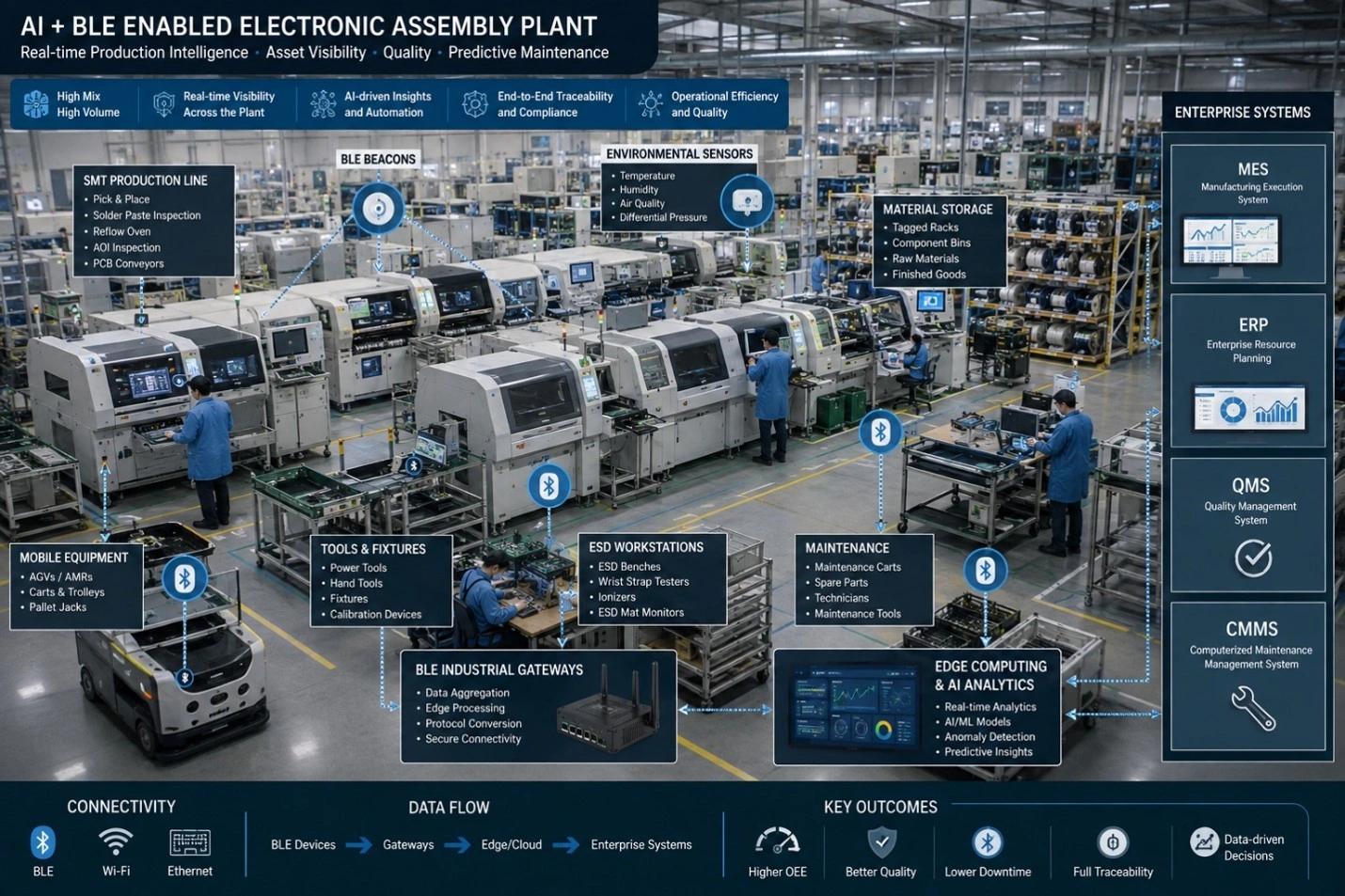
AI for Electronic Assembly Plants: From Production Data to Operational Decisions
AI for electronic assembly plants combines production data, machine information, quality records, material movement, environmental measurements, and workforce or asset location data to improve manufacturing decisions. BLE Gateways, BLE Beacons, and BLE Sensors can provide a practical wireless data layer for tracking materials, mobile assets, tools, work-in-progress, and environmental conditions across SMT lines and supporting production areas.
The value of AI comes from converting these observations into actionable predictions and recommendations. A manufacturing team can use AI to identify production bottlenecks, detect abnormal process conditions, predict equipment maintenance requirements, prioritize quality investigations, and improve material replenishment. BLE provides location, identification, proximity, and sensor information that can complement data already generated by PLCs, machines, MES, ERP, and quality systems.
Electronic assembly plants present particularly demanding data requirements because production depends on tightly coordinated processes such as solder paste printing, component placement, reflow, inspection, testing, rework, material kitting, and line changeovers. AI becomes more useful when these processes are represented by reliable, time-stamped operational data.
GAO supplies BLE, RFID, and IoT hardware products and systems that can support industrial data collection requirements, allowing electronic assembly organizations to select wireless sensing and identification components according to production conditions, asset types, coverage requirements, and integration needs.
How AI Improves Electronic Assembly Operations
AI does not replace the manufacturing control system. It adds analytical capabilities that help engineers, production managers, maintenance teams, and quality personnel interpret large volumes of operational information.
Relevant AI capabilities include:
- Predictive maintenance: Machine operating conditions, maintenance history, alarms, runtime, and environmental measurements can be analyzed to identify patterns associated with equipment degradation or impending failure.
- Production bottleneck detection: AI models can correlate cycle time, queue length, work-in-progress movement, downtime, changeovers, and inspection results to identify constraints across SMT and downstream assembly processes.
- Quality analytics: Historical inspection and process data can be used to detect relationships between process conditions and defects such as solder bridging, insufficient solder, component placement errors, tombstoning, or other assembly anomalies.
- Material flow optimization: AI can analyze component consumption, line-side inventory, replenishment activity, and material movement to improve kitting and reduce production interruptions caused by missing components.
- Work-in-progress visibility: BLE-enabled identification and location data can help determine where carts, trays, kits, assemblies, or other mobile production assets are located.
- Environmental monitoring: BLE Sensors can capture temperature, humidity, vibration, or other applicable conditions around sensitive production, storage, and equipment areas.
- Anomaly detection: Machine, sensor, quality, and location data can be compared with learned operating patterns to flag unusual conditions for engineering review.
- Production forecasting: AI can combine historical throughput, production schedules, equipment utilization, material availability, and quality performance to support capacity and production planning.
Electronic Assembly Plant Use Cases for AI and BLE
AI-Driven Material and WIP Tracking
Electronic assembly depends on the timely movement of PCBs, component reels, feeders, trays, kits, work orders, and completed assemblies. Missing or misplaced materials can interrupt an SMT line even when the production equipment itself is available.
BLE Beacons can be attached to mobile assets, carts, containers, kits, or other trackable items, while BLE Gateways positioned throughout production areas receive beacon transmissions. The resulting location events can be associated with work orders, production lines, material records, and inventory transactions.
AI can analyze movement histories to identify recurring delays, unusual dwell times, inefficient material routes, or WIP accumulation. This can help production teams distinguish between an isolated material delay and a recurring process bottleneck.
Predictive Maintenance for SMT and Assembly Equipment
Equipment availability is critical to electronic assembly throughput. Production environments can contain pick-and-place machines, solder paste printers, reflow ovens, conveyors, AOI systems, SPI equipment, functional testers, compressors, feeders, and supporting utilities.
AI-based maintenance models can combine equipment runtime, alarm information, maintenance records, production loads, sensor measurements, and historical failure patterns. BLE Sensors can complement machine-generated information where additional wireless measurements are practical.
For example, vibration or environmental measurements around supporting equipment can provide additional signals for anomaly detection. The AI system can prioritize equipment requiring engineering attention instead of relying only on fixed maintenance intervals.
AI-Assisted Quality and Defect Analysis
Quality problems in electronic assembly can originate from multiple process stages. A defect detected by AOI or electrical testing may be related to upstream material handling, solder paste conditions, component placement, reflow conditions, tooling, or environmental factors.
AI can correlate inspection results with production timestamps, equipment states, work orders, material lots, operator activities, and environmental observations. BLE data can add location and proximity context to this analysis.
The objective is not simply to identify that a defect occurred. A more useful system attempts to determine the conditions associated with higher defect probability and presents those findings to quality and process engineers for investigation.
Line-Side Inventory and Replenishment
Material availability directly affects line utilization. Component reels, feeder banks, trays, and kits can move between warehouses, kitting areas, staging zones, and SMT lines.
BLE-enabled tracking can provide additional visibility into these movements. AI can then analyze consumption rates, replenishment intervals, production schedules, and historical shortages to help determine when materials should be moved toward a line.
This approach is especially useful where manual inventory checks or barcode scans do not provide sufficiently frequent location information.
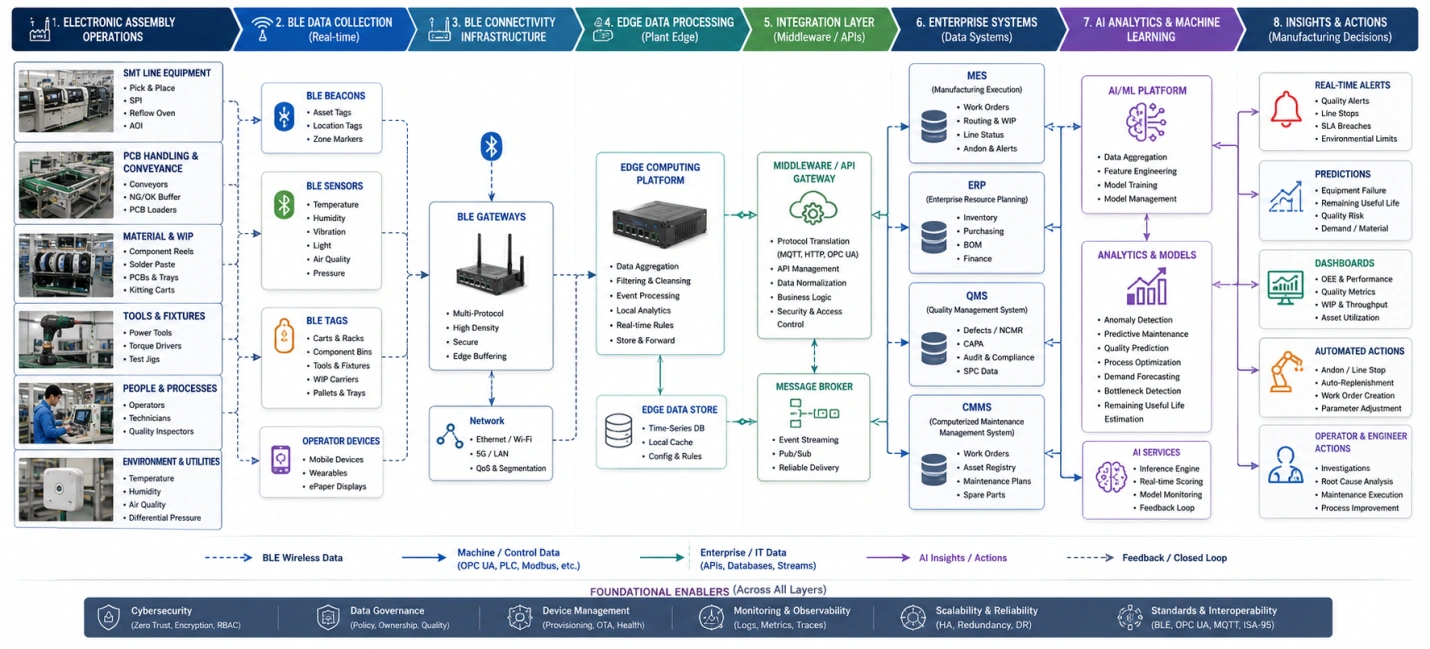
Electronic Assembly Production Workflow: From Data Capture to AI Decisions
AI deployment in an electronic assembly plant typically begins with data acquisition rather than the AI model itself. Reliable data capture, time synchronization, asset identification, communication coverage, integration, and data quality determine whether downstream analytics will be useful.
Data Acquisition Across the Assembly Plant
Production information can originate from SMT machines, PLCs, AOI and SPI equipment, test stations, environmental sensors, MES transactions, ERP records, maintenance systems, and quality databases.
BLE adds another category of operational observations. BLE Beacons can identify mobile assets or locations, while BLE Sensors can provide applicable measurements. BLE Gateways receive wireless transmissions and forward relevant data to software systems.
Wireless Communication and Edge Processing
BLE is well suited to many short-range industrial sensing and identification applications, but deployment should account for metal structures, machinery, RF interference, production-line density, gateway placement, and required coverage.
BLE Gateways can perform functions such as device communication, data collection, filtering, buffering, protocol conversion, and forwarding to higher-level software. Edge processing can reduce unnecessary data transmission and support applications where rapid local processing or temporary network disconnection must be tolerated.
A site survey should therefore consider production-line geometry, equipment enclosures, storage racks, walls, RF propagation, gateway mounting positions, power availability, network connectivity, and maintenance access.
Middleware and Enterprise Software Integration
Collected information becomes operationally useful when it is associated with manufacturing entities such as work orders, production lines, assets, material IDs, equipment IDs, and timestamps.
Middleware can normalize BLE observations and connect them with manufacturing applications. Depending on the existing plant environment, integrations may involve MES, ERP, CMMS or EAM software, QMS, warehouse systems, databases, dashboards, and analytics applications.
Common communication and integration mechanisms can include MQTT, REST APIs, WebSockets, database interfaces, OPC UA, industrial Ethernet, and other protocols appropriate to the equipment and software environment.
AI Analytics and Business Actions
After data normalization, AI models can perform classification, regression, clustering, anomaly detection, forecasting, predictive maintenance analysis, or optimization.
The final output should be connected to a specific manufacturing decision. Examples include:
- Maintenance engineering receives a high-priority equipment anomaly for inspection.
- Production control receives an alert about abnormal WIP dwell time.
- Material handling receives a replenishment recommendation.
- Quality engineering receives an alert identifying a process condition associated with elevated defect rates.
- Operations management receives a production bottleneck indicator.
- Facilities personnel receive an environmental condition alert.
The important engineering principle is to connect every AI output to a defined operational owner and response procedure.
End-to-End Electronic Assembly AI and BLE Workflow
BLE Hardware and Software for Electronic Assembly Plants
BLE infrastructure should be selected according to the physical environment and the specific manufacturing problem being solved. A tracking application for mobile carts has different requirements from an environmental monitoring application or tool-location system.
BLE Beacons
BLE Beacons periodically transmit identification information that can be detected by nearby gateways or compatible receivers. In electronic assembly plants, they can be attached to carts, material containers, tooling, feeders, test equipment, mobile racks, or other assets where location or proximity information is valuable.
Beacon selection should consider battery life, transmission interval, enclosure requirements, mounting method, operating temperature, maintenance access, and required detection range.
BLE Sensors
BLE Sensors extend wireless monitoring beyond identification and proximity. Depending on the selected device, sensors can measure parameters such as temperature, humidity, vibration, motion, or other applicable conditions.
Electronic assembly plants should select sensor types based on the process requirement rather than attempting to monitor every possible parameter. Critical considerations include sensor accuracy, calibration requirements, sampling frequency, battery life, environmental protection, and data retention.
BLE Gateways
BLE Gateways provide the connection between wireless BLE devices and plant software or network infrastructure. Gateway placement is particularly important in production environments containing machinery, metal racks, enclosures, and dense equipment.
A gateway deployment should be engineered around coverage, capacity, redundancy, network connectivity, power availability, cybersecurity requirements, and maintenance accessibility.
GAO provides BLE hardware and IoT systems that can be evaluated for applications including industrial asset monitoring, wireless sensing, identification, and data collection.
AI Models and Computing Resources
The appropriate AI model depends on the manufacturing question and the available data. Anomaly detection may be appropriate when labeled failure data is limited. Classification can support defect or event categorization. Regression can estimate continuous outcomes such as cycle time or energy-related measurements. Time-series forecasting can support production or maintenance planning.
Computing can be distributed between edge systems, private servers, and cloud infrastructure. The choice depends on latency, data volume, cybersecurity requirements, network availability, integration constraints, and organizational IT policies.
Cloud Version and Server Version
A Cloud Version can host AI analytics, data storage, dashboards, device management, and related software within cloud infrastructure. This model can be appropriate for organizations seeking centralized management across multiple electronic assembly plants and easier access to scalable computing resources.
A Server Version can run on factory servers, edge servers, customer-managed infrastructure, private data centers, or other privately hosted enterprise environments. This approach can be preferable when manufacturing data must remain within controlled infrastructure, when plant connectivity is limited, or when organizational policies require greater control over data processing.
Hybrid deployments are also practical. A plant may process time-sensitive events locally while forwarding selected historical data to centralized analytics infrastructure.
The deployment decision should consider data governance, latency, network resilience, integration with existing manufacturing systems, software maintenance, cybersecurity controls, and the number of production sites involved.
Security and Industrial Integration
BLE-enabled systems should be incorporated into the plant’s broader cybersecurity program. Relevant controls can include device authentication, encrypted communications where supported, secure gateway configuration, network segmentation, credential management, access control, software updates, logging, and monitoring.
Integration with MES, ERP, QMS, CMMS, and other systems should use controlled interfaces and clearly defined data ownership. BLE should complement existing manufacturing controls rather than bypassing established safety or production-control mechanisms.
Engineering Considerations Before Deployment
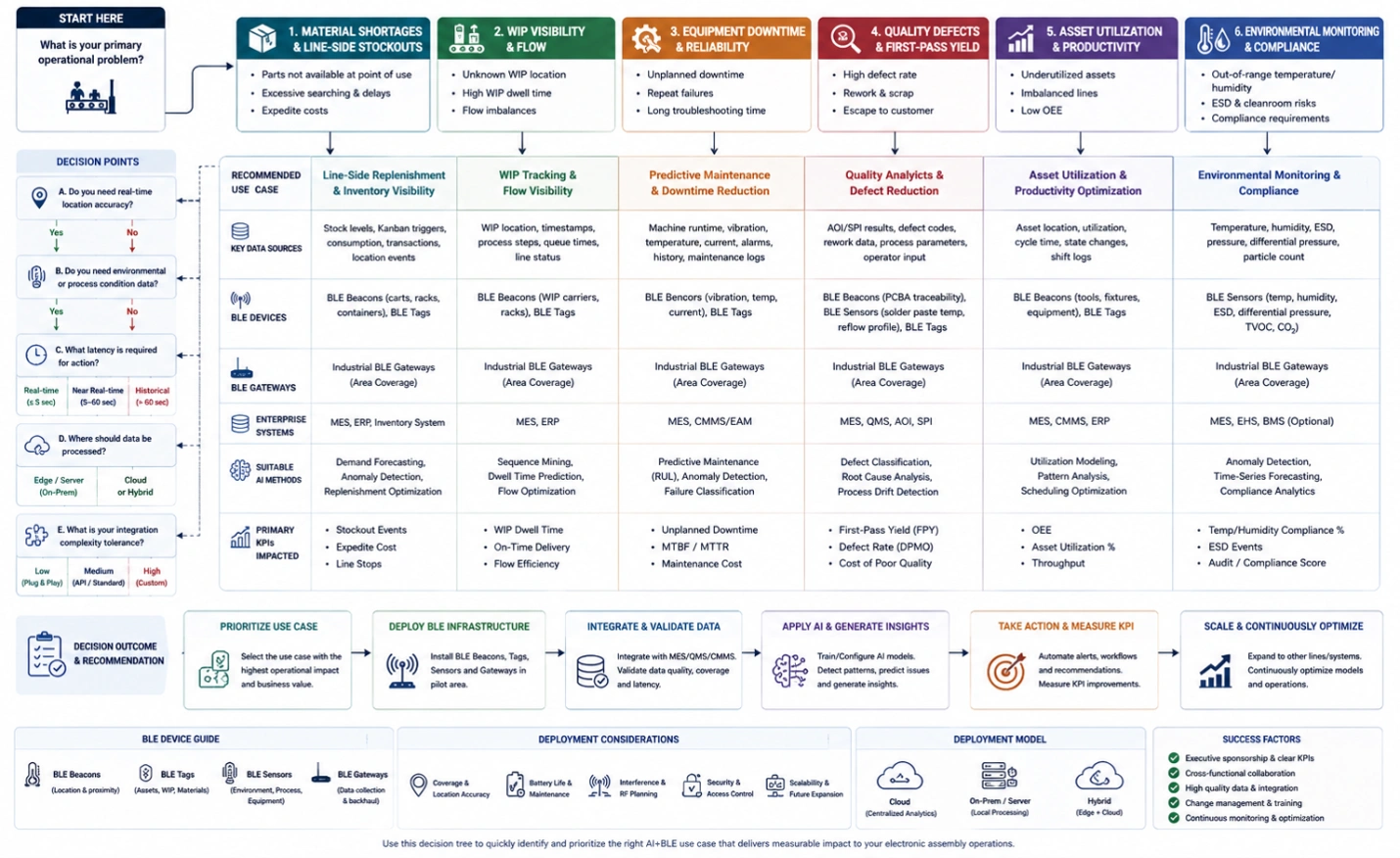
A successful electronic assembly deployment requires more than installing BLE hardware and connecting an AI model. Engineering teams should first establish the operational problem, measurable KPI, data sources, integration requirements, and response workflow.
Key planning considerations include:
- Define whether the primary objective is WIP visibility, material availability, maintenance prediction, quality analysis, environmental monitoring, asset utilization, or another measurable manufacturing outcome.
- Identify the assets, processes, work areas, and production lines that require data.
- Perform an RF site survey before finalizing BLE Gateway locations.
- Determine the required location accuracy and whether room-level, zone-level, or more precise positioning is actually necessary.
- Establish data retention, timestamping, device identity, and event-quality requirements.
- Map BLE observations to MES, ERP, QMS, CMMS, or other relevant records.
- Select AI methods according to available historical data and the specific decision being supported.
- Define cybersecurity requirements before connecting wireless gateways to production networks.
- Pilot the solution on a representative production area before expanding across the plant.
- Establish KPI baselines so improvements can be measured against the pre-deployment process.
The next stage is to validate the system under actual production conditions, including line changeovers, equipment downtime, material movement, RF interference, network interruptions, battery replacement cycles, and maintenance activities.
AI-Driven Operational Improvements in Electronic Assembly Plants
Combining AI analytics with BLE-generated operational data can improve how electronic assembly plants monitor production, materials, equipment, and environmental conditions. The greatest value comes when AI outputs are connected to established manufacturing workflows rather than treated as standalone dashboards.
Improved Production Visibility
BLE-enabled location and identification data can provide additional visibility into mobile production assets, material carts, kits, trays, tooling, and work-in-progress. AI can analyze movement patterns and dwell times to identify abnormal delays.
For example, repeated WIP accumulation between inspection and rework may indicate a capacity constraint, recurring quality issue, or process imbalance. Combining BLE movement events with MES production records allows engineers to investigate the underlying process instead of relying solely on manual observations.
Reduced Unplanned Equipment Downtime
Predictive maintenance models can identify combinations of machine conditions that historically preceded equipment problems. BLE Sensors can provide supplementary measurements around equipment where existing machine instrumentation does not capture sufficient information.
The system can prioritize maintenance based on predicted risk, production impact, and equipment criticality. This supports a shift from purely calendar-based maintenance toward condition-informed maintenance decisions.
Better Material Availability
AI can evaluate component consumption, production schedules, inventory levels, replenishment frequency, and material movement. BLE tracking adds information about where mobile material assets are physically located.
This can help distinguish between material that is genuinely unavailable and material that exists in the plant but has not reached the required production area.
For high-mix electronic assembly operations, this distinction can be particularly important because many component types may be required for different work orders and frequent changeovers can increase material-handling complexity.
Faster Quality Investigation
Quality engineers often need to correlate inspection failures with upstream process information. AI can accelerate this investigation by identifying relationships among defect records, equipment conditions, material lots, process timestamps, environmental measurements, and production events.
BLE data can provide additional context about the movement or location of relevant assets. The result is a more complete event history that can help engineers determine where and when an abnormal condition occurred.
More Effective Asset Utilization
Electronic assembly plants use numerous mobile and semi-mobile assets, including carts, feeders, tooling, test equipment, material racks, and maintenance equipment.
BLE-based visibility can provide utilization and movement information. AI can analyze this history to identify underused assets, excessive idle periods, recurring congestion, or inefficient allocation patterns.
This can support decisions about asset placement, production-line support, maintenance scheduling, and equipment allocation.
Measuring AI Performance in Electronic Assembly Plants
AI and BLE deployments should be evaluated against measurable production and engineering KPIs. A technically sophisticated system has limited operational value if its impact cannot be demonstrated.
Relevant KPIs can include:
- Overall Equipment Effectiveness (OEE): Measures availability, performance, and quality across applicable production equipment.
- First Pass Yield (FPY): Measures the proportion of assemblies that pass the relevant process without requiring rework.
- Defect rate: Tracks quality failures by product, line, process, component, or production period.
- Unplanned downtime: Measures production time lost because of unexpected equipment failures or process interruptions.
- Mean Time Between Failures (MTBF): Helps evaluate equipment reliability.
- Mean Time to Repair (MTTR): Measures how quickly equipment failures are resolved.
- WIP dwell time: Measures how long material or assemblies remain in particular process stages.
- Material shortage events: Tracks production interruptions associated with unavailable or misplaced components.
- Asset utilization: Measures how effectively mobile equipment, tooling, carts, feeders, and other assets are being used.
- AI alert precision: Measures how frequently AI-generated alerts correspond to meaningful operational conditions.
- False-positive rate: Helps determine whether excessive alerts are creating unnecessary engineering workload.
- BLE coverage and event reliability: Evaluates whether wireless observations are sufficiently consistent for the intended application.
Baseline measurements should be established before deployment. Post-deployment performance can then be compared with the baseline to determine whether the solution produces measurable improvement.
Scaling from a Pilot to Multiple Electronic Assembly Lines
A pilot should begin with a clearly defined production problem rather than attempting to digitize an entire plant simultaneously.
A representative pilot might cover one SMT line, one material staging area, or one equipment-maintenance process. The selected area should contain enough operational complexity to validate BLE coverage, data integration, AI performance, and user workflows.
Once the pilot demonstrates reliable data and measurable value, expansion can proceed to additional production lines and supporting areas.
Hardware Scaling
Scaling requires consistent device configuration, gateway placement standards, battery-management procedures, mounting methods, device identification, and maintenance processes.
Production areas should be reviewed individually because RF behavior can differ significantly between open manufacturing floors, component storage areas, enclosed equipment zones, and dense metal-rack environments.
Software Scaling
Software should support increasing numbers of BLE devices, gateways, events, historical records, users, and AI workloads.
Data models should maintain consistent identifiers for assets, equipment, production lines, work orders, materials, and locations. This is essential when data from multiple lines must be analyzed together.
Multi-Site Deployment
Organizations operating multiple electronic assembly facilities may centralize selected analytics while keeping plant-level processing close to production systems.
A multi-site deployment should account for differences in:
- Production equipment
- MES and ERP implementations
- Network infrastructure
- RF environments
- Cybersecurity policies
- Data-retention requirements
- Manufacturing processes
- Product mix
- Local maintenance procedures
Standardizing the data model while allowing site-specific configuration can reduce integration complexity.
Commissioning, Testing, and Optimization
Commissioning should verify both the wireless infrastructure and the complete business workflow.
BLE Commissioning
Engineering teams should verify:
- Gateway coverage throughout required production zones
- Reliable beacon detection
- Sensor reporting intervals
- Battery status and expected battery life
- Device identification
- Gateway connectivity
- RF performance near machinery and metal structures
- Data buffering during temporary network interruptions
- Correct timestamps and location associations
Coverage should be validated under actual operating conditions rather than only during an empty-floor test.
Data Validation
Collected BLE events should be compared against known physical events. For example, when a tagged production cart moves from material staging to an SMT line, the software record should correspond to the actual movement.
Validation should identify missing events, duplicate events, unexpected location changes, incorrect device associations, and timestamp inconsistencies.
AI Model Validation
AI models should be evaluated using appropriate performance metrics and production scenarios. Historical validation should be supplemented with real-world testing because manufacturing conditions can change over time.
Model performance can degrade when:
- Product configurations change
- Production volumes change
- New equipment is introduced
- Maintenance procedures change
- Sensor behavior changes
- Manufacturing processes are modified
- Data distributions shift
Model monitoring and periodic retraining should therefore be included in the operational plan where appropriate.
AI Deployment Lifecycle for Electronic Assembly Plants
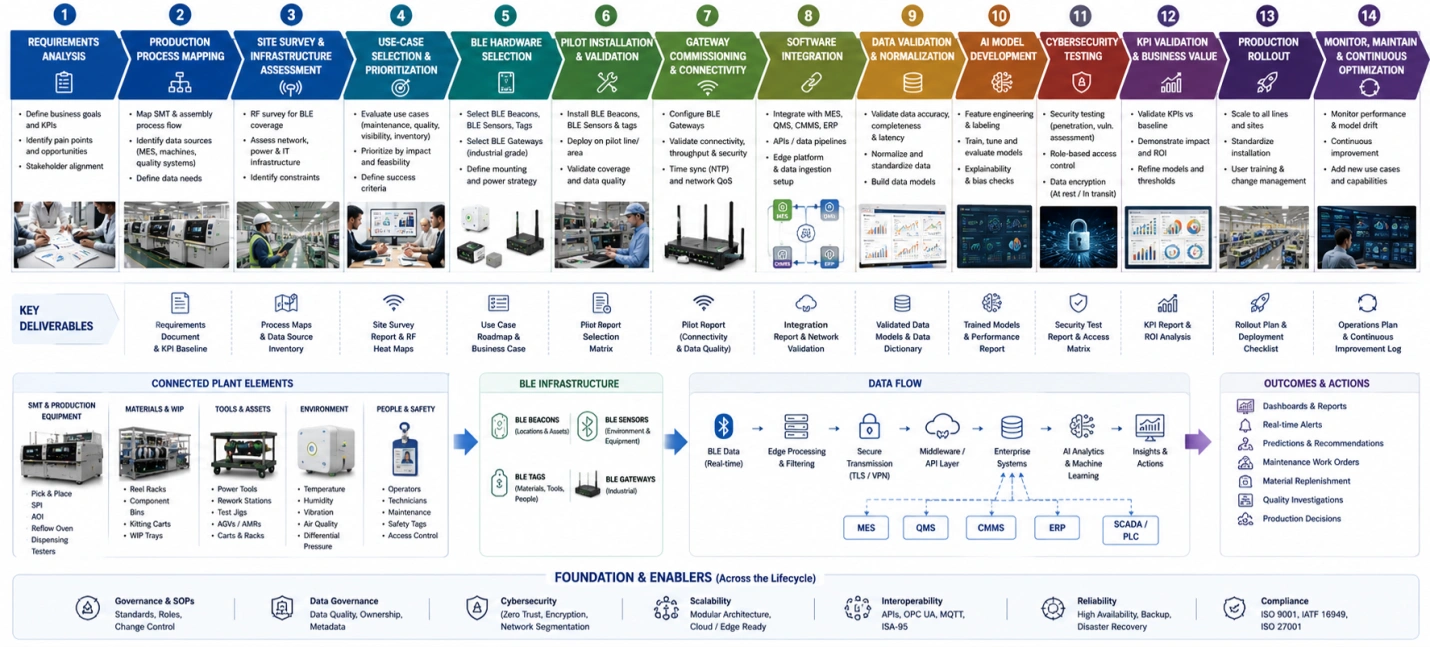
Cybersecurity and Interoperability for Electronic Assembly AI Systems
Security should cover the complete path from BLE devices through gateways, networks, software, AI services, and enterprise applications.
BLE devices should be managed as part of the plant’s connected-device inventory. Gateway access should be restricted according to organizational policies, and credentials should be controlled and rotated where supported.
Network segmentation can separate wireless gateway traffic from sensitive production-control networks. Firewall rules and access controls should restrict communications to required destinations and services.
Data interfaces should also be documented. MES, ERP, QMS, CMMS, and analytics systems should exchange only the information required for the defined workflow.
Interoperability is equally important. Electronic assembly plants frequently operate equipment from multiple manufacturers. A practical solution should therefore accommodate existing interfaces instead of requiring wholesale replacement of production equipment.
Protocols such as MQTT, OPC UA, REST APIs, database interfaces, and industrial networking technologies may be used at different layers depending on the equipment and software involved.
GAO’s experience supplying BLE, RFID, and IoT hardware products and systems can support organizations evaluating wireless identification, sensing, and asset-monitoring requirements alongside existing manufacturing technologies.
Implementation Recommendations for Electronic Assembly Plants
A practical implementation strategy should prioritize measurable manufacturing problems and controlled engineering validation.
- Start with one high-value production problem such as material shortages, WIP visibility, equipment downtime, or quality investigation.
- Establish baseline KPIs before installing the AI and BLE solution.
- Perform an RF site survey and identify gateway locations before final hardware installation.
- Select BLE Beacons and BLE Sensors according to asset type, operating environment, battery requirements, and required data.
- Validate gateway coverage under real production conditions.
- Integrate BLE events with existing MES, ERP, QMS, CMMS, or other relevant software.
- Establish clear ownership for every AI-generated alert or recommendation.
- Validate AI models using representative historical and production data.
- Include cybersecurity, device management, data governance, and software maintenance in the deployment plan.
- Pilot the solution before expanding across multiple lines.
- Monitor AI performance and data quality after commissioning.
- Standardize device identifiers, asset records, locations, and data structures before multi-line or multi-site expansion.
Building the Business Case for AI in Electronic Assembly
The business case should connect technical capabilities with measurable production outcomes. Cost justification can include reduced downtime, fewer material-related production interruptions, faster quality investigations, improved asset utilization, reduced manual tracking effort, and better maintenance planning.
The value will vary by plant configuration. A high-volume SMT facility may prioritize equipment uptime and process quality, while a high-mix assembly operation may place greater emphasis on material availability, WIP visibility, changeover efficiency, and traceability.
AI should therefore be evaluated against the plant’s actual constraints rather than against generic claims about automation.
GAO Solutions for AI-Enabled Electronic Assembly Operations
GAO provides BLE, RFID, and IoT hardware products and systems that can support industrial identification, sensing, asset monitoring, and data collection requirements. These technologies can be incorporated into electronic assembly applications involving material movement, mobile assets, environmental conditions, tooling, equipment monitoring, and production visibility.
GAO is headquartered in New York City and Toronto, Canada, and has served organizations across the United States and Canada for three decades, including Fortune 500 companies, R&D organizations, universities, and government agencies. Its engineering and technical support capabilities include remote and onsite assistance for applicable hardware and system deployments.
For electronic assembly organizations, the appropriate solution should be selected according to production processes, RF conditions, asset characteristics, existing software, cybersecurity requirements, and measurable operational objectives.
Key Takeaways for Electronic Assembly Plant Leaders
AI can provide electronic assembly plants with stronger production intelligence when it is connected to reliable operational data. BLE Gateways, BLE Beacons, and BLE Sensors can supplement machine, MES, quality, maintenance, and inventory data with wireless identification, location, proximity, and sensor observations.
The strongest deployments focus on specific manufacturing decisions rather than technology adoption alone. Material replenishment, WIP visibility, predictive maintenance, quality investigation, asset utilization, and environmental monitoring are practical areas where AI and BLE can complement existing manufacturing systems.
Successful implementation requires RF engineering, data integration, AI validation, cybersecurity, KPI measurement, commissioning, and ongoing operational monitoring.
Organizations evaluating these applications can work with GAO to assess suitable BLE, RFID, and IoT hardware products and systems for their electronic assembly requirements.
AI and BLE Decision Tree for Electronic Assembly Plants
Building the Future of Industrial AI and IoT with Aperture Venture Studio and GAO RFID Inc.
For more than three decades, GAO Group of Companies has invested heavily in R&D for industrial BLE, RFID, and IoT. As generative AI has become increasingly useful for industrial applications, we have expanded our work in AI and IoT technologies and established Aperture Venture Studio to build, launch, and scale next-generation AI and IoT companies for applications across industries, including manufacturing and electronic assembly.
Aperture brings together AI and IoT technical experts, operational leaders, investors, and companies. Through initiatives such as Aperture Ventures Summit and TekSummit, GAO also supports technical discussion around advanced AI and IoT topics. We welcome Advisors, Co-founders or Employees, Investors, and Customers to participate in these activities