
AI and RFID for Pipelines
AI-Enabled Pipeline Asset Management with RFID
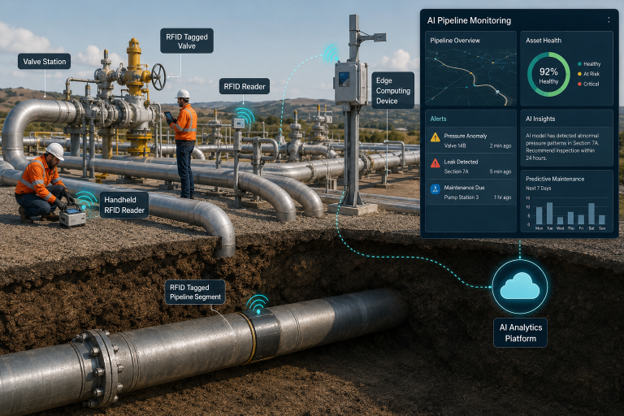
A photorealistic oil and gas pipeline environment showing RFID-tagged assets, inspection crews, RFID readers, edge computing equipment, and an AI monitoring dashboard. The visual illustrates how RFID data can connect physical pipeline infrastructure with AI-driven analytics for asset tracking, anomaly detection, and predictive maintenance.
How AI and RFID Improve Pipeline Operations
AI-enabled pipeline management combines artificial intelligence with connected field data to improve how pipeline operators identify, track, inspect, maintain, and manage critical infrastructure. RFID provides a practical method for identifying physical assets such as valves, fittings, inspection tools, maintenance equipment, access components, and other pipeline-related assets, while AI can analyze the resulting operational data to support maintenance planning, anomaly detection, asset utilization, and decision-making.
For pipeline operators, the value comes from connecting physical asset identification with operational records and analytical systems. RFID tags can associate a unique digital identity with equipment and components, while RFID readers capture identification data during inspection, maintenance, logistics, and field activities. AI can then combine this information with inspection records, maintenance histories, sensor readings, work orders, environmental information, and other pipeline data.
The resulting system can help pipeline organizations improve asset visibility, reduce manual data entry, strengthen maintenance traceability, and provide field personnel with more reliable information about pipeline infrastructure. GAO provides RFID, BLE, and IoT hardware products and systems that can support these types of industrial identification and data-capture requirements.
Understanding AI-Enabled RFID for Pipeline Infrastructure
Pipeline infrastructure extends across large geographic areas and contains many asset categories that must be inspected, maintained, documented, and periodically replaced. These include pipelines, valves, pumps, meters, pressure-control equipment, pigging equipment, inspection tools, fittings, flanges, maintenance materials, safety equipment, and other field assets.
RFID can provide an electronic identity for physical assets. UHF RFID is particularly useful when longer read ranges are required for field identification and inventory activities. HF RFID can be appropriate for shorter-range identification and controlled interactions, while LF RFID can support specialized identification requirements where its operating characteristics are suitable.
AI adds an analytical layer to these identification capabilities. Rather than treating RFID as an isolated tracking technology, pipeline operators can use RFID-generated events as one source of operational data within a broader AI and IoT solution.
Relevant AI capabilities can include:
- Predictive maintenance based on equipment history, inspection findings, operating conditions, and failure patterns.
- Anomaly detection that identifies unusual asset activity, maintenance records, inspection results, or operational conditions.
- Asset utilization analysis for specialized pipeline inspection and maintenance equipment.
- Computer vision for inspection activities where cameras and image-analysis models are deployed.
- Natural-language processing for extracting information from maintenance reports, inspection documents, and field notes.
- Risk-based maintenance prioritization using asset condition, operating history, criticality, and inspection information.
- AI-assisted work-order analysis to identify recurring maintenance issues and potential root causes.
- Forecasting for maintenance requirements, spare parts, inspection resources, and equipment demand.
The combination is especially useful when RFID identification data is integrated with existing pipeline management systems rather than operating as a standalone inventory application.
AI and RFID Pipeline Asset Management Workflow
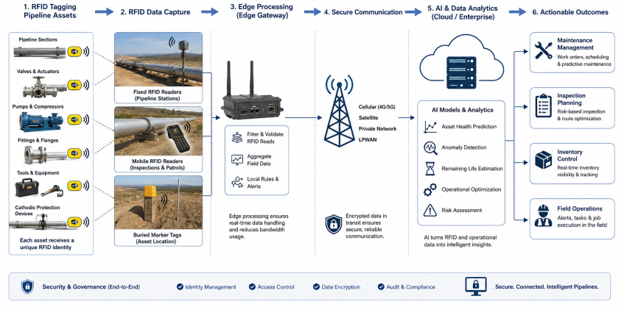
This workflow diagram illustrates how RFID-tagged pipeline assets generate field data that moves through RFID readers, edge gateways, secure communications, and AI analytics. The resulting insights support maintenance management, inspection planning, inventory control, and field operations.
Pipeline Applications for AI-Driven Asset Visibility
RFID Asset Tracking for Pipeline Maintenance
Pipeline maintenance involves numerous tools, components, replacement parts, and specialized equipment. Losing track of these assets can create delays, increase procurement requirements, and make maintenance records less reliable.
RFID can assign unique identities to reusable tools, inspection equipment, maintenance equipment, valve-related components, and other suitable assets. Field personnel can use RFID readers to capture asset movement during maintenance activities, equipment transfers, staging, and return processes.
AI can analyze historical movement and utilization data to identify patterns such as frequently requested equipment, underutilized assets, recurring shortages, or unusual movement behavior. Maintenance managers can use these insights to improve equipment allocation and planning.
Pipeline Inspection and Integrity Management
Pipeline integrity programs depend on accurate inspection records and reliable information about the condition and history of pipeline assets.
RFID can help associate inspection tools, field equipment, inspection documentation, and identified pipeline components with specific work activities. When combined with inspection databases and other operational data, these records can provide stronger traceability.
AI can analyze inspection history to identify recurring defects, unusual inspection findings, asset classes with elevated maintenance requirements, or locations that may require additional investigation. Such systems should support, rather than replace, established engineering integrity assessments and regulatory processes.
Valve and Component Identification
Pipeline networks may contain large numbers of valves, fittings, flanges, actuators, pressure-control components, and other equipment distributed across remote facilities.
An RFID identification system can provide field personnel with a machine-readable asset identity. A technician equipped with an RFID reader can identify a tagged component and retrieve associated information from an integrated software system.
AI can use historical maintenance and inspection information associated with these components to help identify recurring failures, maintenance trends, and service requirements.
Pigging and Pipeline Inspection Equipment Management
Pipeline operators use specialized equipment for cleaning, inspection, and integrity activities. Pigging operations can involve significant coordination between field crews, equipment, pipeline sections, launchers, receivers, and maintenance records.
RFID can help identify reusable inspection equipment and supporting assets. AI-based analytics can examine historical equipment usage, maintenance intervals, deployment frequency, and operational records to support scheduling and resource planning.
Pipeline Spare Parts and Maintenance Inventory
Spare parts management is particularly important for pipeline operators because maintenance materials may need to be available at remote stations or field locations.
RFID can improve identification and movement records for suitable spare parts and maintenance materials. AI can use inventory and maintenance information to forecast demand, identify frequently consumed components, and support replenishment decisions.
The objective is not simply to increase inventory visibility. The larger opportunity is to connect inventory information with actual pipeline maintenance requirements so that procurement and field operations can respond to anticipated demand.
Pipeline Operational Challenges Addressed by AI and RFID
Pipeline operators face several practical challenges that affect asset visibility and maintenance efficiency.
- Large geographic distribution of pipeline assets and facilities.
- Remote valve stations and maintenance locations.
- Manual recording of asset identities and maintenance activities.
- Inconsistent asset naming and identification practices.
- Difficulty connecting field equipment with enterprise maintenance records.
- Limited visibility into specialized equipment utilization.
- Unplanned maintenance and emergency response requirements.
- Large volumes of inspection and maintenance information.
- Difficulty prioritizing maintenance activities across geographically distributed assets.
- Asset history distributed across different operational and enterprise systems.
- Environmental and operational conditions that can affect equipment performance.
- Need for reliable traceability during inspection, maintenance, and replacement activities.
AI and RFID address different parts of these challenges. RFID improves physical identification and data capture, while AI provides analytical capabilities that can turn accumulated operational information into recommendations and predictions.
Pipeline Data Flow from RFID Capture to AI Decision Support
A practical deployment begins with physical asset identification. Appropriate pipeline assets receive RFID tags containing unique identifiers. RFID readers installed in field environments or carried by technicians capture those identifiers during relevant activities.
The captured information can be processed locally through an edge device or gateway before being transmitted through available communications infrastructure. Depending on the operating environment, connectivity can include industrial Ethernet, cellular networks, Wi-Fi, or other suitable communication technologies.
Middleware or application software can normalize RFID events and associate them with asset records, personnel activities, work orders, inspection events, and facility locations. The processed information can then be transferred to maintenance management software, asset management systems, databases, or AI analytics systems.
AI models can analyze the combined information to identify patterns and support operational decisions. For example, an AI system could analyze maintenance history and equipment identification events to highlight assets with repeated service requirements.
A typical pipeline data flow can therefore include:
- RFID-tagged pipeline assets and field equipment.
- Fixed or handheld RFID readers.
- Edge gateways or industrial computers.
- Secure field communication networks.
- RFID middleware and asset identification software.
- Asset management and maintenance management systems.
- Inspection and integrity management databases.
- AI and machine-learning models.
- Analytics dashboards and decision-support applications.
- Maintenance planning and field work processes.
AI and RFID for Pipeline Operations
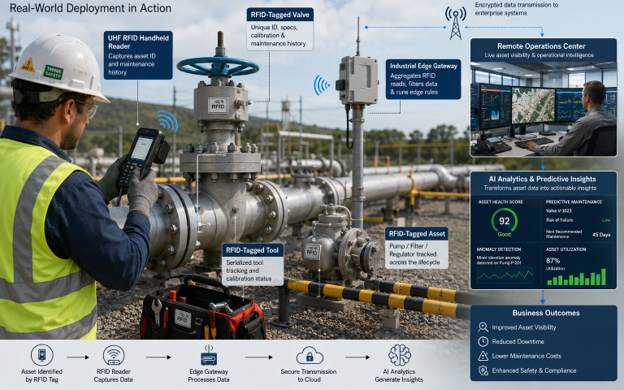
A photorealistic pipeline maintenance scene shows an engineer using a handheld UHF RFID reader to identify tagged valves and equipment. The visual traces asset data from the field through an industrial edge gateway and secure wireless connection to a remote operations center, where AI analytics generate predictive maintenance insights.
RFID Hardware and AI Software for Pipeline Deployments
A pipeline RFID solution normally requires more than RFID tags and readers. Hardware selection should reflect environmental conditions, read distance, asset material, installation location, mobility requirements, and the operational workflow in which identification occurs.
UHF RFID can provide longer-range identification for suitable pipeline field applications. Reader selection should consider antenna configuration, expected tag orientation, surrounding metal infrastructure, environmental exposure, and the required read zone. RFID tags should be selected based on the asset surface, mounting method, temperature range, chemical exposure, mechanical stress, and expected service life.
RFID Technology Comparison for Pipeline Applications
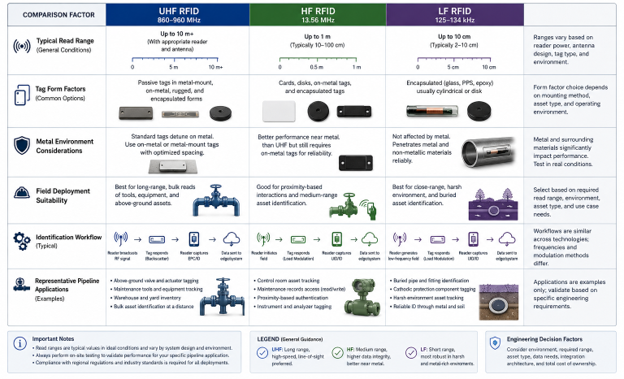
A professional comparison table showing how UHF, HF, and LF RFID differ in read range, tag form factors, metal-environment performance, field deployment suitability, identification workflows, and representative pipeline applications. The visual emphasizes that these are general characteristics and that final technology selection should be based on specific engineering and operating requirements.
HF RFID can support controlled close-range identification scenarios, while LF RFID can be considered for specialized applications where its lower-frequency characteristics provide an engineering advantage.
AI software requires access to reliable data. RFID events therefore need appropriate validation, timestamping, asset association, and integration before they are used for analytics. Poorly configured asset identifiers or inconsistent field data can reduce the reliability of downstream AI outputs.
GAO can provide RFID and IoT hardware products and systems that form part of the field data-capture layer for pipeline applications. Selection should be based on the specific operating environment, required read performance, integration requirements, and lifecycle expectations rather than RFID specifications alone.
Cloud and Server Deployment for Pipeline AI Systems
Pipeline organizations can deploy AI and RFID software using cloud-hosted services or privately managed server environments. The appropriate model depends on connectivity, cybersecurity requirements, data governance, latency requirements, existing IT infrastructure, and operational technology policies.
A Cloud Version can centralize RFID events, asset records, analytics, and AI processing within cloud infrastructure. This approach can be useful for organizations managing geographically distributed pipeline operations because authorized users can access shared information across multiple facilities and regions.
A Server Version can deploy software on edge servers, customer-managed servers, private data centers, facility servers, or other privately hosted infrastructure. This model can be appropriate where pipeline operations require greater control over data location, network connectivity, system integration, or local processing.
Edge processing can also reduce dependency on continuous wide-area connectivity. A field gateway may temporarily process or store RFID events and synchronize information when network connectivity becomes available.
Pipeline deployments should also consider cybersecurity controls, identity management, encryption, network segmentation, access permissions, audit logging, software updates, and protection of interfaces connecting operational technology with enterprise systems.
The choice between cloud and privately hosted deployment should therefore be made according to the pipeline operator’s operational requirements rather than treating either deployment model as universally superior.
Engineering the Pipeline AI and RFID Deployment
Successful pipeline deployments begin with the operating problem, not with the RFID reader or AI model. The engineering team should first identify which pipeline workflows require better asset identity, which decisions require prediction or prioritization, and which systems already contain authoritative operational data.
A useful deployment assessment covers:
- Pipeline segment and facility hierarchy, including compressor stations, pump stations, valve stations, terminals, tank farms, and maintenance depots.
- Asset criticality and failure consequences.
- Existing SCADA, GIS, CMMS/EAM, inspection-management, laboratory, corrosion-management, and document-management systems.
- RFID tag mounting surfaces, environmental exposure, required read distance, and expected service life.
- Cellular, Wi-Fi, private LTE/5G, fiber, satellite, or other available communications.
- Edge computing requirements for remote stations and rights-of-way.
- AI data quality, historical data availability, labeling requirements, and model validation.
- OT/IT network segmentation and cybersecurity controls.
- Regulatory recordkeeping and audit requirements.
- Technician workflow, including offline operation where connectivity is unreliable.
A critical implementation lesson is to establish a reliable asset master before applying sophisticated AI. If the same valve, instrument, tool, or inspection device has inconsistent identifiers across GIS, EAM, RFID middleware, and field applications, an AI model can produce technically sophisticated analysis against the wrong asset.
RFID Commissioning in Pipeline Facilities
RFID commissioning should test the complete chain from physical tag to operational record.
For fixed-reader installations, engineers should characterize antenna placement, read zones, multipath effects, tag orientation, interference, and false reads. Metal pipe, valves, structural steel, vehicles, liquid-filled equipment, and enclosed cabinets can materially affect RF performance.
For handheld deployments, testing should address technician ergonomics, read distance, gloves, sunlight, weather exposure, battery life, barcode coexistence, offline storage, and synchronization after connectivity is restored.
A commissioning test should verify:
- Correct tag-to-asset association.
- Reader and antenna performance at the intended installation locations.
- Duplicate-read filtering.
- Timestamp accuracy.
- Location or zone attribution.
- Offline event buffering.
- Secure synchronization.
- API transmission to business software.
- Exception handling when a tag is missing, damaged, duplicated, or assigned incorrectly.
- Auditability of manual corrections.
GAO’s RFID hardware and software offerings can be evaluated against these requirements as part of a pipeline-specific proof of concept rather than assuming that one RFID configuration will suit every pipeline facility.
Integrating AI, RFID and Existing Pipeline Software
Pipeline operators rarely replace SCADA, GIS, EAM, or integrity-management software simply to introduce RFID. A better approach is usually controlled integration with systems that already contain operational authority.
Common integration points include:
- SCADA: Pressure, flow, temperature, alarms, valve status, compressor or pump operating conditions, and other process information can provide context for AI analysis.
- GIS: Pipeline segment, facility, right-of-way, crossing, and geographic information can associate asset events with physical location.
- CMMS/EAM: Work orders, maintenance history, asset hierarchy, parts, labor, inspection schedules, and equipment criticality provide the business context needed for maintenance analytics.
- Integrity-management software: Inspection findings, corrosion information, risk assessments, repair records, and integrity activities can be correlated with physical asset identity.
- Warehouse and inventory software: RFID events can improve visibility into spare valves, fittings, instruments, repair materials, and emergency-response equipment.
- Document-management systems: Engineering procedures, inspection reports, manuals, drawings, and maintenance instructions can support controlled AI retrieval.
- Identity and access-management systems: Technician and engineer identities can be associated with authorized activities without embedding unnecessary personal information into RFID records.
The integration principle is to preserve system ownership. SCADA should remain authoritative for appropriate process-control information, GIS for spatial information, and EAM or CMMS for maintenance transactions. RFID should provide trustworthy identification and event evidence, while AI should provide analytical assistance rather than silently overriding operational controls.
Pipeline AI and RFID Performance Measures
A pipeline project should establish measurable KPIs before deployment. RFID read counts alone are poor indicators of business value.
| KPI | Pipeline relevance |
|---|---|
| Asset identification accuracy | Measures whether technicians identify the intended valve, tool, instrument, or component |
| RFID read success rate | Indicates field identification reliability |
| Duplicate-event rate | Measures unnecessary or misleading RFID events |
| Asset-location accuracy | Shows whether equipment is associated with the correct facility or work zone |
| Work-order data accuracy | Measures correct association between field activity and EAM/CMMS records |
| Maintenance execution time | Tracks time required to locate and verify equipment |
| Mean time to repair | Indicates operational maintenance improvement |
| Planned-maintenance compliance | Measures execution against scheduled maintenance |
| Unplanned equipment downtime | Tracks failures and operational interruptions |
| Inspection backlog | Indicates whether inspection resources are keeping pace with requirements |
| Tool utilization | Measures productive use of inspection and maintenance equipment |
| Calibration compliance | Tracks whether instruments are available and within required calibration status |
| Spare-parts availability | Measures readiness for scheduled and corrective maintenance |
| False-alarm rate | Important for AI anomaly detection and operational trust |
| AI prediction precision and recall | Evaluates model performance for defined use cases |
| Human override rate | Shows where AI recommendations require engineering correction |
| Decision latency | Measures time from data capture to actionable recommendation |
| Cybersecurity incident rate | Tracks security events affecting connected systems |
| Data synchronization success | Measures reliability between field, edge, and central systems |
AI performance should be measured against an agreed operational baseline. A model that produces many alerts but few useful maintenance actions may increase workload rather than improve integrity management.
Practical Implementation Roadmap for Pipeline Operators
A phased deployment generally reduces technical and operational risk.
- Define the use case: Select a measurable pipeline problem such as maintenance-tool visibility, inspection-equipment tracking, valve-maintenance verification, or spare-parts readiness.
- Map the workflow: Document receiving, staging, assignment, field deployment, inspection, maintenance, return, calibration, and retirement processes.
- Establish asset identity: Reconcile asset IDs across RFID, GIS, EAM/CMMS, inspection systems, and existing databases.
- Select RFID technology: Determine whether UHF, HF, or LF is appropriate based on range, mounting surface, environmental conditions, and workflow.
- Conduct an RF survey: Test representative pipe, valve, equipment, cabinet, and storage conditions before full deployment.
- Build the integration layer: Establish APIs, event processing, data validation, offline synchronization, and system ownership rules.
- Deploy edge processing: Use local computing where field connectivity, latency, or OT separation makes centralized processing unsuitable.
- Train and validate AI models: Establish representative historical datasets and measure precision, recall, false-positive rates, and operational usefulness.
- Run a controlled pilot: Select representative facilities rather than testing only in ideal laboratory conditions.
- Commission and test: Verify RF performance, integration, cybersecurity, failure handling, and user workflows.
- Measure operational outcomes: Compare KPIs against the pre-deployment baseline.
- Scale by workflow: Expand to additional facilities and asset classes only after the first use case demonstrates measurable value.
- Maintain the system: Revalidate tags, readers, integrations, AI models, cybersecurity controls, and asset master data as pipeline operations change.
GAO Expertise for AI-Enabled Pipeline IoT Solutions
Pipeline operators evaluating AI-enabled asset tracking should treat RFID as one component of a larger operational data solution. The appropriate design depends on asset type, facility topology, RF conditions, existing software, network availability, cybersecurity requirements, and the consequences of incorrect identification.
GAO’s experience supplying RFID, BLE, and IoT hardware products and systems allows pipeline organizations to evaluate practical identification and connectivity options alongside their existing operational systems. Our technical support can also assist with product selection, integration considerations, deployment requirements, and system implementation.
Organizations planning a pipeline AI, RFID, asset-tracking, maintenance, or IoT initiative can learn more about GAO’s technology solutions and discuss application-specific requirements with our technical team through GAO’s technology resources.
Building the Future of Industrial AI and IoT with Aperture Venture Studio and GAO RFID Inc.
For more than three decades, GAO Group of Companies has invested heavily in R&D for industrial RFID, BLE, and IoT. As generative AI has become increasingly useful for industrial applications, we have expanded our work across AI and IoT, including RFID and BLE, and founded Aperture Venture Studio to build, launch, and scale next-generation AI and IoT ventures focused on practical industrial applications such as intelligent pipeline asset management, maintenance, inspection, and operational analytics.
Aperture has attracted AI and IoT technical experts, entrepreneurial and operational executives, influential investors, and leading companies. We have also developed Aperture Ventures Summit and TekSummit to discuss advanced AI and IoT topics. We welcome advisors, co-founders, employees, investors, and customers to participate in these growing technical communities.