
AI and BLE for Pulp Production
AI-Driven Pulp Production with BLE-Enabled Industrial Monitoring
AI and BLE for pulp production combines Industrial AI, machine learning, edge computing, connected sensors, and BLE-enabled data capture to improve how pulp mills monitor materials, equipment, production conditions, and maintenance activities. The practical objective is not simply to connect assets, but to convert mill-floor data into decisions that improve uptime, throughput, quality, energy efficiency, safety, and traceability. BLE gateways, beacons, and sensors can provide location, condition, and environmental data from areas where wired instrumentation or conventional manual collection is costly. AI models can then correlate this information with distributed control system data, laboratory results, maintenance records, production orders, and quality measurements. For pulp producers, this creates a practical foundation for predictive maintenance, material movement visibility, abnormal-condition detection, operator decision support, and production optimization. GAO supplies BLE, RFID, and IoT hardware products and systems that can support these connected pulp-mill applications.
AI and BLE Data Flow Across a Modern Pulp Production Mill
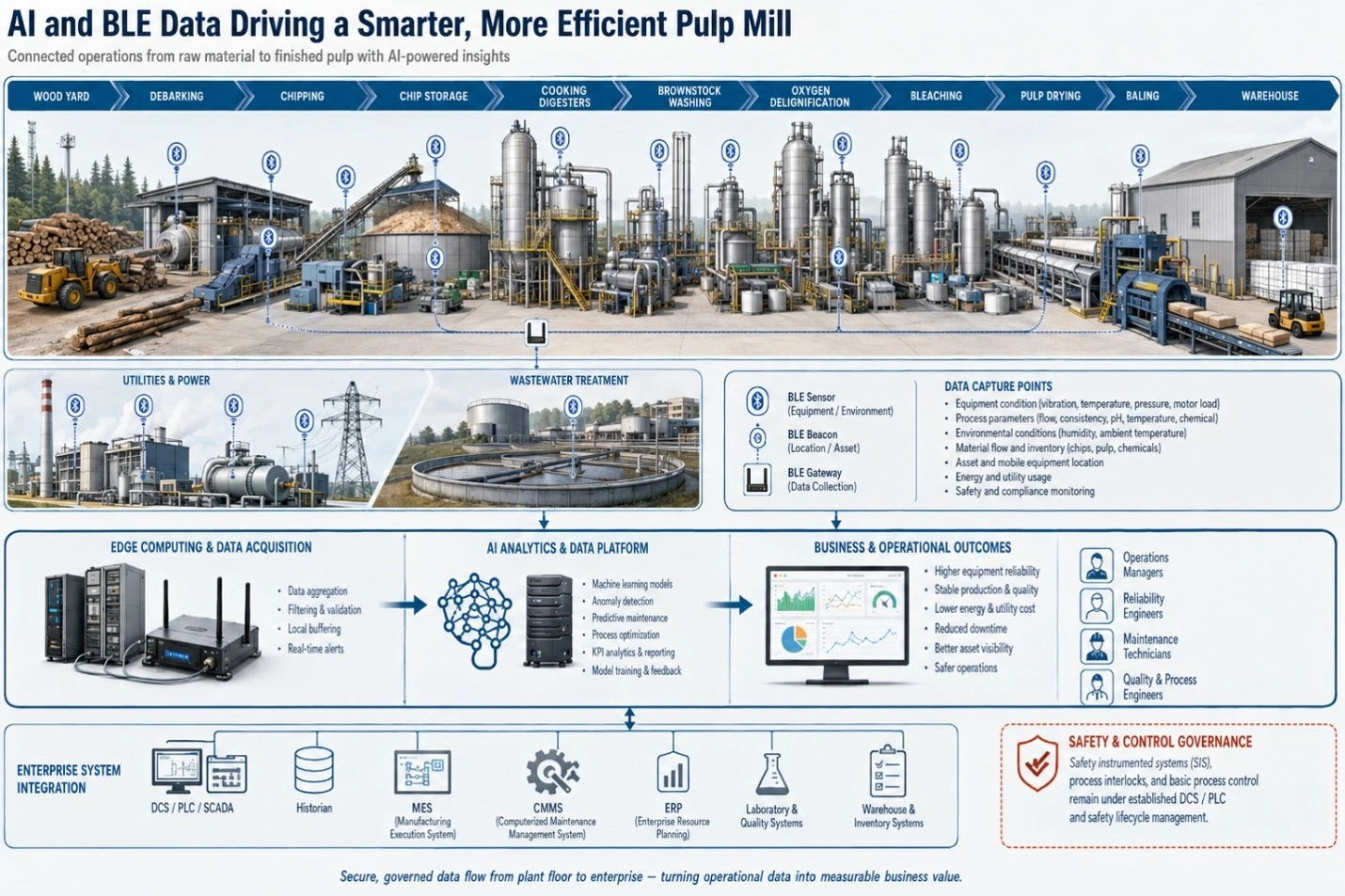
What AI and BLE Mean for Modern Pulp Mills
Pulp production generates large volumes of operational data across interconnected processes. Wood handling, chip preparation, chemical recovery, pulping, washing, screening, bleaching, drying, baling, utilities, and wastewater treatment each produce different signals and operating constraints. Distributed control systems and programmable logic controllers already provide high-value process measurements, but important operational information may remain outside those systems.
BLE can fill selected data gaps by providing relatively low-power wireless identification, sensing, and location capabilities. AI adds the analytical layer needed to interpret those signals alongside existing mill data. The resulting AIoT solution can support decisions such as whether a conveyor bearing is developing an abnormal condition, whether a mobile maintenance asset has reached a work area, whether environmental conditions could affect equipment reliability, or whether a sequence of operating variables indicates an emerging production deviation.
AIoT, or Artificial Intelligence of Things, combines artificial intelligence with IoT devices, sensors, connected equipment, and industrial systems. Pulp mills can use Industrial AI, Edge AI, machine learning, computer vision, and, where autonomous action is appropriate, Physical AI. The technology selection should follow the operational problem rather than the other way around.
GAO’s role is primarily relevant where connected hardware, wireless data capture, gateways, RFID, and IoT systems must be introduced into existing pulp-production environments without disrupting established process-control operations.
High-Value AI Applications Across Pulp Production
Predictive Maintenance for Pulp-Mill Equipment
Predictive maintenance is one of the strongest applications because pulp mills depend on continuous operation of rotating and conveying equipment. Unexpected failures involving chip conveyors, pumps, fans, motors, gearboxes, bearings, screens, compressors, and other equipment can interrupt production and create expensive maintenance events.
AI models can evaluate vibration, temperature, operating state, runtime, maintenance history, alarm patterns, and process conditions to identify deviations from normal equipment behavior. BLE sensors can contribute selected wireless measurements where temporary instrumentation, retrofit sensing, or additional condition data is justified.
Useful outputs include:
- Early warnings for abnormal bearing or motor conditions
- Equipment health scores based on historical operating behavior
- Remaining-useful-life estimates where sufficient training data exists
- Maintenance work-order recommendations
- Identification of recurring failure patterns
- Correlation between operating conditions and equipment degradation
AI-Based Material and Asset Visibility
Pulp mills move large quantities of wood, chips, chemicals, spare parts, maintenance tools, containers, finished pulp, and mobile equipment. Visibility problems are especially significant when assets cross large outdoor yards, production buildings, warehouses, and maintenance areas.
BLE beacons and gateways can support location-aware applications for selected mobile assets. AI can use location history, production schedules, maintenance work orders, and asset utilization data to identify bottlenecks and abnormal movement patterns.
Potential applications include:
- Tracking mobile maintenance equipment
- Locating critical tools and service equipment
- Monitoring movement of selected material-handling assets
- Identifying idle or underutilized equipment
- Supporting maintenance response and dispatch
- Improving traceability of finished pulp handling activities
RFID can complement BLE where fixed identification at controlled points is more appropriate, such as warehouse transactions, pallet identification, inventory checkpoints, and automated gate or dock events.
Production and Process Anomaly Detection
Pulp production depends on tightly controlled relationships among temperature, pressure, flow, chemical concentration, residence time, consistency, pH, brightness, kappa number, moisture, and other process variables. Traditional alarm systems identify predefined limits, while machine-learning models can identify multivariable patterns that precede abnormal conditions.
AI-based anomaly detection can compare current behavior against historical normal states for individual process areas. Examples include unusual pump behavior, abnormal chip-feed patterns, changes in washing performance, unexpected bleaching-process relationships, or deviations in drying behavior.
The most useful implementations generally combine AI predictions with process-engineering rules. A model should not override established safety interlocks, process-control logic, or operator safeguards simply because a statistical model produces a different recommendation.
Pulp Production Workflows for AI Data Acquisition and Decision-Making
A practical AI and BLE deployment begins with the production problem and works backward toward the required data.
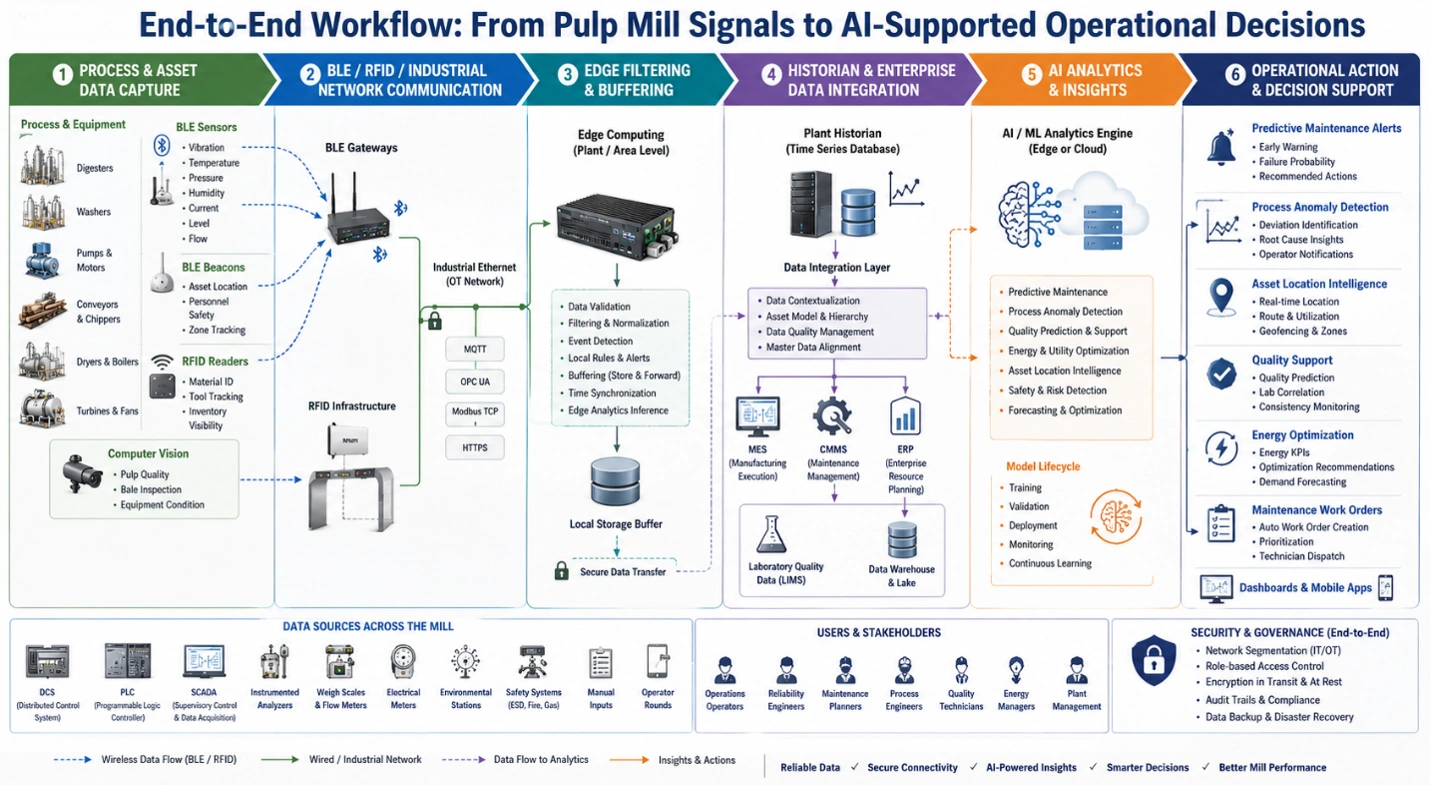
Process and Asset Data Capture
Relevant data sources can include:
- BLE temperature, vibration, humidity, pressure, current, or other condition sensors
- BLE beacons attached to mobile assets or selected material-handling equipment
- BLE gateways installed at defined coverage zones
- PLC and DCS process variables
- SCADA alarms and historian data
- Laboratory and quality-control measurements
- Computer-vision inspection systems
- CMMS and computerized maintenance records
- MES production orders and production states
- ERP inventory, purchasing, and work-order information
- Environmental and utility measurements
- RFID events for controlled identification points
Sensor placement requires more than radio coverage. Engineers should consider equipment temperature, vibration, electromagnetic interference, washdown exposure, dust, chemical exposure, enclosure requirements, battery replacement access, mounting methods, and maintenance accessibility.
Wireless Communication and Edge Processing
BLE gateways collect data from sensors and beacons within their intended coverage areas and forward selected information to industrial servers or cloud services. Gateway placement should be determined through an RF survey rather than assuming that nominal BLE range will translate directly into reliable mill-floor coverage.
Dense machinery, steel structures, process vessels, piping, electrical equipment, and building partitions can affect radio propagation. Outdoor wood yards introduce different challenges, including long distances, weather exposure, moving equipment, and changing obstructions.
Edge processing can filter duplicate readings, validate sensor data, apply thresholds, buffer information during network interruptions, and forward only useful records. Time synchronization is also important when AI models correlate BLE events with DCS, historian, maintenance, and production records.
AI Analytics and Operational Decisions
Validated data can enter machine-learning pipelines for anomaly detection, predictive maintenance, classification, forecasting, optimization, or decision support. The appropriate model depends on the use case and available data.
Examples include:
- Time-series anomaly detection for rotating equipment
- Supervised classification for known equipment failure modes
- Regression models for quality or process prediction
- Forecasting models for production and energy behavior
- Clustering for identifying previously unknown operating states
- Computer vision for pulp, bale, equipment, or workplace inspection
- Optimization models for selected production and utility decisions
Model outputs should be translated into operationally meaningful actions. A maintenance prediction, for example, becomes useful only when it can create an inspection recommendation, maintenance notification, or prioritized work order with sufficient supporting evidence.
AI-Enabled Pulp Mill Data Workflow from BLE and RFID to Operational Decisions
Technical Solution Components for AI-Enabled Pulp Production
BLE Sensors, Beacons, and Gateways
BLE sensors are appropriate when selected operating conditions must be collected without installing new permanent cabling. Typical measurements may include temperature, vibration, humidity, pressure, or other variables depending on the sensor design and application. BLE beacons provide identification or location references, while BLE gateways aggregate wireless messages and forward them into the mill’s data environment.
GAO can provide BLE hardware for applications involving industrial asset monitoring, wireless sensing, identification, and location. Hardware selection should consider ingress protection, operating temperature, mounting method, battery life, measurement accuracy, RF characteristics, maintenance requirements, and hazardous-area requirements where applicable.
Industrial Networks and Data Integration
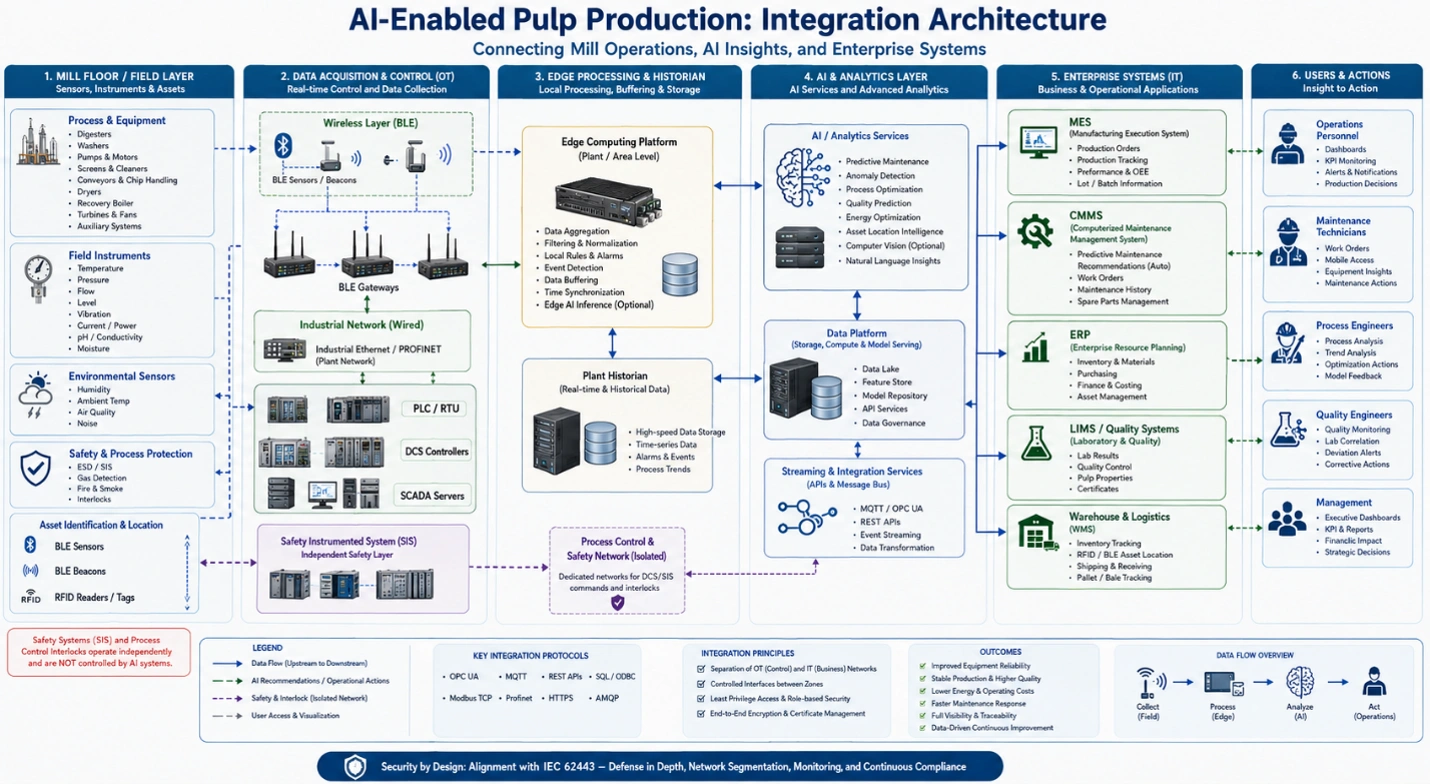
BLE data normally becomes valuable when correlated with established pulp-mill systems. MQTT, OPC UA, REST APIs, industrial Ethernet, and database interfaces may be used depending on the existing environment and integration requirements. OPC UA is particularly useful where standardized industrial data exchange is required between control and information systems.
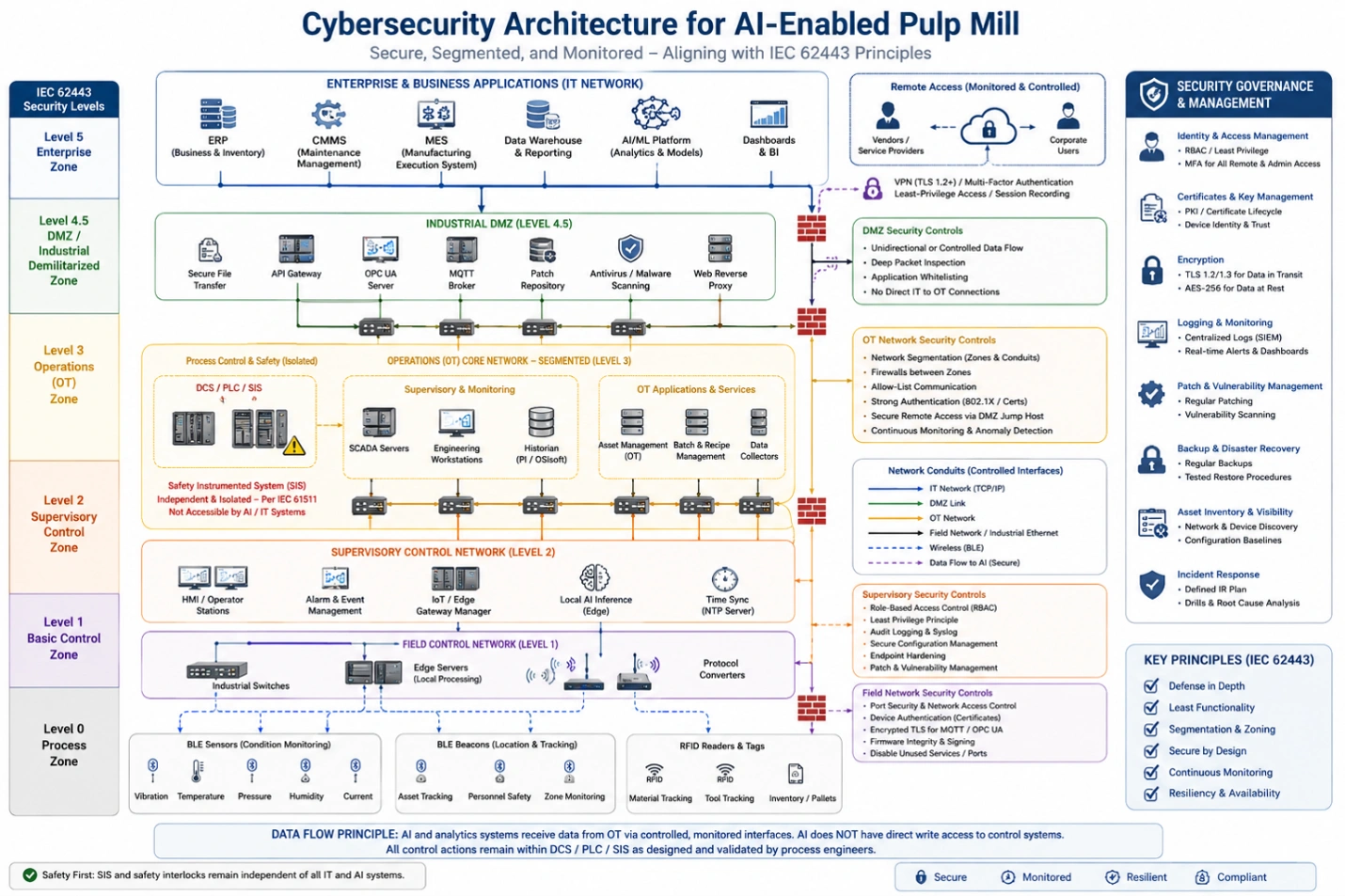
A common design separates process control from analytical workloads. AI applications should consume authorized data from appropriate interfaces rather than directly interfering with safety-critical control logic. Network segmentation, firewalls, access control, certificate management, and monitored data paths should be considered from the beginning.
Cloud Version and Server Version
The Cloud Version places AI application software and supporting data services in managed cloud infrastructure. This model can simplify centralized analytics across multiple pulp mills, support remote monitoring, and provide scalable computational resources. Reliable and secure outbound connectivity is essential, and sensitive operational data may require additional governance before leaving the mill.
The Server Version deploys the software on an edge server, customer-managed server, private data center, factory server, or other privately hosted infrastructure. This approach is often appropriate when pulp production requires local processing, low-latency analytics, restricted data movement, or continued operation during unreliable external connectivity.
A hybrid design can also be appropriate. Edge systems can perform immediate filtering and selected AI inference, while a private or cloud server performs model training, fleet-level analysis, reporting, and long-term data management.
Cybersecurity and Reliability Controls
AI-enabled pulp-production systems should be designed around industrial cybersecurity rather than adding security after deployment. Relevant practices include network segmentation, least-privilege access, encrypted communications, authenticated devices, certificate management, secure software updates, audit logging, backup procedures, vulnerability management, and controlled remote access.
Cybersecurity planning should align with the mill’s OT governance and applicable industrial-security practices, including concepts associated with IEC 62443. Wireless devices also require lifecycle management because battery-powered sensors, gateways, firmware, credentials, and cryptographic keys become part of the operational technology environment.
Reliability engineering is equally important. Gateway redundancy, local buffering, sensor-health monitoring, battery-status reporting, data-quality checks, and defined fallback procedures can prevent a wireless data problem from becoming an operational information gap.
IEC 62443 Cybersecurity Framework for AI-Enabled Pulp Mills
Engineering Considerations Before Mill-Wide Deployment
A successful deployment should begin with a defined production or maintenance problem rather than a general objective to collect more sensor data. Pulp producers should identify the equipment population, failure modes, existing instrumentation, required prediction horizon, data quality, operational consequence, and decision that the AI output is expected to improve.
Baseline measurements should be established before installation. Useful baselines include unplanned downtime, mean time between failures, mean time to repair, maintenance labor, spare-parts consumption, production throughput, energy consumption per ton of pulp, quality deviations, asset search time, and relevant process variability.
BLE coverage should then be verified through an RF site survey and pilot installation. Engineers should test actual equipment locations, antenna orientation, gateway density, interference, battery performance, data latency, packet reliability, and behavior during representative operating conditions.
GAO’s experience supplying connected hardware and IoT systems to organizations in the United States and Canada, including Fortune 500 companies, research organizations, universities, and government agencies, supports a practical approach centered on deployment requirements, quality assurance, and technical support. GAO’s sister companies, GAO Research and GAO Tek, form part of the broader GAO Group, with operations based in New York City and Toronto, Canada. The group has invested substantially in R&D and provides remote and onsite technical support for its products and systems.
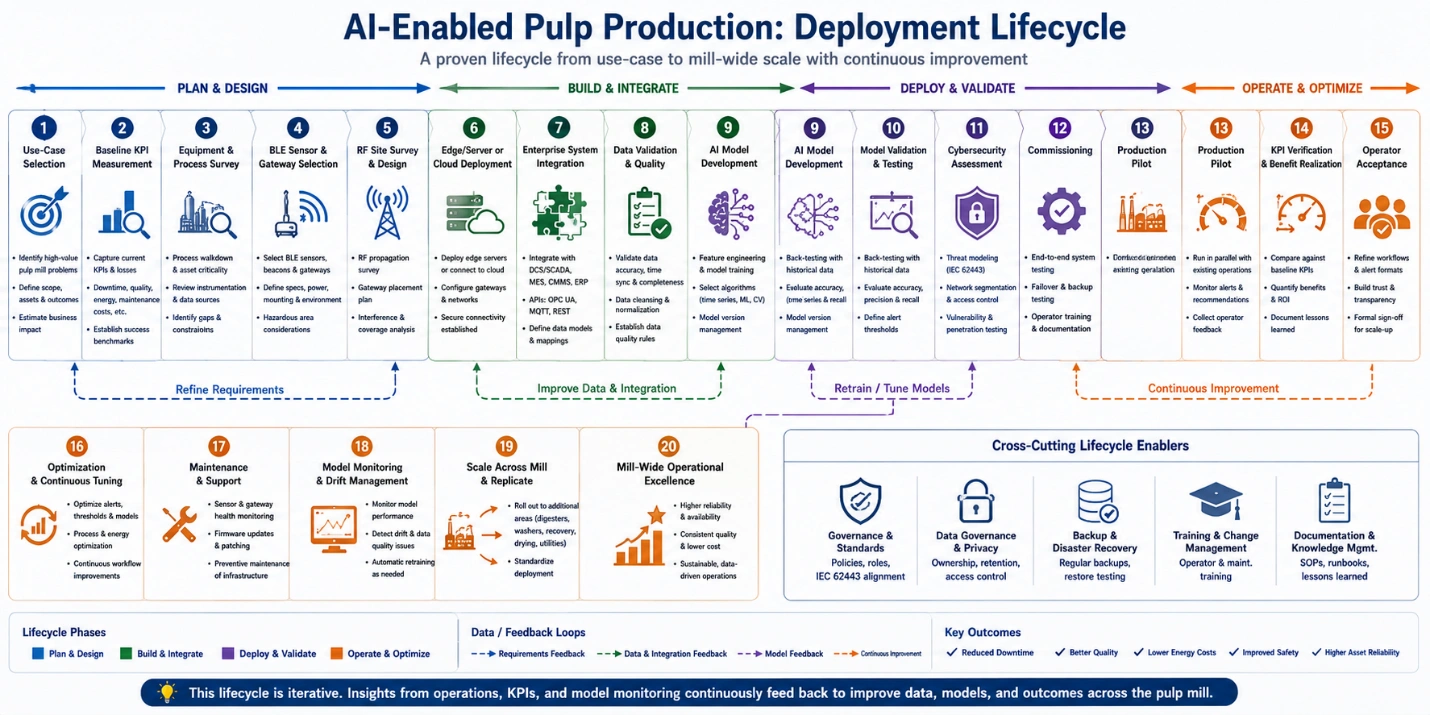
AI-Enabled Pulp Production Deployment Lifecycle
Operational and Business Value of AI-Enabled Pulp Production
AI becomes particularly valuable in pulp production when its predictions are connected to measurable mill objectives. BLE is an enabling data-collection method, but the business value comes from using trustworthy operational data to improve maintenance, production stability, quality, energy performance, material visibility, and workforce response.
Higher Equipment Availability and More Predictable Maintenance
Pulp mills operate with interconnected equipment, so a failure in one area can propagate into downstream production constraints. AI-based predictive maintenance can identify changes in equipment behavior before a failure becomes an unplanned production event.
A useful implementation combines sensor measurements with operating context. A pump operating at an unusual temperature while processing a different consistency or flow condition should not necessarily generate the same diagnosis as a pump showing the same temperature deviation under normal conditions.
AI can therefore help maintenance teams:
- Prioritize inspections according to predicted equipment risk
- Distinguish persistent deterioration from short-lived operating anomalies
- Correlate equipment behavior with maintenance history
- Identify recurring failure patterns across similar assets
- Schedule intervention during planned production windows
- Reduce unnecessary preventive-maintenance activities
- Improve spare-parts planning for high-risk equipment
The appropriate KPI set can include mean time between failures, mean time to repair, unplanned downtime, maintenance schedule compliance, emergency work orders, and maintenance cost per ton of pulp.
Improved Process Stability and Pulp Quality
Pulp quality depends on controlled relationships among raw-material properties, cooking conditions, washing performance, bleaching chemistry, pulp consistency, drying conditions, and other process variables. AI can identify relationships that are difficult to recognize through individual alarms or manual trend inspection.
Machine-learning models can assist with prediction of quality variables, early detection of process drift, and identification of operating states associated with higher variability. Depending on the process and available laboratory data, models may support prediction or classification associated with kappa number, brightness, moisture, consistency, or other mill-specific quality measurements.
The model should remain connected to process engineering. Laboratory measurements provide ground truth for training and validation, while process engineers establish acceptable operating boundaries and determine whether an AI recommendation is operationally appropriate.
Energy and Utility Optimization
Pulp production consumes significant quantities of steam, electricity, water, compressed air, and process chemicals. Recovery boilers, evaporators, turbines, pumps, fans, compressors, vacuum systems, and drying systems create opportunities for data-driven optimization.
AI can analyze historical relationships among production rate, equipment loading, steam demand, electrical consumption, environmental conditions, and process state. The resulting models can identify abnormal utility consumption or forecast demand more accurately.
Useful measurements include:
- Electricity consumption per ton of pulp
- Steam consumption per ton of pulp
- Water consumption
- Compressed-air consumption
- Recovery-system performance indicators
- Boiler and turbine operating conditions
- Dryer energy consumption
- Pump and fan loading
- Peak-demand behavior
AI should first identify optimization opportunities and validate the expected impact. Automated control changes should be introduced only after engineering validation, safety review, and appropriate process-control testing.
Faster Maintenance Response Through Asset Location Intelligence
Large pulp mills can require technicians to travel considerable distances between production areas, workshops, warehouses, and equipment locations. Searching for mobile tools, test instruments, temporary equipment, or maintenance resources can add nonproductive time.
BLE location information can help selected assets become easier to locate. AI can add operational context by correlating location with maintenance schedules, work orders, equipment criticality, and historical utilization.
For example, a maintenance supervisor could determine whether a required diagnostic instrument is already near a production area before assigning a technician to retrieve it. Similar logic can support selected mobile equipment, service carts, inspection devices, and high-value maintenance tools.
Location systems should not be deployed indiscriminately. Critical assets that genuinely benefit from location visibility should be prioritized according to search frequency, replacement cost, operational importance, and response-time requirements.
AI Use Cases by Pulp Production Area
Different mill areas produce different data patterns and therefore require different AI approaches.
| Pulp production area | AI application | Relevant data | Operational outcome |
|---|---|---|---|
| Wood yard | Equipment utilization and anomaly detection | Loader activity, equipment condition, location, fuel or energy data | Improved equipment utilization |
| Debarking | Predictive maintenance | Motor condition, vibration, temperature, runtime | Earlier maintenance intervention |
| Chipping | Process anomaly detection | Motor load, vibration, chipper condition, production rate | Reduced disruption and improved chip consistency |
| Chip storage | Inventory and condition monitoring | Inventory levels, location, environmental measurements | Better material planning |
| Digesters | Process prediction | Temperature, pressure, flow, chemical and quality data | More stable pulping conditions |
| Brownstock washing | Process anomaly detection | Consistency, flow, pressure, filtrate conditions | Reduced process variability |
| Screening | Predictive maintenance | Motor load, vibration, flow, differential pressure | Reduced unexpected equipment downtime |
| Oxygen delignification | Process optimization | Pressure, temperature, flow, chemical conditions | Improved process control |
| Bleaching | Quality prediction | Chemical dosage, temperature, pH, brightness, kappa-related data | Better quality consistency |
| Pulp drying | Quality and energy analytics | Moisture, temperature, steam, airflow, production rate | Better moisture control and energy performance |
| Baling | Computer vision and asset tracking | Images, bale identifiers, location, production records | Improved bale traceability |
| Warehouse | AI inventory management | RFID/BLE events, inventory records, movement history | Reduced search and inventory discrepancies |
| Recovery and utilities | Predictive maintenance and energy analytics | Boiler, turbine, pump, fan, steam and electrical data | Improved reliability and utility efficiency |
| Wastewater treatment | Process monitoring and prediction | Flow, pH, temperature, chemical and laboratory measurements | Earlier identification of treatment deviations |
The strongest first deployment candidates are usually processes where three conditions overlap: the equipment or process is operationally important, the failure or deviation has a measurable cost, and sufficient historical data exists to validate an AI model.
Pulp Production KPI Framework for AI Projects
AI projects should be evaluated using operational KPIs rather than model accuracy alone. A model with excellent statistical performance can still have little value if its prediction arrives too late or does not lead to an actionable maintenance or production decision.
A practical KPI framework includes:
- Reliability: mean time between failures, mean time to repair, unplanned downtime, equipment availability
- Production: tons of pulp per operating hour, production interruptions, throughput stability, production schedule adherence
- Quality: brightness variability, moisture deviation, consistency variation, quality-related rejects or rework
- Maintenance: emergency work orders, planned versus unplanned maintenance, maintenance labor hours, spare-parts consumption
- Energy: electricity per ton, steam per ton, fuel or biomass utilization, peak electrical demand
- Utilities: water consumption, compressed-air demand, wastewater-treatment performance
- Asset visibility: asset search time, location-data availability, asset utilization, missing-asset incidents
- AI performance: false-positive rate, false-negative rate, prediction lead time, model drift, data completeness
- Operational adoption: alert acknowledgment, recommended-action completion, operator acceptance, maintenance response time
Baseline KPIs should be captured before implementation. Post-deployment results should then be compared against the baseline while accounting for production grade, raw-material changes, planned shutdowns, seasonal effects, maintenance interventions, and other confounding factors.
Integration with Pulp-Mill Enterprise Software
AI applications become more useful when their outputs enter the systems where pulp-mill personnel already perform operational work.
DCS, PLC, SCADA, and Historian Integration
DCS and PLC systems remain responsible for established process control functions. AI applications can consume approved process data through controlled interfaces while leaving safety logic and validated control sequences under their existing governance.
SCADA and historians provide valuable time-series context. Historical process states can be synchronized with equipment events, maintenance records, quality results, and BLE sensor data to construct a more complete operational dataset.
MES, CMMS, ERP, and Quality Systems
MES data can provide production orders, product grades, operating states, and production schedules. CMMS data can provide asset hierarchy, failure codes, work orders, inspection records, and maintenance history. ERP systems can contribute inventory, purchasing, supplier, and spare-parts information. Laboratory and quality systems provide measurements needed to validate production and quality models.
A predictive-maintenance workflow can therefore progress from:
Sensor observation → anomaly detection → asset risk assessment → maintenance recommendation → CMMS work order → technician inspection → maintenance result → AI model feedback
That feedback loop is important. A model should learn from confirmed failures, false alarms, inspections that found no fault, and maintenance outcomes rather than treating every alert as a successful prediction.
AI-Enabled Pulp Production Integration Architecture
Implementation Lifecycle for AI and BLE in Pulp Production
A controlled deployment reduces technical risk and makes the resulting business case easier to verify.
Use-Case Selection and Baseline Measurement
Begin with a specific mill problem such as repeated pump failures, excessive conveyor downtime, maintenance-tool search time, unstable drying performance, or unexplained energy variation.
Document:
- Asset criticality
- Current measurement methods
- Existing instrumentation
- Historical failure records
- Current maintenance practice
- Current KPI values
- Data availability and quality
- Expected operational decision
- Financial or production consequence of the problem
A narrow pilot generally produces more useful engineering evidence than attempting to instrument an entire mill immediately.
Site Survey and Hardware Engineering
A site survey should examine process conditions, equipment construction, RF propagation, network connectivity, gateway mounting positions, power availability, sensor mounting, battery access, environmental exposure, and maintenance procedures.
Pulp mills can contain areas with high humidity, chemical exposure, elevated temperatures, vibration, dust, metal structures, and restricted access. Sensor and enclosure selection therefore needs to reflect the actual installation environment.
Hazardous-area classification requires particular attention. Standard BLE equipment should not automatically be installed in classified areas simply because its radio characteristics are suitable. Where hazardous locations are involved, equipment certification and the site’s electrical and process-safety requirements must govern the design.
RF Testing and Pilot Commissioning
RF performance should be measured at actual installation points. Engineers should verify received signal behavior, gateway coverage, packet reliability, latency, battery performance, and interference under representative operating conditions.
The pilot should also test data quality rather than merely confirming that devices communicate. Missing readings, duplicate events, timestamp inconsistencies, sensor drift, and unexpected gateway behavior can materially affect downstream AI performance.
AI Model Validation
Training data should represent normal operation and, where possible, relevant abnormal conditions. Maintenance records and laboratory results require careful alignment with timestamps and asset identifiers.
Validation should use data that was not used to train the model. For predictive-maintenance applications, model performance should be evaluated using operational measures such as:
- Prediction lead time
- Precision and recall
- False-alarm frequency
- Missed-event frequency
- Actionable-alert percentage
- Maintenance intervention success
- Avoided downtime where demonstrable
Model performance should also be monitored after deployment. Process changes, equipment replacements, production-grade changes, sensor degradation, and seasonal conditions can cause model drift.
Production Pilot and Scale-Up
The production pilot should operate alongside established procedures rather than immediately replacing them. Operators and maintenance personnel need enough information to understand why an alert was generated and what evidence supports the recommendation.
Successful pilots can then be expanded to additional asset classes or process areas. Reusable standards should cover device configuration, naming conventions, asset IDs, gateway deployment, cybersecurity, data retention, model monitoring, maintenance, and change management.
Practical Deployment Recommendations for Pulp Producers
Several engineering practices consistently improve the likelihood of a successful AI deployment.
- Start with a measurable pulp-production problem instead of a technology-first objective.
- Select assets according to criticality, failure consequence, and available data.
- Use BLE where wireless sensing, identification, or location provides a practical advantage.
- Retain existing DCS, PLC, SCADA, and safety functions unless a separate control-engineering project justifies changes.
- Conduct an RF site survey before committing to mill-wide gateway quantities.
- Validate sensor performance under actual temperature, vibration, moisture, chemical, and mechanical conditions.
- Establish data-quality rules before using sensor data for AI training.
- Synchronize timestamps across BLE, historians, maintenance systems, and quality records.
- Keep AI recommendations explainable enough for maintenance and process engineers to evaluate.
- Use CMMS integration so predictive-maintenance alerts can become controlled maintenance actions.
- Establish cybersecurity requirements for sensors, gateways, servers, credentials, firmware, and remote access.
- Select cloud deployment where centralized analytics and scalable computing justify external connectivity.
- Select privately hosted server deployment where local processing, data governance, or connectivity requirements favor customer-managed infrastructure.
- Consider hybrid processing when immediate local inference and centralized analytics are both required.
- Measure KPI changes against a documented baseline rather than relying solely on AI model metrics.
- Monitor model drift and sensor health after commissioning.
- Scale only after the pilot demonstrates operational and financial value.
Why GAO’s BLE and IoT Expertise Matters for Pulp Production
Connected hardware projects require more than selecting a sensor specification. Installation conditions, communications, data interfaces, software behavior, maintenance procedures, and integration requirements all influence whether the resulting system will produce reliable operational information.
GAO provides BLE, RFID, and IoT hardware products and systems that can support applications such as industrial asset tracking, wireless sensing, equipment monitoring, and location-aware operations. Its technical approach can be applied where pulp producers need to add selected wireless data sources to existing production and maintenance systems.
Headquartered in New York City and Toronto, Canada, GAO is ranked among the world’s leading B2B and B2G BLE and RFID suppliers. GAO and its sister companies, GAO Research and GAO Tek, form the GAO Group. For three decades, the group has served organizations across the United States and Canada, including Fortune 500 companies, leading R&D organizations, prestigious universities, and government agencies.
Quality assurance is particularly important for industrial deployments because sensor failures, gateway interruptions, incorrect configurations, and inconsistent data can affect downstream analytics. GAO has invested substantially in R&D and maintains stringent quality-assurance processes, supported by remote and onsite technical assistance.
AI and BLE Application Selection Decision Tree for Pulp Production

Key Takeaways for AI-Enabled Pulp Production
AI can improve pulp production most effectively when it is connected to real operational decisions. Predictive maintenance, process anomaly detection, quality prediction, energy analytics, asset visibility, and maintenance optimization are practical starting points because their outcomes can be measured against established mill KPIs.
BLE sensors, beacons, and gateways can provide additional wireless data where existing instrumentation does not adequately cover selected equipment, mobile assets, or environmental conditions. Their value increases when data is correlated with DCS, SCADA, historian, MES, CMMS, ERP, laboratory, and quality information.
Pulp producers should therefore treat AI implementation as an engineering and operational improvement program rather than simply a sensor installation. A disciplined process involving use-case selection, baseline measurement, RF testing, data validation, cybersecurity, AI model validation, commissioning, production pilots, KPI verification, and continuous monitoring provides a stronger foundation for long-term results.
GAO can support organizations evaluating BLE, RFID, IoT hardware, wireless sensing, asset visibility, and related technical systems for pulp-production applications. Readers evaluating a specific mill use case can learn more about GAO’s technology products, engineering capabilities, and technical support to determine an appropriate deployment approach.
Building the Future of Industrial AI and IoT with Aperture Venture Studio and GAO RFID Inc.
For more than three decades, GAO Group of Companies has invested heavily in R&D for industrial BLE, RFID, and IoT. As generative AI has become increasingly useful for industrial applications, we have continued developing AIoT technologies that connect industrial data with practical operational intelligence. Through Aperture Venture Studio, we support the development and scaling of AI and IoT initiatives relevant to applications such as AI-enabled pulp production, predictive maintenance, industrial sensing, and connected asset operations.
Aperture has attracted AI and IoT technical experts, entrepreneurial and operational executives, influential investors, and leading companies. We have also developed the Aperture Ventures Summit and TekSummit to facilitate discussion of advanced AI and IoT topics.
These activities contribute to technical communities focused on practical applications of AI, IoT, BLE, and RFID.
We welcome participation as:
- Advisors, co-founders, or employees
- Investors
- Customers
For pulp producers evaluating AI-driven maintenance, process intelligence, wireless sensing, asset visibility, or related IoT applications, GAO provides a technical starting point for evaluating hardware, integration requirements, deployment options, and implementation support.