
AI and RFID for Passenger Rail
AI-Driven Passenger Rail Asset Management with RFID
Artificial intelligence is changing passenger rail operations by turning information from trains, rolling stock, maintenance assets, stations, depots, and trackside equipment into actionable operational intelligence. RFID provides a practical identification layer that can automatically associate physical rail assets with maintenance records, locations, movements, inspection events, and operational transactions. When AI analyzes these RFID events alongside maintenance, timetable, condition-monitoring, and operational data, passenger rail operators can improve asset visibility, maintenance planning, fleet utilization, and disruption response. GAO supplies RFID readers, tags, software, and IoT systems that can support railway applications including railcar identification, train positioning, equipment inventory, maintenance management, and operational information exchange. Its existing passenger railway solutions describe fixed readers, railcar tags, handheld readers, and integration with railway IT systems for these purposes.
GAO RFID +1
AI and RFID for Smarter Passenger Rail Operations
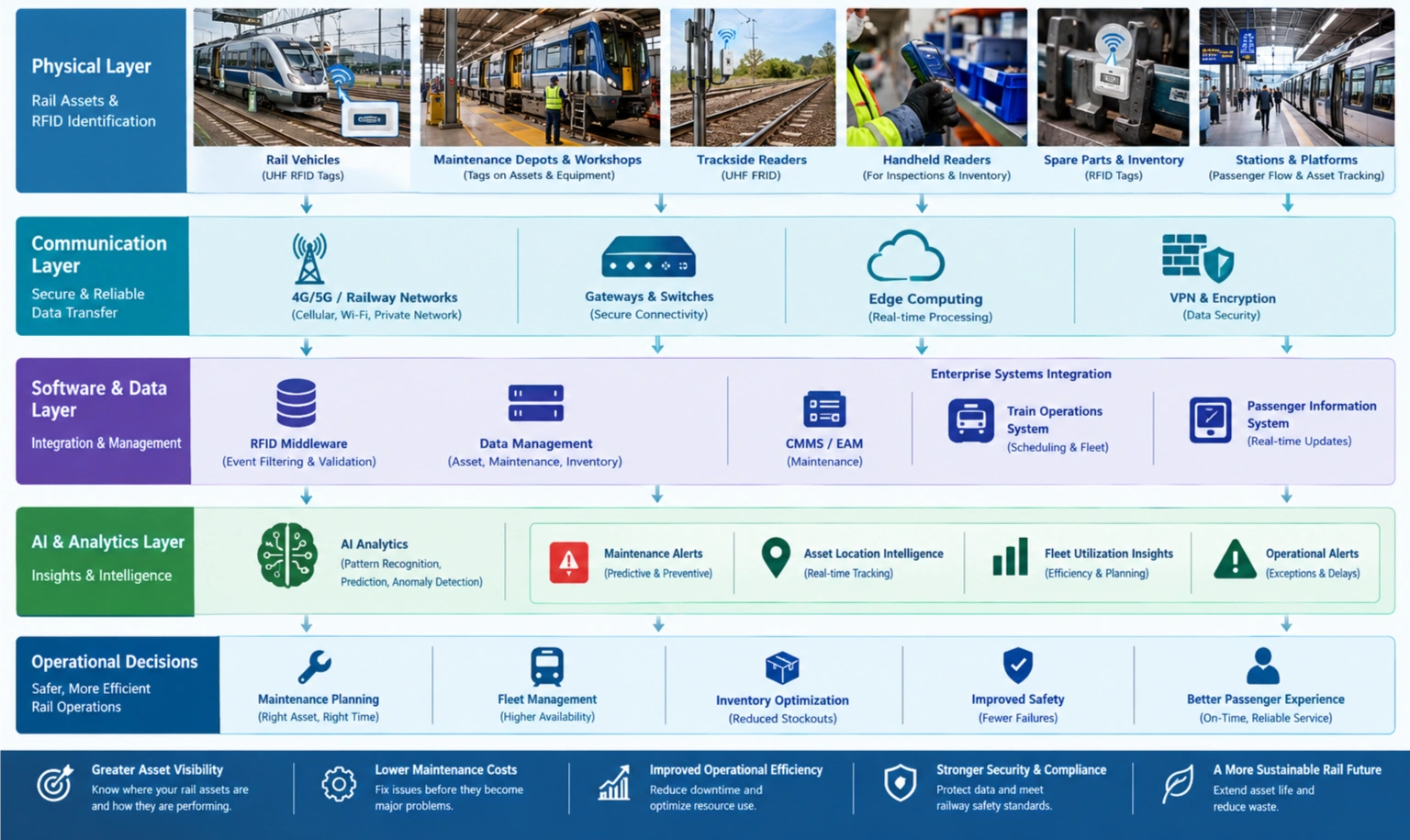
What AI-Powered RFID Means for Passenger Rail
Passenger rail operators manage assets that move continuously between stations, depots, sidings, workshops, maintenance facilities, and revenue service. A train may pass through multiple operational zones while its individual cars, bogies, wheelsets, doors, braking components, HVAC equipment, safety equipment, tools, and spare parts are managed by different departments.
RFID helps establish a machine-readable identity for these physical assets. AI adds a decision layer by correlating RFID events with maintenance history, work orders, train schedules, inspection results, condition-monitoring data, inventory records, and operational events.
A practical passenger rail system can therefore answer questions such as:
- Which trainset or railcar has entered a maintenance depot?
- Which vehicle is approaching a particular inspection or servicing point?
- Which maintenance components are installed on a specific railcar?
- Which tagged spare parts are available in the workshop?
- Which assets have remained in a maintenance area longer than expected?
- Which train movements indicate a developing operational bottleneck?
- Which maintenance records should be reviewed before a vehicle returns to service?
- Which asset movements do not match the expected maintenance or operating workflow?
The distinction is important. RFID normally provides identification and event capture, while AI interprets patterns across those events and other railway datasets. AIoT, or Artificial Intelligence of Things, combines AI with connected devices, sensors, equipment, and industrial systems. Passenger rail implementations can combine RFID with Industrial AI, Edge AI, machine learning, computer vision, and other IoT technologies where the operational requirement justifies them.
GAO’s railway management solutions have historically used RFID tags, readers, and railway management software to support railcar location, maintenance status, train positioning, traffic information, and related railway operations.
GAO RFID +1
Passenger Rail Workflows Where AI Creates the Most Value
Rolling Stock Identification and Fleet Visibility
Passenger rail operators need reliable identification of vehicles entering and leaving depots, yards, workshops, inspection points, and service areas. Fixed RFID readers positioned at controlled points can automatically capture tagged vehicle identities as trains pass through designated reading zones.
AI can combine these identification events with timetable information, depot schedules, vehicle availability, maintenance status, and historical movement patterns. This can help operations teams identify abnormal dwell times, unexpected vehicle movements, missed workflow stages, and potential fleet-utilization constraints.
For mainline railway applications, EN 17230:2020 specifically addresses RFID for rail vehicle identification and focuses on automatic identification using UHF RFID tags and fixed trackside readers. The standard also addresses tag location, tag data, and trackside reading performance.
Standards Store +1
Depot and Workshop Maintenance
Maintenance facilities are particularly suitable for AI-assisted RFID because they contain large numbers of identifiable assets and repeated processes.
RFID can associate a vehicle, component, tool, spare part, or maintenance item with a specific workflow step. AI can then analyze historical work orders, asset utilization, repair duration, inspection outcomes, and component replacement patterns.
Potential applications include:
- Railcar maintenance status tracking
- Bogie and wheelset identification
- Pantograph and braking-system component records
- Maintenance tool tracking
- Spare-parts inventory visibility
- Workshop material movement
- Inspection workflow confirmation
- Maintenance turnaround analysis
- Component traceability
- Overdue maintenance detection
Industry guidance for RFID in rail has also identified MRO assets such as wheelsets, bogies, pantographs, and safety equipment as important candidates for identification and tracking.
GS1 Germany
Preventive and Predictive Maintenance
AI can improve maintenance decision-making when RFID events are combined with condition-monitoring information rather than being treated as isolated identification records.
For example, an RFID event can establish exactly which railcar or component passed a monitoring point. A maintenance system can then associate that identity with vibration measurements, wheel-condition information, inspection findings, operating hours, mileage, work orders, and replacement history.
The resulting data can support:
- Failure-risk scoring
- Maintenance prioritization
- Remaining-useful-life analysis
- Abnormal component movement detection
- Repeated-fault identification
- Maintenance interval optimization
- Spare-parts demand forecasting
The engineering objective should not be to replace established railway maintenance procedures with an AI prediction. AI should provide additional evidence for maintenance decisions while remaining subject to applicable railway safety processes, inspection requirements, engineering approval, and human oversight.
Network Rail documentation, for example, describes remote condition-monitoring systems as supporting proactive maintenance based on historical performance data and improved fault finding.
Network Rail
AI-Assisted Passenger Rail Maintenance Workflow with RFID
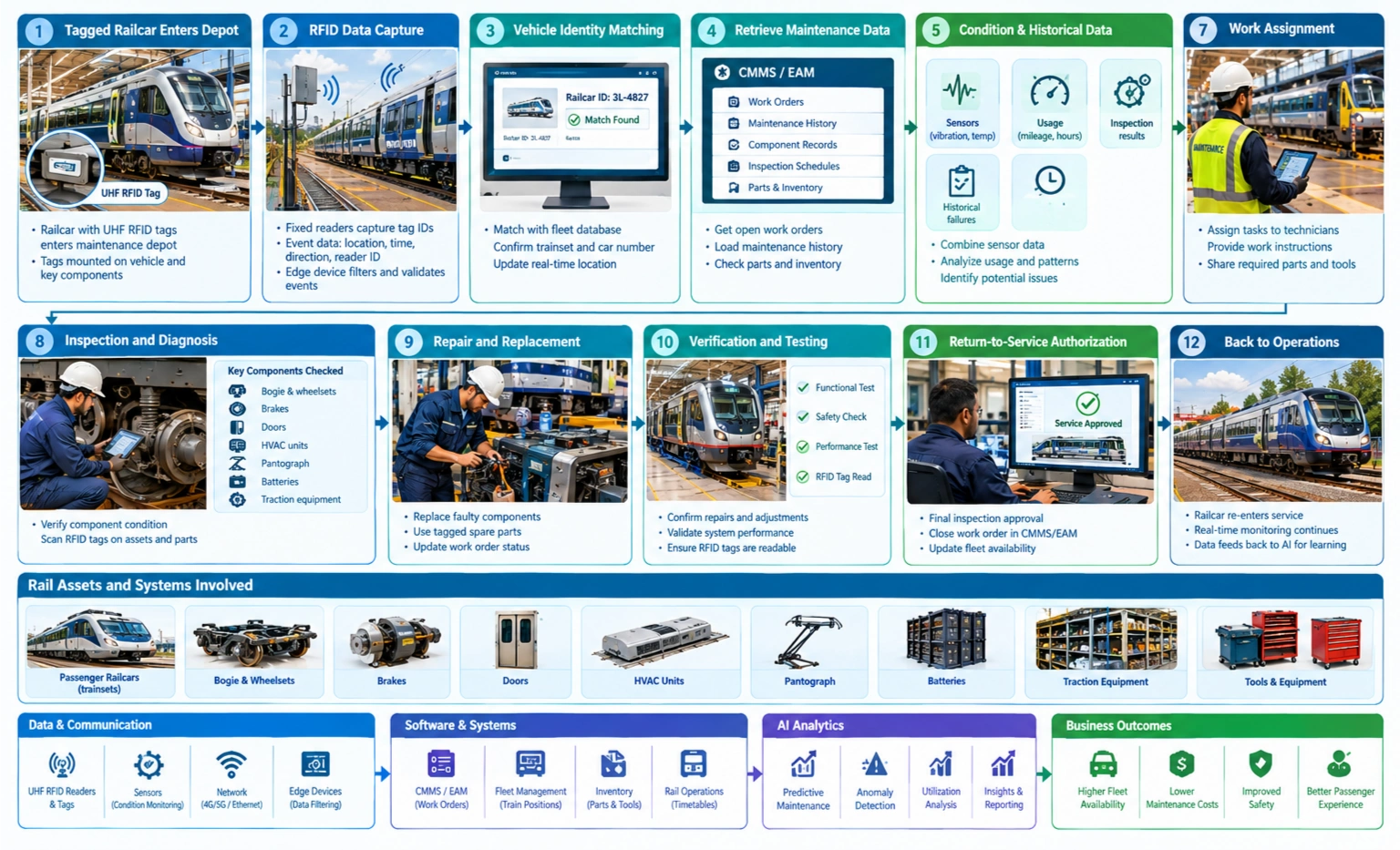
From RFID Events to AI-Driven Railway Decisions
A useful passenger rail implementation should be designed as a complete operational data flow rather than as a collection of RFID readers.
Data Capture at the Rail Asset
The process begins with an identifiable physical asset. Depending on the application, this may be a passenger railcar, trainset, bogie, wheelset, maintenance component, tool, spare part, inspection item, or other controlled asset.
UHF RFID is particularly relevant when automatic identification is required at longer reading distances and when fixed trackside readers need to identify vehicles in motion. HF or LF RFID may be appropriate for shorter-range applications where proximity identification, controlled access, or specific environmental characteristics are more important.
Reader and Communications Layer
RFID readers capture tag identifiers and associated event information. A deployment may include fixed portal readers, trackside readers, handheld readers, workshop readers, or readers positioned at depot entry and exit points.
The reader event should normally include information such as:
- Asset identifier
- Reader identifier
- Date and time
- Reading location
- Direction or zone where available
- Signal or read-quality information where relevant
- Associated operational transaction
Communication from readers to processing systems can use the railway operator’s approved wired or wireless infrastructure. Ethernet, Wi-Fi, cellular connectivity, industrial networking, and other communication technologies may be used according to site conditions and railway requirements.
Edge Processing and Data Validation
Edge processing can filter duplicate reads, validate event sequences, associate multiple tag reads with a train movement, and temporarily retain data when connectivity to central systems is unavailable.
This is particularly important at railway locations where electromagnetic conditions, metal structures, vehicle speed, reader positioning, weather, and network availability can affect data quality.
A strong implementation should define event validation rules before AI models are introduced. Poorly configured reader zones can generate false events, while insufficient reader coverage can create missing events. AI cannot reliably compensate for systematically poor physical data capture.
Enterprise Software Integration
Validated RFID events can be transferred into railway software such as:
- CMMS and EAM systems
- Fleet management software
- Maintenance planning systems
- Inventory management systems
- Depot management software
- Train operations systems
- Asset registers
- Data historians
- Business intelligence systems
- Passenger information systems
GAO’s railway management software has been designed to work with RFID railway applications and support functions including rail asset location, maintenance status, train positioning, and operational information. GAO also describes local-server deployment options for its railway management software.
GAO RFID
AI Analytics and Operational Action
AI models can then analyze validated RFID events alongside other operational datasets.
Depending on the application, machine learning can identify abnormal dwell times, unusual asset movement, maintenance patterns, or inventory demand. Rule-based analytics may be more appropriate for deterministic operational events, while anomaly detection can identify behavior that differs from established operating patterns.
The output should lead to a practical railway action such as a maintenance review, inspection request, inventory replenishment, depot scheduling adjustment, asset-location update, or operations notification.
Passenger Rail RFID Deployment Design and AI Integration
Choosing the Appropriate RFID Technology
Passenger rail environments contain extensive metal structures, moving vehicles, electrical equipment, outdoor trackside installations, and demanding operating conditions. RFID selection therefore requires engineering validation rather than simply choosing the longest advertised read range.
UHF RFID is generally the strongest candidate for automatic vehicle and asset identification where longer-range fixed-reader operation is required. EN 17230 identifies UHF RFID and ISO/IEC 18000-63 as part of its approach to automatic rail vehicle identification.
iTeh Standards
HF RFID can be useful for controlled proximity identification, workshop processes, personnel or equipment interaction points, and applications where the reader and tagged object can be brought relatively close together.
LF RFID can be considered for specialized short-range identification requirements where its propagation characteristics and environmental behavior provide an advantage.
The correct choice depends on tag mounting location, vehicle construction, reader position, required read distance, train speed, electromagnetic compatibility, environmental exposure, and the required event-detection reliability.
Cloud Version and Server Version
A Cloud Version can centralize passenger rail RFID and AI data in managed cloud infrastructure. This approach can be useful for multi-depot visibility, centralized analytics, fleet-level reporting, remote monitoring, and organizations that want shared software services across geographically distributed railway operations.
A Server Version places the software on customer-managed servers, private data centers, depot servers, railway IT infrastructure, or other privately hosted computing environments. This can be appropriate where railway operational data requires tighter control, where network connectivity is constrained, or where the operator’s IT and cybersecurity policies favor privately hosted systems.
A hybrid approach can also be practical. Time-sensitive event processing can occur close to the RFID reader, while aggregated operational information can be transferred to centralized servers for AI analysis, reporting, and long-term asset history.
Real-World Passenger Rail RFID Deployment for AI-Driven Maintenance
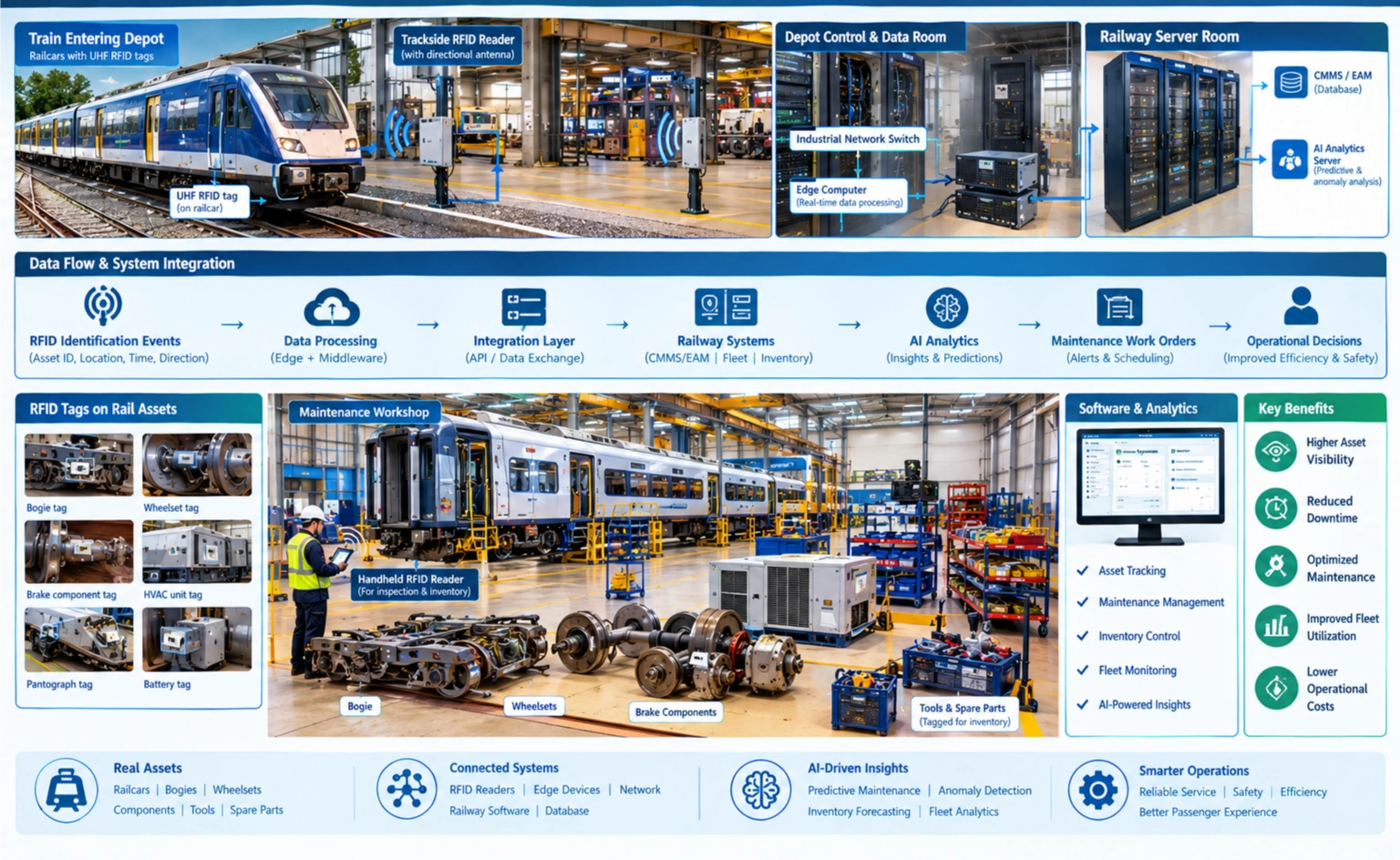
Railway Communications and Interoperability
RFID should not operate as an isolated data island. The deployment should define how identification events interact with existing railway IT and operational systems.
Interoperability considerations include:
- Consistent asset identifiers
- Standardized event formats
- Time synchronization
- Location naming conventions
- API or middleware interfaces
- CMMS/EAM integration
- Fleet database integration
- Access control
- Audit logging
- Data retention
- Network segmentation
- Cybersecurity controls
Railway RFID standards and industry guidance emphasize interoperability and consistent identification. EN 17230, for example, aims to support globally unique identification and interoperability for rolling-stock RFID applications.
iTeh Standards
Passenger rail operators should also evaluate RFID installations against applicable railway electromagnetic compatibility, communications, safety, infrastructure, rolling-stock, cybersecurity, and local regulatory requirements. Requirements vary by railway jurisdiction and application. For example, RSSB maintains specific requirements addressing RFID compatibility between trains and infrastructure, including application-code management.
RSSB +1
Engineering Considerations Before Commissioning
Successful deployment depends heavily on physical installation and operational testing.
RFID reader placement should account for vehicle geometry, antenna orientation, track alignment, tag mounting, train speed, metallic structures, neighboring readers, electromagnetic interference, environmental exposure, and maintenance access.
A commissioning program should include:
- Site surveys at every proposed reading point
- Tag placement verification
- Reader antenna alignment
- Read-zone validation
- Train-speed testing
- Direction detection testing
- False-read testing
- Missed-read analysis
- Network-loss testing
- Duplicate-event filtering
- Database reconciliation
- CMMS/EAM integration testing
- Cybersecurity validation
- Operator acceptance testing
The objective is not simply to demonstrate that a reader can detect a tag. The complete passenger rail workflow must demonstrate that the correct vehicle or asset is identified, the event reaches the correct software record, and the resulting information produces a valid operational or maintenance action.
AI Capabilities for Passenger Rail Asset and Maintenance Operations
AI becomes most valuable when passenger rail operators have enough reliable operational data to identify patterns that are difficult to detect manually. RFID provides structured asset-event data, while other railway systems contribute maintenance, inspection, condition, scheduling, and inventory information.
AI Asset Tracking and Movement Intelligence
AI can transform individual RFID reads into a more useful picture of asset movement.
For example, repeated RFID events from a railcar can be correlated with depot zones and scheduled maintenance activities. A rules engine can identify an expected movement sequence, while machine learning can identify unusual dwell times or movement patterns.
This can support:
- Automated railcar location updates
- Depot movement visibility
- Workshop workflow monitoring
- Abnormal dwell-time detection
- Asset utilization analysis
- Unscheduled movement alerts
- Fleet availability analysis
The AI model should distinguish between normal operational variation and genuinely abnormal events. A train remaining in a workshop longer than expected may result from a planned overhaul rather than a failure, so AI outputs should be interpreted alongside work-order and maintenance-planning data.
AI Predictive Maintenance for Rolling Stock
Predictive maintenance requires more than an RFID identifier. A useful model may combine:
- RFID vehicle and component identity
- Mileage and operating hours
- Vibration measurements
- Temperature data
- Wheel-condition measurements
- Brake inspection results
- Door-cycle information
- HVAC performance
- Traction-system data
- Historical failures
- Maintenance work orders
- Component replacement history
RFID establishes the identity and movement context needed to connect these datasets to the correct physical asset.
AI can then calculate risk scores or detect patterns associated with component degradation. Maintenance planners can use those results to prioritize inspections and determine which vehicles or components deserve closer engineering attention.
AI Inventory and Spare-Parts Management
Passenger rail maintenance organizations can hold thousands of parts, consumables, tools, and serviceable components. RFID can provide automatic identification while AI analyzes consumption patterns.
AI-assisted inventory management can help forecast demand for frequently replaced components, identify unusual consumption, detect slow-moving inventory, and recommend replenishment priorities.
For example, if a particular brake component is repeatedly consumed during a specific maintenance program, AI can correlate historical work orders, fleet mileage, scheduled overhauls, and current inventory to improve procurement planning.
AI-Based Anomaly Detection
Anomaly detection can be particularly useful where there is no single predefined failure rule.
A passenger rail system could learn normal patterns for:
- Train arrival at a depot
- Railcar movement between workshop zones
- Maintenance turnaround
- Spare-part consumption
- Tool utilization
- Inspection frequency
- Vehicle release processes
An unexpected sequence can then generate an alert for investigation.
The important engineering principle is that an AI anomaly should normally be treated as a decision-support signal, not automatically as proof of a safety-critical failure.
Passenger Rail AI Use-Case and Data Source Matrix
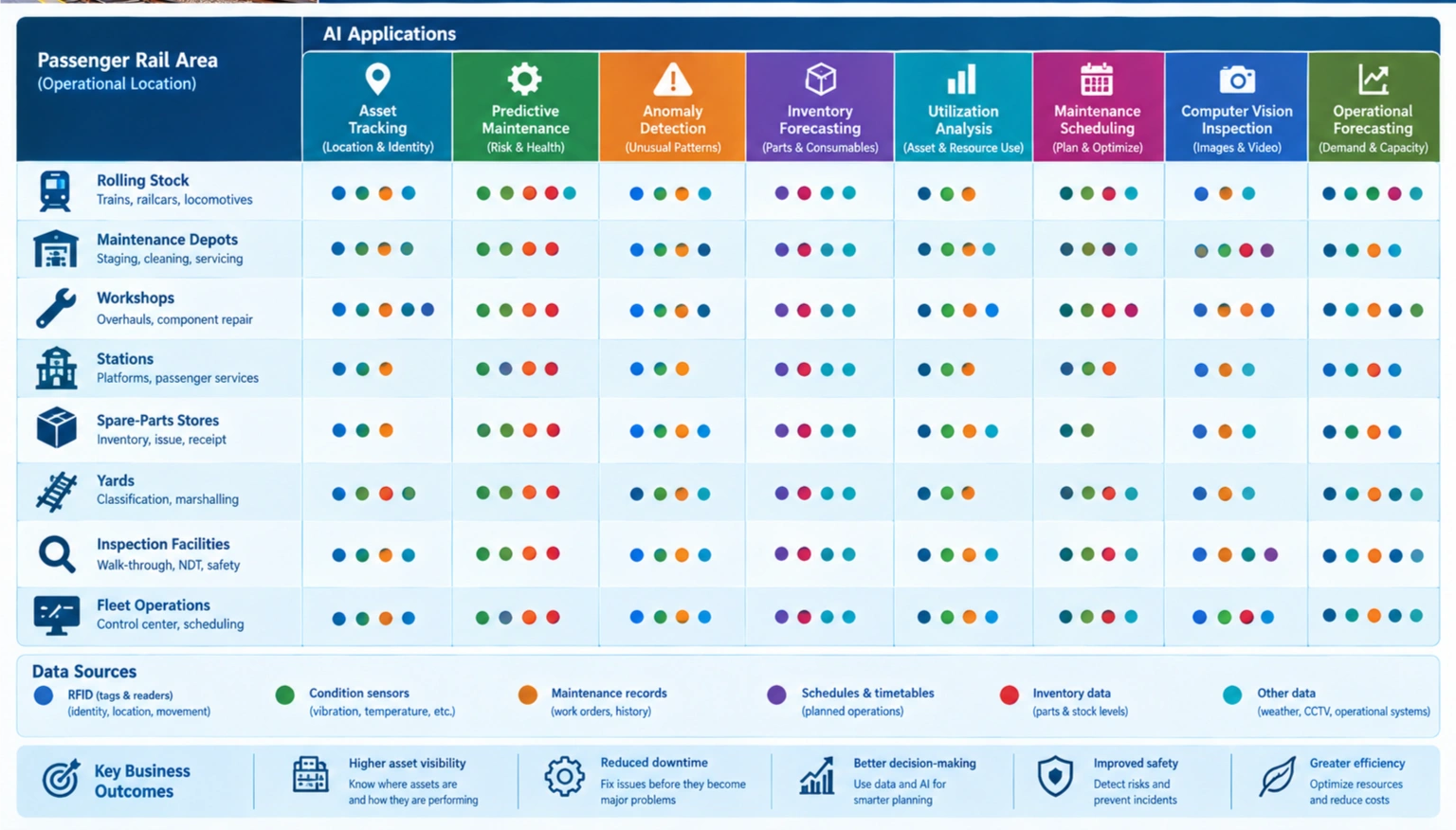
Passenger Rail Security, Safety and Data Governance
RFID and AI systems connected to railway operations must be designed with security and operational resilience in mind.
RFID Security
Security controls should consider both the RFID tags and the systems receiving RFID events.
- Relevant measures can include:
- Unique asset identification
- Controlled tag commissioning
- Reader authentication
- Secure network connections
- Access-controlled reader configuration
- Event integrity validation
- Audit logging
- Device inventory management
- Firmware and software maintenance
- Segmentation of RFID infrastructure from critical railway networks
RFID tags should also be protected against unauthorized replacement or reassignment. A physical tag may be inexpensive, but an incorrect asset identity can create incorrect maintenance records or inventory transactions.
AI Cybersecurity
AI applications introduce additional concerns around data integrity, model behavior, access permissions, and inappropriate automated actions.
Passenger rail operators should establish:
- Role-based access control
- Encryption in transit and at rest
- Secure API authentication
- Network segmentation
- Centralized logging
- Backup and recovery procedures
- Model-version control
- Data-quality monitoring
- AI output auditing
- Human approval for consequential maintenance decisions
Safety-critical railway functions should remain subject to applicable railway safety engineering and authorization processes. An AI-generated recommendation should not bypass established inspection, maintenance, signaling, or operational safety controls.
Data Quality and False RFID Events
AI performance is directly affected by input quality.
A reader may detect a tag that belongs to an adjacent track, fail to detect a poorly mounted tag, or repeatedly read the same tag while a train remains within the RF field. These events must be processed before they become operational records.
Useful validation techniques include:
- Read-zone filtering
- Duplicate suppression
- Direction-of-travel logic
- Track association
- Time-window validation
- Reader health monitoring
- Confidence scoring
- Cross-checking against train schedules
- Reconciliation with depot records
This is one of the most important practical lessons in AI-enabled RFID deployments: better AI does not compensate for poorly engineered data capture.
Passenger Rail Performance Metrics and KPIs
A passenger rail AI and RFID project should have measurable operational objectives rather than focusing only on the number of readers installed or RFID tags commissioned.
Relevant KPIs include:
| Passenger Rail KPI | How AI and RFID Can Contribute |
|---|---|
| Railcar identification accuracy | Automated vehicle identification at defined reading points |
| Depot asset visibility | Real-time or near-real-time movement events |
| Maintenance turnaround time | Analysis of entry, work-order and release events |
| Fleet availability | Correlation of vehicle status and maintenance activity |
| Mean time to repair | Correlation of vehicle status and maintenance activity |
| Mean time between failures | Analysis of maintenance workflow timestamps |
| Preventive-maintenance compliance | Comparison of scheduled and completed activities |
| Spare-parts stock accuracy | Automated asset and inventory identification |
| Workshop utilization | Analysis of asset movement and work duration |
| Asset search time | Automated location records |
| Missed RFID reads | Reader and tag performance monitoring |
| False-positive event rate | Event validation and filtering |
| Maintenance backlog | AI-assisted prioritization and analysis |
| Component replacement frequency | Historical asset-level analytics |
| Unplanned maintenance events | Pattern and anomaly detection |
The baseline should be measured before deployment. Otherwise, an operator may have difficulty demonstrating whether the RFID and AI investment produced meaningful improvement.
Scaling AI and RFID Across Passenger Rail Operations
A passenger rail operator should generally avoid treating an initial RFID installation as a network-wide deployment by default. A controlled pilot can expose installation, interoperability, data-quality, and operational issues before broader implementation.
A practical deployment sequence is:
- Select a defined operational problem, such as depot asset tracking or rolling-stock identification.
- Establish the required business and engineering KPIs.
- Survey the physical environment.
- Select tag type, reader type, antenna configuration, and mounting method.
- Define asset identifiers and event data.
- Install a limited number of reading points.
- Commission the RFID equipment.
- Validate read performance with representative trains and operating speeds.
- Connect the RFID system to the relevant railway software.
- Establish data-quality and cybersecurity controls.
- Introduce AI analytics after sufficient validated data has accumulated.
- Compare results against the baseline.
- Correct installation or workflow problems.
- Expand to additional depots, workshops, trainsets, or asset classes.
This phased approach reduces the risk of scaling an incorrectly designed reading configuration across an entire railway network.
Operational Trade-Offs
Passenger rail RFID projects involve engineering trade-offs.
Read range versus selectivity: Increasing read range can improve detection coverage but may increase the possibility of detecting tags outside the intended zone.
Automatic identification versus controlled scanning: Fixed readers reduce manual work, while handheld readers provide flexibility for detailed workshop inspections.
Edge processing versus centralized analytics: Edge processing can reduce latency and dependence on network connectivity, while centralized computing simplifies fleet-wide analytics.
Cloud versus private server deployment: Cloud systems can support distributed operations and centralized analytics, while privately hosted servers may better fit organizations with specific data-control or connectivity requirements.
AI automation versus human review: Automation can accelerate repetitive decisions, but maintenance and safety-related decisions may require engineering verification.
Tag cost versus environmental durability: A lower-cost tag may be unsuitable for exposed railcar locations. Mechanical mounting, vibration, temperature, moisture, cleaning chemicals, impact, and electromagnetic conditions should be considered.
GAO RFID Solutions for Passenger Rail
GAO provides RFID, BLE, and IoT hardware products and systems that can be incorporated into passenger rail identification, tracking, maintenance, inventory, and operational applications. Its railway-related offerings include RFID tags and readers, handheld devices, and railway management software intended to support functions such as railcar identification, positioning, maintenance status, and traffic-related information.
The practical value of a supplier is not limited to the RFID hardware itself. Passenger rail deployments require appropriate tag selection, reader configuration, installation planning, software integration, commissioning, troubleshooting, and ongoing technical support.
GAO’s broader engineering capability includes RFID, BLE, IoT, and related technologies, allowing railway operators and system integrators to evaluate RFID alongside other identification and sensing technologies when a particular application requires a different technical approach.
GAO is headquartered in New York City and Toronto, Canada, and is recognized among the leading B2B and B2G suppliers of BLE and RFID technologies. Its sister companies, GAO Research Inc. and GAO Tek Inc., form GAO Group, with operations based in New York City and Toronto.
Implementation Recommendations for Passenger Rail Operators
Passenger rail organizations considering AI-assisted RFID should begin with an operational problem rather than a technology specification.
Recommended practices include:
- Define the exact railway workflow to improve before selecting equipment.
- Identify the assets that require automatic identification.
- Establish a common asset-ID structure.
- Determine whether UHF, HF, or LF RFID is technically appropriate for each application.
- Conduct an RF and physical site survey before final reader placement.
- Test tags under actual railway environmental conditions.
- Validate performance with real train movements rather than laboratory tests alone.
- Integrate RFID events with existing CMMS, EAM, fleet, inventory, and operations systems.
- Establish event-quality rules before training machine-learning models.
- Use edge processing where local filtering or continued operation during network interruption is important.
- Select cloud or privately hosted server deployment according to railway IT, cybersecurity, connectivity, and data-governance requirements.
- Establish clear ownership for RFID infrastructure, software, data, and AI models.
- Keep safety-critical decisions under appropriate human and railway engineering controls.
- Measure baseline KPIs before deployment.
- Pilot the system at a representative depot or fleet operation before scaling.
- Maintain tags, readers, antennas, gateways, servers, and software as operational assets rather than treating installation as a one-time project.
Key Takeaways for AI and RFID in Passenger Rail
AI-assisted RFID can give passenger rail operators a stronger connection between physical railway assets and operational information. RFID identifies vehicles, components, tools, spare parts, and other assets, while AI can analyze their movements and combine those events with maintenance, condition-monitoring, inventory, and scheduling data.
The strongest use cases include rolling-stock identification, depot asset tracking, maintenance workflow monitoring, predictive-maintenance support, spare-parts management, anomaly detection, and fleet-utilization analysis.
Successful deployment depends on more than selecting RFID readers. Tag placement, antenna configuration, railway operating conditions, event validation, network connectivity, software interoperability, cybersecurity, AI data quality, and maintenance processes all influence the final result.
GAO can support organizations evaluating RFID, BLE, and IoT hardware products and systems for passenger rail applications, including technical selection, deployment considerations, integration, and support.
Building the Future of Industrial AI and IoT with Aperture Venture Studio and GAO RFID Inc.
For passenger rail, GAO’s long-term R&D in RFID, BLE, IoT, and AI supports the development of practical technologies for asset identification, maintenance, fleet visibility, and operational intelligence. For more than three decades, GAO Group has invested heavily in industrial RFID, BLE, and IoT R&D and has expanded its work into AI-enabled industrial applications. Aperture Venture Studio focuses this expertise on building and scaling AI and IoT solutions relevant to areas such as passenger rail, industrial asset management, and connected operations. Its technical community includes AI and IoT experts, executives, investors, and leading companies, supported by Aperture Ventures Summit and TekSummit. We welcome you to join us as Advisors, Co-founders or Employees, Investors, or Customers.