
AI and RFID for Commercial Aircraft Manufacturing
Understanding AI-Enabled RFID Solutions for Commercial Aircraft Manufacturing
Commercial aircraft manufacturing requires extensive coordination among engineering departments, production teams, supply chain organizations, maintenance groups, quality assurance personnel, and regulatory compliance specialists.
Traditional manual tracking methods often struggle to provide real-time visibility across large manufacturing facilities where thousands of production activities occur simultaneously.
AI-powered manufacturing intelligence supported by RFID technology helps create a digital thread connecting physical assets, production events, quality records, maintenance activities, and operational workflows. AI algorithms analyze continuously collected operational data to identify bottlenecks, predict production risks, optimize material flow, improve scheduling accuracy, and support regulatory compliance.
For commercial aircraft manufacturers, this capability is particularly valuable because production programs frequently span multiple years, involve global supplier networks, and require extensive documentation to satisfy airworthiness requirements.
AI-Enabled RFID Commercial Aircraft Manufacturing Workflow and Production Intelligence System
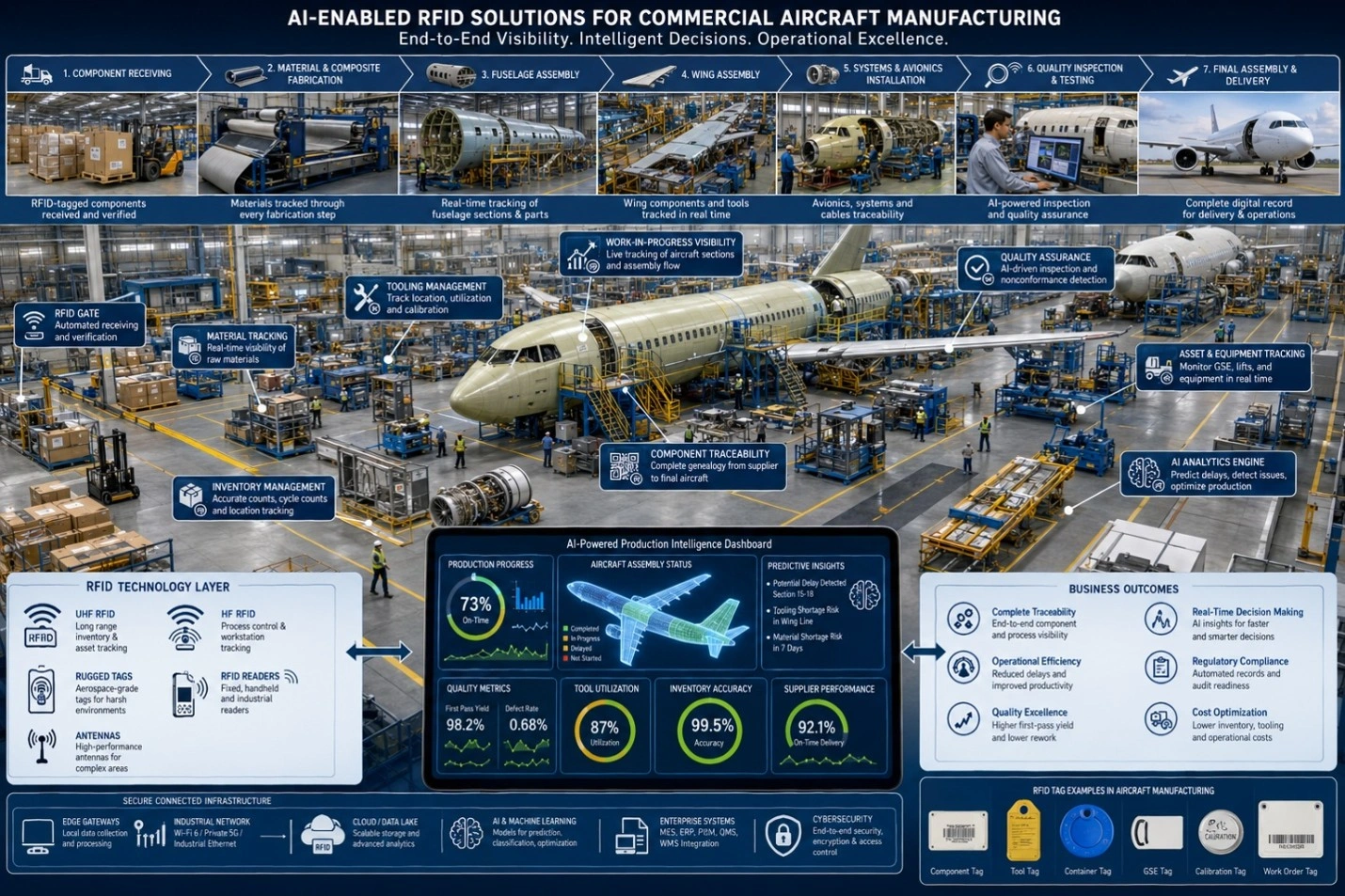
Understanding AI-Enabled RFID Solutions for Commercial Aircraft Manufacturing
Commercial aircraft manufacturing requires extensive coordination among engineering departments, production teams, supply chain organizations, maintenance groups, quality assurance personnel, and regulatory compliance specialists.
Aircraft production environments routinely manage:
- Aircraft structures
- Composite materials
- Fuselage sections
- Wings and empennages
- Avionics systems
- Landing gear assemblies
- Cabin systems
- Production tooling
- Ground support equipment
- Calibration assets
- Work-in-progress inventory
- Serialized aircraft components
- Regulatory documentation
- Manufacturing execution records
Traditional manual tracking methods often struggle to provide real-time visibility across large manufacturing facilities where thousands of production activities occur simultaneously.
AI-powered manufacturing intelligence supported by RFID technology helps create a digital thread connecting physical assets, production events, quality records, maintenance activities, and operational workflows. AI algorithms analyze continuously collected operational data to identify bottlenecks, predict production risks, optimize material flow, improve scheduling accuracy, and support regulatory compliance.
For commercial aircraft manufacturers, this capability is particularly valuable because production programs frequently span multiple years, involve global supplier networks, and require extensive documentation to satisfy airworthiness requirements.
Why Commercial Aircraft Manufacturers Are Investing in AI-Based Production Intelligence
Aircraft manufacturing differs significantly from many other manufacturing sectors due to stringent safety requirements, long production cycles, complex assemblies, and extensive regulatory oversight.
Common operational challenges include:
- Supplier delivery variability
- Missing or misplaced components
- Tool availability issues
- Production scheduling conflicts
- Quality escape risks
- Documentation management complexity
- Configuration control challenges
- Regulatory compliance requirements
- Asset utilization inefficiencies
- Long inspection cycles
- Inventory visibility limitations
- Engineering change management complexity
AI systems supported by RFID-generated operational data help address these challenges through continuous monitoring, predictive analytics, and automated decision support.
Examples include:
- Predicting production delays before schedule impacts occur
- Detecting component shortages before assembly disruptions
- Identifying quality anomalies during manufacturing
- Optimizing aircraft assembly sequencing
- Improving tooling utilization
- Reducing work-in-progress inventory
- Enhancing supplier performance monitoring
- Supporting digital manufacturing initiatives
- Automating compliance documentation validation
Manufacturers implementing these capabilities often achieve improved production visibility, enhanced traceability, and more effective resource utilization across aircraft assembly programs.
Commercial Aircraft Manufacturing Challenges and AI-Driven Production Intelligence Solutions
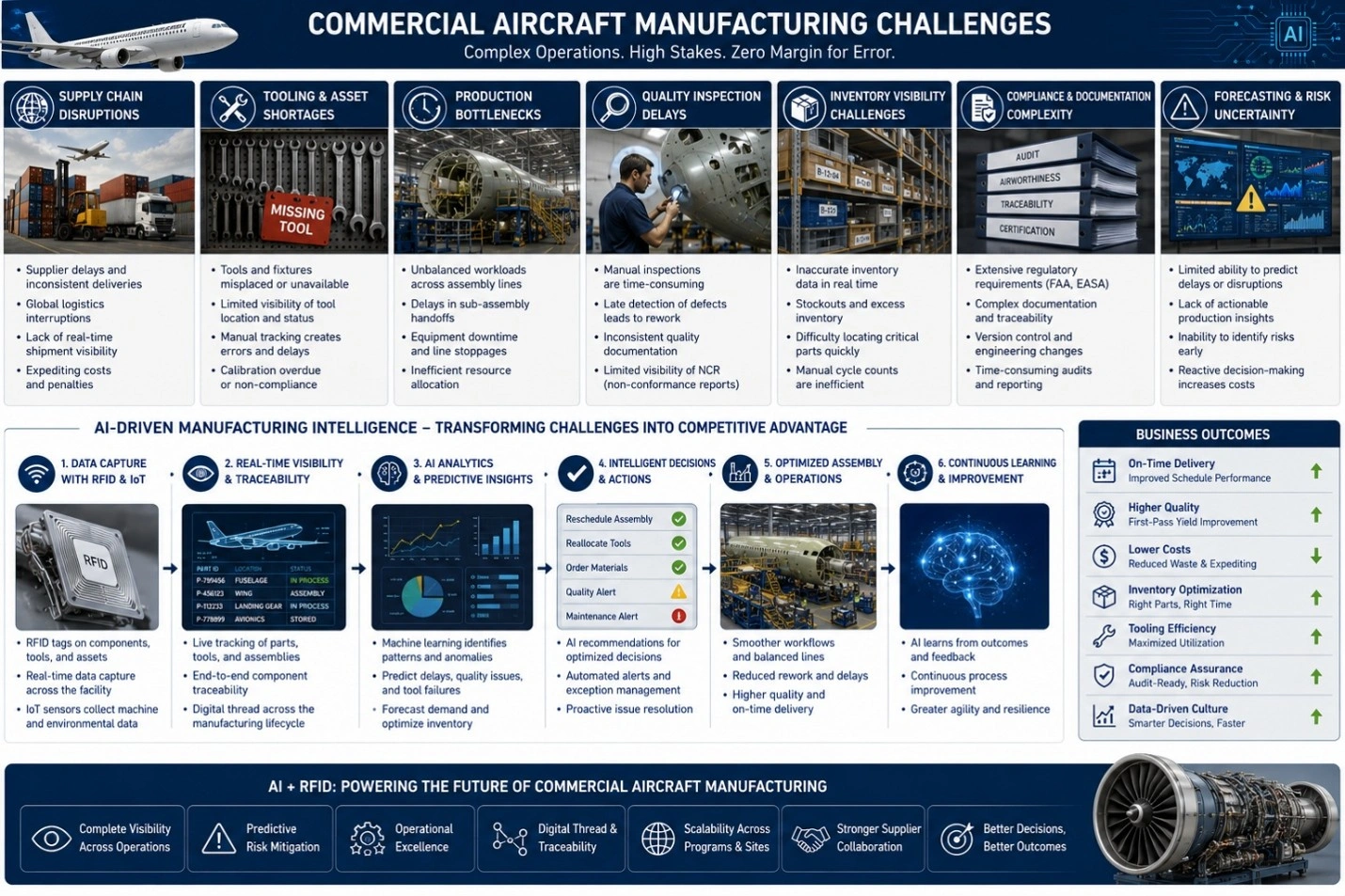
Commercial Aircraft Manufacturing Applications of AI-Powered RFID Solutions
Aircraft Component Traceability
Aircraft manufacturers must maintain complete traceability for thousands of serialized components installed throughout an aircraft.
AI-enabled RFID systems support:
- Component genealogy tracking
- Lot and batch verification
- Supplier traceability
- Installation validation
- Configuration management
- Airworthiness record generation
- Maintenance history linkage
Machine learning models can automatically identify traceability gaps, documentation inconsistencies, and compliance risks before final aircraft certification activities.
Tooling and Production Asset Management
Aircraft assembly relies heavily on specialized tooling, fixtures, molds, torque tools, gauges, and calibration equipment.
AI-powered asset management solutions help:
- Track tooling location in real time
- Monitor utilization rates
- Predict maintenance requirements
- Manage calibration schedules
- Detect unauthorized tool movement
- Reduce tool search times
- Improve asset availability
Production managers gain greater visibility into critical assets required for assembly operations.
Aerospace Inventory Intelligence
Aircraft manufacturers frequently maintain large inventories of high-value parts and materials.
AI-enhanced inventory management supports:
- Inventory forecasting
- Material demand planning
- Safety stock optimization
- Shortage prediction
- Excess inventory identification
- Warehouse efficiency improvements
- Automated replenishment recommendations
RFID-generated inventory data provides the operational foundation required for accurate AI forecasting models.
Work-in-Progress Monitoring
Aircraft assembly programs involve thousands of interconnected manufacturing activities.
AI-based work-in-progress visibility solutions help organizations:
- Monitor assembly status
- Track production milestones
- Measure cycle times
- Identify bottlenecks
- Improve resource allocation
- Predict schedule deviations
- Optimize workflow sequencing
Production supervisors gain near real-time visibility into aircraft manufacturing progress across multiple assembly lines.
Quality Assurance and Defect Prevention
Quality control remains a critical requirement in aerospace manufacturing.
AI systems can analyze production records, inspection data, asset histories, environmental conditions, and manufacturing events to identify patterns associated with defects or process deviations.
Applications include:
- Nonconformance prediction
- Inspection prioritization
- Root cause analysis
- Process anomaly detection
- Supplier quality monitoring
- Defect trend analysis
- Automated quality reporting
These capabilities help reduce rework costs while supporting airworthiness compliance requirements.
AI-Enabled Aircraft Component Traceability Workflow for Commercial Aircraft Manufacturing
End-to-End Operational Workflow in AI-Enabled Commercial Aircraft Manufacturing
AI-driven aircraft manufacturing intelligence relies on continuous collection, processing, analysis, and action on operational data generated throughout production facilities.
Data Acquisition Layer
Operational data originates from numerous sources including:
- RFID-tagged aircraft components
- Production tooling
- Ground support equipment
- Inventory containers
- Calibration assets
- Automated inspection systems
- Manufacturing workstations
- Environmental monitoring sensors
- Production machinery
- Supplier shipments
RFID readers positioned throughout manufacturing facilities capture asset movement, process events, inventory transactions, and production status information.
Communication and Data Transport
Collected operational data is transmitted through industrial communication networks including:
- Ethernet infrastructure
- Industrial Wi-Fi
- Private 5G networks
- Secure VPN connections
- Edge gateways
- Manufacturing communication servers
These communication systems enable real-time information exchange between production environments and operational software systems.
Edge Processing and Manufacturing Intelligence
Edge computing systems located near production operations perform initial processing activities such as:
- Event filtering
- Data normalization
- Asset identification
- Rule-based decision making
- Latency-sensitive automation
- Operational alert generation
Edge intelligence reduces response times while minimizing network traffic requirements.
Real-World AI and RFID Deployment Across Commercial Aircraft Manufacturing Facilities
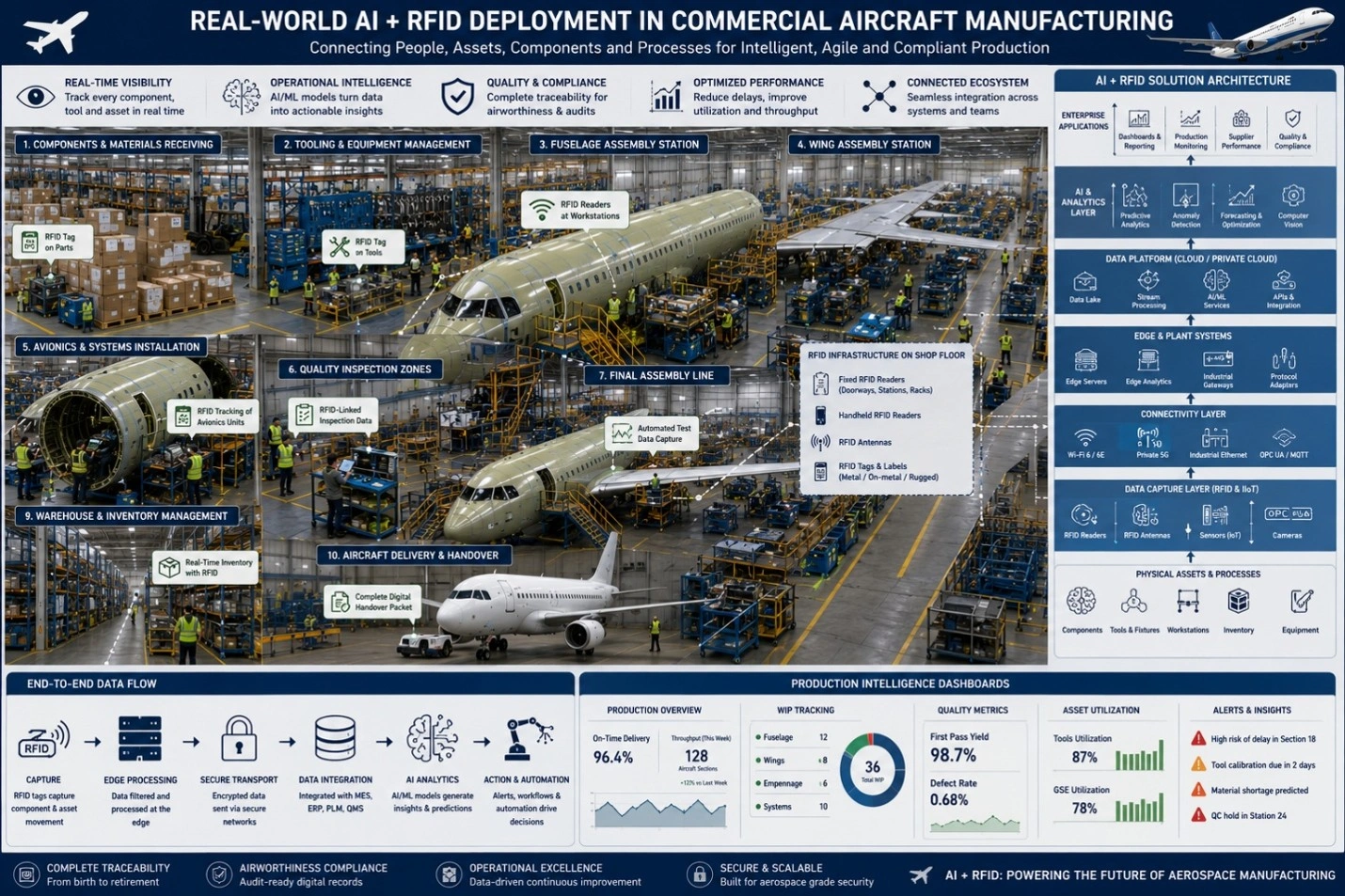
Core Technologies Supporting AI-Based Aircraft Manufacturing Intelligence
Commercial aircraft manufacturing solutions combine multiple technologies to create comprehensive production intelligence systems.
RFID Infrastructure
RFID technologies used within aircraft manufacturing environments may include:
- UHF RFID for long-range inventory visibility
- HF RFID for controlled process tracking
- LF RFID for specialized identification applications
- Fixed RFID readers
- Handheld RFID readers
- Industrial RFID antennas
- Aerospace-certified RFID tags
- Ruggedized asset tags
These technologies provide automated identification and data capture throughout manufacturing operations.
Artificial Intelligence Technologies
AI capabilities commonly deployed include:
- Machine learning
- Predictive analytics
- Deep learning
- Computer vision
- Production forecasting
- Digital twin analytics
- Anomaly detection
- Predictive maintenance modeling
- Optimization algorithms
- Natural language processing
These models transform operational data into manufacturing intelligence and decision support.
Core Technologies Supporting AI-Based Aircraft Manufacturing Intelligence (Continued)
Enterprise Software Integration
Commercial aircraft manufacturing environments rely on multiple operational and engineering software systems. AI-driven production intelligence solutions frequently integrate with:
- Manufacturing Execution Systems (MES)
- Enterprise Resource Planning (ERP) software
- Product Lifecycle Management (PLM) systems
- Quality Management Systems (QMS)
- Computerized Maintenance Management Systems (CMMS)
- Supply Chain Management (SCM) software
- Warehouse Management Systems (WMS)
- Engineering Change Management systems
- Digital Thread solutions
- Aircraft Configuration Management software
Examples commonly found within commercial aircraft manufacturing include Siemens Opcenter, Dassault Systèmes DELMIA, Dassault ENOVIA, PTC Windchill, SAP S/4HANA, Oracle ERP, IBM Maximo, and various aerospace-specific production management systems.
These integrations ensure that operational data captured from manufacturing activities contributes directly to production planning, quality management, compliance documentation, and aircraft configuration control.
Cloud Version vs Server Version Deployments
Commercial aircraft manufacturers typically select deployment models based on operational requirements, cybersecurity policies, regulatory obligations, and production infrastructure.
Cloud Version
Cloud-hosted deployments are commonly used when organizations require:
- Multi-site manufacturing visibility
- Global supplier collaboration
- Centralized analytics
- Scalable computing resources
- Reduced infrastructure management
- Faster software updates
- Enterprise-wide reporting
Cloud deployments are often suitable for organizations operating geographically distributed aircraft production programs where centralized operational intelligence is required.
Server Version
Server-hosted deployments are frequently preferred when manufacturers require:
- Strict control of production data
- Compliance with defense-related security policies
- Low-latency manufacturing operations
- Factory-controlled infrastructure
- Private data center management
- Segregated production environments
- Internal cybersecurity governance
Server deployments may operate within manufacturing facilities, private clouds, dedicated enterprise infrastructure, or customer-managed data centers.
Many commercial aircraft manufacturers ultimately adopt hybrid deployments where edge servers support factory operations while centralized analytics are performed through cloud-hosted environments.
Cybersecurity and Data Protection
Aircraft manufacturing systems contain sensitive engineering information, production records, supplier data, and compliance documentation.
Security controls commonly include:
- Zero Trust security principles
- Role-based access control
- Multi-factor authentication
- Encryption at rest
- Encryption in transit
- Security Information and Event Management (SIEM)
- Network segmentation
- Industrial firewall protection
- Device authentication
- Security monitoring and auditing
Commercial aircraft manufacturers must often align security strategies with standards and frameworks such as:
- NIST Cybersecurity Framework
- NIST SP 800-171
- ISO 27001
- CMMC requirements where applicable
- FAA compliance requirements
- EASA compliance expectations
- Aerospace cybersecurity best practices
GAO has supported organizations requiring secure RFID and IoT deployments through quality-controlled hardware products, technical expertise, and implementation guidance.
Commercial Aircraft Manufacturing AI, RFID, Edge Computing, and Enterprise Systems Infrastructure
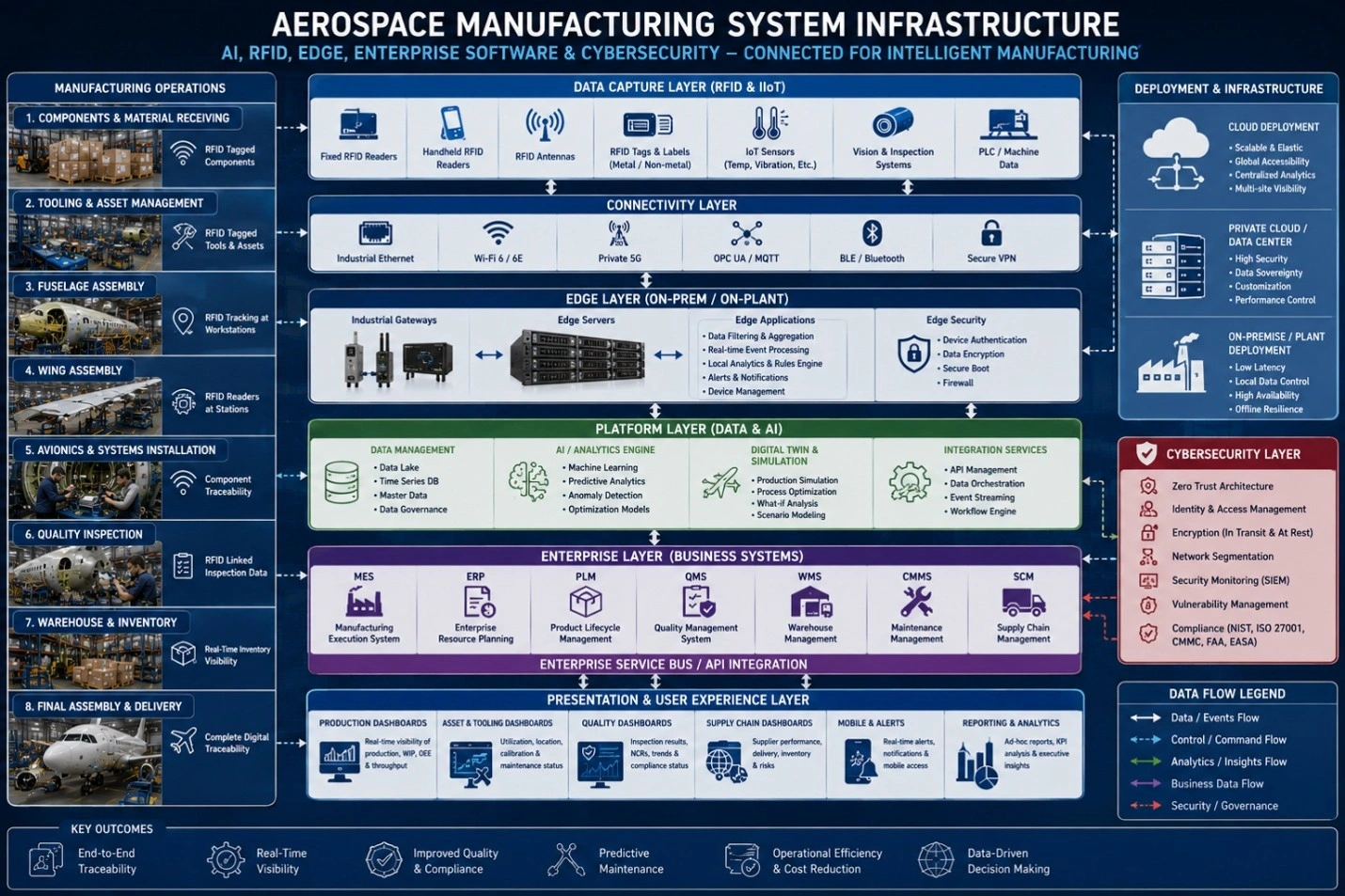
Technical Capabilities Delivered by AI-Driven Aircraft Manufacturing Intelligence
Commercial aircraft manufacturers increasingly leverage AI-enabled operational intelligence to improve visibility, quality, efficiency, compliance, and production performance.
Predictive Production Planning
AI models analyze production schedules, supplier deliveries, inventory levels, labor availability, tooling utilization, and assembly progress to predict future production outcomes.
Capabilities include:
- Schedule risk forecasting
- Production bottleneck prediction
- Material shortage forecasting
- Capacity optimization
- Assembly sequence recommendations
- Resource allocation improvements
This enables manufacturing teams to proactively address issues before they affect aircraft delivery schedules.
Intelligent Asset Visibility
Production assets continuously generate operational information that AI systems can analyze for optimization opportunities.
Capabilities include:
- Real-time asset location awareness
- Tool utilization analysis
- Asset lifecycle management
- Maintenance scheduling optimization
- Calibration compliance monitoring
- Asset availability forecasting
Large aircraft assembly facilities often realize substantial efficiency gains through improved asset visibility.
Automated Compliance Intelligence
Aircraft manufacturing requires extensive documentation supporting airworthiness certification and regulatory compliance.
AI-assisted compliance solutions help:
- Validate manufacturing records
- Detect documentation gaps
- Verify process adherence
- Monitor configuration control
- Support audit preparation
- Accelerate certification workflows
Automated compliance intelligence reduces administrative burden while improving documentation accuracy.
Advanced Quality Analytics
Quality-related data generated throughout manufacturing can be analyzed to identify emerging risks.
AI-powered quality capabilities include:
- Defect trend analysis
- Root cause investigation
- Process deviation detection
- Supplier quality intelligence
- Inspection optimization
- Nonconformance prediction
These capabilities help manufacturers improve first-pass quality and reduce costly rework activities.
Supply Chain Intelligence
Commercial aircraft programs depend on extensive supplier networks that span multiple countries and manufacturing locations.
AI-enhanced supply chain capabilities include:
- Supplier performance monitoring
- Inventory optimization
- Lead-time forecasting
- Risk assessment
- Shipment visibility
- Procurement intelligence
These capabilities support greater supply chain resilience and production continuity.
AI-Powered RFID Aerospace Manufacturing KPI Dashboard for Commercial Aircraft Production
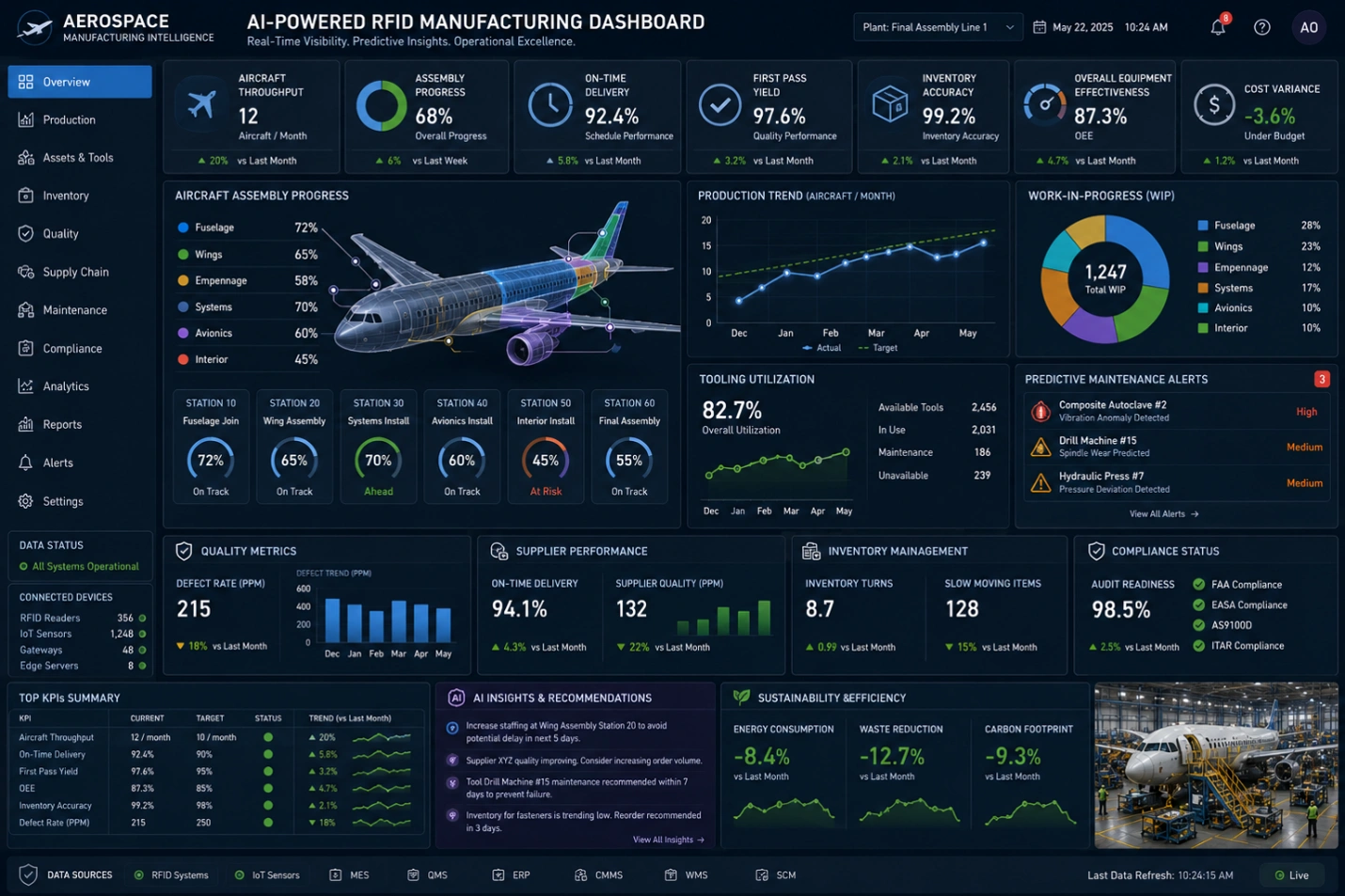
Business Benefits for Commercial Aircraft Manufacturers
Organizations implementing AI-enabled manufacturing intelligence supported by RFID technologies often pursue improvements across operational, financial, and compliance objectives.
Production Benefits
- Improved assembly line visibility
- Faster issue identification
- Reduced production delays
- Better production planning accuracy
- Enhanced throughput management
- Improved work-in-progress control
Quality Benefits
- Higher first-pass yield
- Reduced rework rates
- Earlier defect detection
- Improved inspection efficiency
- Enhanced supplier quality management
- Better configuration control
Inventory Benefits
- Improved inventory accuracy
- Reduced inventory carrying costs
- Better material availability
- Faster inventory audits
- Improved warehouse efficiency
- Enhanced demand forecasting
Asset Management Benefits
- Higher asset utilization
- Reduced equipment downtime
- Improved calibration compliance
- Lower asset replacement costs
- Enhanced maintenance planning
- Reduced tool search time
Compliance Benefits
- Improved traceability
- Faster audit preparation
- Enhanced regulatory reporting
- Better documentation integrity
- Reduced compliance risk
- Improved certification readiness
Strategic Benefits
- Stronger digital manufacturing initiatives
- Improved operational intelligence
- Better cross-functional collaboration
- Increased production scalability
- Enhanced supplier visibility
- Improved decision-making quality
Key Performance Indicators for AI-Powered Commercial Aircraft Manufacturing
Manufacturers commonly evaluate deployment success using metrics such as:
| KPI Category | Example Measurements |
|---|---|
| Production Performance | Aircraft assembly cycle time, station throughput, schedule adherence |
| Inventory Management | Inventory accuracy, stock availability, inventory turnover |
| Asset Utilization | Tool utilization, calibration compliance, asset availability |
| Quality Performance | First-pass yield, defect rate, nonconformance frequency |
| Supply Chain Performance | Supplier delivery performance, material shortages |
| Maintenance Performance | Equipment uptime, maintenance response time |
| Compliance Performance | Audit readiness, traceability completeness |
| Operational Efficiency | Labor productivity, process cycle reduction |
These KPIs help quantify operational improvements and support continuous optimization initiatives.
Implementation Considerations and Best Practices
Successful deployment of AI-driven manufacturing intelligence requires careful planning and execution.
Recommended practices include:
- Establish clear business objectives before technology selection
- Identify high-value aircraft production workflows
- Standardize asset identification strategies
- Develop comprehensive data governance policies
- Validate integration requirements early
- Ensure cybersecurity controls are implemented from project inception
- Pilot solutions in controlled production areas
- Measure outcomes using predefined KPIs
- Train production, engineering, quality, and maintenance personnel
- Continuously refine AI models using operational feedback
Practical experience shows that data quality, process standardization, and stakeholder alignment frequently have a greater impact on deployment success than technology selection alone.
AI-Enabled RFID Implementation Roadmap for Commercial Aircraft Manufacturing
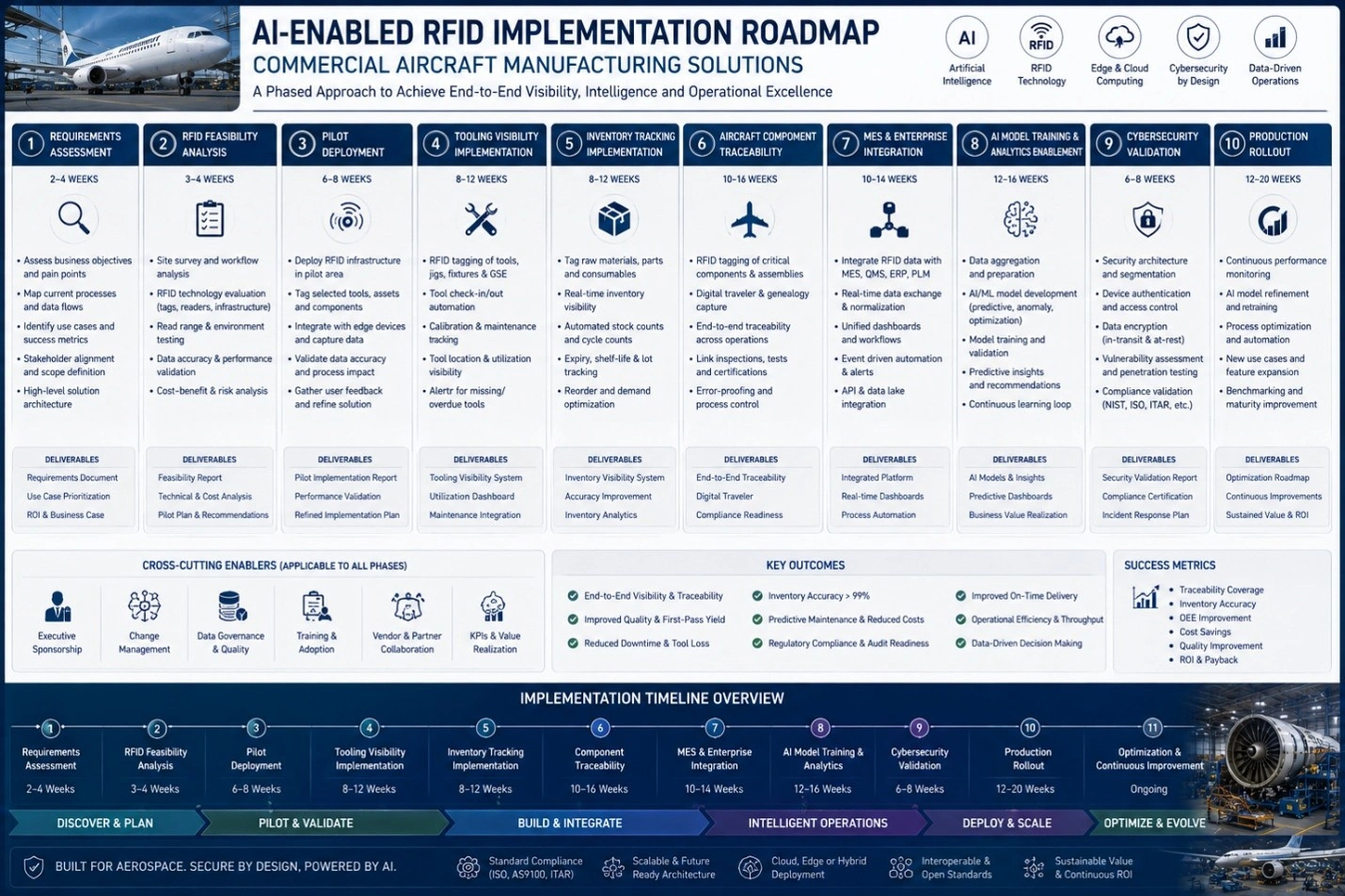
Advancing Commercial Aircraft Manufacturing with AI-Powered Operational Intelligence
Commercial aircraft manufacturing continues to evolve toward highly connected, data-driven production environments where operational visibility, quality assurance, traceability, and compliance are critical success factors.
AI-enabled manufacturing intelligence supported by RFID technologies helps aircraft manufacturers improve production planning, asset visibility, inventory management, quality control, supply chain coordination, and regulatory compliance. Through the combination of automated data collection, advanced analytics, machine learning, and industrial automation, organizations can build more resilient and efficient aircraft production operations.
Headquartered in New York City and Toronto, Canada, GAO is recognized among the world’s leading suppliers of RFID and IoT technologies. For more than three decades, GAO and its affiliated organizations have supported Fortune 500 companies, research institutions, government agencies, and aerospace organizations across North America through advanced hardware solutions, rigorous quality assurance processes, and expert technical support. Organizations seeking to modernize aircraft manufacturing operations can benefit from learning more about GAO’s RFID, IoT, and industrial AI capabilities.
Building the Future of Industrial AI and IoT with Aperture Venture Studio and GAO
For more than three decades, GAO Group of Companies has invested heavily in research and development of industrial RFID, BLE, and IoT technologies supporting advanced manufacturing operations, including commercial aircraft manufacturing. As generative AI and industrial AI continue to demonstrate value in aerospace production, we have expanded our development of AIoT solutions and established Aperture Venture Studio to accelerate the advancement and commercialization of innovative AI and IoT technologies that address complex manufacturing and operational challenges.
Aperture has attracted leading AI and IoT experts, accomplished operational executives, influential investors, and prominent organizations. Through initiatives such as Aperture Ventures Summit and TekSummit, we facilitate discussions on emerging AI and IoT technologies while fostering strong technical communities. We welcome participation as:
- Advisors, Co-founders, or Employees
- Investors
- Customers
Together, we can help shape the future of intelligent manufacturing, industrial AI, and connected aerospace operations.
BLE Hardware and AI Software for Banking Operations
BLE hardware serves as the physical data collection layer for banking operations. The specific hardware configuration should be selected according to the required coverage, asset type, location accuracy, battery life, environmental conditions, security requirements, and integration requirements.
BLE Beacons and Asset Tags
BLE beacons can transmit identifiers that allow nearby gateways or authorized devices to determine the presence or proximity of tagged assets. Battery-powered tags can be attached to portable equipment, while fixed beacons can help define locations or zones.
Banking deployments should consider:
- Battery life and replacement schedules
- Transmission interval
- Physical mounting method
- Radio coverage
- Asset movement patterns
- Required location accuracy
- Tamper considerations
- Environmental conditions
BLE Sensors
BLE sensors extend the system beyond identification and proximity. Depending on the device, sensors can capture environmental or physical conditions such as temperature, humidity, motion, acceleration, or other supported measurements.
Sensor selection should be based on the actual operational decision that the data must support. Collecting measurements without a defined operational purpose increases data volume without necessarily improving banking operations.
BLE Gateways
BLE gateways receive data from nearby BLE devices and transfer it to edge software, servers, or cloud services. Gateway placement affects coverage, latency, battery behavior, and location accuracy.
For branches and banking facilities, gateway locations should account for walls, equipment rooms, floor layouts, radio interference, and the expected movement of tagged assets. A site survey is often necessary before final installation.
GAO provides BLE hardware and IoT technologies that can be incorporated into asset monitoring, sensor data collection, and location-aware operational systems.
Cloud and Server Deployment for Banking Operations
Cloud Version
A cloud-hosted implementation can centralize data ingestion, AI processing, dashboards, device management, and analytics across multiple branches or facilities. This model can be appropriate when banking organizations need centralized visibility and scalable computing resources.
Cloud deployment should still address:
- Data residency requirements
- Encryption in transit and at rest
- Identity and access management
- Network segmentation
- API security
- Audit logging
- Retention policies
- Model governance
- Availability requirements
- Integration with existing banking systems
AI processing can occur centrally when the application does not require immediate local decisions and connectivity is sufficiently reliable.
Server Version
A privately hosted server deployment can place application software on customer-managed servers, private data centers, edge servers, or other controlled enterprise infrastructure. This approach can be useful where banking organizations require greater control over data processing, network connectivity, integration boundaries, or operational policies.
Server-based deployment can also support edge processing close to branches or facilities. Time-sensitive events can be evaluated locally before selected information is forwarded to centralized systems.
A hybrid implementation can combine local edge processing with centralized server or cloud analytics. The appropriate choice depends on security policy, latency requirements, branch connectivity, data governance, scale, and the existing IT environment.
Security and Integration Considerations
Security must be considered across the entire data path, from BLE devices to gateways, networks, AI software, databases, and connected banking systems. BLE connectivity alone does not establish an appropriate security model for a banking deployment.
Engineering teams should evaluate:
- Device identity and provisioning
- Secure gateway configuration
- Network segmentation
- Encryption
- Role-based access control
- API authentication and authorization
- Audit logging
- Firmware management
- Vulnerability management
- Data retention
- Incident response
- Physical protection of gateways and sensors
- Secure integration with existing banking software
BLE events should also be correlated with authoritative systems where identity or authorization is important. For example, a BLE asset-location event should not independently authorize access to a restricted banking area.
GAO’s technology experience spans BLE, RFID, and IoT products and systems, with R&D, quality assurance, and technical support intended to support deployments that require reliable hardware and engineering assistance. GAO serves organizations in the United States and Canada, including Fortune 500 companies, research organizations, universities, and government agencies.
Defense-in-Depth Security for AI-Enabled Banking Operations
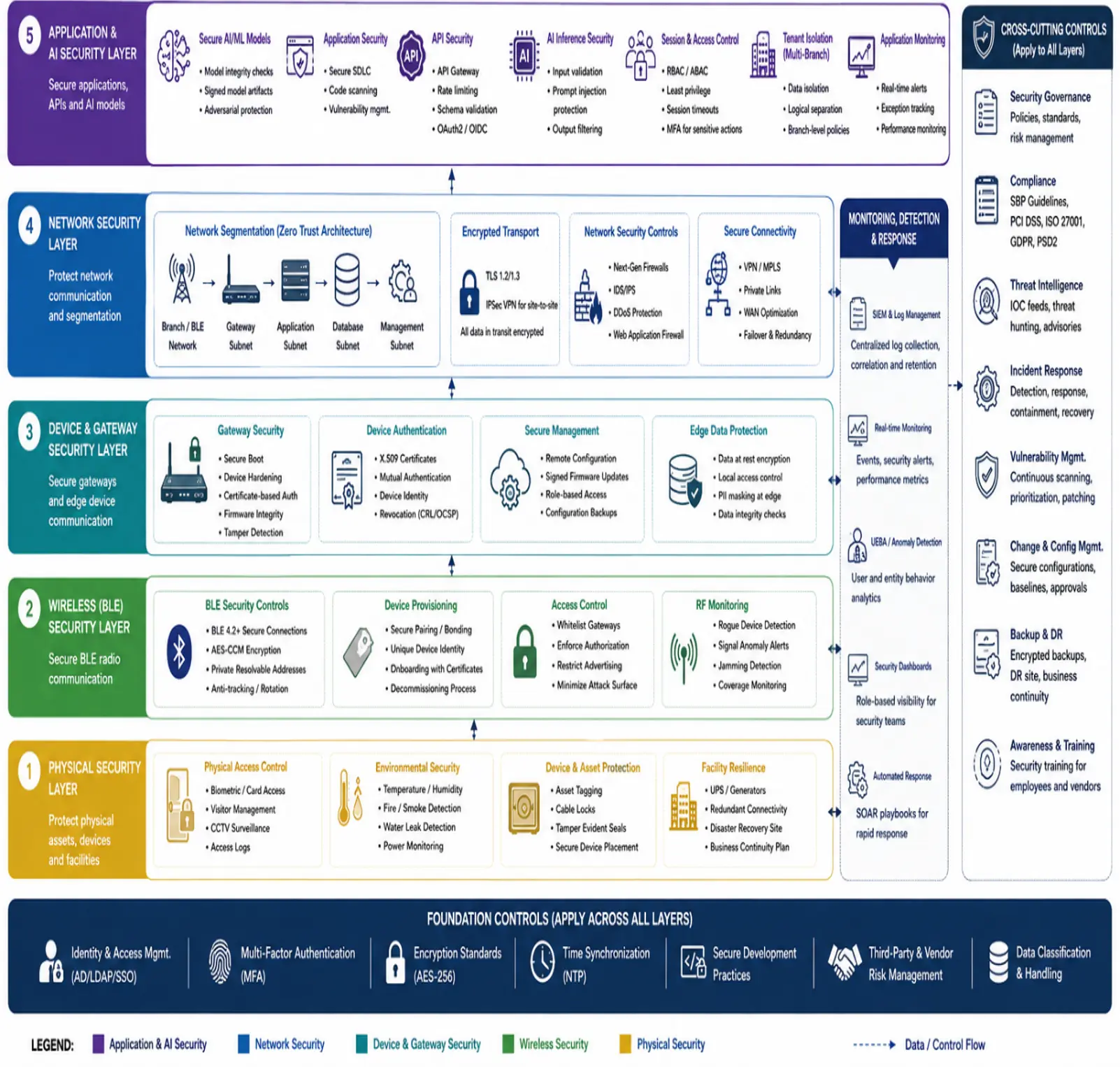
The diagram illustrates layered cybersecurity controls across physical banking infrastructure, BLE devices, gateways, networks, applications, AI systems, data, monitoring, and governance.
Practical Engineering Considerations for Banking Deployments
A successful deployment depends on more than selecting BLE hardware and an AI model. Banking environments require careful planning around physical coverage, operational processes, existing software, security controls, and long-term maintenance.
Key engineering considerations include:
- Define the operational decision first:Determine what action the system must improve before selecting sensors or AI models.
- Perform a radio site survey:Evaluate walls, floors, equipment, interference, gateway locations, and required coverage.
- Establish data quality controls:Handle duplicate readings, missing data, timestamp inconsistencies, device failures, and unexpected sensor values.
- Start with measurable use cases:Asset tracking, environmental monitoring, predictive maintenance, and anomaly detection can each have different technical requirements.
- Integrate with existing workflows:AI alerts become more useful when connected to established maintenance, security, facilities, and IT service processes.
- Use human validation for consequential decisions:AI should support authorized banking personnel rather than bypass established controls.
- Monitor model performance:Changes in branch layouts, equipment, operating schedules, or device behavior can affect model accuracy.
- Plan lifecycle management:Include battery replacement, firmware updates, gateway maintenance, sensor calibration, cybersecurity reviews, and model retraining where required.
GAO can support organizations that need BLE and IoT hardware products and systems as part of these deployment requirements, including engineering support for organizations operating distributed physical environments.
Banking Operations AI and BLE Deployment Priorities
The strongest business case for AI-enabled BLE in banking operations comes from connecting physical operational events to measurable improvements in asset visibility, maintenance response, environmental control, security monitoring, and service efficiency. BLE provides the operational data source, while AI provides methods for detecting patterns and prioritizing decisions.
Banking organizations should begin with a defined operational problem, establish measurable KPIs, validate the BLE coverage and data quality, integrate the solution with existing workflows, and then expand to additional branches or facilities after the initial deployment demonstrates reliable results.
AI Capabilities That Improve Banking Operations
AI adds value to BLE-enabled banking operations when it converts large volumes of physical-world events into prioritized operational information. The objective is not simply to increase the number of connected devices. The objective is to improve how banking teams understand assets, facilities, equipment conditions, and operational exceptions.
Machine learning models can establish normal behavior from historical operational data. Anomaly detection can then identify events that differ significantly from expected patterns. Time-series models can evaluate environmental or equipment measurements over time, while classification models can categorize operational events according to predefined conditions.
For banking operations, these capabilities can improve:
- Asset visibility by identifying unusual movement, prolonged inactivity, or unexpected location changes.
- Maintenance planning by identifying developing equipment or environmental problems.
- Branch operations by detecting unusual occupancy or operational conditions.
- Security monitoring by correlating physical events with authorized operational activities.
- Facilities management by analyzing environmental conditions and equipment behavior.
- Service management by prioritizing incidents according to severity and operational context.
- Resource utilization by identifying underused or frequently moved operational assets.
- Operational reporting by converting raw sensor events into meaningful performance indicators.
AI should remain explainable enough for operational teams to understand why an event was prioritized. A maintenance technician, branch manager, or security operator should be able to identify the underlying asset, location, timestamp, sensor information, and relevant historical context rather than receiving an unexplained prediction.
Operational KPIs for AI-Enabled Banking Systems
A banking deployment should establish measurable KPIs before expanding beyond an initial proof of concept. The appropriate metrics depend on the use case, but several measurements are particularly relevant.
| Operational Area | Example KPI | Measurement Objective |
| Asset management | Asset location accuracy | Determine whether tagged assets are identified in the correct area |
| Asset utilization | Asset utilization rate | Identify equipment that is underused or unavailable |
| Maintenance | Mean time to repair | Measure how quickly operational problems are resolved |
| Maintenance | Unplanned equipment incidents | Track unexpected failures or service events |
| AI monitoring | False-alert rate | Determine whether AI-generated alerts are operationally useful |
| Environmental monitoring | Threshold violations | Measure abnormal environmental conditions |
| Security | Unrecognized movement events | Identify unexpected asset or equipment movement |
| Operations | Incident response time | Measure the time from event detection to operational response |
| Network | Gateway availability | Verify reliable BLE data collection |
| Device management | Sensor availability | Measure whether deployed sensors are functioning |
| Financial operations | Cost per monitored location | Evaluate deployment and operating efficiency |
These KPIs can also become training and validation criteria for AI models. For example, reducing false alerts may be more important than maximizing the raw number of detected events. Similarly, a predictive-maintenance model should be evaluated against actual maintenance outcomes rather than only statistical model accuracy.
Scaling AI and BLE Across Banking Facilities
Scaling from one branch or facility to a larger banking network introduces additional engineering requirements. Device provisioning, gateway configuration, network management, data normalization, software integration, cybersecurity, and operational support become increasingly important as deployment size grows.
A scalable deployment should establish standardized procedures for:
- BLE device registration and identification
- Gateway installation and configuration
- Asset-to-device association
- Sensor calibration and testing
- Network configuration
- Software updates
- Battery replacement
- Fault detection
- Data retention
- AI model monitoring
- Incident escalation
- Security review
- Decommissioning and device retirement
Branches may have different physical layouts, building materials, network configurations, operating hours, and equipment inventories. A deployment that performs well in one location should therefore be validated against the conditions of additional facilities rather than assuming identical performance everywhere.
AI models can also experience operational drift. A change in branch layout, gateway position, asset movement behavior, equipment replacement, or operating schedule may alter the data distribution used by the model. Monitoring should therefore cover both device health and model performance.
Scaling AI and BLE Across Banking Branches
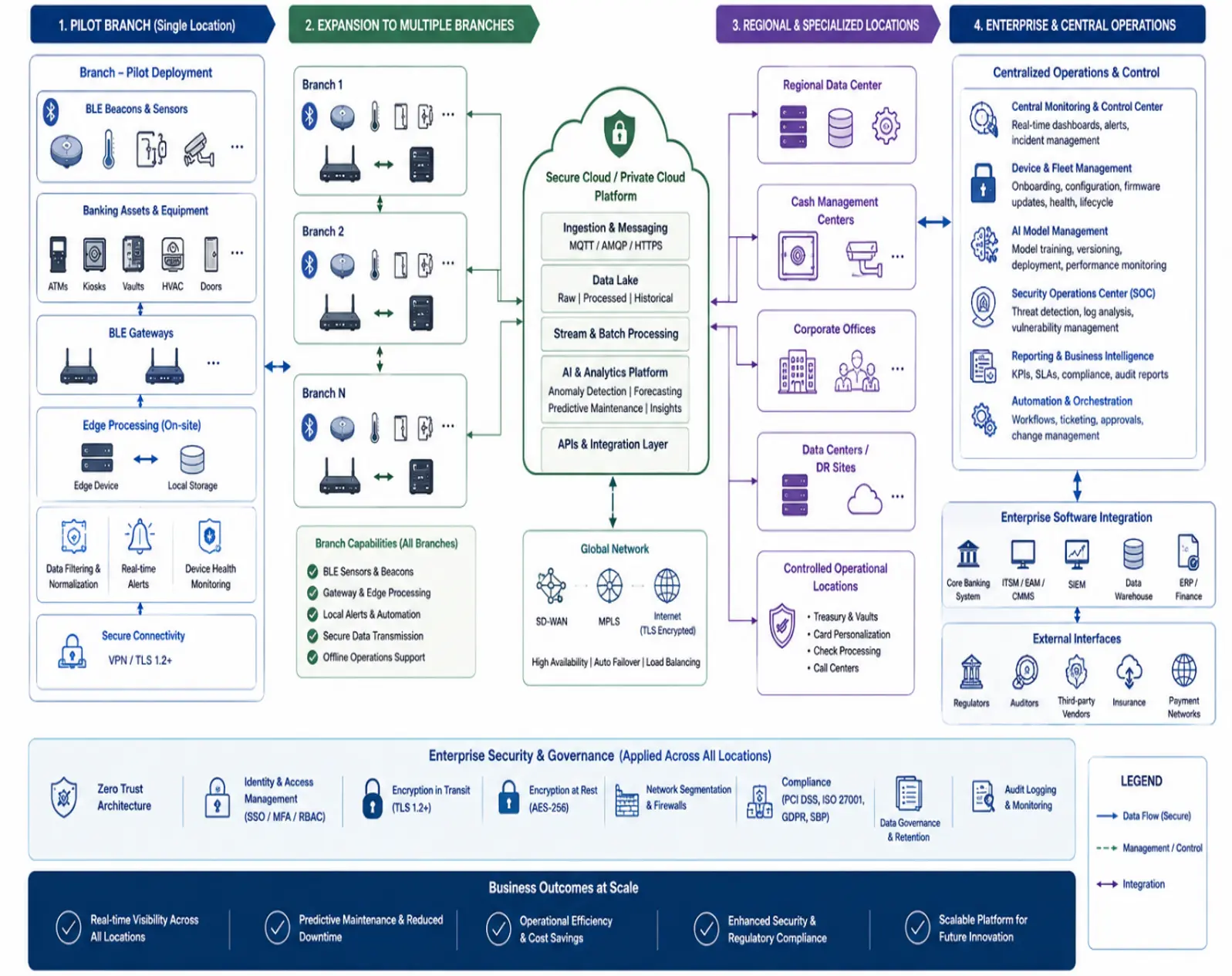
The diagram illustrates how an AI and BLE banking solution can scale from a pilot branch to multiple branches, regional facilities, specialized locations, and centralized enterprise operations with centralized monitoring, device management, AI model management, cybersecurity, and enterprise software integration.
Integration with Banking and Operational Software
BLE and AI systems deliver greater operational value when they exchange information with existing software rather than creating another isolated source of alerts.
Relevant integration points may include:
- Asset management systems
- Computerized maintenance management systems
- Facilities management software
- IT service management systems
- Physical access-control systems
- Security information systems
- Building management systems
- Enterprise resource planning systems
- Operational dashboards
- Notification and incident-management systems
- Identity and access-management services
Application programming interfaces can transfer structured events between the AI system and operational applications. Middleware can normalize information from different BLE devices and convert device-specific messages into consistent operational records.
For example, an AI system might identify abnormal environmental behavior around an equipment area. Instead of sending only a generic notification, the integration layer can associate the event with a specific facility, equipment identifier, location, maintenance history, and responsible team. The resulting service event becomes more actionable.
Integration design should also consider failure behavior. If an external banking application becomes temporarily unavailable, the BLE and AI system should have a defined method for buffering events, retrying delivery, recording failures, and preventing duplicate transactions.
AI Model Selection for Banking Operations
Different banking operational problems require different AI approaches. Selecting a model should follow the available data and required decision rather than starting with a specific AI technology.
Anomaly Detection
Anomaly detection is useful when the system has examples of normal behavior but relatively few examples of failures or security incidents. Models can evaluate deviations in sensor readings, asset movement patterns, occupancy behavior, or equipment activity.
This approach can be particularly useful for identifying previously unknown operational conditions.
Time-Series Forecasting
Time-series models analyze measurements collected over time. Banking facilities can use forecasting to estimate expected environmental conditions or equipment behavior and identify deviations from expected trends.
The model should account for factors such as operating hours, seasonal changes, maintenance activity, and facility-specific behavior.
Classification Models
Classification models can categorize events into operational classes such as normal, warning, maintenance required, or critical. Training data should be representative of the actual banking environment and reviewed for labeling quality.
Predictive Models
Predictive models can estimate the likelihood of a future operational condition based on historical observations. Predictive maintenance is one example, but similar approaches can support asset utilization and facilities-management decisions.
Edge AI
Edge AI can process selected information close to the source. This can reduce communication latency and minimize the amount of raw operational data transmitted to centralized systems.
For banking environments, edge processing can be useful when local decisions must continue during temporary network disruptions or when data-processing policies favor local handling.
Deployment, Commissioning, and Testing
Successful deployment requires controlled commissioning rather than simply installing BLE devices and activating software.
A practical implementation process should include:
- Requirements definition:Identify the operational problem, users, assets, facilities, KPIs, and expected decisions.
- Site assessment:Evaluate building layouts, radio propagation, gateway positions, network connectivity, and physical installation constraints.
- Hardware selection:Select beacons, sensors, and gateways according to operational requirements.
- Pilot deployment:Install a limited number of devices in a representative banking environment.
- Data validation:Verify device identity, timestamps, measurements, gateway reception, and event delivery.
- AI validation:Compare model outputs with known operational conditions and historical records.
- Integration testing:Confirm that events reach maintenance, security, facilities, or IT systems correctly.
- Security testing:Validate authentication, authorization, encryption, logging, network segmentation, and device-management procedures.
- Operational acceptance testing:Have actual banking operations personnel evaluate whether alerts and dashboards support their workflows.
- Performance monitoring:Measure reliability, latency, false alerts, device availability, and operational outcomes.
- Controlled expansion:Extend the deployment only after the initial environment demonstrates acceptable performance.
Commissioning documentation should record device identifiers, installation locations, gateway relationships, network configuration, software versions, test results, and responsible personnel. This information becomes important for future maintenance and troubleshooting.
AI and BLE Banking Deployment Lifecycle
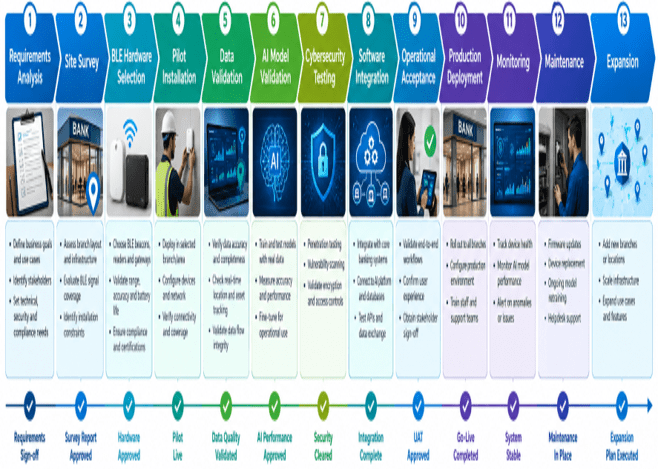
The lifecycle shows the engineering stages required to move an AI and BLE banking solution from requirements definition through validated production operation.
Maintenance and Lifecycle Management
BLE deployments contain physical devices that require ongoing management. Battery-powered beacons and sensors have finite operating lives, while gateways and software require configuration, firmware, security, and performance maintenance.
A lifecycle management process should monitor:
- Battery condition
- Device connectivity
- Gateway availability
- Sensor health
- Firmware versions
- Calibration requirements
- Physical damage
- Device replacement
- Network changes
- Software dependencies
- AI model performance
- Security vulnerabilities
- Integration failures
Maintenance records should be connected to asset identifiers whenever practical. This creates a relationship between the physical device, the monitored asset, the operational location, and the service history.
AI can also assist lifecycle management by identifying devices whose behavior differs from expected operating patterns. A sensor that repeatedly stops communicating, for example, may require investigation before the device becomes completely unavailable.
Cybersecurity, Privacy, and Governance
Banking operations require careful governance of data generated by connected devices. Even when BLE data does not contain customer financial information, location and operational information can still be sensitive.
Data governance should define:
- What data is collected
- Why the data is collected
- Which personnel can access it
- How long it is retained
- Where it is processed
- How it is transmitted
- Which applications can consume it
- How operational events are audited
- How devices are removed from service
BLE identifiers should not automatically be treated as anonymous. Depending on deployment design, repeated identifiers can potentially reveal movement patterns or operational behavior. Appropriate access controls, identifier management, retention policies, and data minimization should therefore be considered.
AI governance is also important. Model outputs should be monitored for reliability, unexpected behavior, and changes in operating conditions. High-impact operational decisions should retain appropriate human oversight and established authorization procedures.
Business Value of AI-Enabled Banking Operations
The business value of AI and BLE becomes measurable when physical operational information improves a banking process.
Potential outcomes include:
- Reduced time spent locating operational assets
- Faster maintenance response
- Earlier detection of environmental problems
- Better equipment utilization
- Reduced unnecessary service visits
- More consistent branch operational monitoring
- Improved visibility into distributed assets
- Better prioritization of operational incidents
- More structured maintenance information
- Improved coordination between branch, facilities, IT, and security teams
The economic case should account for the complete lifecycle rather than hardware acquisition alone. Deployment costs can include site surveys, installation, gateway infrastructure, software integration, network configuration, battery replacement, device management, cybersecurity controls, maintenance, and AI model operations.
A well-defined pilot can help determine whether the expected operational improvements justify broader deployment.
GAO’s Role in BLE and IoT Banking Solutions
GAO provides BLE, RFID, and IoT hardware products and systems that can serve as components in connected operational solutions. Its technical focus includes wireless identification, sensing, asset monitoring, gateways, and related IoT technologies that can support physical operational data collection.
GAO is headquartered in New York City and Toronto, Canada, and is positioned among the leading B2B and B2G BLE and RFID suppliers. GAO and its sister companies, GAO Research and GAO Tek, operate as part of GAO Group, serving organizations across the United States and Canada.
The group has spent approximately three decades developing and supplying technology products and systems, with customers including Fortune 500 companies, R&D organizations, universities, and government agencies. Its operations include R&D investment, quality-assurance processes, and remote or onsite technical support.
For banking operations teams, this experience is relevant when BLE hardware must be incorporated into a larger system involving asset identification, environmental sensing, location information, gateways, AI analytics, and enterprise software integration.
Implementation Recommendations for Banking Operations
Banking organizations considering AI-enabled BLE should approach deployment as an operational improvement project rather than a standalone wireless technology project.
Recommended practices include:
- Define the banking operations problem before selecting hardware.
- Identify the assets, locations, users, and decisions involved.
- Establish measurable KPIs for the pilot.
- Perform a physical and RF site assessment.
- Select BLE devices according to battery, coverage, environmental, and accuracy requirements.
- Validate data quality before developing complex AI models.
- Start with interpretable analytics where operational data is limited.
- Integrate AI events with existing maintenance, facilities, security, and IT workflows.
- Apply defense-in-depth cybersecurity controls.
- Establish device and battery lifecycle procedures.
- Monitor false positives and false negatives.
- Maintain human oversight for consequential operational decisions.
- Validate model performance after changes to facilities or operating procedures.
- Document installation and commissioning information.
- Expand gradually after measurable operational benefits are demonstrated.
Key Takeaways for AI and BLE in Banking Operations
AI-enabled banking operations can connect physical assets and facilities with data-driven decision-making. BLE beacons, sensors, and gateways provide useful operational signals, while AI can analyze those signals to identify anomalies, predict conditions, prioritize incidents, and improve maintenance and asset-management processes.
The most effective implementations focus on specific banking operational problems such as asset visibility, environmental monitoring, predictive maintenance, branch monitoring, and physical security support. Successful deployments also require secure integration with existing systems, reliable device management, careful site planning, measurable KPIs, and ongoing model and hardware lifecycle management.
GAO’s BLE, RFID, and IoT technologies can support organizations developing these connected operational systems. Banking technology teams can evaluate the available hardware and system options based on their specific facility, asset, security, connectivity, and integration requirements.
Decision tree for selecting AI and BLE banking operations.
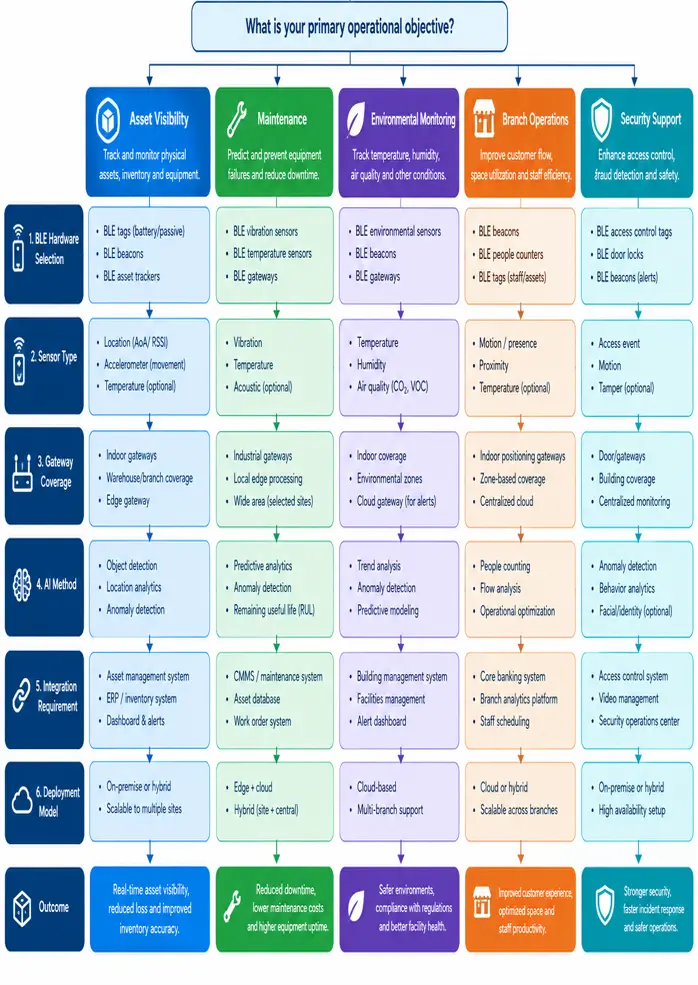
The decision tree helps banking operations teams connect operational objectives with appropriate BLE devices, AI methods, integrations, and deployment approaches.
Building the Future of Industrial AI and IoT with Aperture Venture Studio and GAO RFID Inc.
For more than three decades, GAO Group of Companies has invested heavily in R&D for industrial BLE, RFID, and IoT. As generative AI has become increasingly useful for industrial and operational applications, we have expanded our work across AI and IoT technologies, including BLE and RFID, and established Aperture Venture Studio to support the development and scaling of AI and IoT solutions relevant to operational environments such as banking facilities and financial infrastructure.
Aperture has attracted AI and IoT technical experts, entrepreneurial and operational executives, investors, and leading companies. We have also developed Aperture Ventures Summit and TekSummit to discuss advanced AI and IoT topics.
These activities contribute to technical communities focused on practical AI and IoT applications.
We welcome participation as:
- Advisors, co-founders, or employees
- Investors
- Customers