
AI and RFID for Industrial Machinery
AI-Driven Industrial Machinery Operations with RFID-Based Visibility
AI and RFID for Industrial Machinery combines machine learning, industrial data systems, connected equipment, and RFID identification to improve how machinery manufacturers track components, manage work-in-process, maintain equipment, control quality, and make production decisions. RFID provides machine-readable identity and movement data for tooling, subassemblies, components, finished machines, returnable containers, and maintenance assets, while AI converts that operational data into predictions, anomaly detection, recommendations, and automated decisions. For machinery manufacturers, the value is not RFID identification alone. The greater opportunity is connecting physical production events with manufacturing execution systems, enterprise resource planning, quality management, maintenance software, and AI analytics. GAO supplies RFID, BLE, and IoT hardware products and systems that can support these connected manufacturing workflows, helping organizations establish reliable data capture from production floors, warehouses, assembly stations, test areas, and service operations.
Industrial Machinery AI and RFID Value Chain: From Production to AI-Driven Decisions
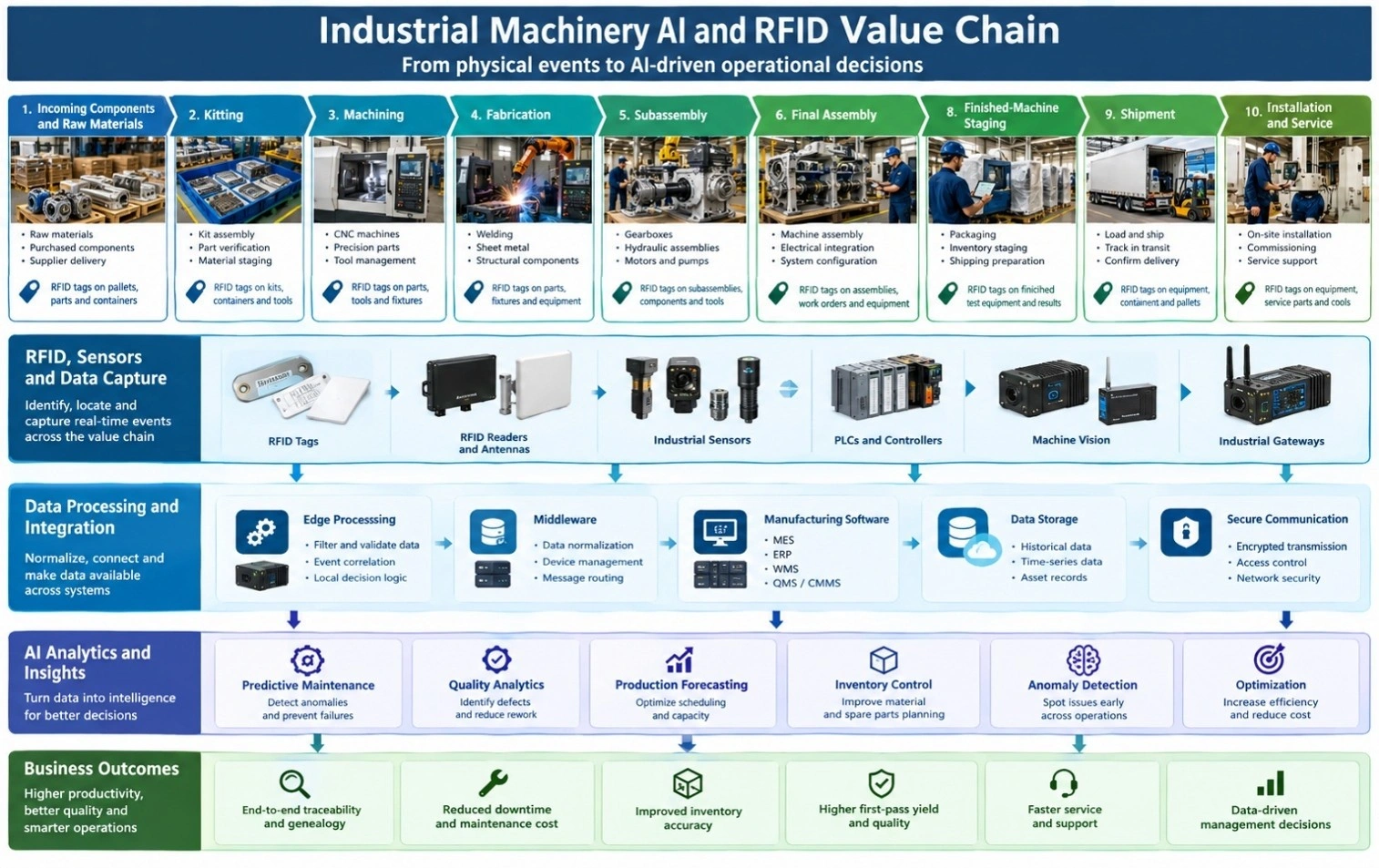
What AI Means for Industrial Machinery Manufacturing
Industrial machinery manufacturing involves highly variable products, engineered-to-order configurations, long production cycles, complex bills of materials, specialized tooling, and stringent inspection requirements. A single machine may contain thousands of components spanning mechanical, electrical, hydraulic, pneumatic, and control systems. Production visibility therefore depends on associating the right physical component with the correct work order, engineering revision, inspection record, assembly stage, and finished-machine serial number.
AI changes this operating model by analyzing relationships across these records rather than treating each transaction independently. Machine learning can identify patterns in production delays, component consumption, inspection results, machine utilization, rework, maintenance events, and material movement. Computer vision can support dimensional and surface inspection, while predictive models can estimate equipment failure risk or identify abnormal production conditions.
RFID serves as one practical source of identity and event data. UHF RFID is particularly useful for longer-range identification of tagged components, containers, tooling, and assets across receiving, storage, kitting, and production areas. HF RFID can support shorter-range identification at controlled workstations or specialized applications. LF RFID may be appropriate where proximity-based identification and specific environmental characteristics are more important than long read range.
The resulting AIoT system can combine RFID with PLC data, machine sensors, industrial Ethernet, barcode records, computer vision, MES data, ERP transactions, maintenance histories, and quality records. The objective is a consistent operational data set that AI can analyze without losing the physical context of the manufacturing process.
Industrial Machinery Processes Most Relevant to AI
AI applications become more valuable when they are connected to specific machinery manufacturing workflows rather than deployed as isolated analytics tools.
Production Planning and Material Readiness
Production planning frequently depends on the availability of thousands of parts with different suppliers, lead times, revisions, and inspection requirements. RFID events can establish whether required components and kits have physically reached the correct production area.
AI can use these events alongside ERP and MES records to identify material-readiness risks before they become assembly delays.
Relevant applications include:
| • | AI-assisted production scheduling based on material availability, machine capacity, labor requirements, and work-order priorities |
|---|---|
| • | Component availability prediction for engineered-to-order machinery |
| • | Identification of incomplete kits before assembly begins |
| • | Detection of material movements inconsistent with production schedules |
| • | Analysis of recurring shortages involving specific components or suppliers |
GAO can support this type of workflow with RFID readers, tags, antennas, gateways, and related IoT hardware used for automated identification and data acquisition.
Machining and Fabrication
Machining operations generate large volumes of production information from CNC equipment, tooling, fixtures, work orders, and inspection processes. The operational challenge is connecting machine activity with the exact job, tooling configuration, material batch, and production sequence.
AI can analyze historical machining records to detect patterns associated with cycle-time variation, tool wear, scrap, rework, and unplanned downtime.
RFID can identify:
| • | Tool holders and specialized cutting tools |
|---|---|
| • | Fixtures and jigs |
| • | Material bins and work-in-process assemblies |
| • | Production orders |
| • | Inspection samples |
| • | Tooling cabinets and controlled storage locations |
Combining identification events with CNC data and quality records allows manufacturers to investigate why a production result occurred rather than simply recording that it occurred.
Assembly and Work-in-Process Tracking
Industrial machinery assembly is often difficult to monitor because large equipment moves between workstations while individual components are manually installed. Paper travelers and manually entered records can introduce missing or inconsistent information.
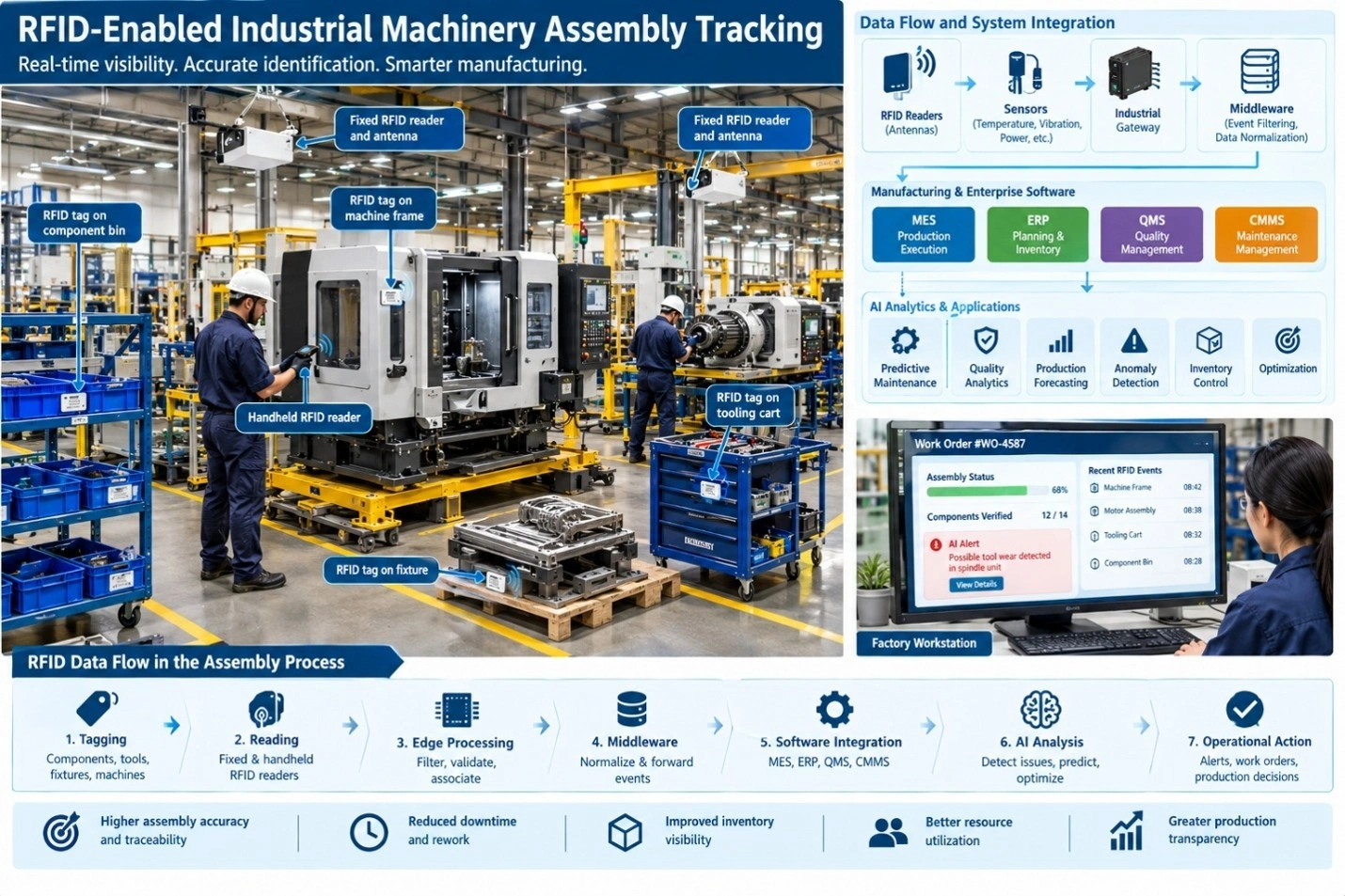
An RFID-enabled work-in-process system can associate a machine frame or major subassembly with its production order and maintain an event history as it moves through assembly stations.
AI can then evaluate:
| • | Assembly cycle time by product configuration |
|---|---|
| • | Station-level bottlenecks |
| • | Repeated work-order deviations |
| • | Missing or unexpected components |
| • | Rework frequency |
| • | Labor and equipment utilization |
| • | Production sequence anomalies |
This approach is particularly useful for manufacturers producing multiple machine variants on shared production resources.
RFID-Enabled Industrial Machinery Assembly Tracking System
AI Applications Across Industrial Machinery Manufacturing
Industrial machinery manufacturers can apply AI at several points where production data has sufficient quality, volume, and context.
Predictive Maintenance for Manufacturing Equipment
CNC machines, robotic cells, compressors, hydraulic systems, material-handling equipment, welding systems, and other production assets generate signals that can indicate deterioration. AI models can analyze vibration, temperature, current, operating hours, alarms, maintenance history, and production conditions to estimate abnormal behavior or remaining useful life.
RFID adds physical asset identity to this process. A maintenance technician can identify a machine, motor, tooling set, or replaceable component and retrieve its associated maintenance history, inspection records, and service instructions.
The resulting workflow can support condition-based maintenance rather than relying exclusively on calendar-based servicing.
AI-Assisted Quality Management
Quality problems in machinery manufacturing can originate from incorrect components, dimensional variation, assembly errors, material inconsistencies, incorrect engineering revisions, or process deviations.
AI can correlate inspection results with:
| • | Component lots |
|---|---|
| • | Suppliers |
| • | Machine settings |
| • | Tooling |
| • | Work orders |
| • | Operators and production stations |
| • | Assembly sequences |
| • | Environmental measurements |
| • | Historical nonconformances |
RFID can strengthen traceability by automatically identifying components and assemblies at inspection points. This reduces dependence on manually entered identifiers and helps maintain relationships between physical products and digital quality records.
Intelligent Inventory and Kitting
Machinery manufacturers commonly maintain high-value spare parts, long-lead components, specialized tooling, hydraulic assemblies, motors, drives, bearings, valves, electrical components, and engineered subassemblies.
AI-based inventory analysis can forecast material requirements, identify slow-moving stock, detect unusual consumption, and prioritize replenishment. RFID provides automated visibility into physical movement and can help reconcile expected inventory with observed inventory events.
The practical benefit is strongest where inventory accuracy directly affects production continuity.
From RFID Events to AI-Driven Manufacturing Decisions
A technically effective industrial machinery solution requires more than installing RFID readers. The complete workflow should preserve the relationship between an identification event and the manufacturing context surrounding it.
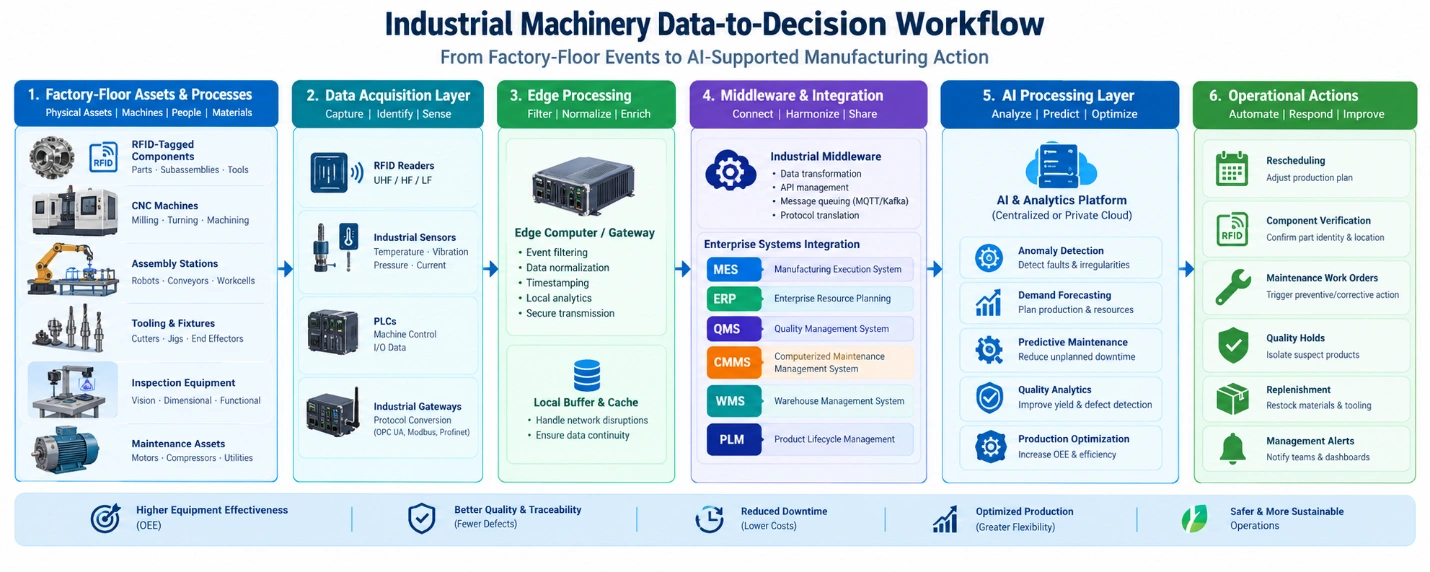
Data Acquisition at the Factory Floor
Data may originate from:
| • | UHF, HF, or LF RFID readers |
|---|---|
| • | RFID antennas and tagged components |
| • | Handheld RFID readers |
| • | PLCs and CNC controllers |
| • | Industrial temperature, vibration, pressure, current, and position sensors |
| • | Barcode scanners |
| • | Machine vision systems |
| • | Operator terminals |
| • | Quality inspection equipment |
| • | Maintenance systems |
RFID event records should normally include an identifier, timestamp, reader or station identity, read direction or zone where available, and relevant work-order or asset context.
Edge Processing and Event Normalization
Industrial environments generate noisy data. A tag may be read multiple times, while metal machinery, liquid-filled components, electromagnetic interference, antenna orientation, and dense tag populations can affect RFID performance.
Edge software or industrial gateways can filter duplicate reads, validate event sequences, associate identifiers with production stations, and forward normalized events to central software.
This stage is important because AI models should not receive uncontrolled raw reads as though every read represents a meaningful manufacturing transaction.
Manufacturing Software Integration
Normalized events can be exchanged with MES, ERP, WMS, QMS, CMMS, PLM, and other manufacturing systems through APIs, message brokers, databases, OPC UA, MQTT, industrial Ethernet, or other supported interfaces.
A practical data relationship might connect:
RFID identifier → component or asset record → work order → production operation → inspection record → finished-machine serial number
This relationship gives AI models the context required to generate useful recommendations.
AI Analytics and Operational Action
AI services can analyze normalized production information using supervised learning, anomaly detection, time-series analysis, forecasting, optimization, or computer vision.
Outputs may include:
| • | Predicted production delays |
|---|---|
| • | Abnormal machine behavior |
| • | Missing component alerts |
| • | Inventory-risk predictions |
| • | Quality-risk indicators |
| • | Maintenance recommendations |
| • | Production bottleneck detection |
| • | Work-order prioritization |
| • | Exception alerts |
The final step is operational action. A useful AI system should connect predictions to a responsible workflow, such as creating a maintenance work request, holding a suspect assembly for inspection, requesting material replenishment, or escalating a production exception.
Industrial Machinery Data-to-Decision Workflow: RFID, Edge AI, MES and Manufacturing Actions
Technical Foundation for Industrial Machinery AI and RFID
The technical design should reflect the physical characteristics of machinery manufacturing rather than assuming that one RFID configuration fits every production area.
RFID Hardware Selection
UHF RFID is generally suited to applications requiring automated identification across receiving docks, warehouses, kitting areas, production buffers, tooling storage, and selected production checkpoints. Read performance depends on tag selection, antenna placement, reader power, material composition, orientation, and the required read zone.
HF RFID can be useful for controlled close-range identification at operator workstations, assembly verification points, or applications where short-range interaction is desirable. LF RFID can serve proximity-oriented applications where its operating characteristics match the machinery environment.
Metal surfaces require particular attention. Machinery components frequently contain steel, aluminum, motors, gearboxes, hydraulic assemblies, and electrical cabinets. Tags intended for ordinary non-metallic surfaces may not perform properly when attached directly to such assets. Industrial deployments therefore require tag selection based on mounting surface, temperature, vibration, chemicals, washdown conditions, and expected mechanical exposure.
AI and Machine Learning
AI models should be selected according to the decision being supported.
| • | Time-series models can analyze machine sensor and production-cycle behavior. |
|---|---|
| • | Classification models can estimate quality or maintenance-risk categories. |
| • | Anomaly-detection models can identify unusual production or equipment behavior without requiring every failure mode to be labeled. |
| • | Forecasting models can estimate material requirements, production completion risk, or equipment demand. |
| • | Computer vision models can inspect components, assemblies, labels, welds, surfaces, and dimensional characteristics where suitable imaging conditions exist. |
| • | Optimization methods can help evaluate production schedules, machine utilization, material constraints, and sequencing decisions. |
The strongest results generally come from combining AI with structured manufacturing context rather than applying a model to isolated RFID reads.
Cloud Version and Server Version
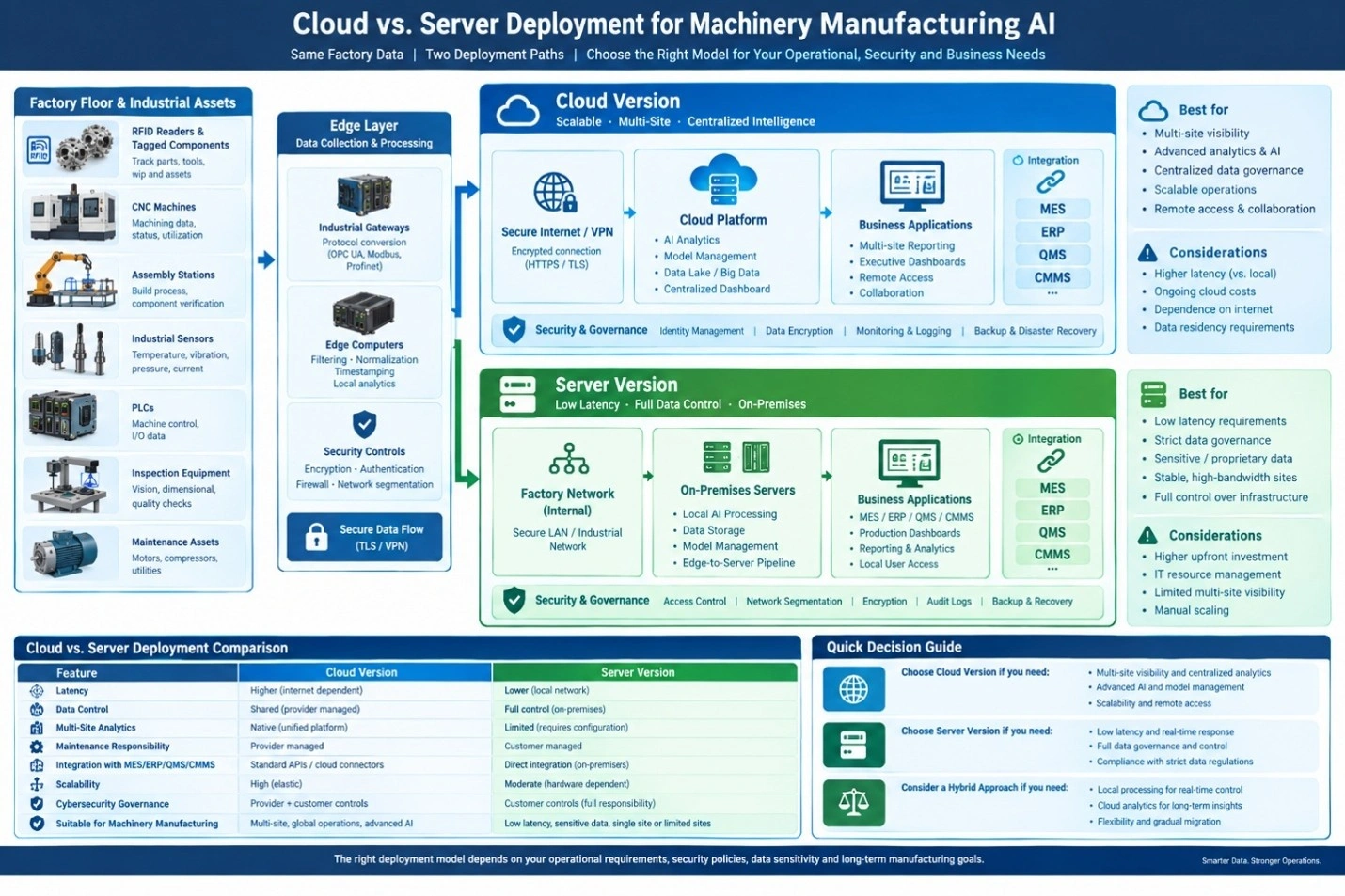
A Cloud Version can be appropriate when machinery manufacturers operate multiple facilities, require centralized analytics, or need consolidated production and asset information across geographically distributed operations. Cloud-hosted software can simplify centralized model management and provide broader analytical visibility when data governance and connectivity requirements permit.
A Server Version can run on factory servers, customer-managed infrastructure, private data centers, edge servers, or other privately hosted enterprise environments. This model can be preferable when production data must remain within controlled infrastructure, when factory connectivity is limited, or when low-latency processing is required for local manufacturing decisions.
Many industrial deployments can use a hybrid approach, keeping time-sensitive processing close to production equipment while sending selected normalized data to centralized analytics.
Cybersecurity and Interoperability
Industrial machinery systems should apply network segmentation, identity and access controls, encrypted communications where supported, secure credential management, software patching, logging, backup procedures, and controlled remote access.
Interoperability also matters. RFID systems should not become isolated data silos. Integration with MES, ERP, QMS, CMMS, WMS, PLM, PLC, and industrial communication systems should be considered during solution design rather than after installation.
GAO’s experience supplying RFID, BLE, and IoT hardware products and systems supports the practical hardware layer required for these connected manufacturing workflows. Its broader R&D and quality-assurance focus also supports deployments where reliable field equipment and technical support are important considerations.
Cloud vs. Server Deployment for Machinery Manufacturing AI: Architecture and Decision Guide
Key Capabilities of AI-Enabled Industrial Machinery Operations
The practical value of AI in machinery manufacturing comes from connecting production events, equipment conditions, material identity, quality information, and business records. RFID is one data-acquisition method within that broader system. The strongest implementations use it where automatic physical identification improves the reliability and context of manufacturing data.
Production Traceability and Genealogy
Industrial machinery manufacturers often need to establish exactly which components were incorporated into a finished machine. This becomes particularly important for serialized equipment, safety-relevant assemblies, customer-specific configurations, and products requiring field-service traceability.
An AI-enabled traceability solution can associate:
| • | Component serial numbers with finished-machine serial numbers |
|---|---|
| • | Material lots with machining and fabrication operations |
| • | Motors, drives, pumps, valves, bearings, and control components with specific assemblies |
| • | Inspection results with individual production units |
| • | Tooling and fixtures with manufacturing operations |
| • | Maintenance and rework events with the affected machine |
RFID can automate physical identification at selected checkpoints, reducing manual transcription and strengthening product genealogy.
Bottleneck Detection and Production Optimization
Production bottlenecks in machinery manufacturing may arise from machining capacity, material shortages, engineering changes, inspection queues, specialized tooling, technician availability, or downstream assembly constraints.
AI can analyze production-event histories to identify recurring bottlenecks and determine whether delays are associated with particular products, work centers, suppliers, components, or production sequences.
RFID movement records can provide additional evidence about where work-in-process is physically waiting. This is especially useful when ERP or MES records indicate that a job is active but do not provide sufficient physical-location context.
Intelligent Tool and Fixture Management
Specialized fixtures, jigs, gauges, cutting tools, welding fixtures, lifting accessories, and assembly tools can represent significant capital expenditure. Misplaced or unavailable tooling can interrupt production even when raw materials are available.
AI can analyze tool usage, production schedules, maintenance history, and availability to identify future shortages or underutilized resources. RFID identification can establish which tool or fixture is present at a workstation, storage location, or maintenance area.
This combination can support tool-life management, controlled issuance, inspection scheduling, and more reliable production preparation.
Spare Parts and After-Sales Service
Machinery manufacturers often support equipment throughout long operating lifecycles. Service organizations need accurate information about installed components, replacement parts, maintenance events, and equipment configurations.
AI can identify recurring component failures and analyze service histories to improve spare-parts planning. RFID can help identify serviceable assets and serialized components during repair, refurbishment, or warehouse operations.
The result is a stronger connection between factory manufacturing records and the installed-base service process.
Industrial Machinery KPIs Improved by AI and RFID
The most useful performance measurements should connect directly to manufacturing objectives rather than simply counting RFID reads or AI predictions.
| KPI | AI Contribution | RFID Contribution |
|---|---|---|
| Overall Equipment Effectiveness (OEE) | Identifies utilization and loss patterns | Adds equipment and tooling context |
| Manufacturing cycle time | Detects recurring delays and variation | Tracks physical movement between stages |
| First-pass yield | Identifies quality-risk patterns | Associates components with production units |
| Rework rate | Finds recurring process relationships | Strengthens assembly and component traceability |
| Inventory accuracy | Predicts discrepancies and demand | Automates physical identification |
| Work-in-process dwell time | Detects bottlenecks | Provides movement and station events |
| Unplanned downtime | Predicts equipment anomalies | Identifies affected equipment and service assets |
| Tool utilization | Forecasts demand and replacement needs | Tracks tool identity and location |
| On-time completion | Predicts schedule risk | Confirms material and WIP availability |
| Mean time to repair | Identifies recurring maintenance causes | Speeds equipment and component identification |
| Scrap rate | Finds relationships between process variables and defects | Links material identity to affected production |
| Material shortage frequency | Forecasts requirements | Improves physical inventory visibility |
A mature deployment should establish baseline measurements before automation. Otherwise, manufacturers may automate an existing process without establishing whether the solution actually improves throughput, quality, or traceability.
Engineering Considerations for RFID Deployment on Machinery Production Floors
RFID performance is highly dependent on the physical environment. Industrial machinery manufacturing presents several conditions that require engineering validation.
Metal, Liquids, and Dense Component Assemblies
Metal can detune or attenuate RFID signals, while liquids can affect RF performance. Machinery components may therefore require specialized tags designed for mounting on metal or other difficult surfaces.
Read zones should be tested using actual production components rather than relying exclusively on laboratory specifications. A tag that performs well on a test bench may behave differently when mounted to a steel gearbox, hydraulic assembly, electrical cabinet, or assembled machine.
Read-Zone Control
More RFID reads do not necessarily mean better manufacturing visibility. Uncontrolled reads from adjacent workstations can create incorrect production events.
Engineering teams should evaluate:
| • | Antenna orientation |
|---|---|
| • | Reader transmit power |
| • | Read-zone dimensions |
| • | Tag orientation |
| • | Shielding requirements |
| • | Conveyor or machine movement |
| • | Interference from nearby RFID installations |
| • | Expected tag population |
| • | Station dwell time |
| • | False-positive read risk |
Critical production transactions may require confirmation logic rather than treating a single RFID read as proof that an assembly operation has been completed.
Tag Selection and Environmental Durability
Industrial machinery production can expose tags to machining fluids, oils, dust, vibration, elevated temperatures, abrasion, cleaning chemicals, and mechanical impacts.
Tag selection should therefore consider:
| • | Operating temperature |
|---|---|
| • | Mounting surface |
| • | IP or environmental protection requirements |
| • | Mechanical durability |
| • | Chemical exposure |
| • | Expected service life |
| • | Required read distance |
| • | Attachment method |
| • | Size constraints |
GAO can provide RFID hardware options for different identification requirements, but final tag selection should always be validated against the actual production environment and mounting conditions.
Manufacturing System Integration and Data Governance
AI performance depends heavily on data quality. Industrial machinery manufacturers should establish a consistent relationship between physical identifiers and enterprise records.
A practical implementation can connect RFID identifiers to master-data records containing part number, revision, serial number, asset class, supplier, work order, and applicable production operation.
The integration layer can then exchange information with:
| • | ERP systems for purchasing, inventory, and order management |
|---|---|
| • | MES systems for production execution and work-order status |
| • | QMS systems for inspection, nonconformance, and corrective action |
| • | CMMS or EAM systems for equipment maintenance |
| • | WMS systems for warehouse and material movement |
| • | PLM systems for engineering revisions and product structures |
| • | SCADA and PLC systems for machine status and process information |
| • | IIoT databases and historians for time-series equipment data |
Data governance should define identifier ownership, master-data synchronization, event retention, timestamp standards, access permissions, and exception handling.
AI models should also be monitored after deployment. Production conditions change when machinery is redesigned, new suppliers are introduced, tooling changes, or manufacturing processes are modified. Model performance should therefore be evaluated against current production data rather than assumed to remain constant.
Industrial Machinery AI Integration Stack: From Physical Assets to Intelligent Manufacturing
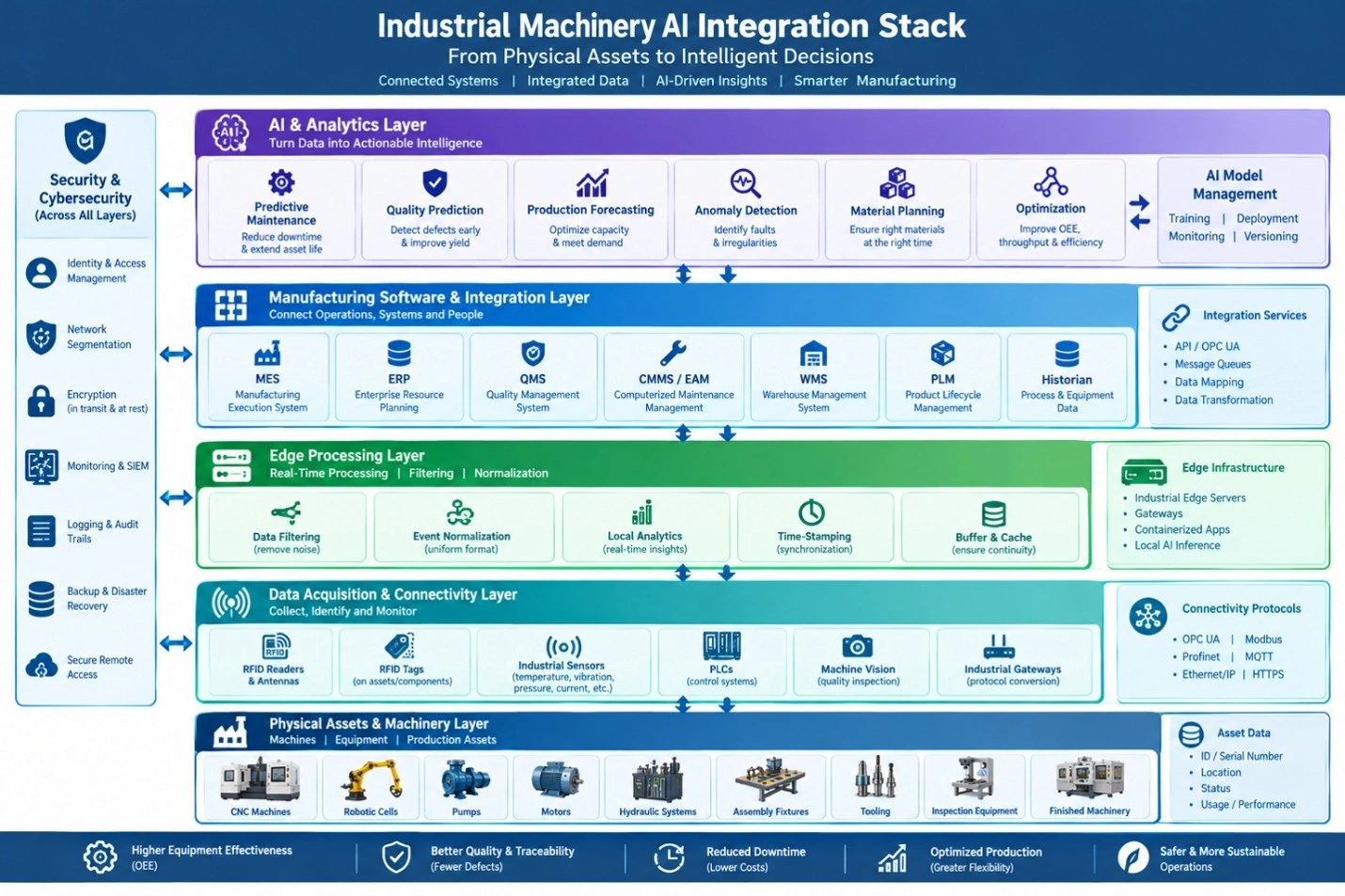
Deployment Lifecycle for Industrial Machinery AI Systems
A successful implementation should progress through controlled engineering stages.
Planning and Use-Case Selection
Start with a measurable manufacturing problem. Suitable candidates include poor WIP visibility, tooling losses, inventory discrepancies, recurring equipment failures, assembly traceability gaps, or production bottlenecks.
Avoid deploying RFID merely because an RFID reader can be installed at a workstation. The business event that the system must capture should be defined first.
Site Survey and Hardware Validation
The site survey should document machinery layout, production flows, material composition, RF conditions, network availability, electrical requirements, tag mounting locations, and environmental conditions.
Proof-of-concept testing should use actual machinery components, production containers, tooling, and operating procedures.
Commissioning and Integration
Commissioning should validate:
| • | RFID read reliability |
|---|---|
| • | Correct event filtering |
| • | Identifier-to-asset mapping |
| • | Network connectivity |
| • | MES and ERP transactions |
| • | User permissions |
| • | AI data pipelines |
| • | Alarm and exception handling |
| • | System logging |
| • | Recovery after network or equipment interruptions |
Optimization and Scale-Up
After initial deployment, manufacturers can evaluate false reads, missed reads, processing latency, data completeness, AI accuracy, operator adoption, and measurable production improvements.
Additional production lines or facilities should be added only after the first implementation demonstrates stable technical performance and measurable operational value.
Security, Reliability, and Operational Resilience
Industrial machinery systems increasingly connect production equipment with corporate networks and external software services. Cybersecurity should therefore be treated as part of system engineering rather than a final-stage feature.
Recommended controls include:
| • | Network segmentation between production and business systems |
|---|---|
| • | Role-based access control |
| • | Unique user identities |
| • | Secure credential management |
| • | Encrypted data transmission where supported |
| • | Controlled API access |
| • | Security logging and monitoring |
| • | Regular software and firmware maintenance |
| • | Backup and recovery procedures |
| • | Controlled remote support |
| • | Device inventory and configuration management |
| • | Incident-response procedures |
Operational resilience is equally important. Manufacturing should not stop simply because an external analytics service becomes temporarily unavailable. Local buffering and edge processing can allow production events to be retained until connectivity is restored.
For critical operations, the system should also define what happens when RFID identification fails. A controlled manual exception process, operator confirmation, or secondary barcode identification method can prevent a technology failure from becoming a production stoppage.
Practical Benefits for Machinery Manufacturers
Combining AI with connected identification and industrial data acquisition can produce measurable improvements across the machinery manufacturing lifecycle.
Better Traceability
Automated identification reduces manual association errors and creates stronger relationships between components, assemblies, work orders, inspections, and finished machines.
Earlier Maintenance Intervention
AI can identify abnormal equipment behavior before a conventional failure occurs, allowing maintenance teams to schedule intervention around production requirements.
More Reliable Production Planning
Material movement and availability data can improve the accuracy of production-readiness decisions and help planners identify risks earlier.
Reduced Rework
AI can reveal relationships between process conditions, components, tooling, suppliers, and quality results that are difficult to identify through manual analysis.
Faster Service Operations
Serialized equipment and component identification can shorten the time required to establish machine configuration, maintenance history, and replacement-part requirements.
Scalable Manufacturing Visibility
A standardized event model can be extended from a single production cell to multiple lines, facilities, warehouses, and service operations without requiring every process to be redesigned from the beginning.
Building a Practical AI and RFID Strategy for Industrial Machinery
Industrial machinery manufacturers should treat AI implementation as a manufacturing improvement program supported by connected data, not as an isolated software project. The most reliable sequence begins with clearly defined production problems, followed by process mapping, data-quality assessment, RFID and sensor selection, controlled testing, software integration, AI model development, cybersecurity validation, and measured deployment.
RFID is most valuable when the manufacturing process requires reliable physical identification. AI becomes valuable when sufficient contextual data exists to predict, classify, optimize, or detect deviations. Combining the two creates a stronger connection between physical machinery manufacturing activities and digital decision-making.
GAO supports organizations with RFID, BLE, and IoT hardware products and systems used for identification, sensing, tracking, and connected industrial applications. Its R&D investment and technical support capabilities can help engineering and operations teams evaluate suitable hardware and deployment approaches for specific manufacturing environments.
GAO’s Engineering Experience in RFID and Industrial IoT
Headquartered in New York City and Toronto, Canada, GAO is recognized among the leading global B2B and B2G suppliers of RFID and BLE technologies. GAO, together with sister companies GAO Research and GAO Tek, forms GAO Group, with operations based in New York City and Toronto.
For three decades, GAO Group has served organizations across the United States and Canada, including Fortune 500 companies, leading research and development organizations, universities, and government agencies. Significant investment in product and system R&D, stringent quality-assurance processes, and remote or onsite expert support provide a practical foundation for industrial deployments.
For machinery manufacturers evaluating AI-enabled production traceability, asset visibility, maintenance identification, tooling management, or connected manufacturing workflows, the appropriate next step is to map the desired operational outcome to the physical data that must be captured and the systems that must consume it. GAO can help organizations evaluate RFID, BLE, and IoT hardware and system requirements as part of that engineering process.
Building the Future of Industrial AI and IoT with Aperture Venture Studio and GAO RFID Inc.
For more than three decades, GAO Group of Companies has invested heavily in R&D for industrial RFID, BLE, and IoT. As generative AI has become increasingly useful for industrial applications, we have developed AI and IoT technologies that connect intelligence with physical systems, including RFID-enabled solutions relevant to machinery manufacturing. We have also established Aperture Venture Studio to advance AI and IoT solutions for industrial applications.
Aperture brings together AI and IoT technical experts, entrepreneurial and operational executives, influential investors, and leading companies. We have also developed Aperture Ventures Summit and TekSummit to discuss advanced AI and IoT topics. We welcome advisors, co-founders or employees, investors, and customers to join us in advancing practical industrial AI and IoT solutions.