
AI and RFID for Aquaculture
Intelligent Aquaculture Operations with AI and RFID
AI is changing aquaculture by turning continuous data from fish farms, hatcheries, recirculating aquaculture systems, cages, ponds, tanks, feeders, water-quality sensors, and connected equipment into operational decisions. RFID provides an identification and traceability layer that can associate fish batches, broodstock, feed, equipment, samples, containers, and maintenance activities with digital records. When RFID identification is combined with IoT sensors, computer vision, machine learning, and operational software, aquaculture operators can move from periodic manual records toward continuous, data-driven management. Applications include fish inventory and batch traceability, automated feeding optimization, biomass estimation, water-quality anomaly detection, equipment monitoring, mortality recording, biosecurity management, and maintenance planning. GAO provides RFID, BLE, and IoT hardware products and systems that can support these connected workflows. The resulting AI-enabled aquaculture system can improve production visibility, reduce avoidable losses, strengthen traceability, and provide operators with earlier indications of biological, environmental, and equipment problems.
AI and RFID for Smart Aquaculture Operations
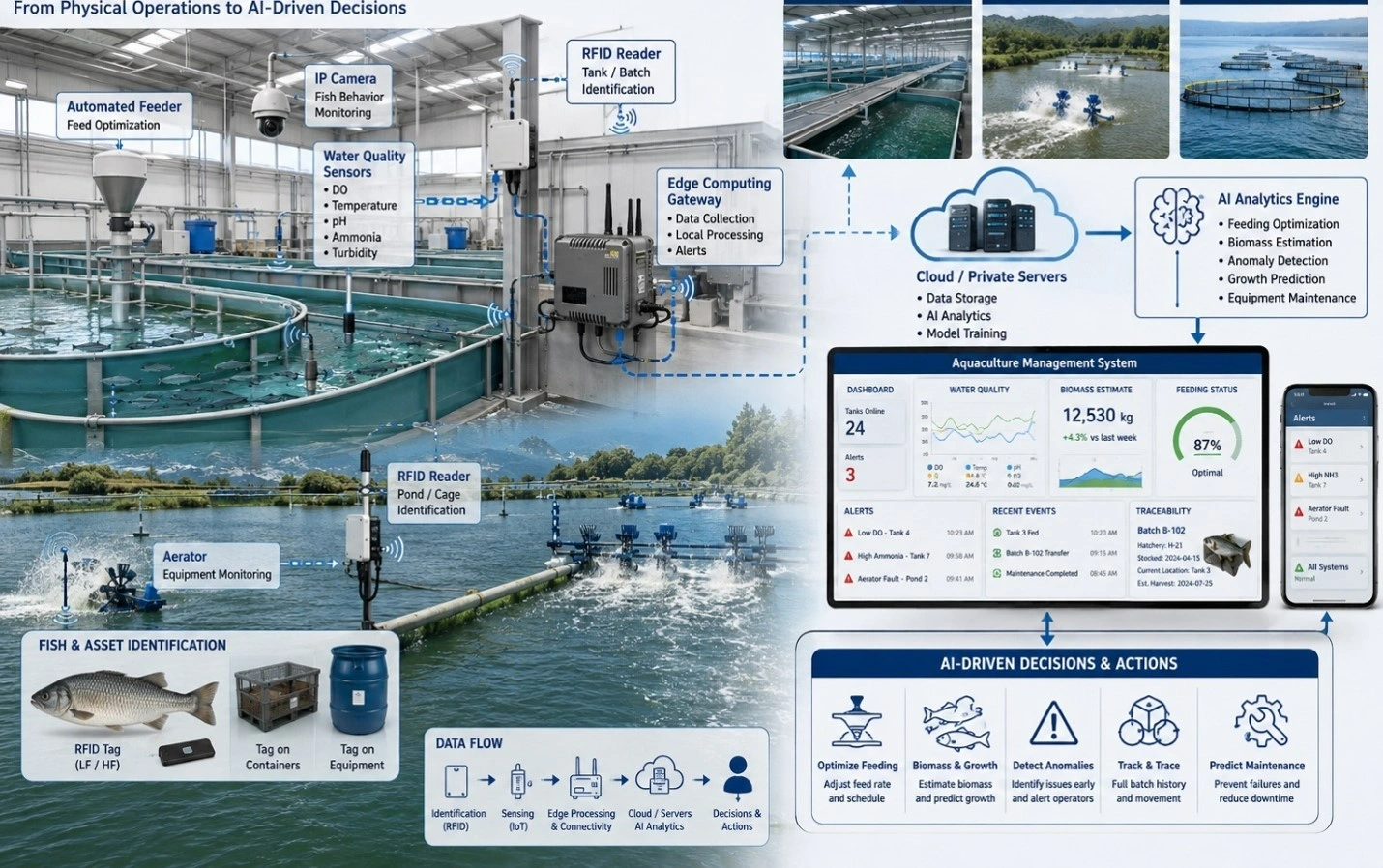
This technical illustration shows how RFID identification, IoT water-quality sensors, cameras, automated feeders, and equipment monitoring connect through edge computing and cloud or private servers. AI analytics transform these data streams into feeding optimization, biomass estimation, anomaly detection, traceability, and predictive maintenance decisions.
Alt Text: AI and RFID aquaculture system connecting sensors, fish tracking, edge computing, servers, and AI analytics.
From Fish Identification to Production Intelligence
Aquaculture generates several interconnected classes of operational data. Fish and shellfish production data includes species, strain, life stage, stocking density, batch identity, origin, movement history, feeding records, mortality, treatment history, harvest information, and transfer events. Environmental data includes dissolved oxygen, temperature, pH, salinity, turbidity, ammonia, nitrite, oxidation-reduction potential, water flow, tank level, and other measurements appropriate to the production system.
RFID can connect physical objects and identified production units to these records. Depending on the operating environment, LF, HF, or UHF RFID can be selected according to read range, tag form factor, water exposure, material interference, identification distance, and the way operators need to capture data. Aquaculture deployments require particular attention to moisture, saltwater exposure, tag encapsulation, antenna placement, and reader reliability because water can significantly affect radio-frequency performance.
AI adds the analytical layer. Machine learning models can identify relationships between environmental conditions, feeding behavior, growth, mortality, and production performance. Computer vision can estimate fish size, count fish, detect abnormal swimming behavior, and support biomass estimation. Edge AI can process selected camera or sensor data close to tanks, cages, or processing areas when low latency or limited connectivity makes local processing valuable.
The important engineering principle is that AI should not operate on isolated datasets. A useful aquaculture solution associates AI predictions with identifiable batches, tanks, cages, equipment, samples, and operational events. RFID can contribute to that identity layer while IoT sensors and other data sources provide the measurements required for analysis.
Why Aquaculture Needs Connected Data
Aquaculture operations are highly sensitive to changes that can develop faster than manual inspection cycles. Dissolved oxygen depletion, temperature excursions, equipment failure, excessive feed, poor water exchange, abnormal fish behavior, or disease-related indicators can affect production before an operator has enough information to respond effectively.
A connected system allows production teams to correlate multiple signals. For example, a reduction in dissolved oxygen can be analyzed together with aerator status, water temperature, feeding activity, stocking density, and historical patterns. An AI model can then identify an abnormal condition and provide an alert for investigation.
RFID contributes a different but complementary capability. It helps answer questions such as which fish batch entered a tank, which container was used for a transfer, which sample belongs to which production lot, when equipment was moved, and which operational event should be associated with a particular record.
GAO’s RFID and IoT products can therefore serve as components within broader aquaculture monitoring and traceability systems rather than functioning as isolated identification devices.
Aquaculture Data-to-Decision Flow: From RFID Capture to AI-Supported Actions
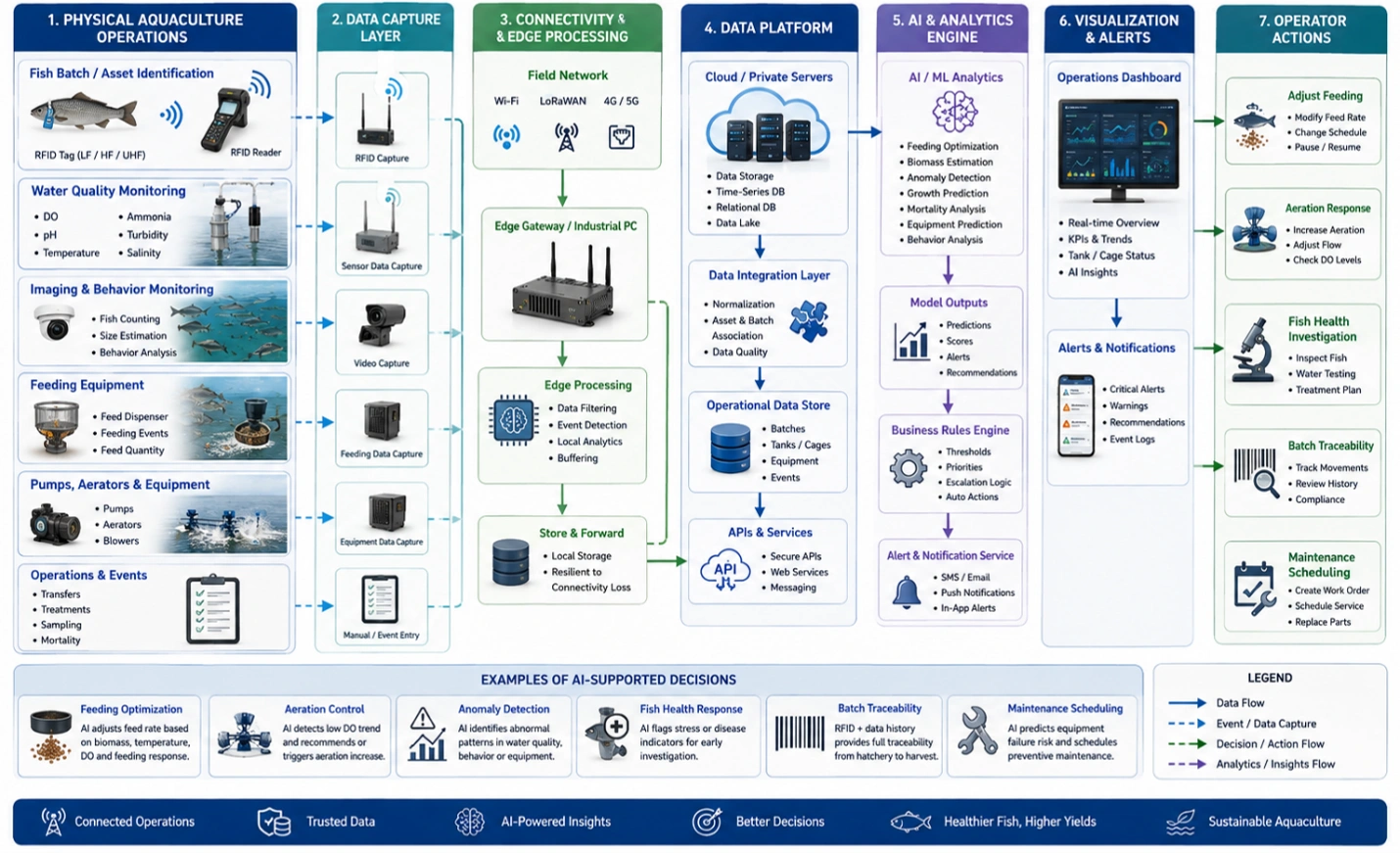
This workflow diagram illustrates how RFID identification, water-quality sensors, cameras, feeding equipment, pumps, aerators, and operational events move through connectivity, edge processing, data storage, and AI analytics. The system converts these data streams into dashboards, alerts, and practical actions such as feeding adjustment, aeration response, fish-health investigation, batch traceability, and maintenance scheduling.
Alt Text: Aquaculture workflow showing RFID, sensors, edge processing, AI analytics, alerts, and operator decisions.
High-Value AI Applications Across Aquaculture Operations
AI Feeding Optimization
Feed is one of the most significant controllable operating inputs in aquaculture. Feeding too little can restrict growth, while excessive feeding increases feed costs and can contribute to poor water quality. AI-based feeding systems can combine feeding history, fish biomass estimates, temperature, dissolved oxygen, growth rates, time of day, and observed feeding behavior to recommend or automate feeding decisions.
Computer vision can monitor fish activity around feeding events, while sensor data provides environmental context. RFID can associate feeding records with the relevant tank, cage, batch, or production unit. This creates a more complete historical record for evaluating feed conversion ratio, growth performance, and feeding response.
Fish Inventory, Batch Tracking, and Traceability
Aquaculture operators need reliable records when fish move between hatchery tanks, nursery systems, grow-out units, quarantine areas, transport containers, and processing locations. RFID can identify tagged fish where appropriate or identify containers, batches, equipment, samples, and other physical assets.
AI can use these records with production data to identify discrepancies, predict inventory requirements, and detect unusual movements or missing records. Traceability becomes particularly valuable when production records need to connect stocking, feeding, health events, transfers, harvest, and processing activities.
Biomass Estimation and Growth Prediction
Traditional biomass estimation can require sampling and manual handling. Computer vision and machine learning can estimate fish size distributions and biomass from images or video. Historical measurements can then support growth models that estimate future biomass and harvest readiness.
Combining these predictions with RFID-based batch identity allows growth estimates to remain associated with the correct production group. Operators can compare predicted and measured growth, investigate deviations, and improve stocking and feeding decisions.
Water-Quality Anomaly Detection
Water quality is central to fish health and production stability. AI models can monitor time-series measurements from dissolved oxygen, temperature, pH, salinity, ammonia, turbidity, flow, and related sensors.
Rather than relying only on fixed thresholds, anomaly detection can identify combinations or trends that differ from normal operating behavior. For example, a gradual decline in dissolved oxygen combined with increasing temperature and reduced aeration performance may represent a more important condition than any single measurement alone.
AI alerts should remain explainable enough for operators to investigate the underlying sensor readings and equipment conditions. Automated responses should also be designed with appropriate safeguards, particularly when decisions could affect animal health.
Predictive Maintenance for Aquaculture Equipment
Pumps, aerators, blowers, feeders, filtration systems, water-treatment equipment, chillers, compressors, and other mechanical systems directly influence production continuity. Unexpected equipment failure can create biological risk as well as maintenance costs.
Machine learning can analyze equipment runtime, vibration, current consumption, temperature, pressure, flow, alarm history, and maintenance records to identify degradation patterns. RFID can support maintenance workflows by identifying equipment, spare parts, tools, or service records.
A maintenance technician can use the resulting information to prioritize inspection before a failure occurs. This is especially valuable for equipment whose failure could rapidly affect dissolved oxygen, circulation, or water quality.
Aquaculture Workflows Enabled by Connected Identification and AI
Hatchery and Nursery Operations
Hatcheries generate large volumes of records associated with broodstock, eggs, larvae, fry, tanks, feed, water conditions, treatments, samples, and transfers. Identification systems can associate physical containers and production batches with digital records.
AI can analyze survival rates, growth patterns, environmental conditions, feeding schedules, and historical production data to identify conditions associated with stronger or weaker outcomes. This supports earlier investigation of production deviations and more consistent operational decision-making.
Grow-Out Tanks, Ponds, and Recirculating Systems
Grow-out operations introduce additional complexity because stocking density, feeding demand, water exchange, filtration, aeration, and biomass change continuously. Sensor networks can provide high-frequency environmental data while cameras provide behavioral and visual information.
RFID can associate measurements and events with tanks, cages, batches, equipment, and work activities. AI can then evaluate the combined dataset to detect abnormal conditions, estimate growth, forecast feed requirements, and support production planning.
Cage and Offshore Aquaculture
Cage-based aquaculture presents additional challenges involving weather, marine conditions, vessel access, communications, biofouling, and distributed equipment. RFID hardware used in these environments must be selected for environmental durability and practical read performance.
Edge processing can be valuable when network connectivity is intermittent. Local systems can collect sensor and identification events, perform selected analytics, buffer records, and synchronize information with centralized software when connectivity becomes available.
Harvest, Processing, and Cold-Chain Traceability
Harvest operations generate important records connecting production batches with harvest weights, containers, processing activities, storage locations, and shipment information. RFID can help maintain identity across physical movements while software records associated transactions.
AI can analyze harvest yields, size distributions, production history, processing throughput, and quality-related information. These datasets can support demand planning, production forecasting, yield analysis, and identification of process deviations.
Realistic RFID Deployment in a Recirculating Aquaculture Facility
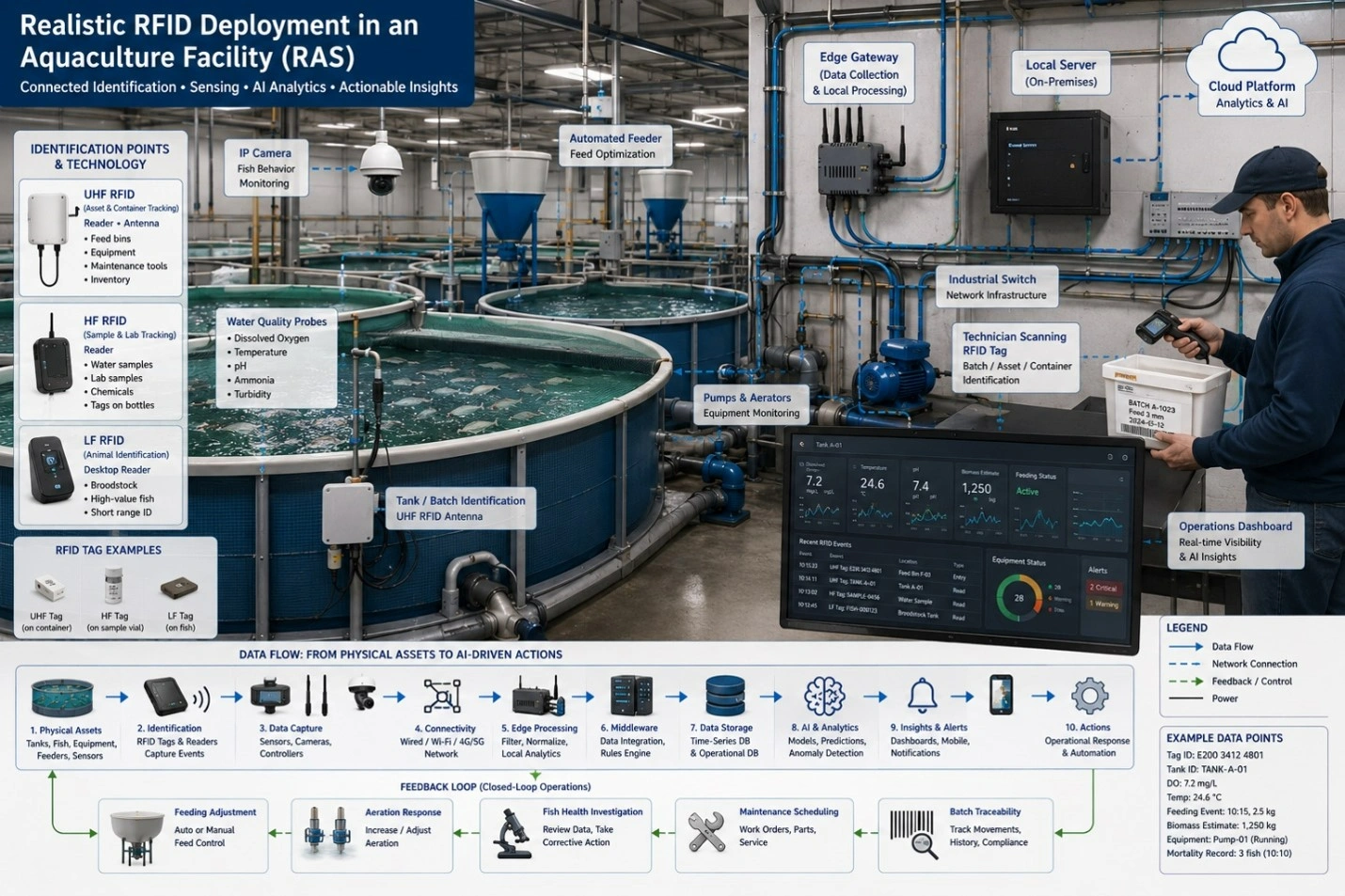
This visual shows a commercial recirculating aquaculture facility with RFID identification points, water-quality probes, cameras, automated feeders, pumps, aerators, edge computing, local servers, and cloud AI analytics. It demonstrates how physical aquaculture operations connect to dashboards and AI-supported actions for feeding, aeration, fish-health investigation, maintenance, and batch traceability.
Alt Text: Recirculating aquaculture facility showing RFID readers, sensors, edge gateway, AI analytics, and operational dashboard.
From RFID and Sensor Capture to AI-Driven Decisions
A practical aquaculture solution normally begins with reliable data capture. RFID readers collect identification events from selected tags, while sensors collect environmental and equipment measurements. Cameras provide visual information where fish behavior, counting, sizing, or biomass estimation is required.
A communication layer transports these records through appropriate wired or wireless networks. Depending on site conditions, this can include Ethernet, Wi-Fi, cellular connectivity, industrial gateways, or other suitable communication methods. Edge devices can normalize data, buffer records during connectivity interruptions, perform filtering, and execute time-sensitive analytics.
Middleware then converts device-level information into usable records. An RFID event such as a tag identifier and timestamp has limited operational value by itself. The system becomes more useful when the event is associated with a tank, cage, batch, species, production stage, location, work order, sample, or equipment record.
AI services can consume these structured records together with time-series sensor data and historical production information. Depending on the application, models may include regression, classification, anomaly detection, time-series forecasting, computer vision, clustering, or optimization techniques.
The final step is operational action. A model output should lead to a meaningful decision such as investigating a water-quality trend, adjusting feeding, inspecting an aerator, verifying a batch transfer, reviewing fish behavior, or planning harvest. This closes the loop between data acquisition and aquaculture operations.
GAO can support the physical identification and connected-device layer with RFID, BLE, and IoT hardware products and systems, while the broader solution can integrate these components with aquaculture management software, databases, analytics systems, and AI services.
RFID Hardware, AI Software, and Aquaculture Infrastructure
Selecting technology for aquaculture requires consideration of the physical environment as well as the digital workflow. Saltwater exposure, humidity, condensation, submerged equipment, metal structures, biological fouling, temperature variation, and limited access can all influence device selection and installation.
Selecting LF, HF, and UHF RFID
RFID frequency should be selected according to the identification task rather than applying one frequency across an entire aquaculture operation.
- LF RFID can be appropriate for certain animal-identification applications where short read distances and proximity-based identification are acceptable. Its use should account for the form factor and environmental conditions of the selected transponder.
- HF RFID can support short-range identification of samples, containers, laboratory materials, tools, and operational items where controlled read zones are practical.
- UHF RFID provides longer read ranges and can be useful for identifying tagged containers, equipment, feed-related assets, pallets, bins, and other objects moving through hatchery, grow-out, processing, warehouse, or logistics areas.
Water and conductive materials can affect RFID performance, particularly when tags and antennas are positioned close to or within wet environments. Testing representative tags, reader power levels, antenna orientation, mounting locations, and expected read distances before full deployment is therefore important.
GAO supplies RFID hardware and related IoT products that can be evaluated according to the specific identification points and environmental requirements of an aquaculture facility.
Sensors, Cameras, Gateways, and Edge Computing
RFID should normally operate as one component of a broader connected system.
Relevant equipment may include:
- Dissolved oxygen, temperature, pH, salinity, turbidity, ammonia, flow, and water-level sensors
- Industrial cameras for fish counting, size estimation, behavior analysis, and biomass estimation
- RFID readers and antennas positioned at controlled identification points
- Automated feeders and feeding-control equipment
- Pumps, blowers, aerators, filtration systems, valves, and other monitored equipment
- Industrial gateways for collecting and normalizing field data
- Edge computers for local analytics, buffering, and selected AI workloads
- Network switches, wireless access points, cellular gateways, or other communication equipment
Edge processing can reduce the amount of raw data that must be transmitted, especially for camera-based AI. Instead of continuously transferring full-resolution video to a remote server, an edge computer can process video locally and transmit events, measurements, classifications, or selected images.
AI and Aquaculture Software
The software layer can include device management, RFID middleware, time-series databases, relational databases, aquaculture management software, maintenance systems, analytics dashboards, and AI services.
AI models should be selected according to the decision being supported. Regression can estimate growth or biomass. Classification can identify predefined conditions. Anomaly detection can identify deviations in environmental or equipment behavior. Time-series models can forecast production variables. Computer vision models can analyze fish images and video.
Model performance should be evaluated against operational measurements rather than relying solely on generic AI accuracy metrics. For example, a feeding model should be evaluated according to feed conversion, growth, mortality, water quality, and feeding response rather than model accuracy alone.
RFID Frequency Selection for Aquaculture Applications
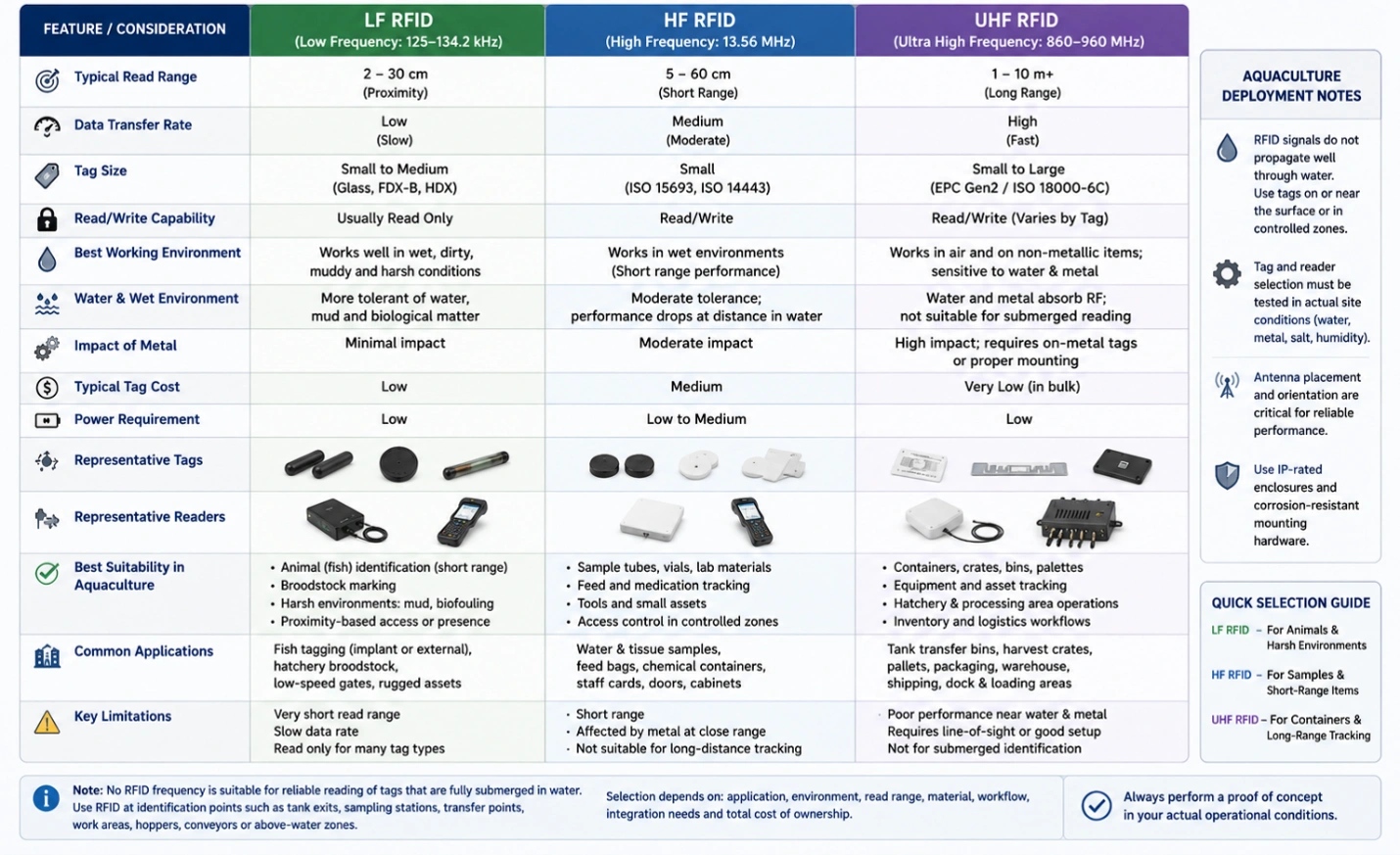
This comparison table evaluates LF, HF, and UHF RFID for aquaculture identification workflows, including animal identification, samples, containers, equipment, and logistics. It highlights read range, wet-environment behavior, metal sensitivity, representative tags and readers, limitations, and practical deployment considerations.
Alt Text: Aquaculture RFID comparison of LF, HF and UHF technologies, applications, read ranges, limitations, and deployment guidance.
Cloud and Private Server Deployment for Aquaculture
The appropriate deployment model depends on connectivity, data governance, latency, existing IT resources, AI computing requirements, and the operating characteristics of the aquaculture site.
Cloud-Hosted Deployment
A cloud-hosted system can centralize data from multiple farms, hatcheries, processing facilities, and remote cage locations. Centralized computing can simplify software updates, provide scalable storage, and make AI models available across geographically distributed operations.
Cloud deployment is particularly useful when organizations need centralized dashboards, multi-site analytics, historical data aggregation, remote monitoring, and scalable AI computing.
Connectivity remains an important engineering consideration. Remote aquaculture facilities may experience intermittent or limited network access. Local gateways should therefore buffer critical records and synchronize them when connectivity is restored rather than assuming continuous connectivity.
Private Server Deployment
A privately hosted server can be deployed on customer-managed servers, edge servers, private data centers, or other controlled computing infrastructure. This model can be appropriate where organizations require greater control over data storage, local processing, network access, or integration with existing operational systems.
Local processing can also reduce latency for operational alerts. For example, an aquaculture facility may require immediate notification when dissolved oxygen falls rapidly or when critical aeration equipment stops operating.
Private deployment may require greater responsibility for server maintenance, backups, operating-system updates, cybersecurity, redundancy, and AI computing resources.
Hybrid Edge and Cloud Deployment
A hybrid model can combine local processing with centralized cloud services. Edge systems can collect RFID events, sensor measurements, and AI-generated events at the farm while the cloud stores historical information and performs larger-scale analytics.
This model is often practical for geographically distributed aquaculture operations. Critical monitoring and local automation can remain functional during temporary connectivity failures, while aggregated production data can later synchronize with centralized software.
Cybersecurity and Data Integrity in Connected Aquaculture
Connected aquaculture systems can contain production records, operational information, equipment status, employee access credentials, network information, and business data. Security therefore needs to cover both information systems and connected field devices.
Important controls include:
- Unique device identities and controlled authentication for RFID readers, gateways, sensors, cameras, and servers
- Role-based access for farm operators, maintenance personnel, production managers, IT administrators, and other users
- Encryption for sensitive data during transmission and storage where appropriate
- Network segmentation separating connected equipment from unrelated corporate systems
- Secure configuration and controlled firmware and software updates
- Audit logging for important identification, configuration, maintenance, and administrative events
- Backup and recovery procedures for production databases and operational records
- Monitoring for unexpected device behavior, unauthorized access, and communication anomalies
Data quality is equally important. AI predictions depend on reliable inputs. Incorrect timestamps, duplicate RFID reads, missing sensor values, failed probes, improperly calibrated instruments, and incorrectly associated batch records can produce misleading AI results.
A robust solution should therefore include validation rules, duplicate-event filtering, sensor-quality checks, time synchronization, calibration procedures, exception handling, and clear ownership of master data.
Integrating AI and RFID with Aquaculture Management Systems
The greatest operational value comes when identification and AI data are connected to the systems that already manage production.
Potential integrations include:
- Aquaculture management software for stocking, feeding, growth, health, mortality, and harvest records
- Laboratory information systems for water-quality and biological samples
- Maintenance management software for pumps, aerators, feeders, filtration systems, and other equipment
- Inventory systems for feed, spare parts, containers, consumables, and equipment
- ERP software for procurement, finance, production planning, and supply-chain information
- Quality management systems for inspections, corrective actions, and production records
- Warehouse and logistics software for containers, pallets, shipments, and cold-chain activities
Integration can use APIs, databases, message brokers, file interfaces, or other supported mechanisms. A common data model is important because the same physical object may appear in several systems.
For example, a tank identifier should remain consistent across RFID events, water-quality records, feeding records, maintenance activities, and production reports. Similar relationships should exist for batch IDs, equipment IDs, sample IDs, and harvest lots.
GAO can provide RFID, BLE, and IoT hardware that serves as the field-data acquisition layer, while integration software can connect those devices with the organization’s existing applications.
Measuring AI-Enabled Aquaculture Performance
A successful deployment should be measured through operational KPIs rather than technology adoption alone. Useful measurements depend on the production model and species, but may include:
- Feed conversion ratio
- Specific growth rate
- Survival rate
- Biomass estimation error
- Mortality rate
- Stocking density
- Harvest yield
- Average time to harvest
- Feeding response
- Dissolved oxygen excursion frequency
- Water-quality alarm frequency
- Equipment downtime
- Mean time between failures
- Mean time to repair
- RFID read accuracy
- RFID event completeness
- Batch traceability completeness
- Inventory accuracy
- Maintenance response time
- AI alert precision and false-alert rate
The baseline should be recorded before deployment wherever possible. Comparing pre-deployment and post-deployment performance helps determine whether an AI solution is actually improving production rather than simply generating additional data.
AI models should also be monitored after deployment. Changes in species, stocking density, equipment, water conditions, camera positioning, seasonal conditions, or production practices can change the data distribution on which a model operates. Model retraining, validation, and performance monitoring should therefore be part of the long-term operating process.
Practical Implementation Considerations for Aquaculture
Successful deployment begins with the operational problem rather than the RFID reader, sensor, or AI model. A farm should identify where unreliable identification, delayed information, manual inspection, equipment failure, feeding inefficiency, or limited traceability creates measurable operational cost.
A practical implementation process should address:
- Define the operational decision that AI must improve.
- Identify the physical assets, production batches, tanks, cages, containers, samples, and equipment requiring digital identity.
- Map existing data sources and determine which measurements are missing or unreliable.
- Select RFID frequency, tag type, readers, antennas, sensors, cameras, gateways, and computing equipment according to the environment.
- Test RFID performance in representative wet, saline, metallic, and operational conditions before large-scale deployment.
- Establish consistent identifiers for tanks, cages, batches, equipment, samples, and locations.
- Implement data validation, timestamp synchronization, duplicate filtering, and sensor-quality checks.
- Integrate field data with existing aquaculture and maintenance software.
- Develop AI models using representative historical and operational data.
- Validate model outputs with aquaculture specialists and production measurements.
- Begin with a controlled pilot before extending the system across multiple production areas.
- Monitor operational KPIs, model performance, RFID reliability, network availability, and equipment health.
- Establish procedures for cybersecurity, backup, calibration, firmware updates, model retraining, and system maintenance.
Human oversight remains important, especially when AI recommendations could affect animal welfare, feeding, water treatment, or other biological processes. AI should support informed operational decisions, with automated control introduced only where the system has been adequately tested and appropriate safety mechanisms are present.
Engineering Benefits of AI-Enabled RFID Aquaculture Systems
Combining AI with RFID and other IoT technologies can improve aquaculture operations because it connects physical identity with continuous measurements and analytical models.
The primary technical and operational benefits include:
- Better batch traceability because physical production units and operational events can be associated with persistent digital identifiers.
- Faster detection of abnormal water conditions because AI can evaluate trends and combinations of sensor readings rather than relying exclusively on manual inspection.
- More informed feeding because feeding decisions can incorporate biomass, behavior, environmental conditions, and historical response.
- Improved production forecasting because historical growth and environmental data can support predictive models.
- Reduced equipment-related production risk because predictive maintenance can identify abnormal equipment behavior before a critical failure.
- Better data consistency because automated identification reduces dependence on manually entered identifiers at selected operational points.
- Improved multi-site visibility because centralized software can aggregate production data from different farms or facilities.
- Greater operational resilience through edge processing and local data buffering at sites with unreliable connectivity.
- Improved traceability across harvest and processing workflows because batch and container identities can remain linked to production records.
GAO’s experience supplying RFID, BLE, and IoT hardware products and systems can help organizations establish the physical data-capture layer required for these applications. The technology selection should remain driven by the aquaculture workflow, environmental conditions, integration requirements, and measurable business objectives.
Aquaculture AI Value Chain: From Connected Identification to Measurable Operational Value
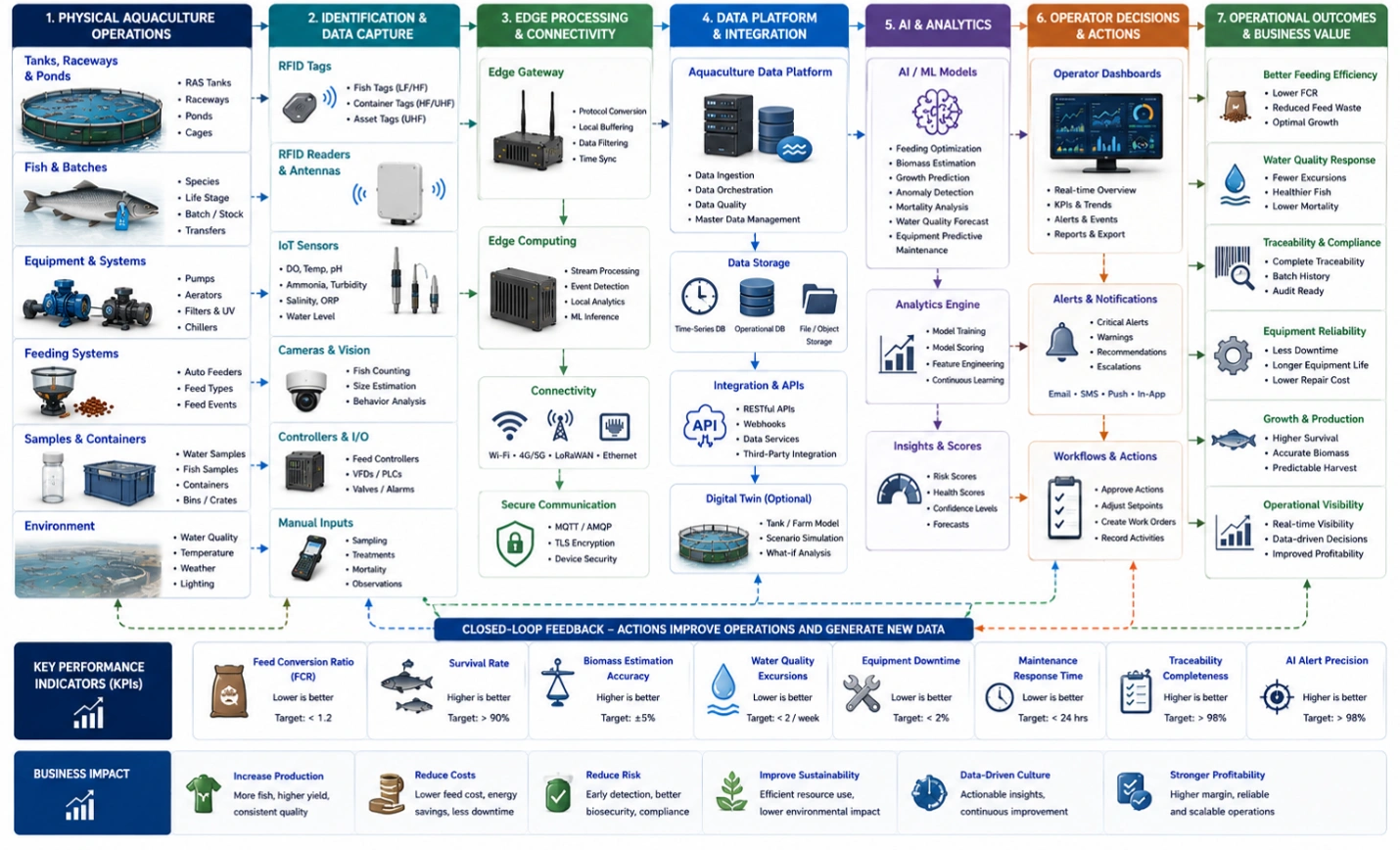
This infographic maps the aquaculture value chain from tanks, fish batches, equipment, feeding systems, samples, RFID tags, IoT sensors, and cameras through edge processing, data integration, AI analytics, and operator actions. It highlights the resulting benefits—including feeding efficiency, water-quality response, traceability, equipment reliability, growth forecasting, and operational visibility—alongside KPIs such as feed conversion ratio, survival rate, biomass accuracy, downtime, maintenance response time, and traceability completeness.
Alt Text: Aquaculture AI value chain linking RFID, IoT data, AI analytics, operational actions, and measurable KPIs.
Advancing AI and RFID Strategy for Aquaculture
AI can provide substantial value to aquaculture when it is connected to reliable operational data and clearly defined production decisions. RFID contributes physical identification, while sensors, cameras, edge computing, software integration, and AI provide the measurement and analytical capabilities needed to turn those identities into useful operational information.
The strongest implementations begin with a specific aquaculture problem such as feeding efficiency, batch traceability, biomass estimation, water-quality monitoring, equipment reliability, or harvest planning. Technology is then selected around that workflow.
Organizations evaluating these systems should test RFID performance under actual environmental conditions, establish reliable data identifiers, integrate with existing operational software, validate AI models against production KPIs, and design cybersecurity and maintenance procedures before scaling.
GAO supports organizations with RFID, BLE, and IoT hardware products and systems that can contribute to connected aquaculture deployments. Readers interested in applying these technologies to specific hatchery, grow-out, recirculating, cage, processing, or logistics workflows can explore GAO’s technology solutions and technical support options.
Building the Future of Industrial AI and IoT with Aperture Venture Studio and GAO RFID Inc.
For more than three decades, GAO Group of Companies has invested heavily in R&D for industrial RFID, BLE, and IoT technologies. As AI has become increasingly useful for industrial applications, we have expanded our work across AI and IoT solutions, including technologies relevant to aquaculture monitoring, traceability, automation, and analytics. We have also founded Aperture Venture Studio to help advance practical AI and IoT solutions for operational challenges such as connected aquaculture and intelligent resource management.
Aperture brings together AI and IoT technical experts, entrepreneurial and operational executives, investors, and leading companies. GAO Group also supports technical communities through the Aperture Ventures Summit and TekSummit, where advanced AI and IoT topics are discussed.
Headquartered in New York City and Toronto, Canada, GAO is among the leading B2B and B2G suppliers of BLE and RFID technologies. GAO Group has served U.S. and Canadian organizations, including Fortune 500 companies, R&D organizations, universities, and government agencies, supported by substantial R&D investment, quality-assurance processes, and remote or onsite technical support.
We welcome organizations interested in working with us as:
- Advisors, co-founders, or employees
- Investors
- Customers