
AI and RFID for Refineries
AI-Powered RFID Solutions for Intelligent Refinery Operations
Refineries operate some of the most complex and safety-critical industrial facilities in the energy sector. They continuously process crude oil into valuable petroleum products through interconnected processing units, storage facilities, pipelines, utilities, and logistics systems that require precise coordination, regulatory compliance, and uninterrupted operations. Artificial Intelligence (AI), supported by Radio Frequency Identification (RFID) technologies, is transforming refinery operations by enabling intelligent asset visibility, predictive decision-making, automated material tracking, and real-time operational intelligence. AI analyzes operational information collected through RFID systems to improve maintenance planning, equipment utilization, workforce safety, inventory management, and turnaround execution while reducing operational risk and unplanned downtime.
Modern refineries increasingly deploy RFID-enabled digital solutions to monitor thousands of tagged assets, maintenance components, safety equipment, inspection tools, chemicals, and mobile resources throughout large industrial sites. RFID readers, intelligent software, AI analytics, edge computing, enterprise maintenance systems, and refinery personnel work together to create a continuously updated operational picture that supports faster and more informed decisions. Rather than relying solely on manual inspections or paper-based records, AI-assisted RFID systems automate identification, improve traceability, optimize workflows, and strengthen regulatory compliance across refinery operations.
Reliable asset visibility has become increasingly important because refineries manage millions of dollars in rotating equipment, pressure vessels, instrumentation, valves, piping components, catalysts, maintenance tools, hazardous materials, and safety-critical equipment. GAO has supported organizations across North America by supplying industrial RFID hardware, RFID readers, antennas, tags, and IoT technologies that help improve operational efficiency, asset traceability, and maintenance management in demanding industrial environments.
AI and RFID Architecture for Intelligent Refinery Asset Tracking and Enterprise Operations
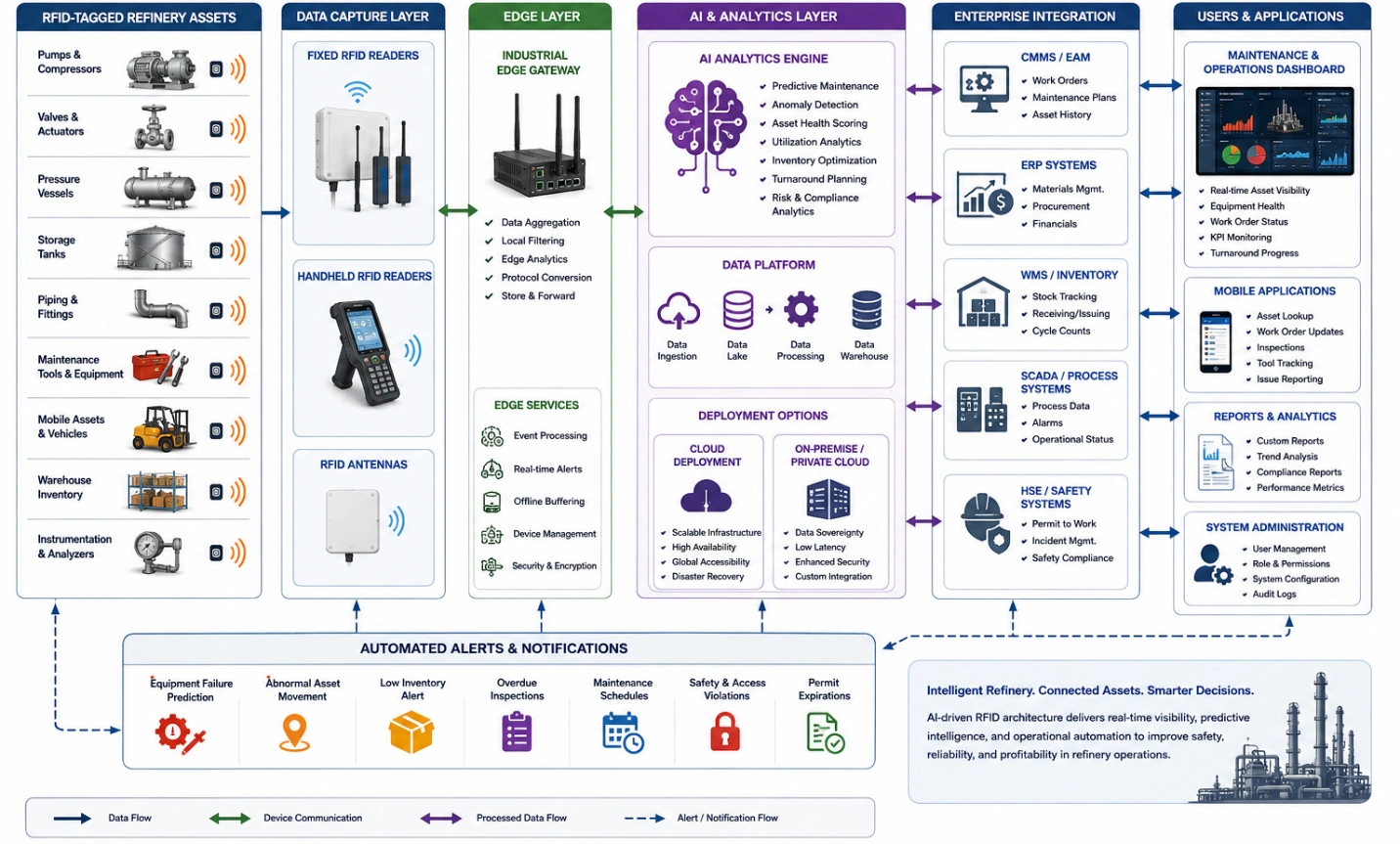
This architecture diagram illustrates how AI and RFID technologies work together within a modern refinery environment. It shows RFID-tagged assets, handheld and fixed RFID readers, an edge gateway, AI analytics, CMMS and ERP integration, cloud/server deployment, maintenance dashboards, and automated alerts connected through secure data flows to improve asset visibility, maintenance efficiency, and operational decision-making.
Understanding AI-Driven RFID Systems for Refinery Operations
Artificial Intelligence enhances refinery operations by converting RFID-generated operational information into actionable insights. RFID systems automatically identify and track tagged equipment, spare parts, maintenance tools, inspection devices, chemical containers, vehicles, personnel badges, and mobile assets throughout refinery facilities. AI continuously evaluates this operational information alongside maintenance histories, production schedules, equipment condition data, and enterprise software records to detect inefficiencies, forecast maintenance requirements, optimize inventory, and improve operational planning.
Unlike conventional RFID implementations that primarily record asset movements, AI continuously analyzes operational patterns across multiple refinery processes, including:
- Equipment location and utilization
- Spare parts availability
- Maintenance workflow progress
- Contractor access control
- Tool accountability
- Turnaround material management
- Warehouse inventory movement
- Hazardous material tracking
- Pipeline inspection scheduling
- Regulatory documentation
- This intelligent approach allows refinery operators to anticipate operational bottlenecks before they affect production reliability or maintenance performance.
RFID serves as the data acquisition technology by automatically identifying physical assets without direct line-of-sight, while AI transforms that identification data into predictive recommendations, optimization opportunities, anomaly detection, and operational intelligence. Together, these technologies support safer, more efficient, and more reliable refinery operations.
Why AI Is Transforming Refinery Asset Management
Refineries operate thousands of interconnected assets that require continuous inspection, preventive maintenance, calibration, and regulatory verification. Equipment failures can result in production interruptions, safety incidents, environmental consequences, and significant financial losses.
Traditional asset management often depends on manual inspections, barcode scanning, spreadsheets, and paper-based maintenance records. These approaches introduce several operational limitations:
- Limited real-time visibility of critical assets
- Time-consuming equipment identification
- Delayed maintenance updates
- Inaccurate inventory records
- Lost or misplaced maintenance tools
- Inefficient turnaround planning
- Manual compliance documentation
- Reduced workforce productivity
- Difficulty locating mobile equipment
- Limited forecasting capabilities
- AI addresses these challenges by continuously learning from RFID-generated operational data and enterprise maintenance information.
- Examples include:
- Predicting spare part demand before scheduled maintenance
- Identifying underutilized maintenance equipment
- Forecasting maintenance resource requirements
- Detecting abnormal asset movement
- Optimizing refinery turnaround logistics
- Improving contractor access management
- Reducing inventory shortages
- Supporting predictive maintenance scheduling
- Improving warehouse operations
- These intelligent capabilities improve operational reliability while helping refineries reduce maintenance costs and improve equipment availability.
AI-Enabled RFID Applications in Refineries
AI-assisted RFID solutions support nearly every operational area within refinery facilities.
Intelligent Asset Tracking
Large refineries manage tens of thousands of tagged assets distributed across processing units, warehouses, maintenance workshops, laboratories, utilities, tank farms, and loading terminals.
RFID automatically identifies:
- Pumps
- Compressors
- Heat exchangers
- Pressure vessels
- Control valves
- Instrumentation devices
- Electrical equipment
- Portable analyzers
- Safety equipment
- Maintenance tools
- AI analyzes asset movement and utilization to improve operational efficiency.
- Business outcomes include:
- Faster asset retrieval
- Improved utilization
- Reduced equipment loss
- Better maintenance planning
- Lower replacement costs
Maintenance and Turnaround Management
Scheduled refinery shutdowns, commonly referred to as turnarounds, involve thousands of workers, contractors, tools, spare parts, and maintenance activities.
RFID tracks:
- Maintenance tools
- Replacement components
- Inspection equipment
- Contractor credentials
- Work packages
- Mobile assets
- AI evaluates this information to optimize:
- Maintenance sequencing
- Resource allocation
- Material availability
- Contractor productivity
- Equipment readiness
- The result is shorter turnaround durations and reduced operational disruption.
Warehouse and Inventory Optimization
Refineries maintain extensive inventories of spare parts, valves, bearings, gaskets, instrumentation, motors, pumps, electrical components, catalysts, lubricants, and maintenance consumables.
RFID automatically records inventory movement while AI analyzes:
- Inventory turnover
- Stock availability
- Usage frequency
- Procurement trends
- Critical spare consumption
- Lead times
- Recommendations include:
- Inventory replenishment
- Warehouse optimization
- Spare parts redistribution
- Procurement planning
- Critical stock management
- These capabilities reduce inventory carrying costs while improving maintenance readiness.
Personnel Identification and Access Control
Worker safety is a top operational priority in refinery environments.
RFID-enabled identification badges help monitor:
- Employee access
- Contractor authorization
- Restricted-area entry
- Training certification
- Emergency evacuation status
- Shift attendance
- AI continuously evaluates access records to identify unusual activity, improve workforce planning, and strengthen site security.
Inspection and Regulatory Compliance
Refineries perform continuous inspections to satisfy safety, environmental, and operational regulations.
RFID tags attached to inspection points simplify the management of:
- Pressure vessel inspections
- Pipeline inspections
- Safety valve testing
- Fire protection equipment
- Gas detection systems
- Emergency shutdown devices
- Electrical inspections
- Calibration schedules
AI prioritizes inspections based on equipment criticality, historical performance, maintenance records, and operational risk, enabling inspection teams to focus resources where they are needed most.
AI-Enabled RFID Workflow for Intelligent Refinery Asset Management and Predictive Maintenance
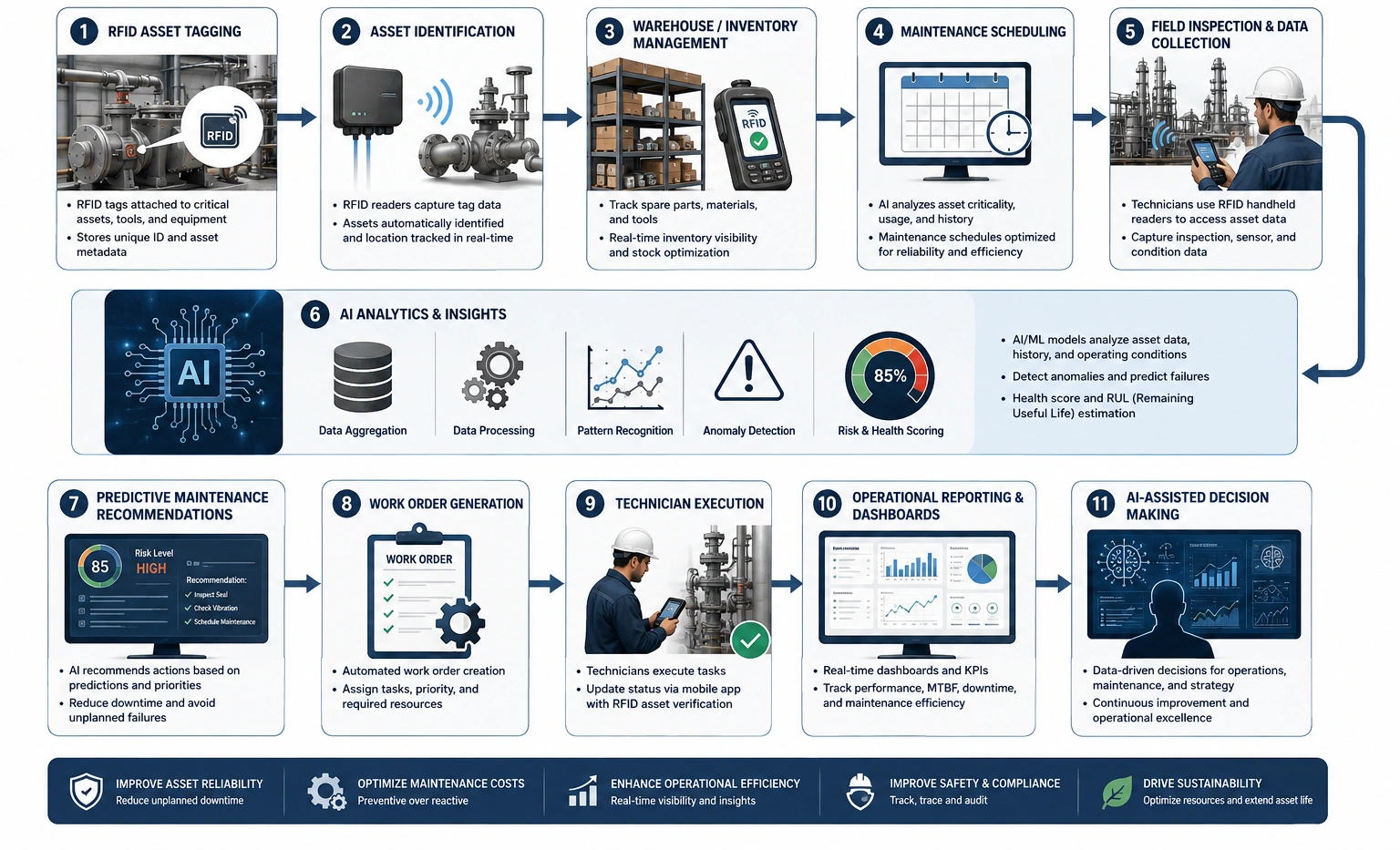
This workflow diagram illustrates the complete AI-enabled RFID lifecycle in refinery operations, from RFID asset tagging and identification through warehouse inventory management, maintenance scheduling, field inspections, AI-powered analytics, predictive maintenance recommendations, work order generation, technician execution, operational reporting, and AI-assisted decision-making. It demonstrates how RFID technology and Artificial Intelligence work together to improve asset visibility, maintenance efficiency, operational reliability, safety, and regulatory compliance across refinery facilities.
RFID Technologies, AI Models, Communication Infrastructure, and Deployment Considerations for Intelligent Refineries
Modern refinery operations require continuous visibility into critical assets, maintenance activities, inventory movement, workforce access, and operational workflows. AI-powered RFID solutions combine automatic identification technologies with intelligent analytics to create a connected operational environment where refinery personnel can make faster, data-driven decisions. RFID hardware captures asset identity and movement, while AI software analyzes this operational data to optimize maintenance schedules, improve warehouse efficiency, strengthen safety compliance, and reduce production downtime.
Unlike conventional RFID deployments that primarily support inventory identification, AI-enabled refinery solutions continuously correlate RFID data with maintenance histories, equipment criticality, inspection schedules, procurement records, and operational KPIs. This enables predictive maintenance, intelligent asset utilization, automated work order generation, and enhanced decision support across refinery operations.
RFID Hardware Components for Refinery Operations
RFID infrastructure forms the foundation of intelligent refinery asset management. The selection of RFID technology depends on asset type, environmental conditions, read distance, material composition, and operational objectives.
Typical RFID hardware includes:
- UHF RFID tags for long-range identification of maintenance equipment, pallets, pipes, valves, and warehouse inventory
- HF RFID tags for inspection records, calibration certificates, maintenance documentation, and tool management
- LF RFID tags for harsh industrial environments where metal interference or close-range identification is required
- Fixed RFID readers installed at warehouse entrances, maintenance workshops, process units, loading terminals, and access control points
- Handheld RFID readers used by maintenance technicians, warehouse operators, inspectors, and turnaround teams
- Industrial RFID antennas designed for hazardous refinery environments
- RFID-enabled personnel identification badges
- Rugged RFID tags engineered to withstand high temperatures, vibration, moisture, corrosive chemicals, UV exposure, and outdoor conditions
- Industrial edge gateways that aggregate RFID data before securely transmitting it to enterprise software
GAO supplies industrial RFID readers, rugged RFID tags, fixed and handheld RFID solutions, antennas, and supporting technologies that help refineries improve asset visibility, maintenance efficiency, and inventory accuracy in demanding industrial environments.
AI Models Supporting Refinery Operations
Artificial Intelligence transforms RFID-generated identification data into operational intelligence through advanced analytical models.
Common AI techniques include:
- Machine Learning for maintenance demand forecasting
- Predictive analytics for equipment failure prediction
- Time-series analysis for asset utilization trends
- Anomaly detection for unauthorized asset movement
- Optimization algorithms for spare parts allocation
- Classification models for maintenance prioritization
- Remaining Useful Life (RUL) estimation for critical refinery assets
- Computer vision integration for inspection validation where imaging systems are deployed
- Natural Language Processing (NLP) for maintenance logs, inspection reports, and work order analysis
- Reinforcement learning for optimizing turnaround scheduling and maintenance resource allocation
These AI models assist maintenance planners, operations managers, and reliability engineers by identifying risks, recommending corrective actions, and improving long-term operational planning without replacing human expertise.
Communication Infrastructure
Reliable communication is essential for transmitting RFID data throughout refinery operations.
Common communication technologies include:
- Ethernet for fixed RFID reader installations
- Industrial Wi-Fi for handheld RFID readers and mobile maintenance devices
- OPC UA for integration with industrial automation systems
- MQTT messaging for lightweight communication between edge devices and enterprise software
- HTTPS and REST APIs for secure application integration
- Modbus TCP for selected industrial monitoring equipment
- VPN connectivity for secure remote monitoring and administration
- These communication methods provide secure and reliable data exchange while supporting refinery operational requirements, network segmentation, and cybersecurity policies.
Enterprise Software Integration
RFID-generated data becomes significantly more valuable when integrated with refinery business and operational software.
Typical integrations include:
- Computerized Maintenance Management Systems (CMMS)
- Enterprise Asset Management (EAM) software
- Enterprise Resource Planning (ERP)
- Warehouse Management Systems (WMS)
- Supply Chain Management (SCM) software
- Process Information Management Systems (PIMS)
- Manufacturing Execution Systems (MES)
- Supervisory Control and Data Acquisition (SCADA)
- Document Management Systems (DMS)
- Health, Safety, and Environment (HSE) management software
These integrations enable automated work orders, inventory reconciliation, maintenance scheduling, regulatory reporting, procurement planning, and operational analytics without duplicate data entry.
Cloud Version vs. Server Version
Selecting the appropriate deployment model depends on refinery cybersecurity policies, operational requirements, existing IT infrastructure, and regulatory obligations.
Cloud Version
Cloud-hosted RFID software is well suited for organizations managing multiple refinery sites, terminals, warehouses, or regional maintenance centers.
Advantages include:
- Centralized visibility across multiple facilities
- Simplified software updates
- Elastic computing resources for AI analytics
- Lower local infrastructure requirements
- Remote access for authorized personnel
- Scalable storage for historical operational data
- Disaster recovery through redundant cloud infrastructure
- Faster deployment of advanced AI capabilities
- Cloud deployments are particularly beneficial for organizations requiring centralized reporting, multi-site asset management, and enterprise-wide operational visibility.
Server Version
Some refinery operators require privately managed software deployments because of cybersecurity requirements, operational policies, or critical infrastructure regulations.
Server deployments may operate on:
- Private refinery data centers
- Industrial edge servers
- Customer-managed enterprise servers
- Hybrid industrial computing environments
- Benefits include:
- Greater control of operational data
- Reduced dependence on external internet connectivity
- Lower latency for operational decision-making
- Custom integration with legacy refinery software
- Compliance with internal cybersecurity policies
- Enhanced operational resilience
Many refinery operators adopt hybrid deployments where RFID data is initially processed on edge servers before synchronized reporting and AI analytics are performed within centralized cloud environments.
Edge Computing in Refinery RFID Systems
Edge computing improves operational responsiveness by processing RFID events near refinery operations before transmitting summarized information to enterprise software.
Typical edge functions include:
- Local RFID event filtering
- Immediate access control decisions
- Temporary data buffering
- Work order synchronization
- Initial anomaly detection
- Local alarm generation
- Device management
- Secure data encryption before transmission
- Processing information locally minimizes latency and ensures continued operation even during temporary network disruptions.
Cybersecurity and Data Protection
Because refineries are designated critical infrastructure, cybersecurity is a fundamental design requirement for AI-enabled RFID systems.
Recommended security practices include:
- End-to-end encryption of RFID communications
- Multi-factor authentication for administrative users
- Role-based access control
- Secure RFID reader authentication
- Network segmentation between operational technology (OT) and information technology (IT)
- Digital certificates for connected devices
- Continuous vulnerability assessments
- Centralized security monitoring through Security Information and Event Management (SIEM) systems
- Comprehensive audit logging
- Regular firmware updates for RFID readers, gateways, and supporting infrastructure
- Implementing these measures helps protect operational data, reduce cybersecurity risks, and maintain compliance with industrial security policies.
Key Technical Capabilities and Business Benefits of AI-Enabled RFID Solutions for Refineries
Refineries are increasingly deploying AI-enabled RFID systems to improve operational visibility, optimize maintenance activities, strengthen safety programs, and increase asset reliability. By combining automatic identification with intelligent analytics, refinery operators can monitor critical assets, maintenance resources, inventory movement, and workforce activities in real time. AI transforms RFID-generated operational data into actionable insights that support safer operations, reduce downtime, and improve overall refinery performance.
Intelligent Asset Visibility
Large refinery facilities contain thousands of physical assets distributed across process units, tank farms, utility systems, maintenance workshops, laboratories, warehouses, and loading terminals. Locating critical equipment manually can consume valuable maintenance time.
RFID provides continuous identification and tracking of:
- Pumps
- Compressors
- Heat exchangers
- Pressure vessels
- Control valves
- Electric motors
- Portable gas detectors
- Inspection equipment
- Welding machines
- Maintenance tools
- AI continuously evaluates RFID location history, utilization trends, maintenance schedules, and equipment movement to improve operational planning.
- Business benefits include:
- Faster asset retrieval
- Reduced equipment loss
- Improved maintenance productivity
- Higher asset utilization
- Lower replacement costs
- Increased operational visibility
- GAO has supplied industrial RFID readers, rugged RFID tags, and asset tracking solutions that help refineries improve visibility across complex industrial facilities.
Predictive Maintenance and Equipment Reliability
Unexpected equipment failures can interrupt refinery production, increase maintenance costs, and introduce operational safety risks.
RFID automatically records equipment identity during inspections, maintenance activities, and spare part replacement. AI analyzes this information together with historical maintenance records and operational trends.
Typical AI capabilities include:
- Equipment health scoring
- Failure probability prediction
- Maintenance prioritization
- Remaining useful life estimation
- Spare parts forecasting
- Inspection scheduling optimization
- Benefits include:
- Reduced unplanned downtime
- Improved equipment availability
- Lower maintenance costs
- Longer equipment life
- Better maintenance resource utilization
- Increased refinery reliability
- Maintenance teams can focus on high-risk equipment before failures occur rather than relying solely on fixed maintenance intervals.
Warehouse and Inventory Intelligence
Refineries maintain extensive inventories of maintenance materials, instrumentation components, electrical equipment, valves, bearings, seals, catalysts, lubricants, and safety supplies.
RFID automatically records inventory movement while AI evaluates:
- Consumption rates
- Inventory turnover
- Critical spare availability
- Supplier lead times
- Procurement trends
- Material demand forecasting
- Operational improvements include:
- Reduced inventory shortages
- Optimized warehouse utilization
- Faster inventory audits
- Improved procurement planning
- Lower carrying costs
- Better maintenance readiness
Workforce Safety and Access Management
Refinery personnel routinely work in hazardous environments containing flammable hydrocarbons, high-pressure systems, elevated temperatures, and confined spaces.
RFID-enabled identification systems improve personnel management by monitoring:
- Worker identification
- Contractor authorization
- Training certification
- Permit-to-work validation
- Restricted-area access
- Emergency assembly accountability
- Shift attendance
- AI analyzes workforce movement patterns to identify unusual access behavior, improve emergency response planning, and strengthen compliance with refinery safety procedures.
Turnaround and Shutdown Optimization
Major refinery turnarounds involve thousands of maintenance activities executed over compressed schedules.
RFID automatically tracks:
- Work packages
- Maintenance equipment
- Contractor tools
- Spare parts
- Mobile assets
- Inspection devices
- AI assists planners by recommending:
- Resource allocation
- Material staging
- Maintenance sequencing
- Equipment prioritization
- Labor optimization
- These capabilities help reduce turnaround duration while improving maintenance quality and reducing project costs.
Operational Performance Improvements and Refinery KPIs
AI-enabled RFID systems provide measurable operational improvements that refinery managers can evaluate using Key Performance Indicators (KPIs).
Typical refinery KPIs include:
- Asset utilization rate
- Equipment availability
- Mean Time Between Failures (MTBF)
- Mean Time To Repair (MTTR)
- Preventive maintenance compliance
- Inventory accuracy
- Spare parts availability
- Warehouse inventory turnover
- Maintenance work order completion rate
- Tool utilization rate
- Contractor productivity
- Inspection completion rate
- Permit-to-work compliance
- Emergency response readiness
- Asset location accuracy
- Turnaround schedule adherence
- Production downtime due to maintenance
- Safety incident frequency
- AI dashboards continuously monitor these indicators, identify operational trends, and recommend improvement opportunities that support refinery performance objectives.
Engineering Best Practices for AI-Enabled RFID Deployment in Refineries
Successful implementation requires careful engineering planning that extends beyond RFID hardware installation.
Recommended best practices include:
- Conduct a comprehensive asset identification and tagging assessment before deployment.
- Select RFID tags rated for high temperatures, corrosive chemicals, vibration, moisture, and hazardous refinery environments.
- Design RFID reader placement to minimize blind spots while accounting for metallic structures and electromagnetic interference.
- Integrate RFID software with CMMS, EAM, ERP, WMS, SCADA, and HSE systems to eliminate duplicate data entry.
- Establish standardized asset naming conventions and tag management procedures.
- Validate RFID read accuracy under normal operating conditions and during maintenance turnarounds.
- Implement cybersecurity measures such as encrypted communications, role-based access control, network segmentation, and regular firmware updates.
- Develop preventive maintenance schedules for RFID readers, antennas, handheld devices, and edge gateways.
- Train maintenance personnel, warehouse operators, reliability engineers, and contractors on RFID system operation and data quality requirements.
- Review AI models periodically to ensure predictive recommendations remain accurate as refinery assets, operating conditions, and maintenance strategies evolve.
Following these engineering practices improves long-term reliability, scalability, cybersecurity, and operational performance while maximizing the return on RFID and AI investments.
Transforming Refinery Operations with AI and RFID
AI-powered RFID solutions are enabling refineries to improve asset visibility, maintenance planning, inventory management, workforce safety, and operational decision-making. By combining RFID technology with intelligent analytics, refineries gain real-time insight into critical assets, maintenance workflows, warehouse operations, and regulatory compliance. These capabilities reduce downtime, optimize resource utilization, strengthen safety performance, and support more reliable production operations.
With more than three decades of experience supplying advanced RFID and industrial identification technologies, GAO, headquartered in New York City and Toronto, Canada, has supported Fortune 500 companies, leading research organizations, universities, and government agencies across North America. Through industrial RFID readers, rugged RFID tags, antennas, and expert technical support, we continue helping organizations improve operational efficiency, asset traceability, and maintenance excellence.
Building the Future of Industrial AI and IoT with Aperture Venture Studio and GAO RFID Inc.
For more than three decades, GAO Group of Companies has invested extensively in research and development of industrial RFID, BLE, and IoT technologies. As Artificial Intelligence continues to transform industrial operations, we have expanded our AI and RFID capabilities while establishing Aperture Venture Studio to accelerate the advancement of intelligent RFID and AI solutions for refineries, energy operations, and other industrial sectors.
Aperture has attracted experienced AI specialists, RFID engineers, industrial technology experts, operational leaders, investors, and corporate collaborators who contribute to advancing intelligent industrial technologies. Through initiatives such as the Aperture Ventures Summit and TekSummit, we promote technical collaboration and knowledge sharing across AI, RFID, and IoT disciplines. We welcome advisors, industry professionals, investors, customers, and technology partners to join GAO as we continue supporting the future of intelligent refinery operations.