
AI and RFID for Municipal Governments
AI-Driven Transformation of Municipal Government Operations
Artificial intelligence is changing how municipal governments manage public assets, deliver services, maintain infrastructure, respond to incidents, and allocate limited operational resources. AI can combine data from work-order systems, geographic information systems, building management systems, traffic infrastructure, connected sensors, cameras, mobile devices, and BLE-enabled equipment to identify patterns and support faster operational decisions. For municipal governments, the value is not simply automation. AI can help departments move from reactive maintenance and manually coordinated field operations toward predictive, data-driven service delivery. BLE gateways, beacons, and sensors can provide location, condition, occupancy, and environmental data for selected municipal assets and facilities. When this information is processed by machine learning, computer vision, forecasting, anomaly detection, or other AI methods, municipal teams can prioritize work, improve asset utilization, reduce unnecessary field inspections, and strengthen accountability across public services.
Municipal AI Transformation Flow
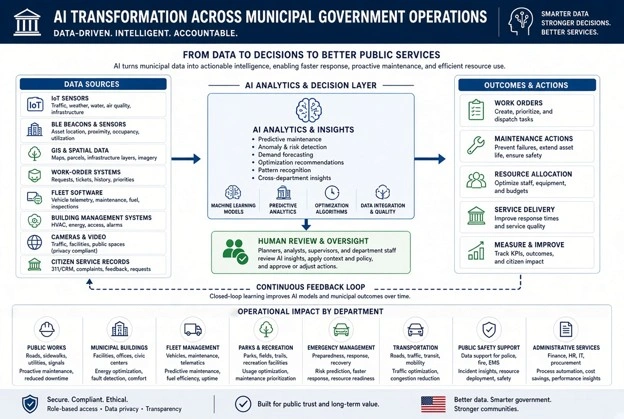
What AI Transformation Means for Municipal Governments
AI transformation in municipal government refers to the practical use of artificial intelligence to improve public-sector decision-making, service delivery, infrastructure management, resource allocation, and operational workflows.
The most valuable municipal AI implementations generally begin with a specific operational problem rather than with an AI model. A public works department may need to predict equipment failures. A facilities department may need better visibility into room utilization. A parks department may need to monitor distributed equipment. A fleet department may need more accurate utilization information. An emergency management team may need faster situational awareness.
AI becomes useful when reliable operational data is available at the point where a decision must be made.
Municipal governments can combine several data sources:
- Computer vision systems for traffic, parking, infrastructure inspection, and public-space monitoring
- Geographic information systems for spatial analysis and infrastructure planning
- Computer-aided dispatch systems for emergency response coordination
- Enterprise asset management and computerized maintenance management systems for work orders and maintenance history
- Building management systems for municipal facilities
- Fleet management software for vehicles and mobile equipment
- IoT sensors for environmental, equipment, occupancy, and condition monitoring
- BLE beacons and sensors for selected indoor location, asset identification, occupancy, and facility monitoring applications
- Public service databases and permitting systems
- Historical maintenance, inspection, incident, and service-request records
Machine learning can then identify correlations, anomalies, utilization patterns, and operational trends that are difficult to recognize manually.
For example, an AI model can analyze historical work orders, equipment operating conditions, inspection records, and environmental measurements to estimate which municipal assets are likely to require maintenance. The resulting prediction can be routed to a maintenance management system so that supervisors can review the recommendation and schedule an appropriate intervention.
This human-in-the-loop approach is particularly important for municipal government because AI recommendations often affect public services, infrastructure spending, field personnel, and citizen-facing operations.
Where Municipal Governments Are Applying AI
Public Works and Infrastructure Management
Public works departments manage roads, bridges, streetlights, drainage infrastructure, public buildings, signage, utility-related assets, and other distributed municipal resources.
AI can help transform infrastructure maintenance from periodic inspection toward condition-based and predictive maintenance.
Relevant applications include:
- Predicting maintenance requirements from historical work orders and inspection records
- Detecting abnormal operating conditions in connected infrastructure
- Prioritizing road, lighting, drainage, and facility maintenance based on risk and service impact
- Identifying recurring infrastructure failures by location
- Forecasting maintenance demand and spare-parts requirements
- Optimizing field-service schedules
- Correlating environmental conditions with equipment failures
- Supporting capital planning using historical asset-condition data
BLE-enabled identification and sensing can complement these systems when municipal assets are located indoors, within facilities, maintenance yards, workshops, storage areas, or other environments where short-range wireless connectivity is practical.
The important engineering consideration is that asset identification and location data should connect to the municipal asset record. A BLE beacon alone does not provide operational value unless its identifier is associated with an asset, facility, room, vehicle, equipment record, or work process.
Municipal Fleet and Vehicle Operations
Municipal fleets can include maintenance trucks, inspection vehicles, emergency-support vehicles, utility vehicles, sanitation equipment, public works machinery, and other mobile assets.
AI can analyze vehicle utilization, maintenance history, operating schedules, location information, fuel consumption, service records, and dispatch information to identify inefficient utilization and emerging maintenance requirements.
Potential applications include:
- Vehicle utilization forecasting
- Predictive maintenance
- Route and dispatch optimization
- Idle-time analysis
- Maintenance scheduling
- Fleet replacement planning
- Abnormal utilization detection
- Assignment optimization for municipal vehicles and equipment
BLE sensors can provide supplementary data for selected equipment, especially where municipal teams need low-power identification or condition information within depots, garages, workshops, or facilities.
GAO provides BLE, RFID, and IoT hardware that can be incorporated into municipal asset identification and sensing solutions where the operating environment and data requirements are appropriate.
Municipal Buildings and Facility Management
City halls, libraries, recreation centers, public safety buildings, maintenance facilities, administrative offices, and other municipal properties generate significant operational data.
AI can analyze occupancy, room utilization, environmental conditions, maintenance history, energy-related measurements, and facility schedules to help departments understand how buildings are being used.
Municipal facility applications include:
- Occupancy pattern analysis
- HVAC anomaly detection
- Predictive maintenance
- Space utilization analysis
- Equipment condition monitoring
- Energy-demand forecasting
- Maintenance prioritization
- Indoor asset location
- Facility service optimization
BLE beacons and sensors can support selected indoor applications by providing proximity, identification, occupancy-related signals, or equipment condition measurements. The appropriate BLE configuration depends on the required location accuracy, battery life, building construction, gateway placement, interference environment, and reporting frequency
Municipal Government Operational Workflows Enhanced by AI
AI transformation is most effective when connected to an existing municipal workflow.
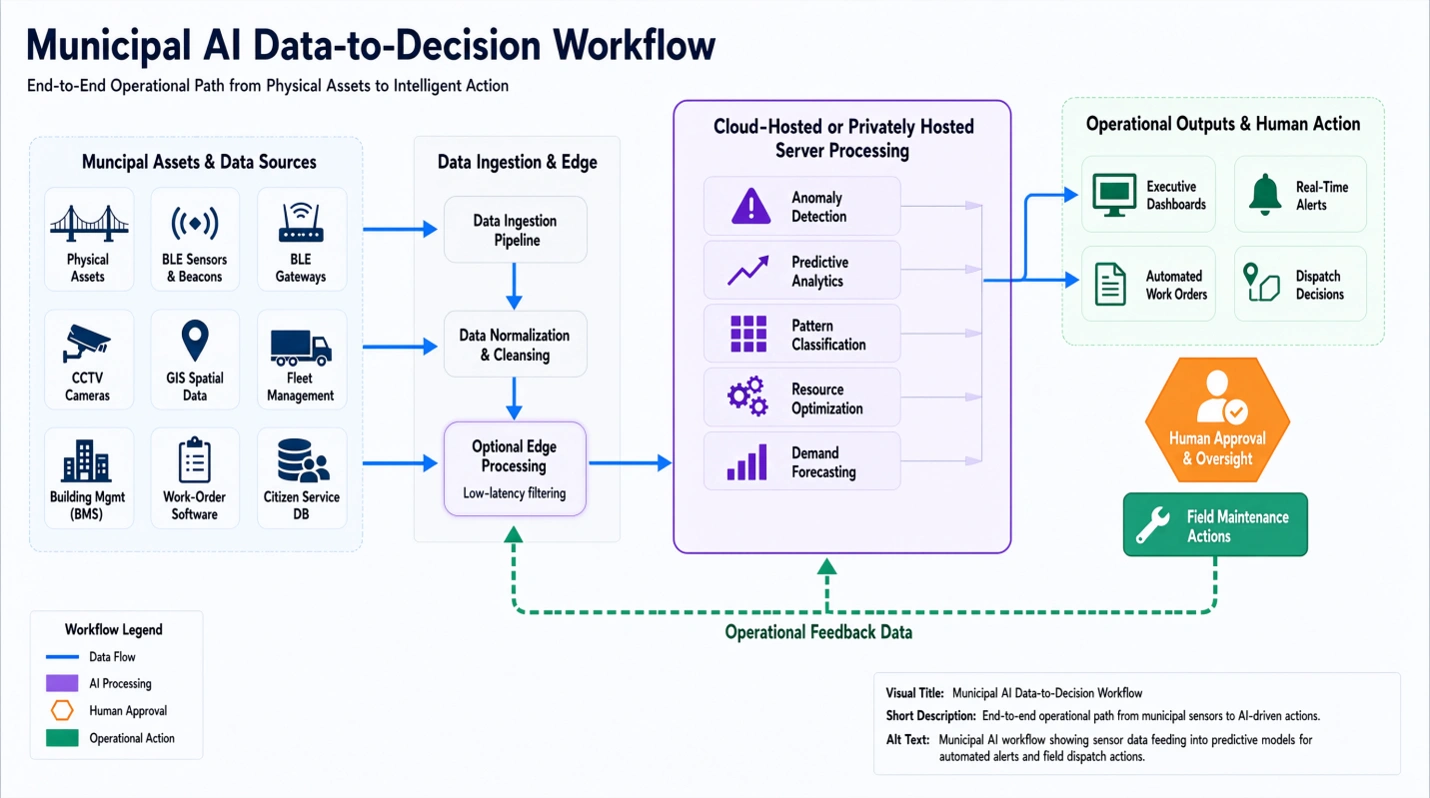
A typical AI-assisted maintenance workflow can begin when a sensor or operational system produces new information. That information is transmitted through an appropriate communication network to an edge device, gateway, server, or cloud service. Data processing removes duplicates, validates measurements, associates identifiers with municipal asset records, and prepares the information for analysis.
The AI layer can then perform tasks such as anomaly detection, classification, forecasting, risk scoring, or pattern recognition.
The resulting recommendation can be presented to a maintenance supervisor or integrated with municipal software for further action.
A practical workflow may therefore look like:
- Data acquisition: Sensors, BLE devices, cameras, GIS records, work orders, inspections, and operational software generate municipal data.
- Connectivity: BLE gateways, Wi-Fi, cellular, Ethernet, LPWAN, or other suitable communication methods transport information according to the operating environment.
- Data normalization: Middleware or data services validate timestamps, identifiers, sensor measurements, and asset associations.
- AI processing: Machine learning, anomaly detection, forecasting, computer vision, or other AI techniques analyze the information.
- Decision support: The system produces alerts, predictions, risk scores, recommendations, or operational dashboards.
- Municipal action: Supervisors assign work, dispatch personnel, schedule inspections, adjust resources, or initiate other appropriate procedures.
- Feedback: Completed work orders and inspection outcomes become additional data for evaluating and improving the AI model.
This feedback loop is important. A prediction is only operationally useful when municipal personnel can act on it and the outcome is captured for later analysis.
From Municipal Data Acquisition to AI-Based Decisions
Data Capture and Asset Identification
Reliable AI begins with reliable source data. Municipal governments frequently operate heterogeneous systems acquired by different departments over many years. Asset identifiers may therefore differ between GIS databases, maintenance systems, fleet records, procurement databases, and physical equipment.
A municipal AI implementation should establish a consistent relationship between a physical asset and its digital record.
BLE can contribute to this process through low-power beacons, sensors, and gateways. For example, a municipal maintenance facility can associate a BLE identifier with a piece of equipment and use gateway observations to determine whether that equipment is present within a defined area.
RFID can also be appropriate where tagged physical assets need rapid identification during inventory, receiving, maintenance, or controlled movement processes.
GAO’s BLE and RFID hardware can support these data-acquisition requirements when selected according to the physical environment, read range, battery requirements, asset type, and integration requirements.
Edge Processing and Gateway Functions
Municipal deployments do not always need to send every raw sensor event directly to a cloud service.
Edge processing can filter unnecessary messages, perform basic validation, aggregate readings, and forward only relevant information. This can reduce network traffic and improve responsiveness for local operational applications.
BLE gateways are particularly useful where multiple low-power BLE devices need to communicate with a backend system. Gateway placement should account for building materials, equipment density, radio interference, expected coverage, maintenance access, and power availability.
Cloud and Server Deployment
Municipal governments have different requirements for data governance, cybersecurity, integration, procurement, and infrastructure management.
A Cloud Version can be appropriate when a municipality wants centrally managed software, elastic computing resources, remote administration, simplified deployment, and integration with cloud-based data services. This model can be useful for departments operating across multiple facilities or geographic locations.
A Server Version can be appropriate when software must run on customer-managed servers, private data centers, municipal facilities, edge servers, or other privately hosted infrastructure. This approach may provide greater control over network boundaries, system administration, data handling, and integration with existing municipal infrastructure.
The choice should be based on data sensitivity, network availability, cybersecurity requirements, IT operating capabilities, integration constraints, procurement policies, and long-term support requirements rather than assuming that one deployment model is universally superior.
Municipal AI Data-to-Decision Workflow Diagram
AI Methods Supporting Municipal Government Operations
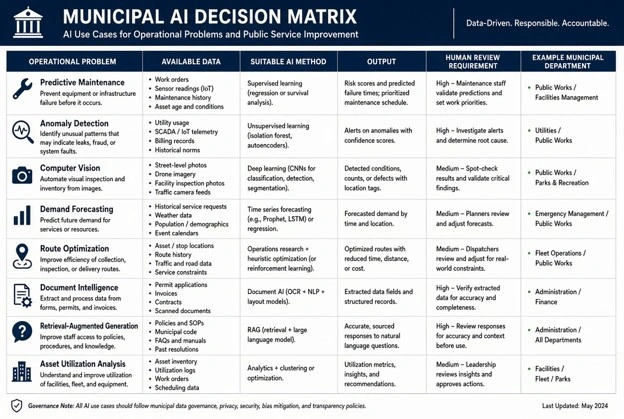
Different municipal problems require different AI methods. Selecting the model should follow the operational requirement and available data rather than forcing every problem into a generative AI workflow.
Predictive Analytics
Predictive models can estimate future maintenance requirements, service demand, equipment failures, energy consumption, or fleet utilization.
Historical work orders, inspection results, operating measurements, weather information, asset age, maintenance frequency, and location can become model inputs where legally and operationally appropriate.
Anomaly Detection
Anomaly detection is useful when normal operating behavior is known but failures are relatively rare.
For municipal facilities and infrastructure, the model can identify unusual temperature, vibration, utilization, operating frequency, or equipment behavior and notify personnel for investigation.
Computer Vision
Computer vision can support infrastructure inspections, traffic analysis, parking management, facility monitoring, and other visual applications.
The implementation must account for camera placement, lighting, environmental conditions, model accuracy, privacy requirements, retention policies, and human verification.
Forecasting and Optimization
Forecasting models can estimate future service demand, maintenance workload, facility utilization, or resource requirements.
Optimization methods can then help municipal managers evaluate schedules, routes, personnel allocation, maintenance priorities, and other operational constraints.
Generative AI and Municipal Knowledge Work
Generative AI can assist with document search, internal knowledge retrieval, report drafting, policy-document analysis, service-request classification, and other administrative workflows.
For municipal applications, retrieval-augmented generation can be useful when responses need to reference approved municipal documents rather than relying solely on a model’s pretrained knowledge.
Human review remains important for public-facing or policy-sensitive outputs.
Municipal Government AI Methods Decision Matrix
Engineering Considerations for Municipal AI Deployment
Municipal AI projects often fail to deliver expected value when the underlying operational process is not clearly defined.
Several engineering questions should be addressed before deployment:
- Which municipal decision will the AI system improve?
- Which asset, facility, vehicle, infrastructure component, or service generates the required data?
- How frequently must the data be captured?
- What level of location accuracy is actually required?
- Which department owns the resulting decision?
- Which existing municipal software must receive the AI output?
- What happens when sensor data is missing or incorrect?
- How will personnel validate an AI recommendation?
- How will model performance be measured after deployment?
- What happens when the physical environment changes?
- How will devices, gateways, firmware, credentials, and software be maintained?
- Which cybersecurity controls apply to connected municipal equipment?
BLE deployment deserves similar discipline. Municipal teams should avoid deploying gateways simply to increase device coverage without establishing the operational requirement. Gateway density, antenna placement, battery replacement schedules, wireless interference, physical security, and network connectivity can directly influence data quality.
The strongest implementations connect physical sensing to a defined municipal workflow, measurable KPI, and accountable operational owner.
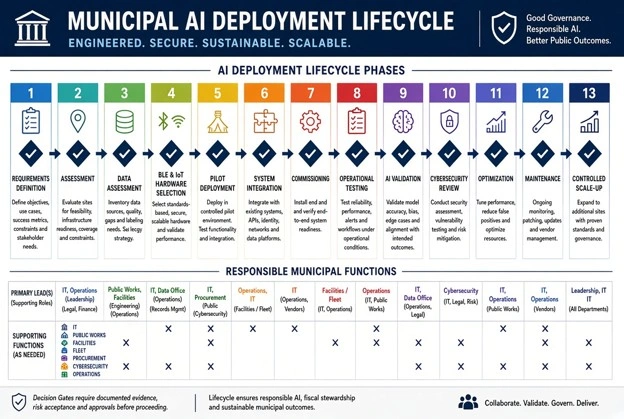
Municipal AI Implementation Lifecycle
A practical municipal deployment should progress through planning, engineering validation, controlled deployment, integration, testing, and continuous optimization.
- Requirements definition: Establish the municipal problem, target users, assets, decisions, KPIs, and operational constraints.
- Site assessment: Review facilities, infrastructure, radio conditions, network availability, power sources, environmental conditions, and device mounting locations.
- Data assessment: Determine whether historical records and real-time data are sufficiently accurate for the intended AI application.
- Hardware selection: Select BLE gateways, beacons, sensors, RFID equipment, cameras, or other devices according to range, battery life, environmental rating, connectivity, and maintenance requirements.
- System integration: Connect collected data with GIS, asset management, maintenance, fleet, facility, or other municipal software.
- Pilot deployment: Validate the solution in a representative municipal environment before broader deployment.
- Commissioning: Verify device identity, gateway connectivity, data quality, timestamps, asset associations, alerts, and software integration.
- Operational testing: Test normal conditions, missing data, communication failures, device replacement, network outages, and unexpected sensor readings.
- AI validation: Measure prediction accuracy, false-positive rates, response time, and operational usefulness.
- Optimization: Adjust device placement, sampling intervals, thresholds, models, workflows, and dashboards based on actual operating results.
- Scale-up: Expand to additional facilities, departments, asset classes, or geographic areas after the pilot demonstrates measurable value.
Municipal AI Deployment Lifecycle Timeline
Building the Future of Industrial AI and IoT with Aperture Venture Studio and GAO RFID Inc.
For more than three decades, GAO Group of Companies has invested heavily in R&D of industrial BLE, RFID, and IoT. As generative AI has become useful in industrial and government applications, we have continued developing AI and IoT technologies, including BLE and RFID, and we have founded Aperture Venture Studio to build, launch, and scale next-generation AI and IoT companies for applications such as intelligent municipal operations.
Aperture has attracted AI and IoT technical experts, entrepreneurial and operational executives, influential investors, and leading companies.
We have also developed the Aperture Ventures Summit and TekSummit to discuss advanced AI and IoT topics.
These efforts have helped us develop diversified technical communities around AI and IoT.
We welcome you to join us as:
- Advisors, co-founders, or employees
- Investors
- Customers