
AI and RFID for Wind Farms
AI-Driven Asset Tracking and Operations for Wind Farms
AI and RFID for wind farms combines artificial intelligence with connected identification and sensing technologies to improve how turbine components, maintenance tools, spare parts, consumables, and field equipment are tracked and managed. UHF RFID can identify tagged assets across turbine service areas, warehouses, staging yards, and maintenance facilities, while HF and LF RFID can support more localized identification requirements. AI analyzes RFID events alongside maintenance records, inventory data, work orders, environmental conditions, and operational information to identify patterns and support decisions. For wind farm operators, this can reduce time spent locating equipment, improve spare-parts availability, strengthen maintenance traceability, and provide better visibility into distributed field operations. The approach is particularly valuable where turbines are geographically dispersed, service activities involve large components and specialized tools, and maintenance teams must coordinate inventory, logistics, safety procedures, and scheduled or corrective work.
What AI and RFID Mean for Modern Wind Farm Operations
Wind farms generate large volumes of operational information through turbine control systems, condition-monitoring equipment, computerized maintenance management systems, inventory applications, logistics records, and field-service activities. RFID adds another source of structured physical-world data by identifying the movement and presence of tagged objects.
AI converts these combined data streams into operational insights. Rather than treating RFID simply as a barcode replacement, a wind farm can use RFID event data as evidence of where an asset is, when it entered a maintenance area, whether it was issued to a work crew, and whether it was returned after a service activity.
Relevant AI methods include:
- Machine learning for maintenance demand forecasting and inventory optimization
- Anomaly detection for identifying unusual asset movements or maintenance patterns
- Predictive analytics for estimating spare-parts requirements
- Computer vision combined with RFID for equipment identification and work-area verification
- Natural-language AI for searching maintenance records and operational events
- Classification models for prioritizing maintenance-related asset and inventory exceptions
- Time-series analysis for correlating asset activity with turbine operating conditions
- Edge AI for processing selected identification and sensor events close to the wind farm
RFID therefore functions as a physical identification layer within a broader wind farm information system. The AI layer adds interpretation, prediction, prioritization, and decision support.
GAO provides RFID, BLE, and related IoT hardware products and systems that can be incorporated into these operational workflows. Its experience supplying technology to organizations in the United States and Canada supports practical consideration of identification hardware, installation conditions, integration requirements, and ongoing technical support.
Wind Farm Applications for AI-Enabled RFID
Turbine Component and Critical Asset Tracking
Wind turbines contain high-value and maintenance-critical components such as gearboxes, generators, bearings, pitch-system components, hydraulic equipment, electrical assemblies, control equipment, and replacement modules. Large components may move between warehouses, staging locations, service facilities, and turbine sites before installation.
RFID identification can establish an event history for tagged components. AI can analyze that history with work orders, maintenance schedules, failure information, and inventory records to identify assets that require attention.
Typical applications include:
- Tracking replacement gearboxes and major drivetrain components
- Monitoring generator and bearing inventory
- Recording movement of pitch and yaw system components
- Tracking electrical cabinets, converters, controllers, and spare modules
- Associating serialized components with individual turbine assets
- Verifying that the correct replacement component reaches a scheduled work site
- Maintaining installation and replacement history
Maintenance Tool and Equipment Management
Wind turbine maintenance requires specialized tools and field equipment, including torque tools, lifting accessories, inspection instruments, hydraulic equipment, electrical test equipment, climbing equipment, and service kits.
Missing tools can delay maintenance work, create additional mobilization requirements, and complicate accountability across crews and service locations. RFID can provide automated identification at tool rooms, warehouse exits, maintenance staging areas, and return points.
AI can identify recurring shortages, unusual movement patterns, frequently used tools, and demand associated with planned maintenance campaigns.
Useful capabilities include:
- Automated tool check-in and check-out
- Crew-level equipment assignment
- Detection of equipment leaving designated areas
- Tool availability forecasting
- Maintenance history association
- Inspection and calibration tracking
- Identification of equipment that has not been returned
- Analysis of tool utilization across turbine service teams
Spare Parts and Wind Farm Inventory Management
Wind farm warehouses often hold a mixture of high-value spare parts, low-cost consumables, electrical components, lubricants, fasteners, filters, hydraulic components, and emergency replacement items.
AI-assisted RFID inventory management can improve visibility without requiring technicians to manually scan every item. UHF RFID is particularly useful for reading multiple tagged items in receiving, storage, staging, and dispatch areas.
AI can then combine inventory events with turbine maintenance plans and historical consumption.
Potential outcomes include:
- More accurate spare-parts availability
- Earlier identification of stock shortages
- Improved maintenance-kitting accuracy
- Reduced time spent searching for parts
- Better reorder forecasting
- Improved inventory traceability
- Identification of slow-moving or misplaced inventory
- More reliable emergency-maintenance preparation
Maintenance Kits and Work-Order Verification
A scheduled turbine service event may require a specific combination of spare parts, tools, consumables, safety equipment, and inspection instruments. A missing item can delay a crew after transportation to a remote turbine.
RFID can identify individual kit contents, while AI compares actual kit composition with the requirements of a work order.
The system can flag discrepancies before equipment leaves a service warehouse. This shifts verification from a largely manual process to an exception-driven workflow.
Component Traceability and Maintenance History
Wind farm operators need reliable records for components that are repaired, replaced, inspected, refurbished, or transferred between locations. RFID identifiers can connect the physical component with digital records.
A component’s identifier can be associated with:
- Turbine identification
- Component serial number
- Manufacturer information
- Installation date
- Removal date
- Maintenance events
- Inspection results
- Repair history
- Work-order references
- Warehouse location
- Current operational status
AI can use these relationships to detect inconsistencies, identify repeated component movements, and support maintenance planning.
Field Logistics and Remote Wind Farm Operations
Geographically distributed wind farms create logistics challenges that differ from centralized industrial facilities. Parts, tools, and technicians may travel between regional warehouses, substations, staging areas, turbine locations, and service vehicles.
RFID event capture can provide visibility as equipment moves through these locations. AI can combine movement information with work schedules and maintenance priorities to identify potential delays.
This can support decisions such as whether a required component has reached the correct staging location, whether a service kit is complete, and whether equipment assigned to a field crew remains available.
AI-Enabled RFID Data Flow for Wind Farm Asset Tracking and Predictive Maintenance
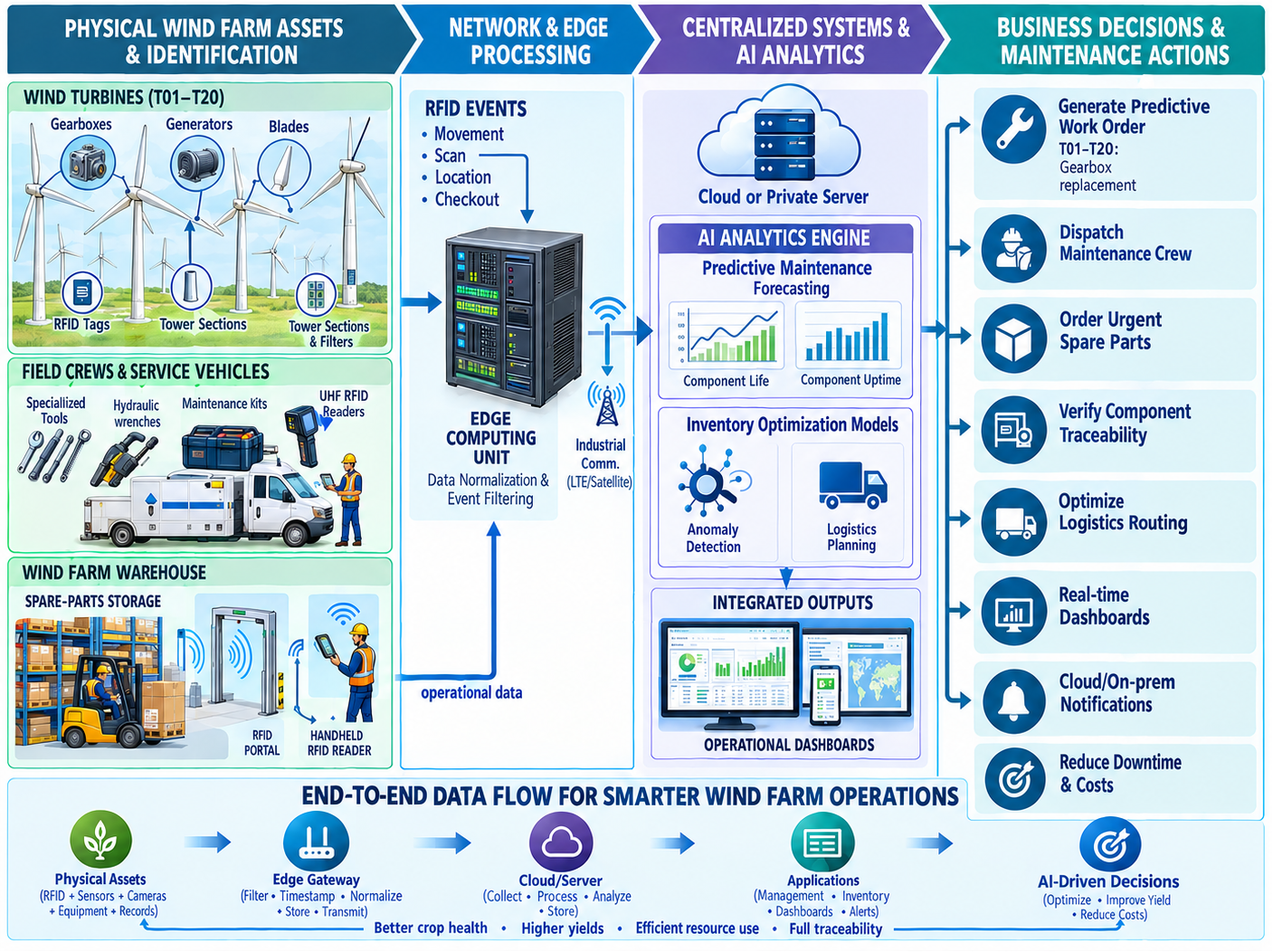
This comprehensive enterprise infographic illustrates the end-to-end data flow for an AI-enabled RFID asset tracking system in a wind farm. It tracks physical components and tools from turbines, warehouses, and maintenance vehicles via various RFID readers and edge processing into a central AI analytics engine. The system then generates predictive maintenance forecasting, inventory optimization, and automated work orders to drive faster business decisions and improve fleet reliability.
Wind Farm Operational Challenges Addressed by AI and RFID
Wind farm asset management has several characteristics that make physical asset visibility difficult. Turbine sites may be remote, maintenance work can involve large quantities of specialized equipment, and field activities often depend on precise coordination between warehouses, technicians, transportation providers, and maintenance planners.
Distributed Assets and Remote Locations
A component may be stored at a central warehouse while its destination is a remote turbine several hours away. Manual tracking can create gaps between warehouse records and field reality.
RFID event capture provides additional evidence of physical movement. AI can use these events to identify assets that appear stationary when they should be moving toward an upcoming maintenance activity.
High-Value and Mission-Critical Components
Major turbine components can represent substantial capital value and may have long procurement or repair lead times. Losing visibility into a gearbox, generator, converter, or specialized replacement assembly can create significant operational consequences.
AI-assisted traceability helps distinguish ordinary inventory movement from exceptions requiring human investigation.
Maintenance Coordination
Wind turbine maintenance depends on coordinating technicians, tools, parts, transportation, permits, work orders, inspection requirements, and site access. RFID provides physical status information that can complement maintenance-management records.
A more complete operational picture can help planners determine whether the physical resources required for a work order are actually ready.
Manual Inventory and Tool Checks
Manual counting remains practical for some low-volume or specialized environments, but repeated counting becomes burdensome when equipment moves frequently between locations. RFID can automate selected identification events, allowing personnel to focus on exceptions and maintenance activities.
Harsh and Variable Operating Conditions
Wind farm equipment may be exposed to rain, dust, temperature variation, vibration, electromagnetic interference, and outdoor environmental conditions. RFID tag selection and reader placement therefore require environmental and application testing rather than assuming that a standard tag will perform equally well everywhere.
Metal turbine components can also affect RF performance. Large metallic surfaces, liquids, composite structures, cable arrangements, and confined service areas may change read performance. A site survey and representative tag testing should be performed before large-scale deployment.
GAO’s RFID and IoT product selection can be evaluated against the physical characteristics of the target wind farm environment, including asset materials, required read distance, installation location, operating temperature, enclosure requirements, and expected reader interaction.
From RFID Events to AI-Driven Wind Farm Decisions
A practical AI-enabled wind farm solution should connect the physical movement of assets with the operational systems used by maintenance and supply-chain teams.
Physical Data Acquisition
The process begins when RFID-tagged assets interact with fixed or handheld readers. Depending on the use case, readers may be installed at warehouse receiving points, tool rooms, staging areas, vehicle loading points, maintenance facilities, or controlled access locations.
The captured information can include:
- RFID tag identifier
- Reader identifier
- Timestamp
- Detection location
- Direction or movement event where supported
- Asset identifier
- Work-order association
- Personnel or crew association where appropriate
- Equipment status
Communication and Edge Processing
Reader events are transferred through the wind farm’s available communications infrastructure. Ethernet, Wi-Fi, cellular connectivity, private wireless networks, or other suitable communications methods may be used depending on site conditions.
Edge processing can filter duplicate reads, normalize events, apply business rules, and temporarily retain data when connectivity to a central system is unavailable.
This is particularly relevant to remote wind farms where continuous wide-area connectivity cannot always be assumed.
Middleware and Data Normalization
RFID middleware converts raw reader observations into operational events such as:
- Asset received
- Asset moved
- Tool issued
- Tool returned
- Maintenance kit verified
- Component staged
- Component dispatched
- Unexpected movement detected
Event normalization is important because AI models should not have to interpret every raw RF observation independently. A structured event layer provides cleaner input for analytics and integration.
AI Analysis and Decision Support
The normalized events can be combined with CMMS, enterprise asset management, inventory, procurement, maintenance, logistics, and turbine operational data.
AI can then evaluate relationships such as:
RFID asset event + work order + maintenance schedule + inventory status + historical usage = operational recommendation
For example, if a gearbox replacement is scheduled, the system can compare the work-order requirements with the physical location and readiness of the gearbox, lifting equipment, tools, and associated spare parts.
Business Action
The final stage is an operational response rather than simply another dashboard notification. Depending on the workflow, the system can generate an exception, notify a planner, update inventory status, create a task, recommend replenishment, or request verification by a technician.
This closed-loop approach makes AI useful because the output is connected to an actual wind farm decision.
Engineering Considerations for Wind Farm RFID Deployment
Successful deployment requires more than attaching RFID tags to equipment. Engineers should evaluate the physical environment, asset materials, reader coverage, communications, software integration, data quality, cybersecurity, and operational procedures together.
Important design questions include:
- Which turbine components require serialized identification?
- Which tools and service equipment need automated movement tracking?
- Which assets require long-range UHF RFID rather than localized HF or LF identification?
- Where should fixed readers be installed?
- Which workflows require handheld RFID readers?
- How will metal components affect tag performance?
- How will outdoor environmental exposure affect tag durability?
- What happens when network connectivity is interrupted?
- Which RFID events should be retained for audit and maintenance history?
- How will RFID identifiers map to existing asset and inventory IDs?
- Which AI decisions require human approval?
- How will false detections and missing reads be handled?
- How will RFID and AI data be protected from unauthorized access?
A pilot should use representative turbine components, tools, storage conditions, and maintenance workflows rather than laboratory-only testing. Read performance should be measured under realistic conditions, including metallic equipment, stacked inventory, outdoor staging, vehicle loading, and technician movement.
RFID-Enabled Wind Farm Maintenance and AI Asset Tracking
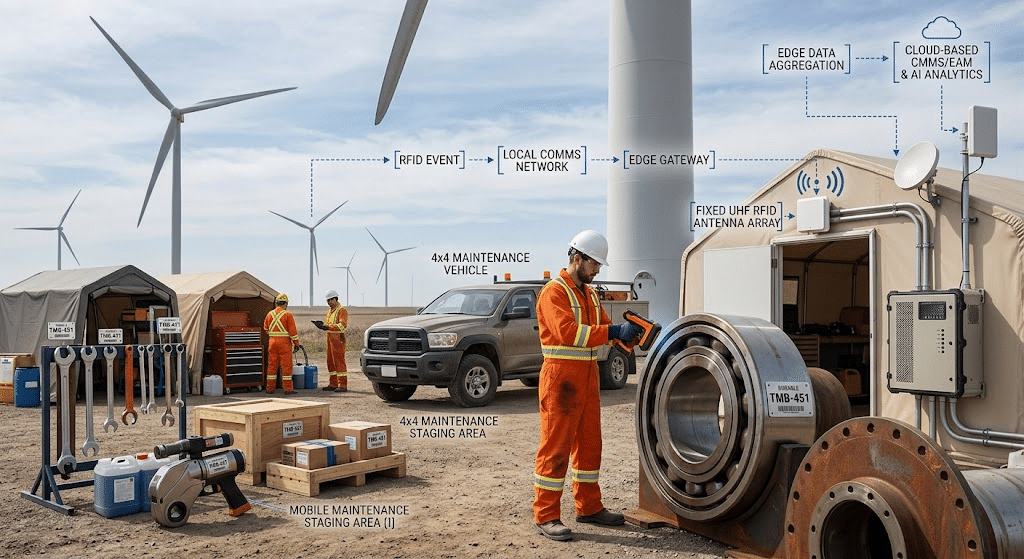
This photorealistic visual shows an active wind farm maintenance staging area featuring field technicians using rugged RFID equipment near wind turbine bases. Fixed UHF RFID readers on field structures and handheld scanners track durable tags attached to large turbine components, specialized tools, and service kits. Data flows seamlessly through an edge gateway into local communication networks, driving CMMS/EAM updates and predictive AI analytics.
RFID Hardware, AI Software, and Communications for Wind Farms
A wind farm deployment typically combines RFID identification hardware with edge computing, communications, enterprise software, and AI analytics. The appropriate configuration depends on asset material, read distance, environmental exposure, connectivity, and the operational workflow being automated.
UHF, HF, and LF RFID Selection
- UHF RFID: Generally the primary choice for wind-farm inventory, spare parts, tools, maintenance kits, warehouse movements, and staging because it supports relatively long read ranges and rapid identification of multiple tagged items.
- HF RFID: Useful where shorter-range, controlled identification is preferable, such as workstation-level verification, selected maintenance processes, or applications requiring deliberate close-range reads.
- LF RFID: Appropriate for specialized short-range identification requirements where LF characteristics provide an advantage, although it is less commonly selected for broad wind-farm inventory visibility.
- RFID tags: Tag construction should match the asset. Metal-mount tags are important for metallic turbine components and tools, while ruggedized tags may be required for outdoor equipment and repeated handling.
- Fixed RFID readers: Suitable for controlled transition points such as warehouse doors, staging entrances, and equipment issue or return areas.
- Handheld RFID readers: Useful for field technicians performing inventory searches, component verification, tool audits, and maintenance preparation.
- RFID antennas: Antenna orientation, polarization, placement, and coverage should be tested against the geometry of turbine components and storage areas.
Edge Computing and Local Processing
Edge computing can process RFID events close to the wind-farm operation before transmitting normalized information to centralized software. This reduces unnecessary data transmission and allows local workflows to continue during temporary connectivity interruptions.
Typical edge functions include:
- Filtering duplicate RFID observations
- Converting raw reads into movement events
- Applying location and timing rules
- Buffering events during network outages
- Forwarding validated events to central software
- Running selected anomaly-detection models
- Maintaining local operational logs
Cloud Version and Server Version
A Cloud Version can host RFID event processing, AI analytics, dashboards, databases, and integration services in cloud infrastructure. This model can be appropriate for wind-farm operators managing geographically distributed sites because centralized software can provide common visibility across multiple warehouses, service centers, and wind farms.
A Server Version can run on customer-managed edge servers, private data centers, regional facilities, or other privately hosted infrastructure. It can be preferable where operational data must remain within controlled infrastructure, where connectivity is limited, or where integration requirements favor locally managed systems.
The two approaches can also be combined. Local edge processing can handle immediate RFID events while selected data is synchronized with centralized cloud or private-server applications.
AI Models for Wind Farm Asset Operations
AI should be selected according to a measurable operational problem rather than added simply because RFID data is available.
Relevant methods include:
- Demand forecasting: Estimates future spare-parts and maintenance-equipment requirements.
- Anomaly detection: Identifies unusual asset movements, inventory discrepancies, or unexpected workflow events.
- Predictive analytics: Estimates future equipment requirements using maintenance history and operational schedules.
- Classification: Categorizes maintenance or inventory exceptions according to urgency.
- Time-series analysis: Correlates asset activity with maintenance schedules and turbine operating information.
- Natural-language AI: Helps maintenance personnel retrieve information from structured maintenance and asset records.
Integration with Wind Farm Software
RFID and AI should connect to the systems already responsible for maintenance and asset information rather than creating a disconnected data store.
Potential integrations include:
- Computerized maintenance management systems (CMMS)
- Enterprise asset management (EAM) software
- Enterprise resource planning (ERP) systems
- Warehouse management systems (WMS)
- Inventory management software
- Procurement systems
- Work-order management
- Field-service management
- Turbine condition-monitoring systems
- Data historians
- Maintenance scheduling applications
- Business intelligence software
GAO can supply RFID and IoT hardware that serves as the physical identification component while integration software and customer systems provide the operational context.
Cybersecurity and Data Governance for Wind Farm AI Systems
Cybersecurity should cover the complete chain from RFID readers and edge computers to enterprise applications and AI services. RFID tags themselves generally contain limited information, but the systems associated with their identifiers can expose valuable operational information.
Important controls include:
- Device authentication
- Role-based access control
- Encrypted communications
- Network segmentation
- Secure reader configuration
- Protected API endpoints
- Centralized logging
- Firmware and software update procedures
- Backup and recovery controls
- Security monitoring
- Credential management
- Data retention policies
- Audit trails for critical asset events
Wind farm operators should also distinguish between identification data and sensitive operational data. A tag identifier may become commercially or operationally significant when linked to turbine configuration, component history, maintenance schedules, or logistics information.
AI governance should include model monitoring, data-quality checks, human review for high-impact decisions, and procedures for handling incorrect or incomplete RFID observations.
Technical Capabilities and Operational Benefits for Wind Farms
Faster Asset Location and Retrieval
RFID can reduce the manual effort required to locate tools, components, and spare parts. A technician can use a handheld reader to search for tagged equipment rather than relying exclusively on warehouse records or manual inspection.
AI can further improve this process by ranking likely locations based on historical movement patterns and recent events.
Better Maintenance Readiness
Maintenance readiness depends on more than having a work order in the CMMS. The required physical resources must also be available.
An AI-enabled RFID system can compare:
Work order requirements → required parts → required tools → physical location → readiness status
This provides planners with a more complete view before a maintenance crew travels to a turbine.
Improved Spare-Parts Forecasting
Historical RFID movements can reveal actual consumption and transfer patterns. AI can combine these observations with planned maintenance, historical failure rates, lead times, and inventory levels.
The resulting forecast can help determine whether a regional warehouse should replenish a particular component before an upcoming maintenance campaign.
Stronger Component Traceability
Serialized RFID identification creates a persistent connection between a physical component and its digital record. This can improve traceability across receiving, storage, installation, removal, repair, refurbishment, and redeployment.
Such traceability is particularly valuable for major components that may be repaired and returned to service rather than permanently discarded.
Reduced Inventory Discrepancies
RFID can capture movement automatically at selected control points. AI can compare expected movement with observed movement and identify exceptions.
For example, an item recorded as available in a warehouse system but repeatedly detected outside its expected storage area can be flagged for investigation.
Improved Tool Accountability
Specialized tools can be expensive, calibrated, difficult to replace, or essential to a particular maintenance task. RFID-based check-in and check-out records can improve accountability across technicians, vehicles, warehouses, and service locations.
AI can identify unusual utilization patterns and recurring shortages that may not be obvious from individual transactions.
Scalability Across Wind Farms
A standardized RFID identification approach can be extended from a pilot warehouse or service center to multiple wind farms. Scalability depends on consistent asset identifiers, reader configurations, integration interfaces, tag standards, data models, and operational procedures.
Scaling without standardization can create isolated RFID deployments that produce inconsistent data. A controlled deployment model is therefore preferable.
Wind Farm KPIs for AI-Enabled RFID
Technology deployment should be measured through operational outcomes rather than RFID read counts alone.
Useful KPIs include:
- Asset location accuracy
- RFID read success rate
- Inventory record accuracy
- Tool recovery time
- Average asset search time
- Maintenance kit completeness
- Work-order readiness rate
- Spare-parts stockout rate
- Emergency parts fulfillment time
- Inventory carrying cost
- Component traceability completeness
- Tool utilization
- Unreturned equipment incidents
- Maintenance preparation time
- Maintenance-related logistics delays
- RFID exception rate
- Mean time to locate critical equipment
- Inventory reconciliation time
- Maintenance schedule adherence
- Percentage of assets with complete digital histories
A pilot should establish baseline measurements before RFID deployment. Improvement should then be measured against those baseline values.
Practical Wind Farm Deployment Lifecycle
Operational Assessment
Start by identifying the most expensive or disruptive visibility problems. A wind farm may gain more value from tracking critical maintenance tools and major spare parts than from attempting to RFID-label every low-value consumable.
Map:
- Turbine maintenance workflows
- Warehouse processes
- Component movements
- Tool issue and return
- Maintenance-kit preparation
- Field logistics
- Asset ownership
- Existing software
- Communications coverage
- Security requirements
Use-Case Prioritization
High-value initial use cases typically have clear operational ownership and measurable outcomes.
Good candidates include:
- Critical spare-parts tracking
- Maintenance-tool accountability
- Maintenance-kit verification
- Warehouse inventory accuracy
- Major component traceability
- Field equipment tracking
RFID Site Survey and Tag Testing
Test representative tags on the actual materials being tracked. Metal components require special attention because they can detune ordinary RFID tags or change RF propagation.
Testing should consider:
- Asset material
- Tag mounting position
- Read distance
- Reader orientation
- Antenna placement
- Multiple-tag environments
- Vehicle loading
- Outdoor conditions
- Temperature and moisture
- Human interaction
- Interference
- Read-zone boundaries
System Integration and Commissioning
Map RFID identifiers to existing asset, inventory, and work-order identifiers. Configure event rules and integration interfaces before introducing AI models.
Commissioning should verify the entire chain:
Tag → Reader → Network → Edge processing → Middleware → Database → Business system → AI analysis → User action
Testing only the RFID reader is insufficient because an operational failure may occur later in the data pipeline.
AI Model Validation
AI outputs should be validated against known operational conditions. False positives can cause unnecessary work, while false negatives may hide important exceptions.
Wind farm operators should therefore establish:
- Model performance thresholds
- Human approval requirements
- Exception-handling procedures
- Data-quality rules
- Model retraining criteria
- Audit requirements
Optimization and Scale-Up
After the pilot demonstrates measurable value, the deployment can expand to additional warehouses, service centers, turbine sites, and asset categories.
Scaling should preserve common naming conventions, tag identification rules, integration interfaces, security controls, and KPI definitions.
Standards, Safety, and Regulatory Considerations
Wind-farm AI and RFID deployments should be evaluated alongside applicable electrical, wireless, occupational-safety, cybersecurity, environmental, and data-management requirements.
Relevant standards and regulatory areas may include:
- OSHA requirements applicable to worker safety and maintenance activities in the United States
- FCC requirements governing applicable RFID radio-frequency equipment in the United States
- Industry Canada/ISED requirements applicable to radio equipment in Canada
- IEC 61400 series for wind energy generation systems
- IEC 62443 concepts where industrial automation and control cybersecurity requirements are relevant
- ISO/IEC 27001 practices for information-security management where applicable
- ISO/IEC 18000-63 for UHF RFID air-interface applications
- Applicable electrical, electromagnetic compatibility, equipment, and environmental requirements based on the deployment location
Exact compliance obligations depend on jurisdiction, equipment configuration, installation environment, and the functions performed by the system. Engineering teams should verify current requirements before deployment.
Why AI-Enabled RFID Matters for Wind Farm Operations
The principal value of this approach is not the RFID tag itself. The value comes from connecting physical asset events to operational decisions.
A conventional inventory record may state that a component is available. RFID can provide evidence that the component was physically received, moved, staged, or dispatched. AI can then compare those events against planned maintenance and identify whether the component is actually ready for use.
This creates several important improvements:
- Better visibility: Physical asset movements become measurable events.
- Faster decisions: AI prioritizes exceptions rather than forcing planners to inspect every transaction.
- Higher maintenance readiness: Required parts and tools can be verified before field mobilization.
- Improved traceability: Components can retain digital histories across their service lives.
- Lower administrative effort: Selected manual counting and checking activities can be automated.
- More predictable inventory: AI can use consumption and maintenance information to forecast requirements.
- Improved scalability: Standardized identification and event processing can support multiple wind-farm locations.
- Stronger operational control: Exception-based workflows help teams focus attention
Implementing AI and RFID for Wind Farms with GAO
A successful deployment should begin with the operational problem rather than the technology. Wind farm operators should identify which assets create the greatest maintenance, inventory, logistics, or traceability burden and then determine whether RFID-generated events can provide useful additional information.
GAO has supplied RFID, BLE, and IoT hardware products and systems to organizations across the United States and Canada, including Fortune 500 companies, research organizations, universities, and government agencies. Headquartered in New York City and Toronto, Canada, GAO is recognized among leading B2B and B2G suppliers of RFID and BLE technologies.
GAO Group, comprising GAO and its sister companies GAO Research and GAO Tek, has invested substantially in research and development for three decades. Its quality-assurance processes and remote or onsite technical support can assist organizations evaluating RFID hardware, system requirements, deployment conditions, and integration considerations.
For wind farm operators, the practical objective is to build a reliable connection between physical equipment and operational decisions. GAO’s RFID and IoT technologies can serve as part of that connection while customer-maintained CMMS, EAM, ERP, inventory, maintenance, and AI systems provide the broader operational context.
Building the Future of Industrial AI and IoT with Aperture Venture Studio and GAO RFID Inc.
For wind farms, AI can turn RFID-generated asset events into actionable intelligence for maintenance, inventory, logistics, and component traceability. For more than three decades, GAO Group has invested heavily in industrial RFID, BLE, and IoT R&D. As generative AI became increasingly useful for industrial applications, we expanded our work in AI and IoT and founded Aperture Venture Studio to develop AI and IoT solutions relevant to operational domains such as wind-farm asset management.
Aperture brings together technical experts, executives, investors, and leading companies, while our summits advance discussion around AI and IoT. We welcome advisors, employees, investors, and customers to join us.