
AI and RFID for Aircraft MRO
How AI-Powered RFID is Transforming Modern Aircraft MRO Operations
Aircraft maintenance, repair, and overhaul (Aircraft MRO) organizations operate under strict airworthiness regulations, demanding maintenance schedules, extensive component traceability, and rigorous documentation. Artificial intelligence combined with RFID enables maintenance organizations to automate asset identification, improve maintenance planning, reduce turnaround time, strengthen regulatory compliance, and increase fleet availability.
Within Aircraft MRO, RFID serves as the trusted identification layer while artificial intelligence converts operational data into maintenance intelligence. Together they enable predictive maintenance scheduling, intelligent inventory management, automated tool accountability, component lifecycle management, maintenance workflow optimization, and continuous operational visibility.
Modern commercial aviation, military aviation, business aviation, cargo operators, and independent MRO providers increasingly deploy AI-enabled RFID solutions to improve maintenance quality while reducing aircraft ground time. Drawing on decades of experience supplying industrial RFID technologies, GAO has helped organizations deploy reliable identification and tracking systems supporting complex maintenance environments requiring high accuracy, durability, and long operational life.
Understanding AI-Enabled RFID for Aircraft MRO
Aircraft MRO involves thousands of serialized parts, calibrated tools, maintenance documents, consumables, repair stations, technicians, inspection procedures, and regulatory records that must remain synchronized throughout every maintenance event. Manual identification methods introduce delays, transcription errors, misplaced assets, and incomplete maintenance histories.
RFID provides automatic identification of aircraft components, tools, repair kits, ground support equipment, calibration assets, and maintenance inventory through LF RFID, HF RFID, and UHF RFID technologies selected according to operating requirements.
Artificial intelligence analyzes RFID-generated operational data together with maintenance histories, aircraft health monitoring information, technician activities, environmental conditions, historical failures, engineering records, and enterprise maintenance databases to support informed operational decisions.
Rather than simply locating assets, AI identifies maintenance patterns, predicts component shortages, recommends maintenance sequencing, prioritizes inspections, detects operational anomalies, forecasts turnaround delays, and improves resource allocation across maintenance facilities.
This combination forms an important part of Industrial AI and AIoT, where connected RFID devices, intelligent software, edge computing, industrial sensors, maintenance systems, and enterprise applications continuously exchange information to optimize Aircraft MRO operations.
Why AI-Enabled RFID Matters for Aircraft MRO
Aircraft MRO organizations manage extremely valuable aircraft while operating under intense pressure to minimize Aircraft on Ground (AOG) events, satisfy regulatory authorities, maintain safety standards, and maximize fleet utilization.
Several operational realities make AI-enabled RFID particularly valuable.
- Complex maintenance packages involving thousands of serialized components
- Strict FAA, EASA, Transport Canada, and military maintenance documentation requirements
- Continuous configuration management throughout an aircraft’s service life
- Frequent movement of tools, engines, landing gear, avionics, and line replaceable units between maintenance zones
- High-value inventory distributed across multiple maintenance hangars
- Calibration control for specialized maintenance equipment
- Traceability requirements for life-limited parts
- Tight maintenance windows with limited aircraft downtime
AI continuously evaluates these operational conditions while RFID automatically captures asset movement without requiring manual barcode scanning or handwritten documentation.
AI-Enabled RFID Solution for Aircraft MRO with Predictive Maintenance and Real-Time Asset Tracking
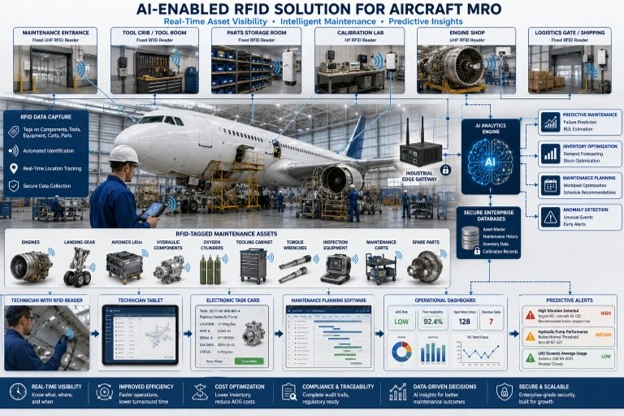
Primary Aircraft MRO Applications of AI-Enabled RFID
Artificial intelligence supported by RFID improves nearly every operational phase of aircraft maintenance.
Heavy Maintenance Checks
Scheduled C-checks and D-checks involve thousands of maintenance tasks spanning structural inspections, corrosion control, avionics servicing, cabin refurbishment, and systems testing. AI prioritizes maintenance activities using historical repair trends while RFID automatically verifies component movement throughout the maintenance process.
Line Maintenance
Rapid turnaround during overnight maintenance depends upon accurate component availability and technician coordination. RFID confirms required parts while AI predicts maintenance bottlenecks before they delay aircraft release.
Engine Maintenance
Aircraft engines contain thousands of serialized parts requiring complete lifecycle traceability. AI analyzes overhaul histories while RFID records component movement through cleaning, inspection, repair, balancing, assembly, and certification.
Landing Gear Overhaul
Landing gear maintenance requires extensive disassembly, inspection, nondestructive testing, replacement of life-limited parts, and certification. RFID preserves complete maintenance genealogy while AI recommends inspection priorities based upon previous findings.
Tool Tracking
Lost maintenance tools create major Foreign Object Debris (FOD) risks. RFID continuously monitors tool accountability while AI identifies abnormal tool usage patterns and missing equipment before aircraft release.
Calibration Management
Aircraft maintenance depends upon calibrated torque tools, pressure gauges, electrical test equipment, and precision measurement devices. AI forecasts calibration schedules while RFID automatically records equipment movement and usage.
Spare Parts Management
Aircraft parts inventory represents significant capital investment. AI predicts inventory demand using maintenance schedules while RFID provides real-time inventory visibility across warehouses and maintenance facilities.
Regulatory Compliance
Maintenance organizations must maintain complete maintenance records supporting FAA Part 145, EASA Part 145, military maintenance regulations, and customer quality requirements. RFID automates identification while AI validates documentation completeness before aircraft release.
Operational Challenges Solved by AI-Driven RFID
Traditional Aircraft MRO operations continue to face operational limitations despite digital maintenance systems.
- Manual recording of serialized component movements
- Delayed aircraft status updates
- Missing maintenance tools
- Inventory shortages during scheduled maintenance
- Excess spare inventory occupying warehouse space
- Paper-based maintenance verification
- Incomplete maintenance genealogy
- Human transcription errors
- Difficulty locating specialized equipment
- Unexpected maintenance delays
- Poor visibility across multiple maintenance facilities
- Limited prediction of maintenance workload
AI transforms these operational challenges by continuously learning from maintenance histories, technician workflows, aircraft utilization patterns, logistics information, environmental conditions, and RFID event streams.
Rather than reacting after delays occur, maintenance planners receive recommendations before operational disruptions affect aircraft availability.
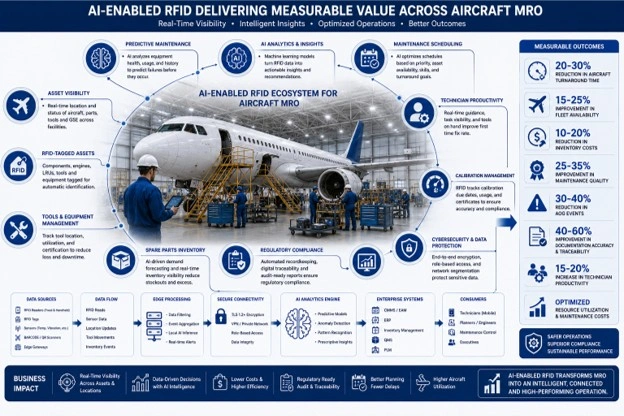
Organizations deploying intelligent maintenance systems often observe measurable improvements in maintenance scheduling efficiency, inventory utilization, technician productivity, compliance documentation quality, and aircraft turnaround performance.
GAO supports organizations implementing RFID hardware and identification systems that provide the reliable operational data necessary for AI software to generate accurate maintenance insights.
AI-Enabled RFID Aircraft MRO Workflow from Maintenance Induction to Fleet Analytics
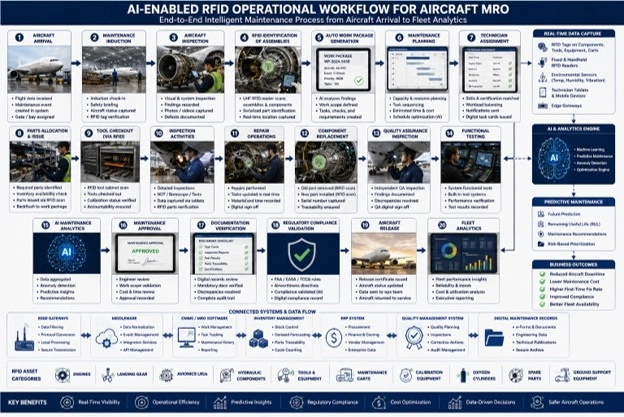
Operational Workflow from RFID Data Capture to AI-Driven Maintenance Decisions
Successful AI-enabled Aircraft MRO begins with high-quality operational data collected throughout maintenance facilities.
RFID tags attached to serialized aircraft components, engines, avionics modules, landing gear assemblies, composite structures, repair kits, maintenance tooling, calibration equipment, mobile maintenance carts, warehouse inventory, and ground support equipment automatically identify assets as they move throughout maintenance operations.
Fixed RFID readers installed at hangar entrances, component receiving stations, bonded stores, engine shops, calibration laboratories, paint facilities, logistics areas, and maintenance workstations continuously capture asset movement without interrupting technician workflows.
Handheld RFID readers supplement automated infrastructure during inspections, incoming receiving, outgoing shipment verification, inventory cycle counting, and field maintenance activities.
Edge computing devices validate RFID reads, remove duplicate events, synchronize timestamps, verify asset identities, and securely forward relevant maintenance events to intelligent software for further processing.
RFID Technologies, AI Components, and Deployment Infrastructure for Aircraft MRO
Reliable AI-driven Aircraft MRO depends on selecting the appropriate RFID technology, intelligent software, secure communications, and computing infrastructure that collectively support maintenance execution, regulatory compliance, and long-term fleet management. Rather than deploying a single identification technology throughout an entire maintenance organization, successful implementations typically combine multiple RFID frequencies according to maintenance tasks, component characteristics, environmental conditions, and reading requirements.
UHF RFID for Aircraft Maintenance Operations
Ultra High Frequency (UHF) RFID is widely deployed throughout aircraft maintenance facilities because of its long read range, rapid identification capability, and ability to read multiple tagged assets simultaneously.
Typical Aircraft MRO applications include:
- Aircraft spare parts inventory
- Tool crib management
- Warehouse automation
- Aircraft component logistics
- Maintenance cart tracking
- Ground support equipment monitoring
- Engine transportation containers
- Parts receiving and shipping
- Mobile maintenance assets
- Aircraft configuration verification
Passive UHF RFID tags enable maintenance personnel to identify hundreds of components during inventory audits without requiring direct line of sight. AI software analyzes these continuous inventory updates to predict shortages before scheduled maintenance events begin.
HF RFID for Controlled Maintenance Processes
High Frequency (HF) RFID provides shorter reading distances while offering excellent performance where controlled identification is required.
Typical applications include:
- Technician identification
- Maintenance authorization
- Electronic work instruction access
- Secure document management
- Calibration records
- Inspection checkpoint verification
- Maintenance history retrieval
- Controlled repair stations
HF RFID minimizes unintended tag reads, making it well suited for maintenance workstations where only one component or technician credential should be identified at a time.
LF RFID for Specialized Aircraft Assets
Low Frequency (LF) RFID remains valuable for specialized maintenance environments where metal interference, liquids, or harsh operating conditions may affect higher-frequency systems.
Representative applications include:
- Specialized maintenance tooling
- Fluid service equipment
- Hydraulic servicing equipment
- Environmental testing equipment
- Harsh maintenance environments
- Rugged maintenance assets
Although LF RFID provides shorter read distances and lower data rates, it offers dependable identification for specific maintenance scenarios requiring high reliability under challenging physical conditions.
Hardware, Software, AI Models, and Supporting Infrastructure
Successful Aircraft MRO solutions combine industrial-grade identification hardware with intelligent maintenance software that continuously improves maintenance planning and operational decision-making.
RFID Hardware
Typical hardware includes:
- Passive UHF RFID tags
- On-metal RFID tags
- High-temperature RFID tags
- Engine-compatible RFID tags
- Handheld RFID readers
- Fixed industrial RFID readers
- RFID antennas
- Smart cabinets
- Tool tracking stations
- Mobile RFID terminals
- Industrial edge gateways
- Environmental sensors
- Barcode scanners for hybrid identification
- Rugged maintenance tablets
- Industrial workstations
Aircraft maintenance facilities require RFID hardware certified for demanding environments involving vibration, hydraulic fluids, aviation lubricants, cleaning chemicals, metallic structures, temperature fluctuations, and continuous operational use.
Artificial Intelligence Software
Artificial intelligence transforms operational RFID events into actionable maintenance intelligence using multiple analytical methods.
Common AI capabilities include:
- Predictive maintenance models
- Remaining useful life estimation
- Failure prediction
- Inventory demand forecasting
- Maintenance workload forecasting
- Workforce optimization
- Maintenance scheduling optimization
- Tool utilization analytics
- Spare parts optimization
- Aircraft turnaround prediction
- Compliance verification
- Maintenance anomaly detection
- Intelligent recommendation systems
- Root cause analysis
Instead of replacing maintenance engineers, these models support engineering teams by identifying operational patterns that would otherwise remain hidden within millions of maintenance records.
Enterprise Software Integration
Aircraft MRO organizations rarely operate isolated maintenance software. AI-enabled RFID solutions exchange information with multiple operational systems.
Common integrations include:
- Computerized Maintenance Management Systems (CMMS)
- Maintenance, Repair and Overhaul (MRO) software
- Enterprise Resource Planning (ERP)
- Enterprise Asset Management (EAM)
- Warehouse Management Systems (WMS)
- Product Lifecycle Management (PLM)
- Manufacturing Execution Systems (MES) for component repair shops
- Quality Management Systems (QMS)
- Digital Technical Publications
- Engineering document management systems
- Flight operations systems
- Procurement systems
- Supply chain management software
- Business intelligence dashboards
These integrations allow maintenance planners to work from a unified operational view rather than switching between disconnected software applications.
Organizations implementing RFID hardware from GAO frequently integrate identification systems with existing maintenance software to minimize operational disruption while improving data quality across maintenance workflows.
AI-Enabled RFID Information Flow for Aircraft MRO Software Integration and Predictive Maintenance
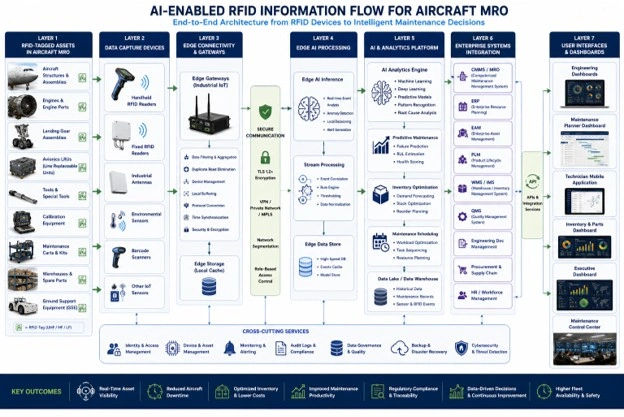
Communication Infrastructure and Security
Reliable Aircraft MRO depends upon secure and uninterrupted information exchange between maintenance facilities, warehouses, engineering departments, and operational management.
Typical communication technologies include:
- Ethernet
- Industrial Wi-Fi
- Secure VPN connections
- Private cellular networks
- Fiber backbone infrastructure
- HTTPS
- REST APIs
- OPC UA where maintenance equipment interfaces are required
- MQTT for lightweight event messaging
- TCP/IP
- TLS encryption
Security mechanisms commonly include:
- Role-based access control
- Multi-factor authentication
- Digital certificates
- Device authentication
- Secure firmware updates
- Network segmentation
- Audit logging
- Data encryption during transmission and storage
- Security Information and Event Management (SIEM)
- Continuous vulnerability monitoring
Maintenance records form part of an aircraft’s continuing airworthiness documentation. Protecting these records against unauthorized modification is essential for both operational safety and regulatory compliance.
Cloud Version and Server Version Deployment Models
Aircraft MRO organizations can deploy AI-enabled RFID software using either cloud-hosted services or privately managed server deployments. The appropriate approach depends on fleet size, cybersecurity policies, regulatory obligations, operational geography, and existing IT infrastructure.
Cloud Version
Cloud-hosted deployment centralizes maintenance intelligence across multiple maintenance bases, line stations, warehouses, and engineering offices. RFID readers transmit validated operational events through secure gateways into cloud-hosted AI software, where predictive analytics, inventory optimization, maintenance dashboards, and reporting services are continuously updated.
Cloud deployment is often appropriate for:
- Airlines operating multiple maintenance locations
- Third-party MRO providers serving numerous customers
- Distributed spare parts warehouses
- Remote line maintenance stations
- Organizations requiring centralized fleet visibility
- Rapid software updates with minimal local IT administration
Advantages include scalable computing resources, simplified software maintenance, centralized reporting, and improved collaboration between geographically separated maintenance teams.
Server Version
Server deployment places the AI-enabled RFID software on customer-managed infrastructure, including edge servers, private data centers, maintenance facility servers, or other privately hosted enterprise environments. Operational data remains under the organization’s direct control while supporting integration with existing maintenance software and security policies.
Server deployment is often selected for:
- Defense aviation maintenance facilities
- Military depots
- Organizations with strict cybersecurity requirements
- Facilities operating isolated or restricted networks
- Maintenance organizations with extensive legacy software
- Operations requiring local processing during network interruptions
This approach offers greater control over data governance, integration, and system customization while supporting high availability within secure maintenance environments.
Many large Aircraft MRO organizations adopt a hybrid strategy in which edge servers process time-critical RFID events locally while selected operational data is synchronized with centralized cloud systems for fleet-wide analytics and executive reporting.
Cloud vs Private Server Deployment Models for AI-Enabled RFID in Aircraft MRO
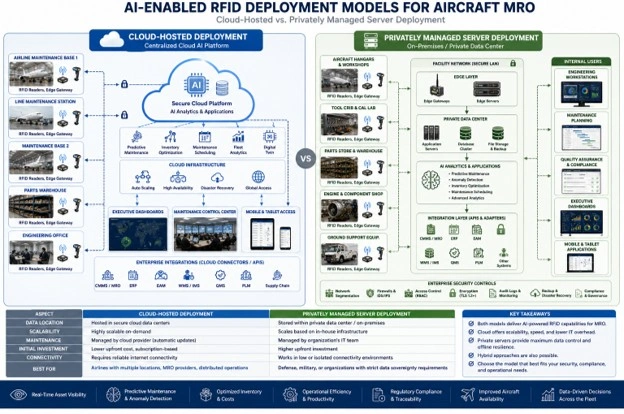
Technical Capabilities and Business Value of AI-Enabled RFID for Aircraft MRO
Aircraft MRO organizations derive the greatest value when RFID-generated operational data is continuously analyzed by artificial intelligence to improve maintenance execution, engineering decisions, inventory management, and regulatory compliance. Rather than functioning as an isolated identification system, RFID becomes a foundational data source that enables intelligent maintenance operations across the entire aircraft lifecycle.
Intelligent Asset Visibility
AI continuously analyzes RFID events to provide real-time visibility of aircraft components, serialized parts, maintenance tooling, calibration equipment, and ground support assets throughout hangars, workshops, warehouses, and repair stations.
Benefits include:
- Reduced time spent locating critical maintenance assets
- Improved utilization of specialized tooling
- Faster component retrieval during scheduled maintenance
- Better coordination across multiple maintenance facilities
- Accurate visibility of work-in-progress assemblies
Predictive Maintenance Planning
Historical maintenance records, RFID movement data, inspection findings, reliability reports, and aircraft utilization information enable AI models to forecast maintenance requirements before failures disrupt operations.
Typical improvements include:
- Earlier identification of high-risk components
- Optimized maintenance intervals
- Better planning for heavy maintenance visits
- Reduced Aircraft on Ground (AOG) events
- Improved fleet availability
Smarter Spare Parts Management
Aircraft maintenance depends on thousands of high-value spare parts with varying lead times and certification requirements. AI evaluates RFID inventory data together with maintenance schedules and historical consumption to improve inventory planning.
Expected outcomes include:
- Lower excess inventory
- Reduced emergency procurement
- Improved inventory accuracy
- Higher parts availability
- Better warehouse utilization
Maintenance Workflow Optimization
AI evaluates technician workloads, task completion history, equipment availability, and maintenance priorities to recommend more efficient work sequencing.
Operational advantages include:
- Shorter maintenance turnaround time
- Improved technician productivity
- Reduced waiting time for tools and components
- Better utilization of maintenance bays
- Faster release of aircraft to service
Enhanced Regulatory Compliance
Every maintenance action performed on an aircraft requires complete documentation to satisfy aviation authorities and customer quality requirements.
RFID automatically records asset identity, while AI validates maintenance documentation for completeness, identifies missing records, and flags potential compliance issues before aircraft release.
Organizations benefit from:
- Improved maintenance traceability
- More complete audit trails
- Reduced documentation errors
- Faster regulatory inspections
- Higher confidence in continuing airworthiness records
Data-Driven Engineering Decisions
Maintenance engineering teams can analyze long-term operational trends generated from RFID data to identify recurring failures, component reliability issues, supplier performance, and opportunities for maintenance program improvements.
Engineering teams gain:
- Better reliability analysis
- Improved maintenance planning
- Enhanced component lifecycle management
- More informed engineering change decisions
- Stronger continuous improvement initiatives
Business Benefits of AI-Enabled RFID for Aircraft MRO: Predictive Maintenance, Asset Visibility, and Operational Performance
Engineering Best Practices for Successful Aircraft MRO Deployment
Organizations planning AI-enabled RFID implementations achieve the best long-term results when technology deployment aligns with established maintenance processes, regulatory obligations, and operational objectives.
Recommended engineering practices include:
- Perform comprehensive maintenance workflow assessments before selecting RFID hardware.
- Choose RFID tag types based on aircraft materials, environmental exposure, temperature, and read-range requirements.
- Validate read performance around metallic aircraft structures, composite materials, engine nacelles, and maintenance tooling.
- Establish standardized asset identification policies for serialized components and life-limited parts.
- Integrate RFID event data with CMMS, ERP, EAM, QMS, and inventory software to eliminate duplicate manual data entry.
- Deploy edge processing to filter duplicate reads and reduce unnecessary network traffic.
- Apply role-based access control and encryption to protect maintenance records and operational data.
- Develop data governance procedures covering asset master data, maintenance histories, and regulatory documentation.
- Train technicians, inspectors, planners, and warehouse personnel on updated maintenance workflows.
- Monitor system performance using operational KPIs and continuously refine AI models with new maintenance data.
GAO has supported organizations by supplying industrial RFID readers, tags, antennas, and related identification systems that integrate with existing maintenance environments while meeting demanding reliability and operational requirements.
Key Performance Indicators for AI-Enabled Aircraft MRO
Organizations commonly evaluate implementation success using operational and business metrics such as:
- Aircraft Turnaround Time (TAT)
- Aircraft on Ground (AOG) frequency
- Fleet availability
- Maintenance schedule adherence
- Mean Time to Repair (MTTR)
- Tool accountability rate
- Spare parts inventory accuracy
- Inventory carrying cost
- Component traceability completeness
- Maintenance documentation accuracy
- Calibration compliance rate
- Technician productivity
- Warehouse picking efficiency
- Regulatory audit findings
- First-pass maintenance quality
- Repeat maintenance events
- Asset utilization
- Engineering change response time
Tracking these indicators enables maintenance managers to quantify operational improvements and identify additional optimization opportunities.
Conclusion
AI-enabled RFID is reshaping Aircraft MRO by transforming routine asset identification into actionable operational intelligence. Through continuous visibility of aircraft components, maintenance tooling, inventory, and engineering workflows, maintenance organizations can improve planning accuracy, strengthen regulatory compliance, reduce aircraft downtime, and support safer maintenance operations.
Successful implementation depends on selecting appropriate RFID technologies, integrating with existing maintenance software, deploying secure communication infrastructure, and applying AI models that reflect real maintenance practices rather than generic analytics.
For more than three decades, GAO has supplied RFID, BLE, and IoT hardware products and systems to organizations throughout North America. Headquartered in New York City and Toronto, Canada, GAO is recognized among the world’s leading B2B and B2G suppliers of RFID and BLE technologies. Backed by extensive research and development, stringent quality assurance, and experienced technical support, we help customers deploy reliable identification solutions that serve as the foundation for advanced AI-driven Aircraft MRO initiatives. Contact GAO to learn how our engineering expertise and RFID technologies can support your maintenance modernization strategy.
Building the Future of Industrial AI and IoT with Aperture Venture Studio and GAO RFID Inc.
For more than three decades, GAO Group of Companies has invested extensively in research and development of industrial RFID, BLE, and IoT technologies. As generative AI has demonstrated significant value in Aircraft MRO, aerospace maintenance, and other industrial applications, we have expanded our AI and IoT initiatives and established Aperture Venture Studio to accelerate the development and adoption of advanced AI and IoT solutions across industry. Aperture has attracted leading AI and IoT experts, experienced business and operational executives, respected investors, and prominent organizations. Through Aperture Ventures Summit and TekSummit, we foster collaboration on advanced AI and IoT topics while strengthening technical communities. We welcome participation from advisors, employees, investors, and customers interested in advancing the future of intelligent industrial technologies.