
AI and RFID for Heavy Civil Construction
AI-Powered Construction Materials Management Using RFID for Modern Construction Operations
Construction materials represent one of the largest cost categories in commercial, residential, infrastructure, industrial, and civil engineering projects. Poor material visibility, delivery delays, misplaced inventory, excessive waste, unauthorized usage, and inaccurate stock records frequently result in schedule overruns and increased project costs. Artificial Intelligence combined with RFID-enabled material identification provides construction organizations with continuous visibility into the movement, storage, utilization, and lifecycle of construction materials across fabrication facilities, distribution centers, warehouses, logistics yards, and active jobsites.
AI continuously analyzes RFID-generated material movement data to identify inventory shortages, delivery bottlenecks, abnormal consumption, theft risks, procurement trends, and project execution patterns. Construction managers, procurement specialists, warehouse supervisors, estimators, project engineers, logistics coordinators, and site supervisors gain actionable intelligence that improves planning, resource allocation, and operational decision making.
For organizations managing thousands of pallets, bundles, prefabricated assemblies, steel members, concrete products, electrical equipment, HVAC components, plumbing systems, insulation materials, and structural elements, AI-assisted RFID solutions transform construction materials management from reactive inventory tracking into predictive operational intelligence. Drawing on more than three decades of industrial RFID and IoT expertise, GAO has helped organizations across North America deploy identification technologies that improve visibility, material accountability, and supply chain efficiency while supporting demanding construction environments.
Understanding AI Construction Materials Management Using RFID
Construction materials move through numerous operational stages before becoming part of completed infrastructure. Every transfer between manufacturers, suppliers, transportation providers, storage yards, fabrication shops, distribution facilities, and construction sites introduces opportunities for inventory inaccuracies, shipment discrepancies, delays, and material loss.
Rather than relying on manual barcode scanning, paper delivery tickets, or visual inspections, RFID automatically identifies tagged construction materials without requiring direct line-of-sight. AI extends this capability by interpreting millions of RFID observations, detecting operational patterns, forecasting future material requirements, and recommending corrective actions before disruptions affect project schedules.
The result is an AIoT solution where connected identification devices, readers, edge computing, enterprise software, and intelligent analytics continuously monitor material flow throughout construction operations.
Construction material categories benefiting from AI-assisted RFID include:
- Structural steel beams
- Reinforcing steel bundles
- Precast concrete components
- Cement bags and bulk materials
- Drywall panels
- Lumber packages
- Roofing materials
- HVAC assemblies
- Electrical switchgear
- Cable reels
- Copper piping
- Plastic piping
- Mechanical equipment
- Fire protection systems
- Insulation materials
- Glass panels
- Doors and windows
- Modular building assemblies
- Pre-engineered building systems
- Heavy construction equipment attachments
AI converts these identification events into operational intelligence supporting procurement planning, warehouse optimization, supplier performance evaluation, logistics coordination, installation sequencing, and project cost management.
AI-Powered Construction Materials Management Using RFID Across the Construction Supply Chain
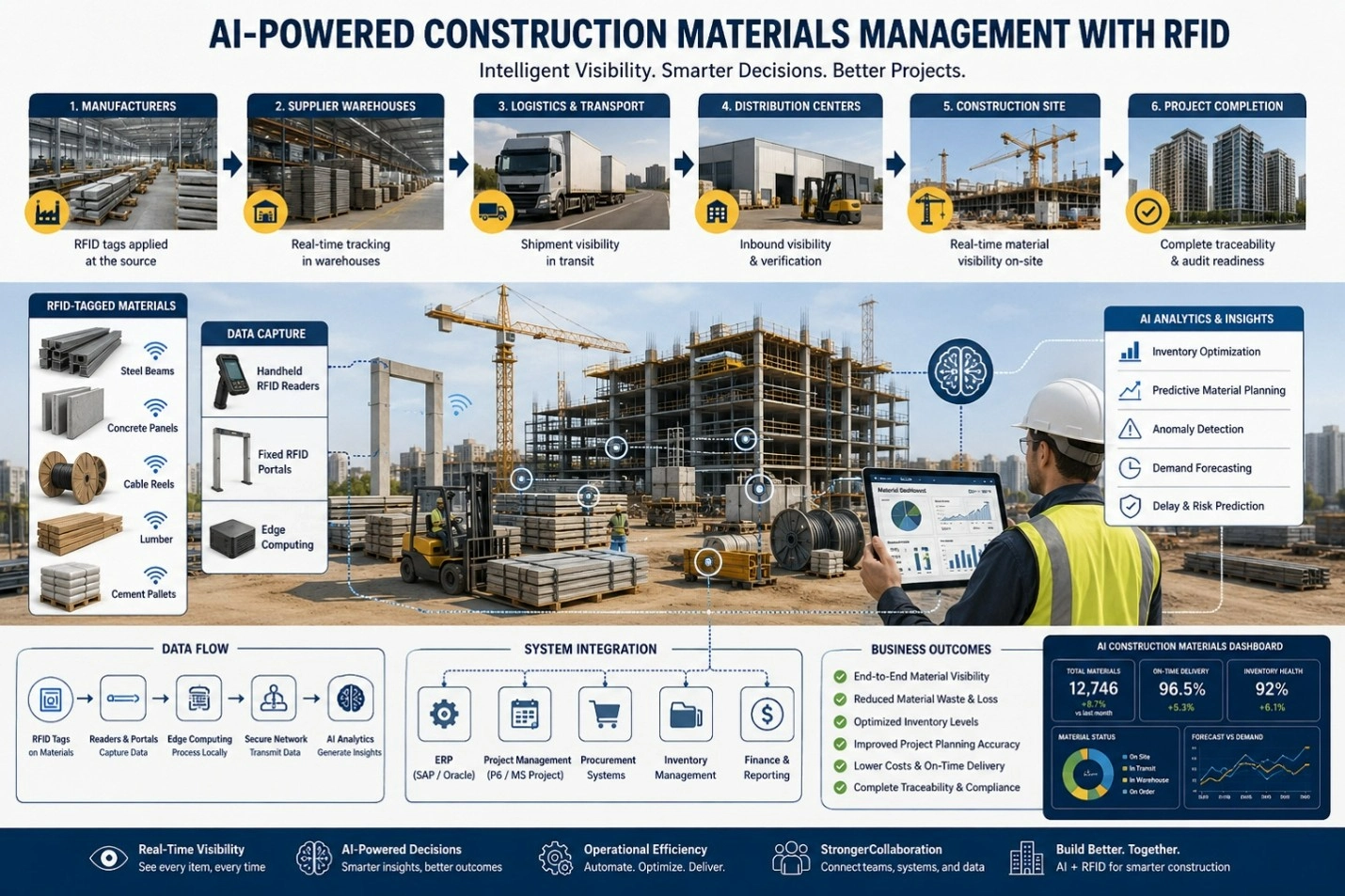
This infographic illustrates how AI-powered RFID technology enables end-to-end visibility of construction materials from manufacturing and warehousing through transportation, on-site storage, and project completion. It highlights RFID-tagged materials, real-time data capture, AI analytics, enterprise system integration, and predictive inventory optimization that improve material traceability, planning accuracy, operational efficiency, and project delivery.
Construction Materials Applications and Operational Deployment Scenarios
Construction materials management extends beyond simple inventory counting. Every project depends upon precise coordination between procurement schedules, supplier deliveries, warehouse operations, staging areas, installation crews, subcontractors, equipment availability, and project milestones.
AI-supported RFID solutions improve visibility across multiple construction workflows.
Intelligent Material Receiving
Incoming deliveries are automatically verified against purchase orders as RFID readers identify tagged materials passing through receiving gates.
AI compares shipment contents with procurement records and immediately identifies:
- Missing deliveries
- Incorrect quantities
- Supplier substitutions
- Duplicate shipments
- Damaged material patterns
- Delivery performance trends
Warehouse personnel receive alerts before materials enter inventory, reducing downstream reconciliation activities.
Smart Warehouse Inventory Management
Large construction projects frequently maintain thousands of inventory locations distributed across central warehouses, temporary storage yards, fabrication facilities, and jobsites.
AI analyzes RFID inventory observations to determine:
- Overstock conditions
- Slow-moving inventory
- Fast consumption rates
- Material expiration risks
- Seasonal demand changes
- Storage optimization opportunities
Warehouse managers gain improved visibility into stock availability while minimizing emergency procurement.
AI Material Allocation for Active Projects
Construction organizations simultaneously manage multiple projects competing for limited inventory.
AI evaluates:
- Project schedules
- Material priorities
- Delivery commitments
- Installation sequencing
- Resource constraints
- Transportation capacity
The software recommends optimized material allocation before shortages delay construction activities.
Construction Logistics Optimization
Construction logistics frequently involve multiple suppliers, trucking companies, temporary storage facilities, staging areas, and crane operations.
RFID continuously records material movement between facilities.
AI identifies:
- Transportation bottlenecks
- Inefficient loading sequences
- Delayed deliveries
- Route optimization opportunities
- Idle transportation assets
- Material congestion at jobsites
Project logistics teams improve scheduling while reducing transportation costs.
Prefabrication Tracking
Modern construction increasingly relies on offsite fabrication.
Examples include:
- Structural steel assemblies
- Mechanical skids
- Electrical rooms
- Bathroom pods
- Wall panels
- Modular buildings
- Pipe spools
RFID provides continuous visibility as assemblies move through fabrication, inspection, transportation, staging, and installation.
AI predicts fabrication completion dates and identifies manufacturing bottlenecks before project schedules are affected.
Jobsite Material Consumption Analytics
Construction managers often struggle to determine where materials are actually consumed.
AI analyzes RFID observations alongside project schedules to identify:
- Material usage by subcontractor
- Installation progress
- Unexpected consumption spikes
- Theft indicators
- Material waste
- Rework trends
Project teams gain improved cost forecasting and schedule accuracy.
AI and RFID Construction Materials Lifecycle Workflow for Smart Construction Supply Chain Management
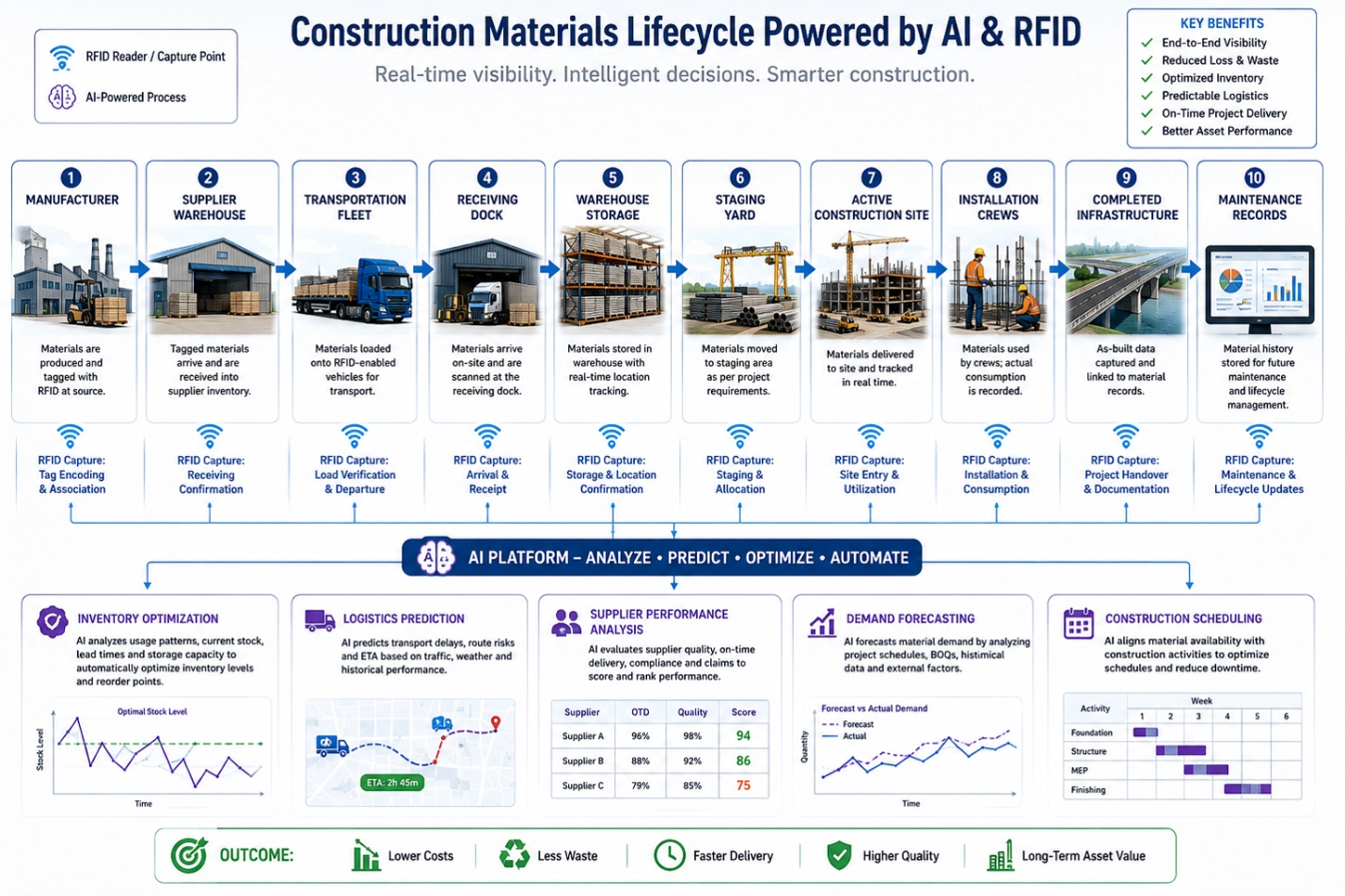
This workflow diagram illustrates the complete lifecycle of construction materials, from manufacturing to long-term maintenance, using AI and RFID technologies. It highlights real-time RFID tracking at every stage while AI supports inventory optimization, logistics prediction, supplier performance analysis, demand forecasting, and construction scheduling. The visual demonstrates how intelligent material management improves efficiency, visibility, and project outcomes.
End-to-End Operational Workflow for AI Construction Materials Management
Successful AI-enabled construction materials management combines automatic identification, intelligent analytics, enterprise software integration, and operational decision support into a continuous workflow.
Material Identification and Data Capture
RFID tags are attached or embedded into construction materials based on environmental conditions, reuse requirements, material value, and expected lifecycle.
Depending on operational requirements, deployments may use:
- Passive UHF RFID labels for palletized inventory
- Durable encapsulated RFID tags for steel members
- Embedded concrete RFID tags
- High-temperature RFID tags for fabrication
- Rugged industrial RFID asset tags
- Reusable hard tags
- Cable identification tags
- Metal-mount RFID tags
- Weather-resistant RFID labels
Fixed readers monitor receiving docks, warehouse entrances, fabrication stations, and logistics checkpoints.
Handheld readers support:
- Inventory verification
- Material searches
- Installation confirmation
- Field inspections
- Cycle counting
Construction equipment may also integrate RFID readers onto forklifts, cranes, automated storage systems, and material handling vehicles.
Communication Infrastructure
Captured identification events are transmitted using communication technologies appropriate for construction environments, including:
- Ethernet
- Industrial Wi-Fi
- Private 5G
- LTE
- VPN connectivity
- Fiber networks
- Edge gateways
- Secure IoT communication services
Edge computing reduces network traffic by filtering duplicate reads, validating tag quality, and preprocessing material movement events before forwarding relevant information.
AI Data Processing
Once RFID events enter the AI software, multiple analytical models evaluate construction operations.
These include:
- Demand forecasting
- Inventory optimization
- Predictive procurement
- Supplier reliability scoring
- Delivery delay prediction
- Material consumption forecasting
- Schedule impact analysis
- Resource optimization
- Material loss detection
- Project progress estimation
- Procurement anomaly detection
Rather than producing static inventory reports, AI continuously updates operational recommendations as new RFID observations become available.
Enterprise Software Integration
Construction organizations typically integrate RFID-generated operational data with business software including:
- Enterprise Resource Planning (ERP)
- Construction Management Information Systems (CMIS)
- Building Information Modeling (BIM)
- Procurement software
- Warehouse Management Systems (WMS)
- Transportation Management Systems (TMS)
- Computerized Maintenance Management Systems (CMMS)
- Supplier relationship management software
- Financial management systems
- Project scheduling software
- Quality management systems
- Digital document management software
This integration enables material movement to automatically update purchasing, project costing, inventory records, inspection documentation, and progress reporting without manual reconciliation.
AI and RFID Enterprise System Integration for Construction Software and Material Management
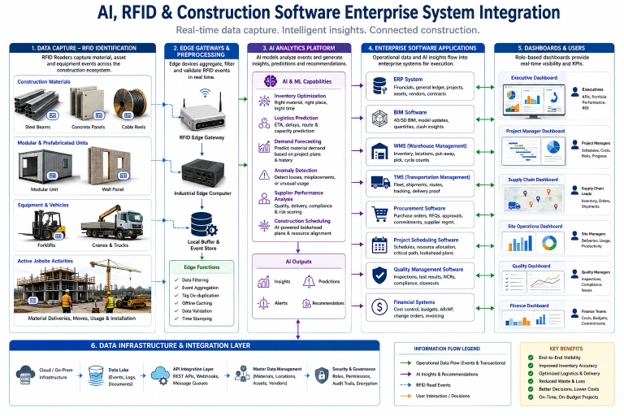
This enterprise system diagram illustrates how RFID readers, edge gateways, and AI analytics integrate with construction management software to enable real-time data exchange. It demonstrates the flow of operational information into ERP, BIM, WMS, TMS, procurement, project scheduling, quality management, financial systems, and executive dashboards. The visual highlights seamless connectivity for smarter decision-making, improved logistics, and enhanced project performance.
RFID Infrastructure, AI Software, and Deployment Considerations for Construction Materials
Construction materials operations demand rugged identification hardware, reliable communication infrastructure, scalable AI software, and deployment models capable of supporting geographically dispersed projects, temporary jobsites, fabrication facilities, and regional distribution centers. Selecting the appropriate combination of RFID technologies, computing resources, and deployment methods directly influences inventory accuracy, system responsiveness, cybersecurity posture, and long-term operational scalability.
RFID infrastructure begins with tag selection based on the physical characteristics of construction materials. Passive UHF RFID tags are commonly applied to palletized products, packaged materials, cable reels, and finished goods because they provide long read ranges suitable for warehouses and logistics checkpoints. Metal-mount RFID tags are designed for structural steel, fabricated assemblies, scaffolding, and reusable construction assets where conventional tags experience signal degradation. Embedded RFID transponders may be incorporated into precast concrete components to support lifecycle traceability from manufacturing through installation and facility maintenance. HF RFID solutions are appropriate for close-range identification of tools, maintenance records, or quality inspection checkpoints, while LF RFID may be selected for specialized environments where resistance to interference is critical.
Readers are strategically deployed at receiving docks, warehouse entrances, fabrication workstations, staging areas, vehicle gates, and material laydown zones. Handheld readers remain essential for field verification, locating misplaced materials, confirming installation activities, and conducting rapid inventory audits. Rugged edge gateways aggregate reader data, eliminate duplicate reads, validate tag events, and forward only meaningful operational information to business software.
RFID Infrastructure, AI Software, and Deployment Considerations for Construction Materials (Continued)
Artificial intelligence software transforms RFID-generated identification events into operational intelligence using machine learning, predictive analytics, optimization algorithms, anomaly detection, computer vision integration where applicable, and natural language reporting. Historical procurement records, project schedules, supplier performance metrics, equipment utilization data, weather information, workforce availability, and inventory movements are correlated to identify risks that conventional inventory systems cannot detect. AI models continuously improve forecasting accuracy as additional construction projects contribute operational data.
Communication reliability is equally important. Construction projects often operate across temporary offices, remote jobsites, fabrication plants, warehouses, and supplier facilities. Industrial Ethernet, secure Wi-Fi, private 5G, LTE, VPN connections, and fiber backbones may be combined depending on project scale and site conditions. Message queuing, edge buffering, and synchronization mechanisms ensure that temporary network interruptions do not result in lost inventory transactions.
Cloud Version
Cloud-hosted deployments are well suited for construction companies managing multiple projects across different geographic regions. Centralized software allows executives, procurement teams, project managers, and logistics coordinators to access dashboards from any authorized location while maintaining consistent software updates and centralized analytics.
Typical advantages include:
- Centralized visibility across multiple construction projects
- Faster deployment with minimal local infrastructure
- Simplified software maintenance and upgrades
- Elastic computing resources for seasonal project growth
- Centralized AI model training using data from multiple sites
- Improved collaboration between suppliers, contractors, and project teams
- Secure remote access for distributed construction operations
Cloud deployment is particularly valuable for national contractors, infrastructure developers, modular construction manufacturers, and organizations coordinating numerous concurrent projects.
Server Version
Server-based deployments provide organizations with greater control over software, databases, cybersecurity policies, and system integration. Software may be deployed within privately managed data centers, regional operations centers, edge servers located near construction sites, or customer-managed enterprise servers.
This approach is appropriate when organizations require:
- Strict data governance
- Integration with existing private construction software
- Low-latency processing for local operations
- Customer-controlled cybersecurity policies
- Operation in environments with limited Internet connectivity
- Compliance with contractual or government security requirements
Large infrastructure projects, defense construction, energy facilities, transportation systems, and government-funded construction programs frequently benefit from privately managed server deployments.
Regardless of deployment model, GAO assists organizations by supplying RFID hardware, readers, tags, IoT devices, and technical expertise that integrate with existing construction software while supporting long-term scalability.
Cloud vs Server Deployment Comparison for AI-Enabled RFID Construction Materials Management
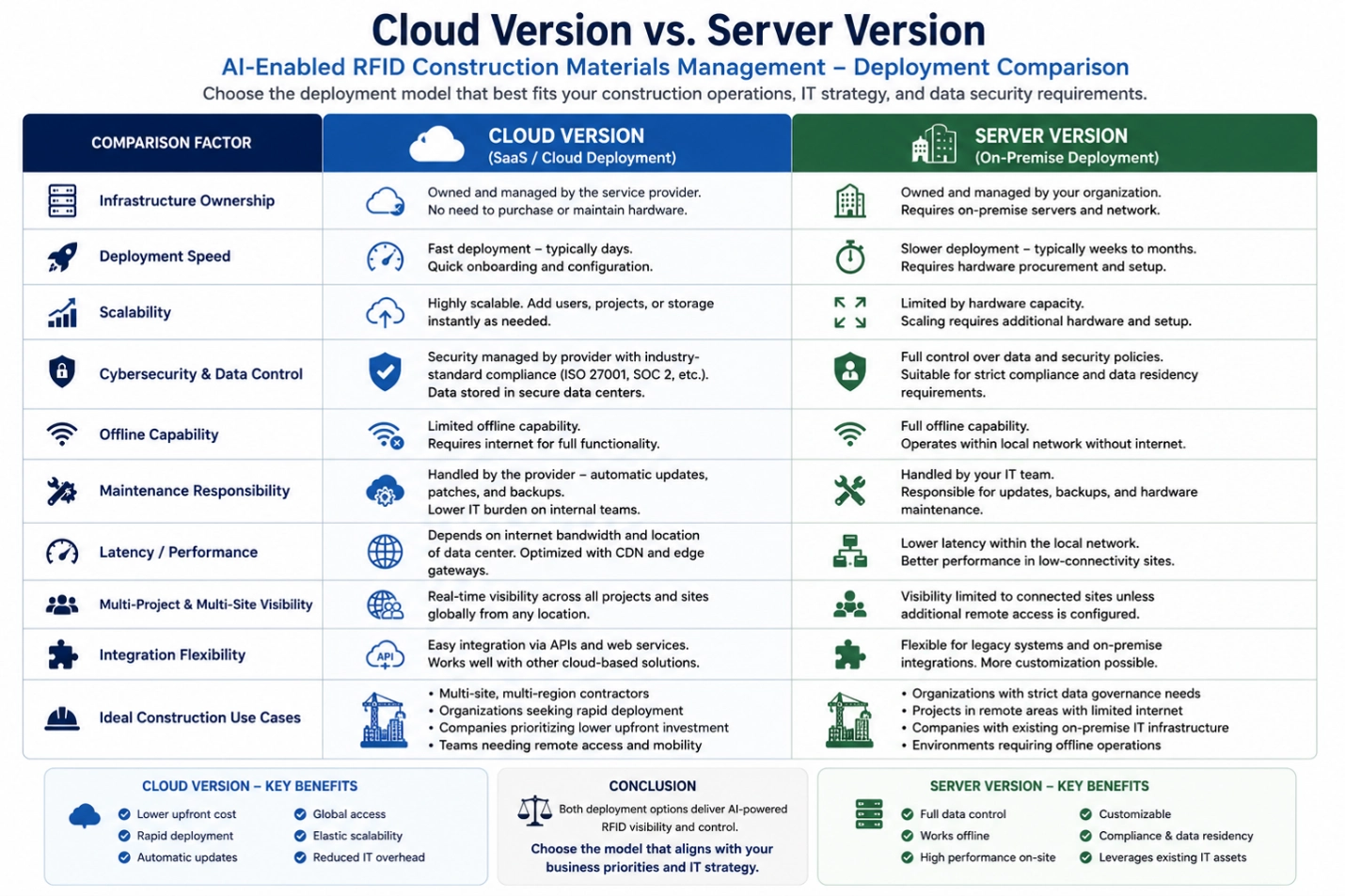
This comparison table evaluates cloud and server deployment models for AI-enabled RFID construction materials management across key operational and technical criteria. It compares infrastructure ownership, deployment speed, scalability, cybersecurity, offline capability, maintenance, latency, multi-project visibility, integration flexibility, and ideal construction use cases. The visual helps organizations select the deployment option that best fits their operational and IT requirements.
Technical Capabilities and Business Value of AI-Driven Construction Materials Management
AI-powered construction materials management supported by RFID extends beyond inventory automation. It creates an intelligent decision-support capability that continuously evaluates operational performance, predicts future requirements, and recommends actions that improve project execution.
Predictive Material Planning
Traditional procurement often reacts to shortages after they occur. AI analyzes historical consumption, project schedules, supplier lead times, weather forecasts, and installation sequences to predict future material demand before shortages affect construction progress.
Benefits include:
- Reduced emergency purchasing
- Improved supplier coordination
- Lower inventory carrying costs
- More accurate procurement scheduling
Construction Inventory Optimization
Construction organizations frequently maintain excess inventory to compensate for uncertainty. AI continuously evaluates inventory levels across warehouses, laydown yards, fabrication facilities, and active jobsites.
This enables:
- Lower excess inventory
- Improved inventory turnover
- Better warehouse utilization
- Reduced material expiration and deterioration
Supplier Performance Intelligence
AI evaluates supplier performance using RFID-confirmed delivery data rather than manual reports.
Metrics may include:
- Delivery punctuality
- Shipment completeness
- Damage frequency
- Lead time consistency
- Purchase order accuracy
Procurement teams gain objective performance indicators that support future sourcing decisions.
Material Loss and Theft Detection
Construction sites present significant challenges for securing valuable materials. AI identifies abnormal movement patterns, unexpected removals, unauthorized after-hours activity, and discrepancies between scheduled work and material consumption.
This improves:
- Material accountability
- Loss prevention
- Insurance documentation
- Investigation efficiency
Installation Progress Verification
Material movement data often reflects actual construction progress more accurately than manual reporting.
AI compares installed materials against project schedules and identifies:
- Installation delays
- Missing components
- Incomplete work areas
- Sequencing conflicts
Project managers receive earlier warning of schedule risks and can allocate resources more effectively.
Sustainability and Waste Reduction
Construction organizations increasingly prioritize sustainability and responsible resource utilization.
AI identifies:
- Excess ordering
- Reusable material opportunities
- Waste generation trends
- Recycling effectiveness
- Packaging optimization
These insights contribute to lower material waste and improved environmental performance while supporting corporate sustainability objectives.
AI-Enabled RFID Deployment in Construction Materials Management with Real-Time Tracking and Analytics
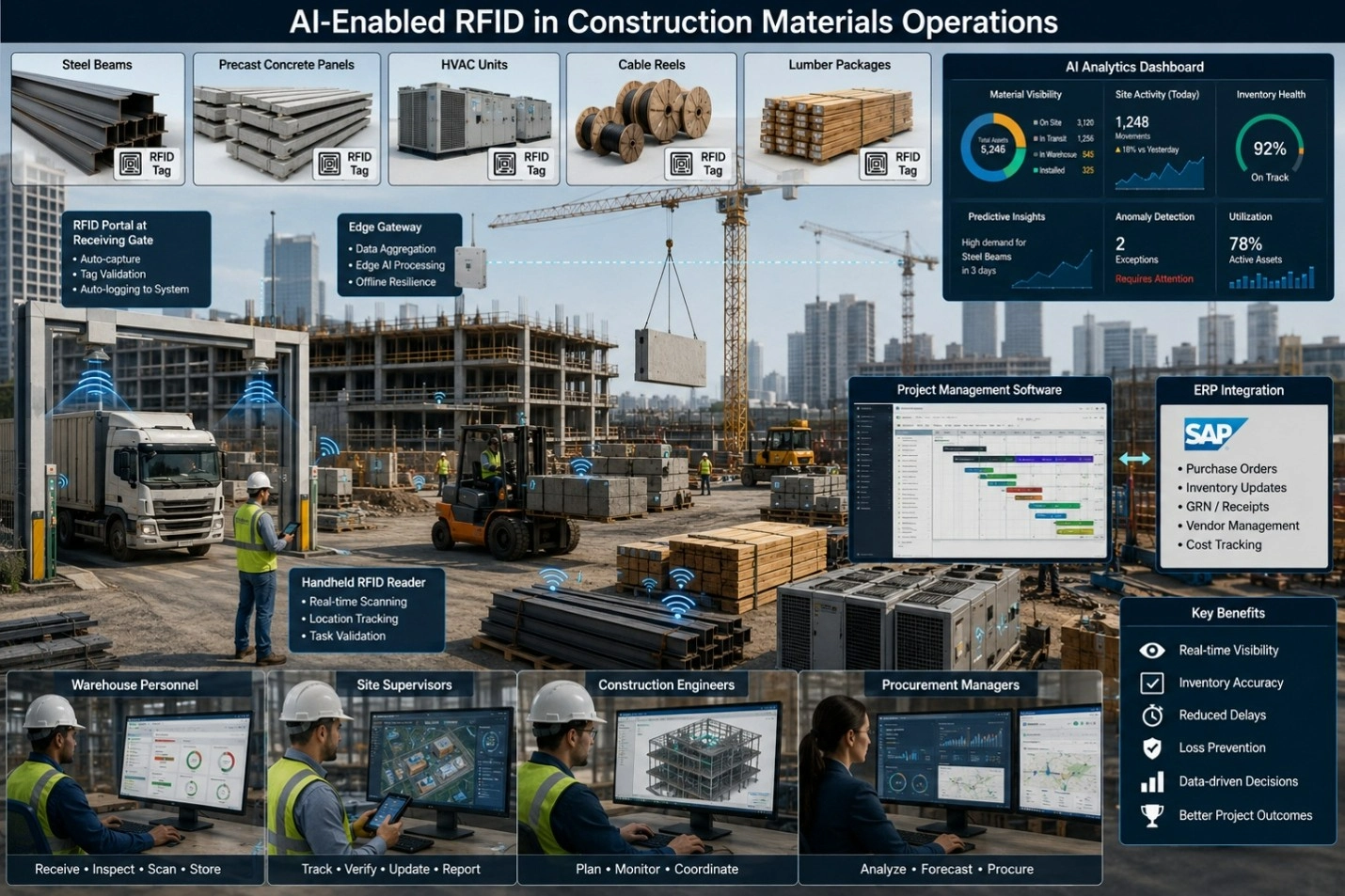
This visual illustrates a real-world construction site using AI-enabled RFID technology to track and manage materials. It showcases automated scanning, live dashboards, and seamless integration with project management and ERP systems. The scenario highlights improved visibility, efficiency, and collaboration across construction teams.
Engineering Best Practices for Successful Implementation
Successful deployment depends on careful planning rather than technology selection alone. Organizations should establish measurable business objectives before selecting tags, readers, software, or AI models.
Recommended engineering practices include:
- Conduct comprehensive RF site surveys before reader installation.
- Select RFID tags based on material composition, environmental exposure, and expected lifecycle.
- Validate read accuracy around structural steel, concrete, and heavy equipment where radio frequency performance may vary.
- Define consistent material identification standards across suppliers.
- Integrate RFID data directly with ERP, BIM, WMS, procurement, and project scheduling software.
- Implement data governance policies covering tag assignment, inventory ownership, and lifecycle management.
- Train warehouse personnel, logistics coordinators, and construction supervisors on operational procedures.
- Continuously evaluate AI prediction accuracy using actual project outcomes.
- Monitor system performance through regular health checks and reader calibration.
- Expand deployments incrementally, beginning with high-value materials before scaling across all inventory categories.
Practical experience demonstrates that phased implementation reduces operational disruption while allowing AI models to learn from validated construction workflows.
Cybersecurity, Data Protection, and Interoperability
Construction materials management systems exchange operational data with multiple business applications, making cybersecurity a critical design consideration.
Organizations should implement:
- Role-based access control
- Multi-factor authentication
- Encrypted communications
- Secure VPN connectivity
- Digital certificate management
- Continuous security monitoring
- Event logging and audit trails
- Backup and disaster recovery procedures
- Network segmentation between operational technology and business systems
- Regular vulnerability assessments and software updates
Interoperability is equally important. Open interfaces and standards-based communication simplify integration with ERP, BIM, WMS, procurement systems, scheduling software, and reporting tools while reducing long-term maintenance complexity.
GAO supports customers by supplying RFID hardware and IoT technologies designed for reliable integration with diverse construction software environments, backed by experienced technical support available remotely or onsite.
Implementation Recommendations for Construction Organizations
Construction companies considering AI-enabled construction materials management should align technology deployment with measurable operational objectives.
Recommended implementation priorities include:
- Identify high-value or high-risk material categories for initial deployment.
- Standardize RFID tagging procedures across suppliers and fabrication facilities.
- Establish data quality requirements before AI model development.
- Integrate identification data with existing business software rather than creating isolated databases.
- Measure performance using construction-specific KPIs such as inventory accuracy, material availability, delivery reliability, schedule adherence, waste reduction, and procurement efficiency.
- Expand deployments after demonstrating measurable operational improvements through pilot projects.
- Continuously refine AI models using completed project data and lessons learned.
Organizations following structured implementation strategies typically achieve stronger adoption, higher data quality, and greater long-term business value.
Advancing Construction Materials Intelligence with GAO
Artificial intelligence supported by RFID is reshaping how construction organizations manage materials across procurement, logistics, warehousing, fabrication, and installation. Continuous visibility into material movement enables predictive planning, improved inventory accuracy, optimized logistics, reduced waste, and more reliable project execution.
Headquartered in New York City and Toronto, Canada, GAO is recognized among the world’s leading suppliers of RFID and BLE technologies for B2B and B2G organizations. Together with its sister companies, GAO Research Inc. and GAO Tek Inc., GAO has served Fortune 500 companies, leading research institutions, prestigious universities, and government agencies throughout the United States and Canada for more than three decades. Significant investment in research and development, rigorous quality assurance, and experienced technical support enable us to help customers implement dependable RFID and AIoT solutions tailored to demanding construction materials environments.
Building the Future of Industrial AI and IoT with Aperture Venture Studio and GAO RFID Inc.
For more than three decades, GAO Group of Companies has invested extensively in research and development of industrial RFID, BLE, and IoT technologies. As generative AI continues to demonstrate measurable value across construction materials management and other industrial applications, we have expanded our development of AI and IoT solutions while establishing Aperture Venture Studio to accelerate the advancement and adoption of intelligent industrial technologies across construction and many other sectors.
Aperture has attracted leading AI and IoT technical experts, experienced operational executives, respected investors, and established technology organizations. Through initiatives such as Aperture Ventures Summit and TekSummit, we foster technical collaboration and knowledge sharing on advanced AI and IoT topics. We welcome professionals and organizations to engage with us as:
- Advisors, co-founders, or employees
- Investors
- Customers
Together, we are helping shape the future of intelligent industrial operations through practical AI, RFID, BLE, and IoT innovation.