
AI and RFID for Spacecraft Manufacturing
Understanding AI-Enabled RFID in Spacecraft Manufacturing
Spacecraft manufacturing demands extraordinary levels of precision, traceability, documentation, and process control. Every flight component, structural assembly, propulsion subsystem, avionics module, composite panel, harness assembly, fastener, and electronic part must remain fully traceable throughout manufacturing, qualification testing, launch preparation, and long-term support. AI-powered RFID systems enable spacecraft manufacturers to transform conventional identification and asset tracking into intelligent operational decision-making by combining industrial RFID with machine learning, Industrial AI, Edge AI, predictive analytics, and AIoT technologies.
Rather than simply identifying tagged assets, AI continuously analyzes manufacturing events, production flow, equipment utilization, component genealogy, environmental conditions, quality inspection results, and workforce activities to optimize spacecraft production. The result is higher manufacturing accuracy, reduced documentation effort, improved schedule predictability, stronger regulatory compliance, and lower risk of assembly errors.
For spacecraft manufacturers building satellites, launch vehicle stages, crewed spacecraft, deep-space probes, or orbital platforms, AI-enhanced RFID supports complete digital traceability across engineering, production, environmental testing, cleanroom operations, logistics, and configuration management. Organizations implementing these technologies benefit from intelligent manufacturing systems capable of improving both operational efficiency and mission assurance while maintaining strict aerospace quality standards.
GAO has supplied RFID hardware products and industrial IoT systems to organizations requiring highly reliable identification and traceability solutions, supporting demanding environments where manufacturing quality, engineering precision, and asset visibility are mission-critical.
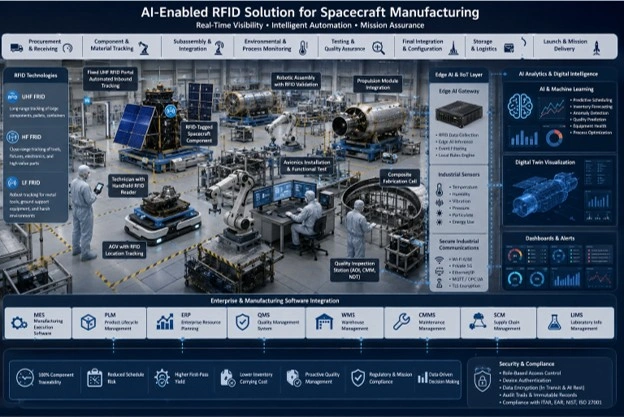
AI-Enabled RFID Solution for Intelligent Spacecraft Manufacturing and Digital Production Traceability
Alt Text
AI-enabled RFID system tracking spacecraft production with Edge AI, digital twins, and enterprise manufacturing software.
Understanding AI-Enabled RFID in Spacecraft Manufacturing
Spacecraft manufacturing differs significantly from conventional manufacturing because production volumes are relatively low while engineering complexity, documentation requirements, component value, and reliability expectations are exceptionally high. A single spacecraft may contain hundreds of thousands of individually controlled parts sourced from global suppliers and assembled under stringent aerospace quality systems.
Artificial Intelligence of Things (AIoT) combines artificial intelligence with connected industrial devices, RFID identification, sensors, manufacturing equipment, and software systems. Within spacecraft manufacturing, AIoT enables manufacturing data to be interpreted automatically rather than simply collected.
RFID serves as the digital identity layer by uniquely identifying:
- Structural assemblies
- Satellite subsystems
- Propulsion components
- Reaction wheels
- Solar arrays
- Electronic modules
- Flight harnesses
- Composite materials
- Tooling assets
- Ground support equipment
- Cleanroom containers
- Calibration equipment
- Inspection fixtures
- High-value inventory
- Production work orders
AI transforms this identification data into operational intelligence by learning manufacturing patterns, identifying abnormal production behavior, forecasting schedule risks, predicting inventory shortages, recommending production sequencing, detecting quality anomalies, and supporting engineering decisions.
Within spacecraft manufacturing, AI models frequently combine RFID data with:
- Manufacturing execution software
- Product lifecycle management software
- Enterprise resource planning software
- Computerized maintenance management software
- Industrial sensor networks
- Environmental monitoring systems
- Machine vision inspection
- Automated optical inspection
- Non-destructive testing results
- Digital twin software
- Supply chain software
- Configuration management databases
This combination creates a continuously updated digital representation of spacecraft production capable of supporting engineering, manufacturing, quality assurance, procurement, logistics, and program management simultaneously.
Why AI Is Reshaping Spacecraft Manufacturing Operations
Spacecraft manufacturers face operational challenges rarely encountered in traditional manufacturing.
These include:
- Long manufacturing cycles
- Extremely expensive components
- Strict configuration management
- Complete component genealogy
- Cleanroom contamination control
- Export control documentation
- Engineering change management
- Lot traceability
- Mission-specific customization
- Zero-defect production objectives
- Multi-stage environmental testing
- Flight certification documentation
Traditional barcode systems often require manual scanning and direct operator involvement, increasing documentation workload while introducing opportunities for human error.
AI-enabled RFID minimizes these limitations by allowing automatic identification throughout production while continuously evaluating manufacturing conditions.
Typical AI applications include:
- Intelligent work order sequencing
- Predictive inventory management
- AI asset tracking
- Automated material verification
- Digital quality documentation
- Manufacturing bottleneck prediction
- Production schedule optimization
- Supplier delivery risk prediction
- Workforce productivity analysis
- Automated engineering documentation validation
- Cleanroom asset monitoring
- Configuration verification before integration
These capabilities reduce administrative effort while improving production confidence.
Because spacecraft manufacturing often spans months or years, AI continuously accumulates operational knowledge, allowing future production programs to benefit from historical manufacturing intelligence.
Spacecraft Manufacturing Applications Where AI and RFID Deliver the Greatest Value
Flight Component Traceability
Every mission-critical component receives a permanent digital identity.
AI continuously verifies:
- Component history
- Supplier information
- Lot numbers
- Manufacturing dates
- Inspection records
- Calibration status
- Environmental exposure
- Installation location
- Engineering revisions
- Acceptance testing
This supports complete component genealogy throughout the spacecraft lifecycle.
Cleanroom Inventory Management
Cleanroom inventory must remain tightly controlled.
AI analyzes RFID events to optimize:
- Material replenishment
- Component availability
- Storage locations
- Shelf life
- Foreign object debris prevention
- Inventory reconciliation
- Controlled access
- Material expiration
Satellite Assembly Operations
Satellite integration involves thousands of sequential assembly tasks.
RFID automatically records movement between:
- Mechanical assembly
- Electrical integration
- Functional testing
- Thermal vacuum preparation
- Electromagnetic compatibility testing
- Final inspection
- Shipping preparation
AI analyzes production progress to identify schedule deviations before they become critical.
Composite Material Management
Composite structures require controlled environmental handling.
AI evaluates RFID identification together with:
- Humidity sensors
- Temperature sensors
- Cure schedules
- Storage duration
- Material shelf life
This reduces material waste while protecting structural quality.
Ground Support Equipment Tracking
Spacecraft production depends upon specialized tooling.
Examples include:
- Torque tools
- Precision fixtures
- Vacuum lifting systems
- Cleanroom carts
- Calibration instruments
- Alignment equipment
- Optical metrology devices
AI predicts equipment utilization while ensuring calibration compliance.
Environmental Test Management
Environmental qualification involves numerous test phases.
Examples include:
- Vibration testing
- Shock testing
- Thermal vacuum testing
- Acoustic testing
- Electromagnetic compatibility testing
- Radiation testing
RFID identifies every hardware configuration entering each test facility.
AI verifies configuration correctness before testing begins.
Supplier Material Verification
Spacecraft manufacturers receive components from hundreds of suppliers.
AI cross-references RFID identification against:
- Approved vendor lists
- Purchase orders
- Engineering specifications
- Quality documentation
- Material certifications
Potential discrepancies are identified automatically before production continues.
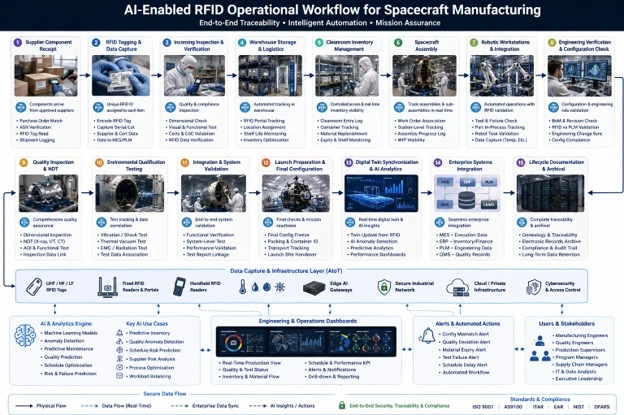
AI-Enabled RFID Operational Workflow for End-to-End Spacecraft Manufacturing Traceability
Alt Text
Workflow showing AI-enabled RFID tracking across spacecraft manufacturing, testing, digital twins, and enterprise systems.
Operational Workflow for AI-Driven RFID in Spacecraft Manufacturing
Successful spacecraft manufacturing depends upon continuous synchronization between physical production activities and digital engineering records. AI-enabled RFID creates this synchronization through automated data collection and intelligent decision support.
Component Identification and Data Acquisition
Production begins with incoming inspection of aerospace-qualified materials and mission-specific components. UHF RFID tags are commonly attached to reusable containers, tooling assets, transport carriers, and larger assemblies, while HF RFID is often selected for applications requiring shorter read distances around specialized workstations. LF RFID may be deployed for rugged industrial assets or environments where metal interference requires alternative identification characteristics.
Each RFID event captures contextual production information, including component identity, operator assignment, workstation location, timestamp, manufacturing order, supplier reference, and quality status. Environmental monitoring devices simultaneously collect temperature, humidity, airborne particulate counts, electrostatic discharge conditions, vibration exposure, and cleanroom pressure differentials to provide additional operational context for AI analysis.
Secure Industrial Communications
Captured identification data is transmitted through resilient industrial communication infrastructure that supports uninterrupted manufacturing operations. Depending on facility requirements, communication may incorporate Industrial Ethernet, secure Wi-Fi, OPC UA, MQTT messaging, REST APIs, or message brokers linking RFID readers, edge gateways, environmental monitoring devices, and production software.
Data integrity is particularly important because spacecraft configuration management requires complete traceability for every production event. Communication pathways therefore include encryption, authenticated device identities, network segmentation, and continuous monitoring to protect manufacturing records against unauthorized modification.
Edge AI Processing
Many manufacturing decisions benefit from immediate analysis without waiting for centralized processing. Edge AI software deployed on industrial gateways evaluates RFID events close to production equipment, allowing rapid detection of unauthorized component movement, missing assemblies, incorrect tooling usage, expired composite materials, calibration violations, or configuration mismatches before they affect downstream manufacturing.
Local inference models also reduce unnecessary network traffic by filtering repetitive RFID reads and forwarding only meaningful operational events for long-term analysis. This improves response time while supporting deterministic manufacturing processes required for aerospace production.
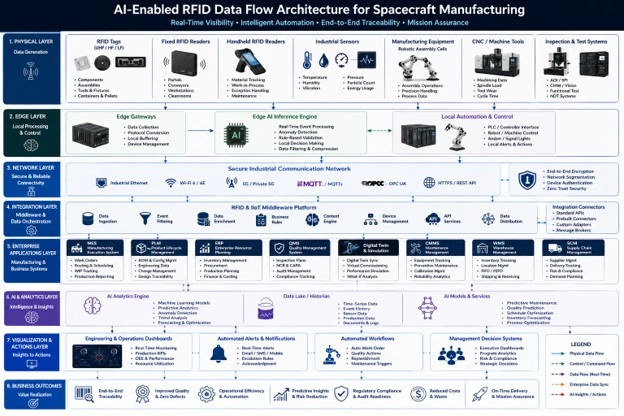
AI-Enabled RFID Data Flow Architecture for Intelligent Spacecraft Manufacturing
Alt Text
Block diagram of AI-enabled RFID data flow linking spacecraft manufacturing equipment, Edge AI, and enterprise software.
Middleware, Enterprise Software Integration, and Intelligent Manufacturing Systems
Middleware serves as the integration layer between RFID infrastructure and manufacturing software, ensuring that identification events are transformed into actionable production information. Rather than forwarding raw tag reads directly into business applications, middleware filters duplicate reads, validates tag identities, applies business rules, and enriches events with contextual manufacturing data before distribution.
Within spacecraft manufacturing, RFID event data commonly integrates with:
- Manufacturing Execution Software (MES)
- Product Lifecycle Management (PLM) software
- Enterprise Resource Planning (ERP) software
- Quality Management Software (QMS)
- Warehouse Management Software (WMS)
- Computerized Maintenance Management Software (CMMS)
- Supply Chain Management (SCM) software
- Laboratory Information Management Software (LIMS) where materials qualification data is required
- Digital twin software
- Engineering document management systems
- Configuration management databases
- Manufacturing analytics software
Each software system contributes a specialized function. PLM software maintains engineering definitions, approved bills of materials, and configuration baselines. MES software coordinates manufacturing work instructions, production sequencing, and operator guidance. ERP software manages procurement, inventory, and production planning. QMS software captures inspection records, corrective actions, and nonconformance reports. Digital twin software correlates physical manufacturing events with virtual spacecraft representations, enabling engineers to validate production progress against design intent.
AI continuously correlates information across these systems to identify production risks that may not be visible within any single application. Examples include predicting shortages of flight-qualified electronic components, identifying recurring quality deviations associated with specific manufacturing cells, detecting schedule conflicts between environmental testing resources, or recommending alternative production sequences when constrained materials become unavailable.
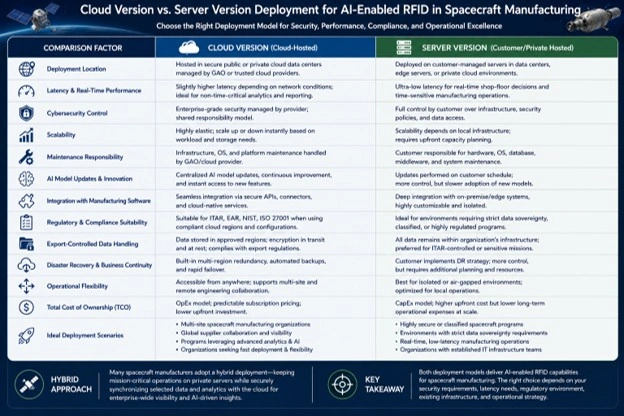
Cloud Version and Server Version Deployment Considerations
Selecting an appropriate deployment model depends upon regulatory requirements, cybersecurity policies, production scale, and organizational IT strategy.
Cloud Version
Cloud-hosted deployments are well suited for spacecraft manufacturers operating across multiple facilities, international suppliers, and geographically distributed engineering teams. Cloud software simplifies centralized reporting, AI model updates, collaborative analytics, supplier visibility, and long-term production data retention.
Typical cloud-hosted functions include:
- Fleet-wide production analytics
- Multi-site inventory visibility
- AI model training
- Long-term manufacturing trend analysis
- Supplier collaboration
- Executive reporting
- Capacity planning
- Predictive supply chain analysis
Cloud deployments are particularly valuable when organizations manufacture multiple spacecraft programs simultaneously and require consolidated operational intelligence across locations.
Server Version
Server deployments place software on customer-managed infrastructure such as private data centers, factory servers, edge servers, or other enterprise-controlled computing environments. These deployments are frequently selected when manufacturing programs involve export-controlled information, highly sensitive intellectual property, classified production activities, or customer-specific cybersecurity requirements.
Typical server-hosted functions include:
- Local AI inference
- Production scheduling
- Configuration management
- Manufacturing execution
- Quality inspection workflows
- Environmental monitoring
- Secure engineering databases
- High-speed RFID event processing
Many spacecraft manufacturers adopt hybrid deployments in which operational control remains on privately managed servers while aggregated manufacturing metrics are securely synchronized with cloud software for enterprise-wide analysis.
Cybersecurity and Data Protection
Cybersecurity is fundamental because RFID event data forms part of the permanent manufacturing record for flight hardware.
Recommended security measures include:
- Device authentication
- Role-based access control
- Multi-factor authentication
- Public Key Infrastructure (PKI)
- TLS-encrypted communications
- Secure boot for edge devices
- Firmware integrity verification
- Network segmentation
- Zero Trust security principles
- Security Information and Event Management (SIEM) integration
- Continuous vulnerability assessments
- Audit logging
- Immutable production records
- Backup and disaster recovery planning
These controls help maintain data integrity, support regulatory compliance, and protect engineering information throughout the manufacturing lifecycle.
GAO has supported organizations requiring dependable RFID hardware and industrial IoT systems by supplying reliable identification technologies backed by rigorous quality assurance and experienced technical support for demanding manufacturing environments.
Cloud vs. Server Deployment Models for AI-Enabled RFID in Spacecraft Manufacturing
Alt Text
Comparison of cloud and server AI-enabled RFID deployments for secure, compliant spacecraft manufacturing operations.
Technical Capabilities and Business Value of AI-Enabled RFID for Spacecraft Manufacturing
AI-enabled RFID delivers substantially greater value than conventional asset identification by transforming production data into predictive operational intelligence. Within spacecraft manufacturing, every capability directly supports mission assurance, engineering quality, and production efficiency.
Intelligent Component Genealogy
AI continuously correlates RFID events across procurement, manufacturing, inspection, testing, and final integration to create complete component genealogy. Engineers can rapidly identify every subsystem, batch, supplier, inspection record, and manufacturing process associated with each flight article.
Predictive Production Scheduling
Machine learning models evaluate historical production performance, workstation utilization, engineering change frequency, and supplier lead times to forecast schedule risks before they delay spacecraft delivery.
AI Inventory Management
Rather than relying solely on inventory counts, AI predicts future material consumption based on production schedules, engineering revisions, historical usage, and supplier performance. This reduces shortages of long-lead aerospace components while minimizing excess inventory.
Automated Configuration Verification
Configuration errors represent significant manufacturing risks. AI compares RFID-identified assemblies with approved engineering configurations before integration, reducing the possibility of installing incorrect hardware or obsolete revisions.
Intelligent Quality Assurance
Quality records from coordinate measuring machines, automated optical inspection, non-destructive testing, and functional testing are linked with RFID identities. AI identifies recurring defect patterns, process variability, and emerging quality trends, enabling corrective actions before defects propagate through production.
Tool and Equipment Optimization
RFID-tagged tooling combined with AI analytics improves utilization of torque tools, metrology equipment, cleanroom fixtures, lifting devices, and calibration instruments. Predictive maintenance models reduce equipment downtime while ensuring calibration compliance.
Environmental Compliance Monitoring
Composite materials, adhesives, batteries, and sensitive electronic assemblies often require controlled environmental conditions. AI evaluates RFID location history together with environmental sensor data to verify that materials remained within approved handling limits throughout manufacturing.
Workforce Decision Support
AI analyzes production flow without replacing engineering judgment. Supervisors receive recommendations regarding workstation balancing, labor allocation, inspection prioritization, and production sequencing, allowing experienced personnel to make better-informed decisions.
Scalability Across Space Programs
The same AI-enabled RFID solution can support:
- Earth observation satellites
- Communications satellites
- Weather satellites
- Navigation satellites
- Deep-space probes
- Lunar spacecraft
- Planetary exploration vehicles
- Launch vehicle manufacturing
- Space station modules
- Human spaceflight hardware
- Scientific payload production
As manufacturing programs expand, AI models continuously improve through accumulated operational knowledge, increasing forecasting accuracy and production efficiency.
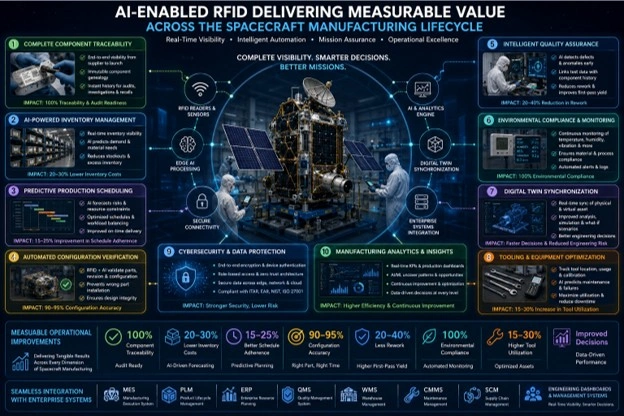
Business Benefits of AI-Enabled RFID in Spacecraft Manufacturing
Alt Text
Infographic showing AI-enabled RFID benefits for spacecraft manufacturing, including traceability, quality, analytics, and security.
Engineering Best Practices and Implementation Recommendations
Successful AI-enabled RFID initiatives in spacecraft manufacturing require disciplined planning, engineering validation, and phased deployment.
Recommended practices include:
- Conduct detailed manufacturing process mapping before selecting RFID tag locations.
- Select UHF, HF, or LF RFID technologies based on read distance, metallic environments, component geometry, and cleanroom requirements.
- Validate RFID read performance around carbon fiber composites, aluminum structures, titanium components, and electronic assemblies.
- Define data governance policies for engineering revisions, configuration control, and component genealogy.
- Integrate RFID event data with MES, PLM, ERP, and QMS software through standardized APIs and middleware.
- Deploy Edge AI for time-sensitive production validation while reserving centralized AI models for predictive analytics and long-term optimization.
- Implement cybersecurity controls throughout the solution lifecycle, including encrypted communications, authenticated devices, and continuous monitoring.
- Pilot the solution on a representative spacecraft production line before scaling across additional manufacturing programs.
- Establish key performance indicators that measure operational improvements and support continuous optimization.
- Train manufacturing engineers, quality personnel, logistics teams, and IT administrators on RFID workflows and AI-assisted decision support.
Typical spacecraft manufacturing KPIs include:
- First-pass yield
- Configuration accuracy
- Component traceability completeness
- Inventory accuracy
- Schedule adherence
- Nonconformance rate
- Tool utilization
- Calibration compliance
- Material availability
- Engineering change cycle time
- Production lead time
- Test readiness
- Rework percentage
- On-time spacecraft delivery
Organizations should continuously evaluate these KPIs to verify that AI-enabled RFID solutions continue delivering measurable operational improvements over time.
GAO works with customers across the United States and Canada by providing RFID hardware products, BLE technologies, and industrial IoT systems that support demanding identification, tracking, sensing, and automation applications. Headquartered in New York City and Toronto, Canada, GAO is recognized among the world’s leading B2B and, to a lesser extent, B2G suppliers of RFID and BLE technologies. Through decades of investment in research and development, we have supported Fortune 500 companies, leading research organizations, prestigious universities, and government agencies with reliable products, expert engineering assistance, and comprehensive technical support.
Advancing Spacecraft Manufacturing with AI-Enabled RFID
AI-enabled RFID is transforming spacecraft manufacturing from event-based tracking into intelligent production management. By combining industrial RFID with AIoT, Edge AI, machine learning, manufacturing software, and digital engineering systems, manufacturers gain comprehensive visibility across component genealogy, configuration management, inventory control, production scheduling, environmental compliance, and quality assurance.
The greatest value is achieved when RFID identification becomes an integrated source of operational intelligence rather than a standalone tracking technology. AI converts manufacturing data into predictive insights that improve mission assurance, reduce production risk, enhance schedule performance, and strengthen regulatory compliance throughout the spacecraft lifecycle.
GAO continues to support organizations implementing advanced RFID, BLE, and industrial IoT technologies by providing dependable hardware products, engineering expertise, and technical support that help manufacturers build intelligent, highly traceable spacecraft production environments.
Building the Future of Industrial AI and IoT with Aperture Venture Studio and GAO
For more than three decades, GAO Group of Companies has invested heavily in research and development of industrial RFID, BLE, and IoT technologies. As generative AI has demonstrated measurable value in spacecraft manufacturing and other advanced engineering environments, we have expanded our AI and IoT capabilities and established Aperture Venture Studio to accelerate the development and adoption of intelligent industrial AI and IoT solutions for aerospace manufacturing and other technology-intensive sectors.
Aperture has attracted leading AI and IoT technical experts, experienced operational executives, influential investors, and established industry organizations. We have also developed the highly successful Aperture Ventures Summit and TekSummit to foster technical discussions on advanced AI and IoT topics. Together, these initiatives have strengthened diverse technical communities focused on industrial AI and IoT innovation. We welcome advisors, employees, investors, and customers who share our commitment to advancing intelligent engineering solutions.