
AI and RFID for Aircraft Components Manufacturing
AI-Driven Aircraft Components Manufacturing Using RFID Solutions
Modern aircraft components manufacturing requires extremely high precision, complete product traceability, strict regulatory compliance, and continuous quality verification across thousands of serialized parts. AI-powered manufacturing intelligence supported by RFID technology enables manufacturers to monitor component movement, automate production visibility, improve process control, and generate predictive operational insights throughout the manufacturing lifecycle.
Within aircraft components manufacturing, AI analyzes production, inspection, and traceability data collected from RFID-tagged materials, tooling, work-in-progress assemblies, finished components, and logistics assets. The result is improved production scheduling, enhanced quality assurance, reduced manufacturing defects, optimized inventory availability, and faster certification readiness.
Aircraft components manufacturers increasingly combine Industrial AI, Edge AI, machine learning, computer vision, industrial IoT devices, robotics, and RFID technologies to build intelligent production systems capable of supporting highly regulated aerospace manufacturing operations. GAO has supplied RFID and industrial IoT hardware to organizations requiring dependable identification, tracking, and automation technologies across demanding industrial environments, helping manufacturers improve operational visibility while maintaining compliance with stringent aerospace quality requirements.
Understanding AI-Powered RFID Solutions in Aircraft Components Manufacturing
Aircraft components manufacturing differs significantly from conventional discrete manufacturing because every component may require full genealogy, serialized identification, manufacturing history, inspection documentation, calibration records, material certifications, and regulatory traceability throughout its operational lifetime.
Examples include:
- Turbine blades
- Compressor disks
- Fan cases
- Engine housings
- Hydraulic actuators
- Landing gear components
- Titanium structural brackets
- Composite fuselage panels
- Flight control surfaces
- Fastener assemblies
- Avionics enclosures
- Electrical harnesses
- Fuel system components
- Heat exchangers
- Bearings
- Machined aluminum structures
Each component progresses through numerous manufacturing stages including raw material receiving, machining, composite layup, additive manufacturing, heat treatment, coating, dimensional inspection, nondestructive testing, assembly, serialization, documentation, warehouse storage, and shipment.
Artificial intelligence transforms this workflow by continuously evaluating manufacturing information collected from RFID identification systems, production equipment, industrial sensors, quality inspection stations, and enterprise software. Rather than simply recording component locations, AI identifies production bottlenecks, predicts quality risks, recommends production adjustments, forecasts material shortages, detects abnormal manufacturing behavior, and supports engineering decision-making.
RFID serves as the automatic identification layer that associates each physical aircraft component with its continuously growing digital manufacturing record. UHF RFID is commonly deployed for warehouse logistics, inventory automation, pallet tracking, and work-in-process visibility. HF RFID supports controlled production environments where shorter read distances improve process accuracy. LF RFID remains valuable for specialized tooling identification and metallic manufacturing environments requiring stable low-frequency communication.
This combination enables manufacturers to establish digital continuity from raw material receipt through final delivery while maintaining strict configuration management and complete manufacturing traceability required by aerospace quality systems.
AI-Powered RFID Solution Workflow for Aircraft Components Manufacturing
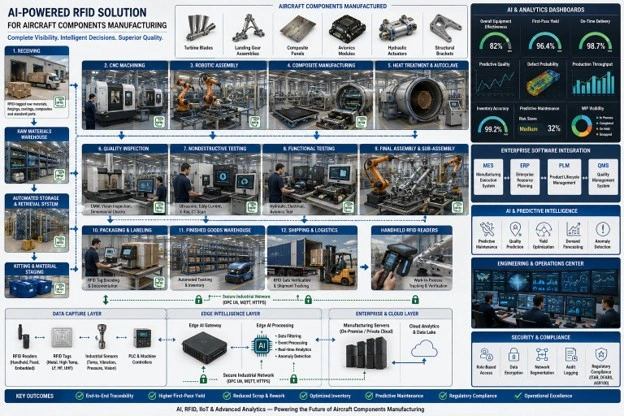
Why AI Is Reshaping Aircraft Components Manufacturing
Aircraft component manufacturers operate under some of the most demanding production requirements across global manufacturing sectors. Every serialized component must satisfy extensive engineering specifications while maintaining complete manufacturing history for future maintenance, airworthiness investigations, and lifecycle support.
Several operational challenges continue driving AI adoption.
Complex Manufacturing Traceability
Single aircraft components often undergo dozens of manufacturing operations distributed across multiple production facilities and specialized suppliers.
AI continuously verifies manufacturing progression using RFID-generated identification records while identifying missing process steps, unauthorized routing changes, incomplete inspections, and documentation inconsistencies before products reach final acceptance.
High-Value Inventory Management
Aircraft manufacturing inventory frequently includes expensive titanium forgings, nickel-based superalloys, composite prepregs, precision castings, electronic assemblies, and specialized tooling.
AI predicts inventory consumption, identifies excess stock, forecasts replenishment timing, and reduces production interruptions caused by unavailable materials.
Production Bottleneck Detection
Manufacturing delays commonly occur during machining, heat treatment, coating, inspection, or assembly operations.
Machine learning models evaluate RFID movement history together with equipment utilization to identify production constraints before they affect customer delivery schedules.
Quality Risk Prediction
Quality defects discovered late during production generate substantial rework costs.
AI analyzes historical manufacturing parameters, inspection results, environmental conditions, machine performance, and operator activities to identify components exhibiting elevated quality risk before defects become irreversible.
Regulatory Compliance
Aircraft manufacturers must comply with stringent quality and documentation requirements while maintaining comprehensive manufacturing records.
RFID-supported digital traceability enables AI software to automatically validate production records, manufacturing approvals, calibration status, inspection completion, and material certifications.
AI Applications Throughout Aircraft Components Manufacturing Operations
Artificial intelligence supports decision-making across virtually every manufacturing stage while RFID provides dependable identification of physical assets throughout production.
Raw Material Receiving
AI validates supplier deliveries using RFID-tagged material containers while comparing purchase orders, material certifications, inspection requirements, and production schedules.
Operational improvements include:
- Automated receiving verification
- Material certification validation
- Supplier performance monitoring
- Warehouse allocation optimization
- Incoming inspection prioritization
Work-in-Process Manufacturing
Every production movement generates new manufacturing intelligence.
AI evaluates:
- Component routing
- Machine utilization
- Queue lengths
- Production sequencing
- Manufacturing cycle times
- Work order completion
- Operator productivity
- Equipment availability
Production supervisors receive recommendations for balancing workloads while reducing bottlenecks.
Tool Management
Aircraft manufacturing depends upon calibrated tooling, fixtures, gauges, torque equipment, cutting tools, molds, dies, and assembly jigs.
RFID identifies tooling automatically while AI predicts:
- Calibration expiration
- Tool wear
- Maintenance scheduling
- Replacement planning
- Tool utilization efficiency
Quality Inspection
AI integrates RFID identification with:
- Coordinate Measuring Machine data
- Laser scanning
- Surface inspection
- Ultrasonic testing
- Eddy current inspection
- X-ray inspection
- Fluorescent penetrant inspection
- Dimensional metrology
Machine learning identifies abnormal inspection trends while supporting first-pass yield improvement.
Warehouse and Logistics
Finished aircraft components require controlled storage before shipment.
AI optimizes:
- Warehouse slotting
- Picking efficiency
- Shipment prioritization
- Inventory rotation
- Serialized component verification
- Packaging validation
GAO supports organizations deploying RFID hardware for warehouse automation, serialized inventory tracking, and industrial asset identification within demanding aerospace production facilities.
AI-Enhanced RFID Workflow for Aircraft Components Manufacturing Process
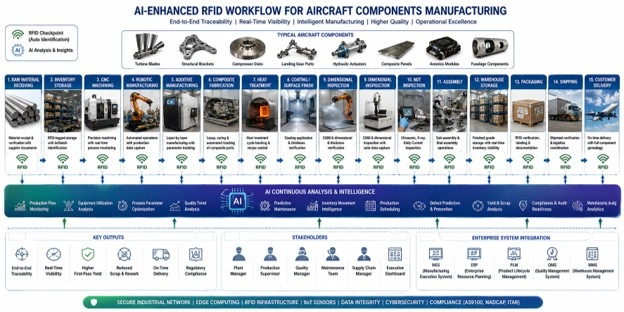
Operational Workflow of AI-Enabled RFID in Aircraft Components Manufacturing
Successful deployment requires coordinated interaction between identification technologies, industrial communications, manufacturing software, AI analytics, and engineering operations.
Component Identification and Data Acquisition
Every aircraft component, pallet, production carrier, tooling fixture, reusable container, or material lot receives a unique RFID identifier linked to manufacturing records.
Additional production information originates from:
- PLC controllers
- CNC machines
- Robotic systems
- Coordinate measuring machines
- Industrial vision systems
- Environmental sensors
- Automated storage systems
- Quality inspection equipment
- MES software
- ERP software
This information forms the operational data foundation used for AI analysis.
Industrial Communication
Manufacturing information moves securely through industrial communication infrastructure including:
- Industrial Ethernet
- OPC UA
- MQTT
- REST APIs
- HTTPS
- TCP/IP
- Wi-Fi 6
- Private 5G
- Fiber backbone connections
Reliable communication enables continuous synchronization between production equipment and manufacturing software.
Edge AI Processing
Latency-sensitive manufacturing decisions often occur directly near production equipment.
Edge servers perform:
- RFID filtering
- Event aggregation
- Duplicate elimination
- Local machine learning inference
- Equipment monitoring
- Anomaly detection
- Production rule validation
Local processing minimizes network traffic while supporting rapid manufacturing responses.
Enterprise Software Integration
Manufacturing intelligence integrates with multiple operational systems.
Typical software includes:
- Manufacturing Execution Systems (MES)
- Enterprise Resource Planning (ERP)
- Product Lifecycle Management (PLM)
- Quality Management Systems (QMS)
- Computerized Maintenance Management Systems (CMMS)
- Laboratory Information Management Systems (LIMS)
- Warehouse Management Systems (WMS)
- Supply Chain Management software
- Statistical Process Control software
- Manufacturing analytics software
Integration enables unified visibility across engineering, production, procurement, quality assurance, logistics, and executive management.
AI-Enabled RFID Operational Data Flow for Aircraft Components Manufacturing
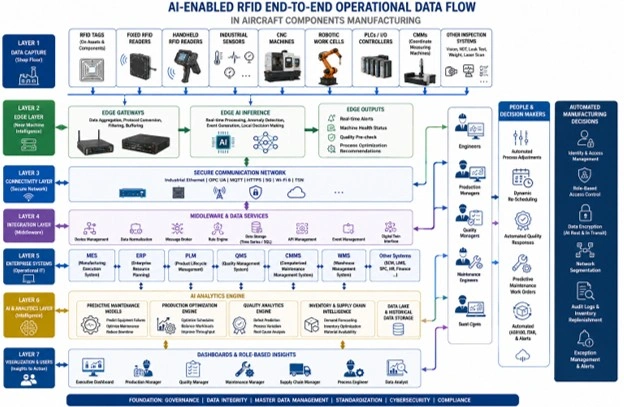
RFID Technologies, AI Software, Infrastructure, and Deployment Models for Aircraft Components Manufacturing
Reliable AI-enabled aircraft components manufacturing depends on much more than RFID readers and AI software. Successful implementations require coordinated hardware, industrial communications, cybersecurity, enterprise software integration, and deployment strategies that support high-value manufacturing operations while maintaining regulatory compliance and production continuity.
RFID Technologies Supporting Aircraft Components Manufacturing
Different RFID frequencies serve different manufacturing requirements.
UHF RFID
UHF RFID is widely deployed for:
- Warehouse inventory management
- Work-in-process visibility
- Finished component tracking
- Returnable transport item management
- Shipping verification
- Automated receiving
- Production staging
- High-volume logistics
Its longer read range allows multiple serialized aircraft components to be identified rapidly while moving through production or warehouse portals.
HF RFID
HF RFID is commonly selected for:
- Controlled manufacturing workstations
- Assembly verification
- Operator-guided production
- Electronic work instructions
- Calibration control
- Small batch manufacturing
The shorter operating range minimizes unintended reads, making it appropriate for precision manufacturing environments.
LF RFID
LF RFID remains valuable for:
- Metallic manufacturing environments
- Tool identification
- Fixture management
- Mold identification
- Maintenance tooling
- Harsh industrial conditions
Although slower than UHF, LF RFID offers dependable performance in applications involving significant metal interference.
Hardware Supporting AI-Enabled Manufacturing
A complete solution typically includes multiple hardware categories.
Identification Hardware
- Fixed RFID readers
- Handheld RFID readers
- Embedded RFID readers
- Industrial RFID antennas
- RFID printer encoders
- RFID tags for metallic aircraft components
- High-temperature RFID tags
- Rugged industrial RFID labels
Industrial Equipment
- CNC machining centers
- Robotic assembly systems
- Automated guided vehicles
- Autonomous mobile robots
- Coordinate Measuring Machines
- Industrial vision cameras
- Laser measurement systems
- Environmental monitoring sensors
- PLC controllers
- Edge computing gateways
Each device contributes operational data that enables AI to evaluate manufacturing performance beyond simple identification.
AI Software Supporting Manufacturing Intelligence
Artificial intelligence continuously evaluates production activities using multiple analytical techniques.
Common AI capabilities include:
- Machine learning for production optimization
- Predictive maintenance models
- Time-series forecasting
- Deep learning quality inspection
- Computer vision defect detection
- Anomaly detection
- Production scheduling optimization
- Inventory forecasting
- Root cause analysis
- Digital twin simulation
- Reinforcement learning for process optimization
- Natural language processing for maintenance documentation
Rather than replacing manufacturing engineers, AI assists them by identifying operational patterns that may not be immediately visible within large production datasets.
Cloud Version
Cloud-hosted software is appropriate when organizations operate multiple manufacturing plants, supplier networks, or geographically distributed engineering teams.
Typical characteristics include:
- Centralized AI analytics
- Multi-site production visibility
- Fleet-wide component genealogy
- Enterprise reporting
- Supplier collaboration
- Scalable computing resources
- Automatic software updates
- Disaster recovery support
Cloud deployment is particularly beneficial for aerospace manufacturers managing production across several facilities while maintaining standardized manufacturing processes.
Server Version
Many aerospace manufacturers prefer privately managed server deployments because of intellectual property protection, regulatory requirements, customer contracts, or operational latency.
Server deployments may operate within:
- Factory data centers
- Regional manufacturing facilities
- Customer-managed private clouds
- Edge server clusters
- Secure engineering environments
Advantages include:
- Greater control over manufacturing data
- Low-latency production decisions
- Integration with existing factory infrastructure
- Customized cybersecurity policies
- Internal validation procedures
- Controlled software upgrade schedules
Many organizations implement hybrid deployments, combining local manufacturing servers with centralized analytics for strategic planning and long-term production optimization.
Security and Supporting Infrastructure
Cybersecurity is essential because aircraft manufacturing systems contain valuable engineering designs, production parameters, and regulatory records.
Recommended security measures include:
- Role-based access control
- Multi-factor authentication
- TLS encryption
- VPN connectivity
- Device authentication
- Secure firmware management
- Network segmentation
- Security Information and Event Management (SIEM)
- Continuous vulnerability monitoring
- Audit logging
- Secure API authentication
- Data integrity validation
GAO has supported organizations implementing industrial RFID hardware and IoT systems requiring dependable identification, secure communications, and reliable operation across demanding manufacturing environments.
Cloud vs. Server Deployment Models for AI-Enabled RFID in Aircraft Components Manufacturing

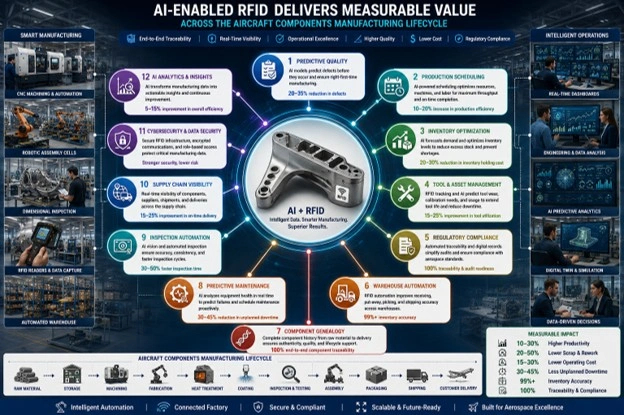
Technical Capabilities and Business Value of AI-Enabled RFID for Aircraft Components Manufacturing
Combining AI with RFID transforms aircraft components manufacturing from reactive production management into intelligent, data-driven operations that improve quality, efficiency, and traceability.
Complete Component Genealogy
Every serialized component maintains a comprehensive digital manufacturing history that includes:
- Raw material origin
- Supplier certifications
- Machining operations
- Heat treatment records
- Inspection results
- Assembly history
- Operator approvals
- Calibration references
- Shipment information
This genealogy simplifies compliance audits, warranty investigations, and lifecycle support.
Improved Production Scheduling
AI evaluates production capacity, work order priorities, machine availability, labor resources, and material readiness to recommend optimized manufacturing schedules, reducing idle time and improving throughput.
Higher First-Pass Yield
Machine learning identifies process variations associated with historical defects, enabling earlier corrective actions that reduce scrap, rework, and production delays.
Better Inventory Accuracy
RFID automates inventory visibility while AI forecasts future consumption, helping manufacturers reduce excess stock and prevent material shortages for high-value aerospace components.
Enhanced Tool Utilization
AI analyzes RFID-tracked tooling usage to improve calibration planning, minimize downtime, and extend tool life through predictive maintenance.
Faster Regulatory Compliance
Automated traceability supports compliance with aerospace quality requirements by ensuring manufacturing records remain complete, accurate, and readily accessible.
Increased Operational Visibility
Production managers receive real-time insights into:
- Work order status
- Machine utilization
- Inventory availability
- Quality trends
- Production bottlenecks
- Equipment performance
- Supplier deliveries
- Workforce productivity
These insights enable faster operational decisions across manufacturing facilities.
Business Benefits of AI-Enabled RFID in Aircraft Components Manufacturing
Engineering Best Practices for Successful Implementation
Organizations planning AI-enabled RFID deployments within aircraft components manufacturing should follow proven engineering practices that reduce implementation risk and maximize long-term value.
Recommended practices include:
- Define traceability objectives before selecting RFID hardware.
- Select RFID tags appropriate for metallic surfaces, composite materials, high temperatures, and harsh manufacturing environments.
- Perform site surveys to evaluate radio-frequency performance around machining centers, storage racks, and production cells.
- Validate read accuracy under normal operating conditions before full-scale deployment.
- Integrate RFID events with MES, ERP, PLM, and QMS software to avoid isolated data repositories.
- Establish standardized component serialization and data governance policies.
- Implement cybersecurity controls for readers, gateways, APIs, and connected software.
- Use Edge AI where low-latency production decisions are required.
- Continuously monitor AI model performance and retrain models using current manufacturing data.
- Develop change management and workforce training programs to encourage operational adoption.
- Conduct periodic audits of RFID infrastructure, calibration status, and communication reliability.
- Define measurable KPIs before deployment to evaluate operational improvements.
These practices help manufacturers achieve scalable, reliable, and compliant implementations while minimizing production disruption.
Key Takeaways for AI-Powered Aircraft Components Manufacturing
AI-powered manufacturing supported by RFID enables aircraft component manufacturers to improve traceability, production efficiency, quality assurance, inventory control, and regulatory compliance throughout complex manufacturing operations.
By combining automated identification, Industrial AI, Edge AI, predictive analytics, industrial communications, and integrated manufacturing software, organizations gain better visibility into every stage of production while supporting data-driven operational decisions. Careful planning, appropriate RFID technology selection, secure system integration, and continuous performance monitoring are essential for successful implementation.
For more than three decades, GAO has supplied RFID, BLE, and industrial IoT hardware products and systems supporting organizations across North America. Headquartered in New York City and Toronto, Canada, GAO is recognized among the world’s leading B2B and B2G providers of RFID and BLE technologies. Through extensive investment in research and development, stringent quality assurance, and expert remote and onsite technical support, we have helped Fortune 500 companies, leading research institutions, universities, and government agencies deploy dependable identification and industrial automation solutions tailored to demanding operational environments.
Building the Future of Industrial AI and IoT with Aperture Venture Studio and GAO RFID Inc.
For more than three decades, GAO Group of Companies has invested extensively in research and development of industrial RFID, BLE, and IoT technologies. As generative AI demonstrated measurable value for aerospace manufacturing and other industrial sectors, we expanded our work in AI, Industrial IoT, RFID, and BLE solutions while founding Aperture Venture Studio to accelerate the development and commercialization of advanced AI and IoT innovations for aircraft components manufacturing and many other industries.
Aperture Venture Studio has attracted leading AI and IoT technical experts, experienced operational executives, influential investors, and recognized technology organizations. We have also established the highly successful Aperture Ventures Summit and TekSummit to advance discussions on emerging AI and IoT technologies, fostering strong technical communities and collaborative innovation. We welcome advisors, co-founders, employees, investors, and customers to join us in shaping the future of Industrial AI and IoT.