
AI and BLE for Energy Transportation
AI-Driven Energy Transportation with BLE Solutions
Artificial Intelligence combined with Bluetooth Low Energy (BLE) technologies is changing how energy transportation organizations monitor, protect, and optimize critical infrastructure. Modern energy transportation operations depend on continuous visibility into pipelines, compressor stations, pump stations, LNG terminals, storage facilities, tanker fleets, rail terminals, and hazardous material logistics. BLE gateways, BLE beacons, and BLE sensors provide low-power operational data that AI systems transform into actionable intelligence for predictive maintenance, leak detection support, workforce safety, equipment utilization, and operational optimization.
Rather than simply collecting sensor readings, AI continuously analyzes equipment behavior, identifies abnormal operating conditions, predicts failures before production is affected, and recommends operational actions based on historical and real-time information. This combination improves reliability, safety, regulatory compliance, and maintenance efficiency while reducing unplanned shutdowns and inspection costs. GAO has supplied BLE and industrial IoT hardware to organizations across North America for decades, helping customers deploy intelligent monitoring systems that integrate with existing operational technology and enterprise software while supporting demanding energy transportation environments.
AI-Enabled BLE Solution for Energy Transportation Using Intelligent Monitoring, Edge AI, and Predictive Maintenance
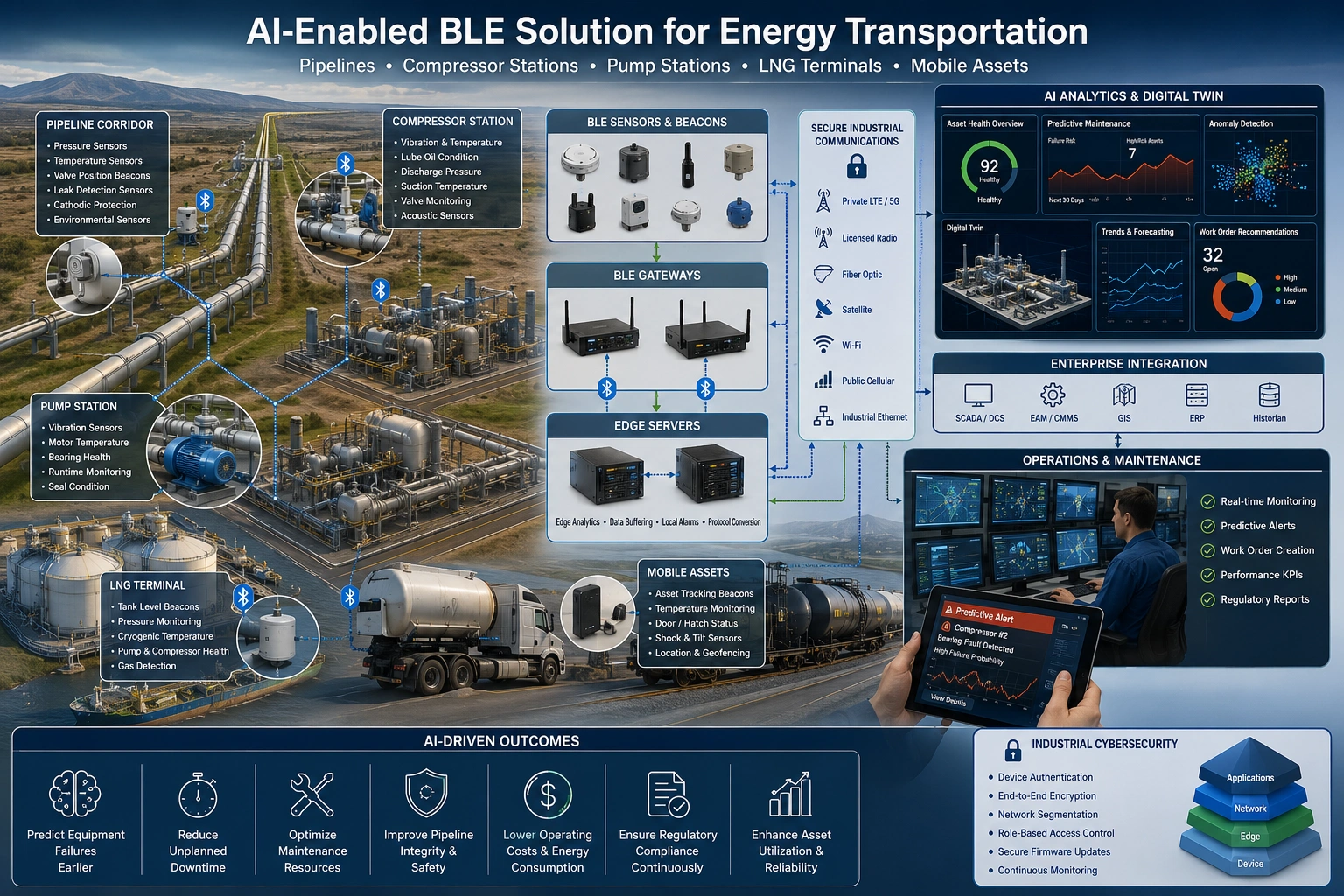
Understanding AI-Enabled BLE Systems for Energy Transportation
Energy transportation includes the movement of crude oil, refined petroleum products, natural gas, liquefied natural gas (LNG), hydrogen, renewable fuels, and other energy commodities through extensive physical infrastructure. Assets often span thousands of miles and include transmission pipelines, gathering systems, marine terminals, storage farms, compressor stations, custody transfer stations, metering facilities, valve stations, pumping facilities, truck loading terminals, and rail distribution networks.
Operational decisions increasingly depend on continuous condition monitoring rather than periodic inspections. AIoT combines artificial intelligence with connected sensors, industrial equipment, and IoT communication systems to transform raw operational data into maintenance recommendations, operational forecasts, safety alerts, and automated decision support.
BLE serves as an important field connectivity technology because many monitoring points require battery-powered devices capable of operating for years while transmitting environmental and equipment condition data. BLE gateways aggregate information from distributed BLE devices before forwarding data through Ethernet, fiber, cellular, Wi-Fi, private LTE, or satellite networks to operational software.
Machine learning enables the system to recognize subtle changes in equipment behavior that conventional threshold-based alarms frequently miss. Examples include gradual bearing degradation, abnormal vibration signatures, valve operation inconsistencies, pressure fluctuations, corrosion indicators, unauthorized asset movement, and workforce proximity anomalies.
Energy transportation operators increasingly combine BLE-enabled sensing with technologies such as:
- Edge AI
- Industrial AI
- Digital twins
- Computer vision
- Acoustic monitoring
- Fiber optic sensing
- Industrial wireless networks
- SCADA systems
- Distributed Control Systems (DCS)
- Geographic Information Systems (GIS)
- Pipeline Management Systems (PMS)
- Enterprise Asset Management (EAM)
- Computerized Maintenance Management Systems (CMMS)
- Enterprise Resource Planning (ERP)
- Operational historians
- Cybersecurity monitoring systems
This combination creates intelligent operational environments where decisions are based on continuously updated equipment health rather than fixed maintenance schedules.
AI Applications Across Energy Transportation Operations
Energy transportation presents operational conditions that differ significantly from other energy sectors. Infrastructure extends across remote environments, harsh weather conditions, environmentally sensitive regions, offshore facilities, and densely populated urban corridors. Equipment reliability directly affects environmental protection, worker safety, regulatory compliance, and supply continuity.
AI-supported BLE deployments address these challenges across multiple operational areas.
Pipeline Integrity Monitoring
BLE sensors installed near valves, pressure monitoring points, cathodic protection systems, and pipeline support structures continuously collect operational information.
AI evaluates:
- Pressure trends
- Temperature variations
- Vibration characteristics
- Equipment operating patterns
- Corrosion indicators
- Valve activity
- Flow irregularities
- Maintenance history
Predictive models identify developing abnormalities long before operational limits are exceeded.
Compressor and Pump Station Intelligence
Rotating equipment represents some of the most maintenance-intensive assets throughout energy transportation systems.
BLE vibration sensors, temperature sensors, and motor condition sensors enable AI software to detect:
- Bearing degradation
- Shaft imbalance
- Misalignment
- Lubrication deficiencies
- Motor overheating
- Cavitation
- Seal deterioration
- Mechanical resonance
Maintenance personnel receive prioritized recommendations based on failure probability instead of fixed inspection intervals.
LNG and Storage Terminal Operations
Large storage terminals contain thousands of interconnected assets including:
- Storage tanks
- Cryogenic equipment
- Transfer pumps
- Loading arms
- Safety valves
- Instrumentation cabinets
- Vapor recovery systems
- Fire suppression equipment
BLE-enabled condition monitoring supports AI models that optimize inspection planning while identifying operational deviations affecting safety and product handling efficiency.
Fleet and Mobile Asset Monitoring
Energy transportation organizations operate extensive fleets of:
- Tanker trucks
- Service vehicles
- Rail tank cars
- Portable pumping equipment
- Mobile generators
- Inspection instruments
- Emergency response trailers
BLE beacons improve asset identification while AI analyzes utilization patterns, maintenance scheduling, idle time, equipment availability, and logistics efficiency.
Workforce Safety and Hazardous Area Monitoring
BLE wearable devices and location-aware monitoring improve worker safety around hazardous environments.
AI evaluates:
- Lone worker activity
- Restricted zone entry
- Personnel accountability
- Emergency evacuation progress
- Fatigue indicators
- Workforce movement trends
- Muster verification
- Exposure duration
These capabilities support emergency response while improving compliance with operational safety procedures.
AI-Driven BLE Data Workflow for Intelligent Energy Transportation Operations
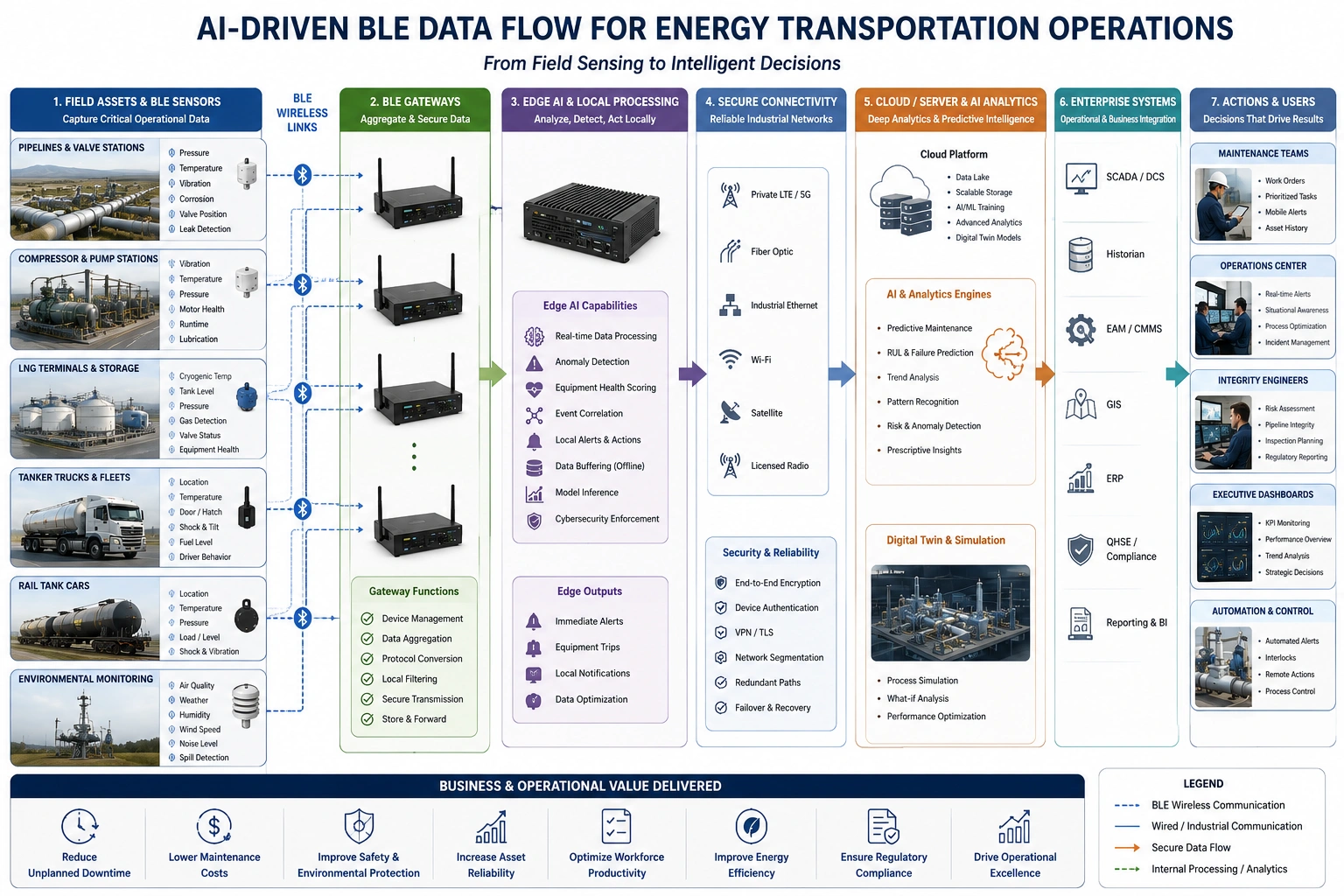
Operational Workflow from BLE Data Collection to AI Decision Support
Successful AI-enabled monitoring depends on the complete operational workflow rather than isolated sensing devices. Each stage contributes to improving data quality, analytical accuracy, and operational decision making.
Field Data Acquisition
BLE sensors collect information from numerous operational assets, including:
- Electric motors
- Centrifugal pumps
- Compressors
- Valves
- Pressure vessels
- Heat exchangers
- Pipeline supports
- Flow meters
- Corrosion monitoring devices
- Tank instrumentation
- Environmental monitoring stations
Sensor measurements may include:
- Surface temperature
- Vibration
- Humidity
- Pressure
- Acceleration
- Equipment runtime
- Battery condition
- Tilt
- Shock
- Position
- Proximity
Local Wireless Communication
BLE devices transmit information using low-power wireless communication to strategically positioned BLE gateways.
Engineering considerations include:
- RF propagation around steel infrastructure
- Hazardous location certification
- Gateway redundancy
- Battery replacement planning
- Signal interference
- Environmental sealing
- Outdoor enclosure protection
- Wireless coverage validation
Proper site surveys significantly improve communication reliability throughout pipeline corridors and terminal facilities.
Edge Processing
Edge servers perform initial processing close to operational assets.
Typical edge functions include:
- Signal filtering
- Data normalization
- Device authentication
- Local anomaly detection
- Buffering during communication outages
- Event prioritization
- Local alert generation
Edge intelligence reduces bandwidth consumption while maintaining operational continuity during intermittent wide-area network connectivity.
Enterprise Integration
Validated operational data is forwarded into business and operational software such as:
- SCADA
- DCS
- PI System historians
- IBM Maximo
- SAP Enterprise Asset Management
- IBM Envizi
- AVEVA software
- Hexagon asset management
- Oracle ERP
- Geographic Information Systems
This integration enables maintenance planners, reliability engineers, operations supervisors, integrity management specialists, and executive management to access consistent operational information.
GAO has supported customers by supplying industrial BLE hardware that integrates with existing monitoring systems rather than requiring organizations to replace established operational investments.
AI Analytics and Operational Decisions
AI continuously evaluates both historical and streaming operational information.
Common analytical outputs include:
- Remaining useful life estimation
- Failure probability scoring
- Maintenance prioritization
- Asset criticality analysis
- Inspection optimization
- Energy consumption analysis
- Workforce scheduling recommendations
- Spare parts forecasting
- Operational risk assessment
- Compliance reporting support
Operational recommendations are delivered to maintenance personnel, operations control centers, integrity engineers, and management teams through dashboards, mobile devices, and maintenance software.
Layered AI-Enabled BLE Data Pipeline for Energy Transportation Infrastructure
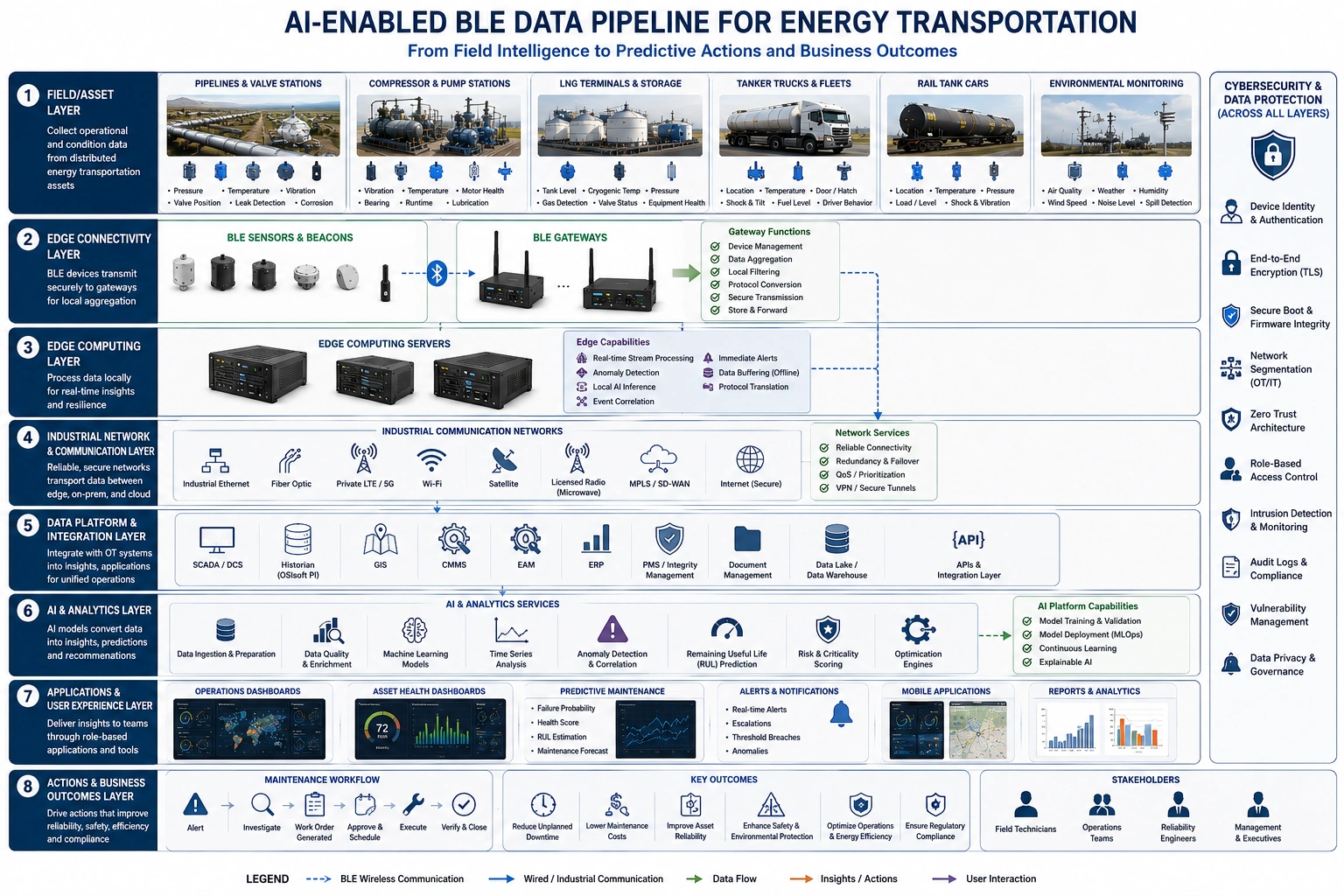
BLE Infrastructure, AI Software, Communications, and Deployment Considerations for Energy Transportation
BLE infrastructure forms one component of a broader intelligent monitoring solution. Effective deployments require careful coordination between field hardware, communications, AI software, cybersecurity controls, and operational systems to ensure reliable performance across geographically dispersed energy transportation assets.
BLE Hardware Components
BLE sensors monitor equipment condition, environmental variables, and operational status while operating on low power for extended periods. Common deployments include vibration sensors mounted on pumps and compressors, temperature sensors installed on bearings and electrical enclosures, humidity sensors within instrumentation cabinets, and BLE beacons attached to portable assets, maintenance tools, emergency response equipment, and inspection devices. BLE gateways aggregate data from hundreds of nearby devices and securely forward it to edge servers or centralized software using Ethernet, industrial Wi-Fi, cellular, fiber, or satellite communications.
AI Models and Software
AI software converts field measurements into operational intelligence using techniques such as supervised machine learning, unsupervised anomaly detection, time series forecasting, reinforcement learning for maintenance optimization, and graph-based analytics for asset relationship modeling. Reliability engineers frequently combine these models with physics-informed algorithms to improve predictions for rotating machinery, valve assemblies, corrosion monitoring, and pipeline integrity.
Cloud-hosted deployments are well suited for geographically distributed pipeline operators seeking centralized analytics, multi-region visibility, scalable computing resources, and simplified software maintenance. Server-based deployments running on customer-managed edge servers, private data centers, or regional operational facilities are often preferred where low-latency decision making, data sovereignty, intermittent connectivity, or regulatory requirements demand local processing.
Communication Infrastructure Supporting AI-Driven Energy Transportation
Reliable communications determine the overall effectiveness of AI-enabled monitoring systems. Energy transportation infrastructure frequently spans remote pipeline corridors, mountainous regions, offshore facilities, deserts, forests, and densely populated metropolitan areas, making network planning an engineering discipline rather than a simple connectivity exercise.
BLE typically provides the short-range communication layer between field devices and nearby gateways. Beyond the gateway, organizations often combine multiple communication technologies based on operational requirements, available infrastructure, cybersecurity policies, and environmental conditions.
Common communication methods include:
- Industrial Ethernet within compressor stations and terminals
- Fiber optic networks for high-bandwidth backbone communications
- Private LTE and private 5G for wide-area industrial connectivity
- Public cellular networks for mobile assets and remote stations
- Wi-Fi for maintenance and engineering access
- Satellite communications for isolated locations
- Licensed industrial radio networks for supervisory communications
- MQTT for lightweight telemetry transmission
- OPC UA for industrial interoperability
- Modbus TCP for equipment integration
- DNP3 where legacy utility infrastructure is present
- HTTPS and REST APIs for enterprise software connectivity
A resilient communication strategy should incorporate redundant paths, automatic failover, local buffering at edge servers, and continuous network health monitoring. These measures help maintain operational visibility during temporary communication disruptions while preventing unnecessary data loss.
Cybersecurity and Data Protection
Energy transportation infrastructure is considered critical infrastructure and therefore requires comprehensive cybersecurity measures. AI solutions must protect both operational technology (OT) and information technology (IT) environments without negatively affecting operational reliability.
Recommended security controls include:
- Zero Trust network segmentation
- Device identity management
- Secure BLE device authentication
- End-to-end encryption
- TLS-protected gateway communications
- Certificate-based authentication
- Hardware secure elements
- Secure boot
- Digitally signed firmware
- Role-based access control
- Multi-factor authentication
- Continuous vulnerability assessments
- Security Information and Event Management (SIEM) integration
- Intrusion detection for industrial networks
- Comprehensive audit logging
Operational environments should also include lifecycle management for BLE devices, ensuring firmware updates, certificate renewal, battery health monitoring, and asset inventory remain synchronized throughout deployment.
Organizations transporting petroleum products, natural gas, LNG, hydrogen, and hazardous chemicals frequently align their cybersecurity programs with recognized standards such as:
- ISA/IEC 62443
- NIST Cybersecurity Framework
- NIST SP 800-82
- API Recommended Practices
- TSA Pipeline Security Directives where applicable
- ISO 27001
- SOC 2 for cloud-hosted software providers
GAO recognizes that cybersecurity is inseparable from industrial IoT deployments. Our BLE hardware is designed to support secure communications while integrating with customer-defined cybersecurity policies and operational procedures.
Defense-in-Depth Cybersecurity for AI-Enabled BLE Monitoring in Energy Transportation
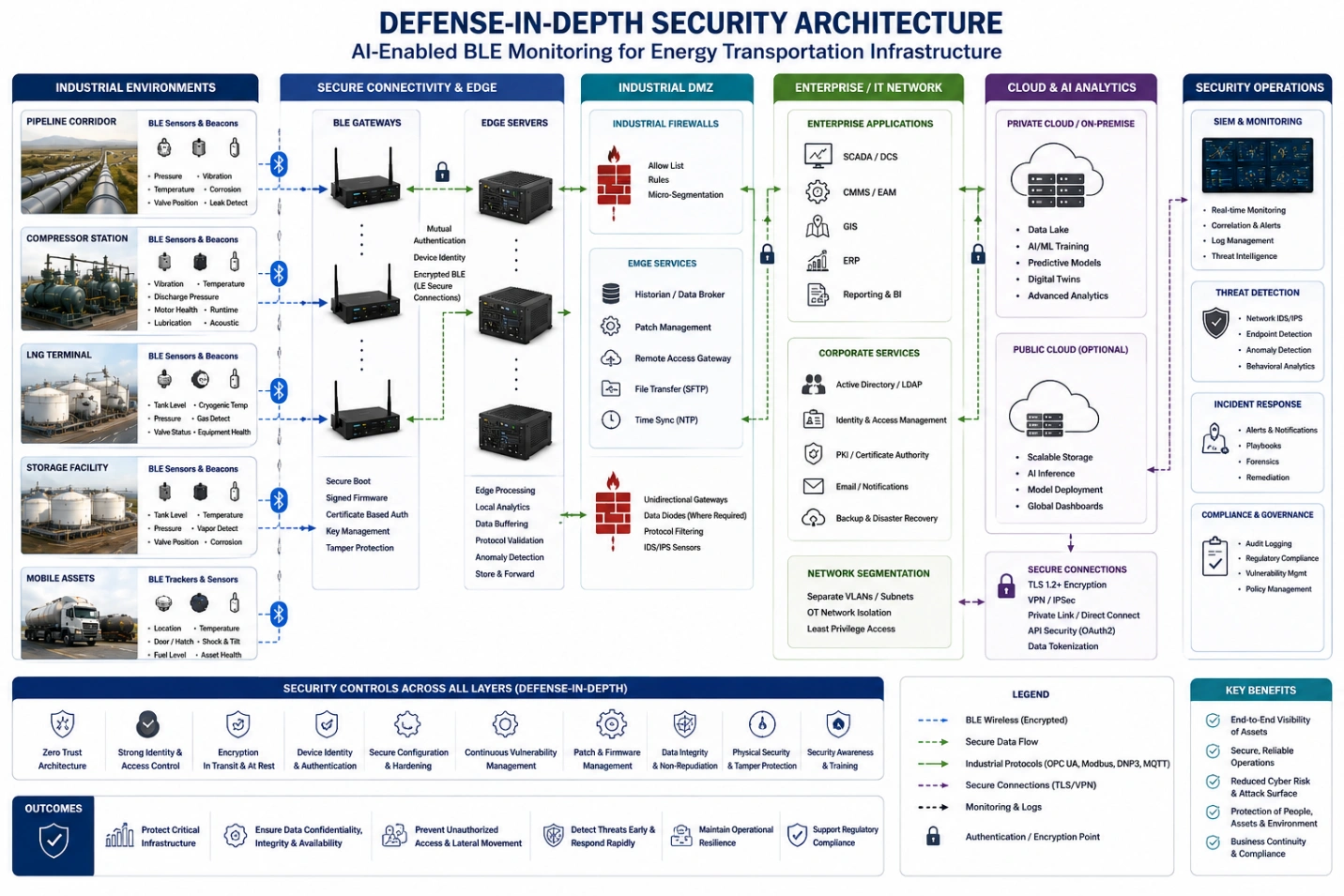
AI Capabilities That Improve Energy Transportation Operations
Artificial intelligence derives its value from recognizing operational patterns that are difficult to identify through manual inspection or fixed alarm thresholds. When combined with BLE-enabled condition monitoring, AI continuously evaluates equipment performance, maintenance history, environmental conditions, operational schedules, and asset criticality to support faster and more informed operational decisions.
Predictive Maintenance
Traditional preventive maintenance often replaces components based on elapsed time rather than actual equipment condition. This approach can lead to unnecessary maintenance or unexpected failures when degradation occurs between scheduled inspections.
AI evaluates trends from BLE vibration, temperature, runtime, and environmental sensors to estimate remaining useful life for critical equipment such as:
- Compressors
- Booster pumps
- Electric motors
- Pipeline valves
- Pressure regulators
- Cooling systems
- Instrumentation cabinets
- Emergency generators
Maintenance planners receive prioritized work recommendations based on actual equipment condition, helping reduce unnecessary maintenance activities while minimizing unplanned outages.
Asset Health Scoring
Modern AI systems generate dynamic health scores for each monitored asset by combining multiple operational variables rather than relying on individual sensor values.
Typical inputs include:
- Historical maintenance records
- Sensor measurements
- Operating hours
- Failure history
- Environmental exposure
- Equipment age
- Criticality ranking
- Inspection findings
Health scoring enables integrity engineers to identify high-risk assets before reliability declines to unacceptable levels.
Intelligent Leak Investigation Support
Although BLE sensors do not directly detect every pipeline leak, they provide valuable supporting operational data that AI can correlate with information from pressure transmitters, acoustic monitoring systems, flow measurements, and other sensing technologies.
AI models can identify abnormal combinations of:
- Pressure changes
- Equipment vibration
- Valve activity
- Temperature variation
- Flow imbalance
- Maintenance activity
- Environmental conditions
These correlations help operations personnel investigate potential incidents more efficiently while reducing false alarms.
Workforce Safety Analytics
Worker safety remains a primary operational objective throughout energy transportation facilities.
BLE-enabled wearable devices, combined with AI, support:
- Personnel accountability
- Hazardous zone awareness
- Restricted-area access monitoring
- Lone worker protection
- Emergency response coordination
- Muster verification
- Fatigue trend analysis
- Exposure duration monitoring
Rather than replacing established safety procedures, AI provides additional decision support that enables supervisors to identify developing safety risks earlier.
Operational Optimization
AI continuously analyzes large volumes of operational information to identify opportunities for improving efficiency across transportation networks.
Examples include:
- Pump scheduling optimization
- Compressor load balancing
- Equipment utilization improvements
- Energy consumption analysis
- Maintenance resource allocation
- Spare parts inventory optimization
- Inspection route optimization
- Fleet dispatch recommendations
- Storage utilization forecasting
These recommendations help organizations reduce operating costs while maintaining system reliability and regulatory compliance.
Technical and Business Benefits of AI-Enabled BLE Solutions for Energy Transportation
Successful deployments produce measurable operational improvements because AI transforms continuous field observations into actionable maintenance and operational intelligence.
Key technical advantages include:
- Continuous condition monitoring across geographically distributed infrastructure
- Earlier identification of equipment degradation
- Reduced dependence on manual inspections
- Improved reliability of rotating equipment
- Better visibility into remote assets
- Scalable monitoring across thousands of BLE devices
- Lower communication power requirements for battery-operated sensors
- Improved edge processing efficiency
- Better integration with operational software
- Faster incident investigation
Operational improvements commonly include:
- Reduced unplanned downtime
- Improved maintenance planning
- Higher workforce productivity
- Better pipeline integrity management
- Increased equipment availability
- Improved asset utilization
- Reduced emergency maintenance
- Better inspection prioritization
- Improved inventory planning
- Enhanced operational transparency
Business outcomes frequently include:
- Lower maintenance costs
- Reduced lifecycle operating expenses
- Increased infrastructure reliability
- Improved regulatory reporting
- Better environmental risk management
- More efficient capital planning
- Improved operational resilience
- Higher return on infrastructure investments
These improvements are achieved because maintenance activities become increasingly condition-based rather than schedule-driven, allowing organizations to focus engineering resources where they deliver the greatest operational value.
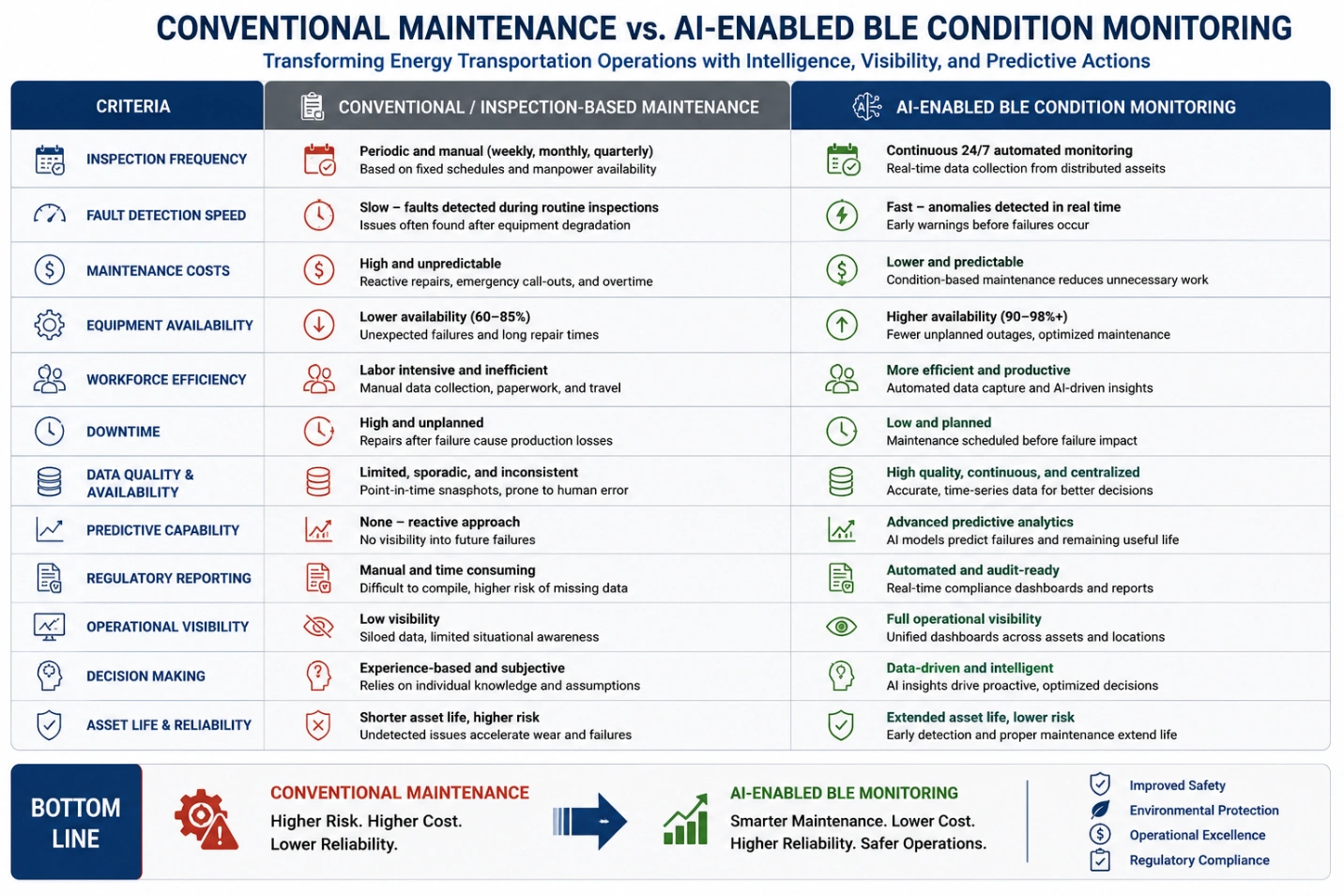
Traditional Maintenance vs. AI-Enabled BLE Condition Monitoring for Energy Transportation
Engineering Best Practices for Deploying AI-Enabled BLE Solutions in Energy Transportation
Successful AI deployments begin with clearly defined operational objectives rather than technology selection. Organizations transporting crude oil, refined fuels, natural gas, LNG, hydrogen, or renewable energy products should identify the highest-value operational problems, establish measurable performance indicators, and validate the quality of available operational data before expanding to larger deployments.
Deployment Planning
A phased implementation reduces technical risk while allowing engineering teams to validate AI models and communication reliability under real operating conditions.
Recommended planning activities include:
- Define business objectives such as reducing compressor downtime, improving pipeline integrity monitoring, or optimizing maintenance scheduling.
- Identify critical assets based on operational risk, maintenance history, and production impact.
- Conduct RF site surveys to determine BLE gateway placement around pump stations, compressor buildings, loading terminals, and storage facilities.
- Evaluate environmental factors including hazardous locations, temperature extremes, humidity, vibration, and electromagnetic interference.
- Establish data ownership, retention, and governance policies before commissioning AI software.
- Develop success criteria using measurable operational KPIs.
Hardware Selection
BLE hardware should be selected according to environmental and operational requirements rather than price alone.
Engineering considerations include:
- Hazardous area certifications where explosive atmospheres may exist
- Battery life appropriate for inspection intervals
- Industrial enclosure ratings for outdoor installation
- Operating temperature range
- Sensor accuracy and calibration requirements
- Gateway capacity and communication redundancy
- Mechanical mounting methods
- Long-term firmware support
GAO has assisted organizations by supplying industrial BLE gateways, BLE beacons, and BLE sensors that support demanding operating environments across North America. Our engineering teams work with customers to select hardware that complements existing operational systems instead of requiring unnecessary infrastructure replacement.
Commissioning and Validation
Commissioning should verify the complete operational workflow rather than simply confirming that individual devices communicate successfully.
Validation activities typically include:
- BLE signal strength verification
- Gateway coverage testing
- Sensor calibration checks
- Data quality validation
- AI model baseline training
- Cybersecurity verification
- Enterprise software integration testing
- Alarm verification
- Failover testing
- Battery health assessment
- Documentation updates
- Operator acceptance testing
Establishing accurate baseline operating conditions during commissioning significantly improves long-term AI model performance.
Scalability, Integration, and Lifecycle Management
Energy transportation infrastructure continues to expand through acquisitions, capacity increases, and modernization projects. AI-enabled BLE systems should therefore be designed for incremental growth without disrupting existing operations.
Enterprise Integration
Operational value increases when AI-generated insights are incorporated into established business processes rather than isolated dashboards.
Common integration points include:
- SCADA systems for operational visibility
- Distributed Control Systems (DCS) for process monitoring
- Enterprise Asset Management (EAM) software for maintenance planning
- Computerized Maintenance Management Systems (CMMS) for automated work order creation
- Geographic Information Systems (GIS) for spatial asset visualization
- Enterprise Resource Planning (ERP) software for inventory and procurement
- Operational historians for long-term trend analysis
- Business intelligence software for executive reporting
This integrated approach enables maintenance engineers, pipeline integrity specialists, operations supervisors, and executive leadership to work from a consistent operational data set.
Lifecycle Management
Industrial IoT deployments require ongoing operational support throughout the service life of the monitoring system.
Recommended lifecycle activities include:
- Periodic firmware updates
- BLE device inventory management
- Battery replacement planning
- Sensor recalibration
- Gateway software maintenance
- Cybersecurity patch management
- AI model retraining using current operational data
- Communication performance monitoring
- Hardware replacement planning
- Documentation maintenance
Regular lifecycle management helps preserve AI accuracy while maintaining system reliability over many years of operation.
Key Technical Insights and Implementation Recommendations
AI-enabled BLE solutions provide the greatest operational value when implemented as part of a broader intelligent monitoring strategy rather than as isolated sensor deployments. Organizations should prioritize high-value operational use cases, establish reliable communication infrastructure, and integrate AI-generated insights into existing maintenance and operational workflows.
Key implementation recommendations include:
- Begin with critical assets where equipment failures have the highest operational or environmental impact.
- Validate data quality before expanding AI model deployment.
- Combine BLE monitoring with existing SCADA, GIS, and integrity management software rather than replacing proven systems.
- Use edge processing for remote facilities where network connectivity may be intermittent.
- Establish cybersecurity policies that address both operational technology and information technology environments.
- Continuously evaluate AI model performance using updated operational data and maintenance outcomes.
- Measure deployment success using KPIs such as equipment availability, maintenance efficiency, mean time between failures (MTBF), mean time to repair (MTTR), inspection productivity, energy consumption, and asset utilization.
Organizations adopting these engineering practices are better positioned to improve infrastructure reliability, strengthen worker safety, optimize maintenance resources, and support regulatory compliance across complex energy transportation networks.
Headquartered in New York City and Toronto, GAO is recognized among the world’s leading B2B suppliers of BLE and RFID technologies. For more than three decades, we have supported Fortune 500 companies, leading research organizations, universities, and government agencies throughout the United States and Canada. Our continued investment in research and development, rigorous quality assurance processes, and remote as well as onsite technical support enables customers to deploy reliable industrial IoT solutions with confidence. Whether modernizing pipeline monitoring, enhancing terminal operations, or expanding condition-based maintenance programs, GAO provides BLE hardware and engineering expertise that integrate with existing operational environments.
Advancing Intelligent Energy Transportation with GAO
Artificial intelligence supported by BLE gateways, BLE beacons, and BLE sensors is enabling energy transportation organizations to move from reactive maintenance toward predictive, data-driven operations. Continuous monitoring of pipelines, compressor stations, storage terminals, mobile assets, and field personnel provides richer operational insight while helping improve reliability, operational efficiency, safety, and regulatory compliance.
Successful implementations depend on thoughtful engineering, secure communications, high-quality operational data, and integration with existing maintenance and operational software. GAO helps organizations address these requirements by supplying industrial BLE hardware products and sharing practical deployment knowledge developed through decades of serving customers across North America. We invite you to learn more about our BLE, RFID, AIoT, and industrial IoT solutions, consult with our engineering specialists, and explore how intelligent monitoring can support your energy transportation modernization initiatives.
Building the Future of Industrial AI and IoT with Aperture Venture Studio and GAO RFID Inc.
For more than three decades, GAO Group of Companies has invested extensively in research and development of industrial BLE, RFID, and IoT technologies. As generative AI demonstrated its value in industrial environments, we expanded our focus to AI-driven IoT solutions, including BLE and RFID, and established Aperture Venture Studio to accelerate the development and growth of advanced industrial AI and IoT solutions for sectors such as energy transportation.
Aperture Venture Studio has attracted accomplished AI researchers, IoT engineers, experienced business leaders, strategic investors, and leading technology organizations that collaborate to advance practical industrial innovation. We have also developed the highly successful Aperture Ventures Summit and TekSummit, where experts discuss emerging trends, engineering practices, and real-world applications of AI and IoT.
These initiatives have fostered diverse technical communities and strong industry collaboration around industrial AI and IoT. We welcome participation from:
- Advisors, co-founders, and technical professionals
- Investors
- Customers seeking advanced AI, BLE, RFID, and IoT solutions for mission-critical operations
This completes the publication-ready webpage on AI and BLE for Energy Transportation, optimized for technical readers, SEO, AEO, GEO, and AI-powered search while maintaining an enterprise engineering focus.