
AI and BLE for LNG Infrastructure
Transforming LNG Infrastructure Operations with AI and BLE Technologies
Liquefied Natural Gas (LNG) infrastructure operates in highly regulated environments where process safety, asset reliability, cryogenic conditions, environmental compliance, and uninterrupted production are critical. Artificial Intelligence of Things (AIoT) combines artificial intelligence with connected industrial devices to transform how LNG terminals, liquefaction plants, regasification facilities, storage farms, marine loading terminals, compressor stations, and pipeline transfer systems are monitored and managed. Within these AI-driven solutions, Bluetooth Low Energy (BLE) gateways, BLE beacons, and BLE sensors provide efficient short-range wireless data acquisition from field assets, personnel, mobile equipment, and critical instrumentation.
AI analyzes continuous operational data to identify abnormal equipment behavior, predict failures before they occur, optimize maintenance schedules, improve workforce safety, and support operational decision-making. Rather than replacing existing industrial control systems, BLE extends visibility into assets that traditionally lack continuous digital monitoring. This combination enables LNG operators to improve reliability, reduce unplanned shutdowns, strengthen process safety management, and increase operational efficiency across complex facilities.
GAO has supplied industrial BLE, RFID, and IoT hardware products and systems for organizations throughout North America for decades, helping energy companies expand operational visibility while integrating modern sensing technologies with existing industrial environments.
AI-Driven BLE Monitoring System for LNG Infrastructure: End-to-End Data Flow from Field Sensors to Predictive Maintenance
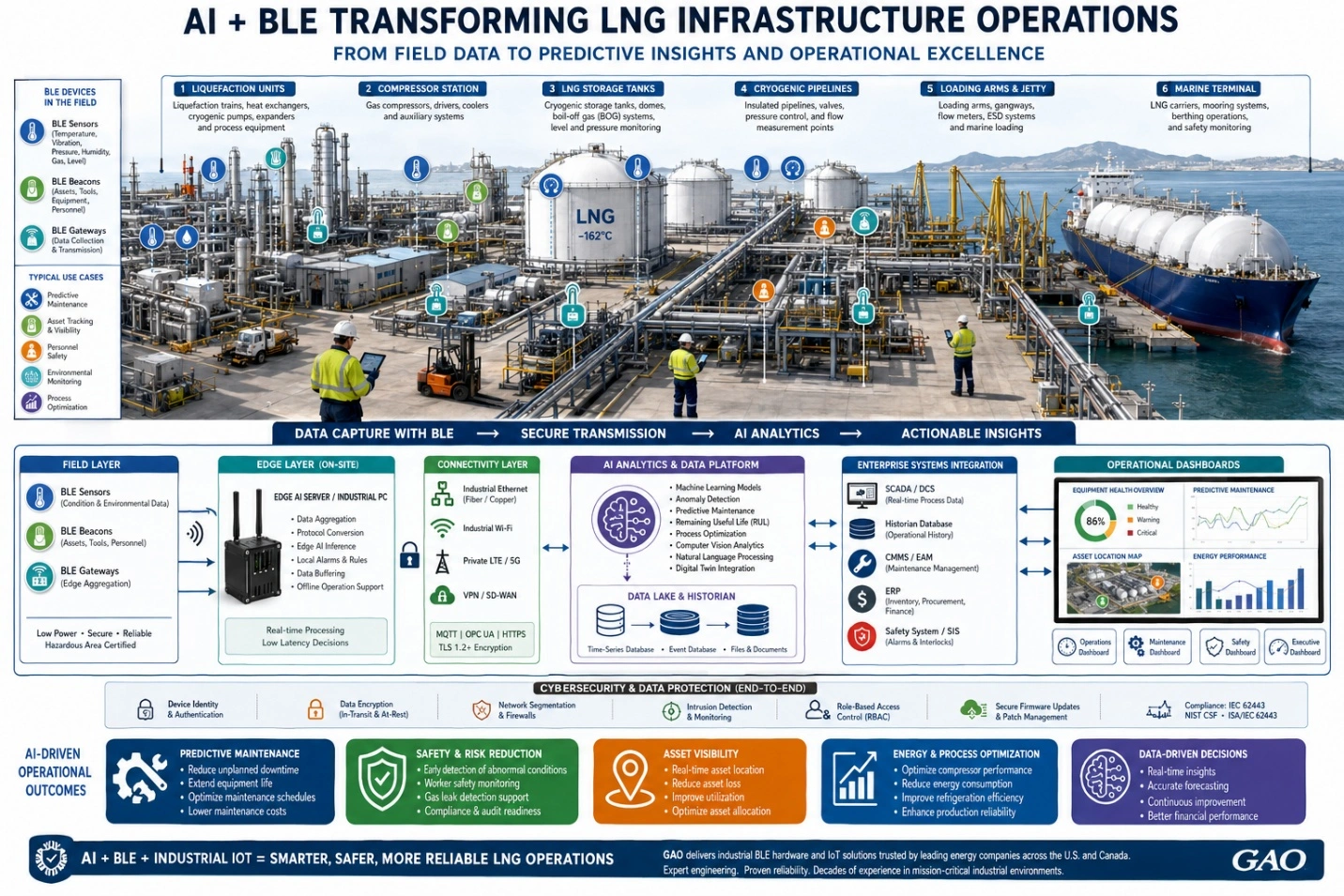
Fundamental Concepts of AI-Enabled BLE Solutions for LNG Infrastructure
LNG infrastructure includes interconnected production, storage, transportation, and distribution assets designed to safely process natural gas at cryogenic temperatures approaching minus 162°C. These facilities contain thousands of rotating machines, pressure vessels, heat exchangers, cryogenic valves, loading systems, custody transfer metering stations, emergency shutdown devices, fire and gas detection systems, electrical equipment, and instrumentation requiring continuous operational oversight.
Artificial Intelligence of Things (AIoT) introduces machine learning, industrial AI, edge AI, statistical modeling, anomaly detection, and predictive analytics into operational environments by combining intelligent software with industrial sensing technologies.
Within LNG infrastructure, BLE technology serves as one layer of the overall sensing strategy by supporting:
- Personnel location awareness
- Mobile asset visibility
- Temporary equipment monitoring
- Condition monitoring sensors
- Environmental sensing
- Maintenance workflow automation
- Digital inspection processes
- Wireless instrumentation expansion
BLE complements existing industrial communication technologies rather than replacing them. Process control continues to rely upon deterministic industrial protocols while BLE efficiently collects supplemental operational information from assets where wired instrumentation may be impractical or prohibitively expensive.
AI converts this operational information into actionable intelligence by detecting emerging equipment degradation, correlating multiple sensor inputs, identifying abnormal operating patterns, forecasting maintenance requirements, and prioritizing operational risks before production is affected.
AI Applications Across LNG Infrastructure Operations
Modern LNG facilities operate continuously, making equipment availability one of the highest operational priorities. AI improves decision-making throughout multiple operational domains.
AI Predictive Maintenance for Cryogenic Equipment
Cryogenic pumps, boil-off gas compressors, refrigerant compressors, LNG transfer pumps, expanders, and auxiliary rotating equipment generate significant operational data. BLE condition monitoring sensors collect vibration, temperature, motor health, bearing condition, and operating status data.
AI models evaluate long-term trends to identify:
- Bearing degradation
- Shaft imbalance
- Lubrication issues
- Cavitation
- Seal deterioration
- Motor overheating
- Performance drift
Maintenance teams receive prioritized recommendations before failures cause production interruptions.
AI Asset Tracking for Critical LNG Equipment
LNG terminals contain thousands of movable assets including:
- Portable gas detectors
- Calibration equipment
- Maintenance toolkits
- Cryogenic hoses
- Inspection instruments
- Portable analyzers
- Emergency response equipment
- Confined-space safety equipment
BLE beacons allow AI software to identify utilization trends, idle assets, misplaced equipment, and maintenance bottlenecks, reducing search time while improving workforce productivity.
AI Workforce Safety Monitoring
Worker safety remains essential throughout LNG infrastructure because personnel routinely perform maintenance near:
- Cryogenic process equipment
- High-pressure gas systems
- Hazardous classified areas
- LNG loading facilities
- Compressor buildings
- Confissioning activities
- Tank maintenance operations
BLE-enabled personnel identification supports AI-assisted monitoring by helping safety systems recognize:
- Worker proximity
- Restricted area entry
- Lone worker conditions
- Muster verification
- Emergency evacuation progress
- Maintenance team accountability
AI correlates these events with process conditions to improve operational safety awareness.
AI Inspection Intelligence
Routine inspections generate thousands of observations every week.
BLE-tagged inspection points enable AI software to compare inspection history against:
- Equipment maintenance history
- Process trends
- Environmental conditions
- Failure history
- Operator observations
Rather than reviewing inspections independently, AI identifies relationships across multiple systems that human reviewers may overlook.
AI Energy Optimization
Liquefaction consumes significant electrical power through refrigeration compressors, cooling systems, pumps, and supporting utilities.
AI continuously evaluates:
- Compressor efficiency
- Refrigeration cycle performance
- Heat exchanger effectiveness
- Pump loading
- Utility consumption
- Power demand trends
BLE environmental sensors provide supplementary localized measurements supporting broader energy optimization initiatives.
AI Environmental Compliance
Environmental regulations require continuous monitoring of methane emissions, equipment condition, safety systems, and operational performance.
AI assists compliance teams by analyzing:
- Leak detection trends
- Inspection completion
- Sensor abnormalities
- Maintenance records
- Alarm frequency
- Equipment health indicators
This improves regulatory reporting while supporting emissions reduction initiatives.
GAO has worked with organizations requiring dependable BLE hardware capable of supporting industrial monitoring initiatives where operational reliability and long-term maintainability are primary design considerations.
AI Operational Intelligence Workflow for LNG Infrastructure Using BLE Sensors and Edge AI
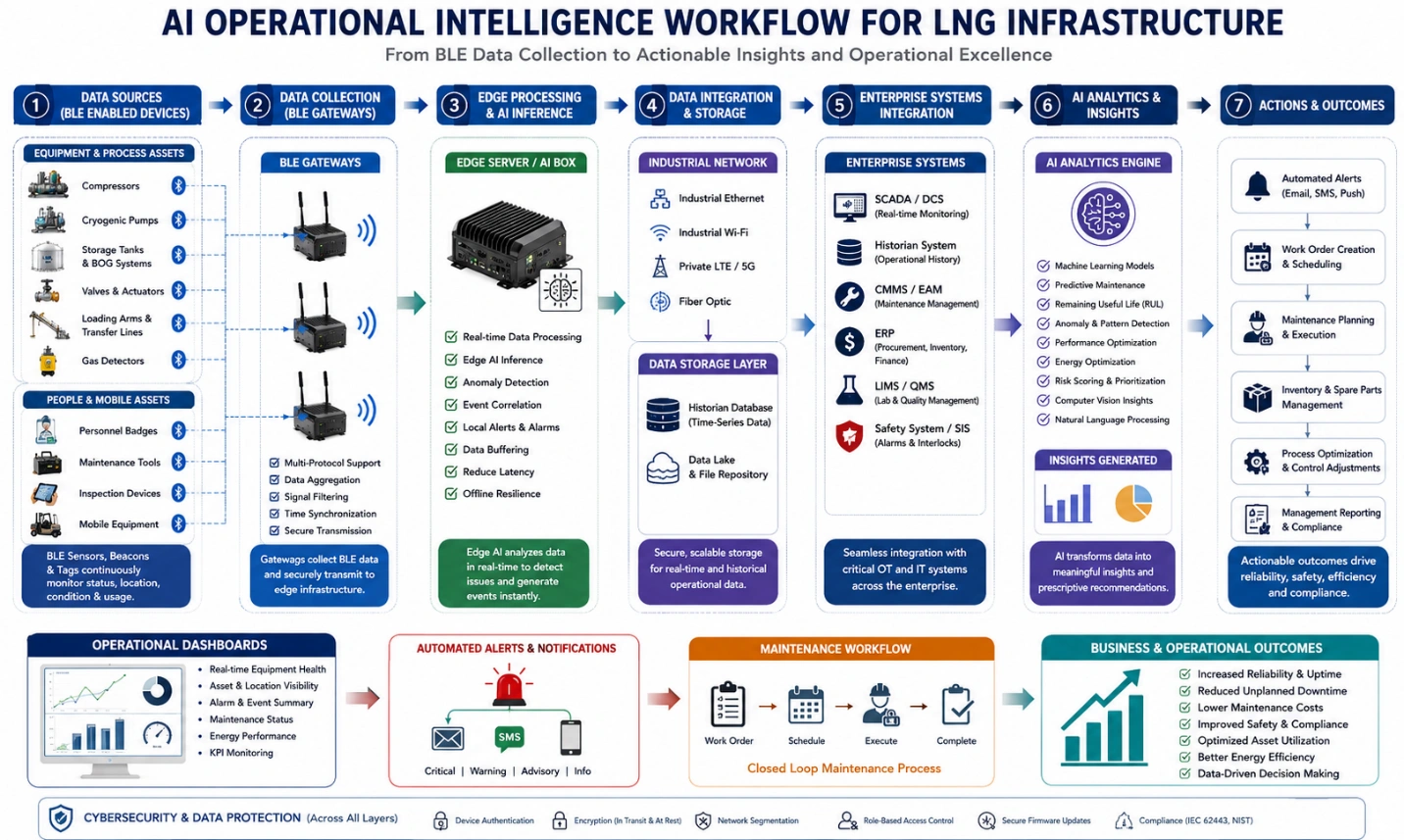
Deployment Scenarios for AI-Driven LNG Infrastructure Monitoring
Successful AI deployment depends on operational objectives, hazardous area classifications, communications availability, maintenance practices, and existing industrial automation systems.
LNG Liquefaction Plants
Large liquefaction facilities benefit from AI-driven equipment health monitoring across refrigeration trains, gas turbines, compressors, cryogenic pumps, heat exchangers, and utility systems.
Engineering considerations include:
- Continuous operation
- High equipment redundancy
- Large rotating machinery
- Predictive shutdown planning
- Process availability
LNG Import and Export Terminals
Marine terminals require coordinated monitoring across loading arms, berth operations, transfer pipelines, custody transfer metering, storage tanks, and marine support equipment.
AI assists terminal operators by improving:
- Equipment utilization
- Loading sequence optimization
- Maintenance coordination
- Operational readiness
- Inspection scheduling
LNG Storage Facilities
Storage tank farms contain extensive supporting infrastructure including pressure relief systems, pumps, valves, boil-off gas recovery equipment, instrumentation, and cryogenic piping.
AI evaluates long-term operational patterns that indicate:
- Valve degradation
- Insulation deterioration
- Equipment utilization changes
- Mechanical wear
- Maintenance priority
Peak Shaving Facilities
Peak shaving plants experience varying operational loads throughout seasonal demand cycles.
AI forecasts equipment readiness based on:
- Historical operating hours
- Maintenance history
- Environmental conditions
- Equipment health indicators
- Seasonal demand forecasts
LNG Distribution Networks
Truck loading terminals, satellite storage facilities, and regional distribution hubs require visibility across distributed assets.
BLE-based monitoring allows AI software to coordinate:
- Equipment inspections
- Asset utilization
- Maintenance scheduling
- Personnel deployment
- Fleet support operations
Operational Workflow from BLE Data Collection to AI Decision Support
A successful AI solution for LNG infrastructure depends on reliable operational data flowing through multiple engineering systems before generating business decisions.
Step 1. Field Data Acquisition
BLE sensors continuously monitor operational parameters including:
- Equipment vibration
- Surface temperature
- Humidity
- Cryogenic environment conditions
- Valve position
- Asset movement
- Personnel location
- Maintenance status
BLE beacons identify movable assets while BLE gateways collect wireless transmissions from surrounding field devices.
Step 2. Local Communications
BLE gateways aggregate nearby sensor traffic before forwarding information through industrial communication networks such as:
- Ethernet
- Industrial Wi-Fi
- Fiber optic networks
- Private LTE
- 5G industrial connectivity
Where operational continuity is essential, redundant communications improve reliability by minimizing single points of failure.
Step 3. Edge Processing
Industrial edge servers located within LNG facilities perform immediate processing functions including:
- Data validation
- Sensor filtering
- Event correlation
- Threshold monitoring
- Local AI inference
- Alarm generation
Edge AI reduces latency for operational events requiring rapid response while minimizing unnecessary network traffic to centralized computing resources.
Step 4. Operational Data Management
Validated operational information is forwarded into multiple industrial software systems including:
- SCADA
- Distributed Control Systems (DCS)
- Industrial historians
- Asset Performance Management (APM)
- Computerized Maintenance Management Systems (CMMS)
- Enterprise Asset Management (EAM)
- Manufacturing Execution Systems (MES)
- Enterprise Resource Planning (ERP)
Data normalization ensures AI models receive consistent operational information across diverse equipment manufacturers and instrumentation technologies.
Step 5. AI Analysis
Machine learning models analyze both real-time and historical operational information using techniques such as:
- Time-series forecasting
- Anomaly detection
- Remaining useful life estimation
- Failure prediction
- Pattern recognition
- Predictive maintenance modeling
- Risk scoring
- Equipment performance optimization
These analytical methods enable maintenance teams to shift from reactive maintenance toward condition-based and predictive maintenance strategies.
End-to-End AI and BLE Architecture for LNG Infrastructure: Secure Data Flow from Field Devices to Enterprise Decision Support
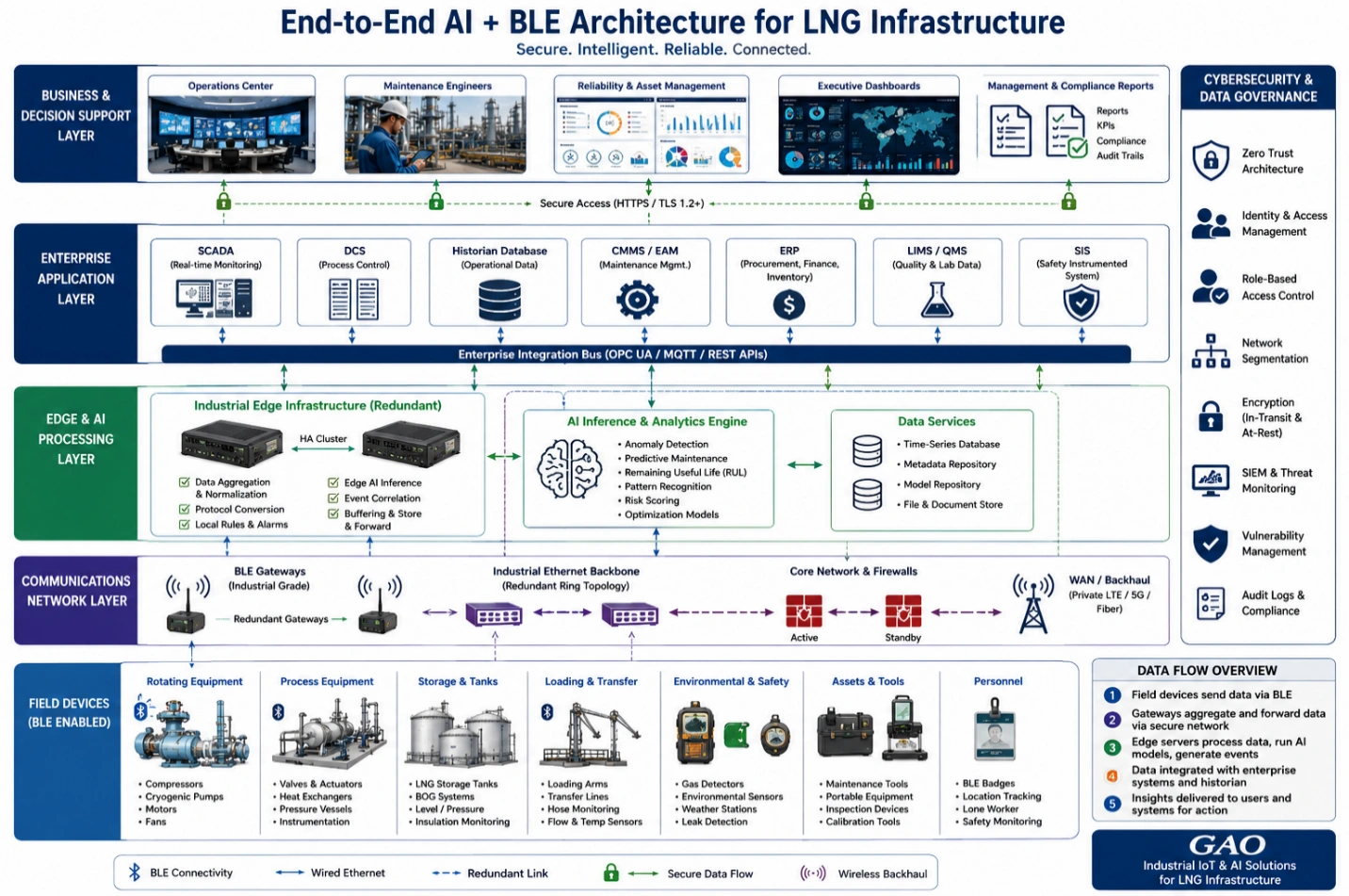
BLE Infrastructure, AI Software, Communications, and Deployment Considerations for LNG Facilities
BLE serves as a low-power wireless connectivity layer that extends operational visibility to equipment, personnel, and mobile assets where continuous wired instrumentation may not be practical. Within LNG infrastructure, BLE gateways, BLE beacons, and BLE sensors are typically integrated alongside existing industrial automation systems rather than functioning as standalone technologies. The resulting AIoT solution combines field data acquisition with industrial software, secure communications, and artificial intelligence to support condition monitoring, operational awareness, and predictive decision-making.
BLE Hardware Components in LNG Infrastructure
BLE gateways act as aggregation points that receive data from multiple nearby BLE devices and forward it through higher-bandwidth industrial networks. Proper gateway placement is influenced by cryogenic process areas, steel structures, pipe racks, storage tanks, hazardous zones, radio frequency propagation, and redundancy requirements. Engineering teams commonly perform radio site surveys to optimize coverage while minimizing interference and ensuring dependable connectivity for maintenance operations and safety-critical monitoring.
BLE Sensors for Equipment and Environmental Monitoring
BLE sensors extend operational visibility beyond traditional process instrumentation by collecting supplementary condition and environmental data from assets that may not justify permanent wired monitoring. Within LNG infrastructure, sensor selection is influenced by hazardous area classifications, cryogenic operating conditions, enclosure ratings, battery life, calibration requirements, and maintenance accessibility.
Common BLE sensing applications include:
- Rotating equipment vibration monitoring
- Bearing temperature monitoring
- Motor housing temperature
- Ambient humidity monitoring
- Portable pressure measurement
- Valve position verification
- Pipe surface temperature monitoring
- LNG transfer hose monitoring
- Portable gas detector status
- Environmental monitoring around loading facilities
These sensors complement existing Distributed Control Systems (DCS) and Safety Instrumented Systems (SIS) by providing additional operational intelligence without modifying critical process control loops.
BLE Beacons for Asset and Workforce Visibility
BLE beacons support location awareness for mobile equipment, maintenance resources, inspection tools, emergency response equipment, and authorized personnel. AI software correlates beacon location information with maintenance schedules, work permits, inspection history, and equipment condition to improve operational coordination.
Typical beacon-enabled assets include:
- Portable gas analyzers
- Thermal imaging cameras
- Confined space rescue equipment
- Calibration instruments
- Portable communications equipment
- Maintenance carts
- Cryogenic PPE inventories
- Emergency breathing apparatus
- Inspection drones
- Mobile maintenance workstations
Rather than simply displaying locations, AI evaluates utilization trends, identifies recurring equipment shortages, recommends redistribution strategies, and supports continuous operational improvement.
Artificial Intelligence Models Supporting LNG Operations
Artificial intelligence transforms operational data into engineering recommendations by applying specialized analytical methods suited to industrial environments.
Frequently deployed AI methods include:
- Supervised machine learning for equipment failure prediction
- Unsupervised anomaly detection for identifying abnormal operating behavior
- Time-series forecasting for process stability
- Remaining Useful Life (RUL) estimation for rotating machinery
- Computer vision for corrosion, insulation, and structural inspections
- Natural language processing for maintenance records and operator logs
- Reinforcement learning for selected energy optimization scenarios
- Statistical process monitoring for early process deviation detection
Each analytical method addresses a different operational objective, allowing maintenance engineers, operations personnel, and reliability teams to make informed decisions based on continuously updated information rather than periodic manual assessments.
Communication Infrastructure
Reliable communications are fundamental to AI-enabled LNG monitoring systems. BLE typically serves as the local wireless layer, while higher-capacity industrial networks transport data throughout the facility.
Typical communications infrastructure includes:
- Bluetooth Low Energy (BLE)
- Industrial Ethernet
- Fiber optic backbone
- Industrial Wi-Fi
- Private LTE
- Industrial 5G
- OPC UA
- MQTT
- Modbus TCP
- PROFINET
- EtherNet/IP
- IEC 61850 where applicable for supporting electrical infrastructure
Network segmentation, redundant communication paths, deterministic industrial networking, and quality-of-service policies help maintain reliable information flow between field devices and operational software.
Cloud Software Deployment
Cloud-hosted AI software is appropriate when LNG operators manage multiple geographically distributed terminals, satellite facilities, regasification sites, or maintenance organizations.
Typical advantages include:
- Centralized AI model management
- Fleet-wide equipment performance comparisons
- Enterprise reporting
- Long-term historical analytics
- Remote engineering collaboration
- Simplified software updates
- Elastic computing resources for large analytical workloads
Cloud deployments are particularly valuable for organizations seeking consolidated operational intelligence across multiple facilities while maintaining standardized maintenance practices.
Server-Based Deployment
Many LNG operators prefer privately managed server deployments because operational continuity, cybersecurity, regulatory requirements, and data governance frequently require greater control over operational information.
Server deployments commonly support:
- Low-latency analytics
- Local AI inference
- Facility-specific data retention policies
- Integration with existing operational technology networks
- High availability configurations
- Operation during limited external network connectivity
Server deployments are especially appropriate for critical LNG infrastructure where immediate operational decisions must remain available regardless of external communications.
Cybersecurity Considerations
Industrial cybersecurity should be incorporated throughout the complete solution rather than treated as an afterthought.
Recommended security practices include:
- Zero Trust principles
- Multi-factor authentication
- Device identity management
- Secure firmware updates
- Role-based access control
- Encrypted communications
- Network segmentation
- Continuous vulnerability assessment
- Security Information and Event Management (SIEM) integration
- Continuous asset inventory
Compliance with recognized industrial cybersecurity guidance such as IEC 62443 and the NIST Cybersecurity Framework helps reduce operational risk while supporting long-term maintainability.
GAO has supplied industrial BLE hardware to organizations operating demanding industrial environments where dependable communications, product quality, and technical support are essential throughout deployment and lifecycle management.
Cloud vs. Server Deployment Models for AI-Enabled LNG Infrastructure: A Technical Comparison
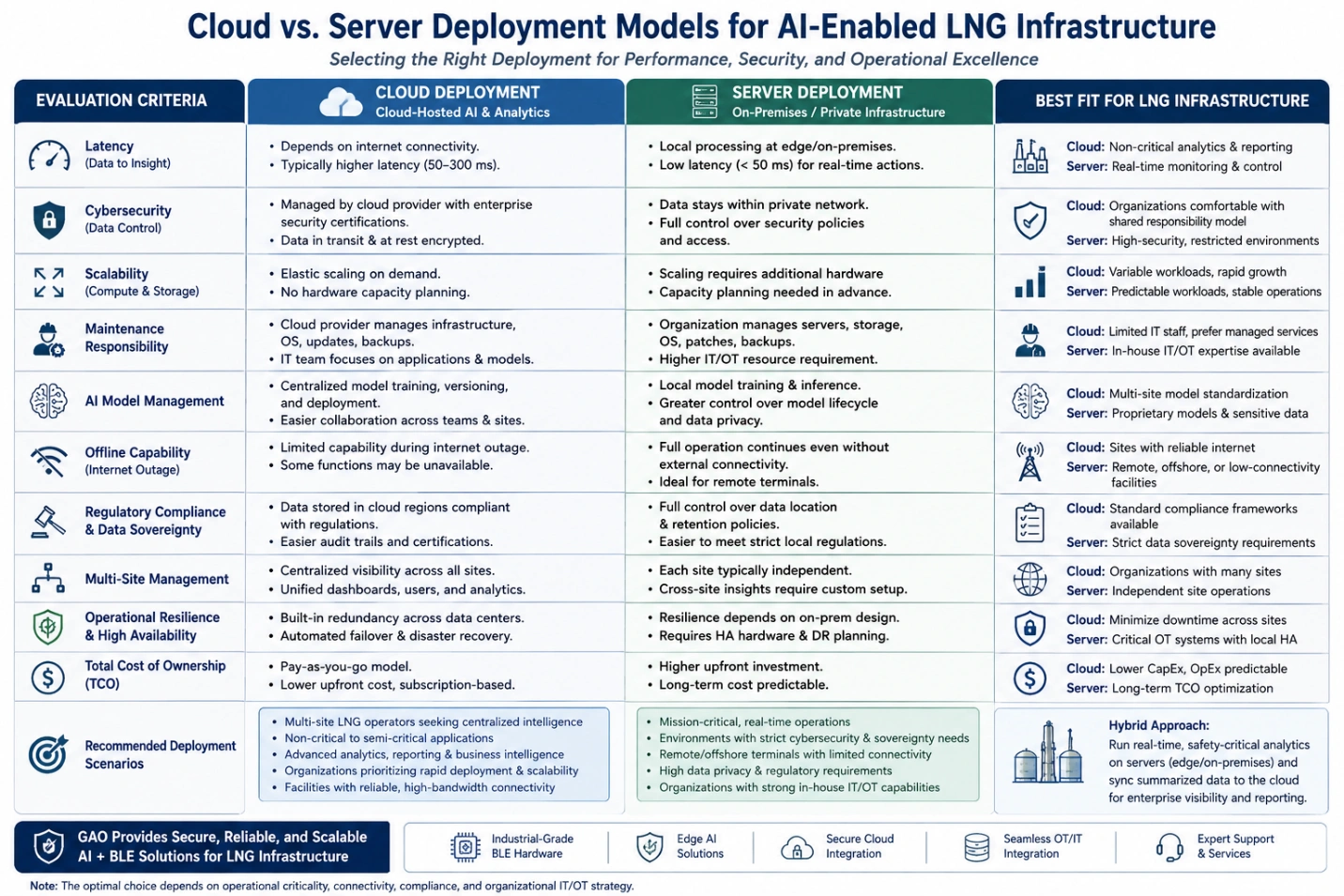
Technical Capabilities and Operational Benefits of AI-Driven LNG Infrastructure
Successful AI implementation delivers measurable operational improvements when supported by high-quality operational data, well-trained analytical models, and dependable industrial communications.
Improved Equipment Reliability
Predictive maintenance reduces unexpected failures by detecting equipment degradation before production is affected. Maintenance teams can prioritize repairs based on actual equipment condition instead of fixed maintenance intervals.
Benefits include:
- Reduced unplanned shutdowns
- Increased compressor availability
- Improved rotating equipment reliability
- Extended equipment service life
- Lower maintenance costs
Enhanced Process Safety
AI continuously evaluates information from multiple operational sources, helping identify developing operational risks that individual systems may not recognize independently.
Safety improvements include:
- Earlier abnormal condition detection
- Improved maintenance planning
- Enhanced emergency preparedness
- Better workforce accountability
- Improved inspection consistency
These capabilities support Process Safety Management (PSM) programs without replacing established engineering safeguards.
Greater Asset Visibility
BLE-enabled monitoring improves visibility across thousands of movable and fixed assets distributed throughout LNG facilities.
Operational improvements include:
- Faster equipment location
- Reduced asset loss
- Improved inspection efficiency
- Better calibration management
- Enhanced maintenance coordination
Energy Performance Improvements
AI continuously evaluates refrigeration efficiency, compressor loading, equipment utilization, utility consumption, and operational scheduling.
Potential benefits include:
- Lower electrical consumption
- Improved refrigeration efficiency
- Reduced unnecessary equipment operation
- Better utility planning
- Improved production efficiency
Better Maintenance Decision-Making
Maintenance organizations gain a comprehensive understanding of equipment health by combining historical maintenance records with real-time operational information.
AI assists maintenance planning through:
- Failure probability estimation
- Maintenance prioritization
- Spare parts planning
- Workforce scheduling
- Work order optimization
- Root cause identification
Regulatory Compliance Support
LNG operators must comply with numerous regulatory and industry standards governing process safety, environmental protection, occupational safety, and equipment integrity.
AI supports compliance by improving:
- Inspection documentation
- Maintenance traceability
- Audit preparation
- Operational reporting
- Equipment history management
- Environmental monitoring
Scalability Across LNG Operations
Well-designed AI solutions can expand from individual compressor trains or storage areas to complete liquefaction facilities and geographically distributed LNG operations.
Scalable deployments typically support:
- Additional BLE devices
- Multiple facilities
- Expanded AI models
- Increased historical data retention
- Centralized engineering oversight
- Standardized maintenance practices
AI-Enabled BLE Monitoring for LNG Infrastructure: Operational Improvements, KPI Tracking, and Continuous Performance Optimization
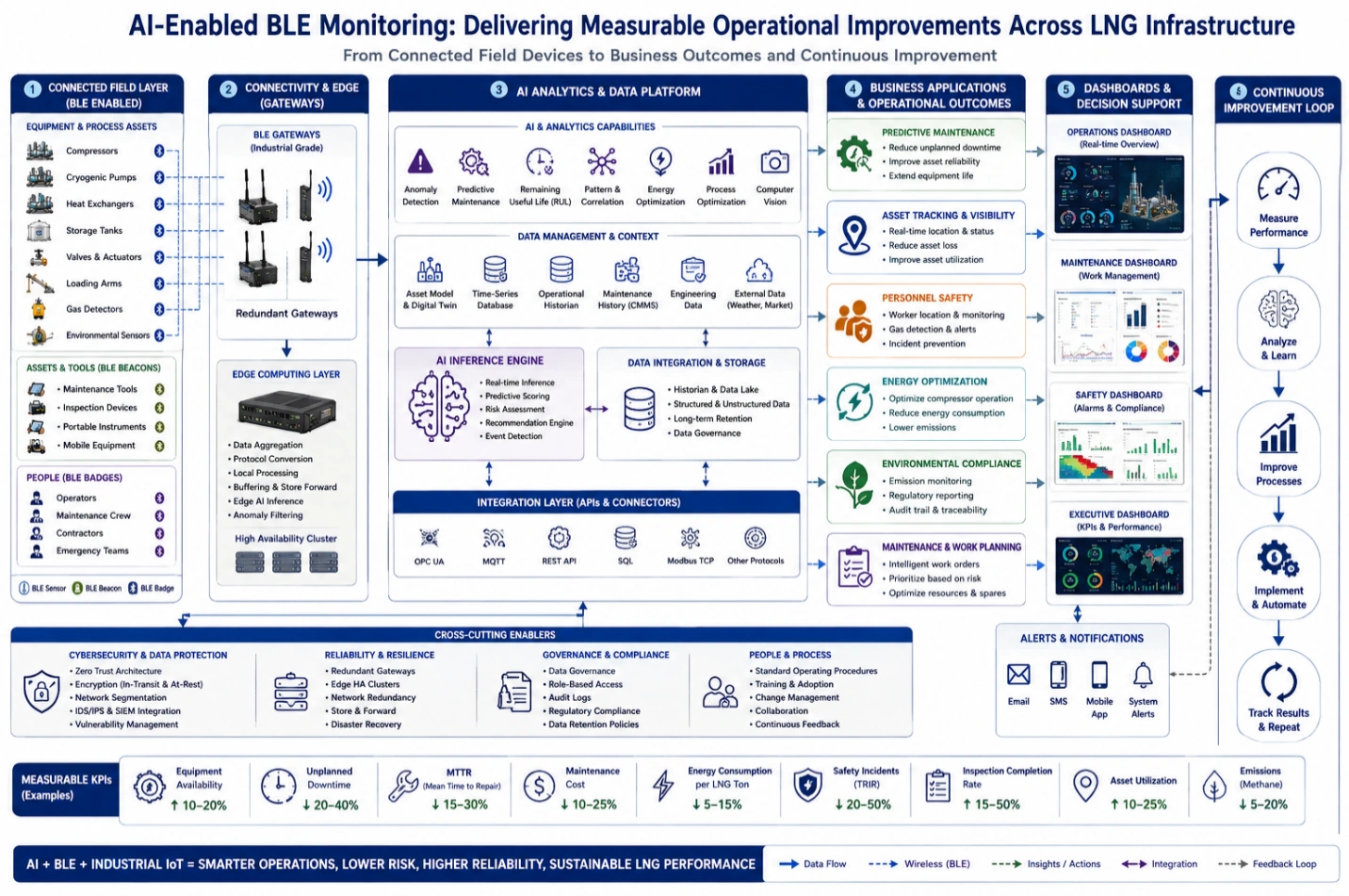
Engineering Best Practices and Implementation Recommendations
Organizations planning AI-enabled BLE monitoring for LNG infrastructure benefit from a phased implementation strategy that minimizes operational disruption while establishing measurable business value.
Recommended practices include:
- Conduct comprehensive site surveys before gateway installation.
- Evaluate hazardous area classifications when selecting field devices.
- Integrate AI with existing SCADA, DCS, CMMS, EAM, ERP, and historian software rather than creating isolated data sources.
- Establish data quality validation before training AI models.
- Standardize equipment naming conventions across facilities.
- Validate AI recommendations against engineering expertise before automating operational decisions.
- Develop cybersecurity policies covering connected field devices throughout their operational lifecycle.
- Define measurable Key Performance Indicators before deployment.
Representative KPIs include:
- Mean Time Between Failures (MTBF)
- Mean Time To Repair (MTTR)
- Equipment availability
- Compressor utilization
- Predictive maintenance accuracy
- Inspection completion rate
- Asset utilization
- Energy consumption per LNG ton
- Unplanned downtime
- Safety incident frequency
- Maintenance backlog
- Methane emission performance
Successful implementation depends on continuous collaboration among operations, maintenance, reliability engineering, instrumentation, cybersecurity, and information technology teams.
For more than three decades, GAO has supported organizations across the United States and Canada by supplying BLE, RFID, and IoT hardware products and systems. Headquartered in New York City and Toronto, Canada, GAO is recognized among the leading global B2B and public-sector suppliers in this field. Together with its sister companies, GAO Research Inc. and GAO Tek Inc., GAO has served Fortune 500 companies, leading research organizations, universities, and government agencies through sustained investment in research and development, rigorous quality assurance, and expert technical support provided remotely and onsite.
Advancing AI-Enabled LNG Infrastructure with GAO
Artificial intelligence supported by BLE technologies enables LNG infrastructure operators to move beyond reactive operations toward data-driven maintenance, improved process safety, enhanced operational visibility, and more efficient asset utilization. Successful implementation requires careful planning, dependable industrial communications, secure system integration, high-quality operational data, and AI models that reflect real operating conditions.
Organizations that adopt a structured deployment strategy can improve equipment reliability, reduce operational risk, strengthen regulatory compliance, and optimize maintenance resources while preserving existing industrial control investments. GAO helps organizations evaluate BLE hardware, integrate IoT technologies with industrial software, and implement practical monitoring solutions tailored to LNG infrastructure operating requirements.
Building the Future of Industrial AI and IoT with Aperture Venture Studio and GAO
For more than three decades, GAO Group of Companies has invested extensively in research and development of industrial BLE, RFID, and IoT technologies. As generative AI demonstrated significant value for industrial operations, we expanded our work in AIoT, integrating artificial intelligence with BLE, RFID, and connected sensing technologies for sectors such as LNG infrastructure. To further accelerate industrial AI innovation, we founded Aperture Venture Studio to help develop and scale advanced AI and IoT solutions addressing complex operational challenges across critical industries. Aperture has attracted leading AI researchers, IoT specialists, experienced executives, investors, and industry collaborators. Through initiatives including Aperture Ventures Summit and TekSummit, we continue to foster technical knowledge sharing and vibrant AI and IoT communities. We welcome opportunities to collaborate with advisors, industry professionals, investors, and organizations seeking dependable AI and IoT solutions.