
AI and BLE for Petrochemical Processing
AI-Driven Petrochemical Processing Using BLE-Enabled Industrial IoT
Petrochemical processing facilities operate some of the world’s most complex continuous manufacturing environments, where feedstock variability, hazardous operating conditions, rotating equipment reliability, process stability, environmental compliance, and production efficiency directly influence profitability and operational safety. Artificial Intelligence of Things (AIoT), which combines artificial intelligence with industrial IoT devices and connected operational systems, is becoming an important technology for transforming refinery and petrochemical operations into data-driven production environments.
Within petrochemical processing, Bluetooth Low Energy (BLE) gateways, BLE beacons, and BLE sensors provide cost-effective, low-power wireless visibility for mobile assets, maintenance activities, worker safety, environmental monitoring, and condition monitoring applications. AI converts these continuously collected operational data streams into predictive insights, anomaly detection, maintenance recommendations, production optimization, and operational decision support.
Rather than replacing traditional Distributed Control Systems (DCS), Supervisory Control and Data Acquisition (SCADA), or Safety Instrumented Systems (SIS), BLE-enabled AI solutions complement existing operational technology by supplying additional contextual information from equipment, personnel, and field assets that historically remained invisible.
Organizations throughout North America increasingly deploy these technologies to improve reliability, reduce unplanned shutdowns, strengthen process safety management, and optimize turnaround planning. GAO has supplied industrial BLE, RFID, and IoT hardware products and systems that help industrial organizations expand operational visibility while integrating with existing industrial automation investments.
AI-Enabled BLE Solution Architecture for Petrochemical Processing with Edge Intelligence and Enterprise System Integration
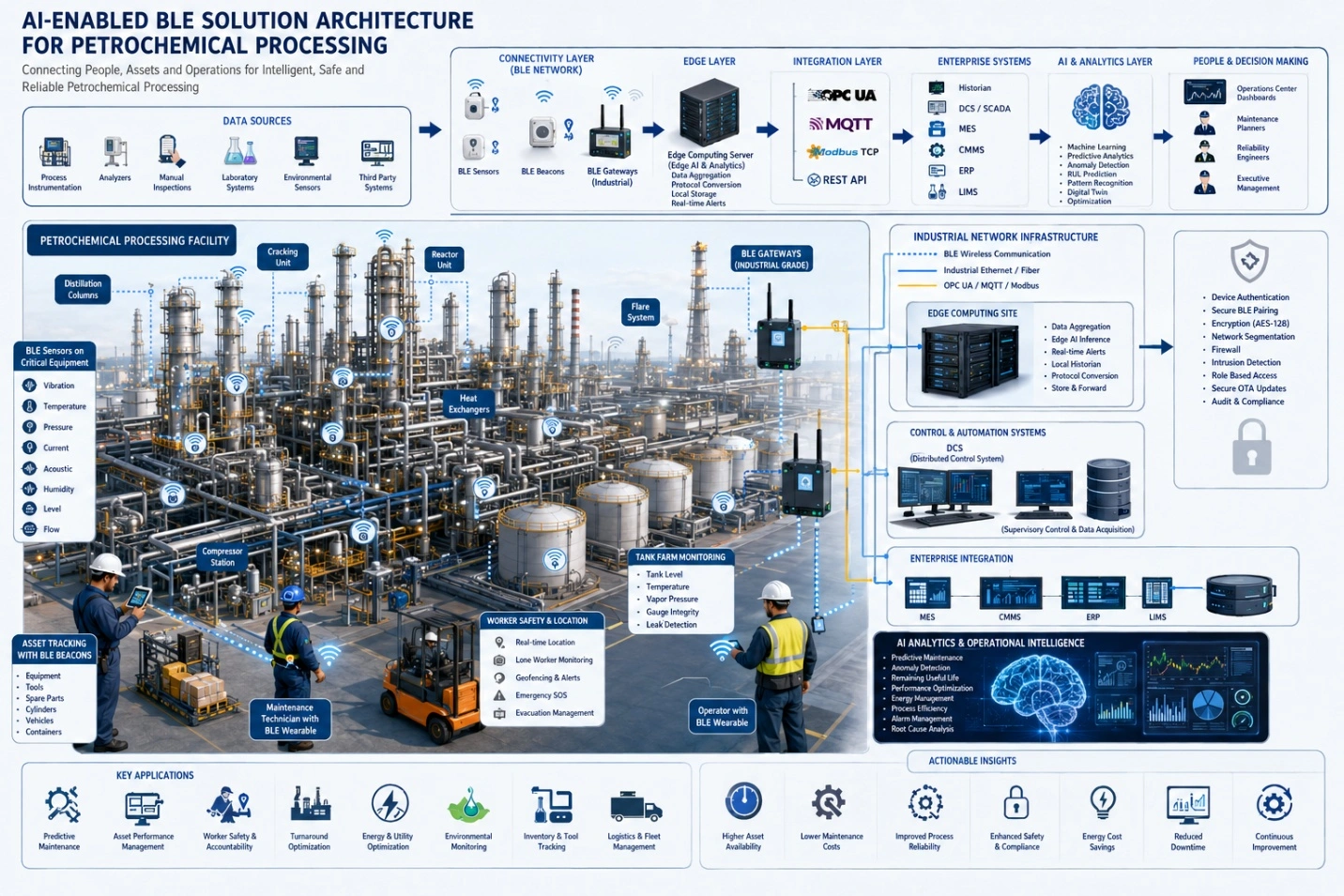
Understanding AI-Enabled BLE Solutions in Petrochemical Processing
Petrochemical production facilities process hydrocarbons through highly integrated chemical conversion operations including steam cracking, catalytic reforming, polymer production, alkylation, hydrogen production, sulfur recovery, solvent recovery, and specialty chemical manufacturing. These operations involve thousands of process instruments, rotating assets, field operators, contractors, maintenance teams, laboratory personnel, and mobile equipment distributed across large production sites.
Traditional industrial automation provides extensive visibility into process variables such as pressure, temperature, flow rate, tank levels, valve positions, and control loops. However, numerous operational activities remain difficult to monitor continuously, including:
• Operator inspections
• Equipment accessibility
• Portable instrument usage
• Maintenance tool tracking
• Contractor movement
• Environmental exposure
• Valve inspection routes
• Safety equipment availability
• Mobile asset utilization
• Manual operating procedures
BLE technologies extend operational visibility into these activities while AI identifies patterns that are difficult for human operators to recognize from millions of operational events.
Typical AI methods include:
• Predictive maintenance models
• Time-series forecasting
• Remaining useful life estimation
• Anomaly detection
• Equipment health scoring
• Computer vision integration
• Reinforcement learning for process optimization
• Large language model assisted operational knowledge retrieval
• Root cause analysis
• Process deviation detection
These analytical methods continuously learn from production history, maintenance records, equipment operating conditions, inspection reports, laboratory measurements, and real-time industrial sensor data.
Because BLE devices consume very little power, battery-operated sensors can remain operational for years while providing continuous operational intelligence from locations where traditional wired instrumentation would be expensive or impractical.
Why AI Is Transforming Petrochemical Processing
Modern petrochemical facilities face simultaneous pressure to improve production efficiency, reduce emissions, increase equipment reliability, strengthen cybersecurity, minimize energy consumption, and comply with increasingly rigorous environmental regulations.
Major operational challenges include:
• Compressor failures
• Pump cavitation
• Heat exchanger fouling
• Catalyst degradation
• Corrosion under insulation
• Pipeline vibration
• Steam system inefficiencies
• Utility optimization
• Turnaround planning
• Flare minimization
• Fugitive emissions
• Operator safety
• Contractor management
• Asset lifecycle optimization
• Aging infrastructure
AI enables engineering teams to transition from reactive maintenance toward predictive operational strategies.
Examples include:
• Predicting centrifugal compressor bearing degradation weeks before failure
• Detecting abnormal pump vibration patterns
• Forecasting heat exchanger cleaning intervals
• Optimizing steam consumption
• Identifying abnormal operator inspection trends
• Predicting catalyst replacement timing
• Forecasting process yield degradation
• Detecting abnormal warehouse inventory consumption
• Optimizing maintenance scheduling
• Improving spare parts planning
These capabilities improve production availability while reducing operational risk.
GAO supports organizations implementing industrial BLE solutions by providing reliable wireless sensing products suitable for challenging industrial environments.
Conventional vs. AI-Assisted BLE-Enabled Maintenance for Petrochemical Processing: Operational Performance Comparison
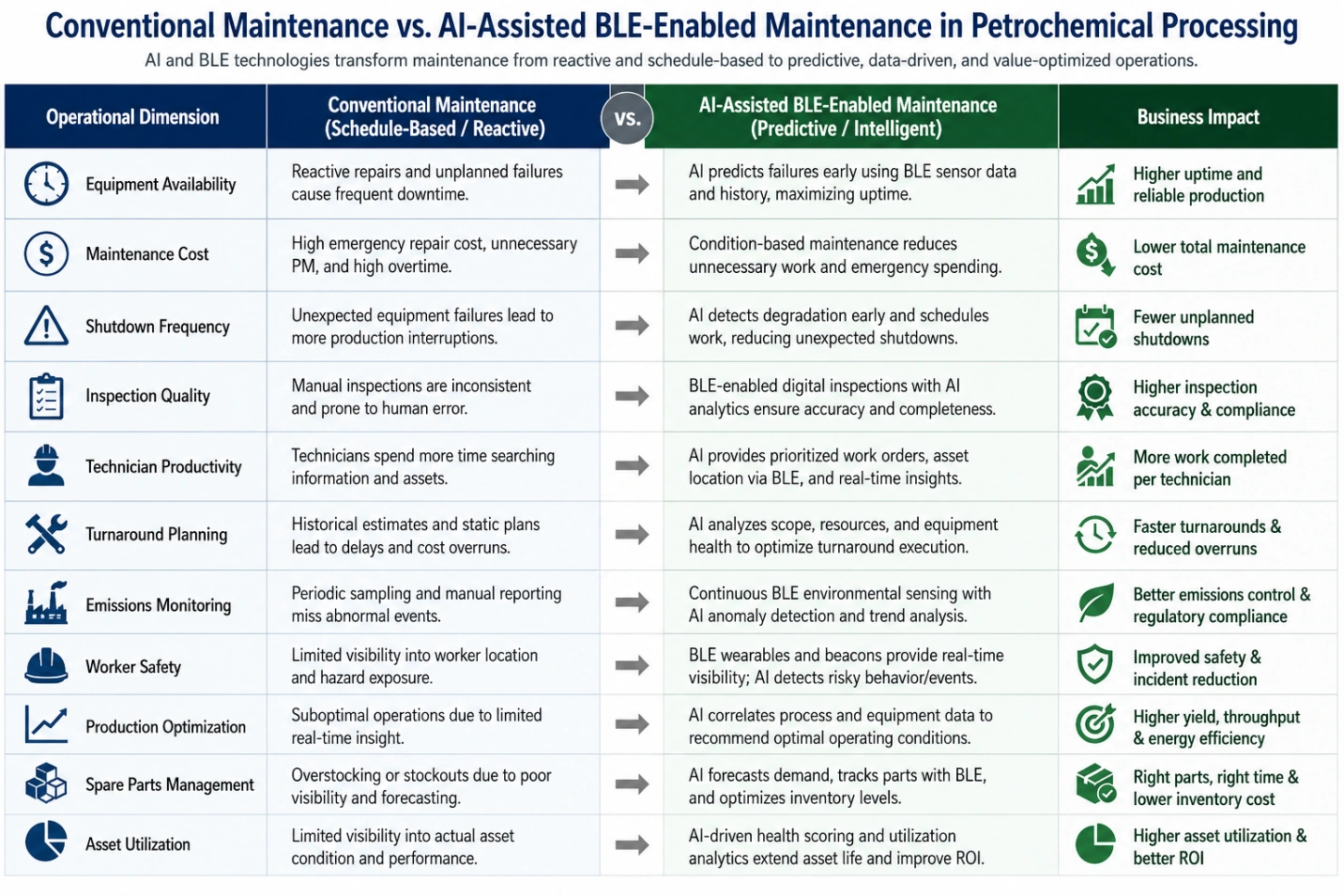
AI Applications Across Petrochemical Processing Operations
Artificial intelligence delivers measurable operational improvements throughout petrochemical production by combining industrial data with BLE-enabled sensing and location awareness.
H3: Predictive Rotating Equipment Maintenance
Critical assets include:
• Centrifugal compressors
• Process pumps
• Cooling tower fans
• Gas turbines
• Electric motors
• Blowers
• Gearboxes
BLE vibration and temperature sensors provide supplementary condition data that AI combines with historian records and maintenance history to predict failures before they interrupt production.
Worker Safety Intelligence
BLE wearables and location beacons improve awareness of personnel operating in hazardous areas including:
• Confined spaces
• Hydrogen processing units
• High-temperature process areas
• Tank farms
• Loading terminals
• Utility plants
AI analyzes worker movement, evacuation routes, lone-worker status, restricted area access, and emergency response readiness to improve industrial safety management.
Turnaround Maintenance Optimization
Scheduled shutdowns involve thousands of coordinated maintenance activities.
BLE asset tracking assists with monitoring:
• Inspection instruments
• Portable analyzers
• Welding equipment
• Scaffold materials
• Calibration devices
• Maintenance tools
• Replacement valves
• Instrumentation components
• Safety equipment
AI identifies scheduling conflicts, predicts labor bottlenecks, recommends equipment allocation, and estimates project completion risk.
Environmental Monitoring
BLE environmental sensors help monitor:
• Ambient temperature
• Humidity
• Gas concentrations
• VOC exposure
• Equipment enclosure conditions
• Storage facilities
AI detects abnormal environmental trends that may affect product quality, worker safety, or regulatory compliance.
Warehouse and Spare Parts Intelligence
Petrochemical maintenance depends upon rapid access to replacement components.
AI combines BLE asset location with ERP, CMMS, and inventory software to improve:
• Spare parts availability
• Inventory forecasting
• Warehouse utilization
• Procurement planning
• Maintenance readiness
• Critical equipment support
AI-Supported BLE Maintenance Workflow for Petrochemical Processing: From Sensor Data Collection to Continuous Machine Learning.
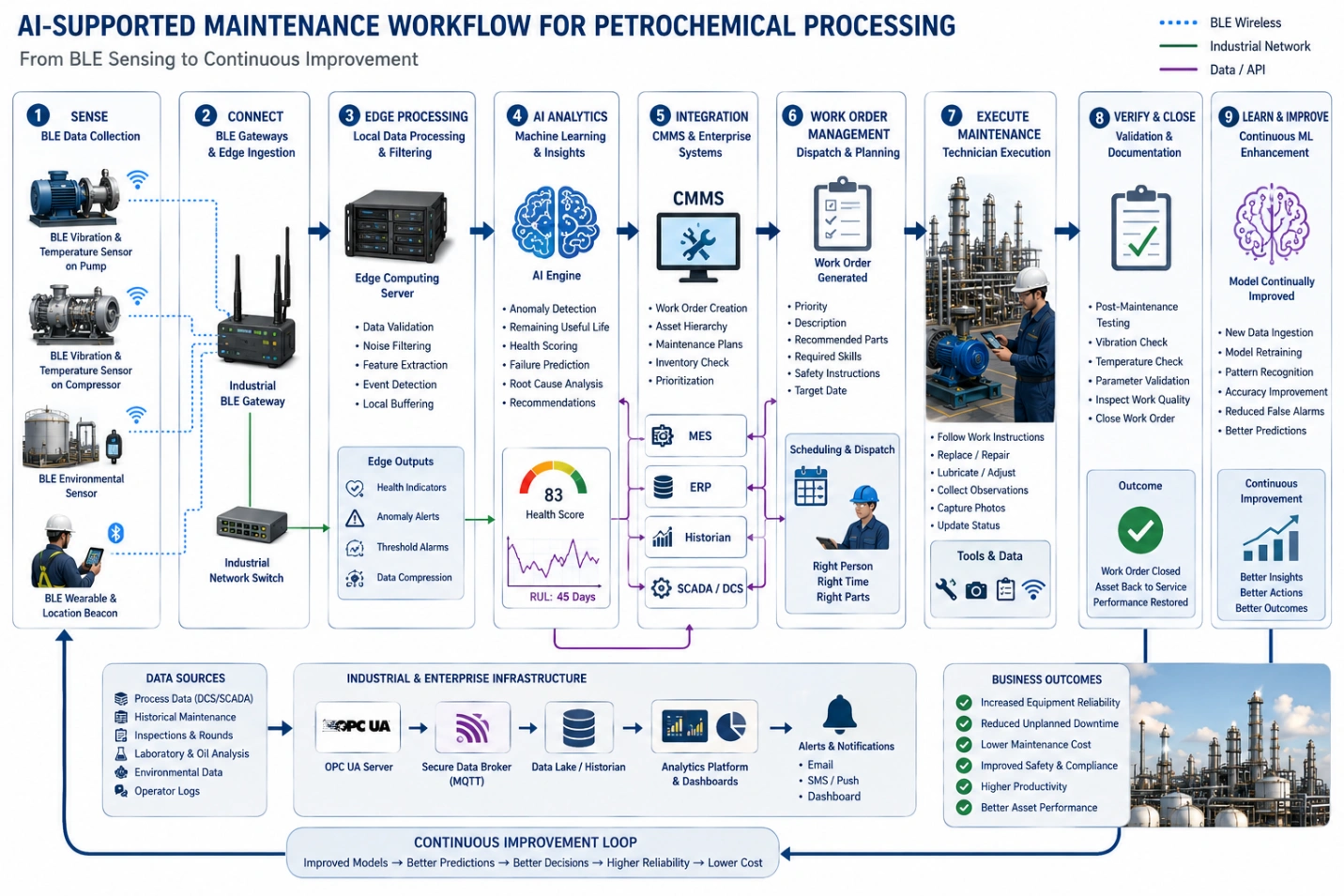
Operational Workflows for AI-Enabled Petrochemical Processing
Successful deployments combine operational technology, industrial software, AI analytics, and wireless sensing into a coordinated production support solution.
Representative workflows include:
• Rotating equipment health monitoring
• Corrosion inspection management
• Valve inspection routing
• Pressure safety valve verification
• Pipeline integrity inspections
• Heat exchanger performance monitoring
• Catalyst lifecycle management
• Utility system optimization
• Steam trap inspection
• Process analyzer calibration
• Operator rounds digitization
• Tank farm monitoring
• Flare system observation
• Environmental compliance inspections
• Contractor access verification
• Permit-to-work validation
• Confined space monitoring
• Instrument calibration management
• Mobile asset utilization
• Maintenance quality assurance
Each workflow generates operational events that can be analyzed using AI to improve production efficiency, maintenance planning, safety performance, and long-term asset reliability.
H2: End-to-End Operational Workflow for AI-Driven Petrochemical Processing with BLE
Petrochemical processing facilities generate enormous volumes of operational data from process instrumentation, rotating equipment, inspection activities, maintenance operations, laboratory systems, and workforce activities. AI becomes most valuable when these data sources are connected into a coordinated industrial solution that converts field observations into operational decisions.
A typical AI-enabled BLE deployment follows a structured operational workflow.
H3: Field Data Acquisition
The process begins with continuous and event-driven data collection from production assets and personnel throughout the facility.
Typical BLE-enabled devices include:
• BLE vibration sensors mounted on centrifugal pumps
• BLE temperature sensors installed on motor housings
• BLE humidity sensors within electrical cabinets
• BLE environmental sensors located around storage tanks
• BLE gateways covering production units
• BLE beacons attached to mobile maintenance equipment
• BLE-enabled wearable devices for maintenance personnel
• BLE tags installed on portable gas detectors
• BLE location tags attached to inspection instruments
These BLE devices complement existing instrumentation rather than replacing process transmitters connected to the DCS or SIS. Their primary role is to capture operational context that has traditionally depended on manual inspections or paper records.
Typical monitored assets include:
• Ethylene crackers
• Distillation columns
• Fractionation systems
• Heat exchangers
• Compressors
• Reactors
• Cooling towers
• Pump stations
• Tank farms
• Pipe racks
• Utility systems
• Loading terminals
Industrial Communication Infrastructure
Collected data are transmitted through secure industrial communication networks.
BLE gateways aggregate wireless data from hundreds or thousands of field devices before forwarding information using industrial communications such as:
• Industrial Ethernet
• Wi-Fi
• Fiber optic networks
• OPC UA
• MQTT
• Modbus TCP
• HTTPS
• REST APIs
The communication design depends on facility size, hazardous area classifications, wireless interference studies, and cybersecurity requirements.
Large petrochemical complexes typically deploy multiple BLE gateway zones to ensure reliable coverage across processing units, warehouses, maintenance workshops, laboratories, and utility areas.
Engineering considerations include:
• RF propagation around steel structures
• Antenna placement near process equipment
• Electromagnetic interference
• Hazardous area certification requirements
• Network redundancy
• Time synchronization
• Communication latency
• Device battery lifecycle
• Gateway failover capability
GAO has helped industrial organizations deploy BLE hardware products and systems that support reliable communications across complex operating environments while integrating with existing industrial networks.
Edge Computing and Local AI Processing
Many petrochemical facilities cannot rely exclusively on cloud processing because operational decisions often require very low latency and continuous availability.
Edge servers located within the production network perform functions such as:
• Sensor data validation
• Data normalization
• Event filtering
• Equipment health scoring
• Initial anomaly detection
• Local machine learning inference
• Alarm prioritization
• Temporary data buffering
• Communication optimization
Executing these workloads locally reduces bandwidth consumption while ensuring that operational decisions remain available during temporary external network interruptions.
Examples include:
• Detecting abnormal compressor vibration within seconds
• Identifying rapidly increasing bearing temperatures
• Monitoring contractor entry into restricted processing units
• Detecting excessive movement near hazardous operating areas
• Validating inspection route completion
Only summarized operational information or selected historical datasets may then be forwarded for broader enterprise analytics.
AI-Enabled BLE Data Flow for Petrochemical Processing: Edge Computing and Enterprise Software Integration
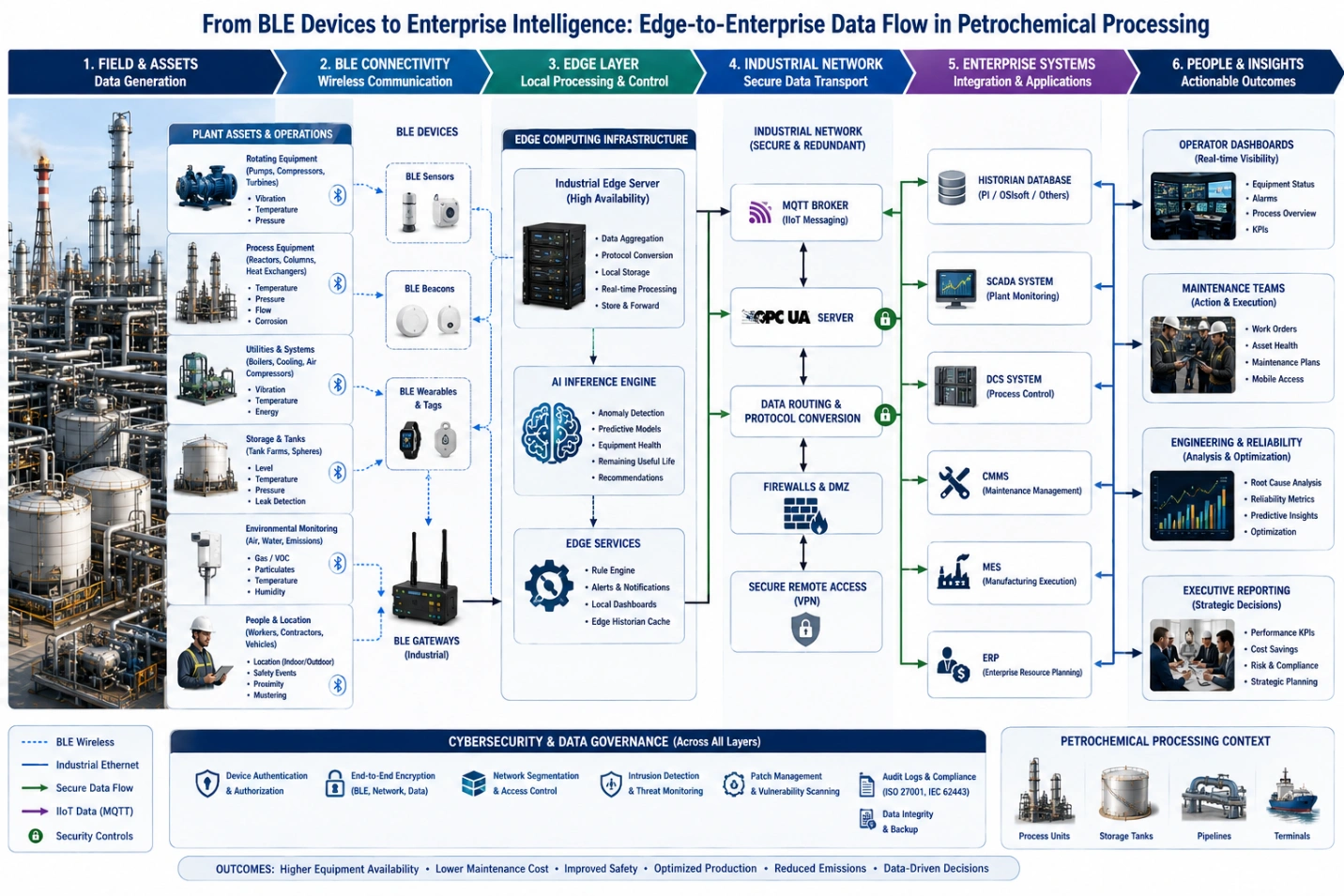
Enterprise Software Integration for Petrochemical Operations
AI recommendations become operationally valuable only when integrated with the software systems already supporting petrochemical production and maintenance.
Typical integrations include:
H3: Distributed Control Systems (DCS)
The DCS continues controlling process variables such as:
• Pressure
• Temperature
• Flow
• Level
• Control valves
• PID loops
AI supplements these control systems by identifying long-term degradation patterns that are difficult to recognize through conventional process alarms alone.
SCADA Systems
SCADA software supervises remote production assets, utility infrastructure, tank farms, pumping stations, and pipeline operations.
BLE-generated operational data enrich SCADA displays by adding:
• Equipment health indicators
• Personnel location awareness
• Maintenance status
• Inspection completion
• Mobile asset visibility
Computerized Maintenance Management Systems (CMMS)
AI integrates with CMMS software to improve maintenance planning by automatically creating recommendations based on equipment condition.
Typical actions include:
• Predictive work order generation
• Spare parts recommendations
• Maintenance prioritization
• Technician scheduling
• Failure trend analysis
• Asset lifecycle reporting
Common examples include IBM Maximo, SAP PM, Oracle Maintenance, and Hexagon maintenance software.
Manufacturing Execution Systems (MES)
MES software coordinates production scheduling and operational execution.
AI-generated equipment health information allows production planners to adjust operating schedules before equipment degradation causes production interruptions.
Enterprise Resource Planning (ERP)
ERP systems use AI insights to improve:
• Procurement planning
• Inventory forecasting
• Capital asset planning
• Contractor management
• Financial reporting
• Production cost optimization
This integration helps maintenance organizations align operational priorities with financial objectives.
Process Historians
Historical process databases provide years of operational information that significantly improve AI model training.
Common data sources include:
• Process variables
• Alarm history
• Maintenance records
• Operator logs
• Production reports
• Laboratory information
• Equipment inspections
• Utility consumption
• Environmental monitoring
Combining historian data with BLE sensor observations enables AI to identify relationships between equipment condition and process performance that would otherwise remain hidden.
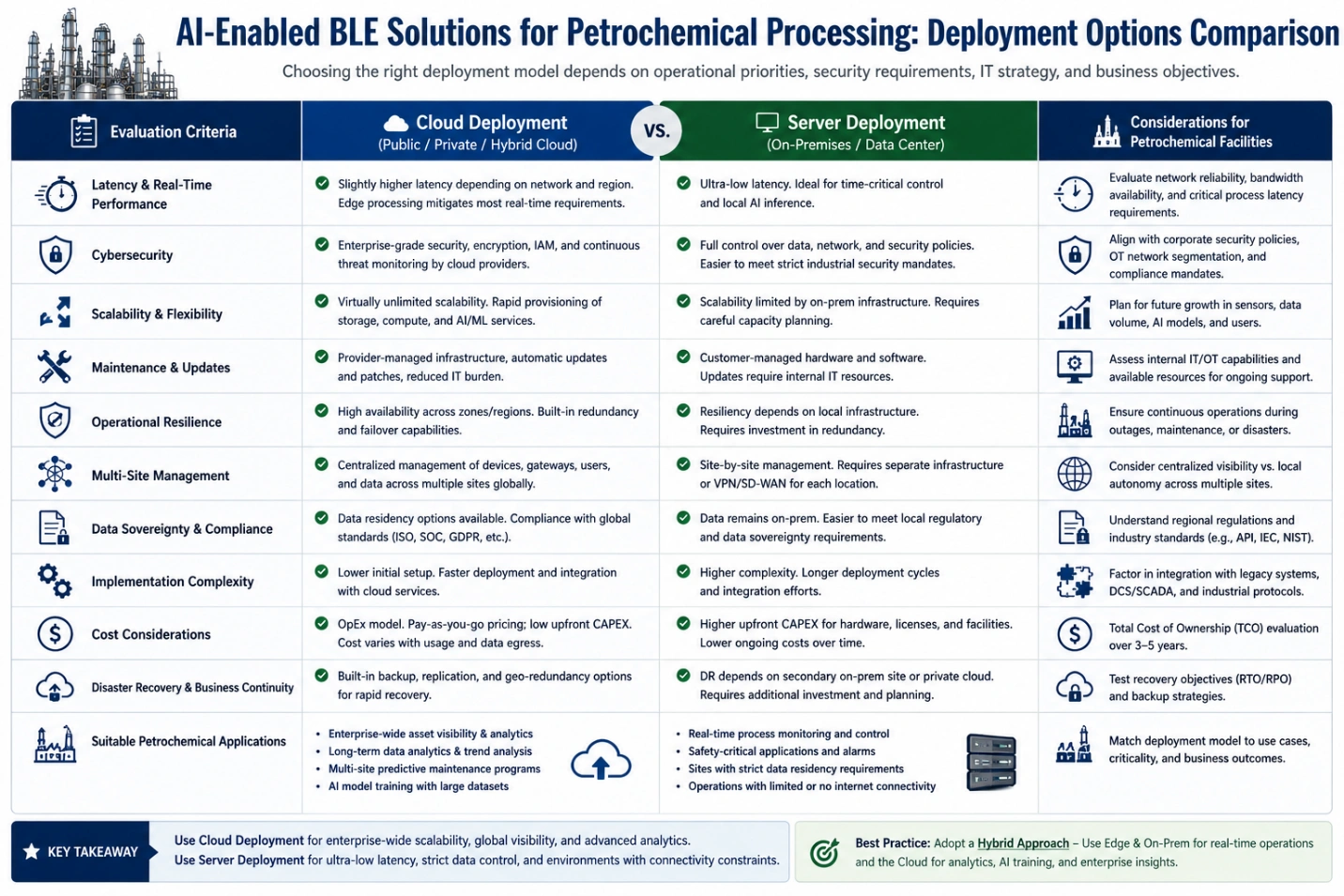
Cloud and Server Deployment Models for AI in Petrochemical Processing
Petrochemical organizations typically select deployment models based on operational requirements, cybersecurity policies, regulatory obligations, and existing IT and OT strategies.
H3: Cloud Deployment
Cloud-hosted software is well suited for organizations managing multiple processing facilities or geographically distributed operations.
Typical characteristics include:
• Centralized AI model management
• Multi-site performance benchmarking
• Fleet-wide asset analytics
• Simplified software updates
• Long-term historical analysis
• Disaster recovery capabilities
• Enterprise reporting
• Cross-site optimization
Cloud deployments are commonly selected when corporate engineering teams require centralized visibility across several refineries or petrochemical plants.
Server Deployment
Many petrochemical organizations operate privately managed servers within production environments to satisfy operational resilience and cybersecurity requirements.
Server-based deployments are appropriate when:
• Continuous local availability is required
• Internet connectivity is restricted
• Corporate policies prohibit cloud processing
• Sensitive production information must remain under customer control
• AI inference requires extremely low latency
• Regulatory or contractual obligations require local data management
Server deployments may operate within private data centers, refinery computing facilities, edge server clusters, or other customer-managed infrastructure.
This approach often supports integration with legacy industrial software that remains essential to daily plant operations.
Cloud vs. Server Deployment for AI-Enabled BLE Solutions in Petrochemical Processing
Cybersecurity and Operational Security Considerations
Because petrochemical facilities operate critical infrastructure, cybersecurity must be incorporated throughout the solution lifecycle.
Recommended practices include:
• Zero Trust security principles
• Multi-factor authentication
• Role-based access control
• Device identity management
• Secure BLE pairing
• Encrypted wireless communications
• TLS-protected network traffic
• Certificate management
• Network segmentation between IT and OT environments
• Continuous vulnerability assessment
• Security monitoring
• Firmware integrity verification
• Secure software update procedures
• Asset inventory management
• Security event logging
Industrial standards and guidance commonly considered include:
• IEC 62443
• NIST Cybersecurity Framework
• ISA/IEC industrial cybersecurity guidance
• ISO/IEC 27001
• Process Safety Management (PSM) requirements where applicable
• Environmental and operational compliance procedures established by regulatory authorities
Cybersecurity should protect operational continuity without introducing unnecessary complexity that interferes with production activities.
GAO’s experience supplying BLE, RFID, and industrial IoT hardware products and systems over more than three decades, supported by stringent quality assurance processes and expert remote or onsite technical support, helps organizations implement reliable wireless solutions that align with demanding operational and cybersecurity expectations.
Key Technical Capabilities of AI-Enabled BLE Solutions for Petrochemical Processing
Artificial Intelligence combined with BLE-enabled sensing provides operational intelligence beyond traditional process automation. While Distributed Control Systems, process analyzers, and instrumentation remain responsible for process control, AI continuously evaluates contextual operational information to improve production reliability, equipment availability, and maintenance efficiency.
H3: Predictive Asset Health Monitoring
Petrochemical production depends on continuous operation of rotating and static assets operating under demanding conditions.
AI continuously evaluates information collected from:
• BLE vibration sensors
• BLE temperature sensors
• Environmental sensors
• Equipment operating history
• Process historian data
• Maintenance records
• Operator inspection logs
• Laboratory analysis
• Process variables from DCS
Instead of reacting to equipment alarms after degradation has become significant, machine learning models estimate equipment health scores, remaining useful life, and probable failure mechanisms.
Engineering teams gain earlier visibility into issues such as:
• Bearing degradation
• Shaft misalignment
• Mechanical looseness
• Cavitation
• Lubrication deficiencies
• Heat exchanger fouling
• Valve performance degradation
• Instrument drift
• Corrosion progression
This proactive approach reduces emergency maintenance while improving production continuity.
AI-Based Operational Anomaly Detection
Many operational abnormalities develop gradually and remain undetected because they occur across multiple systems simultaneously.
AI correlates thousands of operational variables including:
• Equipment utilization
• Environmental conditions
• Maintenance activities
• Personnel movement
• Utility consumption
• Process efficiency
• Production throughput
• Inspection frequency
Examples include:
• Increasing compressor vibration accompanied by rising motor temperatures
• Reduced cooling efficiency combined with abnormal pump loading
• Repeated operator intervention during similar production campaigns
• Increased warehouse withdrawals preceding equipment failures
These relationships are difficult to recognize manually but become apparent through AI-driven multivariable analysis.
Intelligent Workforce and Safety Monitoring
Worker safety remains a primary objective throughout petrochemical processing facilities.
BLE-enabled wearables and location-aware devices support AI analysis of:
• Lone worker status
• Restricted area access
• Muster accountability
• Emergency evacuation
• Contractor movement
• Inspection route completion
• Exposure duration
• Maintenance team coordination
Rather than simply displaying worker locations, AI identifies unusual patterns requiring supervisory attention.
Examples include:
• Missed inspection checkpoints
• Extended occupancy within hazardous zones
• Delayed emergency response
• Unauthorized equipment access
• Incomplete maintenance activities
These insights strengthen operational safety while supporting regulatory compliance.
Production Optimization
AI continuously evaluates relationships between production conditions and equipment performance.
Typical optimization objectives include:
• Higher process yield
• Reduced utility consumption
• Stable operating conditions
• Improved energy efficiency
• Lower steam usage
• Reduced flare events
• Minimized process variability
• Better catalyst utilization
• Improved product consistency
Instead of optimizing individual equipment, AI evaluates interactions across entire production units.
This systems-level perspective helps operations personnel improve throughput without compromising process safety.
GAO has supported organizations deploying BLE hardware products and industrial IoT systems that contribute to broader operational visibility across production environments.
Operational Improvements Across Petrochemical Processing
Successful deployments produce measurable improvements throughout maintenance, production, logistics, environmental management, and engineering operations.
H3: Maintenance Transformation
Traditional maintenance often relies on fixed inspection schedules or reactive repair activities.
AI enables maintenance organizations to transition toward condition-based maintenance by prioritizing work according to equipment health rather than calendar intervals.
Expected improvements include:
• Reduced emergency repairs
• Fewer unexpected shutdowns
• Better maintenance planning
• Improved technician productivity
• Increased equipment availability
• More efficient spare parts utilization
• Lower overtime requirements
• Better turnaround preparation
Maintenance planners can allocate resources more effectively because equipment degradation becomes visible earlier.
Improved Turnaround Planning
Major maintenance shutdowns represent significant operational investments.
AI assists turnaround planning by analyzing:
• Historical maintenance duration
• Equipment failure probability
• Contractor utilization
• Material availability
• Spare parts inventory
• Inspection completion
• Equipment criticality
This analysis supports better scheduling while reducing unnecessary work and minimizing production downtime.
Energy Efficiency Improvements
Petrochemical processing consumes substantial electrical power, steam, cooling water, compressed air, and fuel gas.
AI identifies operational inefficiencies including:
• Steam leaks
• Heat exchanger fouling
• Excessive compressor loading
• Cooling system degradation
• Pump inefficiencies
• Utility imbalances
Improved utility management lowers operating costs while supporting sustainability objectives.
Environmental Performance
Environmental monitoring becomes increasingly proactive when AI evaluates continuous operational information.
Applications include:
• Fugitive emissions detection support
• VOC monitoring
• Environmental sensor correlation
• Tank farm condition monitoring
• Wastewater process optimization
• Flare event analysis
• Regulatory reporting assistance
Earlier identification of abnormal environmental conditions supports timely corrective action.
Business Benefits for Petrochemical Organizations
Technical improvements translate directly into measurable operational and financial outcomes.
H3: Increased Production Availability
Reduced equipment failures allow production units to operate closer to planned capacity.
Benefits include:
• Higher equipment uptime
• Reduced production interruptions
• Improved process stability
• Increased asset utilization
• Better production forecasting
Lower Maintenance Costs
Predictive maintenance reduces unnecessary preventive maintenance while avoiding catastrophic failures.
Organizations frequently experience:
• Reduced maintenance labor
• Lower spare parts consumption
• Fewer emergency purchases
• Better inventory planning
• Reduced contractor costs
Enhanced Process Safety
Earlier recognition of equipment degradation contributes to safer operations by reducing the likelihood of process upsets.
Safety improvements may include:
• Faster incident response
• Better worker accountability
• Improved inspection quality
• Earlier hazard identification
• Better operational discipline
Better Capital Planning
Long-term AI analysis supports strategic investment decisions by identifying assets approaching the end of their economic lifecycle.
Engineering managers can prioritize:
• Equipment replacement
• Modernization projects
• Reliability investments
• Maintenance budget allocation
• Capacity expansion planning
Scalability and Long-Term Operational Value
AI-enabled BLE solutions can expand incrementally without requiring complete modernization of existing automation systems.
Organizations commonly begin with a limited deployment focused on critical production assets before extending monitoring across additional operating units.
Typical expansion stages include:
• Pilot deployment on selected compressors and pumps
• Expansion to utility systems
• Tank farm monitoring
• Maintenance warehouse asset tracking
• Contractor and workforce monitoring
• Environmental sensing
• Multi-site operational benchmarking
Because BLE devices require relatively low installation effort compared with extensive wired instrumentation, expansion projects can often be completed with minimal disruption to ongoing production.
This phased approach reduces implementation risk while allowing engineering teams to validate operational benefits before broader deployment.
Implementation Recommendations for AI-Enabled BLE Solutions in Petrochemical Processing
Successful AI initiatives in petrochemical processing depend more on disciplined engineering, cross-functional collaboration, and operational readiness than on AI algorithms alone. Organizations typically achieve better long-term outcomes by deploying AI incrementally while integrating with existing operational technology and maintenance processes.
H3: Establish Clear Operational Objectives
Projects should begin with measurable business and operational goals rather than technology selection. Common objectives include improving rotating equipment reliability, reducing unplanned process interruptions, strengthening worker safety, enhancing turnaround execution, optimizing energy consumption, and improving environmental monitoring.
Representative key performance indicators include:
• Overall Equipment Effectiveness (OEE)
• Mean Time Between Failures (MTBF)
• Mean Time to Repair (MTTR)
• Unplanned shutdown frequency
• Compressor availability
• Pump reliability
• Heat exchanger efficiency
• Steam consumption
• Energy intensity
• Maintenance schedule compliance
• Inspection completion rate
• Spare parts inventory turnover
• Environmental incident frequency
• Process yield
• Turnaround schedule adherence
These KPIs should be defined before deployment to establish performance baselines and quantify operational improvements.
Prioritize High-Value Production Assets
Many organizations begin with assets where unexpected failures have the greatest operational or financial impact.
Typical candidates include:
• Centrifugal compressors
• Critical process pumps
• Steam turbines
• Gas turbines
• Air compressors
• Heat exchangers
• Reactor circulation systems
• Cooling water systems
• Fired heaters
• Hydrogen production equipment
Initial deployments focused on high-criticality equipment enable engineering teams to validate AI models and refine maintenance workflows before expanding across the facility.
Integrate with Existing Industrial Software
AI should complement established operational software rather than create isolated data silos.
Integration priorities generally include:
• Distributed Control Systems (DCS)
• Supervisory Control and Data Acquisition (SCADA)
• Manufacturing Execution Systems (MES)
• Enterprise Resource Planning (ERP)
• Computerized Maintenance Management Systems (CMMS)
• Process historian databases
• Laboratory Information Management Systems (LIMS)
• Asset Performance Management (APM) software
Well-integrated solutions provide maintenance planners, production engineers, reliability specialists, and operations personnel with consistent information that supports coordinated decision-making.
Design for Industrial Reliability
Industrial wireless deployments require engineering practices that account for demanding operating conditions.
Recommended considerations include:
• RF site surveys before installation
• Hazardous area certification verification
• Redundant gateway placement
• Battery replacement planning
• Environmental enclosure selection
• Routine firmware maintenance
• Preventive inspection schedules
• Device calibration procedures
• Network health monitoring
• Cybersecurity validation
Facilities operating continuously throughout the year benefit from maintenance procedures that minimize disruption while preserving data quality and communication reliability.
GAO has supplied BLE, RFID, and industrial IoT hardware products and systems to organizations requiring dependable wireless performance in complex industrial environments, supported by experienced technical teams capable of assisting with solution planning and deployment.
Engineering Best Practices and Practical Deployment Insights
Practical implementation experience demonstrates several recurring engineering considerations that significantly influence project success.
Recommended practices include:
• Establish data governance policies covering sensor calibration, device lifecycle management, data retention, and model validation.
• Conduct RF propagation studies to identify signal attenuation caused by steel structures, process vessels, and dense piping networks.
• Validate AI models using historical maintenance records and production data before enabling automated recommendations.
• Develop cross-functional governance involving operations, maintenance, reliability engineering, instrumentation, process engineering, information technology, and cybersecurity teams.
• Periodically retrain machine learning models to account for equipment aging, process modifications, catalyst changes, seasonal operating conditions, and maintenance interventions.
• Document integration interfaces and communication protocols to simplify future system expansion and software upgrades.
• Implement phased deployment with clearly defined acceptance criteria for each stage, allowing operational teams to evaluate measurable improvements before scaling across additional production units.
Organizations that treat AI as an ongoing operational capability rather than a one-time technology project typically realize greater long-term value through continuous optimization and incremental improvement.
Summary
AI-enabled operational intelligence supported by BLE gateways, BLE beacons, and BLE sensors is reshaping how petrochemical processing facilities monitor assets, improve maintenance planning, enhance worker safety, and optimize production performance. By combining industrial AI, edge computing, machine learning, and secure wireless sensing with existing operational technology, organizations gain deeper visibility into equipment condition, workforce activities, and environmental factors without replacing established automation systems.
For petrochemical processing facilities seeking to improve reliability, operational efficiency, regulatory compliance, and long-term asset performance, successful implementations emphasize careful engineering, robust cybersecurity, scalable deployment strategies, and close integration with existing industrial software. Headquartered in New York City and Toronto, Canada, GAO is recognized among the world’s leading B2B and B2G suppliers of BLE and RFID technologies. Together with GAO Research Inc. and GAO Tek Inc., we have supported Fortune 500 companies, leading research organizations, prestigious universities, and government agencies throughout the United States and Canada for more than three decades through sustained investment in research and development, stringent quality assurance, and expert remote and onsite technical support.
Whether you are evaluating predictive maintenance, intelligent worker safety, industrial asset monitoring, or broader AIoT initiatives for petrochemical processing, our engineering specialists can help you identify appropriate BLE hardware products, wireless sensing solutions, and integration strategies that align with your operational objectives.
Building the Future of Industrial AI and IoT with Aperture Venture Studio and GAO RFID Inc.
For more than three decades, GAO Group of Companies has invested extensively in research and development of industrial BLE, RFID, and IoT technologies supporting demanding applications such as petrochemical processing. As generative AI has demonstrated measurable value for industrial operations, we have expanded our work in AI, Industrial IoT, BLE, and RFID while establishing Aperture Venture Studio to accelerate the development and growth of advanced AI and IoT solutions that address complex industrial challenges across process industries.
Aperture has attracted highly accomplished AI researchers, industrial IoT specialists, entrepreneurial and operational executives, influential investors, and leading technology organizations committed to advancing industrial innovation.
We have also developed the highly successful Aperture Ventures Summit and TekSummit, where experts exchange knowledge on emerging developments in artificial intelligence, industrial IoT, BLE, RFID, industrial automation, and digital transformation.
These initiatives have helped build diversified technical communities and collaborative networks dedicated to advancing practical AI and IoT solutions for industry.
We welcome you to engage with us as:
• Advisors, co-founders, or employees
• Investors
• Customers