
AI and RFID for Solar Farms
AI-Powered RFID Solutions for Solar Farm Asset Management
AI-powered RFID solutions help solar farm operators identify, locate, monitor, and manage photovoltaic modules, spare parts, tools, test equipment, and field-service activities across geographically dispersed sites. RFID creates a reliable asset identity and event-data layer, while artificial intelligence analyzes that data alongside supervisory control and data acquisition, computerized maintenance management, weather, inspection, and energy-production records.
The combined solution supports solar asset tracking, predictive maintenance, inventory optimization, installation verification, warranty management, theft prevention, and regulatory documentation. UHF RFID enables rapid, non-line-of-sight identification of multiple tagged assets, while HF and LF RFID support controlled short-range applications such as technician authentication and equipment verification.
For utility-scale and commercial solar farms, the principal value comes from connecting physical assets to operational records. This improves traceability from module receipt and installation through inspection, repair, replacement, repowering, and end-of-life recycling.
AI-Powered RFID Asset Management for Solar Farms
This technical illustration shows RFID-tagged solar panels, inverters, tools, spare modules, readers, and an edge gateway connected to AI analytics and operational systems. It highlights how solar farms can improve asset traceability, predictive maintenance, installation verification, inventory control, warranty management, and theft detection.
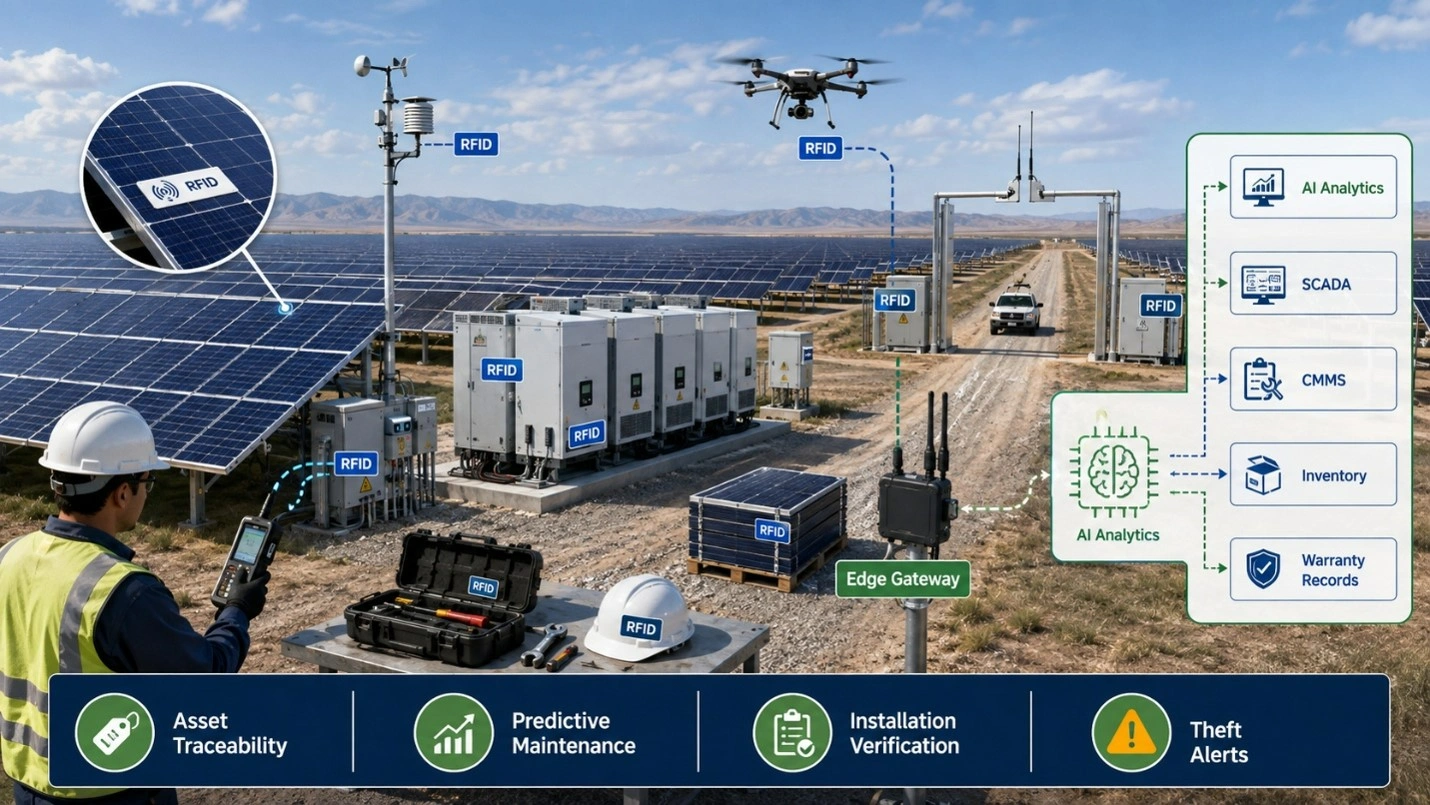
How AI and RFID Work Together in Solar Farm Operations
RFID gives each physical asset a durable digital identity. A tag attached to a solar module, inverter component, cable reel, testing instrument, or replacement part stores or references a unique identifier. Fixed readers, vehicle-mounted readers, handheld terminals, and mobile computers capture tag events during receiving, staging, installation, inspection, maintenance, and removal.
AI turns these identification events into operational intelligence. Machine-learning models can correlate asset movement and maintenance history with inverter alarms, string current, irradiance, module temperature, thermographic findings, soiling measurements, and energy yield. Instead of treating an RFID scan as an isolated transaction, the software evaluates when the asset appeared, where it was detected, which work order was active, who handled it, and whether the event followed an approved process.
Several RFID frequency bands serve different solar farm requirements:
UHF RFID, commonly operating within regional 860 to 960 MHz bands, supports long read ranges, fast multi-tag identification, pallet-level receiving, module tracking, warehouse inventory, and field-service operations.
HF RFID at 13.56 MHz provides shorter, more controlled read zones for maintenance records, component verification, secure check-in, and near-field interactions.
LF RFID generally operates at 125 or 134.2 kHz and can support short-range identification in locations where predictable proximity detection is more important than high tag throughput.
Metal mounting structures, aluminum module frames, glass, cable congestion, electromagnetic noise, tag orientation, and outdoor exposure affect RFID performance. Solar farm deployments therefore require application-specific tag selection, controlled antenna positioning, field testing, and read-zone tuning rather than relying only on nominal reader range.
Solar Farm Applications for AI-Enabled RFID
Photovoltaic Module Traceability
PV modules move through manufacturing, transport, receiving, staging, installation, inspection, replacement, and recycling. RFID tags can connect each module to its manufacturer, model, serial number, wattage class, bill of materials, flash-test results, purchase order, delivery batch, warranty period, installation block, row, table, and string.
AI can identify discrepancies between the planned module allocation and actual installation records. Examples include a module assigned to the wrong string, an unapproved model installed during replacement, duplicate serial records, incomplete commissioning scans, or a warranty claim that does not match the asset’s service history.
Reliable module traceability becomes especially important during repowering, insurance investigations, product recalls, degradation studies, and end-of-life processing. GAO can supply RFID tags, readers, antennas, and supporting systems that help solar operators establish this physical-to-digital asset record.
Spare-Parts and Maintenance Inventory
Solar operations and maintenance teams manage fuses, connectors, cable assemblies, surge-protection devices, inverter boards, power supplies, sensors, communication modules, cleaning equipment, personal protective equipment, and specialized test instruments. These items may be distributed among site warehouses, maintenance vehicles, inverter stations, regional depots, and contractor storage areas.
UHF RFID can accelerate cycle counts and record the movement of tagged parts without requiring workers to scan every barcode individually. AI inventory models can use consumption rates, failure histories, supplier lead times, equipment criticality, and planned preventive-maintenance schedules to recommend reorder points and safety-stock levels.
This approach reduces stockouts without encouraging excessive inventory. A critical inverter control board may require higher local availability than a low-cost item that can be delivered quickly. AI can prioritize inventory according to expected energy loss, mean time to repair, failure probability, and replacement lead time.
Maintenance Tools and Test Equipment
Insulation-resistance testers, I-V curve tracers, thermal cameras, clamp meters, torque tools, electroluminescence testing equipment, drones, and portable power-quality analyzers require controlled issue, return, inspection, and calibration processes.
RFID records can identify which technician took an instrument, which work order required it, when it returned, and whether its calibration remains valid. AI can flag unusual checkout duration, repeated loss patterns, overdue calibration, or a mismatch between the assigned tool and planned maintenance task.
Technicians should not receive an automated instruction to use an instrument solely because it is physically available. The decision should also account for calibration status, battery condition, firmware version, inspection history, and worker authorization.
Installation and Commissioning Verification
Construction teams can scan modules, inverters, combiner boxes, trackers, communication devices, and other tagged equipment during installation. The captured identifiers are matched against engineering drawings, equipment schedules, procurement records, and quality-control checklists.
AI-assisted validation can detect:
Equipment installed in a block or row different from its approved allocation
Missing or duplicate asset records
Component-model incompatibility
Unfinished torque, insulation, polarity, or continuity checks
Commissioning records completed before the related equipment was installed
Replacement assets lacking approved warranty or procurement records
Unexpected movement of commissioned equipment
These controls improve handover from engineering, procurement, and construction contractors to the owner and operations team. They also provide a better baseline for future maintenance analysis because the operational record begins with verified asset data.
Theft Detection and Restricted-Zone Monitoring
Solar farms occupy large sites with long perimeters, remote equipment areas, limited nighttime staffing, and valuable copper cable, modules, batteries, tools, and electronic components. RFID event data can supplement video surveillance, access control, intrusion detection, GPS tracking, and security patrols.
AI can evaluate whether an asset movement is expected based on location, time, work order, technician authorization, vehicle assignment, and gate activity. A spare inverter component moving toward an exit during an approved maintenance task is different from a commissioned module appearing near a gate after working hours.
RFID should not be treated as the only security control. Tags can be damaged, shielded, removed, or missed by a poorly designed read zone. Effective solar farm protection requires layered detection, tamper-resistant mounting where appropriate, camera confirmation, access logs, alarm rules, and documented incident-response procedures.
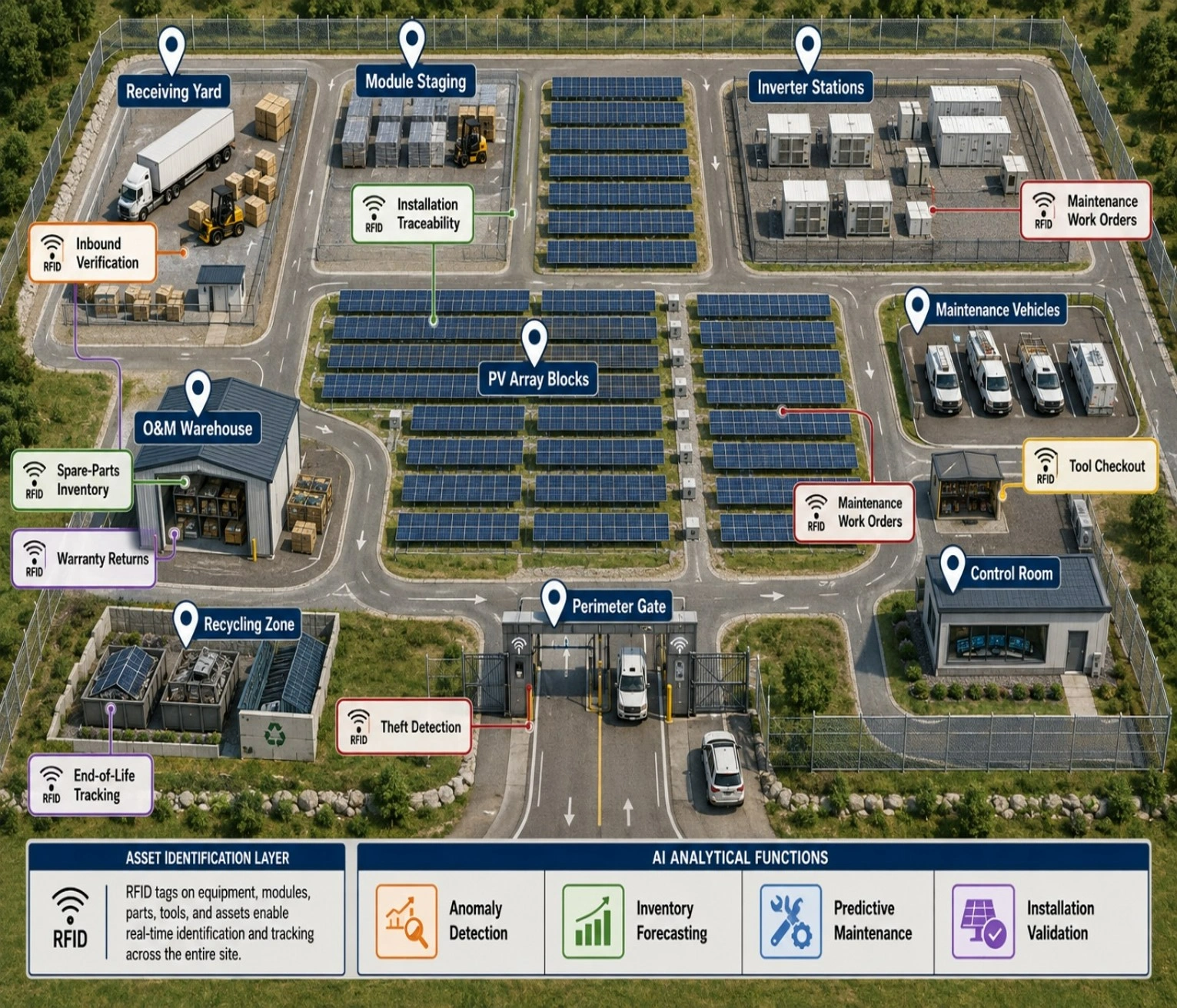
Solar Farm RFID Use-Case and AI Operations Map
This top-down technical map connects RFID applications to key solar farm locations, including receiving, module staging, PV arrays, inverter stations, maintenance facilities, perimeter security, and recycling. It also shows how RFID asset identification supports AI-powered anomaly detection, inventory forecasting, predictive maintenance, and installation validation.
Deployment Scenarios and Engineering Considerations
Utility-Scale Photovoltaic Plants
Utility-scale plants may contain hundreds of thousands or millions of modules distributed across multiple array blocks. RFID system design must account for tag density, long travel distances, outdoor read points, intermittent connectivity, contractor access, and integration with existing SCADA and asset-management records.
Fixed readers are useful at warehouses, controlled gates, tool cribs, repair facilities, and selected material-flow points. Handheld readers are often more practical within array fields because installing continuous fixed-reader coverage across every row may be technically unnecessary and economically unjustified.
AI can prioritize field scans based on open work orders, inverter faults, underperforming strings, weather damage, vegetation incidents, thermal anomalies, or suspected asset movement. This targeted approach is generally more useful than attempting to collect all RFID data continuously.
Commercial and Industrial Solar Installations
Large rooftop and ground-mounted systems at factories, logistics centers, universities, hospitals, and campuses typically contain fewer assets but may have stricter access, safety, and maintenance-window requirements. RFID can support contractor verification, rooftop tool control, replacement-part tracking, and documentation of module or inverter service.
AI can compare maintenance actions with interval-meter data, inverter performance, weather-normalized production, and building energy demand. The solution may also exchange information with computerized maintenance management software, building management systems, energy management software, and procurement records.
Hybrid Solar and Battery Energy Storage Sites
Solar-plus-storage facilities introduce battery racks, battery management systems, power conversion systems, thermal-management equipment, fire-detection devices, and additional spare parts. RFID can maintain traceability for approved replacement components and service tools, while AI evaluates asset history with battery alarms, temperature, state of charge, state of health, and cycling behavior.
Tag and reader installation must respect electrical-clearance requirements, battery-area safety policies, electromagnetic conditions, and equipment manufacturer instructions. RFID records can support maintenance decisions, but safety-critical battery controls must remain within certified battery management, protection, and fire-response systems.
Harsh Outdoor Operating Conditions
Tags and reader enclosures may face ultraviolet radiation, heat, dust, moisture, condensation, hail, wind-driven debris, insects, cleaning chemicals, and wide temperature variation. Deployment teams should evaluate ingress-protection ratings, tag attachment methods, enclosure ventilation, cable glands, corrosion resistance, and maintenance access.
Common engineering lessons include:
Test tags on the actual module frame, inverter enclosure, tool, container, or spare part rather than on a substitute material.
Validate performance during different reader orientations, vehicle speeds, weather conditions, and inventory densities.
Avoid mounting tags where clamps, rails, cable trays, or metal surfaces detune the antenna.
Use protective attachment methods that do not compromise module warranties, electrical insulation, drainage, or structural integrity.
Store events locally when wide-area connectivity is unavailable and synchronize them after communication is restored.
Establish exception-handling procedures for missed reads, damaged tags, duplicate identifiers, and assets moved without an active work order.
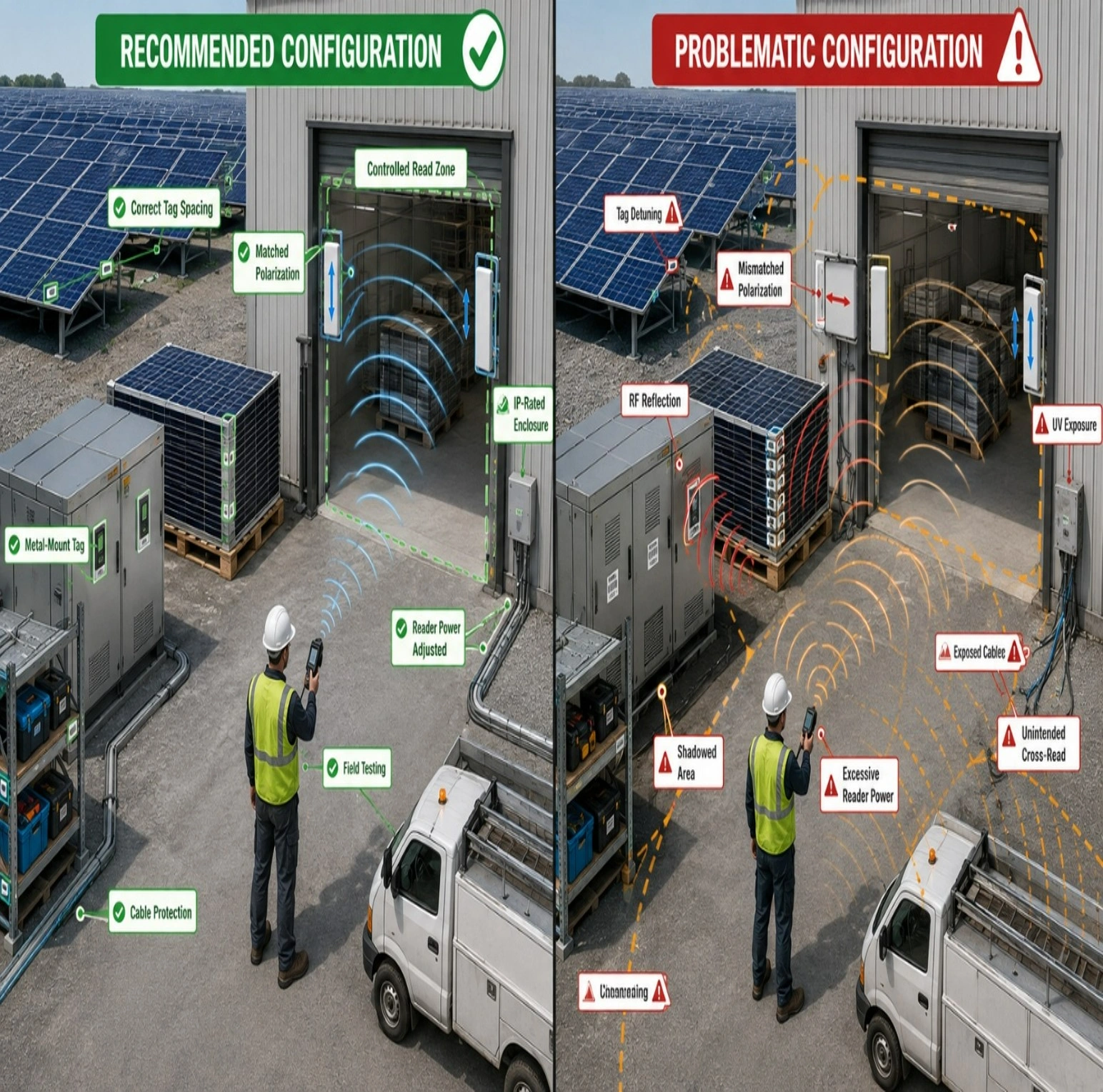
UHF RFID Read-Zone Engineering for Solar Farm Assets
This engineering diagram compares recommended and problematic UHF RFID configurations in a solar farm environment. It demonstrates how tag spacing, antenna polarization, reader power, metal surfaces, RF reflections, shadowed areas, weather protection, and cable management affect identification accuracy.
From RFID Data Capture to AI-Driven Solar Operations
A solar farm RFID workflow begins with asset identification and data governance, not reader installation. Each tag identifier must be associated with an approved master record containing the asset type, manufacturer, serial number, model, ownership, warranty, location hierarchy, maintenance class, and lifecycle status.
The operational data flow typically follows these stages:
Asset registration: RFID tags are encoded or associated with photovoltaic modules, tools, spare parts, test instruments, inverters, tracker components, or maintenance containers. Identifier uniqueness and database accuracy are verified before deployment.
Event capture: Fixed readers, handheld terminals, mobile computers, or vehicle-mounted readers collect tag identifiers, timestamps, antenna data, signal-strength indicators, operator information, and location context.
Local validation: Reader software or an edge gateway filters duplicate reads, applies read-zone rules, checks identifier formats, and temporarily stores events during network outages.
Secure communication: Validated events travel through Ethernet, Wi-Fi, private cellular, LTE, 5G, or other approved connections. MQTT, HTTPS, REST APIs, and message queues can transport operational data depending on system requirements.
RFID middleware processing: Middleware converts raw reader observations into meaningful events such as received, issued, installed, inspected, transferred, returned, quarantined, or removed.
Operational integration: RFID events are connected to SCADA historians, CMMS or enterprise asset management software, warehouse management records, procurement systems, warranty databases, geographic information systems, document repositories, and contractor-management tools.
AI analysis: Machine-learning models correlate RFID events with energy yield, performance ratio, string current, inverter alarms, irradiance, temperature, weather forecasts, thermal images, work orders, failure records, and spare-part usage.
Decision support: The software identifies inventory risks, unusual asset movement, incomplete inspections, probable component failures, installation discrepancies, or maintenance priorities.
Business action: Authorized personnel approve work orders, replenish parts, investigate security events, initiate warranty claims, schedule inspections, or update asset records.
Human review remains necessary when an AI recommendation affects electrical safety, equipment isolation, warranty eligibility, compliance reporting, or high-value replacement decisions. GAO’s experience supplying RFID and IoT hardware and systems can help organizations connect reliable field identification with existing solar operations processes.
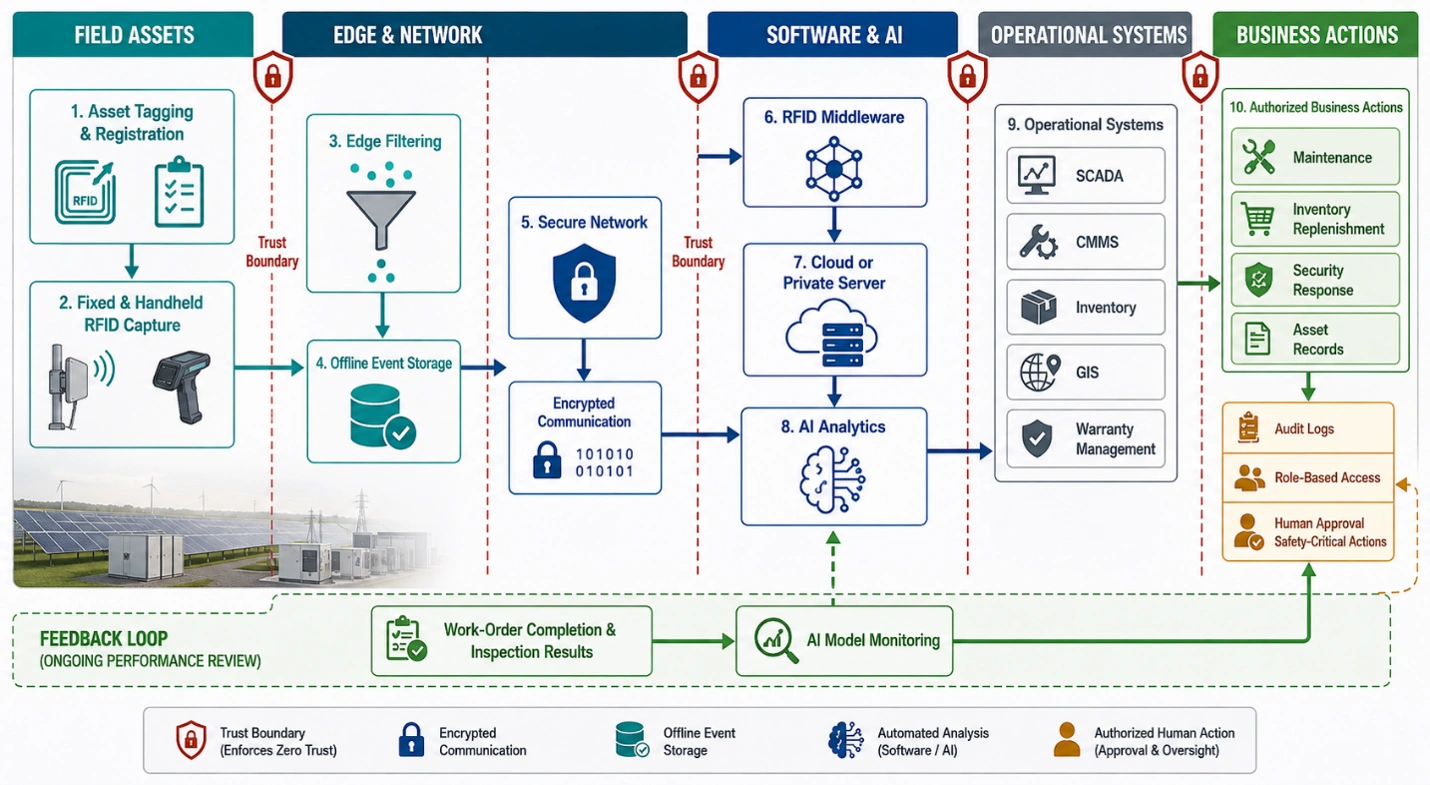
AI-Powered RFID Workflow for Solar Farm Operations
Short Description: This workflow shows how RFID asset data moves from field capture and edge filtering through encrypted communication, middleware, AI analytics, and solar operational systems. Trust boundaries, offline storage, audit controls, role-based access, human approval, and feedback from completed work orders support secure, continuously monitored decisions.
RFID Hardware, AI Software, and Supporting Infrastructure
A dependable AI-powered RFID solution for solar farms requires coordinated field hardware, communication services, data processing, integration software, security controls, and operational procedures. Component selection should reflect the solar farm’s asset volume, physical layout, environmental conditions, maintenance workflows, network availability, and cybersecurity requirements.
RFID Tags and Asset Identification
RFID tag selection depends on the asset material, required read distance, mounting location, environmental exposure, memory needs, and expected service life.
Passive UHF RFID tags: Suitable for photovoltaic modules, packaging, spare parts, cable reels, maintenance tools, and warehouse inventory. These battery-free tags support rapid identification of multiple assets and generally offer the longest practical read range among passive RFID options.
On-metal UHF RFID tags: Designed for inverter cabinets, tool cases, metal containers, tracker components, and equipment enclosures. Their antenna construction helps reduce the detuning caused by conductive surfaces.
HF and NFC tags: Appropriate for close-range maintenance verification, controlled technician interactions, component documentation, and smartphone-accessible asset records.
LF RFID tags: Useful where short, predictable read proximity and stable performance near certain materials are more important than long-distance or high-volume reading.
Ruggedized tags: Required for assets exposed to ultraviolet radiation, rain, dust, chemicals, temperature cycling, abrasion, or pressure washing.
A tag should usually carry a unique identifier rather than sensitive operational data. Detailed maintenance, warranty, ownership, and location information can remain in secured software records linked to that identifier. This reduces the consequences of unauthorized tag reading and allows records to be updated without rewriting every tag.
Fixed, Handheld, and Mobile RFID Readers
Fixed readers provide repeatable monitoring at controlled locations such as receiving gates, warehouse portals, tool rooms, repair areas, and site exits. Their performance depends on antenna placement, transmit power, polarization, shielding, trigger logic, and filtering rules.
Handheld RFID readers provide flexibility inside photovoltaic array blocks. Technicians can use them to locate components, verify installed equipment, perform cycle counts, confirm work-order assets, and identify tools without deploying fixed infrastructure throughout the entire site.
Vehicle-mounted readers can support inventory surveys and field audits along service roads. Read accuracy will depend on vehicle speed, antenna direction, distance from tagged assets, module-row geometry, and interference from metal structures. Field validation is necessary before using mobile reads as proof of an asset’s exact location.
Reader selection should consider:
Supported regional frequency regulations
Read-zone size and required tag throughput
Environmental and ingress-protection requirements
Ethernet, Wi-Fi, cellular, Bluetooth, or serial connectivity
Power over Ethernet or local power availability
Software development kits and API compatibility
Edge-processing and offline-storage capabilities
Secure firmware and device-management support
GAO supplies RFID readers, antennas, tags, and related IoT hardware that can be configured for receiving, inventory, maintenance, and asset-control processes.
Edge Gateways and Local Processing
Edge gateways connect RFID readers to business and operational software. They normalize device data, remove duplicate reads, apply location rules, encrypt communications, and retain events during connectivity interruptions.
Local processing is particularly useful at remote solar farms where cellular or backhaul connections may be intermittent. A gateway can continue recording asset movements and enforcing basic rules even if the cloud or private server is temporarily unavailable. Once connectivity returns, stored events can be synchronized using timestamps, sequence controls, and conflict-resolution rules.
Edge logic can also reduce unnecessary data transmission. Thousands of raw tag observations may represent one meaningful event, such as a pallet entering a warehouse. Converting raw reads into business events at the edge reduces bandwidth use and prevents downstream software from treating repeated observations as separate movements.
RFID Middleware and Integration Software
RFID middleware manages readers, translates vendor-specific data, filters observations, applies event rules, and exchanges information with solar farm software. Common interfaces include REST APIs, HTTPS, MQTT, webhooks, database connectors, and message queues.
Useful integrations include:
SCADA and data historians: Provide inverter alarms, tracker status, string measurements, energy output, irradiance, and equipment operating conditions.
CMMS and enterprise asset management software: Connect RFID asset events with preventive maintenance, inspections, technician assignments, failure codes, work orders, and service history.
Warehouse and inventory systems: Maintain stock quantity, bin location, reservation, issue, return, quarantine, and reorder records.
Geographic information systems: Associate assets with sites, blocks, rows, tables, inverter stations, access roads, and security zones.
Procurement and warranty systems: Connect components to suppliers, purchase orders, delivery batches, warranty periods, claims, repair authorization, and replacement records.
Identity and access management: Determine which operators, contractors, engineers, and administrators can view or modify specific records.
Integration should use a clearly governed asset identifier. Serial numbers, RFID electronic product codes, internal asset numbers, and equipment-location codes must not become competing sources of truth.
AI Models for Solar Asset Intelligence
Different AI methods support different solar farm decisions:
Anomaly detection: Identifies unusual asset movements, unexpected inventory changes, duplicate installations, abnormal tool usage, or maintenance events that deviate from established patterns.
Classification models: Categorize components by failure risk, inspection priority, warranty status, or likelihood of requiring replacement.
Regression models: Estimate remaining useful life, expected spare-part consumption, repair duration, or probable energy loss.
Time-series forecasting: Predicts inventory demand, equipment failures, maintenance workload, and production changes using historical and seasonal data.
Computer vision: Analyzes thermal images, electroluminescence images, drone inspections, and visible defects. RFID links the detected issue to the correct physical module or equipment record.
Natural language processing: Extracts failure descriptions, technician observations, supplier notices, and warranty conditions from unstructured documents.
Model outputs should include confidence levels, supporting factors, and traceable source data. Predictive results also require periodic comparison with actual failures, inspection findings, work-order outcomes, and false-positive rates.
Cloud and Server Deployment Models
Cloud Version
A cloud-hosted SaaS deployment is suitable when an operator needs centralized access across multiple solar farms, rapid capacity expansion, remote collaboration, and reduced responsibility for maintaining application servers. Authorized engineering, inventory, procurement, and operations teams can access shared information from different locations.
Cloud deployment can simplify software updates, centralized reporting, and cross-site AI model management. It still requires careful treatment of network outages. Edge gateways should preserve critical RFID events locally and synchronize them after service restoration.
Cloud selection should evaluate data residency, encryption, identity federation, backup, recovery objectives, API availability, service-level commitments, log retention, and integration with privately managed SCADA networks. Direct exposure of control systems to public networks should be avoided.
Server Version
A Server Version can run on an edge server at the solar farm, a customer-managed server, a private data center, or another privately hosted computing environment. It is not limited to conventional on-premises deployment.
Privately hosted software may be preferred when a solar operator requires greater control over data location, restricted external connectivity, low-latency local processing, customized retention policies, or close integration with operational systems. It may also suit sites operating under strict owner, utility, government, or critical-infrastructure cybersecurity requirements.
The customer typically assumes greater responsibility for server sizing, patching, monitoring, backup, high availability, database maintenance, and disaster recovery. AI model updates must follow controlled testing and release procedures.
Hybrid Deployment
Many solar farms benefit from a hybrid design. Edge devices and local servers handle RFID collection, event filtering, offline operation, and time-sensitive alerts, while cloud services support fleet-level reporting, model training, long-term analysis, and collaboration across sites.
The appropriate division depends on data sensitivity, communication reliability, response-time requirements, integration constraints, and internal IT capabilities. A practical design places essential field continuity close to the solar farm while allowing aggregated analysis at the level required by the owner.
Cybersecurity and Data Protection for Solar RFID Systems
RFID readers and AI software should be governed as part of the solar farm’s connected-technology environment. Controls should follow risk assessments and established security programs rather than relying on a single product feature.
Recommended safeguards include:
Unique device identities and certificate-based authentication
Encrypted communication using current approved protocols
Network segmentation between RFID services, business systems, and operational control networks
Role-based access with least-privilege permissions
Multi-factor authentication for administrative and remote access
Signed firmware and controlled software-update procedures
Secure API authentication, rate limits, and input validation
Centralized logging and security-event monitoring
Backup, recovery, and offline operating procedures
Vendor access restrictions with time-limited authorization
Physical protection for readers, gateways, antennas, and network cabinets
Documented tag replacement and asset-record correction processes
Solar operators can align controls with applicable practices from IEC 62443 for industrial automation and control system security, ISO/IEC 27001 for information security management, and the NIST Cybersecurity Framework. Applicability should be confirmed for the specific owner, jurisdiction, grid relationship, and system boundary.
AI creates additional governance requirements. Training data must be traceable, model access should be restricted, and predictions should be monitored for drift. Human approval is essential where a model recommendation could affect electrical isolation, worker safety, equipment protection, or regulatory reporting.
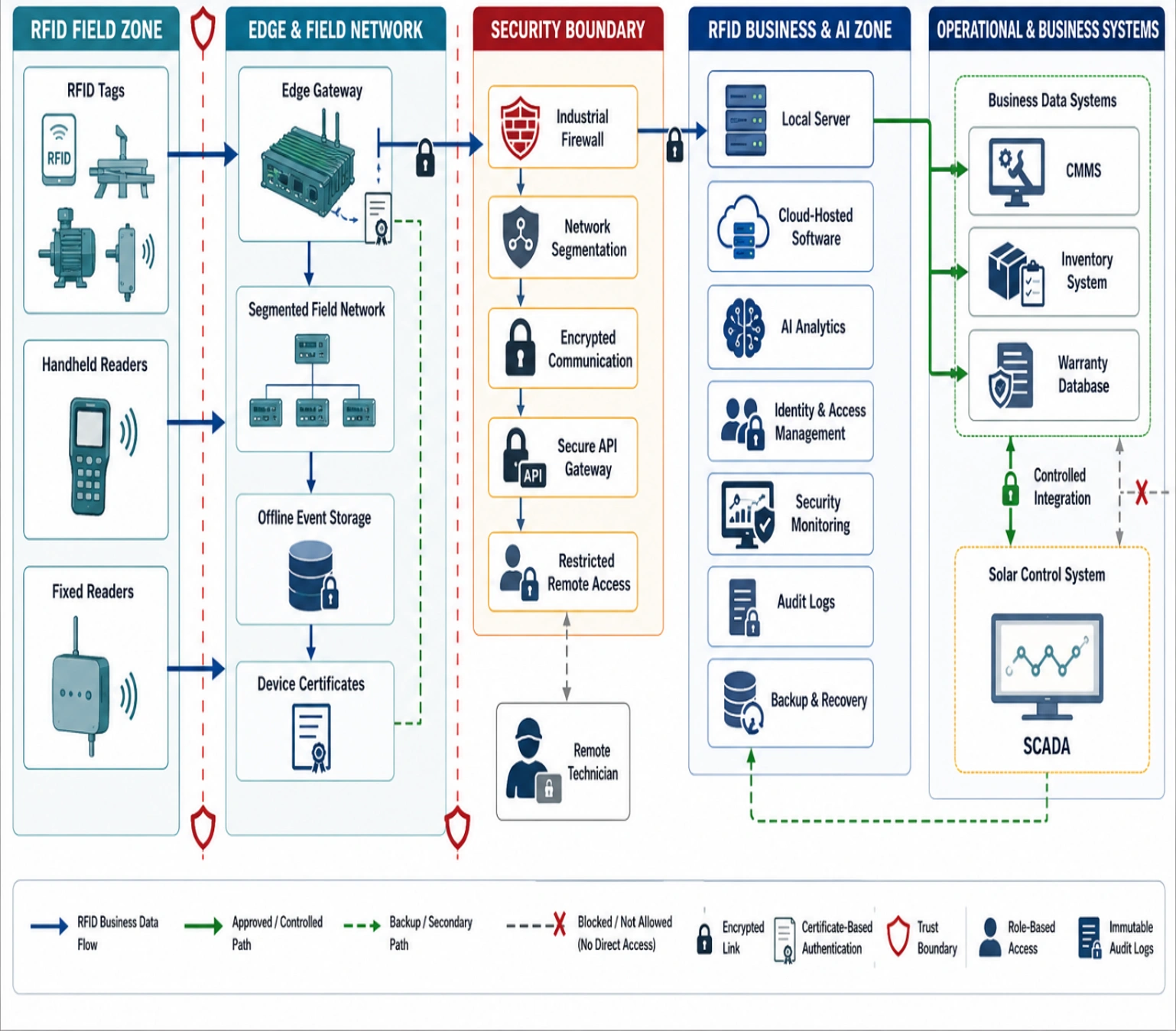
Layered RFID Cybersecurity for AI-Enabled Solar Farms
This block diagram shows how RFID field data moves through segmented networks, authenticated edge gateways, firewalls, encryption, secure APIs, and restricted access controls. It also separates RFID business systems and AI analytics from SCADA, using controlled integration, audit logs, monitoring, and backup paths to protect solar operations.
Technical Capabilities and Operational Benefits
Higher Asset-Record Accuracy
RFID reduces dependence on visual identification, handwritten records, and line-of-sight barcode scanning. Rapid multi-tag reads improve receiving, inventory, installation, and maintenance documentation.
AI strengthens accuracy by identifying conflicting locations, duplicate records, missing process events, and implausible asset movements. Better records support maintenance decisions, insurance reviews, warranty claims, repowering studies, and decommissioning plans.
Faster Maintenance Response
Linking RFID asset identities with SCADA alarms, inspection findings, and CMMS work orders helps technicians locate the affected equipment and collect the correct parts and tools before entering the array field.
AI can prioritize maintenance according to expected energy loss, safety implications, failure probability, weather access, crew availability, and spare-part readiness. This reduces avoidable travel and improves mean time to repair.
Predictive Spare-Parts Planning
Static reorder points may not reflect seasonal weather, aging inverter fleets, supplier lead times, or planned repowering. AI forecasting combines RFID inventory events with failure history and maintenance schedules to estimate future demand.
Operators can monitor stockout risk, emergency purchases, inventory turnover, obsolete stock, fill rate, and time required to issue critical parts. Forecasts should be reviewed when equipment models, suppliers, maintenance strategies, or site conditions change.
Stronger Warranty and Recall Management
A verified record of model, serial number, delivery batch, installation location, inspection history, and replacement activity gives solar operators stronger evidence for warranty claims. AI can identify patterns involving a particular supplier, production lot, module type, inverter component, or environmental condition.
When a recall occurs, RFID helps locate affected assets even if modules or parts have moved since delivery. The system can distinguish active equipment from warehouse stock, quarantined components, removed assets, and items already returned to a supplier.
Improved Construction Quality
RFID-supported commissioning creates a traceable connection between procured equipment and installed equipment. AI validation can expose allocation errors, missing tests, unauthorized substitutions, and incomplete turnover documentation before commercial operation.
The result is not merely faster scanning. The larger value is a more reliable operational baseline for future performance analysis and maintenance planning.
Scalable Multi-Site Oversight
Standard tag identifiers, event definitions, location hierarchies, and integration interfaces allow an owner to compare asset performance across multiple solar farms. AI models can identify fleet-wide patterns while preserving site-specific variables such as climate, module technology, inverter design, terrain, and maintenance strategy.
GAO is headquartered in New York City and Toronto, Canada, and is ranked among the leading global B2B and B2G suppliers of RFID and BLE products and systems. This background supports organizations that need scalable identification hardware, remote technical assistance, and deployment guidance across distributed locations.
Solar Farm KPIs for AI and RFID Programs
A deployment should be measured against defined operational outcomes. Useful indicators include:
Asset inventory accuracy
Percentage of modules linked to verified installation locations
RFID read success rate by read zone
Unresolved duplicate or missing asset records
Spare-parts stockout frequency
Inventory carrying cost
Tool return compliance
Calibration compliance for test equipment
Mean time to detect asset discrepancies
Mean time to repair solar equipment
Preventive-maintenance completion rate
Warranty recovery value
Recall identification time
Unauthorized asset-movement alerts
False-positive and false-negative alert rates
AI model precision, recall, and drift
Gateway and reader availability
Offline event synchronization success
Energy loss associated with delayed maintenance
Percentage of AI recommendations reviewed and resolved
KPI baselines should be established before deployment. Otherwise, teams may demonstrate that the system produces more data without proving that it improves asset control, energy availability, maintenance efficiency, or lifecycle cost.
Implementation Recommendations for Solar Farm Operators
Successful implementation begins with a specific operational problem, such as inaccurate module records, slow spare-parts counts, uncontrolled tool movement, or weak warranty traceability. A limited pilot should test the proposed tags, readers, workflows, integrations, and AI rules under actual field conditions.
Recommended implementation practices include:
Define asset classes, identifier rules, lifecycle states, and location hierarchies before tagging equipment.
Map receiving, installation, maintenance, transfer, quarantine, replacement, and disposal workflows.
Conduct a radio-frequency site survey and test tags on actual solar equipment.
Establish measurable baselines for inventory accuracy, process time, maintenance delays, and asset discrepancies.
Integrate RFID events with authoritative asset, work-order, and inventory records.
Assign ownership for master data, damaged tags, missed reads, and record corrections.
Train employees and contractors on approved scanning and exception-handling procedures.
Validate AI recommendations against confirmed field outcomes.
Monitor model drift, false alarms, reader availability, and synchronization failures.
Expand only after the pilot demonstrates repeatable technical and operational value.
GAO and its sister companies have served customers in the United States and Canada for three decades, including Fortune 500 companies, research organizations, universities, and government agencies. Continued investment in product research, quality assurance, and remote or onsite technical support helps GAO assist customers with RFID hardware selection, system design, testing, and deployment.
Advancing Solar Farm Intelligence with GAO
AI-powered RFID helps solar farm operators build reliable asset records, accelerate inventory processes, improve installation quality, strengthen warranty management, and direct maintenance resources toward the equipment with the greatest operational impact.
The technology delivers the best results when RFID data is connected to SCADA, CMMS, inventory, GIS, procurement, and security records. Accurate master data, field-tested hardware, resilient communications, cybersecurity controls, and human oversight remain essential.
To explore RFID tags, readers, antennas, edge devices, software integration, or technical support for solar asset tracking, contact GAO to discuss your site conditions and operational requirements.
Building the Future of Industrial AI and IoT with Aperture Venture Studio and GAO RFID Inc.
For more than three decades, GAO has invested extensively in industrial RFID, BLE, and IoT research and development. As generative AI demonstrated practical value in industrial applications, we expanded our work in AI-enabled IoT and established Aperture Venture Studio to advance and scale intelligent solutions for solar energy and other industries.
Aperture connects AI and IoT specialists, operational leaders, investors, and established organizations. Aperture Ventures Summit and TekSummit support technical discussion on emerging AI and IoT applications. We welcome participation from
- Advisors,
- Co-founders,
- Employees,
- Investors, and customers.