
AI and RFID for Drug Discovery
AI-Powered Drug Discovery with RFID-Enabled Research Intelligence
Drug discovery organizations are under increasing pressure to reduce research timelines, improve reproducibility, manage complex biological datasets, and accelerate the transition from target identification to clinical candidate selection. Artificial intelligence combined with RFID-enabled laboratory visibility helps research teams improve sample traceability, optimize experimental workflows, and generate higher-quality datasets for machine learning models.
Within drug discovery environments, RFID technologies such as UHF RFID, HF RFID, and LF RFID provide automated identification and tracking of compounds, reagents, biological samples, laboratory assets, and research materials. AI transforms the resulting data into actionable intelligence that supports target validation, high-throughput screening optimization, compound library management, laboratory resource utilization, predictive analytics, and research decision-making.
The combination of AI and RFID contributes to improved laboratory operations, stronger data integrity, reduced sample loss, enhanced regulatory readiness, and faster scientific discovery. Organizations implementing these technologies are creating more connected research environments where data, assets, scientists, and laboratory systems operate as an integrated intelligence-driven research system.
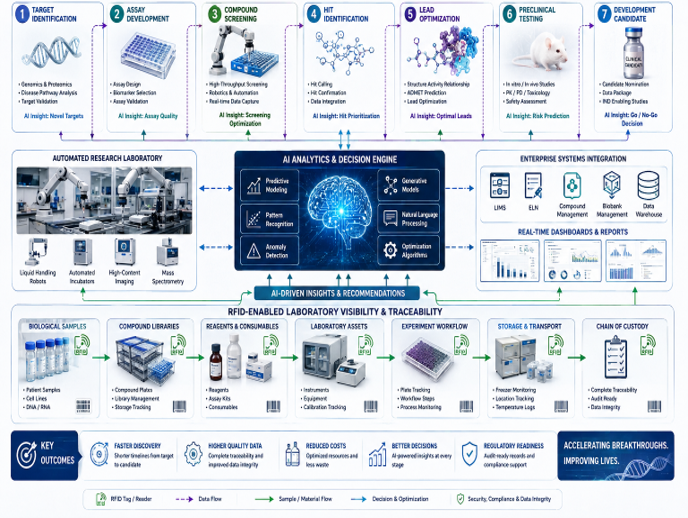
AI-Powered RFID Drug Discovery Lifecycle and Laboratory Intelligence System
This infographic illustrates how RFID-enabled laboratory visibility and AI analytics work together across the entire drug discovery lifecycle, from target identification through development candidate selection. It highlights automated research workflows, compound and sample traceability, laboratory asset tracking, enterprise software integration, and AI-driven decision support. The visual demonstrates how connected laboratory operations improve data quality, accelerate research timelines, enhance regulatory readiness, and support more informed scientific decisions.
Understanding AI-Driven Drug Discovery and RFID-Enabled Laboratory Intelligence
Drug discovery involves a highly complex sequence of scientific activities that include disease target identification, biomarker research, assay development, compound screening, lead identification, lead optimization, toxicology evaluation, and preclinical validation.
Each stage generates substantial amounts of data from:
- High-throughput screening systems
- Liquid handling robots
- Genomics platforms
- Proteomics instruments
- Cell culture laboratories
- Biobanks
- Compound management facilities
- Analytical chemistry laboratories
- Mass spectrometry systems
- Laboratory information management systems (LIMS)
Traditional manual tracking approaches often create challenges related to sample identification, chain of custody verification, reagent management, compound library control, and laboratory asset visibility.
RFID technology addresses these challenges by enabling automatic identification and tracking of laboratory resources. AI algorithms then analyze operational and scientific data generated across the research environment to identify patterns, predict outcomes, optimize workflows, and improve research productivity.
For drug discovery organizations, the value extends beyond operational efficiency. AI models depend on accurate, complete, and traceable datasets. RFID-supported data collection helps improve data quality while reducing human error that can negatively affect model training and research outcomes.
GAO has supported organizations requiring RFID-based asset visibility, inventory control, and laboratory tracking solutions that improve operational transparency across complex research environments.
Drug Discovery Challenges Driving AI and RFID Adoption
Drug discovery organizations face numerous operational and scientific challenges that directly impact research productivity, development costs, and time-to-market.
Sample Traceability Challenges
Biological samples often move through multiple laboratories, storage facilities, screening systems, and analytical workflows.
Common challenges include:
- Sample misidentification
- Incomplete chain-of-custody records
- Freezer inventory inaccuracies
- Delayed sample retrieval
- Cross-contamination risks
- Lost research materials
RFID-enabled sample tracking provides automated visibility throughout the sample lifecycle while AI identifies anomalies that may affect research integrity.
Compound Library Management Complexity
Modern pharmaceutical organizations may manage millions of compounds distributed across multiple facilities.
Challenges include:
- Compound location verification
- Inventory reconciliation
- Storage condition monitoring
- Expired compound identification
- Duplicate inventory management
- Compound utilization optimization
AI analyzes usage patterns and screening demand while RFID continuously tracks compound movement and inventory status.
Data Fragmentation Across Research Systems
Drug discovery data is often distributed across:
- LIMS software
- Electronic laboratory notebooks
- Scientific data repositories
- Instrument software
- Screening databases
- Biobank management systems
- Research data warehouses
AI models require unified datasets to generate meaningful insights. RFID-generated operational data helps establish stronger data continuity between physical laboratory activities and digital research records.
Research Equipment Utilization Issues
Critical laboratory instruments often represent substantial capital investments.
Examples include:
- Flow cytometers
- PCR systems
- High-content screening systems
- Chromatography instruments
- Spectrometers
- Automated storage systems
RFID-based equipment tracking combined with AI-driven utilization analytics helps research organizations maximize instrument availability and reduce scheduling conflicts.
Key Drug Discovery Applications of AI and RFID
AI-Powered Compound Library Management
Compound libraries represent one of the most valuable assets within pharmaceutical research organizations.
RFID tags attached to compound plates, storage containers, and transport units enable real-time inventory visibility. AI systems analyze compound utilization, screening demand, storage conditions, and replenishment requirements.
Benefits include:
- Improved compound availability
- Reduced duplicate acquisitions
- Better screening readiness
- Enhanced inventory accuracy
- Faster compound retrieval
AI-Enhanced Biobank Management
Biobanks contain critical biological specimens used for biomarker discovery, translational medicine, and target validation.
RFID enables:
- Sample identification
- Freezer location tracking
- Storage history monitoring
- Chain-of-custody verification
AI applications include:
- Sample quality prediction
- Utilization forecasting
- Cohort optimization
- Specimen prioritization
- Research resource allocation
High-Throughput Screening Optimization
High-throughput screening generates enormous volumes of experimental data.
RFID helps track:
- Assay plates
- Reagents
- Screening instruments
- Laboratory consumables
AI models analyze screening results to:
- Identify promising hits
- Reduce false positives
- Improve assay performance
- Optimize screening protocols
- Accelerate lead identification
Laboratory Asset Intelligence
Research facilities contain thousands of movable assets.
Examples include:
- Pipettes
- Cryogenic containers
- Incubators
- Mobile laboratory equipment
- Sample transport carts
- Analytical devices
RFID provides real-time visibility while AI identifies utilization trends, maintenance requirements, and asset allocation opportunities.
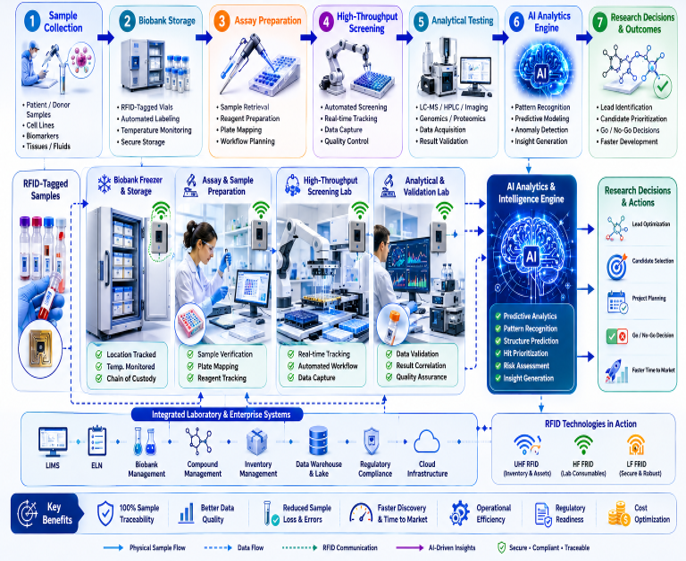
AI-Enabled RFID Sample Tracking Workflow for Pharmaceutical Drug Discovery Laboratories
This workflow diagram demonstrates how RFID-enabled sample tracking and AI analytics support the complete biological sample lifecycle within a pharmaceutical drug discovery environment. The visual follows samples from collection and biobank storage through assay preparation, high-throughput screening, analytical testing, and AI-driven research decision-making. It also highlights integration with LIMS, ELN, biobank management, compound management, and data warehouse systems to improve traceability, data quality, operational efficiency, and regulatory readiness.
Drug Discovery Operational Workflow from Data Acquisition to AI-Driven Decisions
Successful deployment requires a structured workflow connecting physical laboratory operations with AI-powered analytics.
Step 1: Data Capture and Identification
RFID tags are attached to:
- Sample tubes
- Cryovials
- Compound containers
- Reagent kits
- Laboratory assets
- Screening plates
Data captured includes:
- Unique identifiers
- Location information
- Time stamps
- Storage events
- Laboratory workflow activities
Step 2: Laboratory Communication Infrastructure
Data is transmitted through:
- RFID readers
- Laboratory gateways
- Secure wireless networks
- Ethernet-connected laboratory systems
- Edge computing devices
Research organizations often deploy redundant communication paths to maintain data continuity for critical research operations.
Step 3: Edge Processing and Validation
Edge computing systems perform:
- Data filtering
- Duplicate event elimination
- Device authentication
- Event correlation
- Preliminary analytics
Local processing reduces unnecessary data transmission while supporting near real-time laboratory visibility.
Step 4: Integration with Scientific Software
Operational data is integrated with:
- Laboratory Information Management Systems
- Electronic Laboratory Notebooks
- Biobank Management Software
- Research Data Warehouses
- Scientific Data Lakes
- Inventory Management Systems
This integration creates a comprehensive view of laboratory operations and scientific activities.
Step 5: AI Analytics and Model Execution
Machine learning models process combined operational and scientific datasets.
Examples include:
- Predictive inventory analytics
- Sample quality prediction
- Equipment utilization forecasting
- Research workflow optimization
- Compound prioritization models
- Resource allocation optimization
Step 6: Scientific and Operational Actions
AI-generated recommendations support:
- Experimental planning
- Resource scheduling
- Sample prioritization
- Screening optimization
- Inventory replenishment
- Equipment allocation
Research leaders gain improved visibility into operational bottlenecks and scientific opportunities.
RFID, AI, Software, Security, and Infrastructure Components for Drug Discovery
Modern drug discovery environments require coordinated interaction between identification technologies, laboratory software, AI analytics systems, and cybersecurity controls.
The core identification layer typically includes UHF RFID for inventory visibility and warehouse-scale laboratory tracking, HF RFID for laboratory consumables and controlled workflows, and LF RFID for specialized applications involving challenging environmental conditions. RFID readers, antennas, handheld devices, laboratory workstations, and mobile data collection terminals form the foundation of physical asset and sample visibility.
Above the identification layer, middleware software aggregates laboratory events and distributes validated information to business and scientific systems. Integration commonly occurs with LIMS software, electronic laboratory notebooks, compound management software, biobank management applications, scientific data repositories, and laboratory scheduling systems.
AI capabilities frequently include machine learning, predictive analytics, anomaly detection, pattern recognition, natural language processing for scientific literature analysis, and optimization algorithms used for laboratory operations and compound prioritization.
Cloud deployments are often selected when organizations require centralized visibility across multiple research sites, scalable computing resources for AI workloads, and rapid deployment of advanced analytics capabilities. Cloud-hosted environments are particularly useful for collaborative drug discovery programs involving geographically distributed research teams.
Server-based deployments are commonly preferred when organizations manage highly sensitive intellectual property, proprietary molecular datasets, confidential screening results, or regulatory constraints requiring greater control over scientific data. Private servers located within research facilities can provide lower latency, localized processing, and customized security controls.
Security measures typically include:
- Role-based access control
- Data encryption
- Device authentication
- Audit logging
- Identity management
- Network segmentation
- Research data protection controls
These controls help protect valuable scientific assets while maintaining data integrity throughout the drug discovery lifecycle.
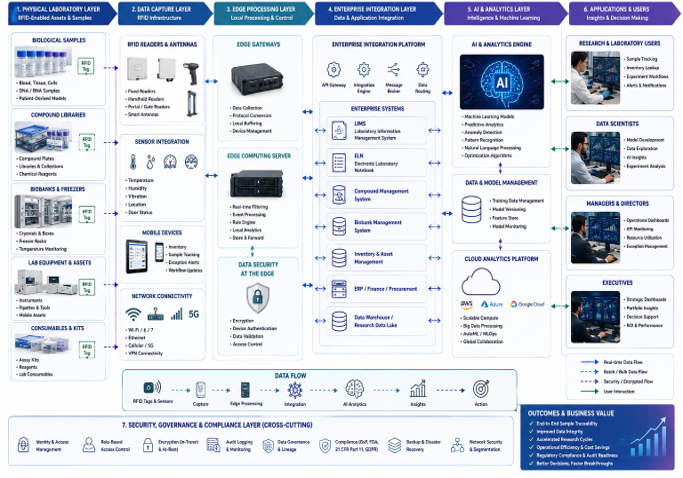
Enterprise AI and RFID Architecture for Drug Discovery Data Management and Laboratory Intelligence
This architecture diagram illustrates a complete AI-enabled RFID deployment for pharmaceutical drug discovery operations, connecting RFID-tagged samples, compound libraries, biobanks, laboratory equipment, edge processing systems, enterprise software, and AI analytics engines. The visual demonstrates how laboratory data flows securely from physical research assets through integration layers, machine learning systems, cloud analytics, and executive dashboards. It highlights cybersecurity controls, regulatory compliance measures, and data governance capabilities that support traceability, operational efficiency, and accelerated scientific discovery.
Technical Capabilities and Business Value of AI-Driven Drug Discovery Solutions
Drug discovery organizations are increasingly seeking ways to improve research productivity, reduce experimental variability, accelerate candidate identification, and maximize the value of scientific data. Combining AI with RFID-enabled laboratory visibility creates measurable operational and scientific advantages across the research lifecycle.
Enhanced Sample Integrity and Traceability
Research outcomes depend heavily on sample integrity and reproducibility. Biological specimens, assay materials, reagents, and compounds often pass through multiple research workflows before generating meaningful scientific results.
AI-supported RFID systems help achieve:
- Continuous sample traceability
- Automated chain-of-custody documentation
- Reduced manual recordkeeping
- Improved freezer inventory accuracy
- Faster sample retrieval
- Lower sample loss rates
These benefits improve data quality and strengthen confidence in downstream research findings.
Improved Data Quality for AI Models
Machine learning systems require high-quality data to produce reliable predictions.
Drug discovery organizations frequently encounter:
- Missing records
- Duplicate entries
- Manual transcription errors
- Inconsistent sample labeling
- Incomplete workflow documentation
RFID-generated event data creates a more accurate operational record. AI models trained using higher-quality datasets can deliver more reliable predictions for compound prioritization, biomarker discovery, assay optimization, and candidate selection.
Accelerated Research Workflows
Research teams spend significant time locating samples, validating inventory, confirming storage conditions, and reconciling laboratory records.
AI-supported workflow intelligence helps:
- Identify process bottlenecks
- Predict resource shortages
- Optimize laboratory scheduling
- Improve experiment planning
- Reduce administrative workload
Scientists spend more time conducting research and less time performing manual operational tasks.
Better Utilization of Research Assets
Drug discovery facilities often manage large inventories of high-value equipment.
Examples include:
- Automated liquid handlers
- High-content imaging systems
- Flow cytometers
- Genomic sequencers
- Spectroscopy instruments
- Chromatography systems
AI analyzes utilization patterns while RFID tracks equipment movement and availability.
Benefits include:
- Improved equipment utilization
- Reduced idle time
- Better maintenance planning
- Increased scheduling efficiency
- Extended asset lifespan
Predictive Inventory and Reagent Management
Research interruptions frequently occur because critical materials are unavailable when needed.
AI forecasting models analyze:
- Historical consumption patterns
- Experimental demand
- Research project schedules
- Procurement lead times
- Inventory turnover rates
RFID provides real-time inventory visibility that supports accurate forecasting and replenishment decisions.
Increased Regulatory Readiness
Drug discovery organizations operate within highly regulated environments where data integrity and traceability are essential.
AI-supported RFID solutions improve:
- Audit preparation
- Documentation quality
- Chain-of-custody verification
- Research data governance
- Electronic record integrity
Organizations can maintain stronger compliance readiness while reducing administrative burdens associated with manual record management.
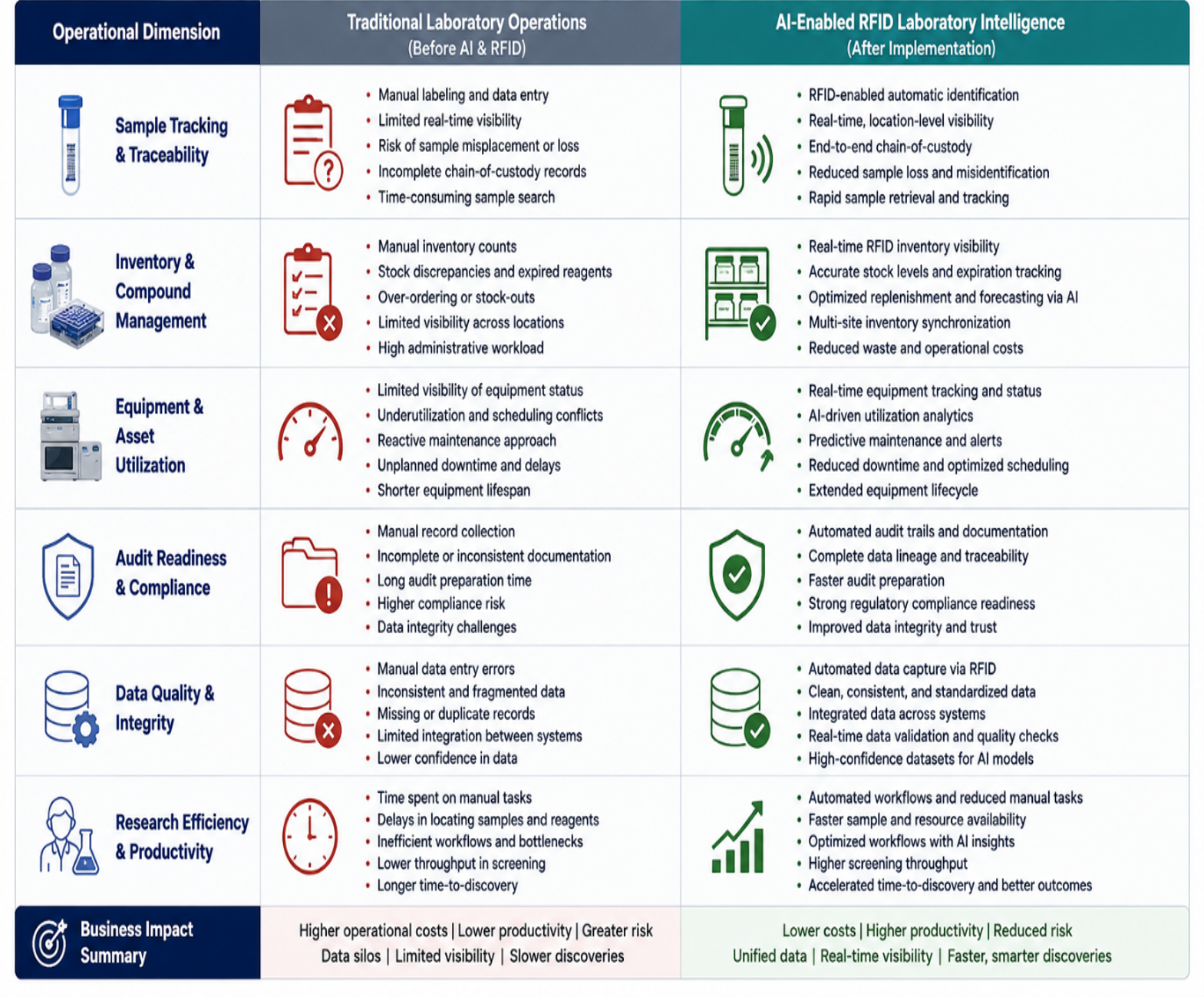
Traditional Laboratory Operations vs. AI-Enabled RFID Intelligence in Drug Discovery Laboratories
This comparison infographic illustrates the operational differences between traditional laboratory processes and AI-enabled RFID laboratory intelligence in pharmaceutical drug discovery environments. It compares key areas including sample tracking, inventory management, equipment utilization, audit readiness, data quality, and research productivity. The visual demonstrates how RFID-driven visibility and AI-powered analytics improve traceability, automate workflows, enhance compliance readiness, and accelerate scientific discovery while reducing operational costs and risks.
Deployment Considerations for Drug Discovery Organizations
Successful implementation requires careful planning across scientific, operational, technical, and regulatory domains.
Laboratory Environment Assessment
Organizations should evaluate:
- Sample volumes
- Compound library size
- Storage facilities
- Laboratory workflows
- Instrument inventory
- Existing software infrastructure
The assessment helps determine appropriate RFID technologies, reader locations, integration requirements, and AI objectives.
Data Governance Strategy
AI initiatives are only as effective as the underlying data.
Key considerations include:
- Data ownership
- Data quality standards
- Metadata consistency
- Retention policies
- Access controls
- Scientific data stewardship
Research organizations should establish governance procedures before deploying advanced analytics capabilities.
Integration Planning
Drug discovery environments typically contain multiple specialized systems.
Common integration targets include:
- LIMS software
- ELN software
- Scientific data management systems
- Compound management software
- Biobank software
- Enterprise resource planning systems
Integration planning should focus on maintaining data consistency while minimizing operational disruption.
Cybersecurity and Intellectual Property Protection
Drug discovery organizations manage highly valuable intellectual property.
Recommended security practices include:
- Multi-factor authentication
- Encryption at rest
- Encryption in transit
- Network segmentation
- Security monitoring
- Vulnerability management
- Access auditing
Organizations should align security controls with research sensitivity and regulatory obligations.
Scalability Planning
Many organizations begin with a single laboratory deployment before expanding across multiple research sites.
Scalability planning should address:
- Reader capacity
- Data storage requirements
- AI computing resources
- Network bandwidth
- Software licensing
- Future laboratory expansion
GAO has helped organizations evaluate RFID hardware requirements and deployment considerations for growth-oriented operational environments where scalability and long-term maintainability are critical.
Practical Engineering Lessons from Drug Discovery Deployments
Real-world implementations often reveal important operational insights that extend beyond technology selection.
Common lessons include:
- Sample labeling standards should be established before deployment.
- Laboratory staff training significantly influences adoption success.
- Integration requirements are often more complex than expected.
- Data quality improvement should begin before AI model development.
- Pilot projects help validate workflows before larger rollouts.
- Reader placement requires testing within actual laboratory environments.
- Laboratory freezer environments may require specialized RFID configurations.
- Governance procedures should be implemented alongside technology deployment.
Organizations that address these factors early generally achieve faster adoption and stronger return on investment.
Key Performance Indicators for AI-Enabled Drug Discovery Operations
Drug discovery organizations frequently evaluate implementation success using measurable scientific and operational KPIs.
Typical KPIs include:
- Sample retrieval time
- Sample identification accuracy
- Compound inventory accuracy
- Screening throughput
- Equipment utilization rate
- Reagent waste reduction
- Laboratory productivity
- Research cycle time
- Data quality score
- Audit preparation effort
- Asset availability
- Inventory turnover
- Experiment completion rate
- Sample loss rate
- Research project completion timelines
AI analytics can continuously monitor these indicators and identify opportunities for improvement.
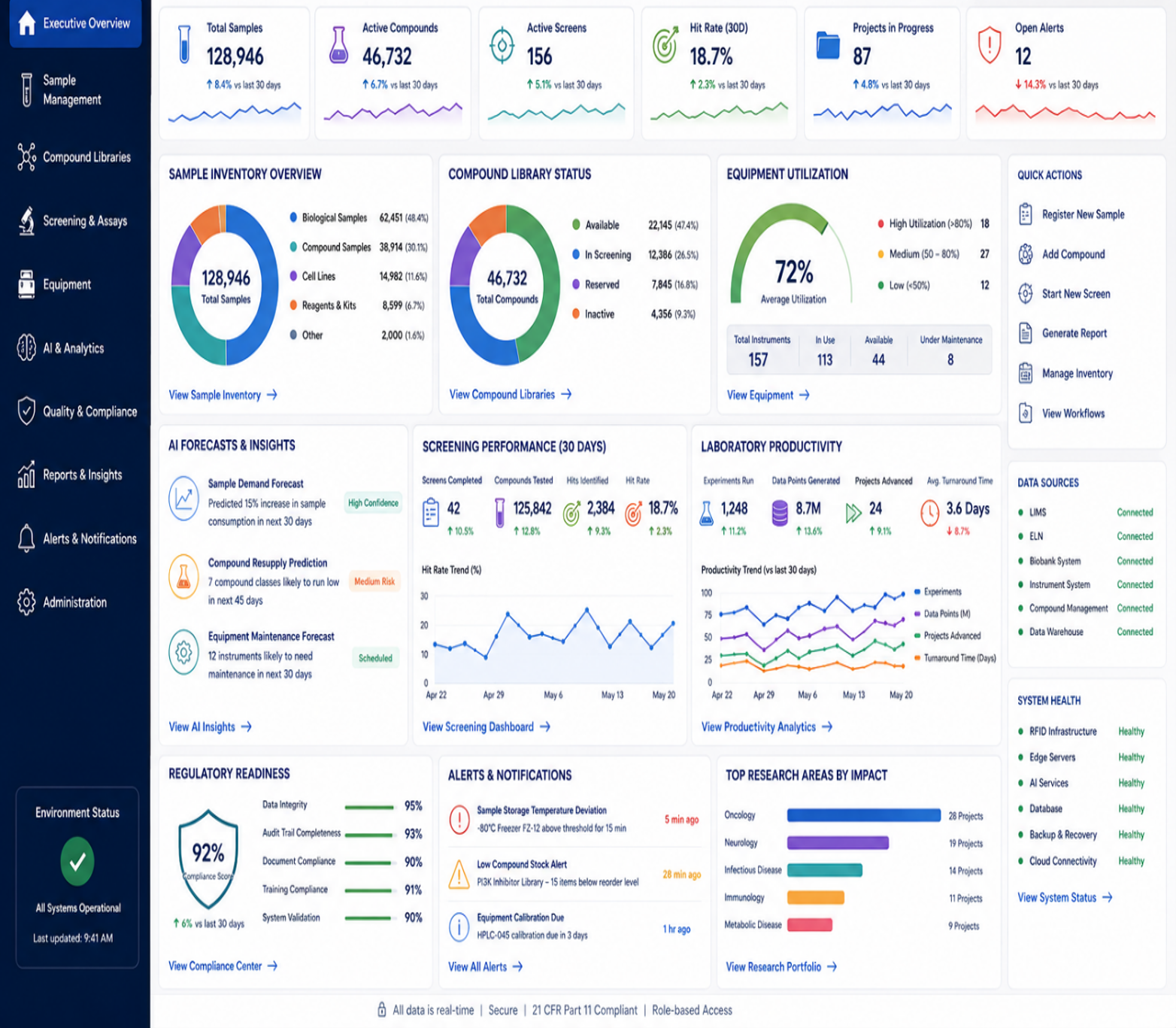
Executive Drug Discovery Operations Dashboard with AI Analytics and RFID Performance Intelligence
This dashboard mockup provides executive-level visibility into pharmaceutical drug discovery operations by consolidating sample inventory metrics, compound library status, equipment utilization, screening performance, laboratory productivity, AI-generated forecasts, and regulatory readiness indicators. The visual demonstrates how AI analytics and RFID-enabled data collection support real-time monitoring, predictive decision-making, operational optimization, and compliance management. Key performance indicators, alerts, research portfolio insights, and system health metrics help research leaders improve resource allocation and accelerate scientific outcomes.
Why Drug Discovery Organizations Are Investing in AI-Enabled RFID Intelligence
Several trends are driving adoption across pharmaceutical, biotechnology, translational medicine, and research organizations.
These include:
- Growing research data volumes
- Increased use of automation
- Expansion of high-throughput screening
- Precision medicine initiatives
- Biomarker-driven research
- Multi-site research collaboration
- Demand for faster candidate identification
- Greater regulatory scrutiny
- Rising R&D costs
- Increased reliance on AI-assisted scientific discovery
RFID-supported visibility provides reliable operational data while AI converts that data into actionable research intelligence.
Organizations are increasingly viewing laboratory visibility and AI-driven decision support as strategic capabilities rather than isolated technology projects.
Advancing Drug Discovery Through AI and RFID Intelligence
Drug discovery depends on accurate data, reliable laboratory operations, efficient resource utilization, and scientific decision-making supported by trustworthy information. AI-enabled research intelligence supported by RFID-based visibility helps organizations strengthen sample traceability, improve inventory management, optimize laboratory workflows, and generate higher-quality datasets for advanced analytics.
Successful implementations combine identification technologies, laboratory software, scientific data management, cybersecurity controls, and AI-driven decision support into a unified research environment. Organizations that adopt these capabilities can improve operational efficiency, accelerate scientific discovery, reduce research risks, and support more informed decisions throughout the drug development lifecycle.
For organizations evaluating drug discovery visibility solutions, GAO provides RFID hardware, IoT technologies, technical expertise, and implementation guidance that support laboratory tracking, asset management, inventory visibility, and AI-ready data collection initiatives.
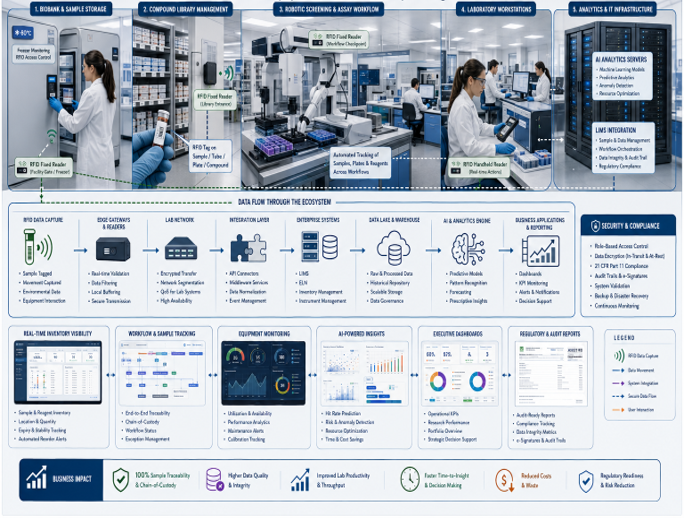
RFID-Enabled AI Drug Discovery Facility Architecture with Real-Time Laboratory Intelligence and Analytics
This deployment scenario diagram illustrates a real-world pharmaceutical drug discovery facility where RFID-tagged samples, compound libraries, biobanks, robotic screening systems, laboratory workstations, and AI analytics platforms operate as a connected ecosystem. The visual demonstrates how data flows from sample capture and laboratory operations through enterprise systems, LIMS integration, AI engines, executive dashboards, and compliance reporting tools. Its key takeaway is that AI-enabled RFID infrastructure provides end-to-end traceability, improved data integrity, enhanced operational visibility, and faster, more informed research decisions.
Building the Future of Industrial AI and IoT with Aperture Venture Studio and GAO RFID Inc.
For more than three decades, GAO and its affiliated organizations have invested extensively in RFID, BLE, IoT, and industrial technology research and development. As artificial intelligence becomes increasingly valuable for scientific research, laboratory automation, and data-driven drug discovery, we have expanded our focus on AI and IoT technologies that help organizations improve operational visibility and research intelligence.
To further support innovation in AI-enabled laboratory systems, connected research environments, and intelligent scientific operations, we founded Aperture Venture Studio to help accelerate the development and adoption of advanced AI and IoT solutions across research-intensive sectors.
Through collaborations with leading technical experts, industry professionals, investors, researchers, and technology organizations, Aperture has contributed to vibrant technical communities focused on AI, IoT, and applied industrial intelligence. Together with initiatives such as Aperture Ventures Summit and TekSummit, these efforts help advance discussions surrounding the future of intelligent research operations, connected laboratories, and AI-powered scientific discovery.
Headquartered in New York City and Toronto, GAO is recognized among the world’s leading suppliers of RFID and BLE technologies. For decades, GAO and its sister organizations have supported Fortune 500 companies, research institutions, universities, and government agencies across North America through extensive R&D investment, rigorous quality processes, and expert technical support delivered remotely and onsite.
We welcome engagement from organizations seeking technical guidance, implementation expertise, advanced RFID technologies, and AI-enabled IoT solutions for drug discovery and life sciences applications.