
AI for Nuclear Power Plants: RFID-Enabled Asset Tracking, Maintenance and Operations
AI for Nuclear Power Plants with RFID-Enabled Operations
AI is changing how nuclear power plants manage maintenance, outage activities, materials, tools, equipment, work packages, and plant records by turning identification data into operational intelligence. RFID provides the physical identification layer that allows tagged components, maintenance tools, spare parts, containers, documents, and other controlled assets to be associated with digital records and operational events. AI can then analyze these events alongside CMMS, EAM, warehouse, maintenance, inspection, work-order, and equipment-condition data to identify anomalies, predict workflow delays, prioritize maintenance activities, and improve asset availability. For nuclear facilities, the greatest value comes from using AI and RFID in carefully bounded applications that support personnel rather than directly controlling safety-related plant functions. The solution must account for electromagnetic compatibility, cybersecurity, nuclear quality assurance, radiation and environmental conditions, access controls, data integrity, and strict separation from safety-related instrumentation and control systems.
AI-Driven RFID Architecture for Nuclear Asset Tracking and Maintenance
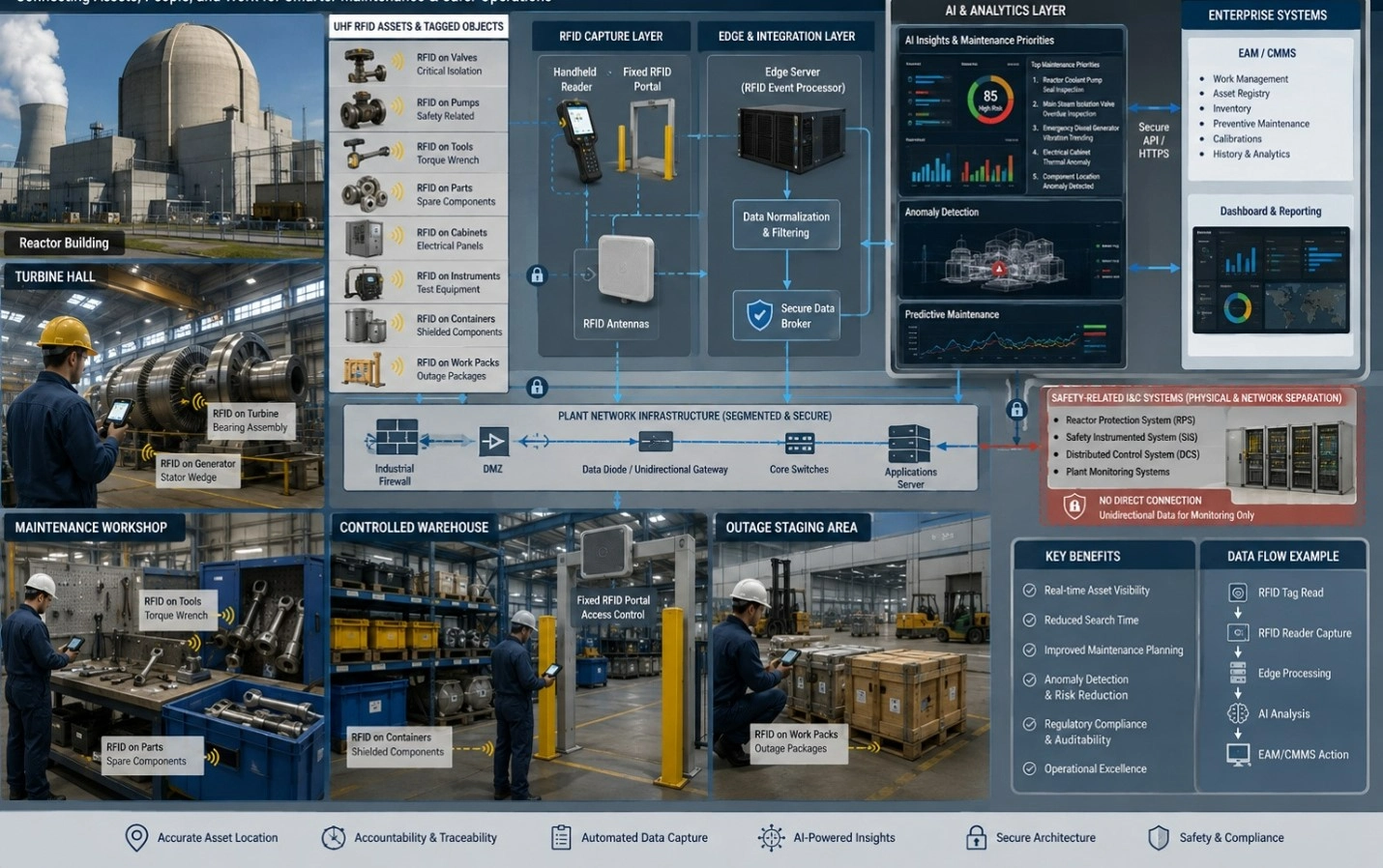
Why AI-Driven Asset Intelligence Matters in Nuclear Power Plants
Nuclear power plants contain thousands of components, tools, instruments, spare parts, maintenance materials, temporary equipment, and documentation items that move between warehouses, workshops, radiation-controlled areas, outage staging zones, and work locations. Manual identification and spreadsheet-based tracking can create gaps between the physical state of an asset and its digital record. Those gaps become particularly important during refueling outages, preventive maintenance, corrective maintenance, surveillance testing, inspections, and component replacement.
RFID addresses the identification problem by giving physical objects machine-readable identities. UHF RFID is particularly useful when multiple tagged items need to be identified without line-of-sight scanning, while HF RFID can support shorter-range identification and controlled interactions. LF RFID can be appropriate for specialized identification applications where its propagation characteristics and reader/tag configuration provide an advantage.
AI adds a decision layer above these identification events. Rather than simply answering “Where is this tool?”, an AI-enabled system can evaluate questions such as:
Which maintenance tools are likely to delay an outage work package because they have not reached the staging area?
Which spare parts have remained in inventory beyond expected movement patterns?
Which equipment-maintenance activities show repeated delays associated with missing tools or materials?
Which RFID event sequences indicate an abnormal movement pattern?
Which maintenance work packages require additional logistical preparation?
Which assets have incomplete or inconsistent location and custody records?
Which inventory items should be verified before a scheduled outage activity?
Which recurring material-handling bottlenecks are increasing maintenance cycle time?
The result is not simply automated asset tracking. It is AI-driven nuclear maintenance and material intelligence, supported by RFID-generated physical-world data.
For nuclear operators, this distinction is important. AI should generally function as an advisory and analytical capability unless a specific safety case, regulatory basis, verification and validation process, and plant licensing framework support a more consequential application. RFID and AI used for maintenance logistics can therefore deliver operational value while remaining separated from systems responsible for direct reactor protection or safety-related control.
The U.S. Nuclear Regulatory Commission continues to evaluate wireless technologies and their interaction with safety-related and important-to-safety equipment. NRC research specifically addresses the safety implications of wireless technologies near nuclear plant equipment, including electromagnetic and radio-frequency interference considerations.
Nuclear Power Plant Applications for AI and RFID
AI-Assisted Maintenance Asset Tracking
Maintenance departments can tag tools, inspection equipment, replacement components, calibration equipment, lifting accessories, temporary equipment, and other controlled assets. RFID readers capture movement events at designated locations while handheld readers support technicians working inside plant areas.
AI can combine RFID movement history with work orders, equipment hierarchy, maintenance schedules, and asset master data. This supports predictions about missing equipment, abnormal movement, repeated search activity, and maintenance logistics.
A practical implementation should distinguish between:
Safety-related equipment
Important-to-safety equipment
Non-safety-related plant equipment
Maintenance tooling
Calibration and test equipment
Temporary outage equipment
Consumable materials
Spare parts and warehouse inventory
This classification helps determine RFID tag requirements, data retention, QA controls, cybersecurity boundaries, and the degree of operational assurance required.
Outage and Refueling Work Management
Refueling outages create concentrated demand for labor, tools, components, temporary equipment, inspection devices, and spare parts. RFID can provide automated movement records as materials leave warehouse locations, enter staging areas, reach work zones, and return after task completion.
AI can analyze these events against outage schedules to identify potential logistics bottlenecks.
For example, an AI model can compare the planned start time of a pump-maintenance work package with the actual arrival of its required tools, gaskets, fasteners, test equipment, and replacement components. If several prerequisite assets have not reached the staging location, the system can flag the work package for human review.
This approach can reduce avoidable waiting time without allowing AI to make unauthorized changes to maintenance procedures or plant operating parameters.
Spare Parts and Nuclear Material Traceability
Nuclear maintenance organizations must maintain accurate records for components and materials subject to procurement, inspection, storage, preservation, testing, and installation requirements. RFID can connect physical items with part numbers, serial numbers, lot information, inspection records, storage locations, and work-order references.
AI can identify unusual inventory patterns, duplicate records, unexpected movement sequences, prolonged storage, and discrepancies between physical and digital inventories.
The system can also support warehouse personnel by prioritizing verification tasks before outage mobilization.
Tool Control and Foreign Material Exclusion
Foreign material exclusion is an important maintenance concern because unintended objects entering equipment or work areas can create operational and quality risks. RFID can provide an automated inventory mechanism for designated tools and equipment before, during, and after maintenance activities.
AI can evaluate expected tool lists against actual RFID observations and highlight unresolved discrepancies.
A typical workflow can include:
Assign RFID identity to approved tools
Associate tools with a work package
Verify tool issue before entry into the work area
Capture RFID observations at controlled locations
Reconcile tool return against the work package
Escalate missing or unexpected assets
Require technician or supervisor confirmation
Preserve the event history for audit and maintenance records
RFID should supplement, not automatically replace, established foreign material exclusion procedures and human verification requirements.
Calibration and Inspection Equipment Management
Portable test instruments, calibration equipment, radiation-monitoring accessories, inspection devices, and specialized maintenance equipment can be difficult to manage across large plant sites.
RFID can associate each item with its equipment ID, calibration status, assigned location, maintenance history, and responsible department. AI can analyze usage patterns and identify equipment approaching calibration or maintenance thresholds.
The system can also detect situations where equipment is repeatedly moved between departments or where high-demand instruments may become a maintenance bottleneck.
RFID-to-AI Workflow for Nuclear Plant Asset Management
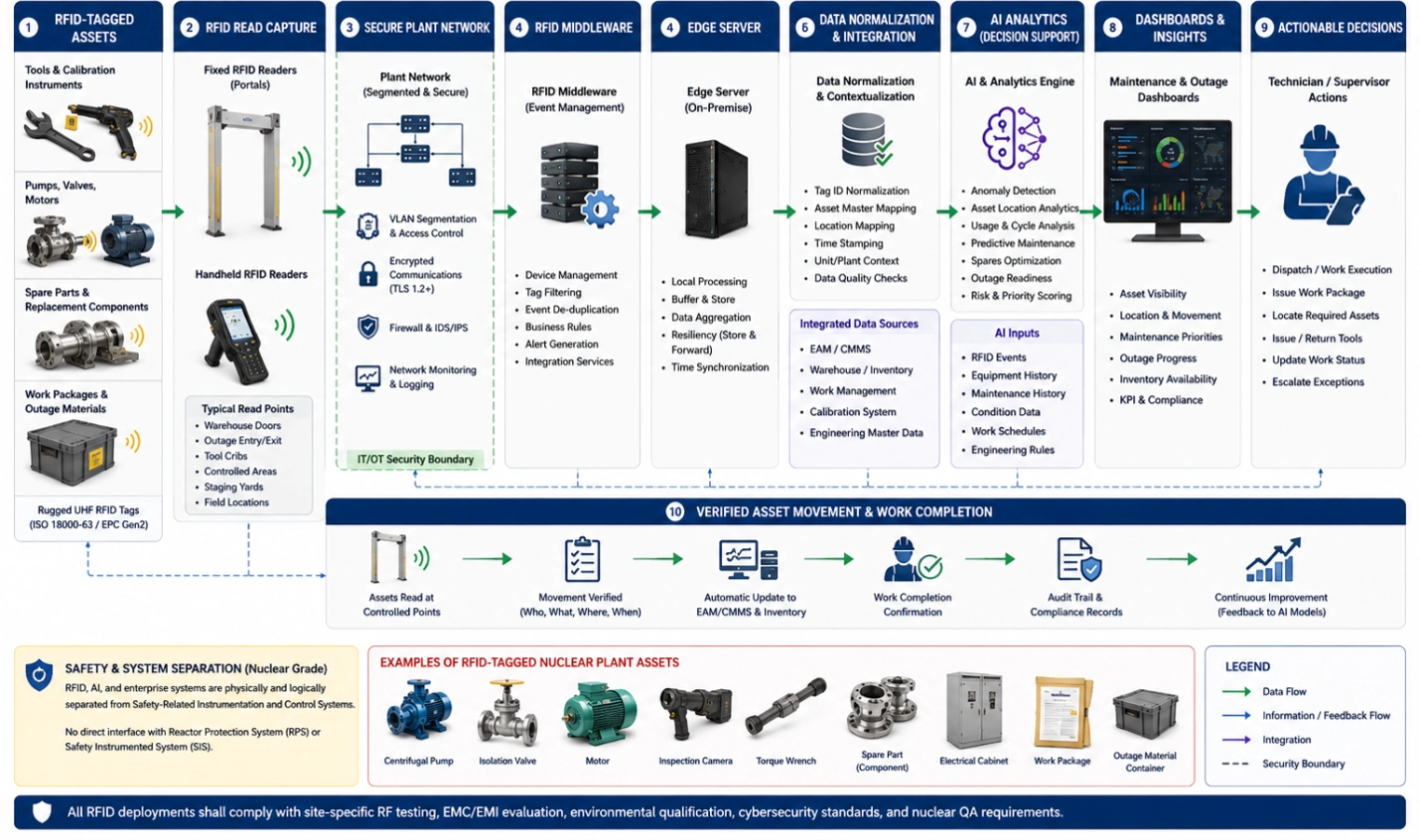
From RFID Events to AI-Based Nuclear Maintenance Decisions
An effective nuclear plant solution should treat RFID data as one operational data source rather than as an isolated tracking application. The complete workflow typically begins with physical identification and ends with a verified operational action.
Data Capture
RFID tags are assigned to approved assets and linked to authoritative asset records. Fixed readers can monitor defined transition points, while handheld readers provide technician-driven identification in locations where fixed infrastructure is impractical.
Tag selection should consider:
Metal mounting surfaces
Equipment geometry
Temperature
Humidity
Radiation exposure
Chemical exposure
Cleaning requirements
Mechanical impact
Required read distance
Tag attachment method
Required memory
Expected service life
The most important engineering lesson is that RFID performance cannot be selected from frequency alone. Antenna orientation, tag construction, mounting material, reader power, interference, enclosure design, reader placement, and the physical environment can materially change read performance.
RFID Middleware and Event Normalization
Raw RFID reads can contain duplicate observations, missed reads, antenna-specific events, and transient detections. Middleware should convert those observations into meaningful business events such as:
Asset entered staging area → asset assigned to work package → asset moved to maintenance area → asset returned → asset verified.
Filtering and event correlation should occur close to the data source when possible. This reduces unnecessary network traffic and prevents downstream AI models from interpreting every raw RFID observation as an independent operational event.
Edge Processing
An edge server located within the plant’s approved computing environment can perform local RFID event processing, caching, rule evaluation, and selected AI inference.
Edge processing becomes especially useful when network segmentation, limited external connectivity, cybersecurity controls, or operational continuity requirements restrict direct cloud communication.
The edge layer can also maintain temporary event buffers during network interruptions and synchronize approved records when connectivity is restored.
Enterprise Software Integration
Normalized RFID events can be integrated with:
EAM software
CMMS software
Maintenance work management
Warehouse management
Inventory management
Procurement systems
Document management
Inspection management
Calibration management
Outage planning software
Business intelligence systems
Security and access management systems
Integration should use controlled interfaces and clearly defined data ownership. The RFID system should not become a competing source of truth for asset master data.
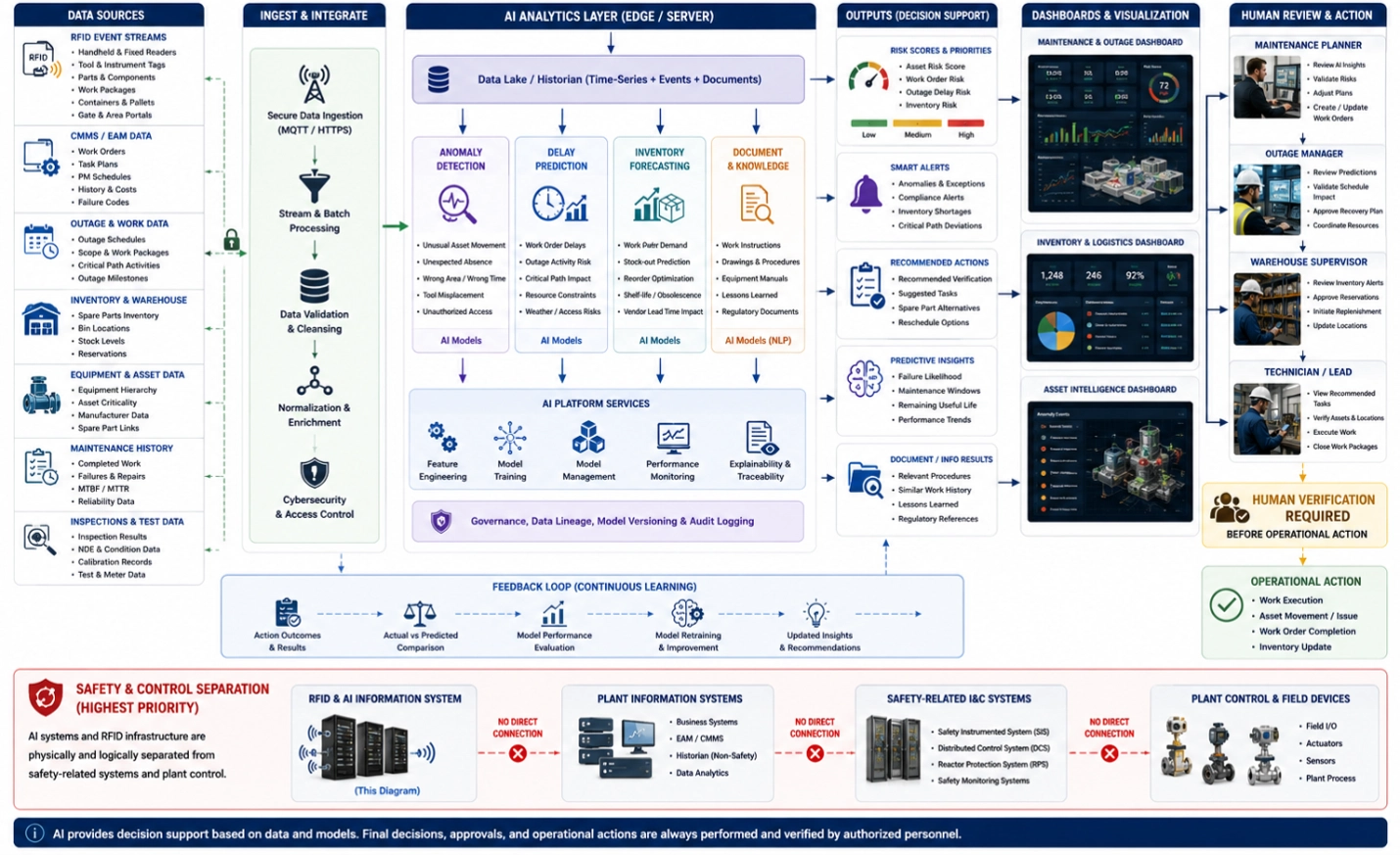
AI Analytics and Human Decision Support
AI models can operate on RFID event histories together with maintenance, inventory, work-order, equipment-condition, and scheduling data.
Appropriate methods can include:
Anomaly detection for unusual asset movement
Time-series analysis for recurring logistics delays
Classification models for work-package delay risk
Clustering for identifying recurring maintenance workflow patterns
Forecasting for inventory demand
Graph-based analysis of asset, location, work-order, and personnel relationships
Natural language processing for maintenance records
Retrieval-augmented AI for searching approved technical documentation
Optimization models for staging and resource allocation
AI recommendations should include explainable evidence where practical. A maintenance planner should be able to see why a work package was flagged, which RFID events contributed to the recommendation, what historical pattern was detected, and which underlying records were used.
RFID Technologies for Nuclear Power Plant Applications
RFID technology selection should be driven by the physical environment and operational objective rather than by a generic preference for one frequency.
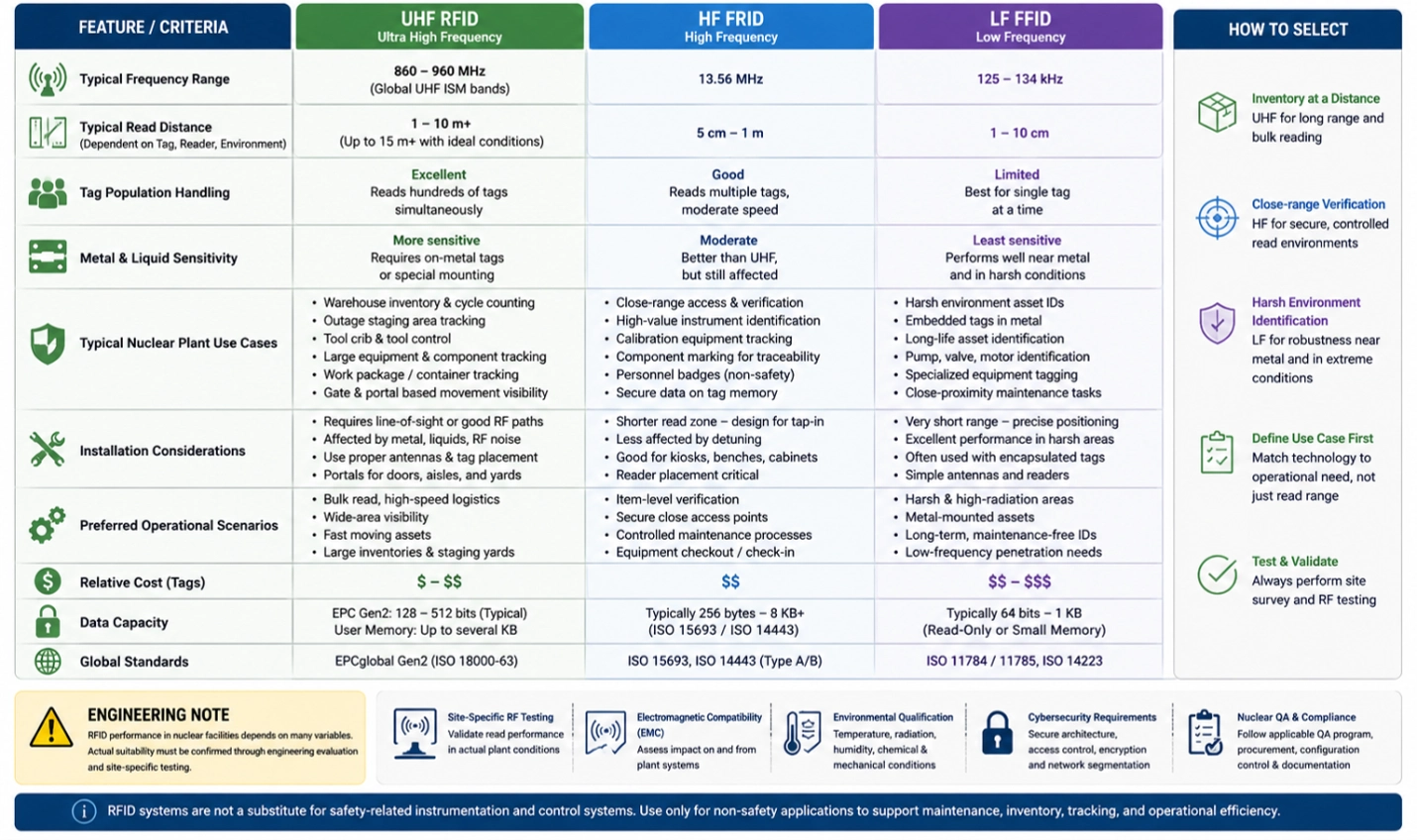
UHF RFID
UHF RFID is well suited to bulk identification, warehouse operations, staging areas, tool inventories, material movement, and portal-style reading. Modern UHF RFID systems commonly operate within regional allocations around the 860 to 960 MHz range. ISO/IEC 18000 specifications define RFID air-interface parameters for this class of item-management applications.
UHF performance can be affected by metal, liquids, equipment orientation, shielding, and dense tag populations. Nuclear plant deployments therefore benefit from site surveys and representative testing with the actual equipment, materials, cabinets, containers, and tag mounting methods.
HF RFID
HF RFID operates around 13.56 MHz and is useful for shorter-range identification, controlled item verification, access-related applications, and situations where close-proximity reads are desirable.
HF can be particularly appropriate where the process intentionally requires a technician to bring the reader close to the tagged object instead of detecting an asset across a room.
LF RFID
LF RFID typically operates around 125 kHz or 134.2 kHz and can be useful for specialized identification requirements. Its shorter-range behavior can help reduce unintended reads in tightly controlled identification processes.
LF should be evaluated based on reader/tag availability, required range, mounting conditions, data requirements, and integration needs rather than simply comparing frequency specifications.
Rugged and Specialized RFID Tags
Nuclear plant environments can require tags capable of tolerating harsh conditions. Depending on the use case, designers may evaluate:
On-metal RFID tags
Rugged industrial tags
High-temperature tags
Encapsulated tags
Waterproof tags
Chemical-resistant tags
Tamper-evident tags
Cable and asset tags
Printable RFID labels
Specialized tags for tools and equipment
For items exposed to elevated temperature, radiation, chemicals, vibration, decontamination processes, or long-term outdoor conditions, environmental qualification should be based on the actual installation conditions.
RFID Readers and Antennas
Fixed readers can create controlled read zones around warehouse doors, staging areas, tool rooms, and material-transfer points. Handheld readers provide flexibility for maintenance technicians and inventory teams.
Reader and antenna design should address RF coverage, polarization, read-zone boundaries, interference, mounting height, cable routing, network connectivity, power availability, physical protection, and maintenance accessibility.
NRC guidance and research emphasize the importance of evaluating electromagnetic and radio-frequency interference when wireless technologies are deployed near safety-related instrumentation and control systems.
UHF, HF, and LF RFID Comparison for Nuclear Plant Maintenance
Cloud and Server Deployment for Nuclear Plant RFID and AI
Cloud Version
A cloud-hosted deployment can be appropriate for selected non-safety operational applications where plant policy, cybersecurity controls, data classification, connectivity, and regulatory requirements permit external hosting.
Typical functions may include enterprise analytics, fleet-level reporting, historical trend analysis, AI model development, centralized inventory analytics, and cross-site operational benchmarking.
For nuclear facilities, cloud connectivity should not be assumed to be available to safety-related or protected operational networks. The NRC notes that systems associated with nuclear plant safety, security, and emergency preparedness functions are subject to stringent cybersecurity protections, including requirements under 10 CFR 73.54.
Server Version
A privately hosted server deployment can place RFID middleware, databases, dashboards, and AI inference within customer-controlled infrastructure. This can be preferable when the nuclear operator requires tighter control over data location, network connectivity, cybersecurity boundaries, latency, or system availability.
A typical server-based implementation may include RFID readers, industrial network switches, segmented VLANs, an edge server, application server, database server, AI inference service, integration services, and operator workstations.
The server does not have to be physically located inside the reactor facility. It can operate in a customer-managed data center, protected plant server room, regional operations center, or other privately hosted computing environment that meets the operator’s cybersecurity and availability requirements.
For most nuclear applications, deployment decisions should be made from the plant’s cybersecurity categorization, data-flow analysis, operational requirements, licensing basis, and network segmentation requirements rather than from cloud-versus-server preferences alone.
AI Models for Nuclear Plant Maintenance and Asset Intelligence
AI should be selected according to the operational question, available data, consequence of error, and required level of human oversight. Nuclear power plants should avoid treating a general-purpose AI model as an appropriate solution for every maintenance or asset-management problem.
Predictive Analytics for Maintenance Logistics
Predictive models can estimate whether a maintenance work package is likely to experience a logistics delay based on historical RFID movement patterns, material availability, work-order status, outage schedules, technician requirements, and equipment dependencies.
Useful features can include:
Time between warehouse issue and staging
Time between staging and work-area arrival
Number of asset movements
Historical work-package duration
Spare-part availability
Tool availability
Previous maintenance delays
Outage phase
Work-center workload
Asset criticality classification
The output should normally be a risk score or recommendation for maintenance planners rather than an autonomous maintenance decision.
Anomaly Detection for RFID Events
Anomaly detection can identify asset behavior that differs from established operational patterns. Examples include a tool appearing in an unexpected area, a spare part moving through an unusual sequence of locations, or an asset remaining in a staging area significantly longer than expected.
This is particularly useful where the plant generates large volumes of RFID events that would be difficult for personnel to review manually.
AI-Assisted Inventory Forecasting
Historical RFID movement can improve inventory forecasting by providing actual physical consumption and movement information. AI can combine this information with maintenance schedules, outage plans, procurement lead times, component failure history, and minimum stock requirements.
The result can help planners identify materials that may require verification or replenishment before scheduled maintenance campaigns.
Generative AI for Maintenance Information Retrieval
Generative AI can provide a natural-language interface to approved maintenance records, equipment histories, procedures, inspection records, work orders, and RFID event histories.
A controlled retrieval-augmented generation approach can allow a maintenance engineer to ask:
“Show the recent movement history and maintenance records for this tagged pump motor.”
The system can retrieve approved records and present the relevant information with references to source documents. It should not invent technical instructions, modify approved procedures, or substitute generated text for controlled nuclear operating procedures.
NIST’s AI Risk Management Framework provides a useful general framework for governing, mapping, measuring, and managing AI risks, while NIST is developing additional work focused on trustworthy AI for critical infrastructure.
AI-Enabled Nuclear Maintenance Analytics and Decision Support
Cybersecurity and Electromagnetic Compatibility for Nuclear RFID Systems
Cybersecurity requirements are more stringent in nuclear facilities because digital systems associated with safety, security, and emergency preparedness functions require protection against cyberattacks. The NRC identifies 10 CFR 73.54 as a central requirement for protecting applicable digital computer and communication systems and networks.
RFID deployments should therefore begin with data-flow mapping and cybersecurity categorization rather than reader installation.
Network Segmentation
RFID readers should communicate through controlled network segments appropriate to the application. Where the RFID solution supports maintenance logistics rather than plant control, the system can generally be designed as a separate information system with controlled interfaces to business applications.
A typical design may include:
RFID reader network
Industrial Ethernet infrastructure
Segmented application network
Edge processing server
Database
AI inference service
Integration gateway
EAM/CMMS interface
Operator and maintenance workstations
Security monitoring
The exact network arrangement must follow the plant’s cybersecurity program and site-specific digital asset categorization.
NIST SP 800-82 provides guidance for protecting industrial control systems while accounting for their performance, reliability, and safety requirements.
Authentication and Access Control
Role-based access should restrict functions according to job responsibilities. A warehouse operator may need to issue or receive RFID-tagged materials, while a maintenance planner may need access to work-package analytics and a cybersecurity administrator may manage system configuration.
Recommended controls include:
Unique user identities
Role-based authorization
Multi-factor authentication where appropriate
Privileged-account management
Audit logging
Secure configuration management
Controlled administrative access
Network monitoring
Vulnerability management
Backup and recovery procedures
RFID Data Integrity
RFID data should be treated as operational evidence rather than automatically accepted as ground truth. Reader collisions, missed reads, duplicate reads, antenna interference, tag damage, and unintended reads can occur.
The software should therefore maintain confidence and event-quality information where appropriate. A high-value maintenance event may require RFID observation plus technician confirmation.
RF and Electromagnetic Compatibility
Wireless equipment installed near safety-related or important-to-safety equipment requires careful engineering evaluation. NRC research specifically addresses electromagnetic interference, radio-frequency interference, electromagnetic compatibility, shielding, grounding, operating envelopes, and testing for nuclear I&C environments.
This means RFID readers should not simply be installed because their nominal operating frequency appears acceptable. Site-specific evaluation should consider:
Transmit power
Antenna type
Antenna location
Frequency allocation
Distance from sensitive equipment
Cable routing
Shielding
Grounding
Ambient RF environment
Equipment susceptibility
Simultaneous wireless transmissions
Installation and maintenance conditions
A conservative deployment strategy is to begin with non-safety-related maintenance, warehouse, logistics, and tool-control applications, followed by engineering evaluation before expanding into more sensitive environments.
Nuclear Quality Assurance, Standards and Engineering Controls
A production deployment should be governed by the plant’s applicable quality assurance program, cybersecurity program, configuration-management procedures, procurement requirements, and engineering change processes.
The exact regulatory treatment depends on the intended function and plant-specific classification. Applications supporting maintenance logistics should not automatically be characterized as safety-related merely because they operate inside a nuclear facility.
Relevant engineering and regulatory considerations can include:
10 CFR Part 50 requirements where applicable
10 CFR 73.54 cybersecurity requirements
NRC Regulatory Guide 5.71 for nuclear reactor cybersecurity programs
NRC Regulatory Guide 1.180 for electromagnetic and radio-frequency interference evaluation
NRC guidance concerning digital instrumentation and controls
IEEE nuclear power engineering standards where applicable
IEC standards applicable to industrial RFID and communications
ISO/IEC 18000 RFID air-interface standards
NIST cybersecurity guidance
NIST AI risk-management guidance
Plant-specific quality assurance procedures
Configuration-management requirements
Environmental qualification requirements where applicable
Procurement and supplier-quality requirements
Standards should be treated as engineering inputs rather than as a substitute for the plant’s licensing basis, approved procedures, or site-specific engineering evaluation.
Deployment Lifecycle for AI and RFID in Nuclear Power Plants
Planning and Use-Case Selection
Start with a measurable operational problem rather than with RFID hardware.
Strong initial candidates include tool control, outage material staging, warehouse inventory, maintenance equipment tracking, calibration-equipment management, and controlled asset reconciliation.
Define:
Asset classes
Required identification accuracy
Read-zone requirements
Required latency
Data ownership
Retention period
AI decision objectives
Human approval points
Cybersecurity classification
Environmental conditions
Success metrics
Site Survey and Engineering Validation
Test RFID performance with representative plant equipment. A cardboard mock-up or laboratory test can be useful during early design, but final validation should reproduce relevant metal surfaces, cabinets, containers, tools, cable trays, doors, shielding, and installation geometries.
Measure:
Read rate
False-read rate
Read-zone boundaries
Reader-to-reader interference
Tag orientation sensitivity
Battery or power requirements where relevant
Network latency
Event processing latency
Environmental performance
Pilot Deployment
A controlled pilot should focus on a defined operational area such as a warehouse or outage staging location.
The pilot can establish a baseline for:
Inventory accuracy
Asset search time
Work-package preparation time
Tool reconciliation time
RFID read performance
User acceptance
Network reliability
AI alert precision
False-positive rate
Integration and Commissioning
Connect RFID middleware to authoritative enterprise records only after identity mapping has been validated.
Commissioning should verify:
Correct tag-to-asset association
Correct reader configuration
Correct location mapping
Correct event filtering
Correct database records
Correct CMMS/EAM integration
Correct user permissions
Correct audit logging
Correct AI outputs
Correct failure handling
Correct backup and recovery
Optimization and Expansion
Once the initial use case is stable, additional asset categories and operational areas can be added.
Expansion should be based on measurable results rather than simply increasing the number of RFID readers or AI models.
GAO can support organizations evaluating RFID hardware, BLE and IoT technologies, readers, tags, and related systems for industrial applications, including requirements analysis, hardware selection, integration planning, and technical support.
Integrated AI, RFID, and Maintenance Operations Dashboard
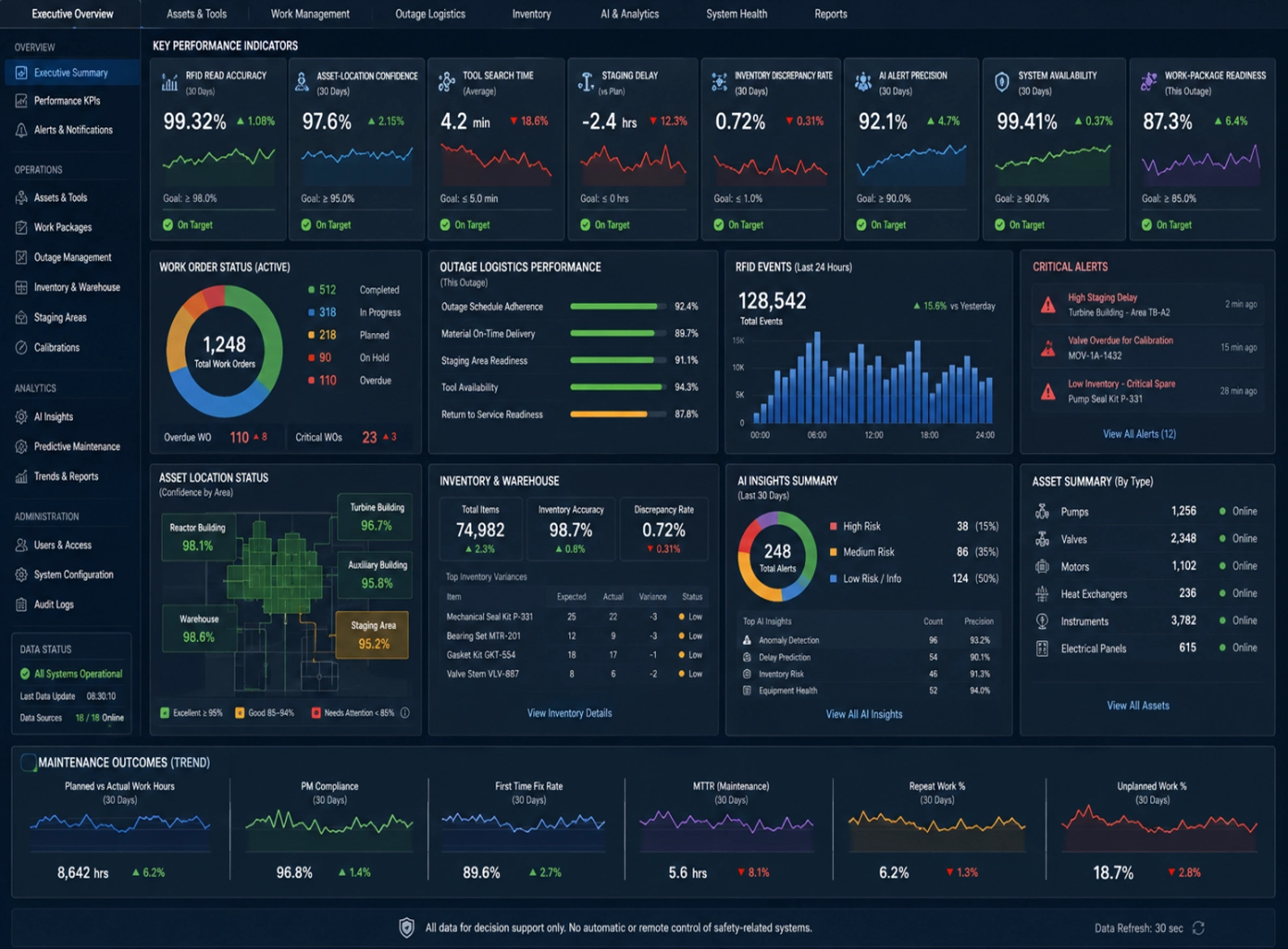
Practical Implementation Recommendations for Nuclear Operators
A successful AI and RFID deployment should begin with a narrow, measurable operational problem and expand only after the physical identification process and data quality are proven.
Recommended engineering practices include:
Start with non-safety-related maintenance and logistics use cases where appropriate.
Perform an RF site survey before selecting reader locations.
Test tags on actual metal, composite, and equipment surfaces.
Maintain authoritative asset IDs in the appropriate enterprise system.
Normalize RFID events before feeding them to AI models.
Keep AI decision support separate from direct reactor protection and safety-related control.
Apply cybersecurity controls before connecting RFID systems to plant networks.
Establish human verification for consequential maintenance decisions.
Validate AI models against historical plant data before operational use.
Monitor false positives and false negatives after deployment.
Maintain configuration management for readers, antennas, software, tags, and integrations.
Document cybersecurity, RF, environmental, and operational assumptions.
Use controlled pilot deployments before plant-wide expansion.
Maintain fallback manual procedures for RFID or network outages.
Revalidate the solution after major changes to plant equipment, network infrastructure, or software.
GAO’s Role in RFID and Industrial IoT Engineering
GAO provides RFID, BLE, and IoT hardware products and systems that can support organizations implementing asset identification, monitoring, tracking, and data-collection applications. Our engineering approach is particularly relevant when a nuclear operator needs to translate a maintenance or material-control requirement into practical tag, reader, network, software, and integration requirements.
Headquartered in New York City and Toronto, Canada, GAO is ranked among the top 10 leading B2B and B2G BLE and RFID suppliers globally. GAO, together with GAO Research and GAO Tek, forms the GAO Group, with operations based in New York City and Toronto.
For three decades, the GAO Group has served customers across the United States and Canada, including Fortune 500 companies, leading research and development organizations, universities, and government agencies. Our work emphasizes product R&D, quality assurance, system engineering, and technical support that can be delivered remotely or onsite.
For nuclear power organizations, the appropriate starting point is not a generic RFID package. It is a documented operational requirement followed by environmental assessment, RF engineering, cybersecurity review, integration design, pilot testing, and controlled commissioning.
Key Takeaways for AI-Enabled Nuclear Power Plant Operations
AI can make RFID-generated asset information more useful by converting physical movement events into maintenance, inventory, outage, and logistics intelligence.
The strongest applications are generally those where better asset visibility improves preparation and decision-making without introducing unnecessary dependencies into safety-related plant functions.
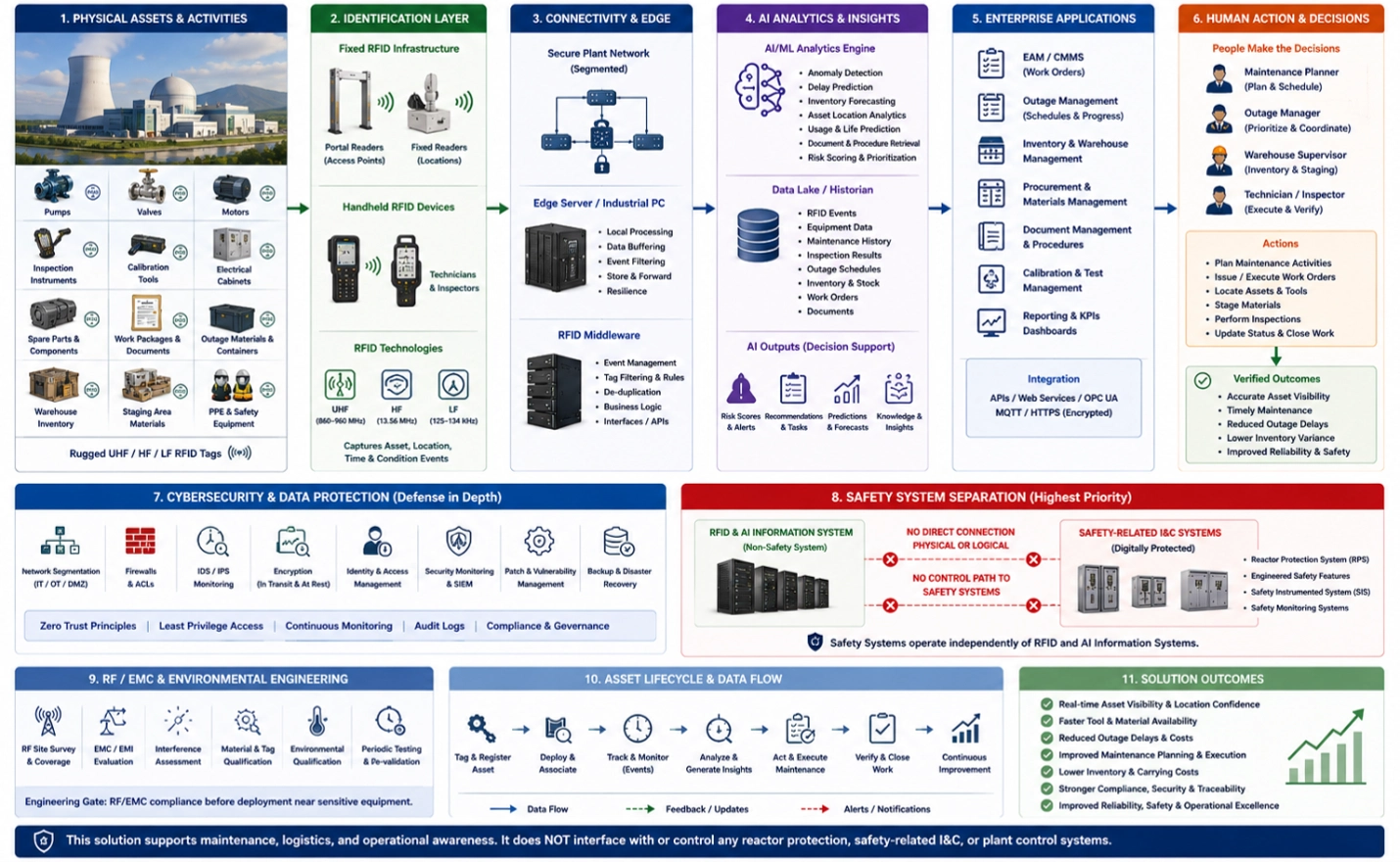
RFID provides the identification layer. Edge and server software provide event processing and integration. AI provides prediction, anomaly detection, forecasting, and information retrieval. CMMS, EAM, warehouse, maintenance, and outage systems provide operational context.
The resulting solution can help nuclear maintenance organizations improve tool accountability, material staging, inventory accuracy, work-package readiness, outage logistics, and asset visibility while preserving human engineering judgment and plant cybersecurity controls.
End-to-End AI and RFID Architecture for Nuclear Asset Management
Building the Future of Industrial AI and IoT with Aperture Venture Studio and GAO RFID Inc.
For more than three decades, GAO Group of Companies has invested heavily in R&D of industrial RFID, BLE, and IoT. As generative AI became increasingly useful for industrial applications, we have continued developing AI and IoT technologies, including RFID and BLE, and have established Aperture Venture Studio to advance AI and IoT solutions relevant to industrial operations such as nuclear maintenance, asset tracking, logistics, and infrastructure management.
Aperture has attracted AI and IoT technical experts, entrepreneurial and operational executives, influential investors, and leading companies. We have also developed the Aperture Ventures Summit and TekSummit to discuss advanced AI and IoT topics. These activities have helped build technical communities around industrial AI and IoT. We welcome you to participate as advisors, co-founders or employees, investors, or customer