
AI and BLE for Electric Mobility Manufacturing
AI-Driven Manufacturing Intelligence for Electric Mobility
AI is transforming Electric Mobility Manufacturing by turning production, battery, equipment, and material data into operational decisions. Artificial Intelligence of Things, or AIoT, combines AI with connected sensors, industrial equipment, and IoT systems so manufacturers can detect process deviations, improve traceability, optimize material movement, and predict equipment problems. BLE provides a practical wireless layer for identifying and monitoring mobile assets, tools, work-in-process materials, battery components, containers, and production equipment through BLE beacons, BLE sensors, and BLE gateways. The resulting system can connect shop-floor observations with manufacturing execution systems (MES), enterprise resource planning (ERP), warehouse management systems (WMS), quality systems, and analytics software. For electric mobility manufacturers, this approach is particularly valuable where battery genealogy, takt time, equipment availability, quality assurance, and real-time material visibility directly affect production performance.
AI-Enabled BLE Smart Manufacturing for Electric Mobility
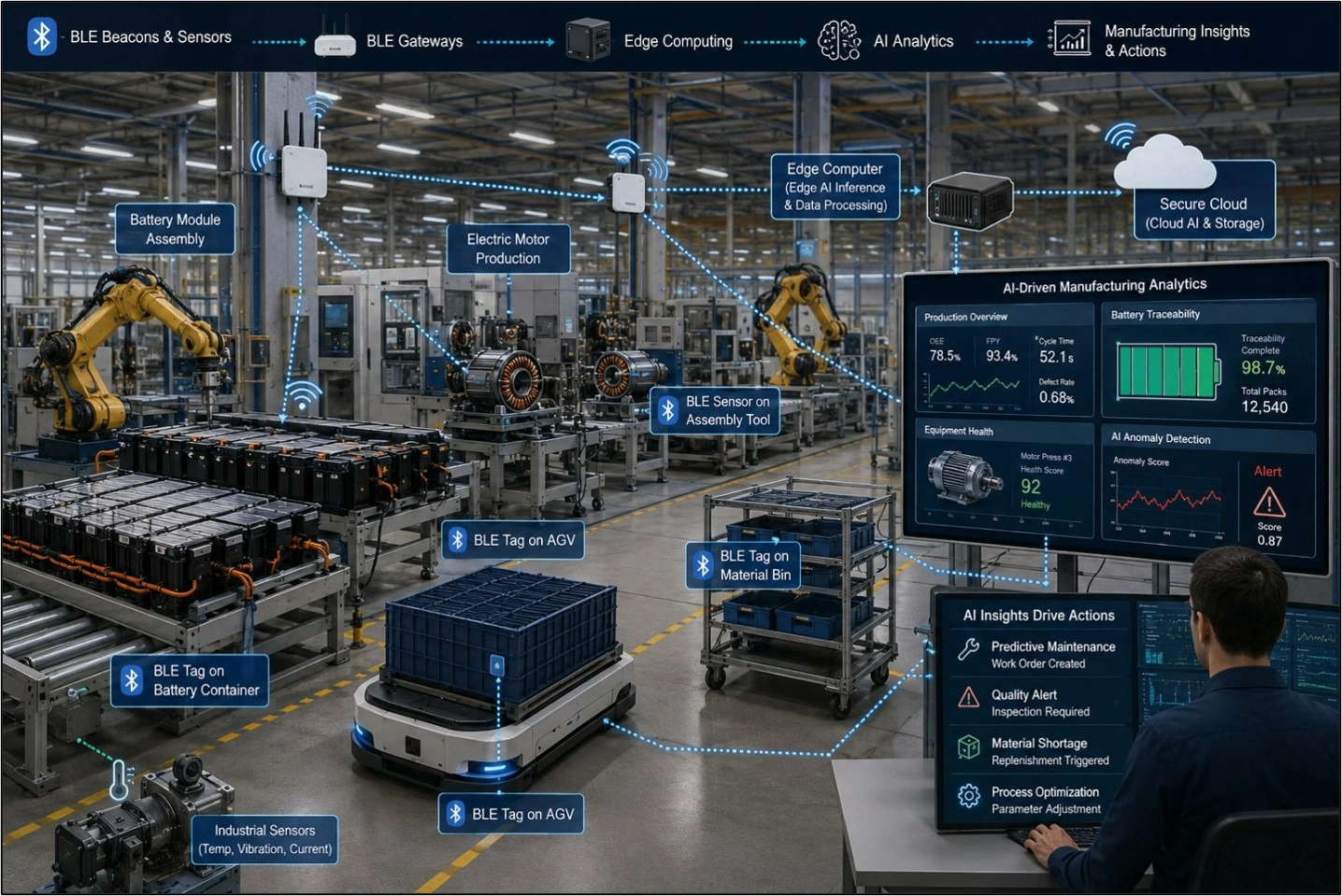
The visual illustrates an electric mobility manufacturing facility where BLE beacons and sensors monitor battery containers, AGVs, tools, and industrial equipment. BLE gateways transmit production data to edge computing and AI analytics, enabling battery traceability, equipment-health monitoring, anomaly detection, predictive maintenance, and manufacturing decisions.
What AI Means for Electric Mobility Manufacturing
AIoT in Electric Mobility Manufacturing is not simply the addition of machine learning to factory software. It is the integration of physical production data, operational context, statistical models, and automated or human-controlled decisions.
A practical implementation can combine:
BLE beacons attached to battery containers, production tooling, carts, AGVs, calibration equipment, and other mobile resources.
BLE sensors measuring conditions such as temperature, humidity, vibration, motion, or shock where the selected sensor supports those measurements.
BLE gateways collecting wireless observations and forwarding normalized data to factory software.
Machine vision for weld inspection, connector inspection, cell orientation verification, surface defects, and assembly verification.
Machine learning for anomaly detection, predictive maintenance, quality prediction, production forecasting, and process optimization.
Edge computing for low-latency analysis where production decisions should not depend on continuous cloud connectivity.
MES, ERP, WMS, computerized maintenance management systems (CMMS), laboratory information management systems (LIMS), and quality management systems (QMS) for operational execution and records.
The important engineering principle is that AI should be connected to a defined manufacturing decision. For example, a model predicting abnormal battery-cell handling is useful only when its output can trigger an inspection, stop a material transfer, create a maintenance work order, or require operator verification.
Battery traceability is becoming an increasingly important data-management requirement. The European Union’s Battery Regulation requires an electronic battery passport for relevant electric vehicle batteries from February 18, 2027, with requirements for accurate, complete, current, machine-readable, structured, searchable, and interoperable information.
This makes reliable identification and event capture increasingly important throughout battery manufacturing.
Where AI Creates Value Across Electric Mobility Production
Electric Mobility Manufacturing includes tightly connected processes such as incoming material inspection, cell preparation, module assembly, battery pack assembly, electric motor production, inverter production, vehicle assembly, end-of-line testing, warehouse operations, and finished-vehicle logistics.
AI can address different decisions within each process:
Manufacturing area
AI application
BLE-enabled data contribution
Operational outcome
Battery cell logistics
Material-flow optimization
Location of containers and handling assets
Reduced searching and waiting
Module assembly
Process anomaly detection
Tool, fixture, and material identity
Better process traceability
Battery pack assembly
Genealogy and quality analytics
Identification of mobile components and containers
Stronger production records
Tool management
Predictive maintenance
Tool location and sensor telemetry
Higher tool availability
AGV operations
Routing and utilization analytics
BLE location observations
Better material movement
Warehouse operations
AI inventory optimization
Asset and container identification
Improved inventory accuracy
Quality inspection
Defect classification
Production context and asset identity
Faster root-cause analysis
Maintenance
Failure prediction
Equipment condition and movement data
Reduced unplanned downtime
Finished-vehicle operations
Yard and process tracking
BLE beacons on vehicles or handling assets
Better vehicle visibility
AI Use-Case Matrix for Electric Mobility Manufacturing
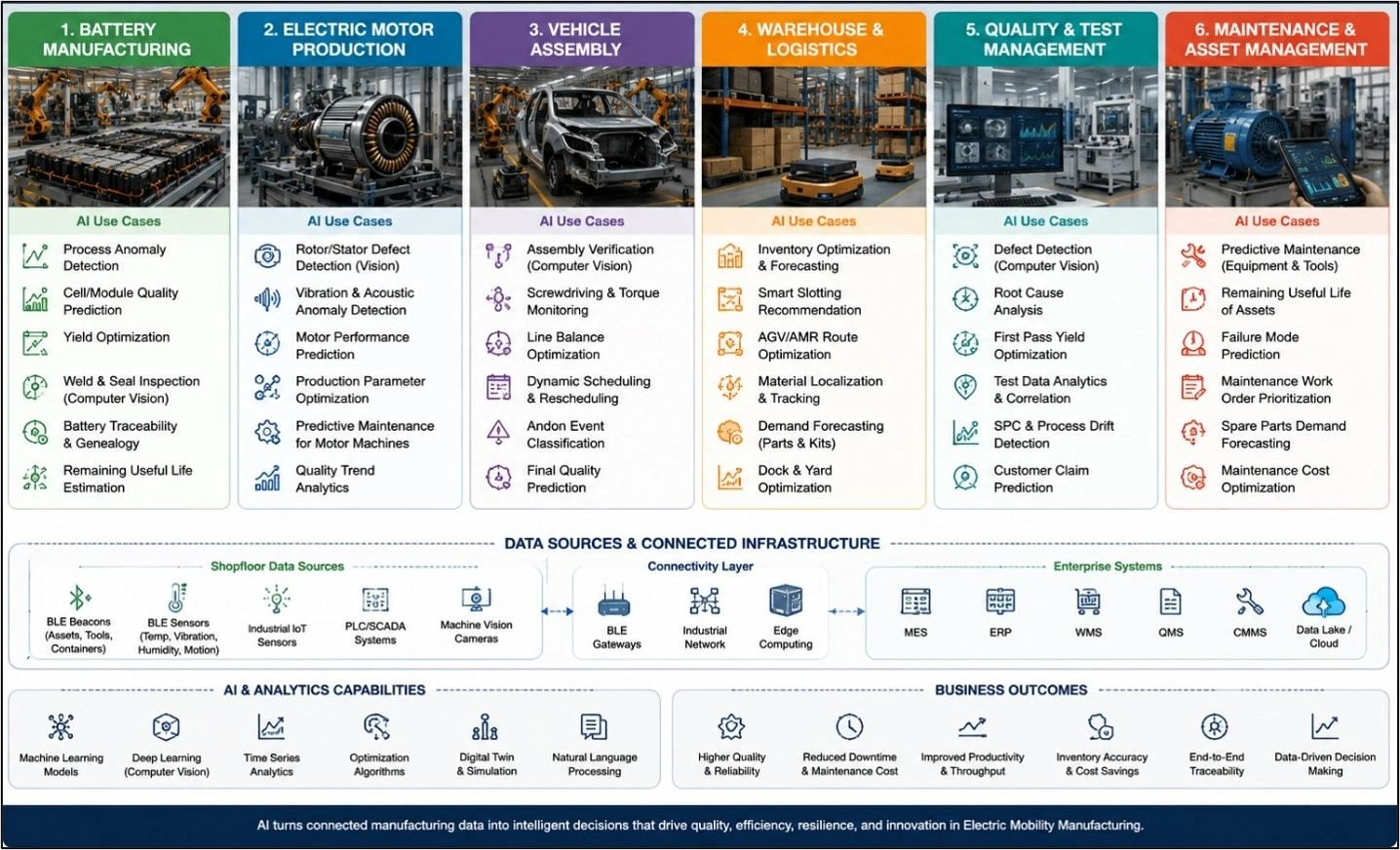
This infographic maps AI applications across battery manufacturing, electric motor production, vehicle assembly, warehouse logistics, quality management, and maintenance. It also shows how BLE beacons, BLE sensors, industrial IoT data, PLC/SCADA systems, and BLE gateways feed AI analytics and connected manufacturing systems to improve quality, productivity, traceability, inventory, and equipment reliability.
Electric Mobility Manufacturing Workflows That Benefit from AI
Battery Material and Component Traceability
Battery production requires accurate association between materials, cells, modules, packs, equipment, operators, process steps, test results, and quality records. AI can identify unusual relationships within this production genealogy.
For example, if battery packs produced during a particular time window show an abnormal failure rate, analytics can correlate the affected units with:
Cell or module production batches
Material lots
Assembly stations
Torque tools
Welding equipment
Operators or shifts
Environmental conditions
Process parameters
Inspection results
Rework events
Equipment maintenance history
BLE can provide the location and identity context for mobile resources that are difficult to monitor continuously with fixed industrial interfaces. A BLE beacon on a battery container can associate that container with production zones as it moves through receiving, staging, kitting, assembly, testing, and finished-goods storage.
GAO supplies BLE gateways, beacons, sensors, RFID equipment, and related IoT systems that can be incorporated into such identification and monitoring workflows. GAO’s existing product range includes BLE gateways and beacons as well as RFID readers and tags for industrial tracking applications.
AI-Based Production Quality Analysis
Quality problems in Electric Mobility Manufacturing can originate from multiple process variables rather than one isolated machine. AI can combine manufacturing history, sensor observations, inspection results, and product genealogy to identify patterns that conventional threshold-based alarms may miss.
Relevant methods include:
Supervised machine learning for classification of known defect categories.
Unsupervised learning for detecting previously unknown process anomalies.
Time-series models for identifying abnormal process behavior.
Computer vision for surface, assembly, and component inspection.
Predictive models for estimating quality risk before end-of-line testing.
Root-cause analytics linking defects to upstream production conditions.
A practical implementation should retain the source data and model version associated with each AI-generated decision. This creates an auditable path from production observation to recommendation.
Predictive Maintenance for Manufacturing Equipment
Battery formation equipment, welding systems, conveyors, robotic cells, torque tools, HVAC equipment, compressors, AGVs, and material-handling systems can all contribute to production downtime.
AI-based predictive maintenance can combine equipment telemetry with:
Vibration trends
Temperature
Motor current
Operating cycles
Runtime
Alarm history
Maintenance records
Production load
Location and utilization
Replacement history
BLE sensors can supplement fixed PLC or industrial sensor data when equipment is mobile, difficult to instrument, or requires an independent monitoring layer.
The engineering objective is not simply to predict failure. The useful output is a maintenance decision with sufficient lead time to schedule intervention without unnecessarily interrupting production.
AIoT Data Flow for Electric Mobility Manufacturing
A reliable implementation typically follows a layered data flow:
Physical production → BLE and industrial sensors → BLE gateways/edge devices → data ingestion → normalization → AI analytics → manufacturing software → operational decision
The physical layer captures events and measurements from battery containers, tools, fixtures, equipment, vehicles, AGVs, and production areas. BLE gateways collect nearby beacon and sensor transmissions and forward them through Ethernet, Wi-Fi, cellular, or another suitable network connection.
The edge layer can filter duplicate observations, apply signal-quality rules, normalize timestamps, buffer data during network interruptions, and perform selected analytics locally.
The software layer then associates observations with manufacturing entities such as:
Work orders
Production lines
Stations
Battery serial numbers
Cell or module lots
Tool IDs
Equipment IDs
Material containers
Operators
Inspection records
Maintenance events
AI services can subsequently evaluate this structured data for anomaly detection, forecasting, optimization, and decision support.
AIoT Data Flow for Electric Mobility Manufacturing
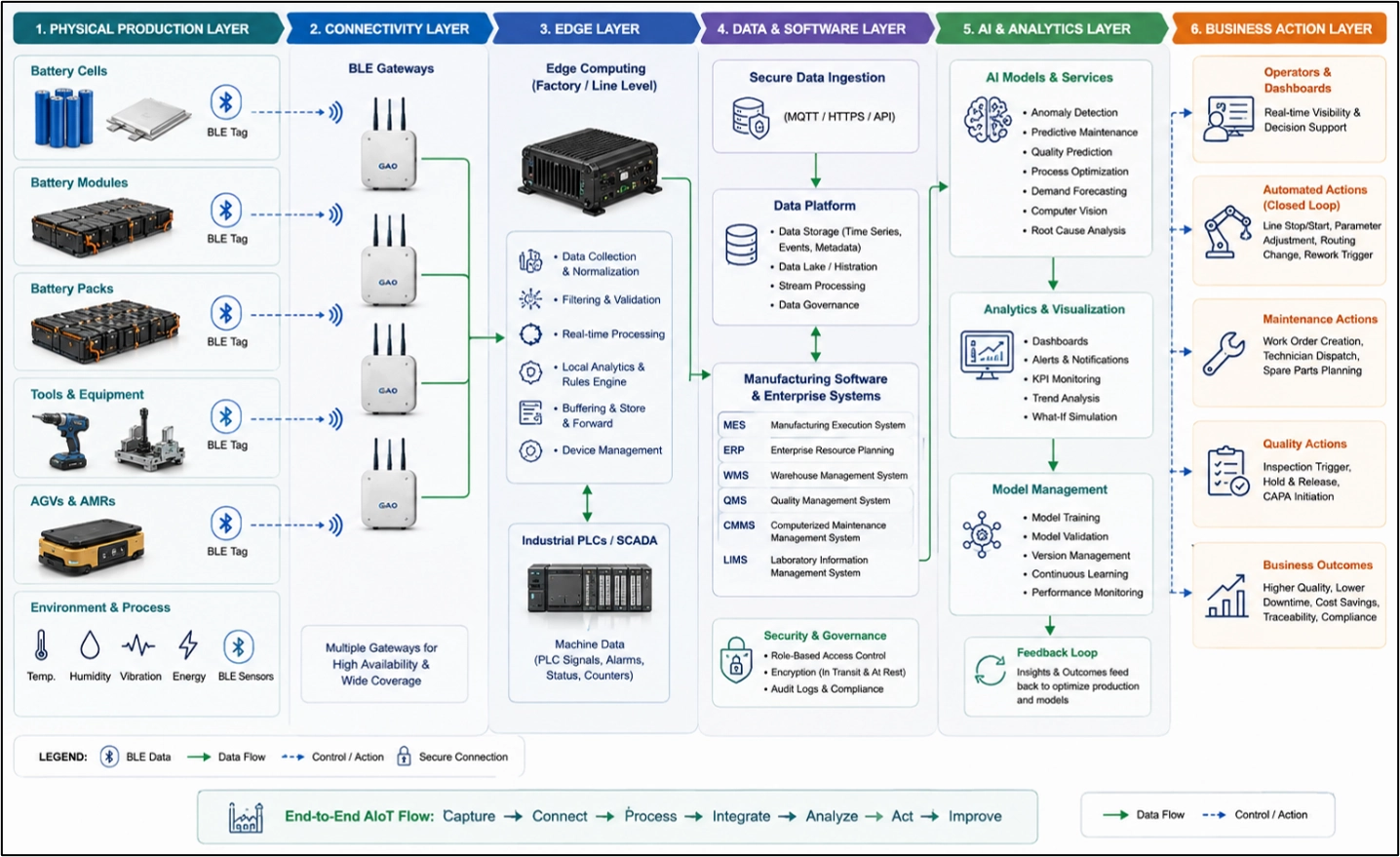
The diagram shows how production data moves from battery cells, modules, packs, tools, AGVs, and BLE sensors through BLE gateways, edge computing, secure data ingestion, manufacturing software, and AI analytics. AI-generated insights then support quality control, predictive maintenance, traceability, automated actions, and continuous manufacturing improvement.
BLE Infrastructure for AI-Enabled Electric Mobility Operations
BLE should be selected according to the physical manufacturing problem rather than treated as a universal location technology. Signal behavior can be affected by metal structures, battery packs, machinery, human bodies, electromagnetic conditions, gateway placement, beacon orientation, and production-cell geometry.
For Electric Mobility Manufacturing, BLE commonly provides three complementary functions:
BLE beacons: Supply persistent identities for mobile production resources, containers, tools, vehicles, fixtures, or other tracked objects.
BLE sensors: Provide wireless measurements such as temperature, humidity, vibration, motion, or shock where applicable.
BLE gateways: Collect nearby BLE transmissions and forward observations to the appropriate edge or server software.
The resulting data can become contextual input for AI rather than an isolated tracking record. For example, a gateway observation showing that a tagged battery-material container entered a production zone becomes more valuable when correlated with a work order, production station, timestamp, and subsequent quality result.
GAO has more than three decades of experience supplying BLE, RFID, and IoT hardware and systems. Its public materials state that more than 11,000 RFID and BLE systems have been deployed across more than 70 countries.
Cloud Version and Server Version
A Cloud Version places the application and AI services in cloud infrastructure. This model is appropriate when multiple manufacturing facilities need centralized analytics, cross-site reporting, remote monitoring, and centralized software management.
A Server Version deploys software on customer-managed infrastructure such as factory servers, edge servers, private data centers, or other privately hosted enterprise environments. This approach can be preferable when production data must remain within controlled infrastructure, connectivity to external services is limited, or integration with factory systems requires local processing.
Both models can use the same fundamental data pipeline. The principal design decision is where data is processed, retained, secured, and integrated with manufacturing systems.
AI Deployment and Manufacturing System Integration
AI implementation in Electric Mobility Manufacturing should begin with the production decision rather than with a particular machine-learning model. The engineering team should first identify which manufacturing event needs to be detected, predicted, optimized, or automated, then determine what data is required to support that decision.
A practical integration can connect BLE observations with existing industrial and business systems:
MES: Associates production events with work orders, stations, process steps, and production quantities.
ERP: Provides material, purchasing, production planning, and product master data.
WMS: Connects material containers, warehouse locations, kits, and inventory transactions.
QMS: Links inspection results, nonconformances, corrective actions, and product genealogy.
CMMS: Converts equipment-health predictions into maintenance planning and work orders.
SCADA and PLC systems: Provide machine states, alarms, process variables, and production signals.
AI services: Analyze historical and real-time data to identify anomalies, predict outcomes, and recommend actions.
BLE gateways: Supply wireless identity, location, and sensor observations from mobile or difficult-to-wire manufacturing resources.
A key implementation lesson is to establish a consistent asset and event identity model. A BLE beacon ID should not exist as an isolated technical identifier. It should be associated with a controlled manufacturing object such as a tooling ID, battery container ID, AGV ID, fixture ID, or equipment ID.
Edge Processing and Data Quality
Edge processing is particularly useful when Electric Mobility Manufacturing operations require low latency or continued operation during temporary network interruptions.
An edge service can:
Filter duplicate BLE observations.
Validate timestamps and device identifiers.
Apply signal-strength or gateway-zone rules.
Buffer observations during network outages.
Normalize sensor units and message formats.
Forward selected events to cloud or factory servers.
Execute lightweight anomaly detection close to production equipment.
Data quality should be treated as an engineering requirement. AI models trained on inconsistent timestamps, duplicated observations, missing production identifiers, or incorrectly mapped assets can generate misleading results regardless of model sophistication.
For location-related applications, RSSI alone should not automatically be interpreted as precise coordinates. Manufacturing environments contain metal racks, battery assemblies, machinery, and other structures that can cause multipath and signal attenuation. Zone-level visibility may therefore be more reliable and operationally useful than claiming centimeter-level positioning without appropriate validation.
BLE Factory Integration for Electric Mobility Manufacturing
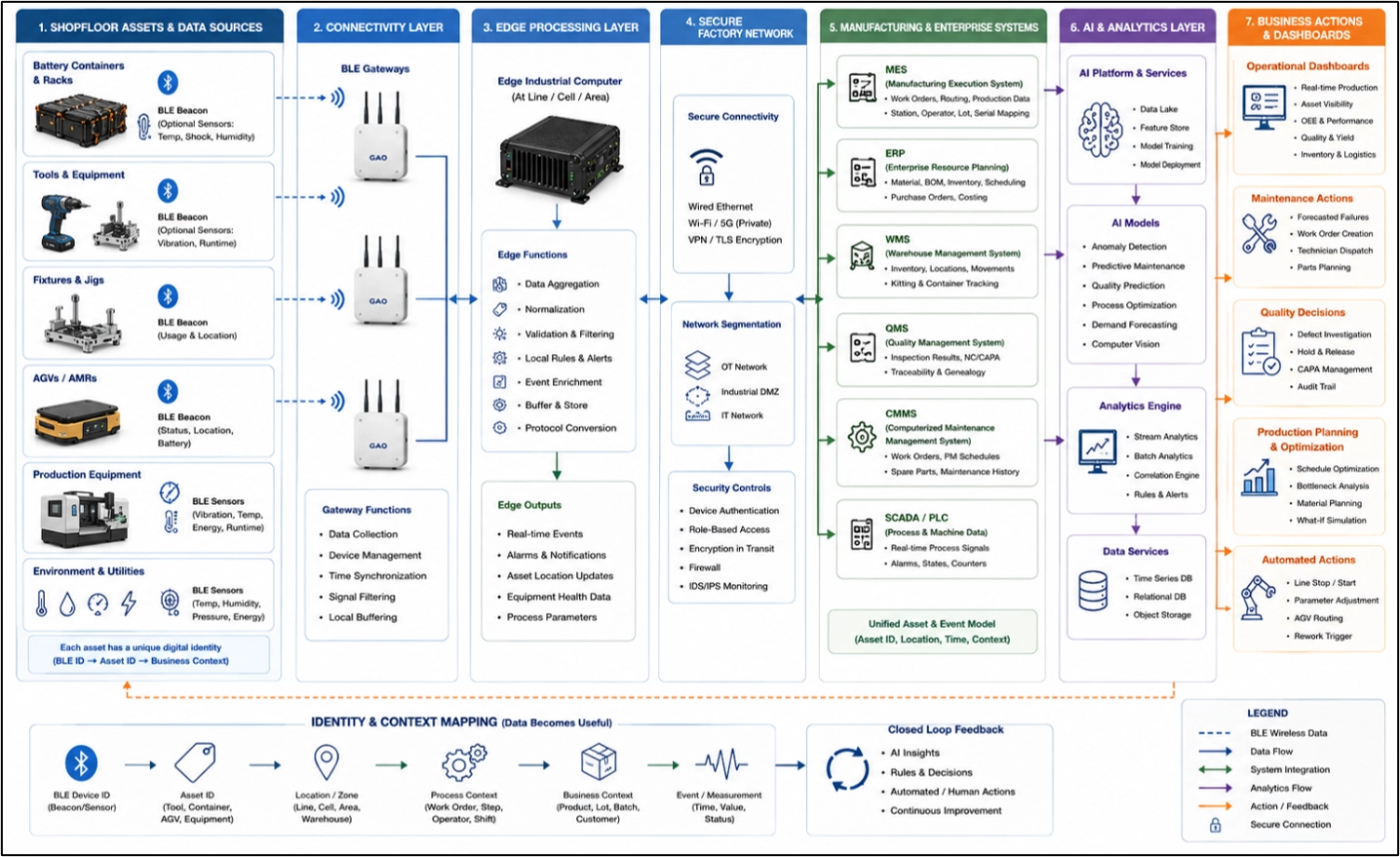
The diagram shows how BLE beacons and sensors attached to battery containers, tools, fixtures, AGVs, and manufacturing equipment connect through BLE gateways and edge processing. Secure factory networking links the collected data with MES, ERP, WMS, QMS, CMMS, SCADA, and PLC systems, while AI analytics support production planning, quality decisions, maintenance actions, and operational dashboards.
Cybersecurity for AI and BLE Manufacturing Systems
Connecting wireless sensors and manufacturing data to AI services increases the number of interfaces that require security controls. The objective is to prevent unauthorized device access, manipulation of manufacturing events, exposure of production information, and compromise of connected OT systems.
Electric Mobility Manufacturing deployments should consider:
Device authentication and unique device identities.
Role-based access control for operators, engineers, maintenance personnel, and administrators.
Encryption for data moving between gateways, edge services, servers, and cloud services.
Network segmentation between BLE infrastructure, IT systems, and operational technology.
Secure API authentication between AI software and MES, ERP, WMS, QMS, or CMMS systems.
Certificate and credential lifecycle management.
Gateway firmware and software patch management.
Audit logging for configuration changes and production decisions.
Data retention policies based on manufacturing and quality requirements.
Monitoring for abnormal gateway, sensor, and API behavior.
BLE itself should not be treated as the complete security boundary. A production-grade system needs controls at the device, gateway, network, application, API, identity, and data layers.
Where AI recommendations can influence equipment or production processes, organizations should also establish human-approval rules for high-impact decisions. An AI model may recommend stopping a production cell because of an unusual quality pattern, but the control strategy should define whether that recommendation creates an alarm, requires operator confirmation, or is permitted to initiate an automated response.
Commissioning, Testing, and Optimization
Commissioning should validate the complete path from physical asset to manufacturing decision rather than testing BLE hardware independently.
A structured commissioning process includes:
Confirming beacon and sensor installation locations.
Recording device IDs and mapping them to manufacturing assets.
Testing gateway coverage throughout production cells, storage areas, and material routes.
Measuring communication reliability under normal operating conditions.
Validating timestamps and event ordering.
Testing network interruption and recovery behavior.
Confirming API authentication and authorization.
Verifying MES, WMS, QMS, CMMS, and ERP data mappings.
Comparing AI outputs against known production events.
Establishing false-positive and false-negative acceptance thresholds.
Testing alarm escalation and operator workflows.
Documenting maintenance and replacement procedures.
A pilot should normally begin with a measurable manufacturing problem such as missing material containers, tool-search time, recurring equipment faults, or a defined quality issue. A controlled production area provides better information than deploying thousands of devices before the data model and operational workflow have been validated.
Electric Mobility Manufacturing AIoT Implementation Workflow
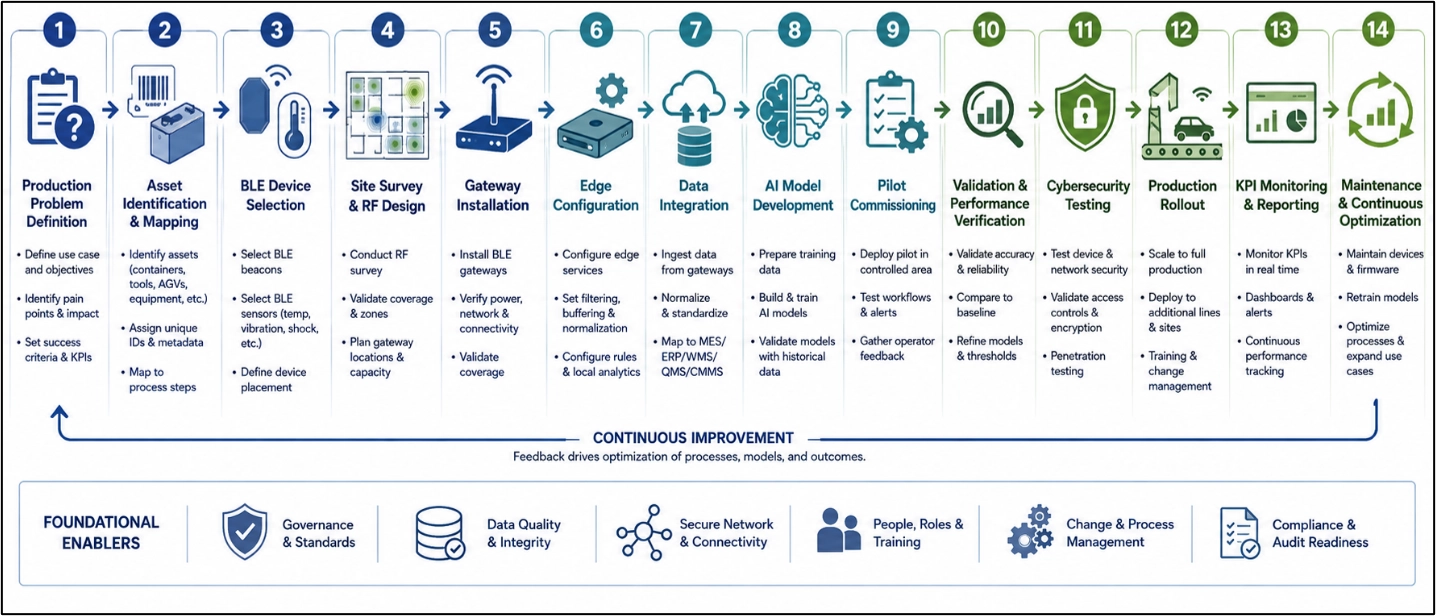
A 14-step workflow showing how AIoT projects progress from production problem definition and BLE deployment through data integration, AI development, validation, cybersecurity, production rollout, KPI monitoring, and continuous optimization.
Operational KPIs for AI-Enabled Electric Mobility Manufacturing
The success of an AI and BLE solution should be measured through manufacturing performance rather than device counts. Relevant KPIs depend on the selected use case, but useful measures include:
Overall equipment effectiveness (OEE)
Unplanned downtime
Mean time between failures (MTBF)
Mean time to repair (MTTR)
First-pass yield (FPY)
Scrap rate
Rework rate
Defect escape rate
Production cycle time
Takt-time adherence
Material search time
Inventory accuracy
Work-in-process visibility
AGV utilization
Tool utilization
Maintenance response time
Predictive-maintenance lead time
Battery genealogy completeness
Traceability event completeness
Quality investigation time
Production schedule adherence
Changeover time
Line stoppage frequency
False-positive rate for AI alerts
False-negative rate for quality detection
Data capture reliability
Gateway availability
Sensor reporting reliability
AI model precision and recall
Time from AI detection to operational action
For example, a material-tracking deployment should not be judged primarily by how many BLE beacons were installed. The more meaningful measure may be the reduction in time required to locate battery containers or the improvement in inventory transaction accuracy.
Similarly, a predictive-maintenance project should demonstrate reduced unplanned downtime or improved maintenance scheduling rather than simply reporting the number of AI predictions generated.
Engineering Benefits of AI-Enabled Electric Mobility Manufacturing
Combining AI with connected manufacturing data can improve operations when the resulting information is connected to a defined business or engineering action.
Better Battery Traceability
AI can analyze relationships across battery cells, modules, packs, materials, process stations, equipment, inspection results, and production events. BLE identification can provide additional context for mobile containers, tools, and fixtures.
This creates a stronger basis for production genealogy, quality investigations, material accountability, and regulatory data management.
Faster Root-Cause Analysis
Traditional investigations may require engineers to manually compare production records from multiple systems. AI can correlate timestamps, equipment states, material movements, quality results, maintenance events, and production history to highlight relationships that deserve investigation.
The engineer remains responsible for validating the physical cause, but the search through production data can become considerably faster.
Improved Manufacturing Asset Utilization
Electric mobility factories contain expensive tools, fixtures, test equipment, AGVs, material-handling resources, and specialized production equipment. Visibility into where these resources are located and how frequently they are used can help production and maintenance teams identify underutilized or bottleneck resources.
More Predictable Maintenance
AI models can combine condition measurements with historical maintenance and production-load information. BLE sensors can add monitoring capabilities to selected mobile or retrofit equipment without requiring extensive new cabling.
The resulting prediction can provide maintenance teams with earlier indications of abnormal equipment behavior and more useful scheduling information.
Scalable Multi-Line Deployment
Once device identity, event formats, security controls, and manufacturing-system interfaces are standardized, the same engineering principles can be extended from one production cell to additional battery assembly lines, motor-production areas, warehouses, and vehicle assembly operations.
Scalability still requires site-specific RF surveys, gateway capacity planning, network engineering, data-volume estimates, and validation of manufacturing workflows.
Practical Recommendations for Electric Mobility Manufacturing
A technically sound deployment should emphasize measurable production outcomes, reliable data, and controlled integration.
Define the manufacturing problem before selecting BLE devices or AI models.
Map every tracked device to a controlled manufacturing asset identifier.
Conduct an RF site survey before fixing gateway locations.
Validate BLE performance around battery packs, metal structures, racks, machinery, and production equipment.
Use edge buffering where temporary network loss could otherwise cause missing production events.
Keep AI training data traceable to its source production records.
Establish data-quality rules before model development.
Integrate AI outputs with the system where the operational action actually occurs.
Separate monitoring and recommendation functions from safety-critical control unless the complete control system has been engineered and validated for that purpose.
Use Cloud Version deployment when centralized multi-site analytics and remote access are priorities.
Use Server Version deployment when local processing, private infrastructure, or factory-controlled data retention is required.
Establish cybersecurity controls before connecting wireless infrastructure to production networks.
Pilot the solution on a clearly bounded manufacturing process and establish baseline KPIs.
Validate AI predictions against actual production and maintenance outcomes.
Plan device replacement, battery replacement, firmware updates, gateway maintenance, and configuration management from the beginning.
Design the data model so additional production lines and manufacturing sites can be added without redesigning the entire software system.
GAO has served customers in the United States and Canada for approximately three decades, including Fortune 500 companies, R&D organizations, universities, and government agencies. Its companies have invested substantially in research and development, supported by quality-assurance processes and remote or onsite technical support. This experience is relevant when Electric Mobility Manufacturing teams require not only individual BLE or RFID products but also practical guidance for integrating identification, sensing, and IoT hardware into operational systems.
Building a Practical AIoT Strategy for Electric Mobility Manufacturing
AI and BLE can provide Electric Mobility Manufacturing with a practical method for connecting physical production resources to data-driven decision-making. The highest-value applications generally begin with a defined operational problem such as battery traceability, material visibility, predictive maintenance, quality investigation, tooling utilization, or production-flow optimization.
The technical foundation should combine appropriately selected BLE beacons, BLE sensors, BLE gateways, industrial data sources, edge processing, secure communications, manufacturing software integration, and validated AI models. Successful deployments depend equally on RF engineering, data governance, cybersecurity, commissioning, and measurable manufacturing KPIs.
GAO provides BLE, RFID, and IoT hardware products and systems that can support these workflows, with technical assistance for organizations evaluating device selection, deployment, integration, and operational requirements. Readers planning AI-enabled Electric Mobility Manufacturing projects can explore GAO’s technology solutions and technical resources to determine which hardware and system configuration best matches their production environment.
AI, BLE & IoT Deployment Decision Tree for Electric Mobility Manufacturing
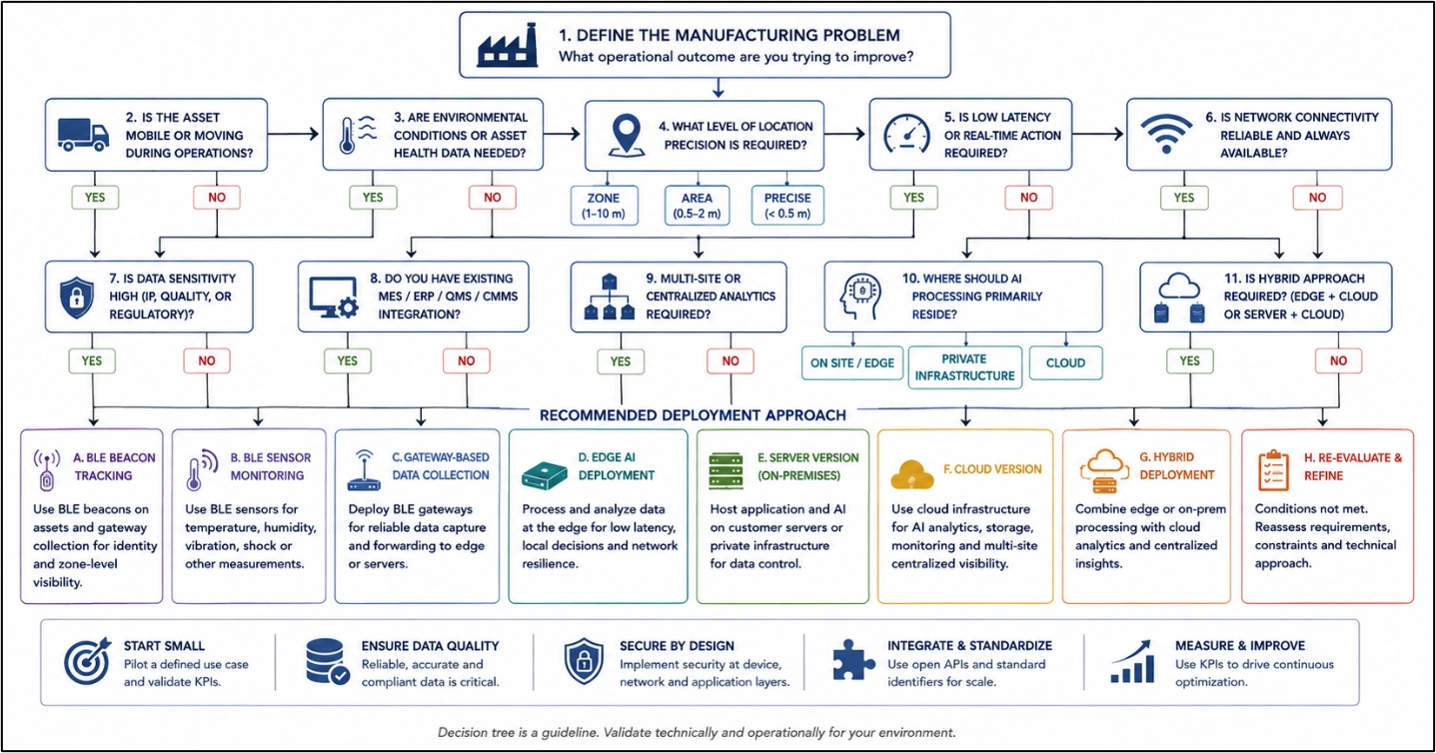
A technical decision tree guiding manufacturing teams from problem definition through asset, sensing, location, connectivity, security, integration, and AI-processing decisions to the appropriate BLE, edge, server, cloud, or hybrid deployment.
Building the Future of Industrial AI and IoT with Aperture Venture Studio and GAO RFID Inc.
For more than three decades, GAO Group of Companies has invested heavily in R&D of industrial BLE, RFID, and IoT. As generative AI became increasingly useful for industrial applications, we expanded our work in AIoT, including AI-enabled BLE and RFID solutions for manufacturing and other operational environments. We have established Aperture Venture Studio to support the development and scaling of practical AI and IoT solutions relevant to applications such as Electric Mobility Manufacturing.
Aperture brings together AI and IoT technical experts, entrepreneurial and operational executives, investors, and leading companies. We have also developed Aperture Ventures Summit and TekSummit to discuss advanced AI and IoT topics and foster technical collaboration.
GAO RFID Inc., GAO Research Inc., and GAO Tek Inc. form GAO Group, with operations based in New York City and Toronto, Canada. GAO RFID Inc. is ranked among the top 10 leading B2B and B2G BLE and RFID suppliers globally. We welcome qualified professionals and organizations to engage with us as advisors, co-founders or employees, investors, or customers.