
AI and RFID for Seafood Processing
AI-Driven Seafood Processing with RFID-Based Traceability
AI is transforming seafood processing by turning production, traceability, quality, and cold-chain data into actionable operational decisions. When AI is combined with RFID-enabled identification and connected processing equipment, seafood processors can monitor raw fish and shellfish from receiving through grading, processing, packaging, cold storage, and shipment. RFID provides machine-readable identity and location data, while Industrial AI and machine learning can analyze production records, temperature histories, inspection results, yields, and inventory movements to identify anomalies and support better decisions.
For seafood processing plants, this combination is particularly valuable because products are highly perishable, processing windows can be short, cold-chain conditions must be controlled, and traceability requirements can extend across receiving lots, processing batches, finished packages, and outbound shipments. AI-enabled seafood traceability can help identify process deviations, improve inventory accuracy, reduce product loss, and provide operations teams with faster visibility into production status. GAO supplies RFID, BLE, and IoT hardware products and systems that can provide the data capture layer required by these applications.
AI and RFID-Enabled Seafood Processing Plant Deployment
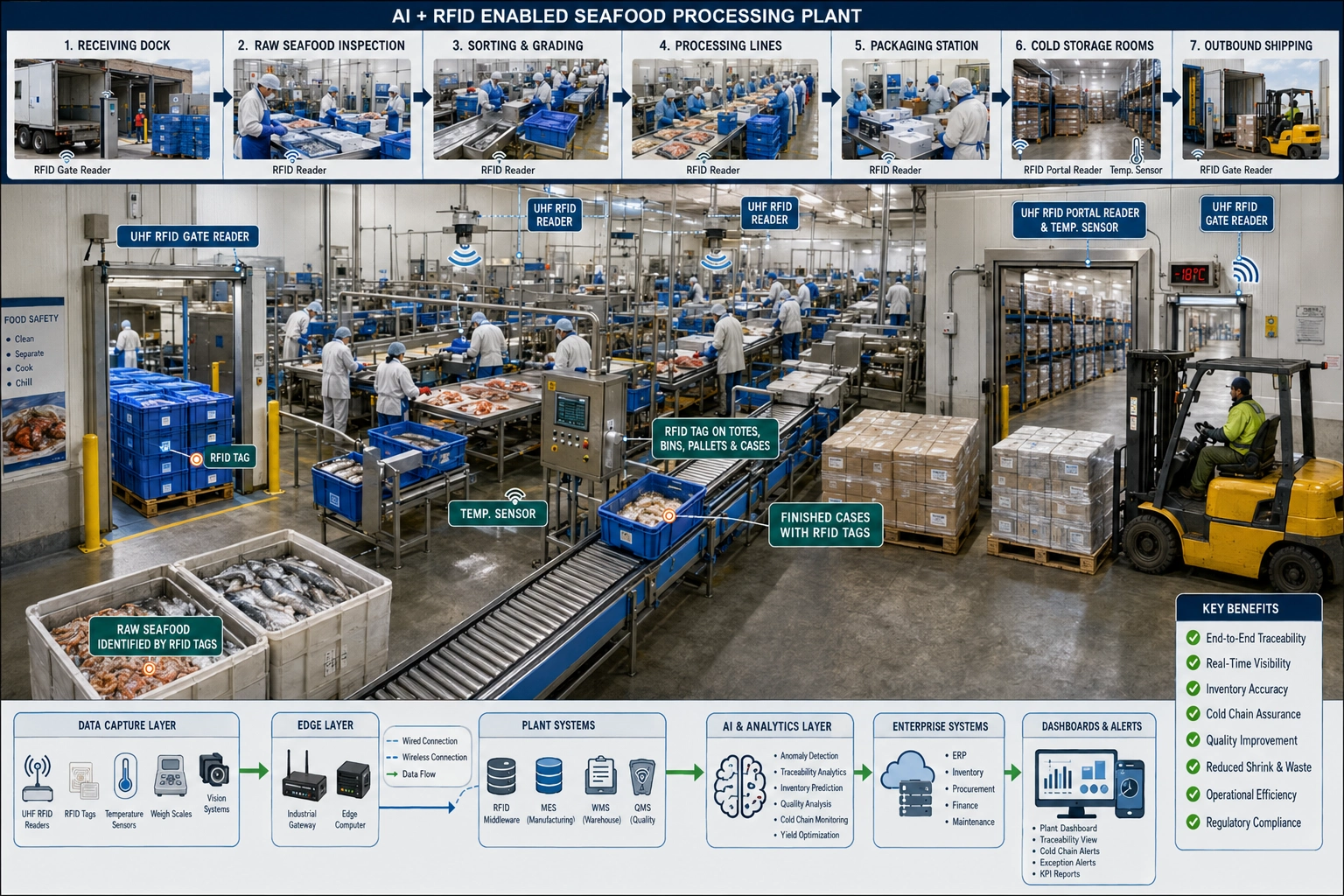
This visual illustrates how RFID, temperature sensors, edge computing, AI analytics, and enterprise software work together across a seafood processing facility. It shows the complete flow from receiving and inspection through processing, packaging, cold storage, and outbound shipping, highlighting traceability, inventory accuracy, cold-chain monitoring, quality improvement, and operational efficiency.
What AI Means for Modern Seafood Processing
AI in seafood processing refers to the use of machine learning, computer vision, predictive analytics, anomaly detection, and related Industrial AI methods to analyze operational data and improve decisions throughout seafood production.
The value of AI depends heavily on the quality and timeliness of plant data. Seafood processing generates information from receiving records, lot identification, scales, temperature sensors, quality inspections, processing equipment, inventory transactions, production schedules, packaging operations, and shipping activities. RFID can provide automatic identification and movement information without requiring operators to manually record every material transfer.
A practical AI-enabled seafood processing system therefore combines several layers:
Data acquisition: RFID readers, RFID tags, temperature sensors, weighing equipment, barcode systems, machine sensors, inspection stations, and operator inputs capture production information.
Connectivity: Industrial Ethernet, Wi-Fi, cellular connectivity where appropriate, and other plant communication methods transfer data from processing areas to local systems.
Edge processing: Industrial gateways or edge computers can filter, normalize, buffer, and evaluate data close to processing equipment.
RFID middleware: Middleware manages reader events, tag identification, filtering, duplicate-event suppression, device configuration, and data forwarding.
AI and analytics: Machine learning models can identify anomalies, forecast demand or processing requirements, detect unusual inventory movements, and analyze quality or production patterns.
Enterprise software integration: Data can be exchanged with ERP, MES, WMS, quality management, inventory, laboratory, maintenance, and traceability systems.
Operational action: Supervisors, quality personnel, warehouse teams, production managers, and logistics staff use the resulting information to investigate exceptions and make decisions.
GAO’s RFID and IoT hardware can serve as part of this data acquisition infrastructure, particularly where seafood processors require automated identification of reusable totes, bins, pallets, cases, or other tracked assets.
Where AI Improves Seafood Processing Operations
AI Seafood Traceability and Lot Tracking
Traceability is one of the strongest applications for AI-supported identification systems. A seafood processor may need to associate incoming raw material with supplier information, receiving time, species, lot, processing batch, packaging records, storage location, and outbound shipment.
RFID can automatically capture the movement of tagged containers and material through defined read points. AI can then analyze those events together with production and quality information.
Potential applications include:
Linking raw seafood receiving lots with processing batches.
Tracking reusable fish totes, shellfish bins, pallets, and containers.
Identifying unexpected material movement between processing zones.
Detecting missing or incomplete traceability events.
Supporting rapid investigation of affected lots.
Correlating production records with finished-product inventory.
Improving genealogy between incoming seafood and packaged products.
The engineering challenge is not simply attaching RFID tags. Read zones must be designed around stainless-steel equipment, liquids, dense product loads, refrigerated areas, conveyors, forklifts, and human traffic. Tag selection and reader placement should therefore be tested using the actual seafood containers and operating conditions.
AI Inventory Management for Seafood Plants
Seafood inventory is difficult to manage because raw materials and finished products may have different shelf-life requirements, storage conditions, lot attributes, grades, species, weights, and processing states.
AI inventory management can combine RFID movement events with ERP and warehouse records to identify discrepancies between physical inventory and system inventory. A processor can use these insights to investigate misplaced containers, unrecorded transfers, delayed production consumption, or unusual inventory aging.
AI can also support inventory forecasting by analyzing historical production rates, order patterns, processing schedules, seasonal supply conditions, and inventory turnover.
For example, a seafood plant could use RFID events to establish when a tagged tote enters a cold room and combine that information with product and lot data. An analytics system can then provide a more complete view of inventory location and dwell time than periodic manual counts.
AI Quality Control and Computer Vision
Seafood quality inspection can involve characteristics such as appearance, size, grading, defects, contamination indicators, packaging condition, and product specifications. Computer vision can assist inspectors by analyzing images captured at inspection points, while machine learning can identify patterns associated with quality deviations.
RFID complements this process by associating inspection observations with the correct lot, tote, batch, or finished-product container.
A combined system could capture:
Product identification from RFID.
Weight and dimensional measurements from production equipment.
Images from machine-vision cameras.
Quality inspection results.
Processing parameters.
Production timestamps.
Storage and temperature information.
The resulting data can help quality teams investigate whether deviations are isolated events or recurring process patterns.
AI-Assisted Seafood Quality Control Workflow: RFID, Computer Vision & AI Analytics
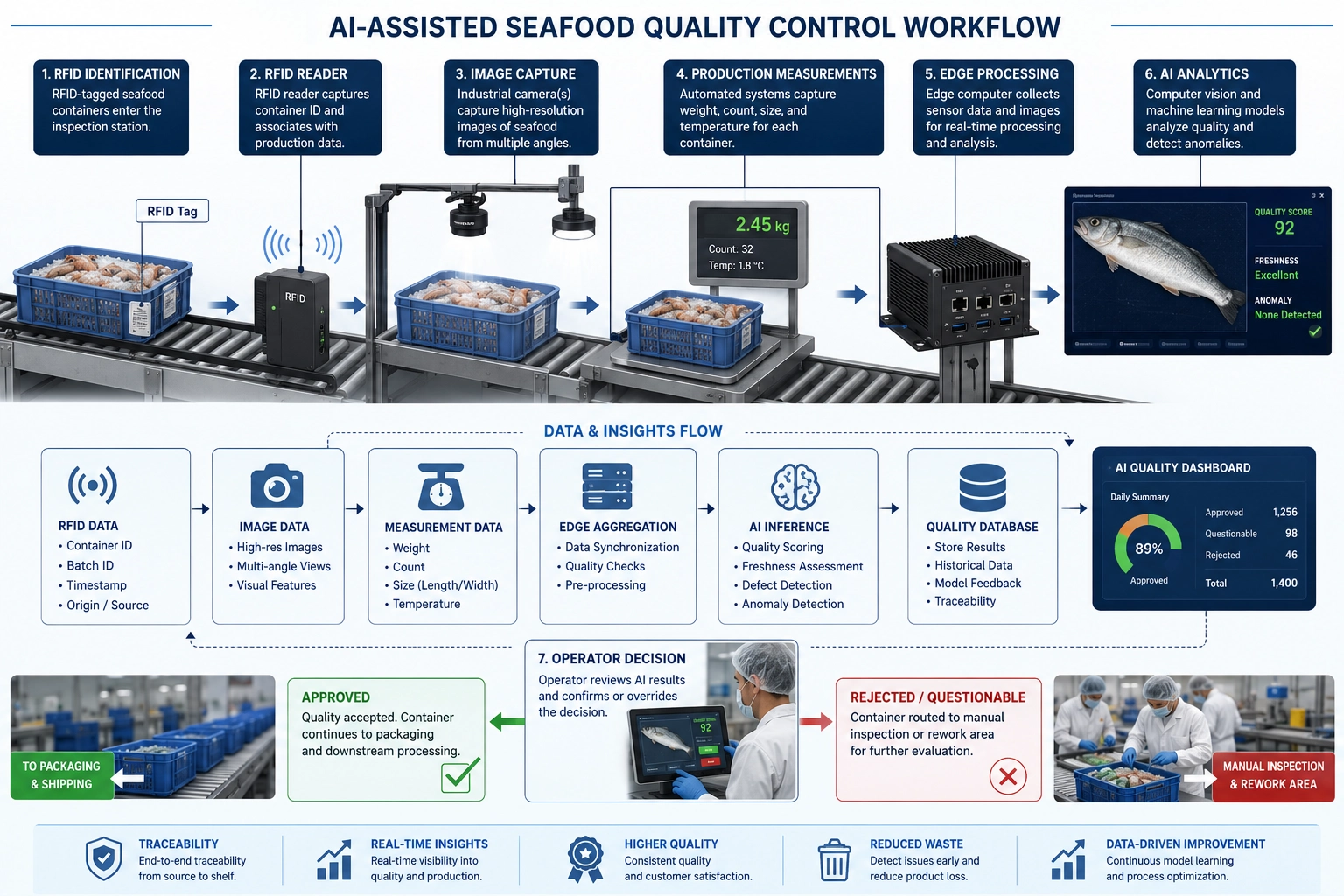
This enterprise workflow illustrates how RFID identification, industrial cameras, weighing and quality measurements feed into edge computing and AI analytics. The system combines computer vision, machine learning, and a quality database to support operator decisions, traceability, and consistent seafood inspection. Approved products continue to packaging, while rejected or questionable products are routed for manual inspection.
AI Cold-Chain Monitoring
Temperature excursions can have serious consequences for seafood quality and product value. Cold rooms, refrigerated staging areas, processing zones, and transportation interfaces therefore require reliable monitoring.
RFID can identify the product or container associated with a movement event, while connected temperature sensors can provide environmental or product-associated measurements. AI can analyze temperature histories to identify abnormal conditions and prioritize events that require investigation.
A useful implementation should distinguish between an actual product-risk condition and a temporary sensor or communications problem. Edge software can buffer sensor information during connectivity interruptions, while AI analytics can evaluate temperature trends rather than relying only on static threshold alarms.
This approach can support:
Cold-room dwell-time analysis.
Temperature excursion detection.
Refrigeration performance monitoring.
Product movement correlation.
Exception prioritization.
Cold-chain compliance documentation.
Investigation of repeated temperature problems.
Seafood Processing Workflow from RFID Data to AI Decisions
A complete implementation begins when seafood enters the facility and continues through processing, storage, and shipment.
Receiving and Raw Material Identification
Receiving personnel record supplier, species, lot, quantity, weight, and receiving information. RFID tags can be associated with reusable containers, pallets, bins, or other tracked units. RFID readers positioned at receiving points automatically capture movement events.
Processing and Batch Association
As material moves toward sorting, grading, cutting, filleting, cooking, freezing, or other processing operations, RFID events can establish where tagged containers move and when. Production software can associate those movements with processing orders or batches.
Edge Data Processing
An industrial gateway or edge computer can receive RFID events and sensor information. Local processing can remove duplicate reads, validate event sequences, temporarily store data during network interruptions, and forward relevant information to central software.
AI Analysis
AI software can combine RFID events with production, quality, temperature, inventory, and historical data. Machine learning models can identify unusual process behavior, inventory discrepancies, abnormal dwell times, and other operational conditions.
Operational Decision
The resulting alerts and analytics can be presented to production supervisors, quality managers, warehouse personnel, maintenance teams, or logistics staff. Actions may include investigating a lot, relocating inventory, checking refrigeration equipment, reviewing a processing stage, or verifying a shipment.
AI-Enabled Seafood Processing End-to-End Workflow: RFID, IoT, AI & Enterprise Integration
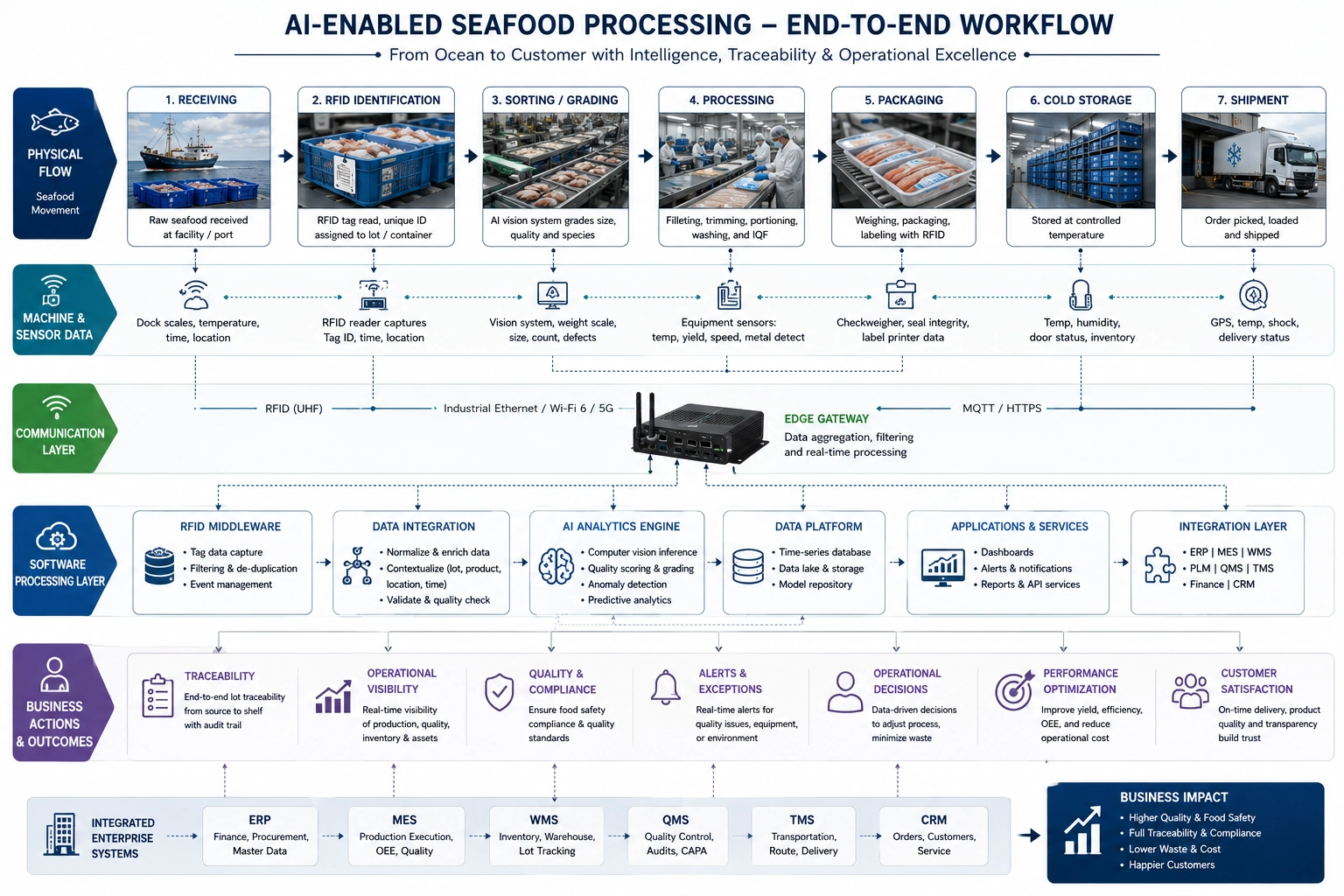
This technical workflow illustrates the complete seafood data journey from receiving and RFID identification through sorting, processing, packaging, cold storage, and shipment. It connects physical seafood movement with sensor data, communication networks, edge gateways, RFID middleware, AI analytics, enterprise systems, dashboards, and operational decisions. The key takeaway is how integrated AI and traceability technologies improve quality, visibility, compliance, efficiency, and customer satisfaction.
Core RFID and AI Technologies for Seafood Processing
Seafood processing deployments generally require a combination of identification hardware, sensing equipment, software, connectivity, and AI capabilities rather than a single technology.
UHF RFID: Well suited to automated identification of tagged totes, bins, pallets, cases, and other items at receiving, production, storage, and shipping read points where longer read ranges are useful.
HF RFID: Can be appropriate for shorter-range identification and controlled read environments where close-range interaction is preferred.
LF RFID: May be useful in specialized identification applications where lower-frequency RFID characteristics match the operating environment.
RFID readers and antennas: Capture tag events at defined locations such as receiving lanes, conveyor points, cold-storage entrances, and shipping areas.
RFID tags: Attach identity to reusable seafood containers, pallets, cases, or other trackable units.
Industrial gateways: Collect and preprocess RFID and sensor information before transferring it to plant or cloud software.
Temperature sensors: Provide cold-chain and environmental data that can be correlated with product movement.
Edge computers: Perform local filtering, buffering, analytics, and selected AI inference close to the processing operation.
AI and machine learning software: Analyze production and traceability data to detect anomalies, forecast conditions, identify patterns, and support operational decisions.
ERP, MES, WMS, and quality systems: Provide business and production context needed to turn identification events into useful operational information.
GAO’s experience supplying RFID, BLE, and IoT products and systems supports deployments where organizations require hardware that can operate as part of a broader industrial data collection and monitoring solution.
Deployment Models and Technical Infrastructure for Seafood Processing
A practical AI-enabled seafood processing solution requires careful selection of RFID hardware, sensing devices, edge computing, software, communications, data storage, and integration methods. The appropriate configuration depends on plant size, processing conditions, connectivity requirements, cybersecurity policies, existing software, and whether the organization wants cloud-hosted or privately managed software.
RFID Hardware and Plant Data Acquisition
RFID readers should be installed at operationally meaningful points rather than simply distributed throughout a facility. Typical locations include receiving doors, production transfer points, cold-room entrances, staging areas, packaging areas, palletizing stations, and shipping docks.
UHF RFID is generally useful where seafood totes, pallets, cases, or containers need to be identified automatically as they pass through a defined read zone. HF or LF RFID can be considered where shorter-range or specialized identification is more appropriate.
A deployment should account for the physical properties of seafood-processing environments. Water, metal processing equipment, stainless-steel surfaces, dense product loads, refrigerated areas, washdown procedures, and changing container orientations can affect RFID performance. Site surveys and pilot testing should therefore be completed using representative tags, containers, products, and operating conditions.
Edge Computing and RFID Middleware
Edge computing provides a local processing point between plant devices and centralized software. An industrial gateway can receive RFID events, sensor measurements, and equipment information and perform basic validation before forwarding data.
RFID middleware is particularly important where multiple readers operate across receiving, production, cold storage, and shipping areas. Middleware can normalize device messages, filter repeated reads, associate events with locations, and forward meaningful events to business applications.
Local processing also provides resilience. If the connection to a central server or cloud service is temporarily unavailable, an edge system can buffer events and transmit them after connectivity is restored.
AI and Machine Learning
AI software can operate on historical and real-time seafood processing information. Suitable techniques depend on the specific application.
Anomaly detection: Identifies unusual material movements, dwell times, inventory changes, temperature patterns, or production behavior.
Predictive analytics: Estimates future inventory requirements, processing demand, or potential operational problems using historical data.
Classification models: Can categorize quality observations or operational conditions when appropriately labeled training data is available.
Computer vision: Analyzes images for selected inspection and grading applications.
Time-series analysis: Evaluates temperature, production rate, equipment measurements, and other sequential data.
Optimization models: Can help evaluate production scheduling, material allocation, or resource utilization under defined operational constraints.
AI models should not be deployed without considering data quality. Incorrect lot identifiers, incomplete RFID events, missing temperature records, or inconsistent production timestamps can produce unreliable analytics even when the underlying AI model is technically sound.
Cloud Version
A cloud-hosted version is appropriate when seafood processors want centralized access to data and analytics across multiple facilities or locations without maintaining all application infrastructure themselves.
A cloud implementation can provide:
Centralized storage of RFID and sensor events.
Remote access to production and traceability dashboards.
Centralized AI model management.
Cross-facility analytics.
Remote software updates and maintenance.
Integration with cloud-based ERP, WMS, MES, or quality applications.
Scalable data storage for historical operational information.
Cloud connectivity should not be treated as a substitute for local plant resilience. Critical RFID event capture and selected control functions can remain at the edge while summarized or validated information is transmitted to cloud software.
Server Version
A server version can be deployed on customer-managed servers, factory servers, edge servers, private data centers, or other privately hosted enterprise infrastructure. This model may be preferred by seafood processors with strict data-control requirements, existing IT infrastructure, limited external connectivity, or established industrial cybersecurity policies.
Private deployment can provide greater control over:
Data storage location.
Network segmentation.
User authentication.
System update procedures.
Integration with internal databases.
Retention policies.
Access to production and quality records.
A hybrid approach can also be appropriate. RFID event processing and selected AI functions can operate locally while aggregated analytics or management dashboards are hosted remotely.
Integration with Seafood Processing Software and Equipment
AI-driven traceability becomes significantly more useful when RFID data is connected with the software already used by the seafood processor.
Common integration targets include:
ERP systems: Connect material consumption, purchasing, inventory, production orders, and shipment information.
MES software: Associate RFID events with production operations, work orders, batches, and processing stages.
WMS software: Correlate container and pallet movements with storage locations and warehouse transactions.
Quality management systems: Connect inspections, nonconformances, test results, and quality decisions with identified lots.
Maintenance systems: Correlate equipment conditions and maintenance events with production interruptions.
Laboratory systems: Associate test results with seafood lots and processing batches.
Shipping systems: Link finished-product identification with outbound orders and shipment records.
Integration can use APIs, database interfaces, message brokers, industrial protocols, or middleware depending on the existing environment.
A key engineering consideration is event semantics. A raw RFID read does not necessarily mean that a product has permanently moved to a new location. Software should interpret multiple reads, reader location, timestamps, direction of travel, and business rules before generating an inventory transaction.
For example, a pallet passing through a shipping-door read zone should not automatically be treated as shipped if the business process requires a shipment confirmation. RFID provides evidence of physical movement, while the software should apply the processor’s operational rules before changing business status.
Cybersecurity and Reliability for AI Seafood Processing Systems
Connected seafood processing systems should be designed with cybersecurity from the beginning rather than adding security after deployment.
Relevant controls include:
Network segmentation between production devices, office networks, and external services.
Role-based access for production, quality, warehouse, maintenance, and IT users.
Strong authentication for software and administrative interfaces.
Encryption for sensitive information transmitted between plant systems and remote services.
Secure device configuration and controlled firmware updates.
Audit logs for system access and significant data changes.
Backup and recovery procedures for traceability and production data.
Monitoring for abnormal device communication.
Controlled remote access for technical support.
Redundant or buffered data collection for critical RFID read points.
Reliability is equally important. A seafood processing plant may operate continuously or within narrow production windows, so a temporary network interruption should not cause the loss of traceability events.
Edge buffering, redundant network paths where justified, reader health monitoring, device diagnostics, and store-and-forward mechanisms can improve system resilience.
AI-Enabled Seafood Processing Cybersecurity & Reliability Architecture
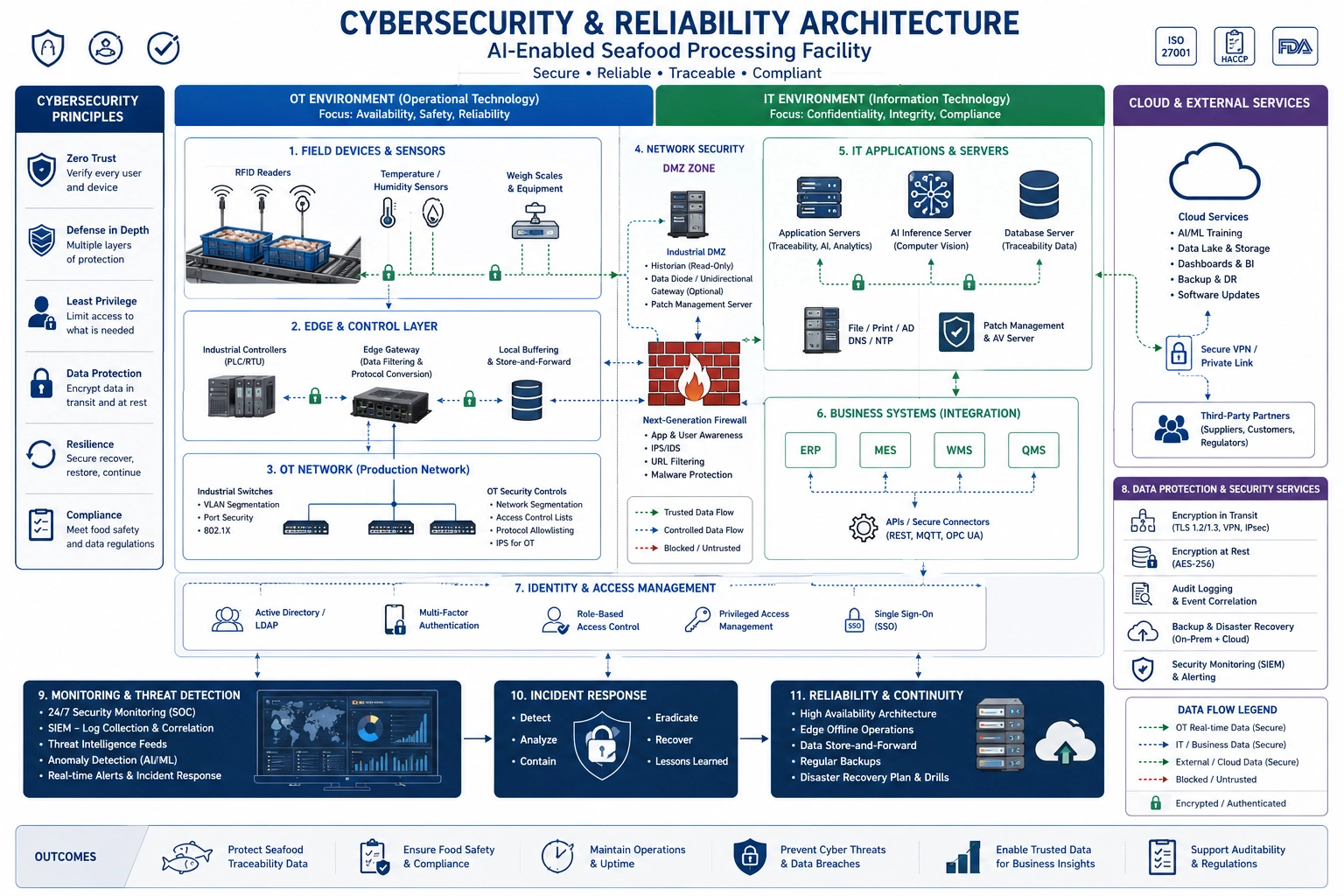
This technical architecture diagram shows how cybersecurity controls protect RFID readers, sensors, edge gateways, industrial OT networks, AI systems, traceability databases, and connected IT environments. It illustrates firewalls, network segmentation, identity management, encryption, audit logging, monitoring, backups, incident response, and secure cloud or ERP/MES/WMS data exchange. The key takeaway is that layered security and reliability controls help maintain safe, traceable, and resilient seafood processing operations.
Operational and Business Benefits of AI-Enabled Seafood Processing
Combining AI with automated identification can improve seafood processing operations because it connects physical product movement with contextual production and business information.
Improved Traceability
RFID-generated movement events can reduce reliance on manual recording and create more frequent visibility into the location and status of tracked containers and products. AI can identify missing or inconsistent event sequences that deserve investigation.
The result is a more complete operational picture of seafood lot genealogy and movement.
Better Inventory Accuracy
AI can compare expected inventory transactions with observed RFID movement and identify discrepancies. This can reduce the time required to locate reusable totes, pallets, and product containers and can help warehouse personnel investigate unexplained inventory differences.
Reduced Product Loss
Seafood processors can use AI to identify unusual storage dwell times, temperature patterns, production delays, and inventory conditions that may contribute to product loss. Earlier identification allows personnel to investigate potential problems before they become larger operational issues.
Faster Quality Investigations
When RFID identity is connected with quality inspection records, production batches, temperature information, and processing history, quality personnel can investigate affected material more efficiently.
Rather than searching across disconnected spreadsheets and manual records, investigators can retrieve information associated with a defined lot or container through the integrated system.
More Effective Cold-Chain Management
Temperature information becomes more useful when it can be correlated with product identity and physical movement. AI can prioritize temperature patterns requiring attention rather than treating every threshold event identically.
Improved Production Visibility
Production managers can gain better visibility into the movement of raw materials, work-in-process containers, finished goods, and reusable assets. AI analytics can identify bottlenecks and recurring delays by examining movement and processing patterns.
Scalable Multi-Site Monitoring
A cloud-hosted implementation can consolidate information from multiple seafood processing facilities. A common data model can allow corporate operations teams to compare inventory movement, production performance, traceability events, and exception patterns across locations.
Seafood Processing KPIs for AI and RFID Programs
The success of an implementation should be measured using operational indicators rather than RFID read counts alone.
Relevant KPIs include:
Traceability record completeness.
Lot genealogy accuracy.
RFID read accuracy at defined read points.
Inventory record accuracy.
Container and pallet location accuracy.
Cold-room dwell time.
Temperature excursion frequency.
Temperature excursion duration.
Product loss and spoilage rate.
Production yield.
Processing throughput.
Batch processing time.
Order fulfillment accuracy.
Shipping verification accuracy.
Quality exception frequency.
Time required for traceability investigations.
Time required to locate reusable containers.
Unplanned production interruptions.
Equipment downtime associated with monitored processes.
AI anomaly detection precision and false-alert rate.
KPIs should have defined measurement methods and baseline values before deployment. For example, inventory accuracy should be measured consistently before and after implementation rather than inferred solely from the number of RFID events captured.
Practical Implementation Approach for Seafood Processors
A successful implementation should begin with the business process rather than the RFID reader.
Identify High-Value Processes
Start with processes where improved visibility can produce measurable value. Receiving, cold storage, reusable-container tracking, batch traceability, packaging, and shipping are common candidates.
Define the Tracking Unit
Determine whether the system will track individual products, cases, totes, bins, pallets, batches, or another operational unit. The tracking unit determines tag placement, reader configuration, software data models, and traceability granularity.
Conduct an RFID Site Survey
Evaluate the actual environment, including metal surfaces, water exposure, conveyor speed, tag orientation, container construction, refrigerated areas, reader placement, antenna positioning, and expected read distances.
A pilot should use real seafood-processing containers and representative products rather than laboratory-only testing.
Establish the Data Model
Define the relationship among supplier lots, receiving records, containers, processing batches, work orders, finished products, storage locations, and shipments.
This step is critical because AI analytics depend on consistent identifiers and timestamps.
Integrate with Existing Systems
Connect RFID middleware and edge systems with ERP, MES, WMS, quality, inventory, and other relevant applications. Define which system remains the authoritative source for each business record.
Validate AI Models
AI models should be evaluated against real plant data. Performance should be measured using suitable metrics, and operators should be able to investigate why an alert was generated when practical.
Commission and Test the System
Testing should include normal production, peak activity, network interruptions, reader failures, tag failures, cold-room conditions, container changes, and unusual material movements.
Scale After Operational Validation
Once the initial deployment demonstrates measurable improvement, additional production areas, cold rooms, shipping points, assets, or facilities can be incorporated.
GAO RFID and IoT Solutions for Seafood Processing
GAO provides RFID, BLE, and IoT hardware products and systems that can support seafood processing applications involving identification, asset tracking, inventory visibility, environmental monitoring, and industrial data collection.
GAO’s product and system experience can be relevant to seafood processors designing solutions around receiving, production, cold storage, reusable-container management, packaging, and shipping. Hardware selection should be matched to the physical operating environment, required read range, tag material, installation location, connectivity requirements, and software integration strategy.
Headquartered in New York City and Toronto, Canada, GAO is ranked among the top 10 leading B2B and B2G RFID and BLE suppliers worldwide. GAO and its sister companies, GAO Research and GAO Tek, form GAO Group, with operations based in New York City and Toronto.
For three decades, GAO Group has served organizations in the United States and Canada, including Fortune 500 companies, leading research and development organizations, universities, and government agencies. Its product and system development includes significant R&D investment, quality assurance processes, and remote or onsite technical support.
Key Takeaways for AI Seafood Processing
AI-enabled seafood processing is most effective when AI analytics are connected to reliable operational data. RFID can provide automatic identification and movement information, while sensors, production equipment, computer vision, and existing business systems add the context required for meaningful analysis.
The strongest implementations focus on specific operational problems such as seafood traceability, inventory accuracy, cold-chain visibility, quality investigation, reusable-container tracking, and production monitoring.
Successful deployment requires more than installing RFID readers. Seafood processors should validate RFID performance under real operating conditions, establish consistent data relationships, integrate with existing software, secure the connected environment, measure baseline KPIs, and validate AI models against actual production data.
GAO can support organizations evaluating RFID, BLE, and IoT hardware and systems for these applications. Readers, tags, gateways, sensors, and related technologies should be selected according to the physical and operational requirements of each seafood processing facility.
Building the Future of Industrial AI and IoT with Aperture Venture Studio and GAO RFID Inc.
For more than three decades, GAO Group of Companies has invested heavily in R&D for industrial RFID, BLE, and IoT. As generative AI has demonstrated practical value in industrial applications, we have continued developing AI and IoT technologies, including RFID and BLE, and founded Aperture Venture Studio to support the development and scaling of AI and IoT solutions relevant to industries such as seafood processing.
Aperture has attracted AI and IoT technical experts, entrepreneurial and operational executives, investors, and leading companies. We have also developed the Aperture Ventures Summit and TekSummit to discuss advanced AI and IoT topics and foster technical communities.
We welcome seafood processing organizations and professionals to engage with us as:
- Advisors, co-founders, or employees.
- Investors.
- Customers.