
AI and RFID for Semiconductor Packaging (OSAT)
AI-Driven RFID Solutions for Semiconductor Packaging (OSAT)
Semiconductor Packaging and Outsourced Semiconductor Assembly and Test (OSAT) facilities operate in one of the most demanding manufacturing environments in the electronics industry. Every wafer, substrate, lead frame, package, carrier, reel, tray, and shipping container must be accurately identified, tracked, processed, inspected, and validated while maintaining exceptional quality standards. As semiconductor devices become more advanced and package architectures continue to evolve toward heterogeneous integration, chiplet designs, advanced system-in-package (SiP), fan-out wafer-level packaging (FOWLP), and 2.5D/3D packaging, manufacturing complexity increases significantly. Traditional identification methods such as barcodes and manual data entry often struggle to provide the speed, automation, and data integrity required for modern OSAT operations.
Artificial intelligence supported by RFID technologies enables semiconductor packaging facilities to transform operational data into actionable manufacturing intelligence. RFID automatically captures real-time information about materials, work-in-progress (WIP), tooling, carriers, and finished semiconductor products without requiring direct line-of-sight scanning. AI continuously analyzes this data to optimize production scheduling, identify quality risks, predict equipment failures, detect process anomalies, improve inventory accuracy, and support automated operational decisions. The result is a highly traceable, intelligent manufacturing environment capable of meeting strict quality, reliability, and customer compliance requirements.
GAO has supplied RFID hardware products and IoT solutions to organizations throughout North America for decades, supporting manufacturers that require reliable asset visibility, automated identification, and industrial-grade data collection. Our experience serving Fortune 500 companies, research organizations, universities, and government agencies has contributed to practical RFID deployments that address demanding industrial applications.
AI-Enabled RFID Architecture for Semiconductor Packaging (OSAT): End-to-End Data Flow, Enterprise Integration, and Intelligent Decision-Making
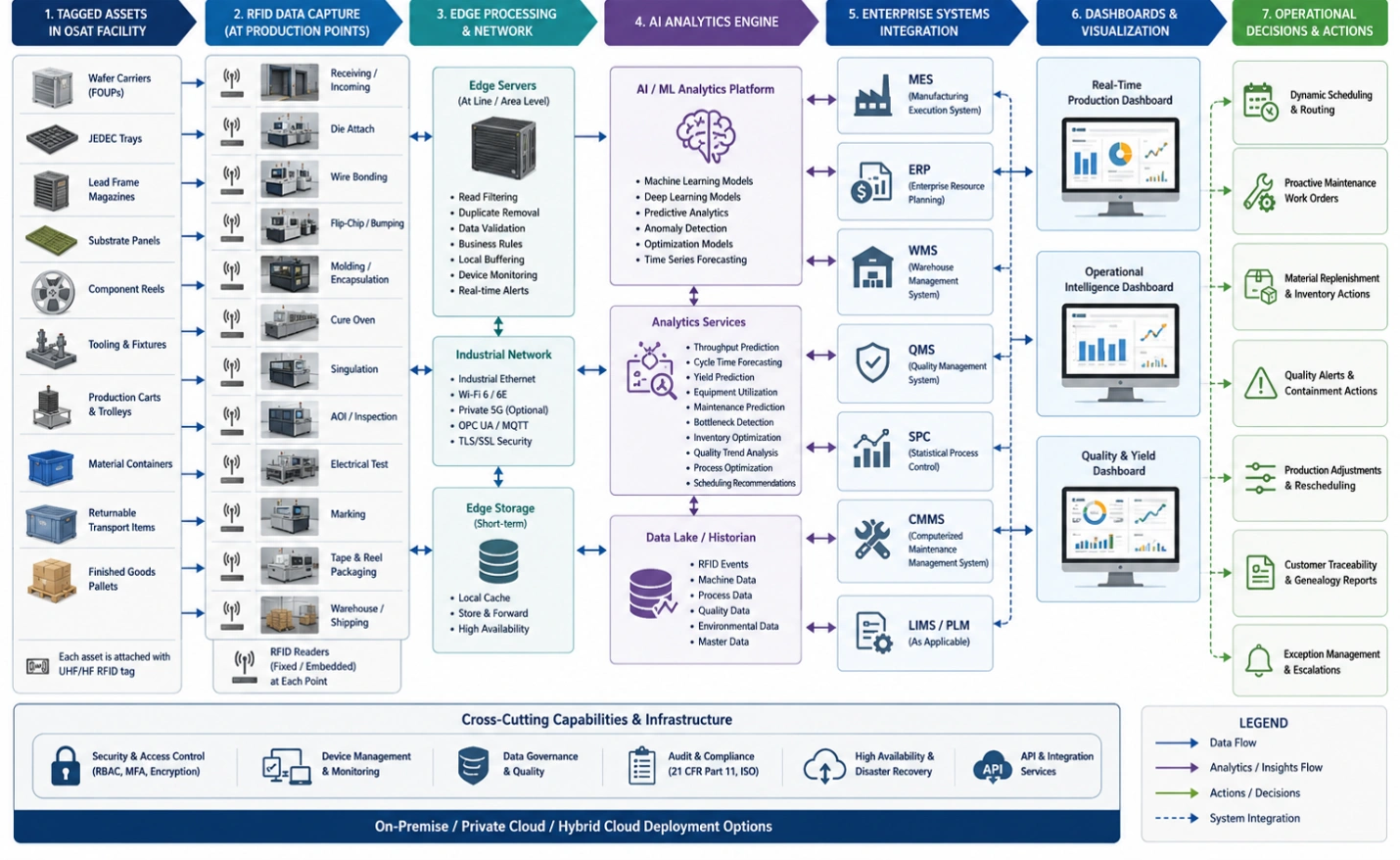
Why AI-Enabled RFID Is Becoming Essential for Semiconductor Packaging (OSAT)
Semiconductor packaging represents the final manufacturing stage before integrated circuits reach equipment manufacturers. Every packaged device passes through numerous precision-controlled processes including die attach, wire bonding, flip-chip assembly, encapsulation, molding, curing, singulation, inspection, electrical testing, marking, tape-and-reel packaging, and final shipment. Throughout these processes, thousands of individual production events generate operational data that influence manufacturing yield, throughput, and product quality.
Without automated identification, manufacturers often experience challenges such as:
- Difficulty locating work-in-progress across multiple production lines.
- Delayed identification of process bottlenecks.
- Limited genealogy tracking for packaged semiconductor devices.
- Manual inventory reconciliation.
- Increased risk of product mix-ups.
- Limited visibility into carrier utilization.
- Higher labor requirements for production tracking.
- Reduced responsiveness to quality incidents.
RFID addresses these limitations by assigning electronic identities to manufacturing assets, production carriers, wafer cassettes, JEDEC trays, material containers, tooling, reusable transport fixtures, and finished products. Unlike optical barcode systems, RFID enables simultaneous reading of multiple tagged items while reducing manual scanning activities.
Artificial intelligence complements RFID by converting large volumes of operational events into manufacturing intelligence. Rather than simply recording asset movement, AI identifies relationships between production variables, predicts future operational conditions, recommends scheduling improvements, and continuously improves manufacturing performance using historical and real-time production data.
This combination enables OSAT providers to move beyond simple tracking toward predictive manufacturing supported by continuous operational learning.
Fundamental Concepts of AI-Powered RFID in Semiconductor Packaging
AI-powered RFID combines automated identification technologies with intelligent analytics to create continuous visibility throughout semiconductor packaging operations.
RFID as the Manufacturing Data Acquisition Layer
RFID serves as the primary mechanism for capturing production events automatically. Within semiconductor packaging facilities, RFID can identify:
- Wafer carriers
- FOUPs where applicable
- Magazine racks
- JEDEC trays
- Strip carriers
- Lead frames
- Substrate panels
- Component reels
- Tooling fixtures
- Production carts
- Material containers
- Finished product pallets
- Returnable transport assets
Every RFID read event records valuable manufacturing information including asset identity, process location, production timestamp, workstation identification, operator association, equipment utilization, and process sequence.
Instead of relying on manual barcode scanning, RFID readers positioned throughout production cells automatically update manufacturing records whenever tagged assets enter or leave controlled processing areas.
Artificial Intelligence as the Manufacturing Intelligence Layer
While RFID captures operational events, artificial intelligence transforms production data into actionable insights. AI models continuously evaluate information collected from RFID readers together with Manufacturing Execution Systems (MES), Enterprise Resource Planning (ERP) software, Statistical Process Control (SPC) systems, equipment sensors, Automated Material Handling Systems (AMHS), quality inspection equipment, and environmental monitoring systems.
Depending on operational objectives, AI may employ:
- Machine learning for production forecasting.
- Deep learning for defect classification.
- Predictive analytics for equipment maintenance.
- Reinforcement learning for production optimization.
- Computer vision integration for package inspection.
- Time-series analysis for process stability.
- Anomaly detection for abnormal production behavior.
- Digital twin simulations for packaging line optimization.
Rather than replacing engineering expertise, AI assists manufacturing engineers by rapidly analyzing operational conditions that would otherwise require extensive manual investigation.
Semiconductor Packaging Data Becomes Operational Intelligence
Every production movement captured through RFID contributes to a growing operational knowledge base. Examples include:
- Material arrival times.
- Queue duration before each production stage.
- Equipment utilization rates.
- Tool change frequency.
- Carrier circulation efficiency.
- Production cycle times.
- Yield trends by product family.
- Batch genealogy.
- Lot history.
- Production bottlenecks.
AI continuously correlates these variables to determine how operational decisions influence throughput, quality, and manufacturing efficiency. For example, repeated delays occurring before wire bonding may indicate insufficient tooling availability rather than equipment failure. AI can recognize these hidden relationships long before they become visible through traditional reporting methods, allowing production planners to adjust material flow proactively.
Enterprise Importance for Modern OSAT Operations
Semiconductor customers increasingly require complete device genealogy, rapid quality investigations, regulatory compliance, and highly responsive manufacturing. AI-enabled RFID supports these requirements by improving visibility across the production lifecycle while reducing dependence on manual data collection.
The technology also strengthens collaboration between manufacturing software systems. RFID-generated events can be shared with MES, warehouse management software, quality management systems, production scheduling software, maintenance management software, and business analytics applications, allowing AI to generate recommendations using consistent, real-time production information.
For organizations deploying private server infrastructure, AI processing may be performed on factory-managed servers to support low-latency production decisions and maintain control over sensitive manufacturing data. Alternatively, cloud-hosted software can aggregate operational information across multiple OSAT facilities, enabling centralized analytics, cross-site benchmarking, and enterprise-wide performance optimization.
As semiconductor packaging complexity continues to increase, combining RFID with AI provides the operational visibility, traceability, and manufacturing intelligence necessary to improve yield, reduce production variability, and support scalable, high-volume packaging operations while maintaining stringent customer quality expectations.
AI-Driven RFID Applications Across Semiconductor Packaging (OSAT) Operations
Semiconductor Packaging (OSAT) facilities manage thousands of production lots, carriers, substrates, lead frames, JEDEC trays, reels, and finished semiconductor packages simultaneously. Every manufacturing stage requires precise synchronization between materials, equipment, operators, automated transport systems, quality inspection stations, and enterprise software. AI-enabled RFID transforms these interconnected activities into intelligent manufacturing workflows by providing continuous visibility, predictive insights, and automated decision support.
Unlike traditional asset tracking solutions that primarily record historical movements, AI-powered RFID continuously evaluates production data to optimize material flow, improve scheduling efficiency, minimize bottlenecks, and enhance overall manufacturing performance.
GAO has supported organizations requiring industrial RFID identification systems capable of operating in demanding production environments where traceability, operational reliability, and data accuracy are critical business requirements. Our experience supplying RFID hardware and IoT technologies has demonstrated the value of automated identification throughout complex manufacturing operations.
AI-Enabled RFID Workflow for Semiconductor Packaging (OSAT): Intelligent Process Flow from Receiving to Shipping
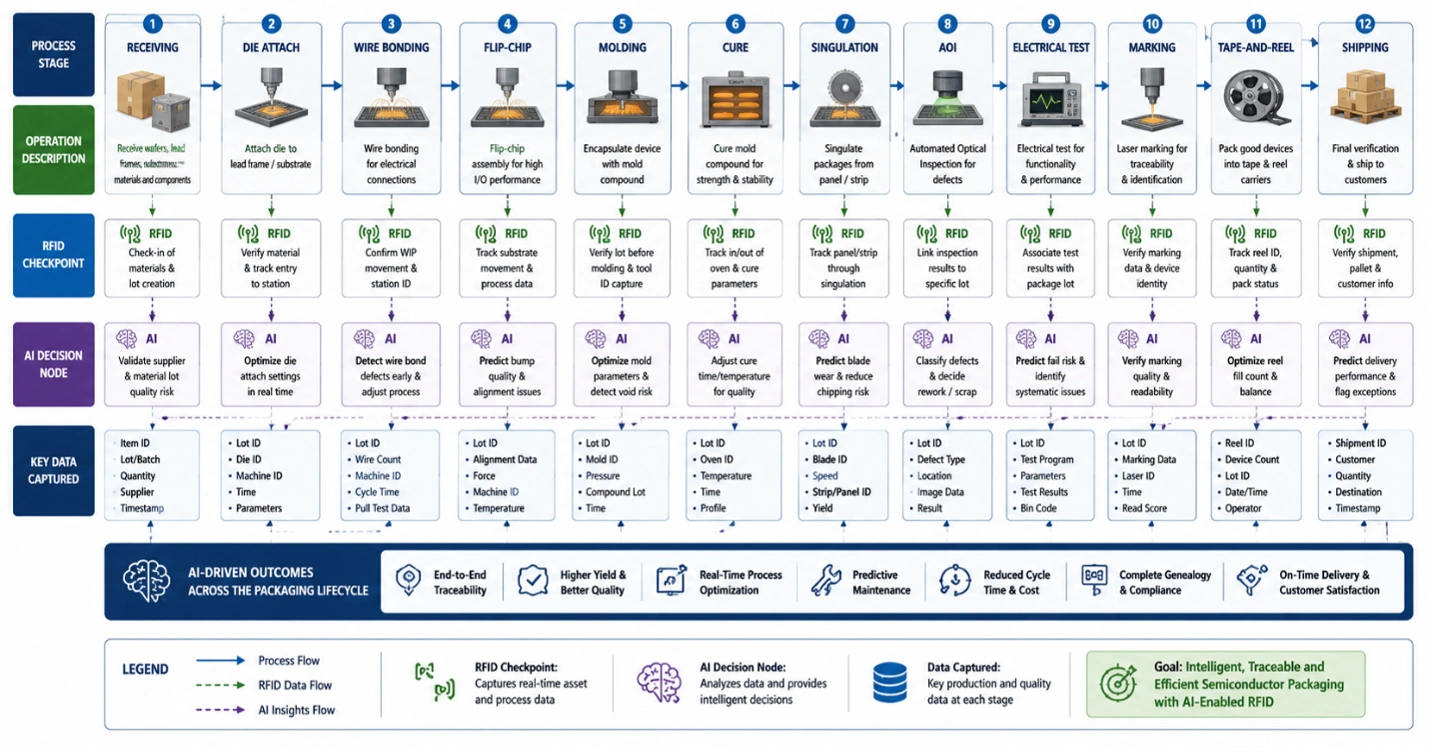
Work-in-Progress (WIP) Tracking and Intelligent Production Visibility
Maintaining accurate visibility of work-in-progress is one of the most significant operational challenges within OSAT facilities. Multiple semiconductor product families often move simultaneously through die attach, flip-chip bonding, molding, curing, inspection, electrical testing, marking, singulation, and packaging. RFID tags attached to carriers, trays, magazines, substrate panels, and production containers automatically report their location whenever they pass fixed or mobile RFID readers.
Artificial intelligence analyzes this continuous stream of movement data to:
- Identify excessive queue times between manufacturing processes.
- Predict congestion before production bottlenecks occur.
- Recommend optimized routing for production lots.
- Balance workloads across parallel production lines.
- Detect production delays affecting delivery schedules.
- Improve manufacturing throughput without increasing equipment capacity.
Rather than relying solely on historical production reports, manufacturing supervisors receive predictive recommendations that support proactive production management.
Intelligent Material Traceability and Product Genealogy
Modern semiconductor manufacturers require complete genealogy records for every packaged integrated circuit. Customers frequently request detailed production histories covering raw materials, processing equipment, inspection results, operator interactions, environmental conditions, and final testing information. RFID automatically establishes digital identities for:
- Wafer lots
- Lead frames
- Organic substrates
- Mold compounds
- Die attach materials
- Packaging carriers
- Component reels
- Finished semiconductor packages
AI correlates RFID events with MES records, equipment logs, SPC measurements, AOI inspection results, and electrical test data to generate comprehensive genealogy records. When field failures occur, engineering teams can rapidly identify:
- Manufacturing lots with similar process histories.
- Equipment used during production.
- Shared tooling.
- Material batches.
- Environmental conditions.
- Quality inspection outcomes.
- Process deviations contributing to failures.
This significantly reduces root-cause analysis time while improving corrective action effectiveness.
AI-Assisted Inventory Optimization
Semiconductor packaging operations maintain inventories consisting of high-value materials with varying storage requirements and shelf-life limitations. Examples include:
- Semiconductor wafers.
- Flip-chip substrates.
- Lead frames.
- Bonding wires.
- Epoxy materials.
- Mold compounds.
- Solder balls.
- Protective packaging.
- JEDEC trays.
- Shipping containers.
RFID provides real-time inventory visibility without requiring manual cycle counting. Artificial intelligence continuously evaluates inventory consumption patterns to:
- Forecast material demand.
- Recommend replenishment timing.
- Reduce excess inventory.
- Identify slow-moving materials.
- Prevent production shortages.
- Optimize warehouse utilization.
- Improve inventory turnover.
- Reduce expired material risk.
These capabilities help procurement teams maintain production continuity while minimizing working capital investment.
Predictive Equipment Maintenance
Packaging equipment represents a significant capital investment. Unexpected downtime directly affects production capacity, customer delivery schedules, and manufacturing costs. RFID enables intelligent tracking of:
- Production tooling.
- Replaceable machine components.
- Maintenance kits.
- Calibration equipment.
- Spare parts.
- Mobile diagnostic instruments.
AI combines RFID asset history with equipment sensor information to predict maintenance requirements before failures occur. Examples include:
- Wire bonder utilization trends.
- Die attach head replacement intervals.
- Mold tool lifecycle monitoring.
- Reflow oven maintenance scheduling.
- Handler usage statistics.
- Test socket replacement forecasting.
Instead of relying on fixed maintenance intervals, maintenance engineers receive recommendations based on actual equipment utilization and operational conditions.
Automated Quality Assurance
Quality requirements within OSAT manufacturing continue to become increasingly stringent due to growing package complexity and customer reliability expectations. RFID ensures every production lot remains uniquely identifiable throughout manufacturing. Artificial intelligence evaluates production records alongside:
- Automated Optical Inspection (AOI)
- X-ray inspection
- Electrical testing
- Burn-in results
- Statistical Process Control (SPC)
- Environmental monitoring
- Vision inspection systems
Machine learning algorithms identify subtle production trends that may indicate:
- Wire bond degradation.
- Die placement variation.
- Molding defects.
- Substrate alignment problems.
- Process drift.
- Increased defect probability.
- Yield degradation.
Rather than waiting until quality limits are exceeded, engineers receive early warnings that support preventive process adjustments.
Operational Workflow from RFID Data Capture to AI-Driven Decision Making
Successful AI-enabled RFID deployments depend upon a structured operational workflow that connects production assets, communication infrastructure, software systems, and manufacturing analytics.
Stage 1 – Automated Identification
RFID readers installed throughout the facility capture identification events whenever tagged materials, carriers, or finished products move between production stations. Captured information typically includes:
- RFID tag identifier.
- Production lot.
- Timestamp.
- Workstation location.
- Equipment identifier.
- Operator assignment.
- Process status.
- Material movement.
This information becomes available immediately without manual intervention.
Stage 2 – Communication and Edge Processing
Captured RFID events are transmitted through industrial communication networks using technologies appropriate for semiconductor manufacturing environments. Common communication methods include:
- Industrial Ethernet
- TCP/IP
- OPC UA
- MQTT
- REST APIs
- Wi-Fi 6
- Private 5G (where applicable)
Edge servers perform initial data validation, filtering duplicate reads, validating tag authenticity, and buffering data during temporary network interruptions. Local processing minimizes latency for time-sensitive production decisions while reducing unnecessary traffic to centralized systems.
Stage 3 – Enterprise Software Integration
Validated RFID events are synchronized with operational software responsible for managing semiconductor production. Typical integrations include:
- Manufacturing Execution Systems (MES)
- Enterprise Resource Planning (ERP)
- Warehouse Management Systems (WMS)
- Laboratory Information Management Systems (LIMS)
- Product Lifecycle Management (PLM)
- Statistical Process Control (SPC)
- Computerized Maintenance Management Systems (CMMS)
- Quality Management Systems (QMS)
This integration creates a unified operational view in which material movement, production status, inventory, maintenance, and quality data remain synchronized across departments.
Stage 4 – AI Analytics and Continuous Learning
After operational data has been consolidated, AI models evaluate historical and real-time information to identify optimization opportunities. Typical analytical functions include:
- Production throughput prediction.
- Cycle time forecasting.
- Queue optimization.
- Yield prediction.
- Equipment utilization analysis.
- Maintenance forecasting.
- Defect trend detection.
- Material consumption forecasting.
- Inventory optimization.
- Production scheduling recommendations.
As additional production data becomes available, machine learning models continuously improve prediction accuracy and adapt to changing manufacturing conditions.
Stage 5 – Automated Operational Decisions
The final stage converts AI-generated insights into actionable recommendations and automated responses. Examples include:
- Redirecting production lots to less congested work cells.
- Alerting engineers to abnormal process conditions.
- Triggering preventive maintenance work orders.
- Updating production schedules.
- Notifying warehouse personnel of replenishment requirements.
- Isolating potentially affected production lots during quality investigations.
- Supporting customer traceability reports with complete genealogy records.
These intelligent actions enable semiconductor packaging facilities to reduce production variability, improve equipment utilization, and maintain consistent product quality while supporting increasingly complex packaging technologies.
Engineering Considerations for RFID Deployment in OSAT Facilities
Successful deployment of AI-enabled RFID within Semiconductor Packaging (OSAT) environments requires careful engineering planning beyond simple tag installation. Engineers must evaluate RF performance around metallic equipment, high-density electronic assemblies, electrostatic discharge (ESD) protected areas, cleanroom classifications, conveyor layouts, and automated material handling systems to ensure reliable tag readability and data integrity.
Important design considerations include:
- Selecting UHF, HF, or LF RFID technology based on read range, tag size, and material characteristics.
- Choosing ESD-safe and high-temperature RFID tags suitable for semiconductor manufacturing processes.
- Determining optimal reader placement to eliminate blind spots and minimize RF interference.
- Integrating RFID events with existing MES, ERP, SPC, QMS, and WMS software without disrupting production.
- Implementing authentication, role-based access control, encrypted communications, and audit logging to protect sensitive manufacturing information.
- Planning scalable reader infrastructure capable of supporting future production expansion, additional packaging lines, and higher-volume manufacturing.
Careful engineering during the planning phase ensures that RFID infrastructure delivers consistent read performance, supports AI analytics with accurate operational data, and provides a reliable foundation for intelligent semiconductor packaging operations.
RFID Technologies, AI Models, Hardware, and Software for Intelligent Semiconductor Packaging (OSAT)
A successful AI-enabled RFID solution for Semiconductor Packaging (OSAT) depends on selecting appropriate RFID technologies, industrial hardware, AI software, communication infrastructure, and deployment models that align with production throughput, traceability requirements, cleanroom constraints, and manufacturing objectives. Rather than functioning as independent technologies, these components operate together as an integrated manufacturing system that continuously captures operational data, analyzes production conditions, and supports intelligent decision-making throughout the packaging lifecycle.
GAO has supplied industrial RFID hardware and IoT technologies to organizations requiring dependable automatic identification systems in manufacturing environments. This practical experience has demonstrated that long-term deployment success depends as much on careful engineering, interoperability, and infrastructure planning as on selecting the appropriate RFID devices.
Selecting the Appropriate RFID Technology for OSAT Manufacturing
Different semiconductor packaging operations require different RFID technologies based on read distance, environmental conditions, material composition, and production objectives.
Ultra High Frequency (UHF) RFID
UHF RFID is commonly selected for production logistics, warehouse automation, pallet identification, shipping verification, returnable transport item tracking, and high-speed material movement. Typical OSAT applications include:
- Finished semiconductor package tracking
- Reel identification
- Cart and trolley tracking
- Warehouse inventory management
- Shipping dock verification
- Automated receiving
- Material staging
- Returnable container management
Advantages include:
- Long read distance
- Simultaneous reading of multiple tagged items
- High inventory scanning speed
- Support for automated logistics
- Reduced manual handling
Engineering considerations include minimizing RF reflections from metallic equipment and optimizing antenna placement around conveyor systems, storage racks, and automated guided vehicles (AGVs).
High Frequency (HF) RFID
HF RFID operates effectively where shorter read ranges and controlled reading zones are preferred. Typical semiconductor packaging applications include:
- JEDEC tray identification
- Workstation authentication
- Operator identification
- Tool verification
- Production recipe confirmation
- Laboratory sample tracking
- Maintenance documentation
HF technology performs well where closely spaced items require selective identification without unintentionally reading adjacent tags.
Low Frequency (LF) RFID
LF RFID is generally reserved for specialized identification applications requiring reliable performance around challenging materials or environments. Potential OSAT uses include:
- Specialized tooling identification
- Maintenance asset management
- Calibration equipment tracking
- Facility access management
Although LF provides shorter read distances, its resistance to environmental interference makes it suitable for selected industrial applications.
Industrial Hardware Supporting AI-Driven RFID Solutions
Reliable hardware forms the foundation of every intelligent semiconductor packaging deployment.
AI-Supported RFID Business Benefits Infographic: Measurable Operational Improvements Across Manufacturing
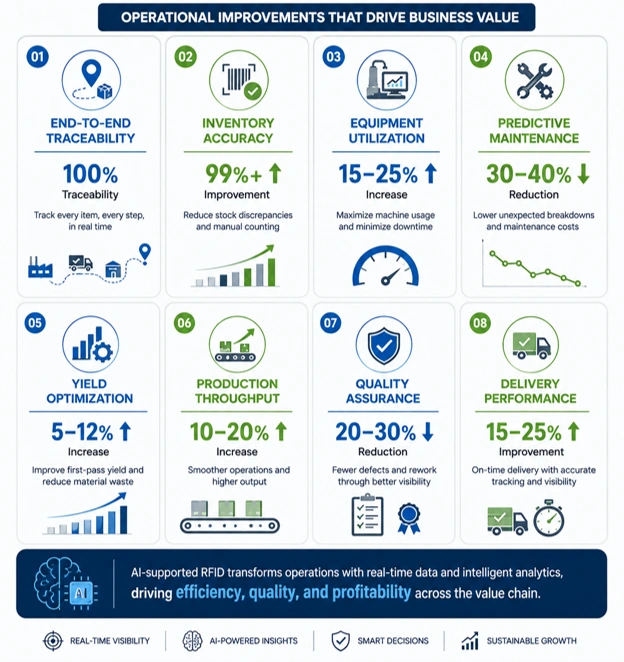
RFID Readers
Industrial RFID readers automatically collect identification events throughout manufacturing operations. Common deployment locations include:
- Receiving docks
- Material warehouses
- Production entrances
- Die attach stations
- Wire bonding cells
- Flip-chip assembly lines
- Mold presses
- Cure ovens
- Singulation equipment
- Automated optical inspection stations
- Electrical testing areas
- Tape-and-reel packaging
- Finished goods warehouses
- Shipping areas
Readers may be fixed, handheld, vehicle-mounted, or integrated into automated material handling equipment depending on operational requirements.
RFID Tags
RFID tags must withstand semiconductor manufacturing environments while maintaining reliable readability throughout production. Typical tagged assets include:
- Wafer carriers
- FOUPs
- Lead frame magazines
- JEDEC trays
- Strip carriers
- Material containers
- Component reels
- Production carts
- Maintenance tools
- Calibration instruments
- Returnable transport containers
- Finished pallets
Tag selection should consider:
- Operating temperature
- Chemical exposure
- ESD compatibility
- Read distance
- Memory capacity
- Mounting method
- Expected lifecycle
- Cleanroom compatibility
RFID Antennas
Proper antenna selection significantly influences read reliability. Engineering considerations include:
- Read zone dimensions
- Conveyor speed
- Tag orientation
- Polarization
- Metal reflections
- Reader density
- Electromagnetic interference
- Production layout
Multiple antennas are often deployed within production cells to eliminate blind spots while maintaining accurate location determination.
Edge Computing Devices
Edge computing devices process RFID information locally before transmitting validated events to enterprise software. Typical edge functions include:
- Read filtering
- Duplicate elimination
- Local buffering
- Device monitoring
- Rule execution
- Temporary data storage
- Network optimization
- Alarm generation
Edge processing reduces communication latency while improving overall system responsiveness.
Artificial Intelligence Models Supporting Semiconductor Packaging
Artificial intelligence transforms operational RFID data into actionable manufacturing intelligence using multiple analytical approaches.
UHF vs. HF vs. LF RFID for Semiconductor Packaging (OSAT): Technology Comparison and Application Guide
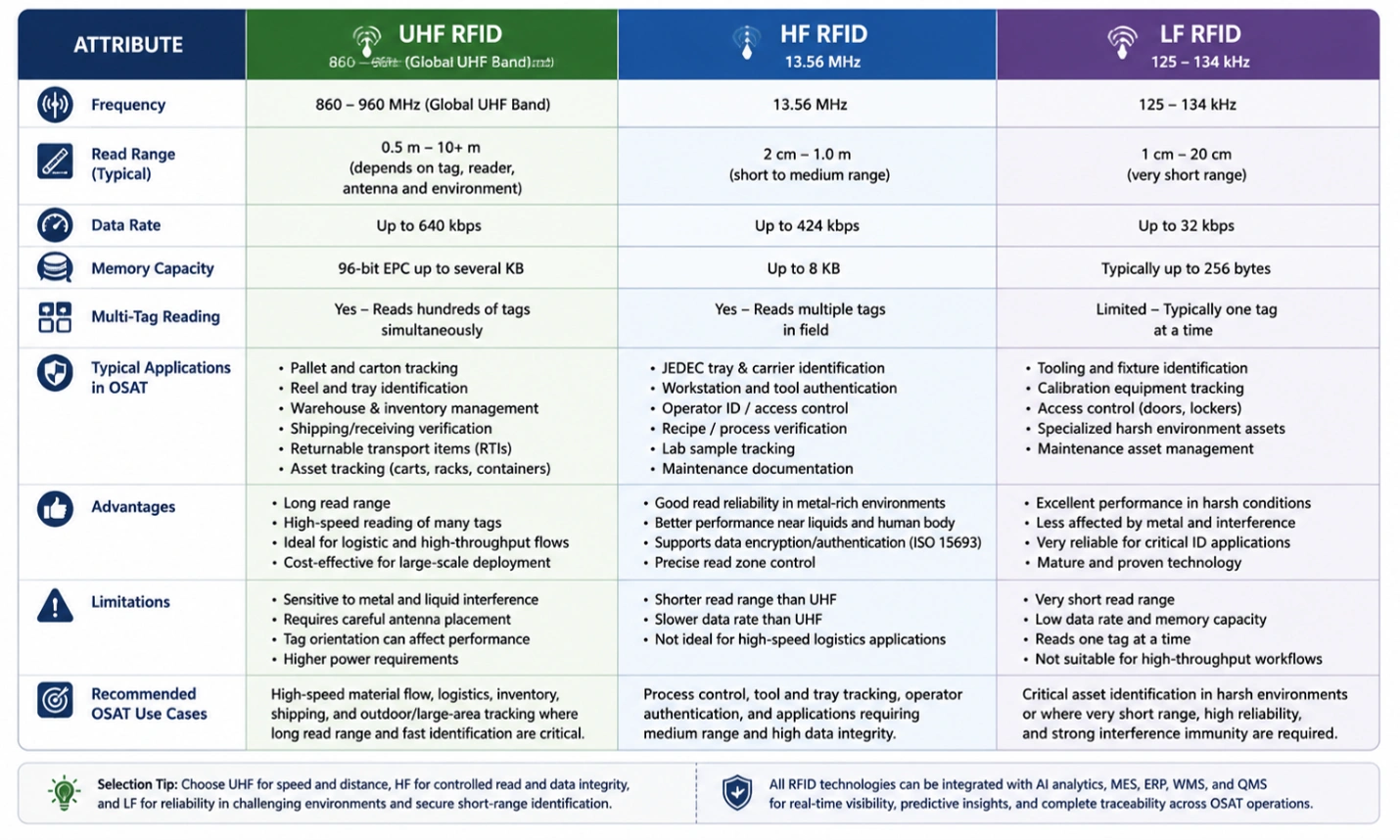
Machine Learning
Machine learning models evaluate historical manufacturing records to predict future operational performance. Applications include:
- Throughput prediction
- Equipment utilization forecasting
- Material demand forecasting
- Inventory optimization
- Production scheduling
- Cycle time estimation
- Yield forecasting
As additional production information becomes available, prediction accuracy improves continuously.
Deep Learning
Deep learning supports complex pattern recognition tasks within semiconductor manufacturing. Typical applications include:
- Automated Optical Inspection (AOI)
- X-ray defect classification
- Surface defect detection
- Package marking verification
- Wire bond inspection
- Die placement validation
- Encapsulation quality assessment
When integrated with RFID genealogy records, detected defects can be associated with specific production lots, materials, tooling, and manufacturing processes.
Predictive Analytics
Predictive analytics identifies operational conditions likely to affect future manufacturing performance. Examples include:
- Maintenance forecasting
- Production bottleneck prediction
- Equipment degradation
- Material shortage forecasting
- Delivery schedule risk
- Process instability
- Capacity utilization
This enables engineering teams to implement preventive actions before production performance deteriorates.
Anomaly Detection
Machine learning algorithms continuously monitor operational data for abnormal behavior. Potential anomalies include:
- Unexpected production delays
- Missing carriers
- Unauthorized material movement
- Abnormal inventory changes
- Equipment utilization deviations
- Unusual process sequences
- Unexpected quality variation
Early identification minimizes production disruptions while improving operational reliability.
Enterprise Software Integration
AI-enabled RFID delivers maximum value when integrated with existing semiconductor manufacturing software rather than operating as an isolated identification system. Typical software integrations include:
- Manufacturing Execution Systems (MES)
- Enterprise Resource Planning (ERP)
- Warehouse Management Systems (WMS)
- Product Lifecycle Management (PLM)
- Quality Management Systems (QMS)
- Statistical Process Control (SPC)
- Computerized Maintenance Management Systems (CMMS)
- Manufacturing Intelligence software
- Business Intelligence dashboards
- Production scheduling systems
RFID provides trusted operational data, while AI analyzes information from multiple enterprise systems to produce recommendations that support engineering, production planning, maintenance, logistics, and quality management.
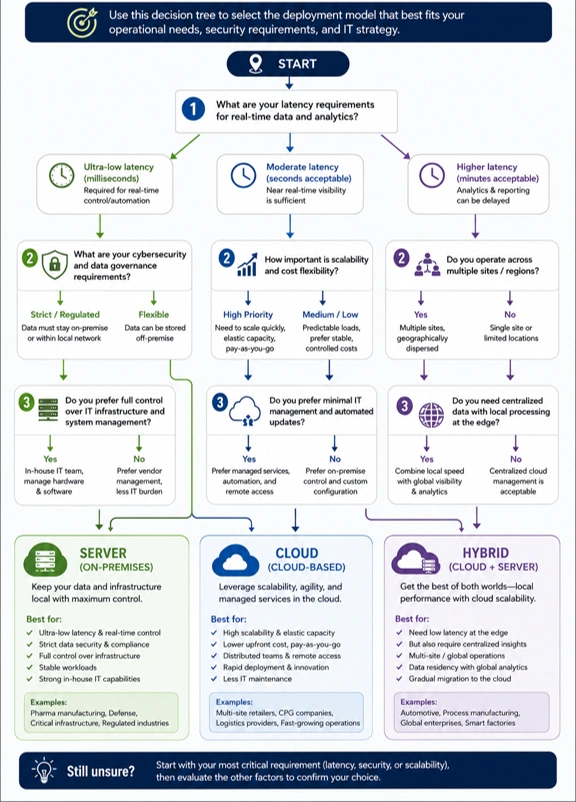
Cloud and Server Deployment Models
Organizations implementing AI-enabled RFID solutions should select deployment models that align with production objectives, cybersecurity policies, regulatory requirements, and IT infrastructure.
Cloud Deployment
Cloud-hosted software centralizes operational data from multiple manufacturing sites, allowing organizations to perform enterprise-wide analytics without maintaining extensive local computing resources. Cloud deployment is often appropriate when organizations require:
- Multi-site production visibility
- Centralized reporting
- Enterprise dashboards
- AI model updates
- Long-term historical analytics
- Cross-facility benchmarking
- Remote operational monitoring
Because computing resources can scale as production expands, cloud environments are well suited for organizations operating geographically distributed OSAT facilities.
Server Deployment
Server deployments place software on customer-managed infrastructure, including factory edge servers, private data centers, or other privately hosted enterprise servers. This approach provides greater control over manufacturing data and supports low-latency processing for time-sensitive production environments. Server deployments are commonly selected when organizations require:
- Low-latency decision making
- Sensitive intellectual property protection
- Compliance with internal cybersecurity policies
- Integration with existing factory infrastructure
- Continuous operation during external network interruptions
- Direct control over software updates and maintenance
Many semiconductor manufacturers adopt hybrid strategies in which edge or private servers manage real-time production operations while selected operational data is synchronized with cloud-hosted analytics for enterprise reporting and long-term optimization.
Cybersecurity and Operational Reliability
Protecting production data is essential because semiconductor packaging facilities handle proprietary designs, customer information, and manufacturing process parameters. Recommended security mechanisms include:
- Role-based access control (RBAC)
- Multi-factor authentication (MFA)
- End-to-end encryption for RFID event transmission
- Secure API authentication
- Digital certificates for connected devices
- Network segmentation between operational technology (OT) and information technology (IT)
- Continuous security monitoring and audit logging
- Routine vulnerability assessments and firmware updates
Operational resilience also depends on redundant readers, edge buffering, failover communication paths, and comprehensive backup strategies to ensure production continuity during hardware or network failures.
By combining industrial-grade RFID hardware, advanced AI models, integrated enterprise software, and secure deployment strategies, Semiconductor Packaging (OSAT) organizations can establish a highly traceable, data-driven manufacturing environment capable of supporting advanced packaging technologies, improving production efficiency, and maintaining the quality standards expected by global semiconductor customers.
Key Technical Capabilities and Operational Improvements
The combination of artificial intelligence and RFID enables Semiconductor Packaging (OSAT) facilities to move beyond traditional identification and tracking toward intelligent, data-driven manufacturing. By continuously collecting operational data and applying advanced analytics, manufacturers gain actionable insights that improve efficiency, product quality, and overall production performance.
End-to-End Semiconductor Traceability
One of the most significant technical capabilities of AI-enabled RFID is comprehensive traceability across the entire packaging process. Every tagged wafer lot, substrate, carrier, JEDEC tray, reel, and finished package can be tracked from receiving through shipping. This level of visibility enables manufacturers to:
- Maintain complete product genealogy.
- Accelerate root cause investigations.
- Support customer audit requests.
- Simplify product recall management.
- Verify manufacturing process compliance.
- Improve lot segregation.
- Reduce manual documentation.
Continuous traceability also supports increasingly stringent customer quality requirements for automotive electronics, aerospace systems, medical devices, industrial automation, and high-performance computing applications.
Intelligent Production Scheduling
AI continuously evaluates production workloads using RFID-generated operational data. Instead of static scheduling, intelligent software dynamically considers:
- Equipment availability.
- Material readiness.
- Operator capacity.
- Tool utilization.
- Queue length.
- Production priorities.
- Customer delivery commitments.
Scheduling recommendations can significantly reduce idle equipment time while improving production throughput and resource utilization.
Higher Manufacturing Yield
Yield improvement remains one of the primary objectives within semiconductor packaging operations. Machine learning identifies relationships between:
- Production sequences.
- Material batches.
- Equipment performance.
- Environmental conditions.
- Operator activities.
- Inspection results.
- Historical defect trends.
Rather than reacting to quality failures after they occur, engineers receive predictive insights that help prevent yield loss before production defects become widespread.
Improved Equipment Utilization
Packaging equipment represents major capital investment. AI evaluates RFID asset movements together with production data to determine:
- Equipment loading efficiency.
- Idle time.
- Utilization balance.
- Changeover frequency.
- Maintenance effectiveness.
- Production bottlenecks.
Engineering teams can optimize production planning without necessarily purchasing additional equipment.
Faster Quality Investigations
When production issues arise, AI-powered genealogy enables quality engineers to identify affected products within minutes rather than hours or days. Investigations can rapidly determine:
- Common production equipment.
- Shared material lots.
- Tooling history.
- Process parameters.
- Environmental conditions.
- Inspection outcomes.
This minimizes disruption while supporting rapid corrective actions.
Business Benefits of AI-Enabled RFID in Semiconductor Packaging
Although technical improvements drive implementation, the resulting operational and financial benefits are equally significant. Organizations implementing intelligent RFID solutions may experience:
- Improved production throughput.
- Reduced work-in-progress inventory.
- Lower manual labor requirements.
- Enhanced inventory accuracy.
- Faster production cycle times.
- Improved on-time delivery performance.
- Better customer traceability.
- Increased equipment utilization.
- Reduced manufacturing variability.
- Lower maintenance costs.
- Improved warehouse efficiency.
- Better decision-making through real-time operational intelligence.
These improvements contribute to stronger operational resilience while supporting increasingly complex semiconductor packaging technologies.
Implementation Recommendations
Successful deployment requires careful planning rather than isolated technology installation.
Begin with Clearly Defined Objectives
Organizations should establish measurable goals before deployment, such as:
- Improving WIP visibility.
- Increasing inventory accuracy.
- Reducing production delays.
- Enhancing genealogy.
- Optimizing equipment utilization.
- Supporting predictive maintenance.
Clearly defined objectives simplify technology selection and project evaluation.
Deploy RFID Incrementally
Rather than tagging every production asset immediately, organizations should begin with high-value workflows such as:
- WIP tracking.
- Finished goods verification.
- Warehouse inventory.
- Returnable asset management.
- Tool identification.
Gradual expansion minimizes implementation risk while allowing engineering teams to validate performance.
Prioritize Enterprise Integration
Maximum value is achieved when RFID data integrates seamlessly with existing software systems. Priority integrations typically include:
- Manufacturing Execution Systems (MES)
- Enterprise Resource Planning (ERP)
- Warehouse Management Systems (WMS)
- Quality Management Systems (QMS)
- Statistical Process Control (SPC)
- Computerized Maintenance Management Systems (CMMS)
Unified operational data enables AI models to generate more accurate recommendations.
Continuously Improve AI Models
Artificial intelligence should evolve alongside manufacturing operations. Organizations should periodically:
- Retrain prediction models.
- Validate analytical accuracy.
- Incorporate new production data.
- Update optimization rules.
- Review engineering assumptions.
- Measure operational improvements.
Continuous refinement ensures AI remains aligned with changing manufacturing requirements.
Advancing Intelligent Semiconductor Packaging with AI-Enabled RFID
Artificial intelligence supported by RFID technologies is transforming Semiconductor Packaging (OSAT) from reactive production management into intelligent manufacturing. Continuous identification of materials, carriers, equipment, and finished products enables AI to optimize production scheduling, improve quality control, strengthen traceability, reduce operational variability, and enhance overall manufacturing efficiency.
As semiconductor packaging technologies continue advancing toward increasingly sophisticated package designs and higher production volumes, intelligent RFID solutions provide the operational visibility and analytical capabilities required to support future manufacturing demands. Organizations that integrate automated identification with AI-driven analytics will be better positioned to improve yield, maintain customer compliance, and respond rapidly to changing production conditions.
Headquartered in New York City and Toronto, GAO continues to support manufacturers by supplying industrial RFID hardware and IoT solutions backed by decades of engineering experience, helping organizations implement reliable identification systems that strengthen operational visibility, manufacturing intelligence, and long-term digital transformation.
Building the Future of Industrial AI and IoT with Aperture Venture Studio and GAO
For more than three decades, GAO has invested extensively in research and development of industrial RFID, BLE, and IoT technologies that enable intelligent manufacturing and digital transformation across numerous industries. As artificial intelligence has matured into a practical technology for industrial applications, we have expanded our work in AI-enabled RFID and IoT solutions to address increasingly sophisticated manufacturing challenges, including semiconductor packaging and advanced electronics production.
Working alongside Aperture Venture Studio , we continue to foster innovation in industrial AI and IoT technologies by supporting the development and growth of advanced technology initiatives that solve real-world operational challenges. Through this collaboration, Aperture has attracted distinguished AI researchers, IoT engineers, experienced operational executives, respected investors, and leading technology organizations dedicated to advancing intelligent industrial solutions.
Our commitment to knowledge sharing extends through initiatives such as the Aperture Ventures Summit and TekSummit, where experts discuss emerging developments in artificial intelligence, RFID, IoT, industrial automation, and semiconductor manufacturing technologies. These collaborative communities encourage the exchange of engineering expertise, practical implementation lessons, and technological innovation.
We welcome opportunities to collaborate with:
- Advisors
- Technical experts
- Industry professionals
- Investors
- Customers seeking advanced RFID and AI-enabled industrial solutions