
AI and RFID for EMS (Electronics Manufacturing Services)
Transforming EMS Operations with AI-Powered RFID Intelligence
Electronics Manufacturing Services (EMS) providers operate in one of the world’s most demanding manufacturing environments, where production speed, product quality, component traceability, regulatory compliance, and supply chain responsiveness directly influence customer satisfaction and profitability. Modern EMS facilities manufacture products for multiple customers simultaneously while managing thousands of electronic components, work-in-progress assemblies, production tools, testing equipment, and finished products across highly automated production lines. Maintaining complete visibility throughout these operations has become increasingly challenging as product complexity and production volumes continue to grow.
Artificial intelligence (AI), supported by RFID technology, enables EMS organizations to transform traditional manufacturing operations into intelligent, data-driven production systems. RFID provides automatic identification and real-time tracking of electronic components, printed circuit board assemblies (PCBAs), manufacturing assets, returnable transport items, and finished products without requiring manual scanning. AI analyzes the continuous stream of RFID-generated operational data to detect production bottlenecks, predict equipment failures, optimize inventory availability, improve quality assurance, and support more accurate production planning.
For organizations seeking greater manufacturing efficiency, AI-driven RFID solutions help reduce material shortages, minimize production delays, improve traceability, strengthen regulatory compliance, and enhance overall operational performance. Drawing on decades of experience supplying RFID and industrial IoT technologies, GAO helps manufacturers implement reliable identification and tracking solutions that integrate with modern electronics manufacturing environments.
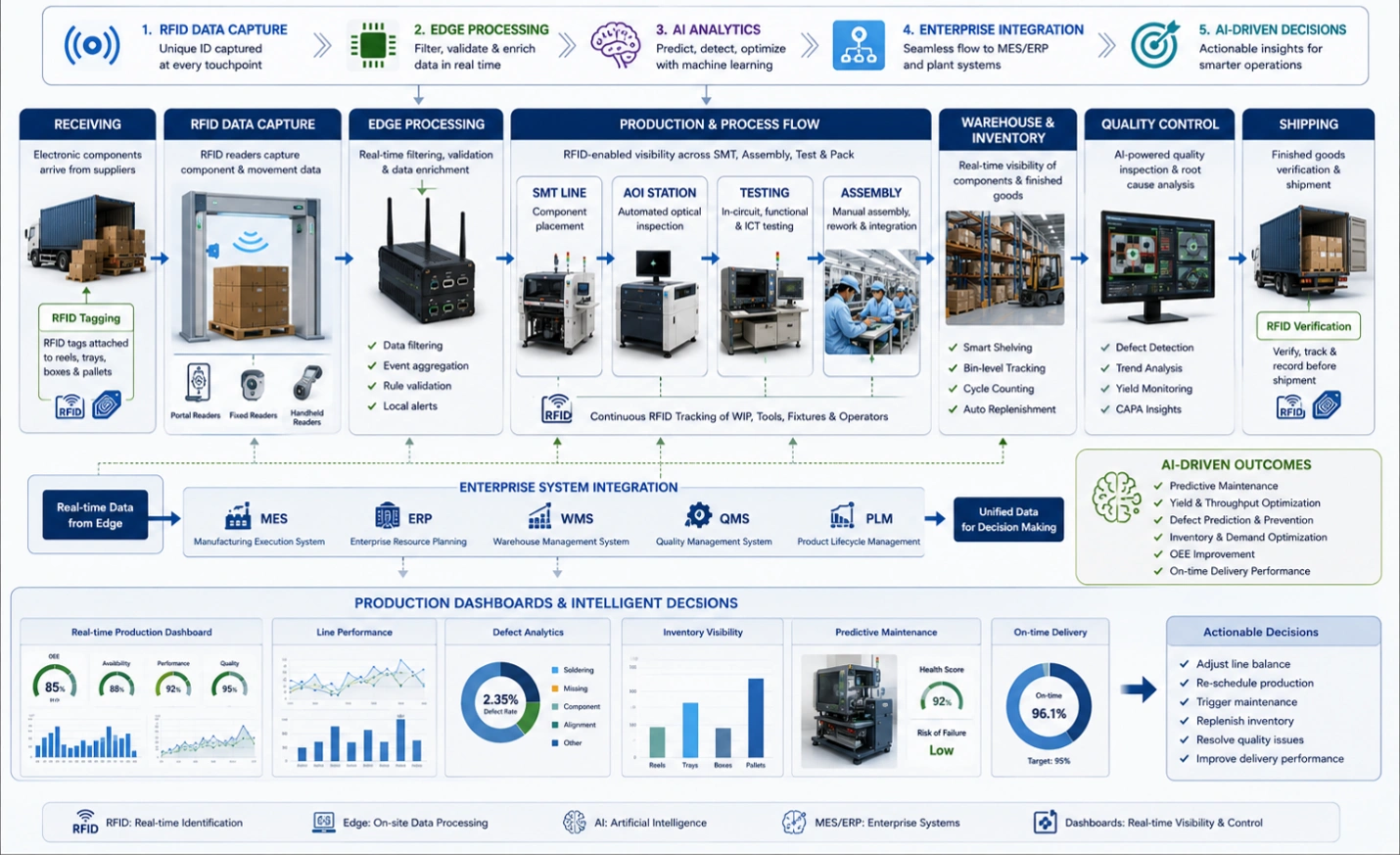
AI-Supported RFID Workflow in Electronic Manufacturing Services (EMS): From Data Capture to Intelligent Production Decisions
Fundamental Concepts of AI-Driven RFID in EMS Manufacturing
Electronics Manufacturing Services organizations rely on highly synchronized production workflows where every electronic component must arrive at the correct workstation, every assembly operation must be accurately recorded, and every finished product must remain fully traceable throughout its manufacturing lifecycle. AI-powered RFID solutions strengthen these capabilities by combining automated identification technologies with intelligent data analysis.
RFID technology uses radio frequency communication to uniquely identify and monitor tagged objects throughout manufacturing facilities. Depending on operational requirements, EMS facilities may deploy Low Frequency (LF), High Frequency (HF), or Ultra High Frequency (UHF) RFID systems for applications such as component tracking, asset management, work-in-progress monitoring, tool identification, warehouse automation, and finished goods verification.
Rather than relying on manual barcode scanning at each production stage, RFID readers automatically capture identification data as tagged materials move through receiving, storage, kitting, surface mount technology (SMT) lines, manual assembly stations, automated optical inspection (AOI), functional testing, packaging, and shipping operations. This continuous data collection provides comprehensive visibility into manufacturing activities while reducing human intervention and minimizing data capture errors.
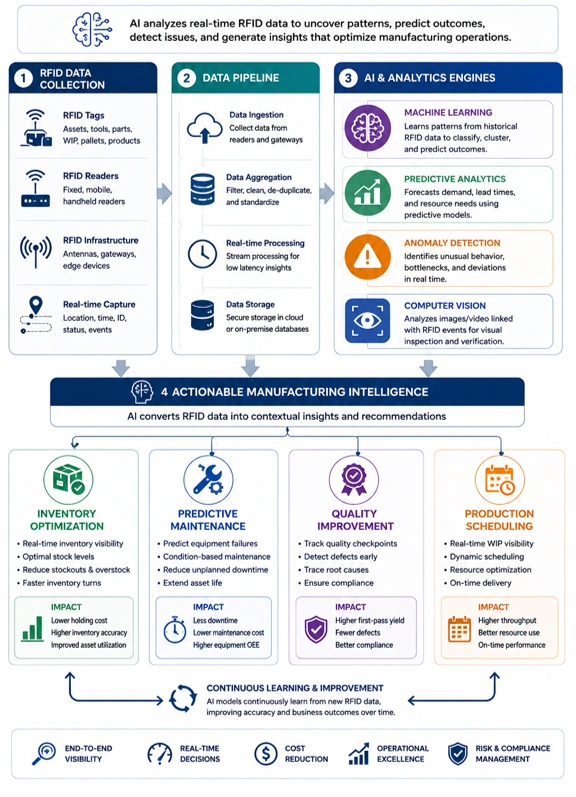
Artificial intelligence transforms this operational data into actionable manufacturing intelligence. Machine learning algorithms analyze production histories, equipment utilization, inventory movement, process cycle times, defect trends, operator performance, and logistics patterns to identify opportunities for continuous improvement. Predictive AI models help forecast component shortages, detect abnormal production behavior, estimate equipment maintenance requirements, optimize scheduling decisions, and improve manufacturing throughput before operational disruptions occur.
The relationship between AI and RFID is complementary rather than independent. RFID functions as the primary source of accurate, real-time manufacturing data, while AI converts that data into predictive insights and automated operational recommendations. Without reliable RFID-generated identification data, AI models have limited operational visibility. Conversely, without AI, RFID systems primarily provide tracking information without advanced decision support capabilities.
Modern EMS environments also integrate RFID and AI with Manufacturing Execution Systems (MES), Enterprise Resource Planning (ERP) software, Warehouse Management Systems (WMS), Product Lifecycle Management (PLM) software, Quality Management Systems (QMS), and Industrial Internet of Things (IIoT) infrastructure. These connected systems enable production managers, quality engineers, manufacturing engineers, logistics personnel, and operations teams to make faster, more informed decisions based on continuously updated operational intelligence.
This combination supports numerous EMS objectives, including:
- End-to-end component traceability
- Automated work-in-progress visibility
- Intelligent production scheduling
- Inventory accuracy improvements
- AI-assisted quality inspection
- Manufacturing bottleneck detection
- Predictive maintenance planning
- Asset utilization optimization
- Counterfeit component prevention
- Regulatory compliance reporting
- Real-time production monitoring
- Supply chain risk identification
By combining AI with RFID-enabled identification systems, EMS manufacturers gain greater operational transparency, improve manufacturing consistency, reduce production risk, and establish a stronger foundation for smart electronics manufacturing initiatives. These capabilities are becoming increasingly important as EMS providers support higher product customization, shorter product lifecycles, and increasingly complex global supply chains.
AI-Driven RFID Applications Across EMS Manufacturing Operations
Electronics Manufacturing Services providers operate highly dynamic production environments where thousands of electronic components, assemblies, and production assets move continuously between receiving, storage, kitting, SMT lines, inspection stations, testing laboratories, packaging areas, and shipping departments. AI-powered RFID systems improve operational visibility by automating data collection while enabling intelligent decision-making throughout the manufacturing lifecycle.
Component Receiving and Inventory Verification
Electronic component availability directly affects production schedules. RFID-tagged reels, trays, moisture-sensitive device (MSD) containers, and returnable packaging enable automatic identification as materials arrive at receiving docks. AI analyzes supplier delivery performance, inventory turnover, demand forecasts, and historical consumption patterns to detect potential shortages before they disrupt production.
Benefits include:
- Automated receiving verification
- Reduced manual inventory counts
- Early detection of shipment discrepancies
- Improved supplier performance analysis
- Better inventory forecasting accuracy
Intelligent Component Kitting
Preparing production kits requires assembling thousands of components for each manufacturing order. RFID automatically verifies that the correct components are selected before materials reach production. AI compares production schedules, historical consumption rates, and inventory availability to optimize kit preparation while minimizing material shortages and production interruptions.
Work-in-Progress (WIP) Visibility
Printed circuit board assemblies (PCBAs) move through numerous manufacturing stages, including:
- Surface Mount Technology (SMT)
- Through-hole assembly
- Manual assembly
- Automated Optical Inspection (AOI)
- X-ray inspection
- In-Circuit Testing (ICT)
- Functional testing
- Burn-in testing
- Final inspection
- Packaging
RFID readers positioned throughout the production floor automatically record movement between workstations. AI evaluates cycle times, workstation utilization, queue lengths, and production flow to identify bottlenecks and recommend scheduling adjustments that improve throughput.
Manufacturing Asset Management
EMS facilities rely on valuable production equipment including solder paste printers, pick-and-place machines, reflow ovens, selective soldering systems, Automated Optical Inspection equipment, testing fixtures, calibration instruments, and mobile production tools.
RFID continuously tracks these assets while AI predicts utilization trends, preventive maintenance requirements, calibration schedules, and equipment availability. Maintenance managers receive proactive recommendations before equipment performance affects production quality.
Quality Assurance and Defect Analysis
Quality control is fundamental to electronics manufacturing. RFID maintains complete traceability between electronic components, manufacturing processes, operators, production equipment, inspection records, and finished assemblies.
AI analyzes this information to identify recurring defect patterns such as:
- Solder joint failures
- Component placement deviations
- Temperature profile inconsistencies
- Process variation trends
- Supplier-related quality issues
- Equipment-induced defects
These insights allow quality engineers to investigate root causes more efficiently and implement corrective actions before defects affect larger production batches.
Finished Goods Traceability
After production is completed, RFID continues tracking finished products through packaging, warehouse storage, distribution, and customer shipment.
AI enhances this visibility by:
- Predicting shipment delays
- Optimizing warehouse allocation
- Improving order fulfillment
- Supporting recall management
- Enhancing customer delivery forecasting
Complete product genealogy also simplifies warranty investigations and regulatory compliance documentation.
Operational Workflow from RFID Data Capture to AI-Driven Manufacturing Decisions
Successful AI-enabled RFID deployment within EMS manufacturing depends on a structured workflow that transforms operational events into actionable manufacturing intelligence.
Stage 1: Automatic RFID Data Acquisition
RFID tags attached to components, PCB panels, production carriers, tools, fixtures, and finished products communicate with strategically positioned RFID readers throughout manufacturing facilities.
Captured information typically includes:
- Product identification
- Component identification
- Manufacturing order numbers
- Production timestamps
- Equipment identifiers
- Operator assignments
- Storage locations
- Workstation transitions
Unlike manual barcode systems, RFID captures information automatically without requiring line-of-sight scanning, reducing labor requirements and minimizing data-entry errors.
Stage 2: Secure Communication Infrastructure
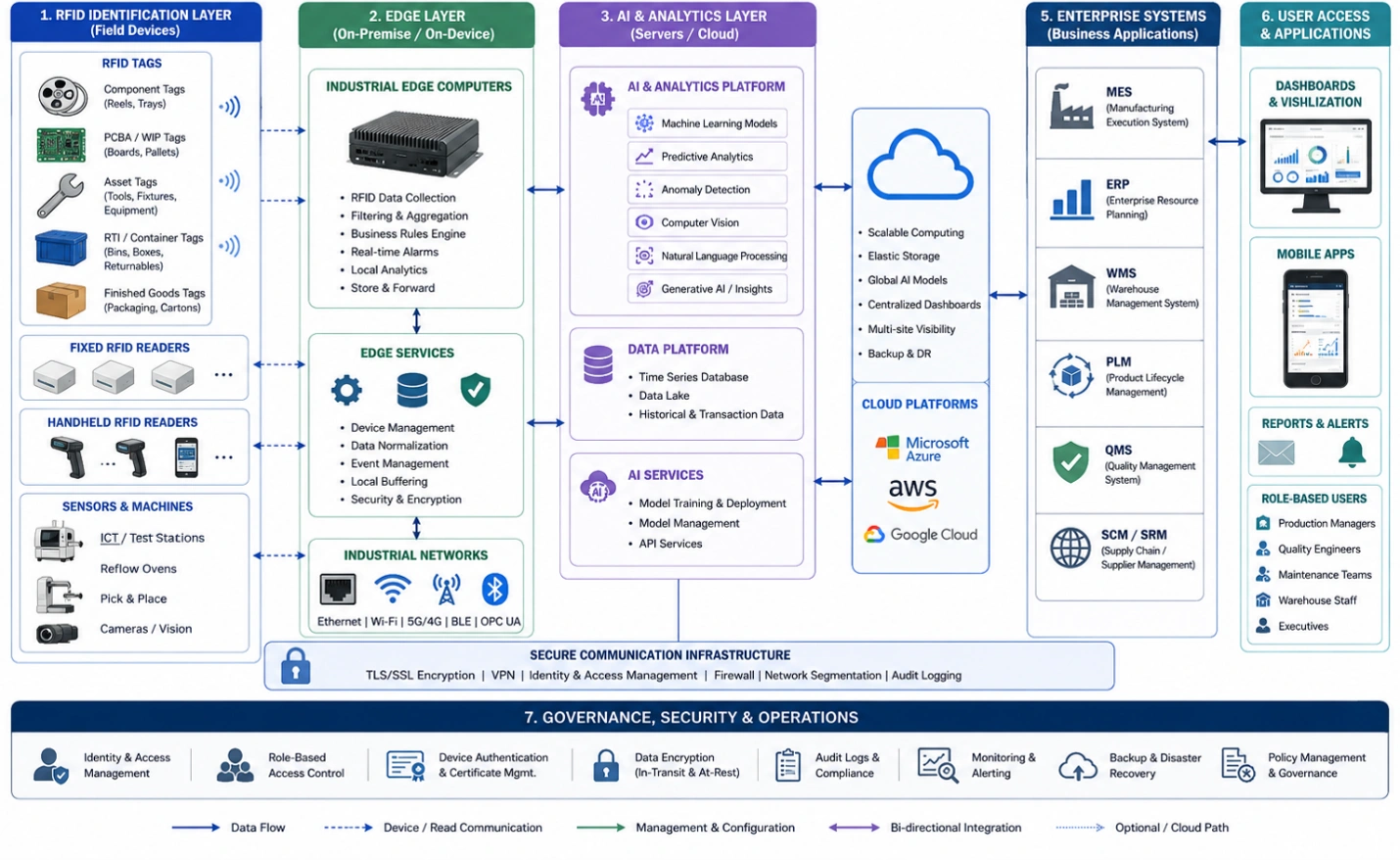
Collected RFID data is transmitted through secure industrial communication networks using technologies appropriate for the manufacturing environment, including Ethernet, Industrial Wi-Fi, TCP/IP, OPC UA, MQTT, and other supported industrial communication methods where applicable.
Secure communication mechanisms help protect production information while ensuring reliable transfer between RFID readers, edge devices, manufacturing software, and centralized information systems.
Stage 3: Edge Processing
Edge computers positioned within manufacturing facilities perform preliminary processing before forwarding selected operational data for additional analysis.
Typical edge functions include:
- RFID event filtering
- Duplicate read elimination
- Data validation
- Device health monitoring
- Local alert generation
- Temporary data storage
- Production rule enforcement
Edge processing reduces communication latency and enables rapid responses to production events that require immediate attention.
Stage 4: AI Analytics and Decision Support
Validated RFID data is analyzed using AI techniques including machine learning, anomaly detection, predictive analytics, and pattern recognition.
AI evaluates manufacturing performance by examining:
- Production throughput
- Cycle time variation
- Equipment utilization
- Inventory consumption
- Quality trends
- Workforce productivity
- Material flow efficiency
- Maintenance indicators
Based on these analyses, AI generates recommendations that assist production managers in improving operational performance.
Stage 5: Enterprise Software Integration
Operational intelligence generated from RFID and AI solutions can be exchanged with business systems commonly used in EMS organizations, including:
- Manufacturing Execution Systems (MES)
- Enterprise Resource Planning (ERP)
- Warehouse Management Systems (WMS)
- Product Lifecycle Management (PLM)
- Quality Management Systems (QMS)
- Supply Chain Management (SCM) software
Integration ensures that operational decisions are supported by accurate manufacturing information across engineering, production, logistics, procurement, and quality management functions.
GAO supports RFID hardware solutions that integrate with these manufacturing environments, helping organizations establish reliable identification systems that support long-term operational visibility and digital transformation initiatives.
RFID Technologies, AI Models, Deployment Methods, and Supporting Infrastructure for EMS Manufacturing
Successful AI-enabled RFID implementations in Electronics Manufacturing Services (EMS) require more than automatic identification. Reliable manufacturing intelligence depends on selecting appropriate RFID technologies, integrating AI models with manufacturing software, establishing secure communication methods, and deploying scalable computing resources that support continuous production without disrupting factory operations.
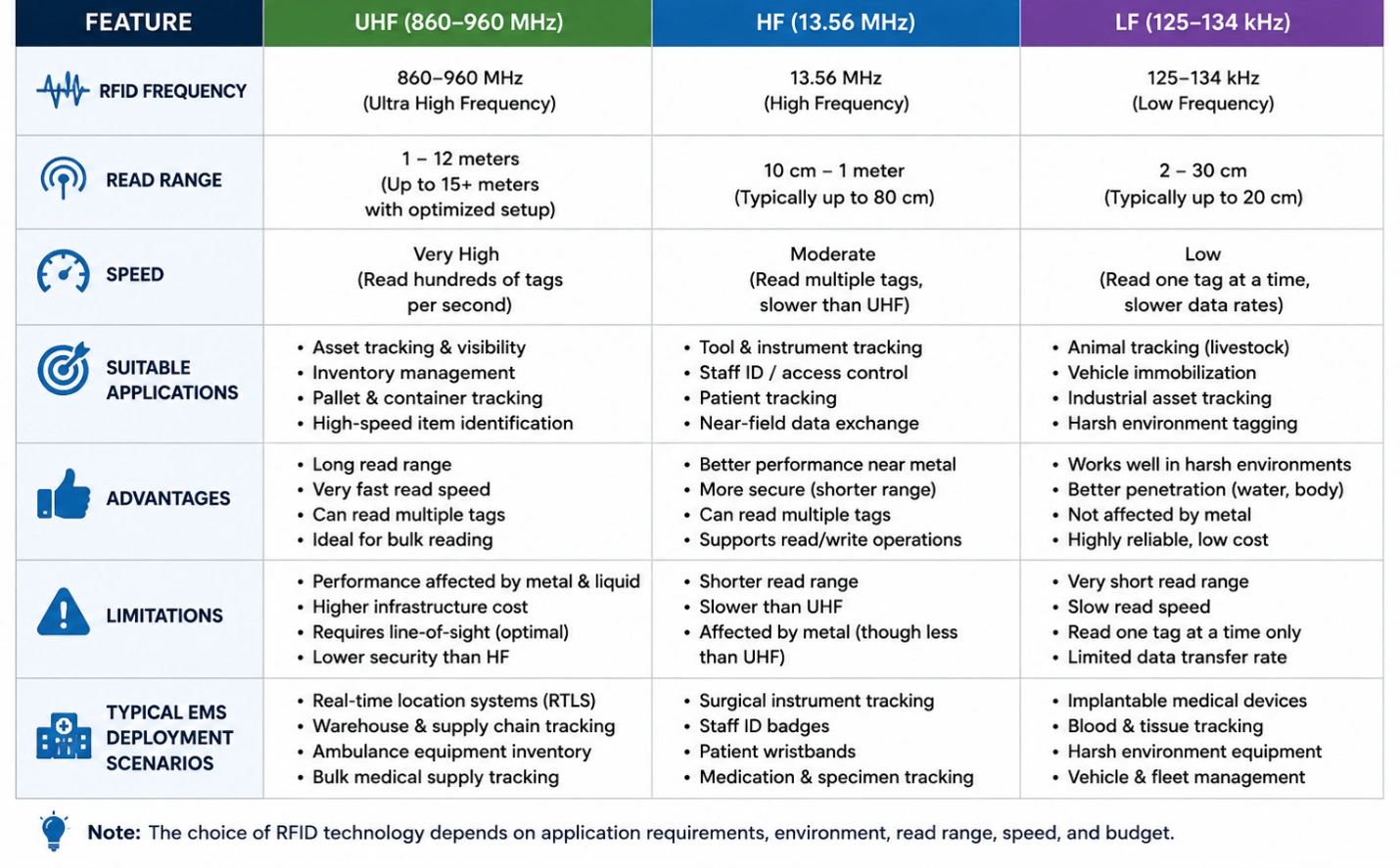
RFID Technologies for Electronics Manufacturing
Different RFID frequencies serve specific operational requirements throughout EMS facilities.
Ultra High Frequency (UHF) RFID
UHF RFID is commonly deployed for:
- Warehouse inventory management
- Returnable transport item tracking
- Finished goods identification
- Work-in-progress visibility
- Production pallet tracking
- Shipping verification
- Asset location management
Its long read range enables multiple tagged items to be identified simultaneously, making it well suited for high-volume manufacturing environments.
High Frequency (HF) RFID
HF RFID is frequently used for:
- Electronic work instructions
- Manufacturing authorization
- Tool identification
- Operator authentication
- Electronic device configuration
- Sensitive production processes
HF technology performs well where controlled read distances and higher data integrity are required.
Low Frequency (LF) RFID
LF RFID supports applications including:
- Tool calibration records
- Maintenance asset identification
- Equipment authentication
- Personnel access management
- Harsh industrial environments
Its resistance to interference makes LF RFID valuable in specialized manufacturing applications.
RFID Hardware Components
A complete EMS RFID solution generally includes:
- RFID tags attached to component reels, PCB carriers, production fixtures, pallets, containers, tools, and finished products.
- Fixed RFID readers installed at receiving docks, warehouse aisles, SMT lines, inspection stations, testing cells, packaging areas, and shipping doors.
- Handheld RFID readers for inventory audits, maintenance activities, and exception handling.
- RFID antennas selected according to production layouts and read-zone requirements.
- Industrial RFID controllers that coordinate data collection and device management.
- Edge computing devices that preprocess RFID events before forwarding information to enterprise software.
GAO supplies industrial RFID hardware designed for demanding manufacturing environments where continuous operation, high read accuracy, and long-term reliability are essential.
Artificial Intelligence Models Supporting EMS Operations
AI transforms RFID-generated operational data into manufacturing intelligence through several analytical techniques.
Machine Learning
Machine learning models continuously analyze production history to improve forecasting accuracy, optimize inventory levels, and identify production trends.
Predictive Analytics
Predictive models estimate:
- Component shortages
- Equipment failures
- Production delays
- Maintenance schedules
- Delivery performance
- Resource utilization
Anomaly Detection
AI identifies unusual manufacturing conditions such as:
- Unexpected inventory movement
- Unauthorized asset relocation
- Abnormal production cycle times
- Repeated equipment alarms
- Quality deviations
- Material consumption inconsistencies
Computer Vision Integration
When integrated with Automated Optical Inspection (AOI) systems and industrial cameras, AI correlates visual inspection results with RFID-based product identities, improving traceability and accelerating root-cause investigations.
Communication Protocols and Enterprise Connectivity
Reliable communication enables RFID devices, AI software, and manufacturing systems to exchange operational data efficiently.
Commonly supported communication technologies include:
- Ethernet
- Industrial Ethernet
- TCP/IP
- OPC UA
- MQTT
- REST APIs
- HTTPS
- Wi-Fi
- Bluetooth Low Energy (BLE) where appropriate
- Secure VPN connections for remote management
These communication methods allow RFID information to flow securely between production equipment, edge devices, servers, and cloud services while supporting interoperability across diverse manufacturing environments.
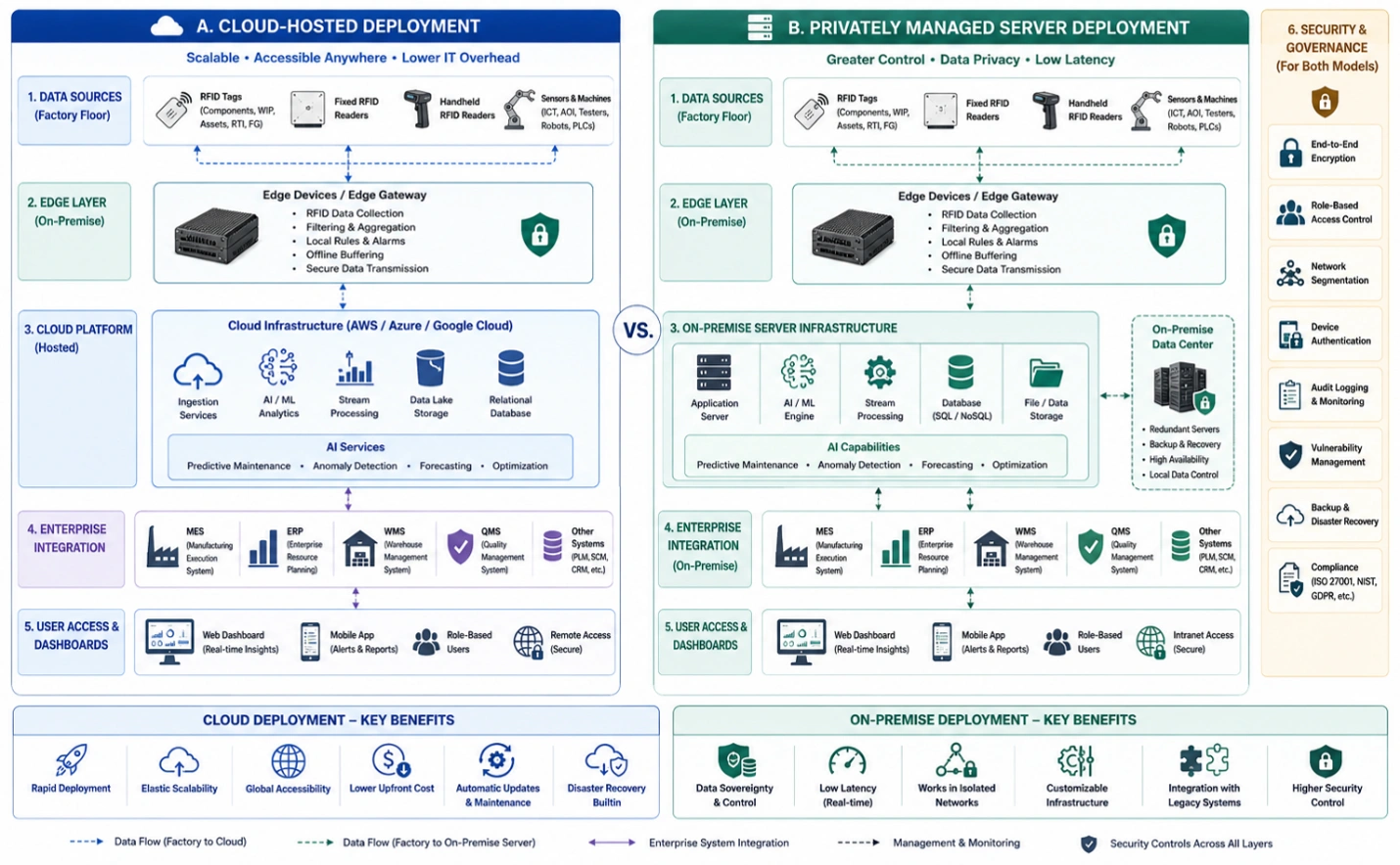
Cloud Version
Cloud-hosted deployments are appropriate for EMS organizations operating multiple manufacturing facilities or requiring centralized operational visibility.
Typical cloud capabilities include:
- Enterprise-wide production monitoring
- Multi-site inventory visibility
- Centralized AI model training
- Long-term production analytics
- Supplier performance reporting
- Remote dashboard access
- Disaster recovery support
- Scalable computing resources
Cloud deployments simplify collaboration across geographically distributed production facilities while reducing local infrastructure management requirements.
Server Version
Many EMS manufacturers prefer privately managed server deployments to maintain greater control over production information and support low-latency manufacturing operations.
Server-based deployments typically provide:
- Local Manufacturing Execution System integration
- Factory-controlled databases
- Low-latency RFID processing
- Internal cybersecurity controls
- Support for restricted production environments
- High availability within manufacturing facilities
- Integration with existing enterprise infrastructure
This approach is particularly suitable for manufacturers handling proprietary designs, defense electronics, medical devices, or customer programs requiring strict data governance.
Security Mechanisms
Protecting manufacturing information is essential throughout RFID and AI deployments.
Recommended security practices include:
- Role-based access control
- Multi-factor authentication
- Device authentication
- Encrypted communications
- Secure API management
- Audit logging
- Network segmentation
- Firmware integrity verification
- Regular software updates
- Continuous cybersecurity monitoring
Security controls should protect RFID devices, AI software, enterprise systems, and operational data without disrupting manufacturing performance.
Engineering Considerations for Successful Deployment
Organizations planning AI-enabled RFID projects should evaluate:
- Manufacturing process complexity
- Read-zone placement
- Tag selection for electronic components
- Electromagnetic interference
- Metal-rich production environments
- Production throughput requirements
- Existing MES and ERP integration
- Network bandwidth
- AI model training data quality
- Scalability for future production growth
Early testing within pilot production areas helps validate system performance before facility-wide implementation.
AI-Enabled RFID System Architecture for EMS (Electronics Manufacturing Services)
RFID Technology Comparison for Emergency Medical Services (EMS): UHF vs HF vs LF Applications
AI-Powered RFID Data Analytics for Smart Manufacturing: From Data Collection to Actionable Intelligence
Cloud vs. Server Deployment Models for AI-Enabled RFID in EMS Manufacturing
Key Technical Capabilities and Business Value of AI-Enabled RFID in EMS Manufacturing
AI-enabled RFID solutions provide Electronics Manufacturing Services (EMS) organizations with capabilities that extend beyond asset identification and inventory tracking. By combining continuous RFID data capture with artificial intelligence, manufacturers gain actionable operational intelligence that improves production efficiency, product quality, resource utilization, and supply chain performance.
Real-Time Manufacturing Visibility
RFID automatically captures the movement of electronic components, printed circuit board assemblies (PCBAs), production tools, fixtures, and finished products throughout the manufacturing process. AI continuously analyzes this operational data to provide production managers with real-time visibility into manufacturing status, workstation utilization, inventory availability, and order progress.
Benefits include:
- Continuous production monitoring
- Accurate work-in-progress tracking
- Faster production status reporting
- Improved operational transparency
- Better decision support for production supervisors
Intelligent Inventory Optimization
Inventory accuracy is essential for EMS providers managing thousands of stock-keeping units (SKUs), customer-owned materials, and just-in-time production schedules. AI evaluates RFID-generated inventory data alongside historical consumption trends and production forecasts to optimize stock levels while reducing excess inventory and material shortages.
Operational improvements include:
- Improved inventory accuracy
- Reduced carrying costs
- Lower risk of production interruptions
- Better warehouse utilization
- Enhanced material planning
Predictive Equipment Maintenance
Manufacturing equipment such as pick-and-place machines, reflow ovens, automated optical inspection (AOI) systems, and testing stations generate operational data that can be associated with RFID-tracked production activities. AI analyzes equipment usage patterns, maintenance history, and production performance to identify potential failures before they impact manufacturing operations.
Expected outcomes include:
- Reduced unplanned downtime
- Longer equipment service life
- Improved maintenance scheduling
- Higher production availability
- Lower maintenance costs
Enhanced Quality Control
RFID provides end-to-end traceability linking electronic components, production batches, operators, inspection records, testing results, and finished products. AI uses this information to detect recurring quality issues, identify process variations, and support root-cause analysis.
Quality improvements include:
- Earlier defect detection
- Improved process consistency
- Faster corrective action implementation
- Enhanced compliance documentation
- Better customer quality reporting
Supply Chain Intelligence
Modern EMS organizations depend on complex global supply chains involving component manufacturers, distributors, logistics providers, and customer production schedules. AI analyzes RFID-based supply chain data to improve procurement planning, supplier performance evaluation, and delivery forecasting.
Business value includes:
- Better supplier performance monitoring
- Improved delivery predictability
- Reduced supply chain disruptions
- Enhanced procurement planning
- Greater customer satisfaction
Improved Asset Utilization
Production tools, mobile equipment, testing fixtures, calibration devices, and returnable transport assets represent significant investments. RFID continuously tracks asset locations while AI evaluates utilization rates and movement patterns to improve asset allocation.
Benefits include:
- Reduced equipment search time
- Improved asset availability
- Higher utilization rates
- Lower replacement costs
- Better maintenance planning
Scalability and Future Readiness
AI-enabled RFID solutions are designed to scale alongside evolving EMS manufacturing operations. As production volumes increase, product portfolios expand, or additional manufacturing facilities are added, RFID infrastructure and AI software can be extended to support higher transaction volumes and more complex operational requirements.
Emerging technologies expected to further enhance AI-enabled RFID deployments include:
- Digital twins for production simulation
- Generative AI for manufacturing knowledge assistance
- Collaborative industrial robotics
- Autonomous mobile robots (AMRs)
- Advanced predictive maintenance models
- AI-assisted production scheduling
- Intelligent warehouse automation
- Industrial Internet of Things (IIoT) integration
Organizations implementing scalable RFID solutions today establish a strong foundation for future smart manufacturing initiatives.
Implementation Recommendations
Successful deployment of AI-enabled RFID solutions within EMS environments requires careful planning, engineering validation, and phased implementation. Organizations should begin by identifying operational objectives, evaluating existing manufacturing workflows, and selecting RFID technologies appropriate for their production environment.
Recommended implementation practices include:
- Define measurable business objectives before deployment.
- Conduct pilot implementations within selected production areas.
- Choose RFID tags suitable for electronic manufacturing environments.
- Position RFID readers to maximize read accuracy while minimizing interference.
- Integrate RFID data with existing MES, ERP, WMS, PLM, and QMS software where appropriate.
- Establish cybersecurity policies covering RFID devices, AI software, and enterprise networks.
- Train production personnel, maintenance teams, and system administrators.
- Continuously evaluate AI model performance using operational data.
- Expand deployment in phases after successful validation.
- Monitor key performance indicators to measure return on investment and operational improvements.
Organizations following structured deployment methodologies typically achieve faster implementation, lower project risk, and more sustainable operational benefits.
Advancing Intelligent EMS Manufacturing with AI and RFID
AI-powered RFID is transforming Electronics Manufacturing Services by combining automated identification with intelligent analytics that improve manufacturing visibility, production efficiency, quality assurance, and supply chain performance. RFID delivers reliable, real-time operational data while artificial intelligence converts that information into predictive insights that support faster and more informed decision-making.
For more than three decades, GAO has supplied RFID and industrial IoT technologies to organizations across North America, supporting Fortune 500 companies, research institutions, government agencies, and manufacturers with reliable hardware products, technical expertise, and engineering support. By implementing AI-enabled RFID solutions, EMS organizations can strengthen operational resilience, improve manufacturing performance, and prepare their facilities for the continued evolution of intelligent electronics manufacturing.
Building the Future of Industrial AI and IoT with Aperture Venture Studio and GAO RFID Inc.
For more than three decades, GAO Group of Companies has invested extensively in research and development of industrial RFID, BLE, and IoT technologies. As generative AI has demonstrated increasing value across manufacturing and industrial environments, we have expanded our development efforts to combine AI with RFID, BLE, and other IoT technologies while establishing Aperture Venture Studio to accelerate the advancement of innovative AI and industrial IoT solutions serving manufacturing and other technology-driven industries.
Aperture has attracted experienced AI researchers, IoT specialists, engineering leaders, operational executives, strategic investors, and industry partners who collaborate to advance practical industrial technologies. Through initiatives such as the Aperture Ventures Summit and TekSummit, technical professionals exchange knowledge on emerging AI and IoT developments, helping strengthen professional communities and encourage continued innovation.
We welcome opportunities to collaborate with organizations and professionals as:
- Advisors
- Employees
- Investors
- Customers
Together with GAO’s engineering expertise and long-standing commitment to RFID and industrial IoT innovation, these collaborations help organizations explore intelligent manufacturing solutions that improve operational performance, strengthen product traceability, and support the future of Electronics Manufacturing Services.