
AI and RFID for Passenger Vehicle Manufacturing
AI-Driven Production Visibility for Passenger Vehicle Manufacturing
AI and RFID for passenger vehicle manufacturing combines machine learning, computer vision, industrial IoT, and connected production systems with RFID-based identification and location data to improve how automotive plants manage parts, work-in-process (WIP), tools, equipment, and finished vehicles. The primary value is not RFID identification alone. RFID provides machine-readable production events, while AI converts those events into predictions, anomaly detection, quality insights, and operational decisions. Passenger vehicle manufacturers can use this combination across stamping, body-in-white, painting, powertrain and component assembly, final assembly, inspection, material handling, and finished-vehicle operations. AI-driven RFID systems can help identify missing components, detect process deviations, improve line-side inventory visibility, reduce search time for tools and materials, and strengthen vehicle build traceability. GAO supplies RFID readers, tags, antennas, printers, BLE devices, and tracking systems that can be integrated into manufacturing workflows requiring reliable identification and visibility.
RFID and AI Deployment in Passenger Vehicle Manufacturing
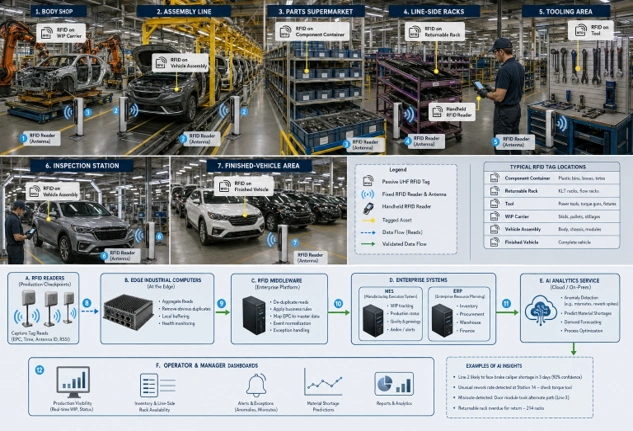
The completed visual should show how tagged automotive components, WIP carriers, tools, and production checkpoints generate RFID events that are processed at the edge and analyzed by AI for manufacturing decisions.
What AI and RFID Mean for Passenger Vehicle Manufacturing
Passenger vehicle production is a high-mix, tightly synchronized manufacturing environment in which thousands of components can pass through receiving, kitting, sequencing, subassembly, body shop, paint, final assembly, inspection, and shipping operations. A production interruption can originate from a missing part, incorrect sequencing, unavailable tooling, an unplanned equipment condition, a quality deviation, or inaccurate inventory information.
RFID provides an automated method for associating a physical object with a digital identity. Depending on the application, a tag may identify a component container, returnable packaging unit, tool, fixture, WIP carrier, vehicle body, or other production asset. Fixed readers can capture events at defined locations, while handheld readers support exception handling, inventory verification, cycle counts, and locating activities.
AI adds a decision layer to those events. Instead of simply recording that a rack passed a reader, an AI-enabled system can correlate the rack identity, timestamp, production order, workstation, material requirement, previous process event, and current inventory state. The resulting analysis can identify patterns such as abnormal dwell time, missing process events, material shortages, route deviations, or recurring bottlenecks.
This distinction is important for passenger vehicle manufacturing. RFID is primarily an identification and event-capture mechanism. AI is responsible for interpreting data, recognizing patterns, forecasting conditions, prioritizing exceptions, and supporting decisions. Together, they form an AIoT approach in which connected physical objects and manufacturing equipment provide operational data for intelligent manufacturing processes.
Where AI Creates Value Across the Vehicle Production Flow
- Inbound material control: AI can analyze RFID receiving events against expected deliveries, production schedules, and material requirements to identify shortages or discrepancies before they affect line-side operations.
- Line-side inventory management: RFID events can establish the location and movement of racks, totes, containers, and components. AI can estimate consumption patterns and identify conditions that may lead to stockouts.
- Sequenced parts delivery: AI can compare RFID movement events with the vehicle build sequence and identify parts or kits that are likely to arrive late or out of sequence.
- Work-in-process tracking: RFID can provide checkpoints for body assemblies, carriers, subassemblies, and production containers. AI can detect abnormal dwell times and route deviations.
- Tool and fixture management: Tagged torque tools, welding fixtures, jigs, dies, and other production equipment can be associated with workstations and maintenance records. AI can help identify unusual utilization or repeated movement patterns.
- Quality traceability: RFID events can connect materials, components, process stations, and production timestamps to a vehicle or production order, creating a stronger foundation for root-cause analysis and recall investigation.
- Finished-vehicle movement: RFID can support yard and staging visibility, while AI can analyze dwell time, location events, and shipment schedules to identify congestion and dispatch risks.
Passenger Vehicle Manufacturing Workflows That Benefit from AI and RFID
A useful implementation begins with the physical production process rather than with the RFID hardware. The engineering team first identifies where a reliable digital event can change a manufacturing decision.
Receiving, Storage, and Material Kitting
Inbound components such as engines, transmissions, seats, instrument panels, wheels, electronic modules, fasteners, body components, and supplier packaging can be associated with RFID identities. Reader events at receiving docks and storage or supermarket locations establish movement history.
AI can compare these events with purchase orders, inventory records, production schedules, and material requirements. A practical implementation should distinguish between an actual inventory shortage and a temporary RFID read gap. AI should therefore receive confidence indicators and exception states from the RFID event-processing layer rather than treating every missing read as proof that an item is absent.
Body Shop and WIP Traceability
Body-in-white operations may include robotic welding, joining, fastening, inspection, material handling, and transfer between stations. WIP carriers and selected assemblies can carry RFID identities that associate physical production units with process events.
AI can evaluate expected process sequences and timestamps. If a carrier appears at a downstream checkpoint without the expected upstream event, the system can flag a possible routing or data-quality exception. If dwell time at a workstation repeatedly exceeds the normal range, production engineering teams can investigate the underlying constraint.
Paint Shop and Controlled Process Areas
Paint operations introduce challenging RF conditions, metal structures, enclosed areas, process equipment, and environmental constraints. RFID deployment therefore requires site surveys, antenna positioning, tag selection, reader power configuration, and testing under actual production conditions.
AI can use RFID events together with production schedules and process timestamps to identify abnormal dwell periods, missed transitions, or accumulated WIP. The objective is not to make an AI model responsible for process safety controls. Safety-critical interlocks and validated control systems should remain under appropriate industrial control mechanisms.
Final Assembly and Vehicle Build Verification
Final assembly is particularly suitable for event-based traceability because the production sequence is closely tied to the vehicle build configuration. RFID can identify components, containers, tools, and WIP carriers as they move between stations.
AI can correlate RFID events with manufacturing execution system (MES) records, bill-of-material information, work instructions, and quality results. This enables exception-oriented workflows such as identifying a vehicle or production order that lacks an expected component event, has an unusual process sequence, or requires manual verification.
Inspection, Rework, and Finished-Vehicle Logistics
Inspection stations generate valuable data for quality management. RFID events can associate a vehicle, carrier, inspection station, tooling set, or component with a specific production timestamp. Rework movements can then be correlated with earlier process events.
AI can help identify recurring relationships between rework, production stations, material lots, tools, and process conditions. Finished vehicles can also be tracked through staging and yard areas, providing additional data for shipment planning and congestion analysis.
AI and RFID Workflow for Passenger Vehicle Production
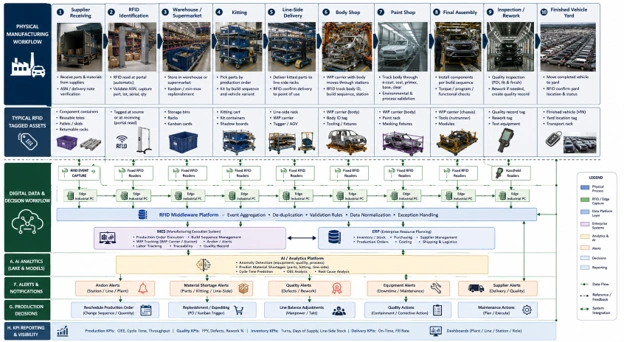
The completed workflow should connect physical vehicle production stages with RFID event capture, AI analysis, manufacturing software, and operational decisions.
AI Use Cases Built on RFID Production Data
AI should be applied to specific manufacturing decisions rather than added simply because RFID data is available. The strongest use cases generally combine event history with production context from MES, ERP, warehouse management, quality, maintenance, and scheduling systems.
| Passenger Vehicle Manufacturing Need | RFID Data Contribution | AI Method | Operational Decision |
|---|---|---|---|
| Line-side material shortages | Rack, container, and component movement events | Demand forecasting and anomaly detection | Replenish material before a production interruption |
| WIP bottlenecks | Station entry, exit, and dwell events | Time-series analysis and anomaly detection | Investigate constrained stations |
| Build-sequence deviations | Vehicle, carrier, and component events | Sequence analysis | Verify missing or incorrectly sequenced material |
| Tool utilization | Tool identity and workstation events | Pattern analysis | Review utilization and maintenance requirements |
| Traceability gaps | Process checkpoint events | Data-quality anomaly detection | Trigger verification before vehicle release |
| Yard congestion | Vehicle movement and staging events | Predictive analytics | Improve dispatch and staging priorities |
| Inventory discrepancies | Receiving, storage, and issue events | Reconciliation and anomaly detection | Investigate physical-versus-system differences |
AI-Driven Inventory and Material Flow
AI-based material intelligence can combine RFID movement history with production schedules, historical consumption, supplier lead times, and current inventory. The objective is to move from static inventory visibility toward predictive material management.
For example, if RFID events show that a specific component rack is being consumed faster than normal while the next replenishment is still in transit, an AI model can raise an early exception. The manufacturing team can then prioritize replenishment before the component becomes a line-stop risk.
AI-Based WIP and Bottleneck Detection
WIP tracking becomes more valuable when the system understands expected process timing. RFID checkpoints provide timestamps that can be used to calculate station dwell time, transfer time, queue duration, and route adherence.
A model can establish normal ranges by production line, vehicle program, shift, or process type. Deviations can then be surfaced for production engineers rather than requiring supervisors to manually reconstruct movement histories.
AI-Assisted Quality Traceability
Passenger vehicle quality investigations often require correlation across multiple systems. RFID can contribute physical event history, while MES, quality management systems, supplier records, and production databases provide additional context.
AI can help identify relationships among a vehicle build, component batch, workstation, tool, operator event, process timestamp, and inspection result. Such analysis can accelerate root-cause investigation, but the final disposition of a safety or quality issue should remain subject to established engineering and quality procedures.
Engineering Considerations Before RFID Deployment
Passenger vehicle manufacturing plants contain large quantities of metal, machinery, conveyors, electrical equipment, moving vehicles, and dense production infrastructure. These conditions can significantly affect RFID performance. A technically sound deployment therefore requires more than selecting a reader and attaching tags.
GAO’s RFID services include site surveys intended to determine suitable reader and antenna locations and appropriate tag placement. Such surveys are especially important when RFID checkpoints must operate reliably around automotive production equipment and metal-intensive environments.
Tag and Reader Selection
- Use UHF RFID where longer-range identification and portal-style reading are appropriate, subject to the regional frequency allocation and site conditions.
- Evaluate on-metal RFID tags for metallic racks, tooling, fixtures, and equipment where conventional labels may perform poorly.
- Use ruggedized or application-specific tags when exposure to vibration, temperature, chemicals, paint processes, washing, or repeated handling could affect tag performance.
- Select fixed readers and antennas based on the required read zone rather than simply maximizing read range.
- Retain handheld RFID readers for cycle counts, exception resolution, commissioning, and maintenance activities.
GAO provides UHF RFID readers, tags, antennas, printers, and related systems for manufacturing applications, including passenger vehicle manufacturing. Its published automotive applications include tracking parts, equipment, tools, WIP, and production assets.
Read-Zone Engineering and Data Quality
A high-performing RFID deployment should deliberately control where reads are expected. Excessive read range can create false positives when a nearby tagged object is detected outside the intended process point.
Engineering validation should therefore measure:
- Read accuracy for tagged assets under normal production conditions
- Missed-read frequency
- Unwanted reads from adjacent lanes or workstations
- Tag orientation effects
- Metal and liquid interference
- Reader and antenna placement
- Conveyor or vehicle speed
- Environmental effects
- Duplicate event filtering
- Network interruptions and offline buffering
AI models should not compensate for fundamentally poor RFID data. If the event layer produces unreliable identities or timestamps, predictive models can amplify rather than solve the underlying problem.
From RFID Events to AI Decisions
The complete technical flow typically begins with a tagged physical object and ends with an operational action.
Physical asset → RFID tag → reader and antenna → edge processing → RFID middleware → validated event → MES/ERP/WMS/QMS data → AI analytics → exception or prediction → production decision
The edge layer can perform initial filtering, duplicate suppression, buffering, protocol handling, and event normalization before information reaches centralized software. This reduces unnecessary upstream traffic and provides resilience when network connectivity is interrupted.
Middleware should transform raw reader observations into meaningful manufacturing events such as:
- Rack arrived at line-side supermarket
- WIP carrier entered body shop
- Tool entered workstation zone
- Component container issued to production
- Vehicle entered inspection
- Finished vehicle entered staging area
The AI layer can then use these events alongside production schedules, inventory records, quality information, maintenance data, and other approved sources.
This separation is an important engineering principle: RFID captures physical identity and movement; middleware establishes trustworthy events; AI interprets those events in manufacturing context; MES, ERP, WMS, QMS, or human operators execute the resulting business action.
AI and RFID Data Flow for Automotive Manufacturing
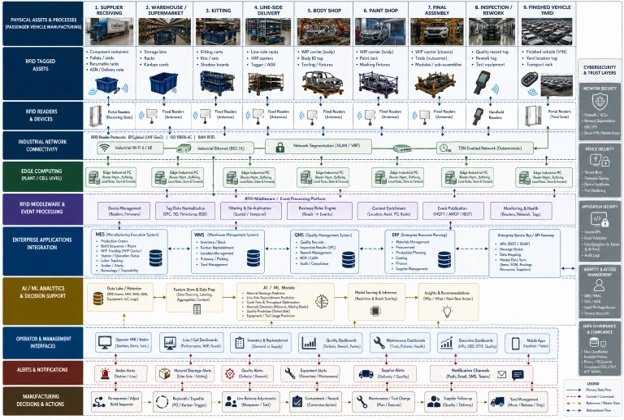
The completed diagram should illustrate how physical production events are captured, validated, integrated with manufacturing software, analyzed by AI, and converted into operational decisions.
Cloud and Server Deployment for Passenger Vehicle Manufacturing
GAO’s automotive RFID solutions can be implemented with software running on a local server or with software running in the cloud.
A cloud deployment is appropriate when a manufacturer needs centralized access across plants, remote analytics, centralized software administration, or consolidated reporting. RFID events can be transmitted through secured network connections to cloud-hosted services, where AI analytics and multi-site reporting can operate across authorized facilities.
A server deployment can be preferable where manufacturing data must remain within privately managed infrastructure, where factory systems require local processing, or where operational resilience and low-latency plant-floor processing are priorities. The server may reside on an industrial edge computer, factory server, private data center, or other customer-managed infrastructure.
A hybrid design can place RFID event processing and critical operational functions close to the production line while sending selected datasets to centralized AI services. This approach can reduce latency, limit unnecessary data transfer, and allow production operations to continue during temporary wide-area network disruptions.
Deployment decisions should consider network reliability, cybersecurity requirements, data residency, integration with MES and ERP systems, AI compute requirements, latency, disaster recovery, software maintenance, and the consequences of losing connectivity during production.
Technical Capabilities and Operational Improvements
Combining AI with RFID-generated manufacturing events can improve passenger vehicle production when the solution is designed around measurable operational decisions. The value comes from connecting physical production activity with manufacturing software and analytical models.
Predictive Material Management
RFID provides current movement information for racks, containers, kits, and production materials. AI can combine these events with consumption history, production schedules, supplier lead times, and inventory records to forecast replenishment requirements.
This can help material control teams prioritize deliveries according to production risk rather than relying only on fixed replenishment intervals. A useful implementation should also distinguish between genuine consumption and an RFID read anomaly so that incorrect data does not trigger unnecessary material movements.
Production Anomaly Detection
AI can establish normal patterns for WIP movement, station dwell time, material consumption, and production sequence. When new RFID events deviate substantially from those patterns, the system can generate an exception for investigation.
Examples include:
- A WIP carrier remaining at a station substantially longer than its normal process interval
- A production container appearing at an unexpected workstation
- A required material not appearing at a designated line-side location
- An unusually high number of repeated RFID reads at one checkpoint
- A vehicle or assembly missing an expected process event
- Finished vehicles accumulating in a staging area beyond normal dwell time
The AI model should support human decision-making rather than automatically overriding validated production controls.
Digital Traceability
Vehicle traceability becomes stronger when RFID events are associated with production orders, component identities, material lots, process stations, inspection records, and timestamps.
This creates a chronological evidence trail that can support quality investigations and manufacturing engineering. The objective is not simply to collect more data. It is to establish trustworthy relationships between a physical vehicle or component and the processes through which it passed.
Scalable Multi-Line Visibility
Once RFID event structures and integration interfaces are standardized, manufacturers can extend the solution from one production line to additional lines, plants, or vehicle programs.
Standardized event definitions are important for scalability. A “component consumed” event should have a consistent meaning regardless of whether it originates from a body shop, final assembly line, or another facility. This allows centralized analytics to compare operational performance without forcing every plant to use identical physical equipment.
Cloud and Server Deployment Options for Automotive RFID Systems
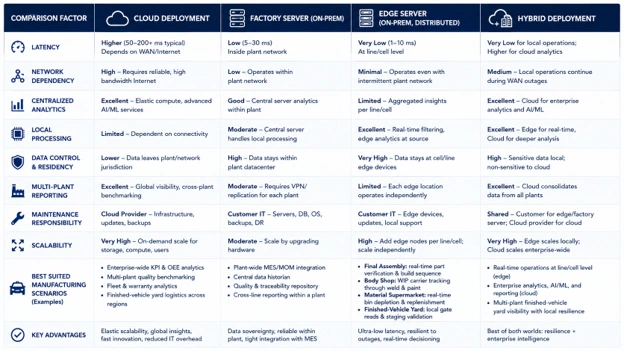
The completed comparison should show how different deployment models support passenger vehicle manufacturing requirements such as low latency, centralized analytics, local processing, and multi-plant visibility.
Integration with Manufacturing Software
AI-driven RFID should not operate as an isolated tracking application. Its greatest value comes from integrating physical event data with the software already responsible for manufacturing execution and business planning.
Relevant systems may include:
- Manufacturing Execution Systems (MES)
- Enterprise Resource Planning (ERP)
- Warehouse Management Systems (WMS)
- Quality Management Systems (QMS)
- Manufacturing Operations Management (MOM) software
- Computerized Maintenance Management Systems (CMMS)
- Supplier management systems
- Production scheduling software
- Transportation and yard management software
- Industrial databases and data historians
Integration can use REST APIs, message queues, database interfaces, OPC UA where appropriate for industrial interoperability, MQTT for selected IoT messaging applications, or other customer-approved interfaces.
The integration design should define ownership of each data element. For example, RFID middleware may own the interpretation of reader observations, while MES remains the authoritative system for production order status. Avoiding duplicate ownership reduces inconsistent records and makes troubleshooting easier.
AI Model Selection
The appropriate AI method depends on the manufacturing question.
- Time-series forecasting can estimate material consumption or expected production flow.
- Anomaly detection can identify unusual movement, dwell time, or consumption patterns.
- Classification models can categorize operational exceptions according to predefined risk conditions.
- Clustering can identify recurring production patterns without requiring every condition to be manually labeled.
- Computer vision can complement RFID where visual inspection or object recognition is required.
- Predictive models can estimate the likelihood of material shortages, process delays, or operational congestion.
- Generative AI can help summarize production exceptions, search technical records, or assist engineers in interpreting complex operational information when implemented with appropriate data controls.
AI should be selected according to the quality and volume of available data. A simple statistical threshold can be more reliable than a complex model when the underlying RFID event history is limited.
Cybersecurity and Data Protection
Passenger vehicle manufacturing connects operational technology with IT systems, making cybersecurity an important part of RFID and AI deployment.
RFID tags themselves generally contain limited information, but the associated databases may contain sensitive production, supplier, quality, tooling, or vehicle information. Protection should therefore focus on the complete data path.
Recommended controls include:
- Device authentication and controlled reader access
- Role-based access to manufacturing applications
- Network segmentation between production systems and broader corporate networks
- Encryption for sensitive data in transit and at rest
- Secure API authentication
- Credential management and regular credential rotation
- Firmware and software patch management
- Logging of administrative and system events
- Monitoring for unusual device or network behavior
- Backup and disaster-recovery procedures
- Controlled remote maintenance access
- Data minimization for information transmitted outside the factory
Security controls should be coordinated with the plant’s existing OT cybersecurity program rather than introduced as an independent IT project. Where applicable, manufacturers should align security practices with recognized industrial cybersecurity frameworks and organizational requirements.
Performance Metrics for AI-Driven RFID Manufacturing
Measurement should begin before deployment so that the manufacturer can establish a baseline and determine whether the solution produces operational improvement.
Relevant KPIs include:
- RFID read accuracy
- Missed-read rate
- False-read rate
- Asset location accuracy
- Inventory record accuracy
- Line-side stockout frequency
- Material replenishment response time
- WIP dwell time
- Production cycle time
- Queue time between operations
- Production schedule adherence
- Build-sequence exception rate
- Traceability completeness
- Time required to locate production assets
- Tool utilization
- Finished-vehicle staging dwell time
- Rework identification time
- Quality investigation time
- RFID system availability
- Event-processing latency
The correct KPI depends on the use case. A material replenishment project should not be judged primarily by the number of RFID reads generated. It should be assessed by whether the system improves material availability, reduces emergency replenishment, and supports production continuity.
AI and RFID Manufacturing KPI Dashboard
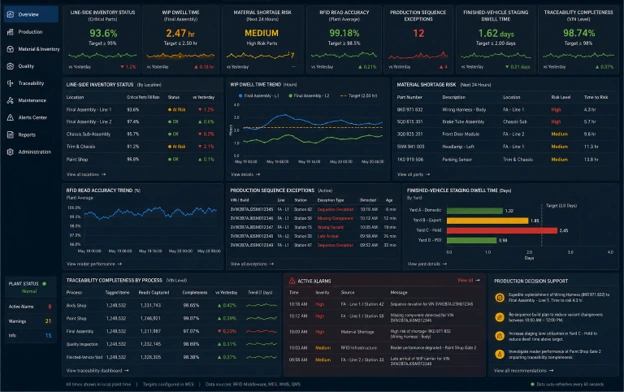
The completed dashboard should show how RFID event data and AI analytics can help passenger vehicle manufacturing teams monitor material flow, WIP, traceability, and production exceptions.
Implementing AI and RFID in Passenger Vehicle Manufacturing
A successful deployment should proceed from a defined manufacturing problem to a validated production workflow rather than beginning with hardware procurement.
Planning and Site Assessment
The first step is to identify the operational decision that requires better information. Candidate processes should have measurable problems such as inventory inaccuracies, excessive asset-search time, WIP visibility gaps, traceability limitations, or recurring material shortages.
A site assessment should then examine:
- Production-line layout
- Material movement paths
- Tagging locations
- Reader and antenna mounting points
- Metal and RF-interference conditions
- Network connectivity
- Existing MES, ERP, WMS, and QMS interfaces
- Environmental conditions
- Operator workflows
- Required read zones
- Cybersecurity requirements
Pilot Deployment and Commissioning
A pilot should normally focus on a constrained process with a clearly measurable outcome. For example, a manufacturer could begin with tracking returnable component racks between a material supermarket and final assembly.
Commissioning should verify actual production performance rather than relying solely on laboratory tests. Tags should be tested at realistic orientations and distances, with normal production traffic, metal structures, operators, forklifts, conveyors, and other potential sources of interference present.
The team should validate both the RFID layer and the AI data pipeline. A technically successful reader installation can still produce a poor business outcome if events are not correctly mapped to production orders or if the AI model receives incomplete data.
Integration and Testing
Integration testing should cover normal transactions, duplicate reads, missed reads, network interruptions, reader failures, incorrect tag associations, delayed events, and recovery after system outages.
Production users should also test exception workflows. If an AI alert identifies a missing component, the responsible operator or material-control team should know exactly what action is expected.
Optimization and Maintenance
After commissioning, production data should be reviewed continuously. Antenna positions may require adjustment, tags may need repositioning, and event-filtering rules may need refinement as production conditions change.
AI models also require monitoring. Changes in vehicle programs, production schedules, supplier behavior, material packaging, or plant layouts can change the patterns on which a model was trained.
A mature deployment therefore treats AI and RFID as an operational system requiring maintenance, validation, cybersecurity management, and periodic performance review.
AI and RFID Implementation Lifecycle for Vehicle Manufacturing
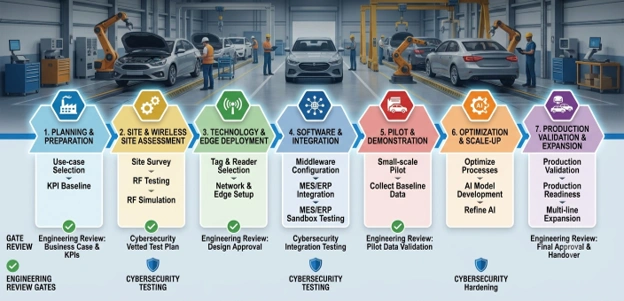
The completed timeline should illustrate the engineering stages required to move from an automotive manufacturing use case to a validated and scalable AI-driven RFID deployment.
Practical Engineering Recommendations
Passenger vehicle manufacturers considering AI-driven RFID should prioritize data quality, process fit, and integration before model complexity.
- Begin with a production problem that has a measurable operational KPI.
- Select tagging points where identification events directly support a manufacturing decision.
- Conduct an RF site survey before finalizing reader and antenna placement.
- Test tags under actual automotive manufacturing conditions rather than relying only on laboratory specifications.
- Separate raw RFID observations from validated manufacturing events.
- Integrate RFID events with authoritative MES, ERP, WMS, and quality records.
- Use edge processing where low latency, network resilience, or local data handling is important.
- Select cloud deployment where centralized analytics and multi-site reporting provide clear value.
- Use privately managed servers where local processing, data control, or plant-level resilience is a priority.
- Treat AI output as decision support unless the application has been formally validated for automated control.
- Establish cybersecurity requirements before connecting production readers to wider networks.
- Define baseline KPIs before deployment and measure improvement after commissioning.
- Monitor AI model performance as production programs, suppliers, layouts, and operating conditions change.
- Design the event model so additional production lines can be added without redesigning the entire software interface.
GAO has supplied RFID, BLE, and IoT hardware products and systems to organizations in the United States and Canada, including Fortune 500 companies, leading R&D organizations, universities, and government agencies. GAO’s engineering support includes remote and onsite assistance, while its product development activities are supported by extensive R&D and quality assurance processes.
Headquartered in New York City and Toronto, Canada, GAO is recognized among the leading global B2B and B2G suppliers of BLE and RFID technologies. GAO’s work across RFID, BLE, IoT tracking, and industrial sensing provides a practical foundation for manufacturing organizations evaluating connected production systems.
Choosing AI and RFID Use Cases for Vehicle Manufacturing
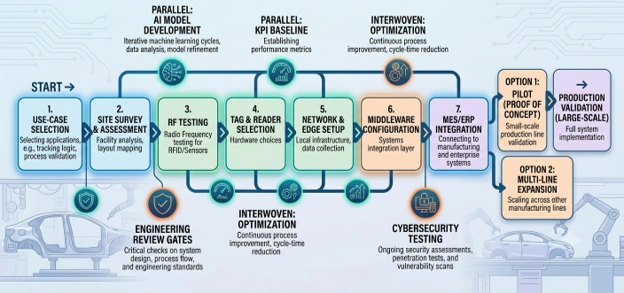
The completed decision tree should help manufacturing teams match production problems with appropriate identification, sensing, AI, and deployment approaches.
Conclusion: Turning Production Events into Manufacturing Intelligence
AI-driven RFID can give passenger vehicle manufacturers a stronger connection between physical production activity and digital manufacturing decisions. RFID identifies and records the movement of components, containers, tools, WIP carriers, vehicles, and other assets, while AI can transform those events into forecasts, anomaly alerts, traceability insights, and operational recommendations.
The strongest implementations begin with a measurable manufacturing problem, establish reliable event capture, integrate with existing production software, and then introduce AI where sufficient data exists to support a useful decision. GAO can support organizations evaluating RFID, BLE, IoT, and related hardware and systems for manufacturing applications through product expertise, engineering support, and deployment assistance.
Building the Future of Industrial AI and IoT with Aperture Venture Studio and GAO RFID Inc.
For passenger vehicle manufacturing and other industrial applications, we have founded Aperture Venture Studio to help advance practical AI and IoT technologies relevant to connected production, RFID, BLE, and intelligent manufacturing. For more than three decades, GAO Group of Companies has invested heavily in R&D of industrial RFID, BLE, and IoT. As generative AI became increasingly useful in industrial applications, we expanded our work across AI and IoT technologies and established Aperture Venture Studio to build, launch, and scale next-generation AI and IoT companies for various industries.
Aperture has attracted AI and IoT technical experts, entrepreneurial and operational executives, influential investors, and leading companies. We have also developed the Aperture Ventures Summit and TekSummit to discuss advanced AI and IoT topics.
These efforts have helped build diverse technical communities around industrial AI and IoT. We welcome you to join us as:
- Advisors, Co-founders or Employees
- Investors
- Customers