
AI-Powered RFID Solutions for Intelligent Lithium Mining Operations
Transforming Lithium Mining with AI-Powered RFID Intelligence
Artificial intelligence is reshaping lithium mining by enabling data-driven extraction, processing, equipment management, and workforce safety across both hard-rock spodumene mines and lithium brine operations. RFID serves as a trusted identification technology within Industrial AI and IoT solutions by continuously identifying critical mining assets, mobile equipment, personnel, laboratory samples, maintenance components, and material movements throughout the lithium production lifecycle.
Lithium mining presents unique operational challenges, including remote extraction sites, corrosive brine environments, abrasive dust, fluctuating ore grades, long equipment operating cycles, strict battery-material quality requirements, and growing sustainability expectations.
GAO has helped organizations deploy RFID, BLE, and Industrial IoT hardware and systems that improve operational visibility, asset identification, and data quality across demanding industrial environments throughout North America.
AI-Powered RFID Deployment Across Hard-Rock and Lithium Brine Mining Operations
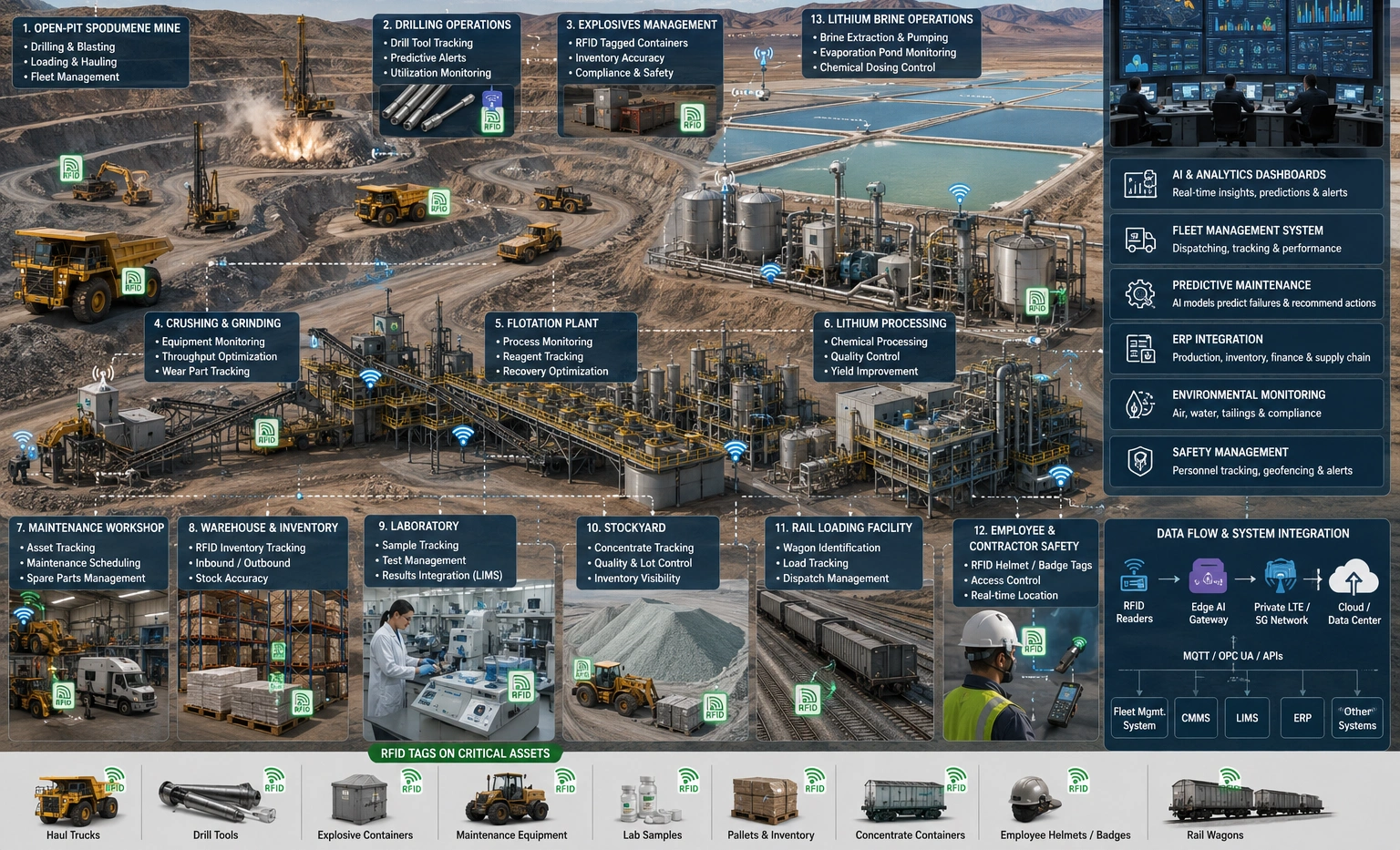
This illustration presents a comprehensive AI-enabled RFID solution spanning both hard-rock spodumene mining and lithium brine extraction, integrating extraction, mineral processing, laboratory operations, warehousing, rail logistics, and centralized mine control. It demonstrates how RFID, Industrial IoT sensors, Edge AI, enterprise software, and predictive analytics work together to improve asset visibility, lithium recovery, maintenance planning, workforce safety, environmental monitoring, and end-to-end supply chain traceability.
Understanding AI-Driven RFID Solutions for Lithium Mining
Lithium mining has become one of the most strategically important sectors supporting electric vehicles, battery manufacturing, renewable energy storage, and advanced electronics. Modern operations generate extensive operational data from drilling activities, ore characterization, mineral processing, evaporation ponds, reagent management, equipment maintenance, laboratory analysis, environmental monitoring, and logistics. Transforming this information into actionable operational intelligence requires AI-enabled Industrial IoT solutions capable of processing both real-time and historical operational data.
Within these intelligent mining environments, RFID provides the reliable identification layer that links physical assets, equipment, materials, and personnel to digital operational records. Rather than functioning solely as an identification technology, RFID becomes an essential source of structured operational data that AI models use to detect patterns, predict operational issues, and optimize mining workflows.
Depending on operational requirements, lithium mining organizations commonly deploy multiple RFID technologies:
- UHF RFID for long-range identification of haul trucks, mobile equipment, rail wagons, pallets, bulk containers, warehouse inventory, and outdoor logistics assets.
- HF RFID for laboratory sample tracking, maintenance records, calibration management, chemical inventory, access control, and document verification.
- LF RFID for metallic mining equipment, drilling tools, hydraulic components, and harsh environments where reliable performance near metal surfaces is critical.
AI combines RFID events with data generated by fleet management systems, geological models, drilling automation, lithium grade analysis, conveyor monitoring, condition monitoring sensors, weather stations, evaporation pond measurements, vibration monitoring, and energy consumption systems. These integrated datasets support predictive maintenance, production optimization, ore blending strategies, lithium recovery forecasting, environmental compliance, and intelligent resource planning.
Unlike conventional RFID implementations focused primarily on tracking assets, AI-enabled lithium mining solutions continuously learn operational behavior, helping engineers and operations teams make proactive decisions that improve productivity, reduce downtime, and enhance long-term operational resilience.
Geological Exploration and Resource Evaluation
Exploration teams manage thousands of geological samples and field assets during resource evaluation.
RFID supports identification of:
- Core sample trays
- Drill cores
- Geological specimens
- Exploration equipment
- Survey instruments
- Laboratory samples
- Field testing devices
AI correlates exploration data with geological block models, mineralogical analysis, and historical drilling information to improve reserve estimation and exploration planning.
Drilling and Blasting Operations
Efficient drilling directly influences ore fragmentation and downstream processing efficiency.
RFID identifies:
- Drill rods
- Drill bits
- Explosive containers
- Detonators
- Blast hole markers
- Mobile drilling equipment
AI evaluates drilling performance, equipment utilization, blast design accuracy, and fragmentation outcomes to improve mine planning while reducing operational delays.
Loading, Haulage, and Material Transport
Lithium ore moves continuously between extraction areas and processing facilities.
RFID enables identification of:
- Hydraulic excavators
- Wheel loaders
- Haul trucks
- Water trucks
- Fuel vehicles
- Ore containers
- Mobile service vehicles
AI optimizes:
- Haul route selection
- Payload balancing
- Fleet dispatch
- Equipment utilization
- Fuel efficiency
- Queue management
- Cycle time reduction
These improvements increase equipment productivity while lowering transportation costs.
Lithium Processing and Beneficiation
Mineral processing facilities require accurate coordination between crushing, grinding, flotation, dense media separation, reagent handling, and concentrate production.
RFID tracks:
- Processing equipment
- Wear components
- Reagent containers
- Pumps
- Valves
- Conveyor components
- Maintenance assets
AI predicts equipment degradation, optimizes flotation performance, improves reagent consumption, forecasts lithium recovery, and recommends preventive maintenance schedules.
Expanding AI Applications Across Lithium Mining Operations
Lithium Brine Extraction and Evaporation Pond Management
Lithium brine operations differ significantly from hard-rock mining because production depends on pumping lithium-rich brine from underground aquifers into large evaporation ponds before chemical processing. These facilities operate continuously over extended production cycles where evaporation rates, brine chemistry, weather conditions, and pond sequencing directly influence lithium recovery and production schedules.
RFID supports identification of:
- Brine transfer pumps
- Pipeline sections
- Flow control valves
- Chemical dosing equipment
- Pond monitoring stations
- Mobile maintenance equipment
- Laboratory sample containers
- Water treatment assets
AI combines RFID-generated asset identification with data from:
- Brine concentration sensors
- Flow meters
- Weather stations
- Solar radiation measurements
- Evaporation rate calculations
- Conductivity sensors
- pH monitoring
- Temperature sensors
- Water level sensors
These combined datasets enable AI to optimize evaporation sequences, predict pump failures, improve lithium concentration forecasting, reduce water consumption, and recommend maintenance schedules that minimize production interruptions.
Stockpile, Concentrate Storage, and Warehouse Management
Lithium concentrate must be stored, blended, and transported while maintaining strict product traceability required by battery manufacturers.
RFID identifies:
- Concentrate containers
- Bulk bags
- Pallets
- Storage silos
- Warehouse inventory
- Export shipments
- Packaging materials
- Forklifts
- Loading equipment
AI evaluates:
- Inventory turnover
- Storage capacity utilization
- Shipment prioritization
- Product traceability
- Warehouse congestion
- Loading efficiency
- Customer order fulfillment
These capabilities reduce inventory discrepancies while improving supply chain visibility from mine to battery manufacturing facilities.
Rail, Port, and Export Logistics
Global lithium demand has significantly increased the importance of efficient logistics throughout the supply chain.
RFID enables automated identification of:
- Rail wagons
- Shipping containers
- Bulk handling equipment
- Export pallets
- Loading conveyors
- Weighbridge transactions
- Dispatch vehicles
AI supports:
- Rail scheduling optimization
- Container allocation
- Shipment forecasting
- Export documentation validation
- Logistics capacity planning
- Transportation cost optimization
Improved logistics coordination reduces shipment delays while maintaining complete traceability throughout the export process.
Maintenance and Reliability Engineering
Lithium mining depends on high-value production equipment operating continuously in demanding environments. Unexpected equipment failures may interrupt concentrate production, delay shipments, and increase operating costs.
RFID automatically records maintenance activities involving:
- Jaw crushers
- Cone crushers
- SAG mills
- Ball mills
- Flotation cells
- Thickener systems
- Filter presses
- Pumps
- Electric motors
- Gearboxes
- Conveyor drives
- HVAC equipment
- Compressors
- Laboratory instruments
AI analyzes maintenance records together with vibration monitoring, oil analysis, thermal imaging, operating hours, electrical load measurements, and historical failure patterns to estimate remaining useful life and recommend predictive maintenance activities before failures occur.
Operational benefits include:
- Reduced unplanned downtime
- Higher equipment availability
- Lower maintenance costs
- Improved spare parts planning
- Extended equipment service life
- Better technician scheduling
AI-Enabled RFID Workflow Across the Complete Lithium Mining Lifecycle
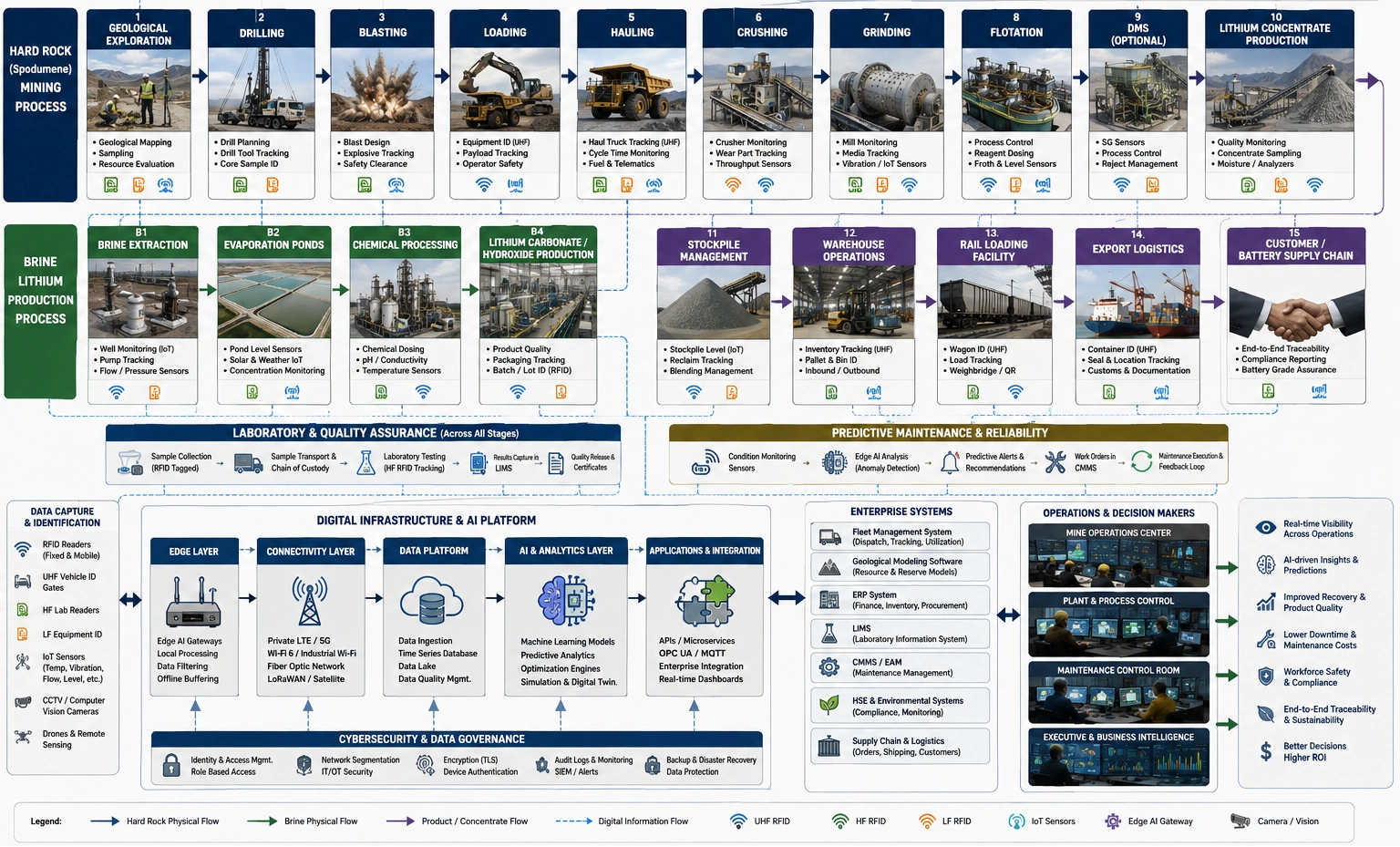
This workflow diagram illustrates the complete lithium mining lifecycle for both hard-rock spodumene and lithium brine operations, from geological exploration and extraction to processing, warehousing, rail loading, export logistics, and battery supply. It shows how RFID, Industrial IoT sensors, Edge AI, enterprise software, and predictive analytics work together to provide real-time visibility, optimize lithium recovery, improve equipment reliability, strengthen laboratory traceability, and support data-driven operational decisions.
End-to-End Operational Workflow for AI-Enabled Lithium Mining
Successful AI implementation requires continuous operational intelligence rather than isolated automation projects. RFID-generated identification events become significantly more valuable when integrated with Industrial IoT sensors, enterprise software, and AI analytics across the complete lithium production lifecycle.
Data Acquisition
Operational information originates from numerous connected devices distributed throughout lithium mining operations.
Typical data sources include:
- Fixed RFID readers
- Handheld RFID readers
- Passive RFID tags
- Active RFID tags where continuous location monitoring is required
- Fleet telematics systems
- GNSS receivers
- Conveyor monitoring sensors
- Vibration sensors
- Pressure transmitters
- Temperature sensors
- Flow meters
- Electrical power monitoring
- Weather stations
- Evaporation pond monitoring equipment
- Water quality sensors
- Computer vision cameras
- Drone imagery
- Laboratory instruments
RFID provides reliable identification of physical assets while Industrial IoT devices continuously measure operational conditions affecting lithium production.
Edge Processing and Local Intelligence
Industrial Edge AI computers positioned throughout mining operations perform localized processing before transmitting information to central systems.
Typical edge functions include:
- RFID event validation
- Duplicate read filtering
- Sensor aggregation
- Local AI inference
- Temporary data buffering
- Alarm generation
- Equipment status monitoring
- Communication optimization
Local processing reduces communication latency while allowing critical operational processes to continue during temporary network disruptions commonly encountered at remote lithium mining sites.
Industrial Communication Infrastructure
Reliable communications are essential because lithium mining operations often span extensive geographical areas with challenging environmental conditions.
Common communication technologies include:
- Industrial Ethernet
- Fiber optic backbone
- Private LTE
- Private 5G
- Wi-Fi 6
- LoRaWAN
- Satellite communication links
- OPC UA
- MQTT
- Modbus TCP
- REST APIs
Redundant communication paths improve operational reliability while supporting continuous production.
Enterprise Software Integration
Operational information integrates with multiple software systems supporting mining, maintenance, production, laboratory operations, and business management.
Typical software integrations include:
- Fleet Management Systems
- Computerized Maintenance Management Systems (CMMS)
- Enterprise Resource Planning (ERP)
- Geological modeling software
- Mine planning software
- Laboratory Information Management Systems (LIMS)
- Warehouse Management Systems
- Asset Performance Management software
- Environmental monitoring software
- Dispatch software
- Production reporting systems
These integrations enable AI models to evaluate operational performance using engineering, production, maintenance, logistics, and environmental data simultaneously.
AI Analytics and Operational Decision Support
Machine learning continuously evaluates:
- Ore grade variability
- Lithium recovery performance
- Fleet productivity
- Equipment health
- Maintenance history
- Inventory consumption
- Processing throughput
- Energy utilization
- Water consumption
- Chemical dosing efficiency
- Environmental conditions
- Production scheduling
The resulting insights support predictive maintenance, fleet optimization, reagent management, inventory planning, laboratory prioritization, shipment scheduling, environmental compliance, and executive decision-making.
GAO has supplied RFID and Industrial IoT hardware to organizations requiring dependable asset identification and operational visibility in demanding industrial environments. These deployments demonstrate how high-quality data collection forms the foundation for reliable AI-driven operational intelligence.
RFID, AI Technologies, and Supporting Infrastructure for Lithium Mining
Reliable AI-enabled lithium mining depends on a carefully engineered combination of RFID technologies, Industrial IoT devices, communications infrastructure, AI software, cybersecurity controls, and enterprise software integration. Rather than operating as independent technologies, these components work together to provide continuous operational visibility across exploration, extraction, mineral processing, warehouse operations, laboratory testing, environmental monitoring, and logistics.
Selecting the appropriate hardware and deployment strategy requires evaluating lithium mining conditions such as abrasive dust, corrosive brine, elevated temperatures, vibration, heavy machinery, long communication distances, and remote operating locations. Proper engineering design improves system reliability while reducing maintenance requirements throughout the mine lifecycle.
RFID Hardware for Lithium Mining
RFID hardware should be selected according to the operational environment, required read distance, and the characteristics of the assets being identified.
Typical deployments include:
- Rugged UHF RFID readers installed at haul roads, crusher entrances, beneficiation plants, warehouse loading docks, weighbridges, rail loading stations, and shipping areas.
- Fixed HF RFID readers supporting laboratory operations, maintenance workshops, chemical storage facilities, calibration rooms, and secure access locations.
- LF RFID readers deployed on metallic equipment, drilling assemblies, hydraulic components, and harsh industrial environments where reliable reading near metal surfaces is essential.
- Passive UHF RFID tags attached to haul trucks, wheel loaders, excavators, forklifts, pallets, concentrate containers, warehouse inventory, rail wagons, pipelines, and reusable transport containers.
- Rugged encapsulated RFID tags designed to withstand abrasion, vibration, moisture, ultraviolet exposure, chemical splashes, and washdown procedures.
- Handheld RFID readers used by maintenance engineers, warehouse personnel, laboratory technicians, environmental inspectors, and logistics operators.
For lithium brine operations, RFID tags should be selected with corrosion-resistant encapsulation to withstand prolonged exposure to saline environments and chemical processing facilities.
GAO supplies industrial RFID hardware designed for demanding operational environments where long equipment life, dependable identification performance, and low maintenance are critical.
Artificial Intelligence Technologies
Artificial intelligence enables mining organizations to transform operational data into predictive recommendations that improve productivity, reliability, quality, and sustainability.
Common AI capabilities include:
- Predictive maintenance models
- Machine learning classification
- Time-series forecasting
- Deep learning
- Computer vision
- Anomaly detection
- Reinforcement learning for fleet optimization
- Remaining useful life estimation
- Predictive inventory forecasting
- Ore grade prediction
- Lithium recovery optimization
- Process parameter optimization
- Workforce safety analytics
- Energy consumption forecasting
- Water usage optimization
- Environmental compliance monitoring
Computer vision complements RFID by monitoring conveyor belts, flotation cells, evaporation ponds, crushing circuits, haul roads, and processing equipment for abnormal operating conditions that may not be detected using conventional sensors alone.
Historical operational data continuously improves model performance, allowing AI recommendations to become increasingly accurate as additional production cycles are completed.
Supporting Industrial IoT Components
RFID operates alongside numerous Industrial IoT technologies that provide contextual operational information throughout lithium mining facilities.
Supporting devices commonly include:
- Industrial IoT gateways
- Edge AI servers
- Industrial computers
- GPU-enabled inference devices
- Programmable Logic Controllers (PLCs)
- Distributed Control Systems (DCS)
- SCADA software
- Digital twin software
- Condition monitoring sensors
- Smart vibration sensors
- Thermal imaging cameras
- Environmental monitoring stations
- Water quality analyzers
- GNSS positioning systems
- Smart energy meters
- Drone inspection systems
- Autonomous mobile inspection vehicles
These technologies provide continuous measurements that complement RFID-generated identification events, allowing AI models to evaluate operational conditions with significantly greater accuracy.
Communication Protocols and Network Infrastructure
Lithium mining operations often span several kilometers and include geographically separated production areas, laboratories, processing plants, warehouses, evaporation ponds, and administrative facilities. Reliable communications are therefore essential for maintaining uninterrupted operational visibility.
Frequently used communication technologies include:
- Industrial Ethernet
- Fiber optic backbone
- Private LTE
- Private 5G
- Wi-Fi 6
- LoRaWAN
- Satellite communications
- OPC UA
- MQTT
- HTTPS
- REST APIs
- Modbus TCP/IP
Network redundancy is recommended for mission-critical operational areas to maintain continuous communication during equipment failures or adverse weather conditions.
Cloud Version
Cloud-hosted deployments are well suited for lithium mining companies operating multiple extraction sites, regional processing facilities, or international logistics networks.
Cloud software enables:
- Centralized production reporting
- Enterprise-wide asset visibility
- Multi-site fleet monitoring
- AI model management
- Long-term historical data storage
- Remote expert collaboration
- Corporate sustainability reporting
- Cross-site performance benchmarking
Cloud deployments reduce infrastructure management responsibilities while providing scalable computing resources for advanced AI workloads and enterprise analytics.
Server Version
Server-based deployments are frequently preferred for lithium mining operations requiring deterministic performance, local operational control, or compliance with internal cybersecurity policies.
Customer-managed servers may be installed within:
- Mine control centers
- Private data centers
- Regional operational facilities
- Processing plants
- Edge computing rooms
Advantages include:
- Lower operational latency
- Improved resilience during internet outages
- Greater control over operational data
- Faster response for real-time automation
- Simplified integration with existing operational technology systems
Many organizations implement hybrid deployments where operational control remains on privately managed servers while selected operational data is securely synchronized with cloud software for enterprise reporting, AI model training, and executive analytics.
Security Mechanisms
As AI-enabled RFID systems become increasingly integrated with production operations, cybersecurity becomes an essential engineering consideration.
Recommended security controls include:
- Device authentication
- Role-based access control
- Multi-factor authentication
- TLS-encrypted communications
- Secure API authentication
- Network segmentation
- Industrial firewalls
- Security Information and Event Management (SIEM)
- Continuous vulnerability assessment
- Firmware validation
- Digital certificate management
- Centralized audit logging
- Backup and disaster recovery procedures
These controls help protect operational data while maintaining the availability and integrity of mining operations.
GAO supports customers by supplying RFID hardware and Industrial IoT solutions backed by rigorous quality assurance, technical expertise, and engineering support. Headquartered in New York City and Toronto, GAO has served customers throughout the United States and Canada for more than three decades, including Fortune 500 companies, leading research organizations, prestigious universities, and government agencies.
AI-Enabled RFID Solution Diagram for Hard-Rock and Lithium Brine Mining Operations
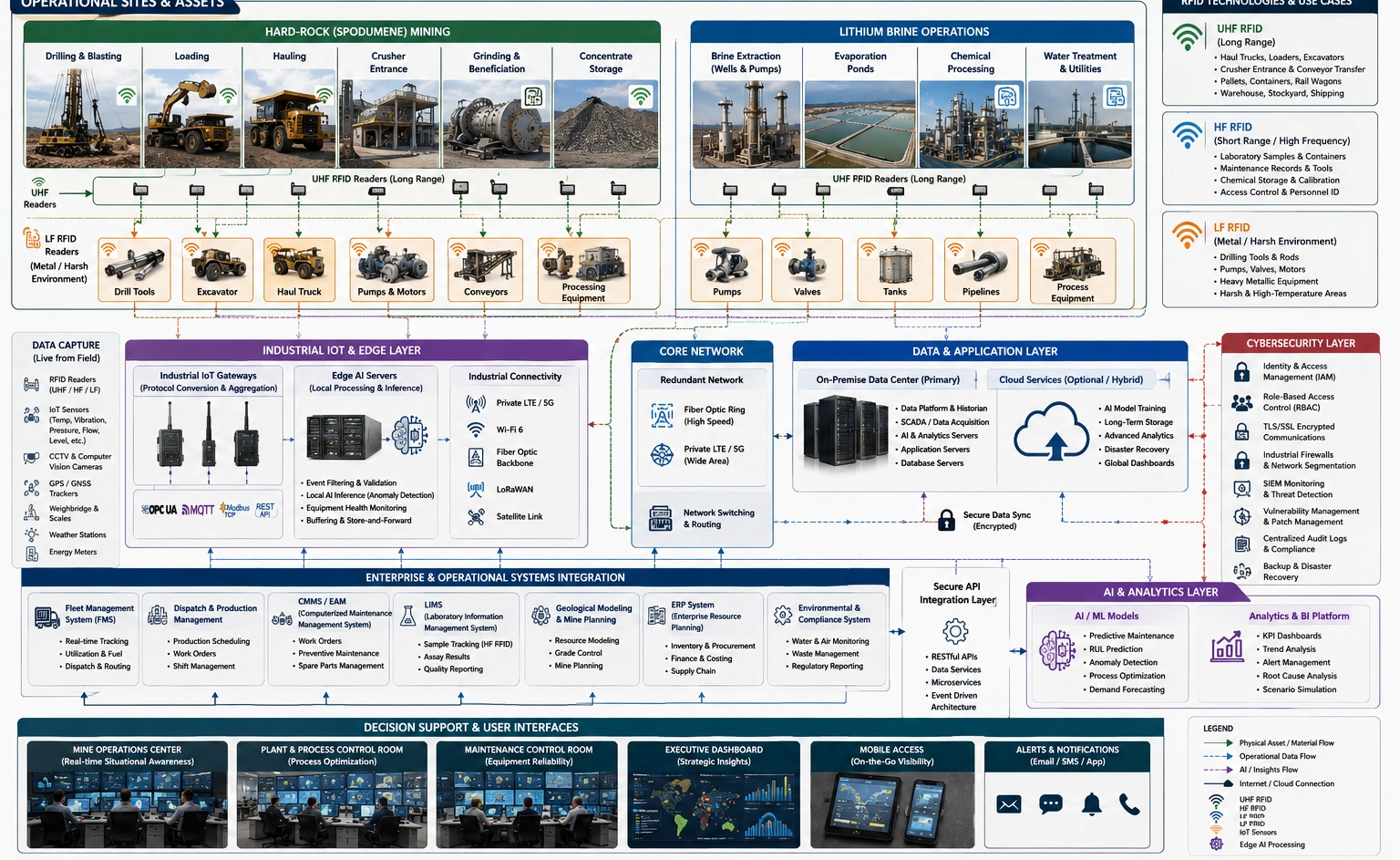
This engineering solution diagram illustrates an end-to-end AI-enabled RFID deployment across both hard-rock spodumene and lithium brine mining operations. It shows how UHF, HF, and LF RFID technologies integrate with Industrial IoT gateways, Edge AI, enterprise software, cybersecurity controls, and operational dashboards to enable real-time asset visibility, predictive maintenance, production optimization, laboratory traceability, and data-driven decision support.
Key Technical Capabilities and Operational Value of AI-Enabled RFID for Lithium Mining
Artificial intelligence transforms RFID from a technology focused primarily on identification into an intelligent operational data source supporting predictive decision-making throughout lithium mining. RFID provides reliable visibility into equipment, personnel, materials, laboratory samples, and logistics assets, while AI analyzes operational trends to improve production efficiency, equipment reliability, sustainability, and safety.
For lithium mining organizations, this combination delivers measurable improvements across extraction, mineral processing, laboratory operations, warehouse management, maintenance, and export logistics while supporting the increasing traceability requirements of the global battery supply chain.
Intelligent Fleet Management and Mobile Equipment Optimization
Large lithium mining operations rely on continuous movement of drilling equipment, hydraulic excavators, wheel loaders, haul trucks, service vehicles, water trucks, fuel trucks, and maintenance fleets.
RFID automatically identifies each vehicle at:
- Haul roads
- Fuel stations
- Maintenance workshops
- Weighbridges
- Crusher entrances
- Processing facilities
- Warehouse gates
- Rail loading areas
AI combines RFID events with GNSS positioning, fuel monitoring, payload sensors, dispatch information, and equipment telemetry to improve:
- Fleet utilization
- Haul cycle efficiency
- Payload consistency
- Equipment dispatch
- Fuel efficiency
- Queue management
- Vehicle availability
- Route optimization
- Shift productivity
Engineering teams gain continuous visibility into fleet performance, allowing production bottlenecks to be identified before they significantly affect lithium concentrate output.
Predictive Maintenance for Critical Processing Equipment
Lithium processing facilities contain high-value assets operating under continuous mechanical and chemical stress. Unexpected equipment failures can interrupt production, reduce lithium recovery, and delay customer deliveries.
RFID automatically records maintenance activities for equipment including:
- Jaw crushers
- Cone crushers
- SAG mills
- Ball mills
- Flotation cells
- Hydrocyclones
- Filter presses
- Pumps
- Compressors
- Electric motors
- Gearboxes
- Conveyor drives
- Thickener systems
- Drying equipment
AI correlates maintenance records with:
- Vibration analysis
- Thermal imaging
- Lubrication analysis
- Operating hours
- Electrical load monitoring
- Historical failure records
- Spare parts consumption
- Inspection reports
These analyses support:
- Remaining useful life estimation
- Failure probability prediction
- Preventive maintenance scheduling
- Spare inventory optimization
- Maintenance workforce planning
Benefits include:
- Reduced unplanned downtime
- Improved equipment availability
- Longer equipment life
- Lower maintenance costs
- Increased plant reliability
Ore Traceability and Lithium Product Quality
Battery manufacturers require complete traceability throughout the lithium supply chain. Maintaining product integrity from extraction to shipment has become increasingly important for regulatory compliance and customer confidence.
RFID enables continuous identification of:
- Ore batches
- Concentrate lots
- Laboratory samples
- Processing batches
- Chemical reagents
- Storage containers
- Export shipments
- Rail wagons
- Shipping containers
AI evaluates:
- Ore grade variability
- Mineral recovery
- Concentrate quality
- Batch consistency
- Product blending
- Laboratory turnaround time
- Customer specifications
These insights improve production consistency while supporting comprehensive digital traceability.
Warehouse and Spare Parts Intelligence
Lithium mining operations maintain thousands of maintenance components that must remain available without excessive inventory investment.
RFID supports automated identification of:
- Bearings
- Conveyor rollers
- Pumps
- Electric motors
- Hydraulic cylinders
- Instrumentation
- Valves
- Filters
- Laboratory supplies
- Welding consumables
- Calibration tools
- Personal protective equipment
AI forecasts inventory demand by evaluating:
- Historical maintenance trends
- Equipment operating conditions
- Seasonal production schedules
- Supplier lead times
- Equipment health indicators
Operational improvements include:
- Reduced emergency procurement
- Lower inventory carrying costs
- Improved warehouse accuracy
- Faster maintenance execution
- Better procurement planning
Laboratory Sample Management
Lithium mining depends heavily on laboratory analysis throughout exploration, beneficiation, and quality assurance.
RFID provides reliable identification for:
- Drill core samples
- Geological specimens
- Process samples
- Concentrate samples
- Chemical reagents
- Laboratory instruments
- Calibration equipment
AI assists laboratories by:
- Prioritizing sample workflows
- Predicting laboratory workload
- Monitoring turnaround times
- Identifying quality deviations
- Detecting anomalous assay results
- Supporting automated reporting
Improved laboratory efficiency accelerates operational decision-making while strengthening quality assurance.
Workforce Safety and Operational Compliance
Mining operations require continuous awareness of workforce location, equipment authorization, contractor access, and emergency preparedness.
RFID supports:
- Personnel identification
- Contractor verification
- Equipment authorization
- Access control
- Emergency evacuation accountability
- Visitor management
- Restricted-area monitoring
AI analyzes:
- Worker movement patterns
- Vehicle interactions
- High-risk operational zones
- Equipment utilization
- Near-miss trends
- Fatigue-related operational indicators
- Safety inspection records
These insights strengthen operational safety programs while supporting regulatory compliance and reducing operational risk.
Environmental Monitoring and Water Resource Optimization
Lithium mining operations, particularly brine extraction facilities, require careful management of water resources and environmental impacts.
RFID identifies inspection assets and monitoring equipment associated with:
- Water treatment systems
- Brine extraction wells
- Monitoring stations
- Environmental sampling equipment
- Chemical storage
- Waste management assets
AI combines RFID information with environmental monitoring systems to evaluate:
- Water consumption
- Brine extraction efficiency
- Evaporation pond performance
- Chemical usage
- Energy consumption
- Environmental compliance indicators
These capabilities support more sustainable lithium production while improving resource utilization.
Supply Chain Visibility and Export Coordination
Lithium concentrate frequently travels through multiple logistics partners before reaching battery manufacturers and cathode processing facilities.
RFID provides automated identification across:
- Packaging operations
- Warehouses
- Rail terminals
- Port facilities
- Export shipments
- Distribution centers
AI improves:
- Shipment scheduling
- Container allocation
- Export documentation
- Inventory reconciliation
- Customer delivery forecasting
- Transportation planning
Enhanced supply chain visibility reduces delays while strengthening end-to-end product traceability.
Scalability for Future Mining Expansion
Lithium demand continues to increase rapidly due to global electrification initiatives.
AI-enabled RFID solutions are designed to scale alongside operational growth by supporting:
- Additional extraction sites
- New processing plants
- Expanded warehouse facilities
- Additional rail terminals
- Increased RFID read volumes
- More connected Industrial IoT devices
- Larger AI datasets
- Multi-site operational reporting
Scalable deployments reduce future implementation costs while supporting long-term digital transformation initiatives.
GAO has helped organizations deploy RFID and Industrial IoT hardware capable of supporting operational growth while maintaining reliable performance under demanding industrial conditions.
Conventional vs. AI-Enabled RFID Lithium Mining Operations Comparison
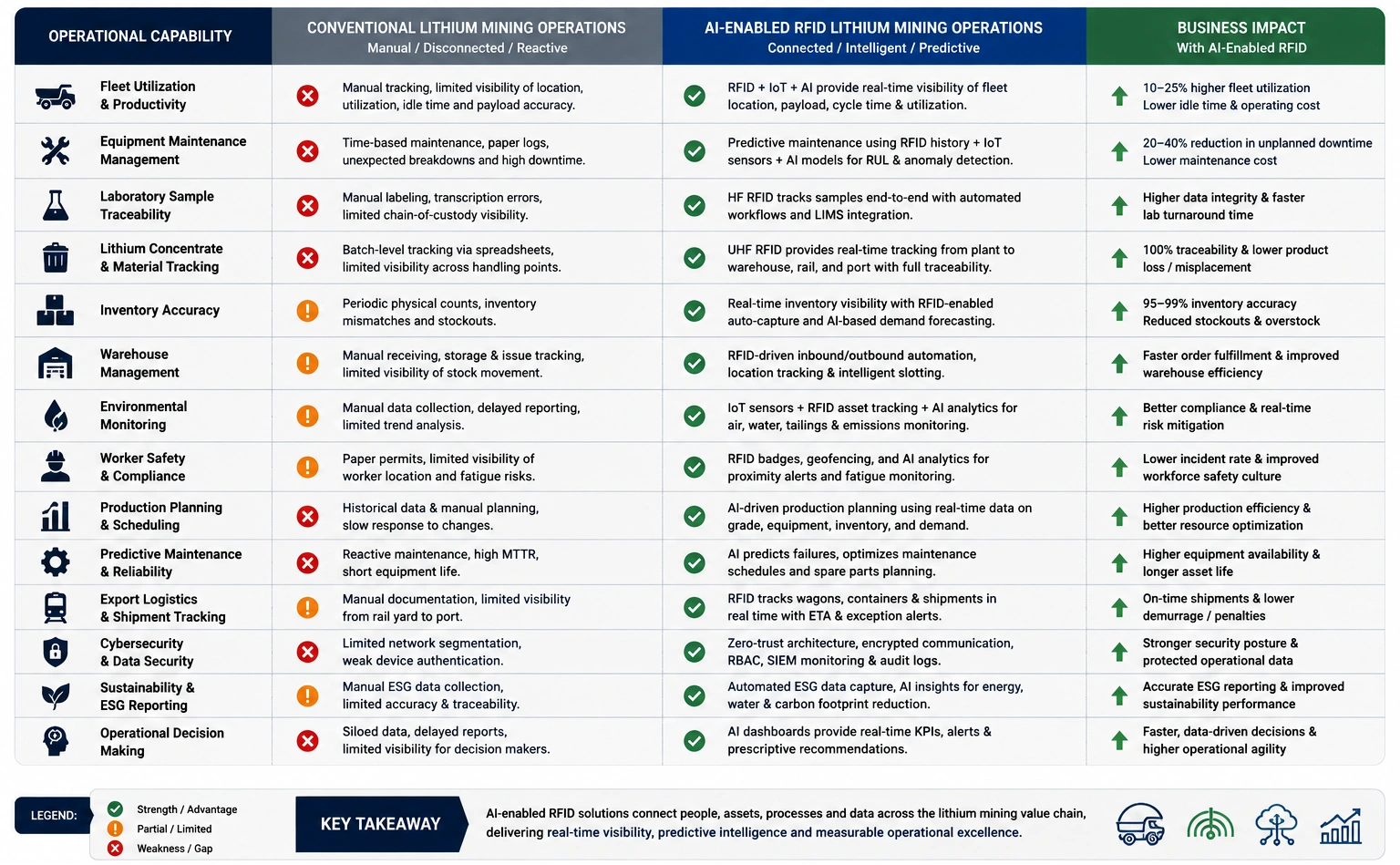
This comparison table contrasts conventional lithium mining operations with AI-enabled RFID mining across critical operational capabilities, including fleet utilization, predictive maintenance, laboratory sample traceability, inventory management, environmental monitoring, export logistics, and cybersecurity. It demonstrates how integrating RFID with AI and Industrial IoT delivers real-time visibility, end-to-end traceability, improved operational efficiency, enhanced sustainability reporting, and data-driven decision-making throughout the lithium mining value chain.
Engineering Best Practices for Deploying AI-Enabled RFID in Lithium Mining
Successful AI-enabled RFID implementations in lithium mining require careful engineering planning, site-specific hardware selection, reliable communications, and close integration with existing operational technology. Lithium mining environments present unique challenges, including abrasive spodumene ore, highly saline brine, chemical processing facilities, extreme temperatures, remote locations, and continuous production schedules. Addressing these factors during system design improves long-term reliability and maximizes operational value.
Perform a Comprehensive Site Assessment
Every lithium mining operation has unique workflows, infrastructure, and environmental conditions that influence RFID performance.
Engineering teams should evaluate:
- Open-pit and underground extraction layouts
- Lithium brine well fields
- Evaporation pond locations
- Crushing and grinding circuits
- Flotation plants
- Chemical processing facilities
- Warehouse operations
- Rail loading terminals
- Laboratory workflows
- Maintenance workshops
- Existing communication infrastructure
- Environmental exposure to dust, moisture, vibration, and corrosive chemicals
Site surveys should include RFID read-range testing, antenna placement studies, radio frequency interference analysis, and communication coverage verification before deployment begins.
Select the Appropriate RFID Technology
Different lithium mining applications require different RFID technologies to achieve reliable performance.
UHF RFID is well suited for:
- Haul trucks
- Wheel loaders
- Excavators
- Rail wagons
- Bulk concentrate containers
- Warehouse inventory
- Outdoor logistics
HF RFID is recommended for:
- Laboratory sample tracking
- Maintenance documentation
- Calibration equipment
- Chemical inventory
- Access control
- Quality assurance workflows
LF RFID performs effectively for:
- Metallic mining equipment
- Hydraulic components
- Drilling assemblies
- Pumps
- Harsh industrial environments with significant metal interference
Many lithium mining operations benefit from combining all three RFID technologies within a single integrated solution.
Design Reliable Communication Infrastructure
Continuous production requires dependable communication between RFID devices, Industrial IoT equipment, AI software, and operational control systems.
Recommended communication infrastructure includes:
- Fiber optic backbone
- Industrial Ethernet
- Private LTE
- Private 5G
- Wi-Fi 6
- LoRaWAN
- Satellite connectivity for remote sites
- MQTT messaging
- OPC UA integration
- REST API connectivity
Redundant communication paths reduce operational disruption caused by network failures or adverse environmental conditions.
Integrate with Existing Operational Software
RFID and AI deliver greater operational value when integrated with the software already supporting lithium mining activities.
Common integrations include:
- Fleet Management Systems
- Computerized Maintenance Management Systems (CMMS)
- Enterprise Resource Planning (ERP)
- Geological modeling software
- Mine planning software
- Laboratory Information Management Systems (LIMS)
- Warehouse Management Systems
- Asset Performance Management software
- Environmental monitoring software
- Production reporting systems
- Dispatch software
Integrated workflows eliminate duplicate data entry while providing AI with richer operational context for analysis.
Validate AI Models Continuously
Lithium mining operations evolve over time due to changing ore characteristics, expanding production areas, new processing methods, and seasonal operating conditions.
AI models should be retrained using updated operational data to maintain prediction accuracy.
Model validation should consider:
- Ore grade variability
- Equipment replacement
- Process modifications
- Production expansion
- Seasonal weather effects
- Brine chemistry changes
- New maintenance strategies
- Updated operational procedures
Continuous model improvement helps ensure reliable recommendations throughout the mine lifecycle.
Establish Data Governance and Asset Standards
AI models depend on accurate, consistent operational data.
Recommended practices include:
- Standardized RFID tag naming conventions
- Consistent equipment identifiers
- Uniform laboratory sample IDs
- Asset hierarchy management
- Data quality validation
- Master asset registers
- Automated synchronization across business systems
- Version-controlled AI models
Strong data governance improves interoperability between operational software while reducing inconsistencies that affect AI performance.
Cybersecurity and Scalable System Design
AI-enabled RFID deployments increasingly connect production systems with enterprise software, making cybersecurity an essential design consideration throughout the solution lifecycle.
Recommended cybersecurity practices include:
- Mutual authentication between RFID readers and application servers
- TLS-encrypted communications
- Role-based access control
- Multi-factor authentication
- Network segmentation between information technology and operational technology environments
- Industrial firewalls
- Secure API authentication
- Continuous vulnerability assessments
- Firmware integrity verification
- Centralized audit logging
- Security Information and Event Management (SIEM)
- Backup and disaster recovery planning
- Periodic penetration testing
- Zero Trust security principles where appropriate
These controls help protect operational data while maintaining system availability and reducing cybersecurity risk.
Scalable deployments should also support future operational growth, including:
- Additional mining sites
- Expanded beneficiation facilities
- New evaporation ponds
- Increased RFID read volumes
- More Industrial IoT sensors
- Additional AI inference workloads
- Enterprise-wide reporting
- Long-term historical data storage
- Cross-site operational benchmarking
GAO has supported organizations by supplying RFID and Industrial IoT hardware designed for dependable performance in challenging industrial environments, complemented by technical guidance for deployment planning, integration, and long-term operational support.
Key Performance Indicators for AI-Enabled Lithium Mining
Organizations typically evaluate AI-enabled RFID solutions using operational, maintenance, environmental, logistics, and business performance metrics.
Common KPIs include:
- Overall Equipment Effectiveness (OEE)
- Fleet utilization rate
- Equipment availability
- Mean Time Between Failures (MTBF)
- Mean Time to Repair (MTTR)
- Lithium recovery rate
- Ore grade prediction accuracy
- Processing throughput
- Concentrate quality consistency
- Laboratory turnaround time
- Inventory accuracy
- Warehouse order accuracy
- Spare parts availability
- Haul cycle time
- Payload utilization
- Fuel consumption per tonne
- Energy consumption per tonne
- Water consumption per tonne of lithium produced
- Reagent utilization efficiency
- Evaporation pond productivity
- Predictive maintenance accuracy
- Environmental compliance performance
- Workforce safety incident rate
- Contractor compliance
- Asset location accuracy
- Shipment on-time performance
- Export documentation accuracy
- Production cost per tonne
- Carbon emissions intensity
- Supply chain traceability coverage
Monitoring these indicators enables mining organizations to measure return on investment while continuously improving operational efficiency, sustainability, and product quality.
RFID Technology and AI Deployment Decision Tree for Lithium Mining Operations
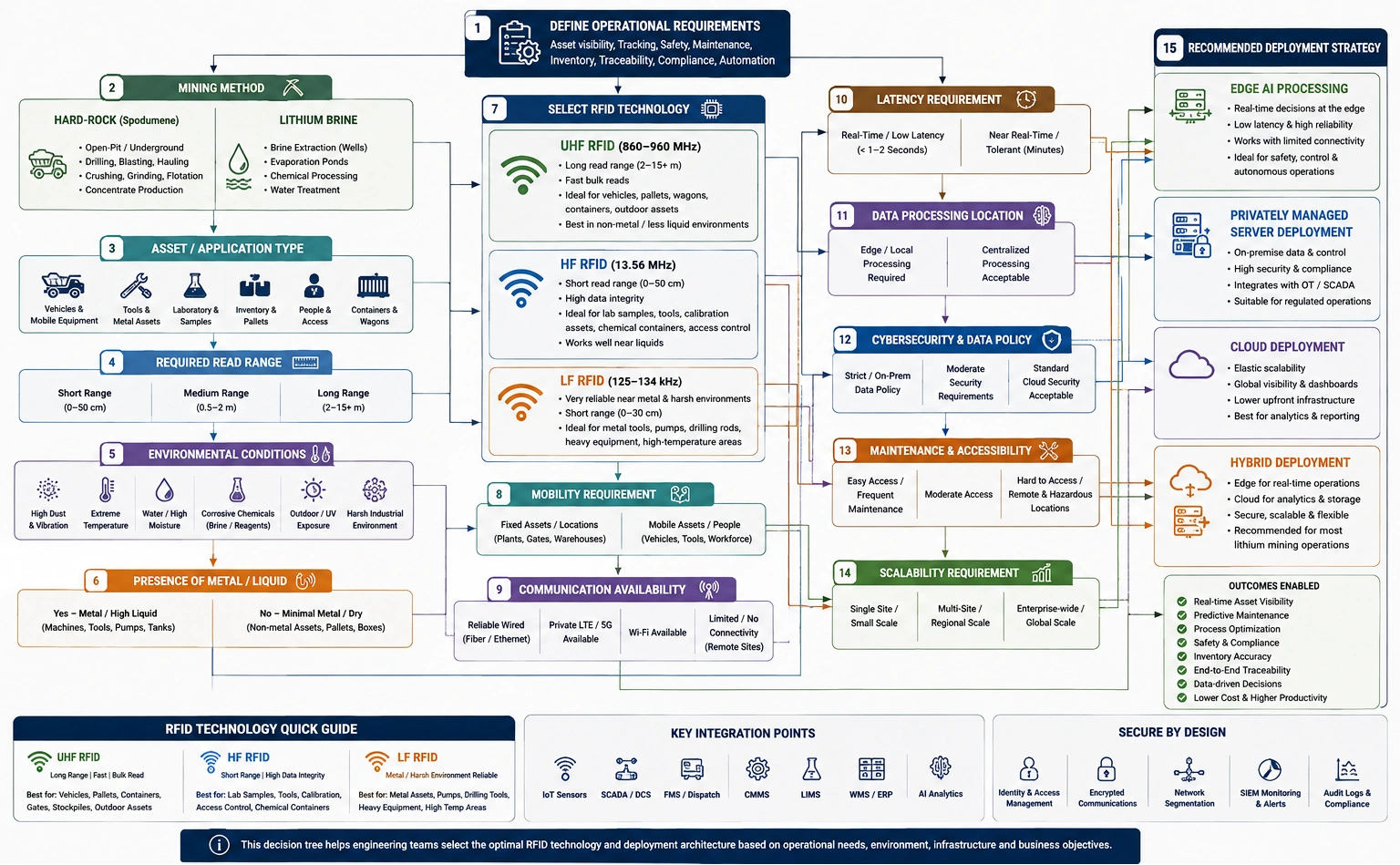
This engineering decision tree helps technical teams select the optimal RFID technology and AI deployment strategy for lithium mining based on mining method, asset type, environmental conditions, communication infrastructure, latency, cybersecurity, and scalability requirements. It guides users toward UHF, HF, or LF RFID and recommends Edge AI, privately managed server, cloud, or hybrid deployments to support efficient, secure, and scalable lithium mining operations.
Emerging Trends in AI-Powered Lithium Mining
Lithium mining continues to evolve as battery manufacturers demand higher product quality, greater supply chain transparency, lower environmental impact, and increased production efficiency. AI-enabled RFID solutions are becoming integral components of intelligent mining operations by supporting autonomous decision-making, predictive analytics, and connected Industrial IoT systems.
Emerging technologies expected to influence future lithium mining include:
- Autonomous drilling and haulage systems coordinated through AI-driven fleet optimization.
- Edge AI enabling real-time operational decisions with minimal communication latency.
- Computer vision for monitoring conveyor belts, flotation cells, evaporation ponds, and concentrate quality.
- Digital twin software that simulates extraction, beneficiation, and processing scenarios to optimize production planning.
- AI-assisted geological modeling that continuously refines resource estimates using exploration and production data.
- Predictive energy management to reduce electricity consumption across crushing, grinding, flotation, and chemical processing facilities.
- Intelligent water management for lithium brine extraction through AI analysis of evaporation rates, groundwater conditions, and brine chemistry.
- Drone-assisted inspection of tailings storage facilities, pipelines, evaporation ponds, and remote infrastructure.
- Automated environmental compliance monitoring integrating RFID, Industrial IoT sensors, and AI analytics.
- Supply chain traceability supporting battery passport initiatives and responsible sourcing requirements.
- Foundation AI models that assist engineers in interpreting production, maintenance, laboratory, and environmental data.
As these technologies mature, RFID will continue serving as a dependable identification layer that supplies trusted operational data to increasingly sophisticated AI systems, improving productivity, sustainability, and operational resilience across lithium mining operations.
Advancing Intelligent Lithium Mining with AI-Powered RFID Solutions
Artificial intelligence supported by RFID and Industrial IoT technologies is transforming lithium mining from reactive operations into data-driven production systems capable of continuously optimizing equipment performance, lithium recovery, laboratory workflows, logistics, maintenance, and workforce safety. Rather than functioning solely as an asset identification technology, RFID provides trusted operational data that enables AI to generate predictive insights supporting production planning, equipment reliability, inventory optimization, environmental monitoring, and end-to-end material traceability.
Successful implementation requires more than selecting appropriate RFID hardware. Organizations achieve the greatest value by integrating AI, Industrial IoT sensors, communication infrastructure, enterprise software, cybersecurity controls, and operational workflows into a unified solution aligned with mining objectives. Careful engineering design, robust communications, high-quality operational data, and continuous AI model refinement ensure long-term reliability while supporting future expansion.
GAO has helped organizations implement RFID, BLE, and Industrial IoT hardware products and systems across demanding industrial environments requiring dependable asset identification, operational visibility, and reliable engineering performance. Headquartered in New York City and Toronto, GAO is recognized among the world's leading B2B suppliers of RFID and BLE technologies. Together with GAO Research Inc. and GAO Tek Inc., GAO has invested extensively in research and development while serving Fortune 500 companies, leading research institutions, prestigious universities, and government agencies throughout the United States and Canada. Through rigorous quality assurance, experienced engineering teams, and expert remote and onsite technical support, we help customers deploy reliable AI-enabled RFID solutions that improve operational efficiency, strengthen traceability, and support long-term digital transformation initiatives.
Whether modernizing an existing lithium mining operation or planning a new intelligent mining facility, organizations can work with GAO to evaluate RFID technologies, design scalable AI-enabled Industrial IoT solutions, and implement systems that support production efficiency, sustainability objectives, workforce safety, and supply chain visibility.
Building the Future of Industrial AI and IoT with Aperture Venture Studio and GAO RFID Inc.
For more than three decades, GAO Group of Companies has invested extensively in research and development of industrial RFID, BLE, and Industrial IoT technologies. As generative AI has demonstrated significant value for intelligent lithium mining operations, we have continued advancing AI and IoT technologies, including RFID and BLE, while establishing Aperture Venture Studio to accelerate the development and adoption of advanced Industrial AI and IoT solutions for resource extraction, critical minerals, and other industrial applications.
Aperture has attracted leading AI researchers, Industrial IoT specialists, experienced operational executives, influential investors, and established technology organizations to collaborate on solving complex industrial challenges.
Through initiatives such as the Aperture Ventures Summit and TekSummit, we bring together technical experts and industry leaders to explore emerging developments in AI, Industrial IoT, intelligent sensing, and connected industrial systems.
These initiatives have strengthened collaborative technical communities while advancing practical AI and IoT innovation across industrial sectors.
We welcome you to join us as:
- Advisors
- Employees
- Investors
- Customers
End-to-End AI-Enabled RFID Deployment Across the Lithium Mining Lifecycle
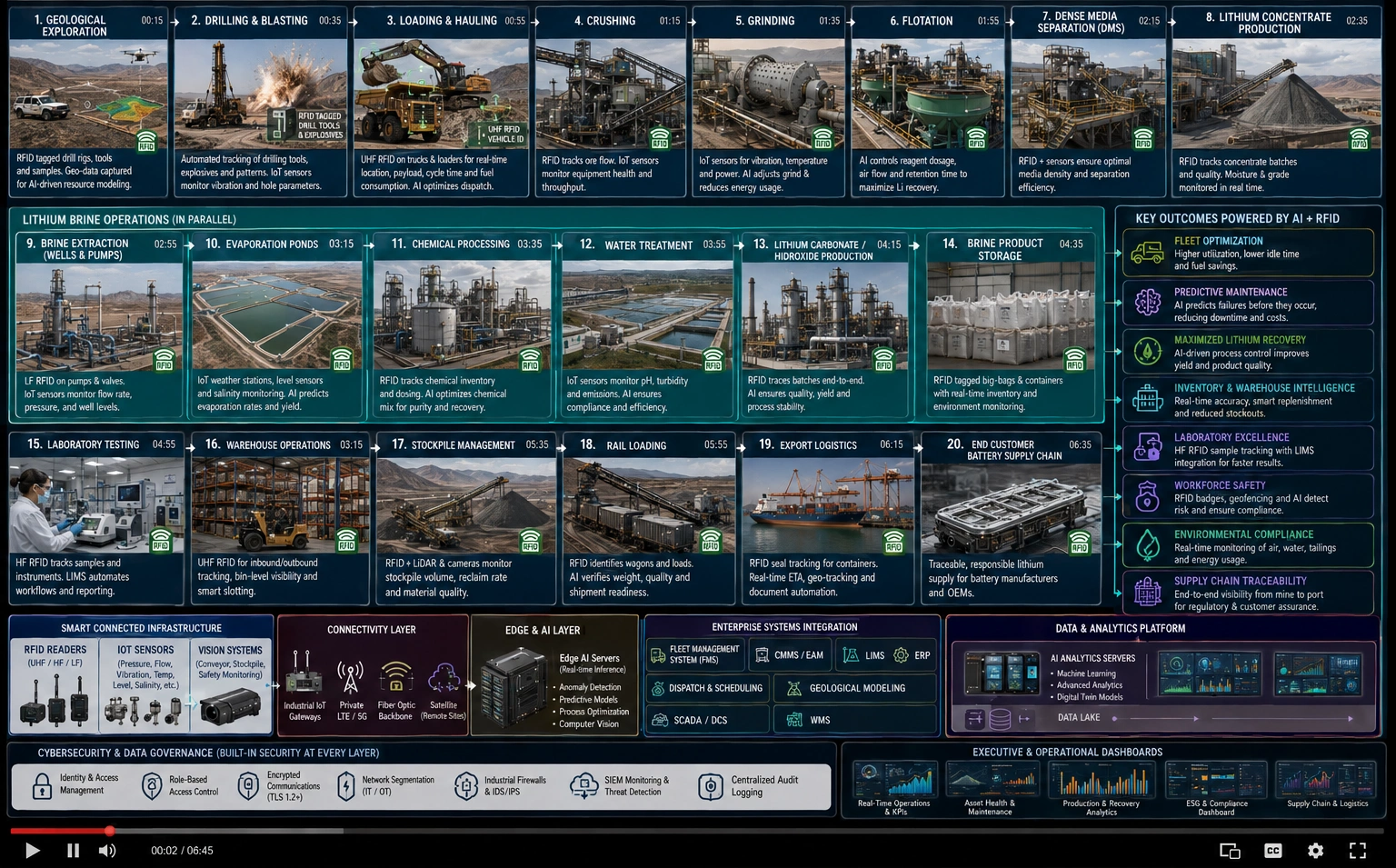
This storyboard-style engineering visual illustrates the complete lithium mining lifecycle, covering both hard-rock spodumene extraction and lithium brine production from geological exploration through processing, laboratory testing, warehousing, rail loading, export logistics, and battery supply. It demonstrates how RFID, Industrial IoT sensors, Edge AI, enterprise software, predictive analytics, and cybersecurity work together to optimize fleet management, lithium recovery, predictive maintenance, environmental compliance, laboratory traceability, and end-to-end supply chain visibility.