
AI and RFID for Universities: Intelligent Campus Operations, Asset Visibility, and Data-Driven Decision Making
How AI Is Transforming RFID-Powered University Operations
Artificial intelligence is transforming how universities manage physical assets, academic resources, campus facilities, research laboratories, libraries, student services, and operational workflows. Rather than simply identifying tagged assets, AI analyzes RFID-generated data to recognize operational patterns, predict resource demand, detect anomalies, automate routine decisions, and improve institutional efficiency. RFID serves as the data acquisition layer while AI converts continuous campus data into actionable operational intelligence.
Modern universities operate complex environments consisting of multiple campuses, research buildings, libraries, classrooms, residence halls, athletic facilities, medical education centers, maker spaces, and administrative offices. Thousands of assets including laboratory instruments, audiovisual equipment, IT hardware, library collections, scientific samples, maintenance tools, safety equipment, and mobile teaching devices move continuously across departments. Manual asset management frequently results in misplaced equipment, underutilized resources, delayed maintenance, duplicate purchases, and compliance challenges.
AI-powered RFID solutions address these operational issues by combining UHF RFID, HF RFID, and LF RFID technologies with machine learning, Edge AI, computer vision, predictive analytics, AIoT, and intelligent automation. These systems continuously monitor asset movement, occupancy, equipment utilization, inventory status, environmental conditions, and operational events to support evidence-based campus management.
For university administrators, research managers, laboratory supervisors, librarians, IT departments, facilities management teams, procurement professionals, and campus security personnel, AI-enabled RFID provides measurable improvements in operational visibility, research asset accountability, student experience, regulatory compliance, and infrastructure utilization.
Drawing upon more than three decades of industrial RFID innovation, GAO, headquartered in New York City and Toronto, has supplied RFID and IoT hardware products and systems to universities, research institutions, Fortune 500 organizations, and government agencies throughout North America. Our engineering experience supports universities implementing intelligent campus operations with reliable RFID technologies integrated into broader AI-driven digital transformation initiatives.
AI-Powered RFID Smart University System for Intelligent Campus Operations
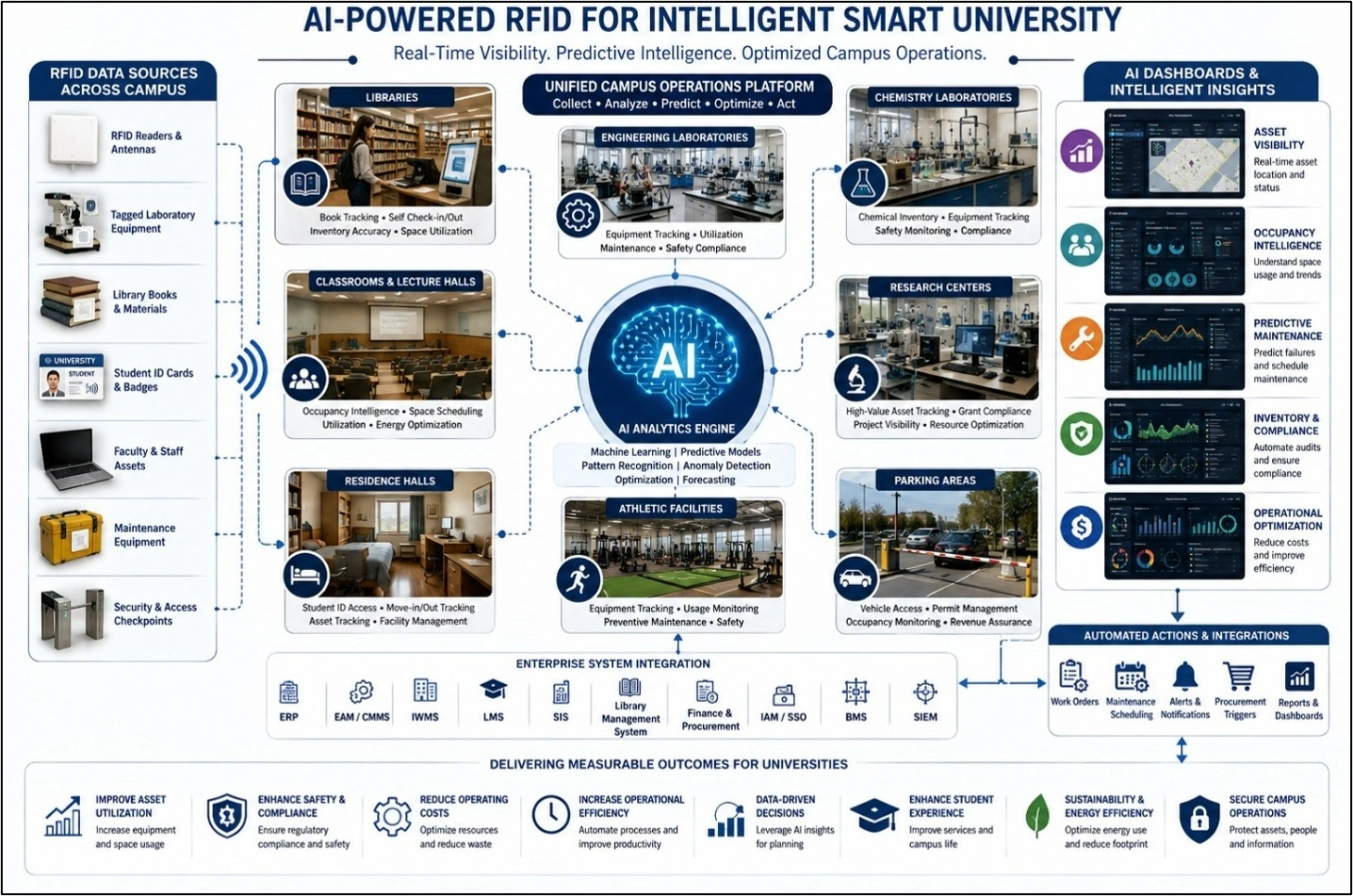
This infographic illustrates how AI analyzes RFID-generated data across a modern university to improve asset visibility, classroom utilization, laboratory management, library operations, residence hall access, parking, and campus security. It also shows the integration of RFID readers, AI analytics, enterprise software, and operational dashboards that enable predictive maintenance, occupancy intelligence, automated workflows, and data-driven decision-making throughout the campus.
AI-Powered RFID Fundamentals for Modern Universities
Universities represent one of the most operationally diverse environments within the education sector. A single institution may simultaneously operate advanced research laboratories, digital libraries, clinical simulation centers, engineering workshops, innovation hubs, conference facilities, museums, data centers, greenhouses, athletic complexes, residence halls, and transportation systems. Each environment introduces unique operational requirements, regulatory obligations, asset management practices, and security considerations.
Traditional RFID systems primarily answer questions such as:
- Where is a laboratory microscope?
- Which books have been checked out?
- Which classroom projector is available?
- Has a student entered the laboratory?
- Which maintenance equipment is currently deployed?
Artificial intelligence extends these capabilities by answering significantly more valuable operational questions.
Examples include:
- Which laboratory instruments are consistently underutilized?
- Which classrooms require dynamic scheduling adjustments?
- Which departments will require additional equipment next semester?
- Which research assets demonstrate abnormal movement patterns?
- Which HVAC systems should receive preventive maintenance first?
- Which library collections require redistribution?
- Which student study spaces experience persistent overcrowding?
- Which research laboratories present elevated compliance risks?
Instead of generating isolated RFID events, AI develops contextual understanding by correlating historical campus activity, occupancy trends, academic schedules, maintenance records, procurement data, energy consumption, environmental sensor readings, security logs, and institutional planning information.
This transformation represents a practical implementation of Artificial Intelligence of Things (AIoT), where connected RFID infrastructure continuously supplies trusted operational data to AI software for automated analysis and decision support.
University Applications Where AI-Powered RFID Delivers the Greatest Value
University environments involve thousands of daily asset movements, equipment reservations, academic activities, maintenance tasks, and research operations. AI-supported RFID solutions improve operational intelligence across virtually every campus function.
Research Laboratory Asset Management
Research laboratories contain high-value scientific instruments including:
- Spectrometers
- PCR systems
- Oscilloscopes
- Centrifuges
- Electron microscopes
- Biosafety cabinets
- Environmental chambers
- Analytical balances
- Chemical inventories
- Calibration equipment
AI analyzes RFID movement histories to identify:
- Equipment utilization trends
- Laboratory bottlenecks
- Unauthorized equipment relocation
- Maintenance scheduling priorities
- Calibration deadlines
- Shared equipment demand
- Research workflow optimization
Rather than maintaining static inventory records, laboratory managers receive operational intelligence supporting research productivity and grant-funded asset accountability.
Intelligent Library Operations
University libraries manage hundreds of thousands or millions of physical resources.
AI-supported RFID improves:
- Collection visibility
- Automated circulation
- Shelf accuracy
- Missing item detection
- Book recommendation analytics
- Study space utilization
- Self-service borrowing
- Return logistics
- Archive management
- Collection redistribution
Machine learning identifies borrowing trends across semesters, predicts demand for textbooks before enrollment peaks, recommends redistribution between branches, and assists acquisition planning using historical circulation patterns.
Classroom and Learning Space Optimization
Universities frequently struggle with inefficient classroom scheduling despite growing infrastructure costs.
AI analyzes RFID occupancy information together with:
- Academic timetables
- Student attendance
- Faculty schedules
- Room utilization
- Department demand
- Historical occupancy
The software can recommend:
- Classroom reassignment
- Space consolidation
- Schedule optimization
- Energy-saving opportunities
- Facility expansion priorities
Facilities managers gain measurable improvements in classroom utilization while reducing unnecessary infrastructure investments.
Campus Facilities and Maintenance
Maintenance departments oversee thousands of assets including:
- HVAC equipment
- Electrical systems
- Plumbing infrastructure
- Cleaning equipment
- Safety devices
- Emergency response equipment
- Utility meters
- Mechanical tools
- Campus vehicles
- Landscaping equipment
AI evaluates RFID asset histories together with maintenance records to identify:
- Equipment failure patterns
- Spare part consumption
- Technician productivity
- Maintenance backlog
- Preventive maintenance schedules
- Asset lifecycle replacement
This reduces emergency repairs while improving service availability throughout the campus.
Student Services and Campus Experience
Student identification cards incorporating HF RFID support multiple campus functions.
Combined with AI, universities can improve:
- Dining hall utilization
- Residence hall access
- Student service demand forecasting
- Recreation center occupancy
- Campus transportation planning
- Parking optimization
- Event attendance analytics
- Academic facility utilization
Rather than monitoring individual students, properly governed AI systems focus on aggregated operational intelligence supporting campus planning and resource allocation while respecting institutional privacy policies.
AI-Powered RFID Use Case Matrix for University Departments and Campus Operations
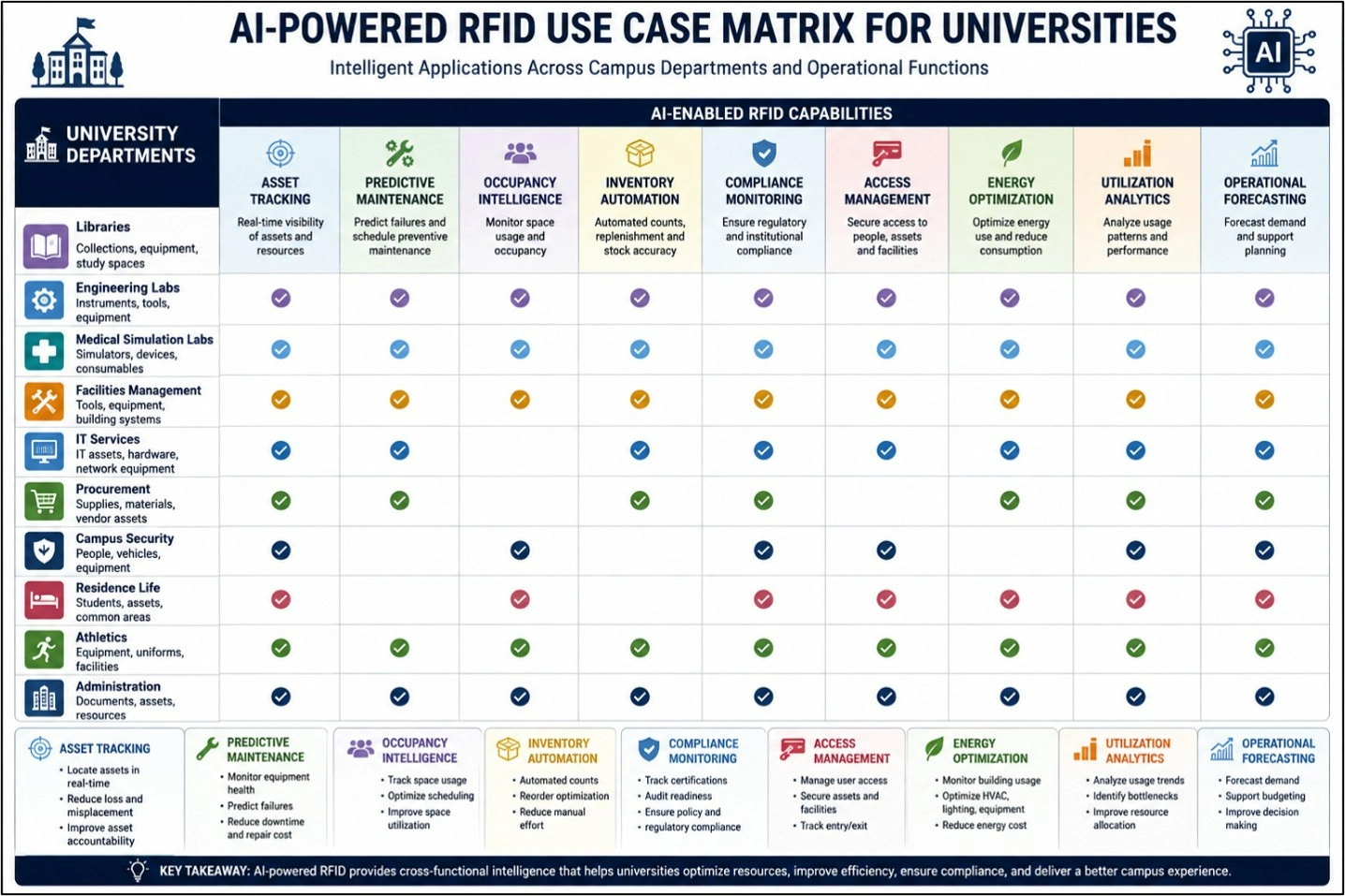
This matrix compares how AI-powered RFID supports operational functions across major university departments, including libraries, engineering laboratories, medical simulation labs, facilities management, IT services, procurement, campus security, residence life, athletics, and administration. It highlights department-specific capabilities such as asset tracking, predictive maintenance, occupancy intelligence, inventory automation, compliance monitoring, access management, energy optimization, utilization analytics, and operational forecasting. The visual demonstrates how a unified AI-enabled RFID solution enhances operational efficiency, resource utilization, compliance, and data-driven decision-making across the campus.
End-to-End Operational Workflow of AI-Supported RFID in Universities
Successful university deployments depend on integrating RFID infrastructure with institutional software, operational workflows, and AI decision support rather than treating RFID as an isolated identification technology.
Data Acquisition
The operational process begins with RFID-tagged assets distributed across the campus.
Typical tagged university assets include:
- Laboratory instruments
- Research samples
- Laptops
- Desktop computers
- Projectors
- Library books
- Scientific equipment
- Medical simulation devices
- Audio-visual systems
- Maintenance tools
- Campus vehicles
- Safety equipment
- Student identification cards
- Faculty identification badges
Fixed RFID readers are installed at laboratory entrances, library exits, equipment rooms, receiving docks, storage facilities, and research buildings.
Handheld readers support:
- Annual audits
- Laboratory inventory
- Department transfers
- Equipment verification
- Mobile inspections
Communication Infrastructure
Captured RFID events travel through secure communication networks using technologies appropriate for university environments, including Ethernet, secure Wi-Fi, industrial gateways, and campus backbone networks. Edge gateways normalize reader data, remove duplicate reads, synchronize timestamps, and enforce local business rules before forwarding validated events.
For geographically distributed campuses, regional gateways can aggregate information from multiple buildings to reduce bandwidth consumption and improve resilience during temporary network disruptions. Encryption, network segmentation, certificate-based authentication, and role-based access controls help protect sensitive operational data as it moves between readers, gateways, and central software.
Edge Processing and Intelligent Event Filtering
Edge computing plays a critical role in reducing latency and minimizing unnecessary data transmission. Rather than sending every RFID read to central systems, edge software filters repetitive tag events, validates tag identities, correlates reader locations, and detects predefined conditions such as unauthorized equipment movement or after-hours laboratory access.
AI models deployed at the edge can perform rapid anomaly detection, occupancy estimation, and rule-based decision making without requiring constant cloud connectivity. This is particularly valuable for research laboratories, secure facilities, and high-traffic campus buildings where immediate responses improve operational efficiency and security.
AI-Powered RFID Deployment Across a Smart University Campus
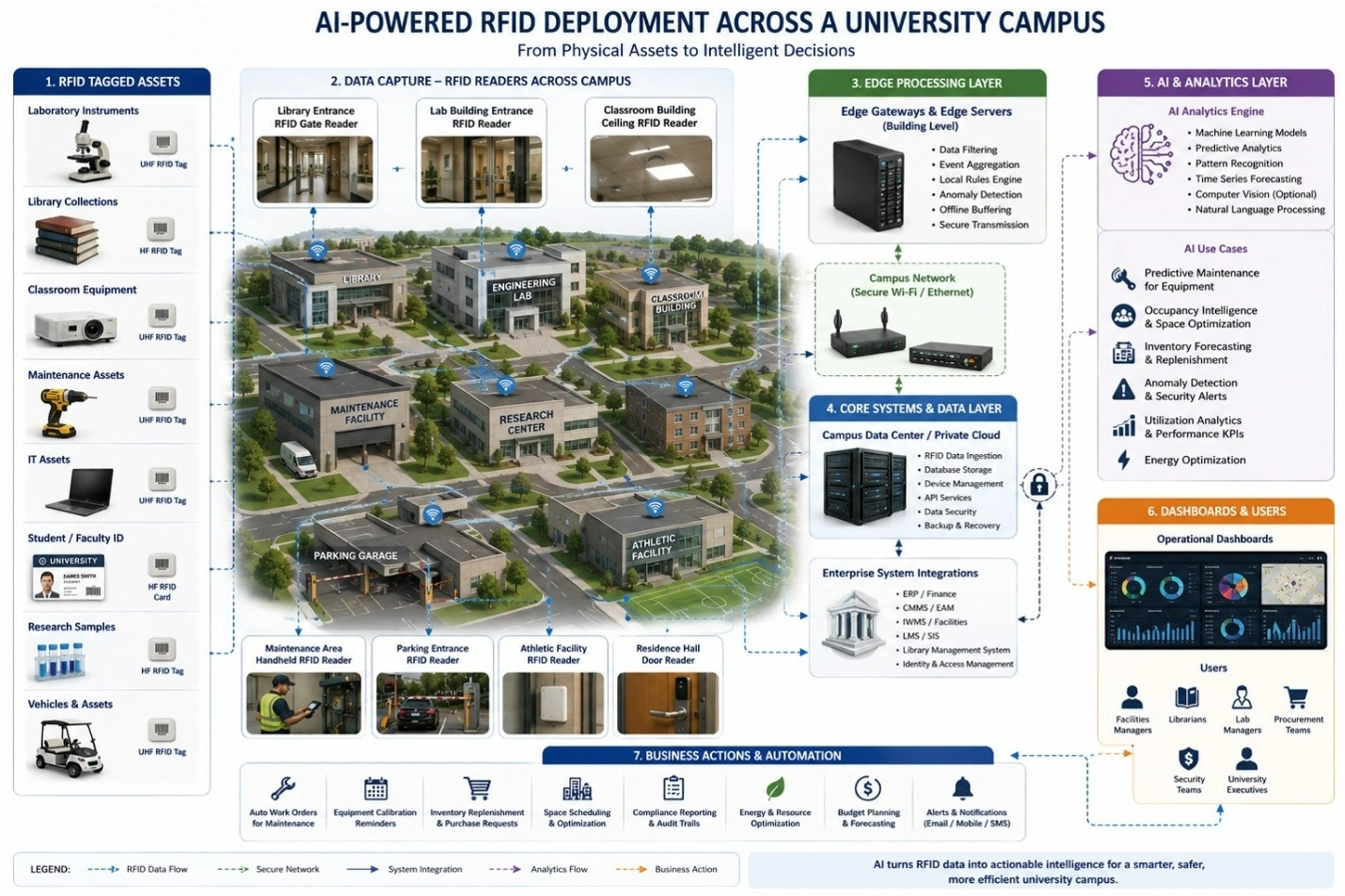
This deployment diagram illustrates the complete operational flow of an AI-supported RFID solution across a modern university campus, from RFID-tagged assets and fixed or handheld readers to edge processing, AI analytics, enterprise software integration, and executive dashboards. It demonstrates how RFID data is securely collected, processed, and transformed into actionable intelligence for predictive maintenance, inventory replenishment, classroom optimization, compliance reporting, and campus-wide operational management. The visual highlights the end-to-end interaction between physical infrastructure and AI-driven decision-making that enables efficient, data-driven university operations.
Technical Components Supporting AI-Powered RFID in Universities
Delivering reliable AI-assisted university operations requires coordinated interaction between RFID hardware, communication infrastructure, intelligent software, enterprise applications, cybersecurity controls, and analytics engines. Each component contributes to transforming raw identification events into operational intelligence that supports academic, research, and administrative decision making.
RFID Technologies
Universities commonly deploy a combination of RFID technologies based on operational requirements.
UHF RFID supports long-range identification of laboratory assets, classroom equipment, maintenance inventories, warehouse materials, and campus logistics.
HF RFID is widely used for student identification cards, library circulation, secure document management, and controlled access applications.
LF RFID remains appropriate for specialized legacy systems, selected access control deployments, and environments where shorter read distances are advantageous.
Rather than selecting a single frequency for the entire campus, universities often implement a mixed RFID strategy aligned with specific operational workflows, asset characteristics, and environmental conditions.
RFID Readers, Antennas, and Supporting Hardware
Reader placement directly influences data quality and the effectiveness of AI analytics. Universities typically deploy fixed readers at strategic locations where asset movement naturally occurs rather than attempting blanket coverage.
Common reader installation locations include:
- Library entrances and exits
- Laboratory access points
- Equipment issue and return rooms
- Receiving and loading areas
- Central warehouses
- IT storage facilities
- Research buildings
- Campus museums and archives
- Medical simulation centers
- High-value equipment storage rooms
Supporting hardware commonly includes:
- Circular and linear polarized antennas
- RFID-enabled cabinets
- Smart storage shelves
- Mobile inventory carts
- Handheld RFID readers
- RFID printers and encoders
- Environmental sensors
- Edge gateways
- Industrial switches
- Uninterruptible power supplies
Engineering experience shows that antenna orientation, read zone design, tag placement, multipath reflections, metallic laboratory equipment, and liquid-containing research materials all influence read performance. Pilot testing within representative university environments should validate read accuracy before campus-wide deployment.
Artificial Intelligence Software and Analytics
Artificial intelligence transforms RFID event streams into operational recommendations that support facilities managers, research administrators, librarians, procurement teams, campus security personnel, and university leadership.
AI capabilities commonly include:
- Predictive maintenance models for laboratory equipment
- Asset utilization forecasting
- Occupancy prediction
- Demand forecasting for classrooms and study spaces
- Inventory optimization
- Equipment sharing recommendations
- Anomaly detection
- Movement pattern analysis
- Resource allocation optimization
- Preventive maintenance prioritization
- Procurement forecasting
- Compliance monitoring
Common AI methods include:
- Supervised machine learning
- Unsupervised clustering
- Time-series forecasting
- Reinforcement learning for scheduling optimization
- Graph analytics for asset relationships
- Natural language processing for maintenance records
- Computer vision where RFID is combined with camera systems
- Edge AI for low-latency operational decisions
Rather than replacing university staff, these AI models augment operational decision making by identifying patterns that are impractical to detect manually across millions of RFID events.
Enterprise Software Integration
An AI-supported RFID solution delivers the greatest value when integrated with existing university software rather than operating independently.
Common integrations include:
- Enterprise Resource Planning (ERP)
- Computerized Maintenance Management Systems (CMMS)
- Enterprise Asset Management (EAM)
- Integrated Workplace Management Systems (IWMS)
- Learning Management Systems (LMS)
- Library Management Systems (LMS/ILS)
- Student Information Systems (SIS)
- Identity and Access Management (IAM)
- Procurement software
- Finance and budgeting systems
- Building Management Systems (BMS)
- Geographic Information Systems (GIS)
- Security Information and Event Management (SIEM)
- Help desk and IT service management software
These integrations enable automated work orders, inventory updates, maintenance scheduling, procurement approvals, equipment reservations, and executive reporting without requiring duplicate data entry.
Having supplied RFID hardware products and systems to educational institutions and research organizations for decades, GAO has seen that interoperability with existing university software is often a greater determinant of project success than RFID hardware selection alone.
Cloud Version and Server Version Deployment
Universities vary significantly in their IT governance, cybersecurity requirements, research sensitivity, and operational scale. Consequently, deployment models should align with institutional policies rather than following a single approach.
Cloud Version
A cloud-hosted deployment places AI software, reporting tools, databases, and management services within a professionally managed cloud environment.
Typical advantages include:
- Simplified software updates
- Elastic computing resources
- Centralized management across multiple campuses
- Faster deployment
- Lower infrastructure maintenance
- High availability
- Built-in disaster recovery
- Easier collaboration among geographically distributed campuses
Cloud deployment is well suited for:
- Multi-campus university systems
- Public universities
- Institutions seeking rapid deployment
- Universities with limited internal IT resources
- Institutions requiring centralized reporting
Server Version
A server deployment installs software on customer-managed infrastructure such as university data centers, private cloud environments, research computing centers, or dedicated edge servers.
Typical advantages include:
- Greater control over sensitive research data
- Local data residency
- Lower operational latency
- Easier integration with isolated research networks
- Compliance with institutional cybersecurity policies
- Greater customization opportunities
Server deployment is commonly preferred by:
- Research-intensive universities
- Defense research laboratories
- Medical research institutions
- Universities operating private research networks
- Institutions with strict governance requirements
Many universities ultimately adopt hybrid deployments where operational AI processing occurs on institutional servers while selected reporting and analytics functions are securely synchronized with cloud services.
Cloud vs. Server Deployment Comparison for AI-Powered RFID in Universities
| Feature | Cloud Version | Server Version |
|---|---|---|
| Infrastructure Ownership | Hosted and managed by a cloud service provider | Hosted and managed by the university on private servers, data centers, or edge infrastructure |
| Deployment Model | Cloud-hosted Software as a Service (SaaS) | Software deployed on customer-managed servers, private cloud, or edge servers |
| Scalability | High scalability with on-demand computing resources | Scalable by expanding local server and storage infrastructure |
| Cybersecurity Management | Shared responsibility between the cloud provider and the university | Fully managed by the university’s IT and cybersecurity teams |
| Data Residency | Data stored in approved cloud regions according to institutional policies | Data remains within university-controlled infrastructure |
| Research Data Governance | Suitable for standard research environments with appropriate security controls | Preferred for highly sensitive research, defense projects, and regulated data environments |
| Latency | Dependent on internet connectivity and cloud region | Lower latency through local processing and campus-based servers |
| Software Updates | Automatic updates managed by the cloud provider | Updates scheduled and managed by the university IT department |
| Disaster Recovery | Built-in cloud redundancy, backup, and failover capabilities | University designs and manages backup, replication, and recovery procedures |
| Customization | Moderate customization using configurable cloud services | Extensive customization to meet institutional workflows and integration requirements |
| Maintenance Responsibility | Cloud provider manages infrastructure maintenance; university manages application configuration | University manages hardware, operating systems, databases, middleware, and application software |
| System Availability | High availability through geographically distributed cloud infrastructure | Availability depends on university redundancy, failover, and infrastructure design |
| Integration with Campus Systems | API-based integration with ERP, SIS, LMS, CMMS, BMS, and library management systems | Deep integration with internal systems, research networks, legacy applications, and specialized databases |
| Multi-Campus Management | Centralized management across multiple campuses from a single cloud environment | Multiple campuses can be supported but require coordinated server infrastructure and network management |
| Operational Flexibility | Rapid deployment and simplified expansion for growing institutions | Greater control over configuration, security policies, and operational procedures |
| Internet Dependency | Requires reliable internet connectivity for full functionality | Core operations can continue within the campus network even during external connectivity interruptions |
| Initial Capital Investment | Lower upfront infrastructure investment with subscription-based costs | Higher initial investment in servers, networking equipment, storage, and IT resources |
| Long-Term Cost Model | Predictable operational expenses based on subscription and usage | Higher capital expenditure with ongoing maintenance and infrastructure management costs |
| Best Suited For | Public universities, multi-campus institutions, universities seeking rapid deployment, and organizations with limited IT infrastructure | Research-intensive universities, medical schools, defense-funded research centers, institutions with strict data governance, and universities requiring maximum infrastructure control |
This comparison table evaluates Cloud Version and Server Version deployment models for AI-powered RFID solutions in university environments. It compares infrastructure ownership, scalability, cybersecurity, latency, disaster recovery, research data governance, customization, maintenance responsibilities, and operational flexibility. The table helps university IT leaders, facilities managers, and research administrators determine the most appropriate deployment model based on institutional requirements, compliance needs, and operational objectives.
Cybersecurity and Data Protection
Because university environments include research data, intellectual property, student records, and operational information, cybersecurity should be incorporated throughout the solution lifecycle.
Recommended practices include:
- Role-based access control
- Multi-factor authentication
- Zero Trust network principles
- TLS-encrypted communications
- Secure API authentication
- Digital certificates for devices
- Network segmentation
- Security monitoring
- Continuous vulnerability assessments
- Software patch management
- Comprehensive audit logging
- Backup and recovery testing
AI should also be governed using institutional policies that define acceptable data usage, model validation procedures, bias monitoring, and human oversight for operational decisions.
Technical Capabilities and Business Value for Universities
Combining AI with RFID enables universities to transition from reactive asset tracking toward predictive campus operations. The resulting improvements extend across academic, research, administrative, and facilities functions.
Operational Improvements
AI-supported RFID enables universities to:
- Improve laboratory equipment availability
- Reduce misplaced research assets
- Increase classroom utilization
- Enhance library circulation efficiency
- Automate inventory audits
- Accelerate receiving and distribution
- Improve maintenance scheduling
- Optimize campus space planning
- Support grant-funded asset accountability
- Reduce duplicate equipment purchases
- Improve emergency equipment readiness
- Enhance campus logistics visibility
Technical Advantages
The combination of AI and RFID provides:
- Continuous operational visibility
- Real-time event processing
- Predictive analytics
- Automated exception management
- Scalable multi-campus monitoring
- Improved asset lifecycle management
- Better forecasting accuracy
- Reduced manual data collection
- Faster operational reporting
- Improved integration across university software
Business Benefits
University leadership can realize measurable improvements in:
- Asset utilization rates
- Laboratory productivity
- Library service quality
- Facilities efficiency
- Procurement optimization
- Energy management
- Student experience
- Regulatory compliance
- Research accountability
- Operational cost control
Representative KPIs include:
- Asset inventory accuracy
- Equipment utilization percentage
- Laboratory downtime
- Preventive maintenance compliance
- Classroom occupancy rate
- Library circulation accuracy
- Asset recovery time
- Procurement cycle time
- Inventory carrying costs
- Annual equipment loss rate
AI-Powered RFID Benefits for Intelligent University Operations
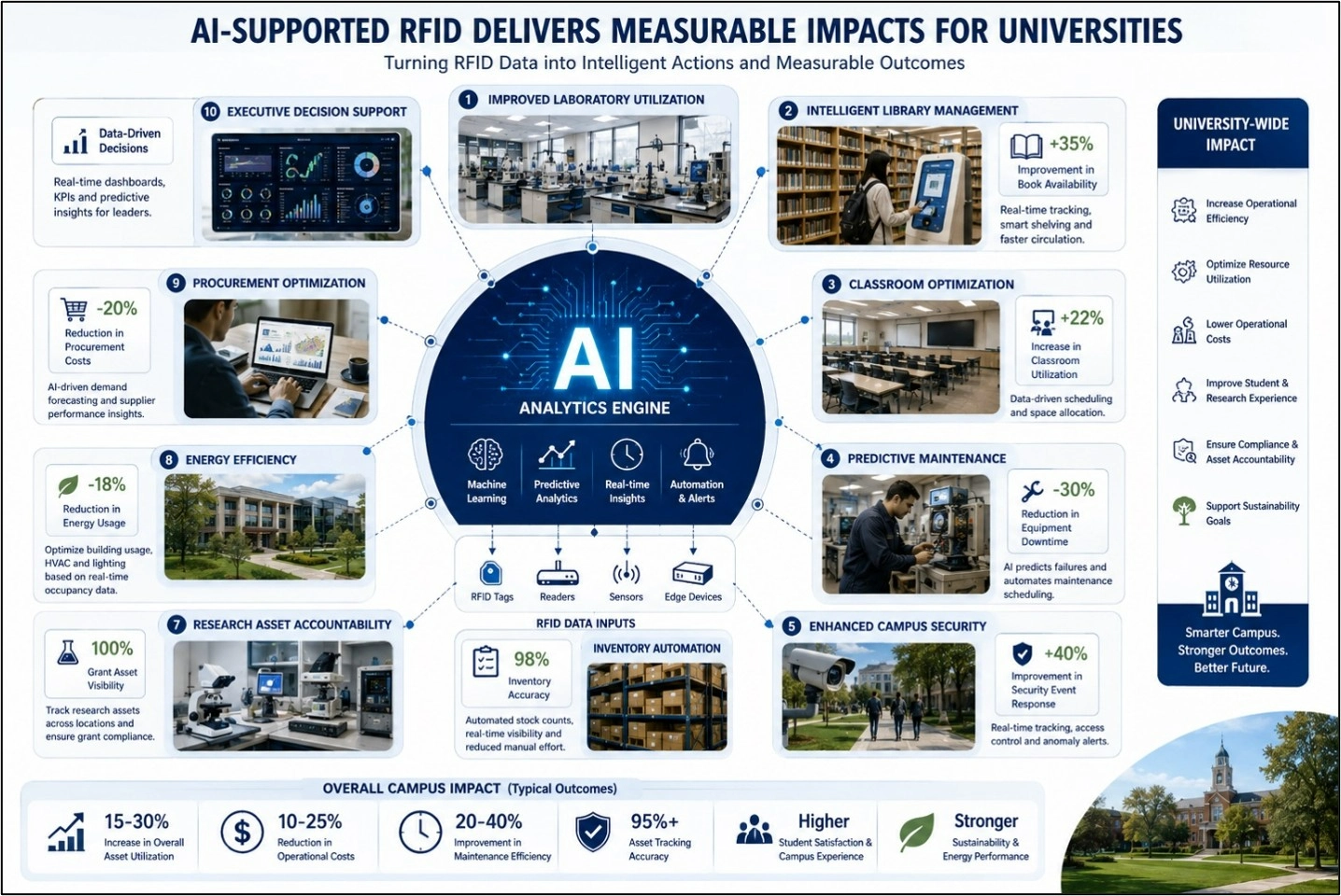
This infographic highlights the measurable operational improvements achieved by combining AI analytics with RFID-enabled university operations. It illustrates how intelligent insights improve laboratory utilization, library management, classroom scheduling, predictive maintenance, campus security, inventory automation, research asset accountability, energy efficiency, procurement, and executive decision-making. The visual also emphasizes key performance indicators that demonstrate gains in operational efficiency, asset visibility, cost reduction, and campus-wide resource optimization.
Engineering Considerations and Deployment Best Practices
Successful university implementations depend on disciplined planning and phased execution rather than campus-wide deployment from the outset.
Recommended engineering practices include:
- Conduct comprehensive asset classification before tag selection.
- Validate read performance through pilot deployments in representative buildings.
- Select RFID tags appropriate for laboratory equipment, metal assets, books, IT equipment, and outdoor infrastructure.
- Design reader locations to match natural asset movement.
- Integrate RFID data with existing university software through standardized APIs.
- Define governance for AI model training, validation, and continuous improvement.
- Establish cybersecurity controls before commissioning.
- Develop operational procedures for exception handling.
- Train librarians, laboratory managers, facilities personnel, and IT administrators.
- Continuously monitor KPIs to refine AI models and operational workflows.
Experience across large educational environments indicates that organizational readiness, stakeholder engagement, and software integration frequently contribute more to long-term success than hardware deployment alone.
AI-Powered RFID Is Enabling the Future of Smart Universities
Universities are increasingly expected to deliver world-class education, advanced research, efficient facilities management, and exceptional student experiences while controlling operational costs. AI-supported RFID enables institutions to make better operational decisions by transforming physical asset data into actionable intelligence.
When integrated with university software, secure communication infrastructure, and well-defined operational processes, RFID becomes more than an identification technology. It becomes a trusted source of data supporting predictive maintenance, intelligent resource allocation, research accountability, campus planning, and evidence-based decision making.
For more than three decades, GAO has supplied RFID, BLE, and IoT hardware products and systems to organizations across North America. Supported by extensive investments in research and development, stringent quality assurance, and expert remote and onsite technical assistance, we continue helping universities implement reliable AIoT solutions that improve operational visibility, efficiency, and long-term digital transformation.
Building the Future of Industrial AI and IoT with Aperture Venture Studio and GAO RFID Inc.
For more than three decades, GAO Group, through its companies in New York City and Toronto, Canada, has invested extensively in research and development of industrial RFID, BLE, and IoT technologies. As generative AI has demonstrated significant value across higher education, research, and intelligent campus operations, we have expanded our work in AI and IoT technologies, including RFID and BLE, and established Aperture Venture Studio to accelerate the development and adoption of advanced AI and IoT solutions for education and many other industries. Aperture has brought together leading AI researchers, IoT specialists, experienced business leaders, investors, and technology organizations while also developing the successful Aperture Ventures Summit and TekSummit. These initiatives have strengthened technical collaboration and knowledge sharing across the AI and IoT community. We welcome professionals to participate as:
- Advisors, Co-founders, or Employees
- Investors
- Customers