
AI and RFID for Industrial Electronics Manufacturing
Advancing Industrial Electronics Manufacturing with AI-Driven RFID Intelligence
Industrial electronics manufacturing demands exceptional product traceability, manufacturing precision, component authentication, and production visibility. Printed circuit boards (PCBs), industrial controllers, power electronics, embedded systems, programmable logic controllers (PLCs), sensors, industrial communication modules, and electronic assemblies often pass through hundreds of manufacturing, inspection, and testing operations before shipment. Artificial Intelligence (AI) combined with RFID enables manufacturers to transform these highly complex operations into intelligent, data-driven manufacturing environments by delivering continuous visibility into materials, work-in-progress, production assets, tooling, and finished products. RFID serves as the primary identification and data acquisition technology while AI analyzes operational data to optimize production scheduling, detect anomalies, predict quality issues, improve inventory accuracy, and support automated decision-making across manufacturing facilities.
Industrial AI within Industrial Electronics Manufacturing extends beyond simple automation by combining RFID, connected sensors, edge computing, industrial software, and machine learning to continuously monitor manufacturing operations and recommend operational improvements. Organizations implementing AI-driven RFID systems frequently achieve better production traceability, reduced manufacturing defects, improved component accountability, enhanced regulatory compliance, and greater operational efficiency throughout complex electronics production environments. Drawing on decades of supplying RFID and industrial IoT hardware to organizations across North America, GAO has helped manufacturers deploy reliable identification technologies that support modern intelligent manufacturing initiatives while meeting demanding industrial performance requirements.
AI-Driven RFID Workflow for Industrial Electronics Manufacturing: End-to-End Smart Factory Process
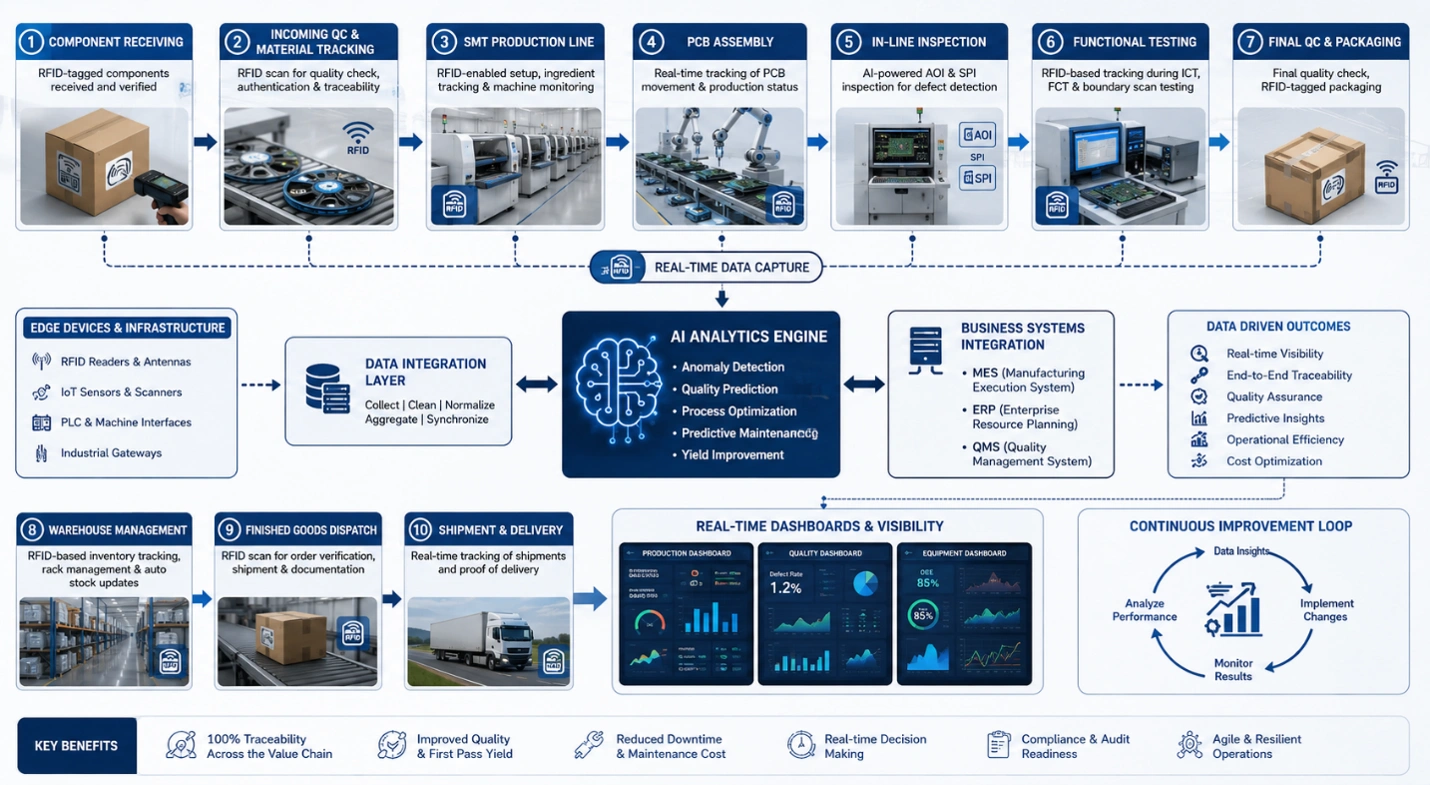
Understanding AI-Driven RFID Systems for Industrial Electronics Manufacturing
Industrial electronics manufacturing differs significantly from consumer electronics production because products are typically built for mission-critical industrial automation, energy systems, transportation, telecommunications, aerospace, medical equipment, and process industries. Production environments require rigorous quality assurance, complete product genealogy, serialized component tracking, extensive testing procedures, and long product life cycles.
Within these manufacturing operations, RFID provides automated identification of materials, components, subassemblies, production fixtures, reusable containers, calibration equipment, and finished products without requiring direct line-of-sight scanning. AI transforms the captured operational information into actionable manufacturing intelligence capable of supporting production engineers, quality managers, manufacturing supervisors, maintenance personnel, and supply chain teams.
Rather than functioning as separate technologies, AI and RFID operate as complementary elements within an Industrial AIoT solution. RFID continuously captures accurate production data while AI interprets historical and real-time operational information to identify patterns, predict future conditions, recommend corrective actions, and automate manufacturing decisions.
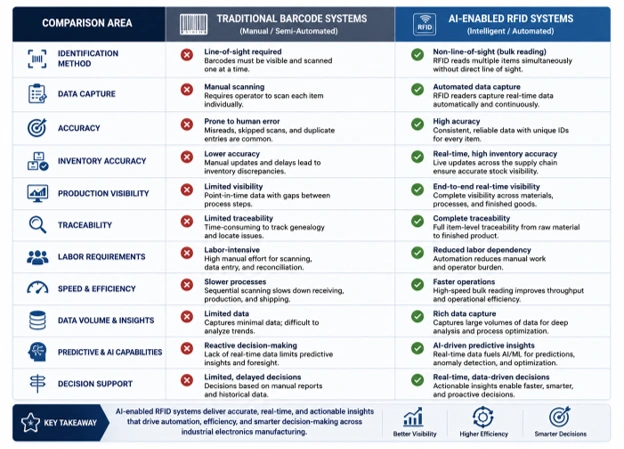
This intelligent combination enables manufacturers to move beyond traditional barcode-based tracking toward dynamic manufacturing environments where production equipment, electronic assemblies, inspection stations, warehouse operations, and logistics activities continuously contribute data that improves operational performance.
Industrial electronics manufacturers particularly benefit because their operations involve:
- High-value electronic components
- Multi-stage PCB assembly processes
- Surface Mount Technology (SMT) production
- Through-hole assembly operations
- Automated Optical Inspection (AOI)
- Functional testing
- Burn-in testing
- Calibration procedures
- Cleanroom production
- Electrostatic discharge (ESD) controls
- Strict lot traceability
- Regulatory documentation
- Long-term product lifecycle management
These operational characteristics generate large volumes of manufacturing data, making AI especially valuable for identifying production bottlenecks and improving decision quality.
Where AI-Powered RFID Delivers the Greatest Value in Industrial Electronics Manufacturing
Intelligent Component Traceability
Industrial electronics products often contain hundreds or thousands of individual electronic components sourced from multiple suppliers worldwide. RFID identification allows every incoming component reel, tray, pallet, and storage container to be uniquely identified throughout procurement, warehouse storage, production staging, SMT assembly, inspection, testing, packaging, and shipment.
AI continuously analyzes traceability information to detect inventory inconsistencies, supplier quality trends, component shortages, excessive handling, and production delays before they affect manufacturing schedules.
Smart PCB Production Management
Printed circuit board manufacturing involves multiple interconnected production stages including solder paste printing, component placement, reflow soldering, automated optical inspection, X-ray inspection, manual repair, conformal coating, functional testing, and final assembly.
RFID enables automatic identification of PCB carriers, manufacturing pallets, production lots, and work orders at every workstation.
AI evaluates production throughput, identifies recurring quality deviations, predicts process bottlenecks, recommends scheduling adjustments, and assists manufacturing engineers in optimizing production flow while maintaining product quality.
AI-Assisted Work-in-Progress Visibility
Work-in-progress inventory represents one of the largest operational challenges within industrial electronics manufacturing because assemblies frequently move between multiple production cells, testing laboratories, environmental chambers, and quality inspection stations.
RFID readers automatically capture movement events without requiring operator intervention.
AI analyzes production flow to:
- Detect unexpected production delays
- Identify idle manufacturing lots
- Predict downstream congestion
- Recommend routing adjustments
- Improve manufacturing throughput
- Reduce unnecessary material movement
Production Equipment and Tool Tracking
Industrial electronics production depends on expensive assets including:
- Pick-and-place machines
- Reflow ovens
- Wave soldering systems
- AOI equipment
- X-ray inspection systems
- ICT testers
- Flying probe testers
- Robotic assembly stations
- Torque tools
- Calibration instruments
- ESD monitoring equipment
RFID identifies production assets while AI evaluates utilization rates, maintenance histories, calibration intervals, and operational availability to improve equipment scheduling and reduce unexpected downtime.
GAO has supported industrial organizations by providing RFID hardware capable of tracking valuable manufacturing assets operating in demanding factory environments.
Supplier Material Authentication
Counterfeit electronic components present significant risks within industrial electronics manufacturing.
RFID-enabled material identification combined with AI analysis helps manufacturers verify supplier shipments, compare procurement histories, identify unusual purchasing patterns, and flag components requiring additional inspection before entering production.
The result is stronger supply chain visibility and improved confidence in component authenticity, particularly for mission-critical industrial control systems.
Deployment Considerations for AI-Enabled RFID in Industrial Electronics Manufacturing
Successful implementation requires careful planning across manufacturing operations rather than simply installing RFID readers.
Engineering teams typically evaluate:
- Manufacturing process flow
- PCB handling methods
- Component packaging formats
- Environmental conditions
- Metal interference
- Reader placement
- Antenna coverage
- Production throughput
- Tag durability
- Data synchronization
- Enterprise software integration
- Cybersecurity requirements
- Regulatory documentation
- Future production scalability
RFID tag selection varies according to production requirements. High-frequency (HF) RFID may be selected for close-range workstations and tooling identification, while ultra-high frequency (UHF) RFID often supports warehouse logistics, pallet tracking, and work-in-progress visibility across larger production areas. Low-frequency (LF) RFID can remain appropriate for specialized industrial identification applications where environmental robustness is prioritized.
AI implementation also depends on the availability of high-quality operational data. Poor data governance, inconsistent product identification, or incomplete manufacturing records reduce AI model effectiveness. Consequently, manufacturers often establish standardized RFID data capture policies before deploying predictive analytics or intelligent automation solutions.
Barcode vs. AI-Enabled RFID Systems for Industrial Electronics Manufacturing Traceability
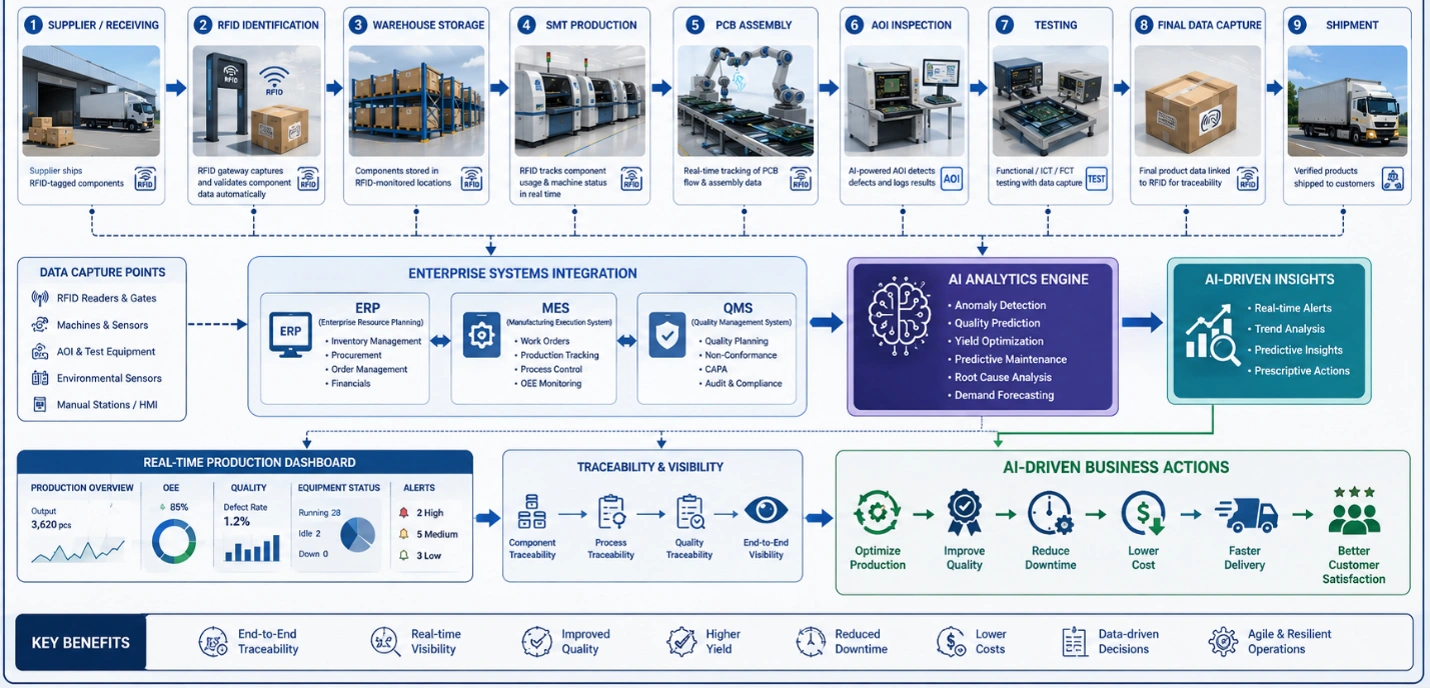
Operational Workflow from RFID Data Capture to AI-Driven Manufacturing Decisions
Industrial electronics manufacturing generates enormous volumes of production data across procurement, warehousing, PCB assembly, inspection, testing, packaging, and logistics. AI-powered manufacturing intelligence depends on collecting accurate operational information throughout this workflow. RFID provides automated identification while AI transforms production events into actionable recommendations that improve quality, efficiency, and resource utilization.
A typical AI-enabled RFID solution for industrial electronics manufacturing follows this operational workflow:
Material Receiving and Component Registration
Production begins with incoming electronic components, printed circuit boards, industrial connectors, semiconductor devices, passive components, wiring harnesses, mechanical enclosures, and supporting manufacturing materials arriving from qualified suppliers.
Each shipment is associated with RFID-tagged pallets, reusable containers, reels, trays, or cartons that contain serialized identification linked to procurement records. Fixed RFID readers positioned at receiving docks automatically identify incoming materials without requiring manual barcode scanning.
Captured information typically includes:
- Purchase order information
- Supplier identification
- Component serial numbers
- Manufacturing lot numbers
- Date codes
- Quantity verification
- Receiving timestamps
- Warehouse destination
- Storage requirements
- Quality inspection status
AI immediately evaluates incoming data against historical procurement trends, supplier performance, expected inventory levels, and production schedules. Manufacturing planners receive early notification of component shortages, unexpected deliveries, or materials requiring additional inspection before production begins.
Warehouse Storage and Inventory Intelligence
Following inspection, materials move into controlled warehouse locations or automated storage systems.
RFID readers installed at warehouse entrances, storage aisles, automated guided vehicles (AGVs), and material handling stations continuously update inventory records without interrupting operations.
Rather than relying on periodic inventory counts, AI receives continuous inventory updates that enable:
- Dynamic inventory forecasting
- Safety stock optimization
- Material replenishment planning
- Warehouse space optimization
- Slow-moving inventory identification
- Component expiration monitoring
- Production material reservation
- Automated inventory reconciliation
This continuous visibility helps reduce inventory discrepancies while supporting just-in-time manufacturing strategies commonly used within industrial electronics production.
Production Line Material Distribution
Before production begins, component reels, PCB panels, tooling fixtures, and work orders are delivered to SMT lines and manual assembly stations.
RFID readers verify that the correct materials arrive at the correct production line.
AI compares production schedules, bill of materials (BOM), historical production rates, machine availability, and workforce capacity before recommending material allocation priorities.
Manufacturing supervisors gain visibility into production readiness before assembly begins, reducing delays caused by missing components or incorrect material staging.
Assembly Process Monitoring
Throughout PCB assembly and final product integration, RFID continuously records movement between manufacturing operations.
Typical monitored production stages include:
- Solder paste printing
- Surface mount placement
- Reflow soldering
- Through-hole assembly
- Wave soldering
- Automated Optical Inspection (AOI)
- X-ray inspection
- Manual repair
- Functional testing
- Firmware programming
- Product calibration
- Final assembly
Each manufacturing event contributes to a complete digital production history for every electronic assembly.
AI evaluates production throughput across all workstations to identify recurring bottlenecks, excessive queue times, equipment utilization trends, and abnormal production delays.
Quality Inspection and Traceability
Industrial electronics manufacturers maintain rigorous quality documentation for regulatory compliance and customer requirements.
RFID enables every inspection result to be associated automatically with:
- Individual PCB assemblies
- Manufacturing lots
- Test fixtures
- Calibration equipment
- Production operators
- Manufacturing equipment
- Inspection stations
- Environmental conditions
AI analyzes inspection results using historical quality data to identify recurring defect patterns before defect rates increase significantly.
Instead of reacting after quality failures occur, production engineers receive predictive recommendations supporting earlier process adjustments.
Shipping and Product Genealogy
Finished industrial electronics products remain traceable through packaging, warehouse staging, customer shipment, warranty management, service operations, and lifecycle support.
RFID preserves complete manufacturing genealogy while AI assists logistics planning, shipment prioritization, demand forecasting, and post-production performance analysis.
Organizations producing industrial controllers, automation systems, energy equipment, and communications hardware benefit from maintaining long-term traceability throughout extended product service lives.
Operational Workflow from RFID Data Capture to AI-Driven Manufacturing Decisions in Industrial Electronics
RFID Technologies, AI Components, Communication Infrastructure, and Supporting Systems
Successful AI-enabled RFID deployments within industrial electronics manufacturing depend on selecting appropriate identification technologies, computing resources, industrial communications, software systems, cybersecurity controls, and deployment models that align with production requirements rather than adopting a one-size-fits-all approach.
RFID Technologies Supporting Industrial Electronics Manufacturing
Industrial electronics manufacturers frequently combine multiple RFID technologies because different manufacturing operations require different read ranges, environmental tolerances, and identification precision.
Ultra High Frequency (UHF) RFID
UHF RFID is commonly deployed across warehouse logistics, pallet tracking, work-in-progress visibility, finished goods identification, shipping verification, and automated inventory management. Longer read distances enable rapid identification of multiple tagged assets moving through dock doors, conveyor systems, and storage areas.
High Frequency (HF) RFID
HF RFID is well suited for workstation-level identification where controlled read zones are required. Electronics manufacturers frequently deploy HF RFID for tooling identification, fixture management, operator authentication, calibration tracking, and PCB carrier identification because of its reliable short-range performance around densely populated production cells.
Low Frequency (LF) RFID
LF RFID remains valuable for specialized industrial applications requiring stable performance in challenging operating environments or around metallic equipment. Typical uses include durable asset identification, maintenance tooling, and selected production equipment where environmental robustness is prioritized over reading distance.
Together, these RFID technologies create accurate manufacturing identification while AI extracts operational intelligence from the resulting production data.
Hardware Components
A complete AI-enabled RFID solution typically includes:
- Fixed industrial RFID readers installed at receiving docks, warehouse entrances, production cells, inspection stations, and shipping areas.
- Handheld RFID readers used for inventory validation, maintenance activities, exception handling, and field audits.
- RFID antennas positioned to maximize read accuracy while minimizing interference from metallic machinery and dense electronics.
- RFID tags attached to pallets, component reels, reusable containers, fixtures, production tooling, calibration equipment, and finished products.
- Industrial edge computers for local data processing and low-latency decision support.
- Industrial IoT gateways connecting RFID infrastructure with enterprise software and cloud services.
- Network switches, wireless infrastructure, and secure industrial communication equipment.
GAO has supplied RFID readers, antennas, tags, and related industrial IoT hardware that help manufacturers build dependable identification systems supporting intelligent manufacturing initiatives.
AI Software and Enterprise Integration
AI models rely on continuous RFID event streams integrated with production and business software, including Manufacturing Execution Systems (MES), Enterprise Resource Planning (ERP), Warehouse Management Systems (WMS), Product Lifecycle Management (PLM), Quality Management Systems (QMS), and Computerized Maintenance Management Systems (CMMS).
Machine learning techniques such as anomaly detection, predictive maintenance, demand forecasting, computer vision-assisted quality inspection, optimization algorithms, and digital twin modeling can analyze these combined datasets to improve production scheduling, inventory planning, equipment utilization, and quality assurance.
Communication Infrastructure and Deployment Models
Industrial communication commonly uses Ethernet, Wi-Fi, OPC UA, MQTT, Modbus TCP/IP, REST APIs, and secure message brokers to connect RFID readers, edge computers, AI software, and enterprise systems. These technologies enable reliable data exchange while supporting interoperability across production equipment and information systems.
Organizations may deploy AI software using either:
- Cloud Version: A cloud-hosted SaaS deployment managed within cloud infrastructure. This model is appropriate for organizations requiring centralized analytics across multiple manufacturing facilities, simplified software updates, scalable computing resources, and enterprise-wide reporting.
- Server Version: Software deployed on customer-managed edge servers, private data centers, factory servers, or other privately hosted enterprise infrastructure. This model is often selected where deterministic performance, low-latency processing, intellectual property protection, regulatory requirements, or limited external connectivity are critical.
Security and Operational Resilience
Industrial electronics manufacturers should incorporate cybersecurity throughout RFID and AI deployments by implementing role-based access control, encrypted communications, network segmentation, secure device authentication, continuous monitoring, software patch management, and comprehensive audit logging. Protecting manufacturing data helps maintain product integrity, supports regulatory compliance, and reduces operational risk.
AI-Enabled RFID System for Industrial Electronics Manufacturing: Hardware, Edge Computing, Enterprise Integration, and Deployment Models
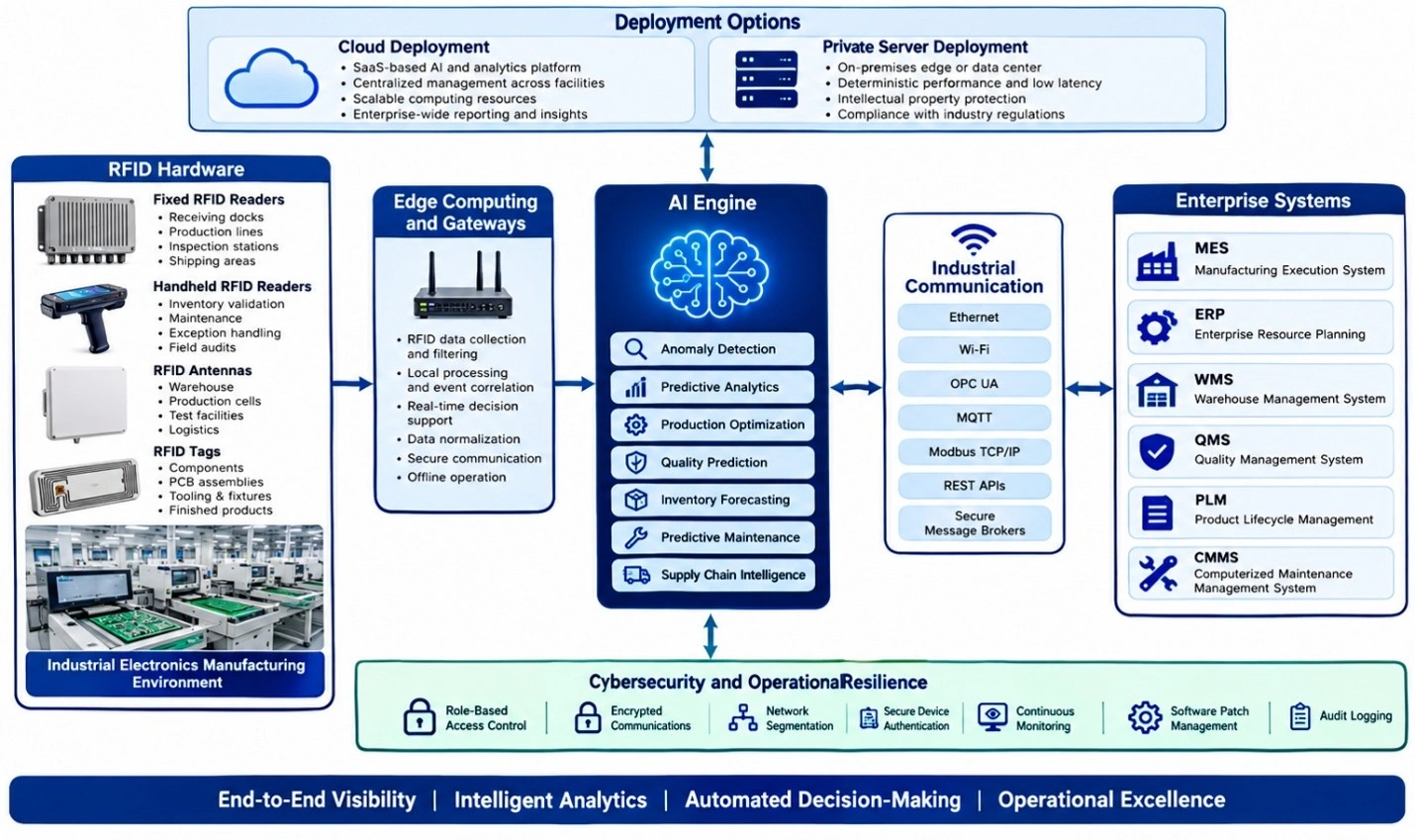
End-to-End AI-Enabled RFID Solution Architecture for Industrial Electronics Manufacturing
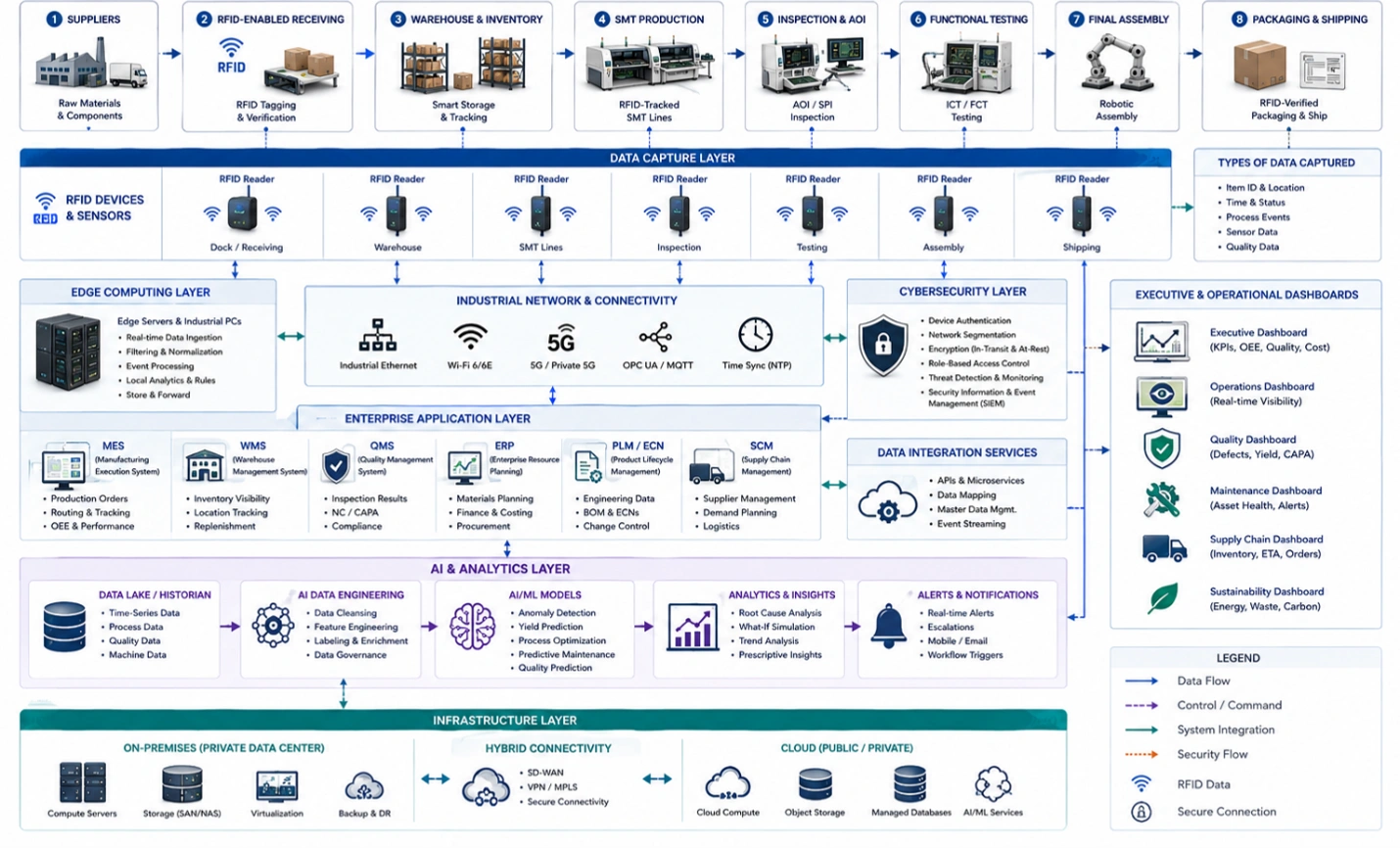
Technical Capabilities and Business Value of AI-Driven RFID in Industrial Electronics Manufacturing
AI-enabled RFID solutions provide measurable operational improvements across industrial electronics manufacturing by combining continuous identification with intelligent analysis. Rather than relying on periodic manual data collection, manufacturers gain real-time visibility into production activities, enabling faster decisions and proactive process optimization. The value of these systems extends beyond asset identification, supporting production planning, quality assurance, maintenance, inventory control, and supply chain resilience. As organizations expand digital manufacturing initiatives, GAO has supported these efforts by supplying RFID hardware and IoT solutions that enable reliable data collection for Industrial AI applications.
Enhanced Production Visibility
RFID continuously captures the movement of components, PCB assemblies, tooling, reusable carriers, and finished products throughout production. AI aggregates these events into operational dashboards that provide manufacturing managers with current production status, work-in-progress locations, equipment utilization, and process bottlenecks.
Benefits include:
- Improved production scheduling
- Better resource allocation
- Reduced search time for materials and tooling
- Increased manufacturing throughput
- Faster response to production disruptions
Improved Product Quality and Traceability
Industrial electronics products often require complete product genealogy for warranty support, regulatory compliance, and customer documentation.
AI analyzes RFID-derived production histories together with inspection and testing records to identify recurring quality trends.
This enables manufacturers to:
- Detect process deviations earlier
- Correlate defects with production conditions
- Improve root-cause analysis
- Support corrective and preventive actions (CAPA)
- Maintain complete traceability throughout the product lifecycle
Intelligent Inventory Management
Accurate inventory is essential because production interruptions caused by missing electronic components can significantly impact manufacturing schedules.
AI continuously evaluates RFID inventory data to improve:
- Inventory accuracy
- Component replenishment
- Warehouse utilization
- Material allocation
- Safety stock optimization
- Obsolete inventory identification
These capabilities reduce carrying costs while improving production continuity.
Predictive Equipment Maintenance
Production equipment such as SMT placement machines, AOI systems, reflow ovens, X-ray inspection equipment, and automated test systems represent significant capital investments.
RFID identifies maintenance tools, spare parts, calibration assets, and service activities while AI predicts maintenance requirements using historical utilization patterns.
Expected improvements include:
- Reduced unplanned downtime
- Improved maintenance scheduling
- Better spare parts planning
- Higher equipment availability
- Extended equipment service life
Supply Chain Intelligence
Industrial electronics manufacturers frequently manage global supply chains involving semiconductor suppliers, PCB fabricators, contract manufacturers, logistics providers, and distribution centers.
AI analyzes RFID data collected across procurement, warehousing, production, and shipping to identify supply chain risks before they affect production.
Operational advantages include:
- Better supplier performance monitoring
- Earlier detection of material shortages
- Improved shipment visibility
- Enhanced procurement planning
- Reduced supply chain disruption
Engineering Best Practices for Successful Implementation
Successful AI-driven RFID implementations within industrial electronics manufacturing require more than selecting appropriate hardware. Organizations should adopt a structured implementation strategy that aligns technology deployment with manufacturing objectives.
Recommended engineering practices include:
- Perform detailed manufacturing workflow analysis before hardware deployment.
- Select RFID tags based on environmental conditions, read range requirements, and material compatibility.
- Conduct comprehensive RF site surveys to minimize interference from metallic equipment and dense electronic assemblies.
- Standardize product identifiers, serialization methods, and data governance policies before AI model development.
- Integrate RFID data with MES, ERP, WMS, QMS, PLM, and CMMS software to maximize operational value.
- Validate AI models using representative production datasets before full-scale deployment.
- Apply role-based access control, encrypted communications, and continuous monitoring to protect operational technology environments.
- Establish performance metrics and continuous improvement processes that measure production efficiency, inventory accuracy, equipment utilization, and quality performance.
Organizations implementing these practices generally achieve more reliable deployments while reducing implementation risk and improving long-term return on investment.
Why Industrial Electronics Manufacturers Choose GAO
Industrial electronics manufacturing requires dependable RFID hardware capable of operating reliably across warehouses, production lines, inspection laboratories, testing facilities, and shipping operations.
Headquartered in New York City and Toronto, Canada, GAO is recognized among the world’s leading suppliers of RFID and BLE technologies serving business and government organizations. For more than three decades, GAO and its affiliated companies have supported customers throughout the United States and Canada, including Fortune 500 companies, leading research organizations, universities, and government agencies. Continuous investment in research and development, rigorous quality assurance processes, and remote or onsite technical support enable us to assist organizations implementing industrial RFID and IoT solutions that support modern AI-driven manufacturing initiatives. This experience allows us to help customers select appropriate RFID hardware and supporting technologies that integrate effectively with existing manufacturing software and operational processes.
Transforming Industrial Electronics Manufacturing with AI-Driven RFID
AI-powered manufacturing intelligence supported by RFID is reshaping industrial electronics manufacturing by improving traceability, production visibility, quality assurance, inventory management, equipment utilization, and operational decision-making. RFID supplies the trusted identification data required for AI to generate meaningful operational insights, enabling manufacturers to optimize production while maintaining the strict quality and compliance requirements associated with industrial electronic products.
Organizations planning digital manufacturing initiatives should evaluate identification strategies, software integration, cybersecurity, deployment models, and operational objectives together rather than treating RFID and AI as isolated technologies. A carefully planned implementation provides the data foundation necessary for intelligent automation, predictive analytics, and continuous operational improvement.
Whether deploying new production facilities or modernizing existing manufacturing operations, GAO provides RFID hardware products, industrial IoT technologies, and technical expertise that help organizations build reliable AI-enabled manufacturing solutions tailored to industrial electronics production.
Building the Future of Industrial AI and IoT with Aperture Venture Studio and GAO
For more than three decades, GAO Group of Companies has invested extensively in research and development of industrial RFID, BLE, and IoT technologies. As generative AI has demonstrated increasing value in industrial electronics manufacturing, we have expanded our development of AI-enabled IoT solutions, including RFID technologies that support intelligent manufacturing, traceability, automation, and operational analytics. We have also established Aperture Venture Studio to accelerate the development and commercialization of advanced AI and IoT innovations that address evolving industrial challenges.
Aperture has attracted leading AI and IoT technical experts, experienced operational executives, influential investors, and established technology organizations. Through initiatives such as the Aperture Ventures Summit and TekSummit, we foster technical collaboration and knowledge sharing on advanced AI and IoT topics. These efforts have helped build diverse technical communities focused on the future of Industrial AI and connected technologies.
We welcome you to join us as:
- Advisors, co-founders, or employees
- Investors
- Customers seeking advanced AI, RFID, BLE, and Industrial IoT solutions.